REVIEW 3 major objections 6 minor 1 cited by
A factorized, interpretable quantized network synthesizes tau-PET from T1-weighted and FLAIR MRI at parity with the strongest conventional baselines, while exposing which latent stream — redundant, unique, or complementary — carries each pa
Reviewed by Pith at T0; open to challenge. T0 means a machine referee read the full paper against a public rubric. the ladder, T0–T4 →
T0 review · deepseek-v4-flash
2026-08-02 20:42 UTC pith:DSXNOMYE
load-bearing objection Worth reading, but the Shapley/interpability half is unsupported until the authors reconcile Table 6 with Table 2 and disclose the coalition protocol. the 3 major comments →
SFL-Net: Source-Factorized Latent Representation Learning for Multi-Contrast MRI to Tau-PET Synthesis
The pith
A machine-rendered reading of the paper's core claim, the machinery that carries it, and where it could break.
Core claim
On its own terms, the paper's central discovery is that interpretability does not have to be bolted on after training. DisQ-HNet — a vector-quantized encoder with a latent space split by pairwise normalized-mutual-information penalties into redundant, unique, and complementary streams, feeding an edge-conditioned decoder with no direct skip connections — can synthesize tau-PET from paired T1-weighted and FLAIR MRI as well as the strongest conventional synthesis baselines. In the authors' evaluation across 17 models on 605 training and 83 validation subjects, the best variant (DQ2H-MSE-Inf) achieved the highest raw PET fidelity (MAE 0.1043), tied the strongest SPADE-based UNet on SUVR maps (M
What carries the argument
The load-bearing mechanism is DisQ-HNet, built from three parts. A vector-quantized encoder (VQ-VAE-style, with K=4096 codebooks) is factorized into an RU encoder that emits redundant and unique partitions for each modality and a complementary encoder that sees the concatenated inputs; a Partial Information Decomposition-inspired loss (pairwise normalized mutual information penalties plus a variance floor) pushes these streams to be redundant, unique, and complementary. A Half-UNet decoder then reconstructs the target, but instead of standard skip connections it receives pseudo-skips derived from a multi-scale 3D Sobel edge pyramid of the input, with an auxiliary loss that keeps the edge rec
Load-bearing premise
The load-bearing premise is that the pairwise normalized-mutual-information penalties computed from soft codebook assignments actually enforce the intended redundant/unique/complementary separation in the trained model; the paper itself concedes it does not optimize exact PID atoms and that the estimator can weaken under codebook under-utilization or collapse.
What would settle it
A synthetic paired-input experiment with known ground-truth redundant, unique, and complementary factors: train DisQ-HNet and check whether the learned codebook streams recover the known decomposition and whether the game-theoretic attributions match. If they do not, the architecture's interpretability claim fails even if the PET numbers hold.
If this is right
- Tau-PET can be synthesized from routinely acquired T1 and FLAIR MRI with the best raw PET fidelity among 17 compared models and with the strongest disease-stage tracking among all baselines.
- Removing direct encoder-to-decoder skip connections and conditioning the decoder on an edge pyramid does not hurt performance, so structural detail does not require an uninterpretable high-bandwidth bypass.
- The information-theoretic regularization is functionally useful: the regularized model beats its matched ablation on raw PET fidelity, high-uptake Dice and sensitivity, and soft staging accuracy.
- SPADE spatial modulation adds no benefit once this bottleneck-accountable architecture is in place; in paired tests it degrades raw and SUVR reconstruction.
- Synthetic tau-PET is not interchangeable with acquired tau-PET: all models retain substantial subject/ROI variability and compress late-stage disease burden toward underestimation.
Where Pith is reading between the lines
- Editorial inference: the attribution hierarchy (complementary and redundant streams dominate, T1-unique contributes little) suggests the T1-unique pathway could be pruned or reweighted in future variants without much loss, and that cross-modal interaction is the primary driver of tau signal.
- Editorial inference: if the latent separation transfers to other paired-modality synthesis tasks, the same architecture could provide provenance for where a predicted lesion or uptake pattern came from — something clinicians ask of any synthetic image.
- Editorial inference: because the paper's NMI estimator is explicitly fragile under codebook under-utilization, a target-aware PID estimator (one that measures information about the PET target, not just between latent streams) is a natural next step and may sharpen both separation and attribution.
- Editorial inference: the systematic late-stage underestimation points to a calibration-aware or ordinal objective as a testable remedy; reweighting high-SUVR regions during training could recover advanced-stage burden more effectively than global contrast losses.
Editorial analysis
A structured set of objections, weighed in public.
Referee Report
Summary. The paper proposes SFL-Net/DisQ-HNet, a multi-input synthesis framework that predicts tau-PET from paired T1-weighted and FLAIR MRI. The architecture combines a vector-quantized encoder with a PID-inspired factorization that partitions latent information into redundant, unique, and complementary streams, and a Half-UNet decoder that uses edge-conditioned pseudo-skip connections instead of direct encoder-to-decoder skips. The method is evaluated on 605 training and 83 validation subjects from ADNI-3 and OASIS-3, and compared against 16 baselines on raw PET fidelity, SUVR agreement, high-uptake overlap, Bland-Altman agreement, Braak-stage tracking, and Shapley attribution. The authors report that the DQ2H-MSE-Inf variant achieves the best raw PET fidelity and Braak-stage tracking among the 17 models while remaining statistically comparable to the strongest SPADE baseline on several SUVR metrics.
Significance. If the claims are verified, the paper makes a useful contribution: architectural interpretability in multimodal medical image synthesis without an obvious performance penalty. The Inf-vs-noInf ablation is a genuine control that isolates the information-theoretic regularization, and the use of paired Wilcoxon/McNemar tests is appropriate when the comparison set is fixed in advance. The paper is also commendably explicit about its limitations, including the fact that the model does not optimize exact PID atoms and that the NMI estimator is subject to codebook collapse and finite-sample bias. However, the significance of the work is substantially weakened by two load-bearing problems: the Shapley coalition evaluation in Table 6 is internally inconsistent with the deployed model's performance in Table 2, and all performance claims are made on the same 83-subject validation set used to select the best of 17 models, with no independent test set.
major comments (3)
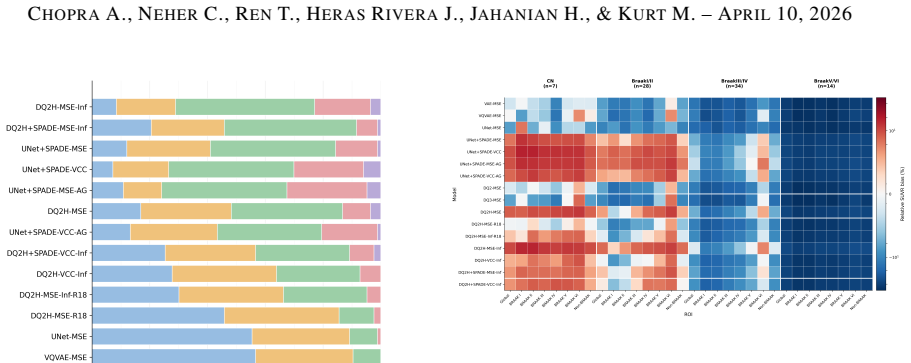
- [§4.5, Table 6 vs §4.1, Table 2] The 'Full' coalition row in Table 6 reports MAE 0.0281 and PSNR 24.49, whereas the same model, DQ2H-MSE-Inf, reports MAE 0.1043 and PSNR 18.53 in Table 2. Since 'Full' should correspond to the deployed model with all latent streams active, this discrepancy of ~3.7x in MAE and ~6 dB in PSNR means the Shapley attributions are not computed on the model actually claimed to be the paper's main contribution. No protocol in §4.5 specifies whether Table 6 uses a different decoder, a different PET target (e.g., SUVR or normalized intensities), a different spatial crop/ROI, or a different evaluation script. Because Shapley values are weighted averages of coalition evaluations, this internal inconsistency invalidates the claimed hierarchy (complementary > redundant > uniqueT2 > uniqueT1) as an attribution of DQ2H-MSE-Inf. The authors must specify the exact reconstruction protocol for every coalitio
- [§4/§4.6] All quantitative results and all statistical tests are computed on the same 83-subject validation set that was used to select the best model among the 17 evaluated variants. This is a model-selection double-dipping problem. The headline numbers for DQ2H-MSE-Inf (Tables 2, 4, 5) are therefore optimistically biased, and the p-values in §4.6 are not valid for the selected model because the hypotheses being tested were effectively formed after seeing the same data. To support the claim that DQ2H-MSE-Inf is 'the strongest' model, the paper needs either a pre-specified holdout test set, nested cross-validation, or an explicit correction for multiple comparisons and selection. The current validation does not establish that the selected model's advantages generalize.
- [§2.4, §4.5] The interpretability claim rests on the assumption that the pairwise NMI penalties in Eq. (10) actually separate the quantized latents into redundant, unique, and complementary streams. The paper itself concedes that the estimator 'can weaken under codebook under-utilization or collapse' and is 'affected by quantization geometry and finite-sample estimation' (§2.4), and that the model 'does not optimize exact PID atoms during training' (§5). With K=4096 codebooks and finite minibatches, the plug-in joint in Eq. (5) is severely undersampled. The Shapley analysis in §4.5 and the statistical tests in §4.6.4 assume the intended structure was learned, but no evidence is provided about codebook utilization, empirical entropy of the learned distributions, or the actual NMI values before and after training. The authors should add diagnostic measurements of codebook usage, per-stream entropy, and
minor comments (6)
- [Title/Abstract] The title and abstract call the method 'SFL-Net', while the main text introduces 'DisQ-HNet' (and 'DQ2H'). Please unify the naming.
- [Fig. 2 caption] The caption says 'shared EncoderRU' and 'EncoderC', but §3.2 describes an RU encoder and a C encoder; clarify that the RU encoder is shared between modalities.
- [Eq. (10)-(12)] Eq. (12) reassigns L_info by adding the variance-floor terms, but Eq. (10) already defines L_info. Please use a distinct symbol (e.g., L_info_total) to avoid ambiguity.
- [§4.4 / Braak staging] The Braak-stage thresholds (1.3, 1.2, 1.1) are arbitrary and directly determine the downstream classification metrics. Please state whether these thresholds were prespecified or tuned, and consider a sensitivity analysis over threshold values.
- [§4.5] Table 6 does not define what each coalition includes (e.g., which latent factors are active, and how inactive factors are handled — zeroed, mean-filled, or removed from the decoder input). A precise coalition protocol is needed for reproducibility.
- [Throughout] Minor typos and wording issues: 'complimentary' should be 'complementary', 'significiant' should be 'significant', 'V oxelwise' should be 'Voxelwise'.
Circularity Check
Partial circularity in the PID-Shapley interpretability claim: Eq. 10 defines the redundant/unique/complementary roles that §4.5 reports as discovered. The quantitative performance chain is not circular, but the 'Full' coalition in Table 6 does not match the deployed model's Table 2 metrics, leaving the attribution ungrounded.
specific steps
-
self definitional
[§2.4 (Eq. 10a-10e) and §4.5 (Table 6, Fig. 9)]
"we enforce the intended dependence structure among quantized latent factors with pairwise normalized mutual information penalties and an optional value-space alignment term. The intended behavior is that redundant factors agree across modalities, unique factors remain modality-specific, and complementary factors capture interaction-driven content while remaining distinct from both redundant and unique factors ... Both redundant and Complimentary streams are much more important for reconstruction on all metrics indicating multimodal information is imperative for MRI to PET reconstruction."
The factorization loss (Eq. 10) explicitly trains r1,r2 to be mutually redundant (maximizes NMI(r1;r2), plus value alignment), forces u1 to be independent of u2 and of both rj, and forces c to be independent of rj and ui. These penalties, not the data, define which stream is 'redundant,' 'unique,' or 'complementary.' The Shapley analysis in §4.5 then reports, as an empirical discovery, that redundant and complementary streams contribute the largest gains and uniqueT1 is weak/negative. That hierarchy is partly a restatement of the imposed factorization: the loss made those streams the only ones allowed to carry shared/cross-modal content and made uniqueT1 an isolated, penalized T1-only stream. The claim is only partially circular because the Shapley values also depend on the target y and de
full rationale
The paper's main quantitative chain — training DQ2H-MSE-Inf, comparing it against 16 baselines on raw/SUVR PET, high-uptake Dice, Bland-Altman agreement, Braak staging, and paired statistical tests (Tables 2–5, §4.1–4.4, §4.6) — is an empirical evaluation and is not circular: the reported numbers are external to the model definition, and the DQ2H-MSE-Inf vs DQ2H-MSE ablation (§4.6.2) is a genuine matched comparison. I find no load-bearing self-citation or imported uniqueness theorem; self-citations (e.g., Abderezaei et al. 2023; Ren et al. 2025) are used as related work or implementation precedent, not as the proof of the central claim. The one partial circularity is in the interpretability half (§2.4 vs §4.5): the NMI penalties in Eq. 10 define the redundant/unique/complementary roles, and the Shapley analysis then reports those roles as discoveries. Because Shapley also measures reconstruction value through y, this is partial rather than identity, so it does not invalidate the performance claims. Separately, there is a serious internal-consistency problem that the paper does not address: Table 6's 'Full' coalition (MAE 0.0281, PSNR 24.49) does not match DQ2H-MSE-Inf in Table 2 (MAE 0.1043, PSNR 18.53) on the stated validation set, so the Shapley attributions are not demonstrably attributions of the deployed model. The paper also acknowledges that the NMI estimator 'can weaken under codebook under-utilization or collapse' (§2.4) and that the model 'does not optimize exact PID atoms during training' (§5), which are limitations but not themselves circularity. Overall score: 4.
Axiom & Free-Parameter Ledger
free parameters (7)
- information-factorization weights α, β, γ, δ, η, υ (Eq. 10) =
not reported
- loss weights λvq, λinfo, λskip, λvf (Eqs. 12, 18) =
not reported
- soft-assignment temperature τ (Eq. 4) =
not reported
- variance floor σ0 (Eq. 11) =
not reported
- Braak SUVR thresholds (1.3, 1.2, 1.1) =
1.3 / 1.2 / 1.1
- high-uptake mask threshold (§4.2) =
not reported
- VCC contrast weights α, γ (Eq. 19) =
not reported
axioms (6)
- domain assumption Tau-PET-related signal is recoverable from co-registered T1-weighted and FLAIR MRI
- ad hoc to paper Pairwise NMI penalties on quantized latent streams enforce the intended redundant/unique/complementary separation
- domain assumption Soft-assignment NMI estimator (Eqs. 4-6) is an unbiased-enough objective
- domain assumption Per-subject global intensity normalization makes 'raw PET' metrics comparable across subjects
- domain assumption PET-derived Braak grouping by SUVR thresholds is a meaningful proxy for tau staging
- standard math Standard ML machinery (VQ-VAE, straight-through estimator, Shapley value, Wilcoxon/McNemar tests) applies as used
invented entities (1)
-
Complementary (synergistic) latent stream c and redundant/unique partitions r_i, u_i
no independent evidence
read the original abstract
Tau positron emission tomography supports Alzheimer's disease staging but is difficult to scale because of tracer, scanner, and radiation constraints. Synthesis from structural MRI is therefore attractive, but it is a particularly difficult setting. T1-weighted and FLAIR MRI provide anatomy and disease correlated morphology, but they do not directly measure Tau-PET relevant signal. We introduce SFL-Net, a multi-input synthesis framework that predicts Tau-PET from T1-weighted and FLAIR MRI. SFL-Net factorizes the latent representation into shared, T1-specific, FLAIR-specific, and complementary pathways and preserves anatomical detail through latent structural conditioning rather than direct encoder-decoder connections. We evaluated SFL-Net and baseline models using 605 training and 83 validation subjects from ADNI-3 and OASIS-3 datasets. Evaluation included raw image fidelity, standardized uptake value ratio agreement, high uptake overlap, regional Bland-Altman bias, braak derived stage agreement, non-inferiority sensitivity analysis, and latent component Shapley attribution. SFL-Net performed competitively on both clinically relevant and reconstruction metrics, while also delivering explicit source level auditability that conventional UNet derived models lack.
Figures




Forward citations
Cited by 1 Pith paper
-
Partial Information Decomposition as a Multi-Contrast 3D MRI Selection Strategy for Resource-Constrained Deep Neural Network Training in Brain Tumor Segmentation
A region-aware MMI-PID score selected T1c+T2-FLAIR as the best two-contrast MRI pair, and the pair achieved the best two-input Dice (0.676) on held-out brain-tumor segmentation.
Reference graph
Works this paper leans on
-
[1986]
doi: 10.1016/S0140-6736(86)90837-8. Lloyd S. Shapley. A value for n-person games. In Harold W. Kuhn and Albert W. Tucker, editors,Con- tributions to the Theory of Games II, pages 307–317. Princeton University Press, 1953. doi: 10.1515/ 9781400881970-018. Scott M. Lundberg and Su-In Lee. A unified approach to interpreting model predictions. InAdvances in N...
-
[2016]
Published as a conference paper at ICLR 2016
URL https://arxiv.org/abs/1511.06391. Published as a conference paper at ICLR 2016. 16 CHOPRAA., NEHERC., RENT., HERASRIVERAJ., JAHANIANH., & KURTM. – APRIL10, 2026 Manzil Zaheer, Satwik Kottur, Siamak Ravanbakhsh, Barn- abas Poczos, Ruslan Salakhutdinov, and Alexander J. Smola. Deep sets. InAdvances in Neural Informa- tion Processing Systems, volume 30, ...
Pith/arXiv arXiv 2016
-
[2017]
URL http: //dx.doi.org/10.1016/j.jalz.2016.10.006
doi: 10.1016/j.jalz.2016.10.006. URL http: //dx.doi.org/10.1016/j.jalz.2016.10.006. 17 CHOPRAA., NEHERC., RENT., HERASRIVERAJ., JAHANIANH., & KURTM. – APRIL10, 2026 Pamela J. LaMontagne, Tammie L.S. Benzinger, John C. Morris, Samuel Keefe, Robert Hornbeck, Chengjie Xiong, Emily Grant, Jason Hassenstab, Krista Moul- der, Andrei G. Vlassenko, Marcus E. Raic...
-
[2018]
Kyle Schick-Poland, Abdullah Makkeh, Aaron J
URLhttps://arxiv.org/abs/1711.00937. Kyle Schick-Poland, Abdullah Makkeh, Aaron J. Gutknecht, Patricia Wollstadt, Anja Sturm, and Michael Wibral. A partial information decomposition for dis- crete and continuous variables, 2021. URL https: //arxiv.org/abs/2106.12393. Seiya Tokui and Issei Sato. Disentanglement analysis with partial information decompositi...
Pith/arXiv arXiv 2021
-
[2020]
doi: 10.1016/S0140-6736(20)30367-6. C. R. Jack, D. A. Bennett, K. Blennow, et al. Nia-aa research framework: Toward a biological definition of alzheimer’s disease.Alzheimer’s & Dementia, 14(4): 535–562, 2018. doi: 10.1016/j.jalz.2018.02.018. H. Braak and E. Braak. Neuropathological stageing of alzheimer-related changes.Acta Neuropathologica, 82 (4):239–25...
Pith/arXiv arXiv 2018
-
[2023]
doi: 10.1038/s42256-023-00657-x. Peiying Hu et al. SHAPE: An unified approach to evaluate the contribution of individual modalities and the coop- eration of multiple modalities. InProceedings of the International Joint Conference on Artificial Intelligence (IJCAI), 2022. Tianyi Ren, Juampablo Heras Rivera, Hitender Oswal, Yutong Pan, Agamdeep Chopra, Jaco...
-
[2024]
doi: 10.1002/alz.13809. G. Livingston, J. Huntley, A. Sommerlad, et al. Dementia prevention, intervention, and care: 2020 report of the lancet commission.The Lancet, 396(10248):413–446,
discussion (0)
Sign in with ORCID, Apple, or X to comment. Anyone can read and Pith papers without signing in.