REVIEW 3 major objections 3 minor 73 references
A dark axion coupled to dark baryons can produce the apparent phantom-crossing dark energy favored by recent data, fitting CMB, BAO, and supernova observations better than ΛCDM.
Reviewed by Pith at T0; open to challenge. T0 means a machine referee read the full paper against a public rubric. the ladder, T0–T4 →
T0 review · deepseek-v4-flash
2026-08-01 21:05 UTC pith:47FRU5LL
load-bearing objection First real data constraints on DADB: credible Δχ², but EFT control and code release are the gating issues before calling it 'evidence.' the 3 major comments →
Cosmological Evidence for Dark Axion-Dark Baryon Interactions from Apparent Phantom Crossing
The pith
A machine-rendered reading of the paper's core claim, the machinery that carries it, and where it could break.
Core claim
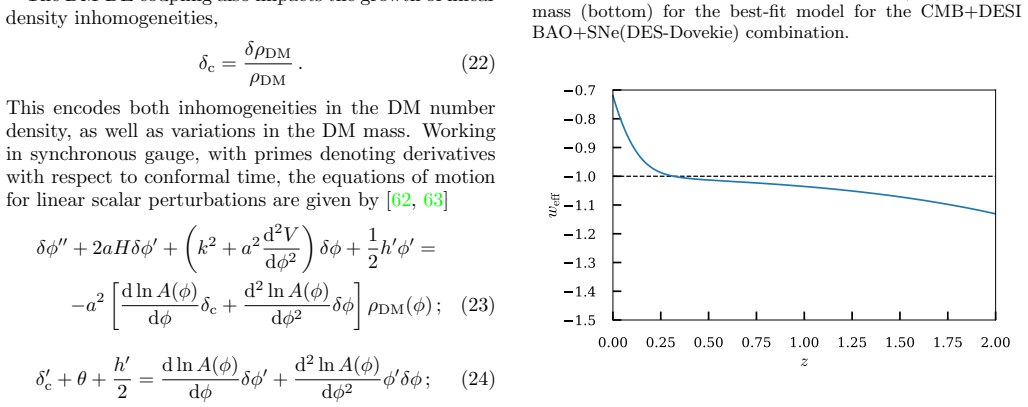
The central claim: apparent phantom crossing can arise from a well-defined interacting dark sector, not a fundamental phantom field. In the DADB model, the dark QCD axion's effective potential depends on dark-baryon density; the baryon mass varies as the axion rolls, falling before recombination and rising afterwards. This non-monotonic mass evolution fits the CMB while producing an apparent phantom crossing over the BAO/supernova epoch. Fitted to CMB, BAO, and recalibrated supernova data, the best model beats ΛCDM by Δχ²=-14.48 with three extra parameters. The same dynamics yields an early-dark-energy component peaking at ~0.8% of total density, too small to resolve the Hubble tension.
What carries the argument
The central mechanism is a density-dependent effective potential for the dark QCD axion: when dark baryons are dense, the axion sits near ϕ=πf, and the dark-baryon mass is comparatively low; as the universe expands and the density falls below a critical value, the potential's minimum shifts to ϕ=0, the axion rolls, and the dark-baryon mass grows. The early-time roll from the initial value toward πf makes the mass decrease before recombination; the late-time roll from πf toward 0 makes it increase afterwards. The dimensionless coupling σ_N/m_N sets the strength of this axion–dark-baryon interaction; in the large-coupling limit the model reduces to ΛCDM.
Load-bearing premise
The model assumes the density-dependent axion potential remains valid up to matter-radiation equality, which requires the parameter ε to be far below 10^-12; the paper does not verify the best-fit parameters satisfy this.
What would settle it
Take the best-fit parameters and compute ε from Λ⁴ = ε m_π² f_π²; check whether ε ≪ 10^-12 as required by footnote 5. If the inequality fails, the density-dependent potential is not under control at matter-radiation equality, and the early-time mass evolution that underpins the CMB fit is unsupported.
If this is right
- Apparent phantom crossing can be produced by a canonical scalar coupled to dark baryons, so the distance data do not require a fundamental phantom field that violates the null energy condition.
- The model predicts a scale-dependent growth signature—enhanced small-scale clustering and suppressed large-scale power relative to ΛCDM—testable with future galaxy clustering and weak-lensing measurements.
- A single interacting dark sector can generate both late-time dark energy and a transient early-dark-energy component near matter-radiation equality, though the data-preferred peak is only ~0.8%, too small to relieve the Hubble tension.
- Compared to the phenomenological w0wa parametrization, the model improves the fit by about Δχ²≈-2 with one extra parameter, adding a particle-physics explanation for the apparent dynamical dark energy.
Where Pith is reading between the lines
- A consistency check the paper leaves open: whether the best-fit parameters satisfy ε ≪ 10^-12 (Eq. 15). If not, the density-dependent potential is uncontrolled at matter-radiation equality, and the early-time mass decrease that anchors the CMB fit would need revision.
- The predicted large-scale suppression and small-scale enhancement in the matter power spectrum is a distinctive signature that could discriminate this model from w0wa dark energy in future redshift-space distortion and weak-lensing analyses.
- Since the best-fit EDE peak (0.8%) is far below the ~10% needed for the Hubble tension, the framework's unification of early and late dark energy suggests a targeted search for parameter regions that raise f_EDE while preserving the CMB fit.
- The ΛCDM limit of the model sits at large σ_N/m_N, outside the chiral-perturbation-theory expectation; a more physical derivation of the coupling range would sharpen the Bayesian evidence for a nonzero interaction.
Editorial analysis
A structured set of objections, weighed in public.
Referee Report
Summary. This paper confronts the dark axion–dark baryon (DADB) model of Khoury, Lin, and Trodden with CMB, DESI DR2 BAO, and multiple SN Ia samples. The authors implement the model, including linear perturbations, in a modified CLASS code and run MCMC analyses. For the default CMB+DESI+DES-Dovekie combination they report a best-fit improvement of Δχ²_total = -14.48 relative to ΛCDM, with a preferred solution in which the DM mass decreases between matter-radiation equality and recombination and then increases over the BAO/SNe-sensitive epoch, yielding an apparent phantom crossing in the effective dark-energy description. The same dynamics produces a small early-dark-energy-like component. A geometric argument is given for why CMB and low-redshift distance data favor this non-monotonic mass history.
Significance. If the central result holds, the DADB model provides a concrete, microphysical realization of the apparent phantom-crossing preference suggested by DESI, with testable predictions for matter clustering and growth. The paper has notable strengths: a well-specified model from earlier work, a consistent treatment of linear perturbations, a broad comparison across SNe calibrations, per-dataset Δχ² breakdowns, and explicit caveats about posterior non-Gaussianity and the f prior. However, the evidence claim is conditional on two load-bearing points that are not yet fully established: the validity of the effective potential in the high-density early-universe regime, and a model comparison in which ΛCDM lies outside the sampled coupling prior. The lack of released numerical code also hampers verification of the quoted Δχ².
major comments (3)
- [Sec. V.A, Table II] The quoted Δχ² improvement is not a nested-model comparison. The ΛCDM limit is identified in Sec. III.C with σ_N/m_N → ∞, but the MCMC prior restricts σ_N/m_N ∈ [0, 0.5]. Thus ΛCDM lies outside the sampled support. Comparing the best-fit DADB model with an independently optimized ΛCDM model while counting 'three additional parameters' does not give a standard model-selection significance, especially because the prior has a hard truncation. Please extend the prior to include the ΛCDM-like regime, or use a comparison that properly accounts for the boundary (e.g., profile likelihood or an effective-parameter estimate). Otherwise the claim of 'evidence for nonzero interaction' in Sec. V.B is overstated.
- [Footnote 5, Eqs. (10), (15), (31); Sec. IV.C] The early-time dynamics that underlies the reported Δχ² is not verified to lie within the controlled regime of the effective potential. The potential (10) is justified to linear order in density; higher-order corrections are small only if Eq. (15) holds, which for the best-fit coupling and Λ~meV requires ε ≪ 10^-12, as the footnote states. In the best-fit background, ρ_DM at matter-radiation equality exceeds the critical density ρ_c = Λ^4/(2σ_N/m_N) by roughly ten orders of magnitude, so the density-dependent term in (10) is strongly dominant. The paper neither specifies ε (or the underlying m_π, f_π) nor checks that the best-fit trajectory satisfies Eq. (15). If higher-order density corrections are not negligible, the pre-recombination mass decrease and the EDE-like injection change, directly affecting the central Δχ². Please specify ε and verify the condition along the best-fit traject
- [Sec. V.A and Sec. IV (numerical implementation)] The central numerical result relies on a modified version of CLASS, but the code is not provided and the implementation is not described in sufficient detail to reproduce the perturbation equations (23)-(27) and the background solver. In particular, the treatment of the dark-baryon sound speed, the discretization of the new source terms, and the initial conditions for the dark-sector perturbations are not fully specified. Given that the headline Δχ² and posterior shapes come from this code, please release the code or provide a detailed implementation document so that the result can be independently verified.
minor comments (3)
- [Sec. V.B, Table I] The text states that the f posterior 'reaches the physical upper bound, f≤M_Pl' and is bimodal, but the best-fit f/M_Pl is 0.22, far from the boundary. Clarify whether the boundary support is a secondary mode, and quantify how the best-fit and Δχ² depend on the upper prior on f.
- [Eq. (35)] The dilution law ρ_EDE ∝ a^{-9/2} is derived assuming the oscillatory regime with m_φ,eff ∝ a^{-3/2}. Please state the adiabaticity condition m_φ,eff ≫ H and indicate the redshift interval over which this scaling actually holds for the best-fit parameters.
- [Sec. V.A] The sentence 'The arbitrary upper limit of σ_N/m_N is only valid when a non-zero coupling is significantly preferred over the ΛCDM limit' is confusing, because ΛCDM corresponds to σ_N/m_N → ∞, which is outside the [0,0.5] prior. Rephrase or justify how the upper limit interacts with the claimed preference.
Circularity Check
No significant circularity: the central Δχ² result is a genuine fit to external data, and the phantom-crossing/EDE statements are interpretive descriptions of the best-fit solution rather than inputs relabeled as predictions.
full rationale
The paper's central evidence is the likelihood comparison of the DADB model against external CMB, DESI DR2 BAO, and SNe data, yielding Δχ²_total = -14.48. This is obtained by varying model parameters and nuisance parameters against the data, so it is not equivalent to an input. The apparent phantom crossing is not an independent prediction but an interpretation of the best-fit solution through the effective-DE mapping defined in Eqs. (19)-(20); the paper explicitly defines ρ_eff_DE and shows that A(φ)<A(φ0) produces weff crossing, so the crossing is a derived property of the fitted solution, not a fitted parameter renamed as a prediction. The model equations are summarized from the authors' prior paper [1], but they are stated explicitly in Section III and then tested against external cosmological data; the self-citation supplies model motivation, not the data-fitting result. No uniqueness theorem is invoked to force the model, and no ansatz is smuggled in solely via citation. The unverified validity condition in footnote 5 (Eq. 15, ε ≪ 10^-12) is a model-control/EFT-correctness concern that could affect the early-time mass evolution, but it is not a circularity: the derivation does not assume the conclusion. No fitted parameter is relabeled as a prediction, and the model is self-contained enough for its claims to be falsified by the data it confronts. Therefore the circularity score is 0.
Axiom & Free-Parameter Ledger
free parameters (5)
- σ_N/m_N (dark axion–dark baryon coupling) =
best-fit ~0.032–0.044 (varies with SNe sample)
- f / M_Pl (axion decay constant) =
best-fit 0.22; marginalized >0.28–0.30 for some samples; posterior has support at prior upper bound f=M_Pl
- θ_i = φ_i/f (initial field value) =
best-fit ~1.9–2.1
- ε (ad hoc potential parameter) =
not sampled; Λ derived via Eq. (14); required ε << 10^-12 for validity
- m_u/m_d (dark quark mass ratio) =
fixed to 0.8
axioms (7)
- standard math Standard FLRW background and linear cosmological perturbation theory (synchronous gauge) apply.
- domain assumption The effective dark-QCD potential (Eq. 10) with linear density correction is valid up to matter-radiation equality (requires ε << 10^-12, Eq. 15).
- domain assumption Dark baryons are the sole dark matter and their number density redshifts as a^-3, with no additional number-changing processes.
- domain assumption Linear perturbation equations (23)-(27) from refs [62,63] correctly describe the dark sector perturbations in synchronous gauge.
- domain assumption Adiabatic initial conditions with δφ=δφ'=0 and zero CDM velocity in the radiation era.
- domain assumption The axion is initially frozen (neglect of the 'kick' effect from [64]) and starts at rest.
- ad hoc to paper The prior f ≤ M_Pl (sub-Planckian axion decay constant) is appropriate; posterior has support at this boundary.
invented entities (2)
-
Dark QCD axion (φ)
no independent evidence
-
Dark baryons
no independent evidence
read the original abstract
Interactions between dark matter and dark energy can lead to an apparent phantom-crossing behavior that mimics the expansion history preferred by the latest cosmological observations from DESI baryon acoustic oscillations (BAO), Cosmic Microwave Background (CMB), and Type Ia supernovae (SNe Ia) data. In a previous paper [Khoury, Lin, and Trodden 2025 arXiv:2503.16415], we proposed a concrete particle physics realization of this idea, consisting of a strongly coupled dark sector in which a dark axion is coupled to dark baryons. In this paper, we investigate this idea further by comparing its predictions to the latest cosmological data. We implement the dark axion-dark baryon interaction model in a Boltzmann code and confront it with CMB, DESI DR2 BAO, and SNe Ia data. For the CMB+DESI DR2+DES-Dovekie combination, the best-fit model improves the fit relative to $\Lambda$CDM by $\Delta\chi^2=-14.48$. The preferred solution exhibits a non-monotonic dark-matter mass evolution: the mass decreases between matter-radiation equality and recombination, while increasing over the BAO/SNe-sensitive epoch, leading to an apparent phantom crossing in an effective dark-energy description. Interestingly, the same dynamics produces an Early Dark Energy-like energy injection near matter-radiation equality, but in the data-preferred region this component is too small to raise $H_0$ enough to substantially reduce the current tension.
Figures



Reference graph
Works this paper leans on
-
[1]
Apparentw <−1 and a LowerS 8 from Dark Axion and Dark Baryons Interactions,
Justin Khoury, Meng-Xiang Lin, and Mark Trodden, “Apparentw <−1 and a LowerS 8 from Dark Axion and Dark Baryons Interactions,” Phys. Rev. Lett.135, 11 181001 (2025), arXiv:2503.16415 [astro-ph.CO]
arXiv 2025
-
[2]
Adam G. Riesset al., “A Comprehensive Measurement of the Local Value of the Hubble Constant with 1 km s−1 Mpc−1 Uncertainty from the Hubble Space Telescope and the SH0ES Team,” Astrophys. J. Lett.934, L7 (2022), arXiv:2112.04510 [astro-ph.CO]
Pith/arXiv arXiv 2022
-
[3]
Planck 2018 results. VI. Cosmological parameters,
N. Aghanimet al.(Planck), “Planck 2018 results. VI. Cosmological parameters,” Astron. Astrophys.641, A6 (2020), [Erratum: Astron.Astrophys. 652, C4 (2021)], arXiv:1807.06209 [astro-ph.CO]
Pith/arXiv arXiv 2018
-
[4]
Early Dark Energy Can Resolve The Hubble Tension,
Vivian Poulin, Tristan L. Smith, Tanvi Karwal, and Marc Kamionkowski, “Early Dark Energy Can Resolve The Hubble Tension,” Phys. Rev. Lett.122, 221301 (2019), arXiv:1811.04083 [astro-ph.CO]
Pith/arXiv arXiv 2019
-
[5]
Acoustic Dark Energy: Potential Conver- sion of the Hubble Tension,
Meng-Xiang Lin, Giampaolo Benevento, Wayne Hu, and Marco Raveri, “Acoustic Dark Energy: Potential Conver- sion of the Hubble Tension,” Phys. Rev. D100, 063542 (2019), arXiv:1905.12618 [astro-ph.CO]
Pith/arXiv arXiv 2019
-
[6]
Oscillating scalar fields and the Hubble tension: a reso- lution with novel signatures,
Tristan L. Smith, Vivian Poulin, and Mustafa A. Amin, “Oscillating scalar fields and the Hubble tension: a reso- lution with novel signatures,” Phys. Rev. D101, 063523 (2020), arXiv:1908.06995 [astro-ph.CO]
Pith/arXiv arXiv 2020
-
[7]
The Hubble Tension and Early Dark Energy,
Marc Kamionkowski and Adam G. Riess, “The Hubble Tension and Early Dark Energy,” Ann. Rev. Nucl. Part. Sci.73, 153–180 (2023), arXiv:2211.04492 [astro-ph.CO]
Pith/arXiv arXiv 2023
-
[8]
Vivian Poulin, Tristan L. Smith, and Tanvi Karwal, “The Ups and Downs of Early Dark Energy solutions to the Hubble tension: A review of models, hints and con- straints circa 2023,” Phys. Dark Univ.42, 101348 (2023), arXiv:2302.09032 [astro-ph.CO]
Pith/arXiv arXiv 2023
-
[9]
DESI DR2 results. II. Measurements of baryon acoustic oscillations and cosmo- logical constraints,
M. Abdul Karimet al.(DESI), “DESI DR2 results. II. Measurements of baryon acoustic oscillations and cosmo- logical constraints,” Phys. Rev. D112, 083515 (2025), arXiv:2503.14738 [astro-ph.CO]
Pith/arXiv arXiv 2025
-
[10]
Extended dark energy analy- sis using DESI DR2 BAO measurements,
K. Lodhaet al.(DESI), “Extended dark energy analy- sis using DESI DR2 BAO measurements,” Phys. Rev. D 112, 083511 (2025), arXiv:2503.14743 [astro-ph.CO]
Pith/arXiv arXiv 2025
-
[11]
Accelerating uni- verses with scaling dark matter,
Michel Chevallier and David Polarski, “Accelerating uni- verses with scaling dark matter,” Int. J. Mod. Phys. D 10, 213–224 (2001), arXiv:gr-qc/0009008
Pith/arXiv arXiv 2001
-
[12]
Exploring the expansion history of the universe,
Eric V. Linder, “Exploring the expansion history of the universe,” Phys. Rev. Lett.90, 091301 (2003), arXiv:astro-ph/0208512
Pith/arXiv arXiv 2003
-
[13]
B. Popovicet al.(DES), “The Dark Energy Survey Supernova Program: A Reanalysis Of Cosmology Re- sults And Evidence For Evolving Dark Energy With An Updated Type Ia Supernova Calibration,” (2025), arXiv:2511.07517 [astro-ph.CO]
Pith/arXiv arXiv 2025
-
[14]
Union3.1: Self- consistent Measurements of Host Galaxy Properties for 2000 Type Ia Supernovae,
Taylor J. Hoyt, David Rubin, Greg Aldering, Saul Perl- mutter, Andrei Cuceu, and Ravi Gupta, “Union3.1: Self- consistent Measurements of Host Galaxy Properties for 2000 Type Ia Supernovae,” (2026), arXiv:2601.19424 [astro-ph.CO]
arXiv 2000
-
[15]
Constraints on Dynamical Dark Energy from Multiple Probes in the Full Dark En- ergy Survey,
T. M. C. Abbottet al.(DES), “Constraints on Dynamical Dark Energy from Multiple Probes in the Full Dark En- ergy Survey,” (2026), arXiv:2605.27221 [astro-ph.CO]
Pith/arXiv arXiv 2026
-
[16]
Crossing the phantom divide: Dark energy internal degrees of freedom,
Wayne Hu, “Crossing the phantom divide: Dark energy internal degrees of freedom,” Phys. Rev. D71, 047301 (2005), arXiv:astro-ph/0410680
Pith/arXiv arXiv 2005
-
[17]
Dark energy constraints from the cosmic age and super- nova,
Bo Feng, Xiu-Lian Wang, and Xin-Min Zhang, “Dark energy constraints from the cosmic age and super- nova,” Phys. Lett. B607, 35–41 (2005), arXiv:astro- ph/0404224
arXiv 2005
-
[18]
Cosmological evolution of a quin- tom model of dark energy,
Zong-Kuan Guo, Yun-Song Piao, Xin-Min Zhang, and Yuan-Zhong Zhang, “Cosmological evolution of a quin- tom model of dark energy,” Phys. Lett. B608, 177–182 (2005), arXiv:astro-ph/0410654
Pith/arXiv arXiv 2005
-
[19]
Can the dark energy equation-of-state parameterw be less than−1?
Sean M. Carroll, Mark Hoffman, and Mark Trodden, “Can the dark energy equation-of-state parameterw be less than−1?” Phys. Rev. D68, 023509 (2003), arXiv:astro-ph/0301273
Pith/arXiv arXiv 2003
-
[20]
The Phantom menaced: Constraints on low-energy effective ghosts,
James M. Cline, Sangyong Jeon, and Guy D. Moore, “The Phantom menaced: Constraints on low-energy effective ghosts,” Phys. Rev. D70, 043543 (2004), arXiv:hep-ph/0311312
Pith/arXiv arXiv 2004
-
[21]
Null energy condition and superluminal propagation,
S. Dubovsky, T. Gregoire, A. Nicolis, and R. Rattazzi, “Null energy condition and superluminal propagation,” JHEP03, 025 (2006), arXiv:hep-th/0512260
Pith/arXiv arXiv 2006
-
[22]
Energy’s and amplitudes’ positivity,
Alberto Nicolis, Riccardo Rattazzi, and Enrico Trincherini, “Energy’s and amplitudes’ positivity,” JHEP 05, 095 (2010), [Erratum: JHEP 11, 128 (2011)], arXiv:0912.4258 [hep-th]
Pith/arXiv arXiv 2010
-
[23]
Galilean Genesis: An Alternative to infla- tion,
Paolo Creminelli, Alberto Nicolis, and Enrico Trincherini, “Galilean Genesis: An Alternative to infla- tion,” JCAP11, 021 (2010), arXiv:1007.0027 [hep-th]
Pith/arXiv arXiv 2010
-
[24]
Sublu- minal Galilean Genesis,
Paolo Creminelli, Kurt Hinterbichler, Justin Khoury, Alberto Nicolis, and Enrico Trincherini, “Sublu- minal Galilean Genesis,” JHEP02, 006 (2013), arXiv:1209.3768 [hep-th]
Pith/arXiv arXiv 2013
-
[25]
The State of the dark energy equation of state,
Alessandro Melchiorri, Laura Mersini-Houghton, Car- olina J. Odman, and Mark Trodden, “The State of the dark energy equation of state,” Phys. Rev. D68, 043509 (2003), arXiv:astro-ph/0211522
Pith/arXiv arXiv 2003
-
[26]
Interacting quintessence. The Coincidence problem and cosmic accel- eration,
Greg Huey and Benjamin D. Wandelt, “Interacting quintessence. The Coincidence problem and cosmic accel- eration,” Phys. Rev. D74, 023519 (2006), arXiv:astro- ph/0407196
arXiv 2006
-
[27]
Super-acceleration as signature of dark sec- tor interaction,
Subinoy Das, Pier Stefano Corasaniti, and Justin Khoury, “Super-acceleration as signature of dark sec- tor interaction,” Phys. Rev. D73, 083509 (2006), arXiv:astro-ph/0510628
Pith/arXiv arXiv 2006
-
[28]
Can we be tricked into thinking thatwis less than−1?
Sean M. Carroll, Antonio De Felice, and Mark Trodden, “Can we be tricked into thinking thatwis less than−1?” Phys. Rev. D71, 023525 (2005), arXiv:astro-ph/0408081
Pith/arXiv arXiv 2005
-
[29]
How a brane cosmological constant can trick us into thinking that w <−1,
Arthur Lue and Glenn D. Starkman, “How a brane cosmological constant can trick us into thinking that w <−1,” Phys. Rev. D70, 101501 (2004), arXiv:astro- ph/0408246
arXiv 2004
-
[30]
Hints of Nonminimally Coupled Gravity in DESI 2024 Baryon Acoustic Oscillation Measurements,
Gen Ye, Matteo Martinelli, Bin Hu, and Alessandra Sil- vestri, “Hints of Nonminimally Coupled Gravity in DESI 2024 Baryon Acoustic Oscillation Measurements,” Phys. Rev. Lett.134, 181002 (2025), arXiv:2407.15832 [astro- ph.CO]
Pith/arXiv arXiv 2024
-
[31]
Nonminimally coupled gravity constraints from DESI DR2 data,
Jiaming Pan and Gen Ye, “Nonminimally coupled gravity constraints from DESI DR2 data,” Phys. Rev. D113, L041304 (2026), arXiv:2503.19898 [astro-ph.CO]
Pith/arXiv arXiv 2026
-
[32]
Assessing Cosmological Evidence for Nonminimal Coupling,
William J. Wolf, Carlos Garc ´ ıa-Garc ´ ıa, Theodore Anton, and Pedro G. Ferreira, “Assessing Cosmological Evidence for Nonminimal Coupling,” Phys. Rev. Lett.135, 081001 (2025), arXiv:2504.07679 [astro-ph.CO]
Pith/arXiv arXiv 2025
-
[33]
Cosmological constraints on Galileon dark en- ergy with broken shift symmetry,
William J. Wolf, Pedro G. Ferreira, and Carlos Garc ´ ıa- Garc ´ ıa, “Cosmological constraints on Galileon dark en- ergy with broken shift symmetry,” Phys. Rev. D113, 023551 (2026), arXiv:2509.17586 [astro-ph.CO]
Pith/arXiv arXiv 2026
-
[34]
The Status of Single Scalar Field Dark Energy,
Carlos Garc ´ ıa-Garc ´ ıa, Pedro G. Ferreira, and William J. Wolf, “The Status of Single Scalar Field Dark Energy,” (2026), arXiv:2607.07777 [astro-ph.CO]
Pith/arXiv arXiv 2026
-
[35]
Uplifting, Depressing, and Tilting Dark 12 Energy,
Eric V. Linder, “Uplifting, Depressing, and Tilting Dark 12 Energy,” (2025), arXiv:2506.02122 [astro-ph.CO]
Pith/arXiv arXiv 2025
-
[36]
Null Impact of the Null Energy Condition in Current Cosmology,
Robert R. Caldwell and Eric V. Linder, “Null Impact of the Null Energy Condition in Current Cosmology,” (2025), arXiv:2511.07526 [astro-ph.CO]
arXiv 2025
-
[37]
New constraints on interacting dark energy from DESI DR2 BAO observations,
Emanuelly Silva, Miguel A. Sabogal, Mateus Scherer, Rafael C. Nunes, Eleonora Di Valentino, and Suresh Kumar, “New constraints on interacting dark energy from DESI DR2 BAO observations,” Phys. Rev. D111, 123511 (2025), arXiv:2503.23225 [astro-ph.CO]
Pith/arXiv arXiv 2025
-
[38]
Interacting dark energy after DESI DR2: A challenge for the ΛCDM paradigm?
Supriya Pan, Sivasish Paul, Emmanuel N. Saridakis, and Weiqiang Yang, “Interacting dark energy after DESI DR2: A challenge for the ΛCDM paradigm?” Phys. Rev. D113, 023515 (2026), arXiv:2504.00994 [astro-ph.CO]
arXiv 2026
-
[39]
Tian-Nuo Li, Guo-Hong Du, Yun-He Li, Yichao Li, Jia- Le Ling, Jing-Fei Zhang, and Xin Zhang, “Updated constraints on interacting dark energy: A comprehen- sive analysis using multiple CMB probes, DESI DR2, and supernovae observations,” (2025), arXiv:2510.11363 [astro-ph.CO]
arXiv 2025
-
[40]
Late-time back- ground constraints on linear and non-linear interacting dark energy after DESI DR2,
David Figueruelo, Marcel van der Westhuizen, Amare Abebe, and Eleonora Di Valentino, “Late-time back- ground constraints on linear and non-linear interacting dark energy after DESI DR2,” Phys. Dark Univ.52, 102238 (2026), arXiv:2601.03122 [astro-ph.CO]
arXiv 2026
-
[41]
Robust Preference for Dark Sector Interactions,
Tian-Nuo Li, William Giar` e, Guo-Hong Du, Yun-He Li, Eleonora Di Valentino, Jing-Fei Zhang, and Xin Zhang, “Robust Preference for Dark Sector Interactions,” (2026), arXiv:2601.07361 [astro-ph.CO]
Pith/arXiv arXiv 2026
-
[42]
Tian-Nuo Li, Guo-Hong Du, Hao Wang, Yun-He Li, Jing- Fei Zhang, and Xin Zhang, “Dark Energy in the DESI Era: A Brief Review of Evidence, Beyond-ΛCDM Inter- pretations, and Tensions,” Res. Astron. Astrophys.26, 084002 (2026), arXiv:2606.21826 [astro-ph.CO]
Pith/arXiv arXiv 2026
-
[43]
Evolving Dark Sector and the Dark Dimension Scenario,
Alek Bedroya, Georges Obied, Cumrun Vafa, and David H. Wu, “Evolving Dark Sector and the Dark Dimension Scenario,” (2025), arXiv:2507.03090 [astro- ph.CO]
Pith/arXiv arXiv 2025
-
[44]
Screened axio- dilaton cosmology: novel forms of early dark energy,
Adam Smith, Philippe Brax, Carsten van de Bruck, C. P. Burgess, and Anne-Christine Davis, “Screened axio- dilaton cosmology: novel forms of early dark energy,” Eur. Phys. J. C85, 1062 (2025), arXiv:2505.05450 [hep- th]
Pith/arXiv arXiv 2025
-
[45]
David Andriot, “Phantom matters,” Phys. Dark Univ. 49, 102000 (2025), arXiv:2505.10410 [hep-th]
Pith/arXiv arXiv 2025
-
[46]
Resolving the Planck-DESI tension by nonminimally coupled quintessence,
Jia-Qi Wang, Rong-Gen Cai, Zong-Kuan Guo, and Shao-Jiang Wang, “Resolving the Planck-DESI tension by nonminimally coupled quintessence,” Phys. Rev. D 113, 083534 (2026), arXiv:2508.01759 [astro-ph.CO]
Pith/arXiv arXiv 2026
-
[47]
Mimicking phantom dark energy with evolving dark matter mass,
Lorenzo La Penna, Alessio Notari, and Michele Redi, “Mimicking phantom dark energy with evolving dark matter mass,” JCAP07, 033 (2026), arXiv:2601.05235 [astro-ph.CO]
arXiv 2026
-
[48]
High-redshift physics from the acoustic scale,
Zachary J. Weiner, “High-redshift physics from the acoustic scale,” (2026), arXiv:2603.18131 [astro-ph.CO]
arXiv 2026
-
[49]
Cosmological Impact of Redshift- Dependent Type Ia Supernovae Calibration,
Seyed Hamidreza Mirpoorian, Meng-Xiang Lin, and Levon Pogosian, “Cosmological Impact of Redshift- Dependent Type Ia Supernovae Calibration,” (2026), arXiv:2604.24761 [astro-ph.CO]
Pith/arXiv arXiv 2026
-
[50]
Quark and gluon condensates in nuclear mat- ter,
Thomas D. Cohen, R. J. Furnstahl, and David K. Griegel, “Quark and gluon condensates in nuclear mat- ter,” Phys. Rev. C45, 1881–1893 (1992)
1992
-
[51]
The QCD axion at finite density,
Reuven Balkin, Javi Serra, Konstantin Springmann, and Andreas Weiler, “The QCD axion at finite density,” JHEP07, 221 (2020), arXiv:2003.04903 [hep-ph]
Pith/arXiv arXiv 2020
-
[52]
Probing axions with neutron star inspirals and other stellar processes,
Anson Hook and Junwu Huang, “Probing axions with neutron star inspirals and other stellar processes,” JHEP 06, 036 (2018), arXiv:1708.08464 [hep-ph]
Pith/arXiv arXiv 2018
-
[53]
Chiral Dynamics in the Large n Limit,
P. Di Vecchia and G. Veneziano, “Chiral Dynamics in the Large n Limit,” Nucl. Phys. B171, 253–272 (1980)
1980
-
[54]
Giovanni Grilli di Cortona, Edward Hardy, Javier Pardo Vega, and Giovanni Villadoro, “The QCD ax- ion, precisely,” JHEP01, 034 (2016), arXiv:1511.02867 [hep-ph]
Pith/arXiv arXiv 2016
-
[55]
Solving the Hierarchy Problem Dis- cretely,
Anson Hook, “Solving the Hierarchy Problem Dis- cretely,” Phys. Rev. Lett.120, 261802 (2018), arXiv:1802.10093 [hep-ph]
Pith/arXiv arXiv 2018
-
[56]
Luca Di Luzio, Belen Gavela, Pablo Quilez, and Andreas Ringwald, “An even lighter QCD axion,” JHEP05, 184 (2021), arXiv:2102.00012 [hep-ph]
Pith/arXiv arXiv 2021
-
[57]
Natural Phan- tom Dark Energy from aZ N –Axion,
C´ edric Delaunay and Admir Greljo, “Natural Phan- tom Dark Energy from aZ N –Axion,” (2026), arXiv:2607.06774 [hep-ph]
Pith/arXiv arXiv 2026
-
[58]
On the possibility of large axion decay con- stants,
Tom Banks, Michael Dine, Patrick J. Fox, and Elie Gorbatov, “On the possibility of large axion decay con- stants,” JCAP06, 001 (2003), arXiv:hep-th/0303252
Pith/arXiv arXiv 2003
-
[59]
The String landscape, black holes and gravity as the weakest force,
Nima Arkani-Hamed, Lubos Motl, Alberto Nicolis, and Cumrun Vafa, “The String landscape, black holes and gravity as the weakest force,” JHEP06, 060 (2007), arXiv:hep-th/0601001
Pith/arXiv arXiv 2007
-
[60]
Constraints on Axion Inflation from the Weak Gravity Conjecture,
Tom Rudelius, “Constraints on Axion Inflation from the Weak Gravity Conjecture,” JCAP09, 020 (2015), arXiv:1503.00795 [hep-th]
Pith/arXiv arXiv 2015
-
[61]
H0 tension, swampland conjectures, and the epoch of fading dark matter,
Prateek Agrawal, Georges Obied, and Cumrun Vafa, “H0 tension, swampland conjectures, and the epoch of fading dark matter,” Phys. Rev. D103, 043523 (2021), arXiv:1906.08261 [astro-ph.CO]
Pith/arXiv arXiv 2021
-
[62]
Early dark sector, the Hubble tension, and the swampland,
Evan McDonough, Meng-Xiang Lin, J. Colin Hill, Wayne Hu, and Shengjia Zhou, “Early dark sector, the Hubble tension, and the swampland,” Phys. Rev. D106, 043525 (2022), arXiv:2112.09128 [astro-ph.CO]
Pith/arXiv arXiv 2022
-
[63]
Dark matter trigger for early dark en- ergy coincidence,
Meng-Xiang Lin, Evan McDonough, J. Colin Hill, and Wayne Hu, “Dark matter trigger for early dark en- ergy coincidence,” Phys. Rev. D107, 103523 (2023), arXiv:2212.08098 [astro-ph.CO]
Pith/arXiv arXiv 2023
-
[64]
Misalign- ment from kicks: the impact of particle interactions on ultra-light dark matter,
Clare Burrage and Sergio Sevillano Mu˜ noz, “Misalign- ment from kicks: the impact of particle interactions on ultra-light dark matter,” (2026), arXiv:2603.28881 [hep- ph]
arXiv 2026
-
[65]
Dark forces suppress structure growth,
Marco Costa, Cyril Creque-Sarbinowski, Olivier Simon, and Zachary J. Weiner, “Dark forces suppress structure growth,” (2025), arXiv:2510.00098 [astro-ph.CO]
arXiv 2025
-
[66]
Unifying Early and Late Dark Energy: Dynamical Requirements and Ob- structions,
William Giar` e and Jeremy Sakstein, “Unifying Early and Late Dark Energy: Dynamical Requirements and Ob- structions,” (2026), arXiv:2605.26116 [astro-ph.CO]
Pith/arXiv arXiv 2026
-
[67]
The Cosmic Linear Anisotropy Solving System (CLASS) I: Overview,
Julien Lesgourgues, “The Cosmic Linear Anisotropy Solving System (CLASS) I: Overview,” arXiv e-prints , arXiv:1104.2932 (2011), arXiv:1104.2932 [astro-ph.IM]
Pith/arXiv arXiv 2011
-
[68]
The Cosmic Linear Anisotropy Solving Sys- tem (CLASS). Part II: Approximation schemes,
Diego Blas, Julien Lesgourgues, and Thomas Tram, “The Cosmic Linear Anisotropy Solving Sys- tem (CLASS). Part II: Approximation schemes,” JCAP 2011, 034 (2011), arXiv:1104.2933 [astro-ph.CO]
Pith/arXiv arXiv 2011
-
[69]
Cobaya: Code for Bayesian Analysis of hierarchical physical models,
Jesus Torrado and Antony Lewis, “Cobaya: Code for Bayesian Analysis of hierarchical physical models,” JCAP05, 057 (2021), arXiv:2005.05290 [astro-ph.IM]
Pith/arXiv arXiv 2021
-
[70]
T. M. C. Abbottet al.(DES), “The Dark Energy Sur- vey: Cosmology Results with∼1500 New High-redshift Type Ia Supernovae Using the Full 5 yr Data Set,” Astro- phys. J. Lett.973, L14 (2024), arXiv:2401.02929 [astro- 13 ph.CO]
Pith/arXiv arXiv 2024
-
[71]
The Pantheon+ Analysis: The Full Data Set and Light-curve Release,
Dan Scolnicet al., “The Pantheon+ Analysis: The Full Data Set and Light-curve Release,” Astrophys. J.938, 113 (2022), arXiv:2112.03863 [astro-ph.CO]
Pith/arXiv arXiv 2022
-
[72]
Union Through UNITY: Cosmology with 2,000 SNe Using a Unified Bayesian Framework,
David Rubinet al., “Union Through UNITY: Cosmology with 2,000 SNe Using a Unified Bayesian Framework,” arXiv e-prints (2023), arXiv:2311.12098 [astro-ph.CO]
Pith/arXiv arXiv 2023
-
[73]
David Rubin, Taylor Hoyt, Greg Aldering, and Saul Perlmutter, “Banana Split: Improved Cosmo- logical Constraints with Two Light-Curve-Shape and Color Populations Using Union3.1+UNITY1.8,” (2026), arXiv:2601.19854 [astro-ph.CO]
arXiv 2026
discussion (0)
Sign in with ORCID, Apple, or X to comment. Anyone can read and Pith papers without signing in.