REVIEW 3 major objections 3 minor 1 cited by
RuNNer 2.0: A Software Suite for High-Dimensional Neural Network Potentials
T0 review · 3 major / 3 minor · reviewed 2026-08-01 · deepseek-v4-flash
Pith's one-line read A plane-wave trick cuts charge equilibration from O(N^3) to O(N log^2 N), making fourth-generation neural network potentials with global charge transfer practical at scale.
desk verdict Substantial open-source HDNNP release that makes 4G training and single-node MD practical, but the quasi-linear O(N log^2 N) scaling claim overreaches because 4G multi-node scaling is absent and the LAMMPS MD path serializes QEq on one MPI rank. read the letter →
The pith
A machine-rendered reading of the paper's core claim, the machinery that carries it, and where it could break.
The reading
What carries the argument
The load-bearing mechanism is a particle-mesh charge equilibration scheme: atomic Gaussian charge densities are projected onto a real-space grid, the Poisson equation is solved in Fourier space with the 4π/G^2 kernel, and the resulting electrostatic potential is integrated against each atom's localized Gaussian to obtain every component of A·q. Charge equilibration (QEq) is the global linear solve that determines environment-dependent atomic charges in 4G HDNNPs; this matrix–vector product is what the conjugate-gradient solver needs at each iteration. By evaluating the product in O(N log N) time and never materializing the dense O(N^2) Coulomb matrix, the scheme removes the cubic bottleneck
What would settle it
Take a 4G potential and run the plane-wave/CG QEq on a series of systems from 10^3 to 10^6 atoms with a deliberately delocalized charge distribution, such as a charged metallic slab or a solvated ion at low concentration. Count the number of CG iterations per QEq solve: if iteration count grows linearly with N, or if wall time per step grows faster than N log^2 N, the paper's central complexity claim is refuted. A second check: run the same 96,000-atom 4G molecular dynamics on 1, 2, 4, and 8 compute nodes and measure whether the global QEq wall time decreases with additional MPI ranks.
Extended reading notes
Core claim
The central discovery is that charge equilibration in 4G HDNNPs can be made quasi-linear by recognizing that the matrix–vector product (A·q)_i equals the gradient of the electrostatic energy with respect to the charge on atom i, which is the integral of that atom's Gaussian charge density times the electrostatic potential. For periodic systems, the potential is obtained by projecting the charge density onto a grid, applying an FFT, multiplying by the reciprocal-space Coulomb kernel 4π/G^2, and back-transforming. This avoids forming or storing the dense Coulomb matrix A. With conjugate-gradient iterations that grow only slowly with system size in practice, the total cost becomes O(N log^2 N),
Load-bearing premise
The quasi-linear scaling claim rests on the observation that conjugate-gradient iterations in the plane-wave QEq solver grow only slowly with system size; if some materials require iteration counts that grow much faster, the O(N log^2 N) advantage—and with it the thesis that 4G models are now scalable—weakens.
Editorial extensions
If this is right
- Fourth-generation HDNNP molecular dynamics becomes practical for systems of tens of thousands of atoms: the paper reports about 0.03 ns/day for a 96,000-atom water system on a single node, with FFT-based QEq scaling well up to 192 threads.
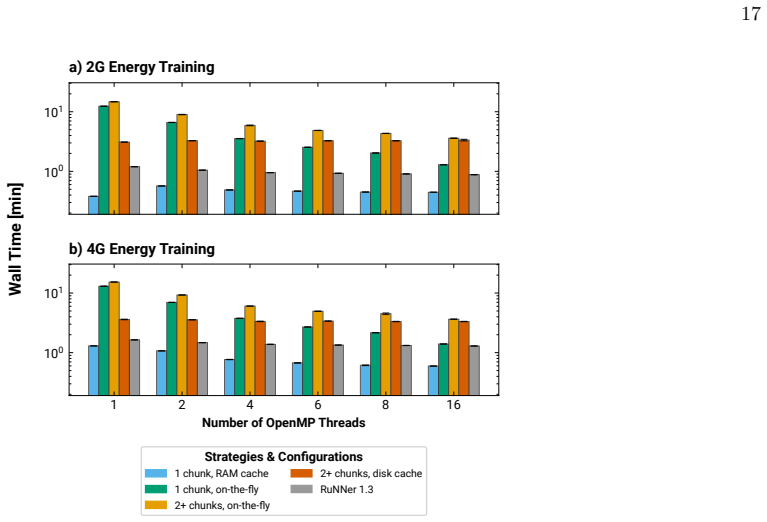
- 4G training no longer carries a large long-range penalty: with full RAM caching, per-epoch 4G force training is reported as only marginally slower than 2G training, and 5–25 times faster than the previous code version.
- Committee-based uncertainty quantification is nearly free at inference because neighbor lists and features are shared across committee members; the marginal cost of adding a member is roughly one extra neural-network forward pass per atom.
- The Au/MgO benchmark shows 4G models reproduce doping-induced non-local charge transfer across multiple slab thicknesses, while a strictly local 2G model remains blind to a deep subsurface dopant, implying 4G is necessary for such systems.
- Quasi-linear scaling across all HDNNP generations means one codebase can cover local and non-local electrostatics without a sharp performance cliff at the 4G level.
Reading between the lines
- The stated O(N log^2 N) complexity depends on the empirical observation that conjugate-gradient iterations grow slowly with system size; the most direct test of the headline claim is to count iterations for strongly delocalized charge distributions, such as metallic slabs or charged interfaces, where screening length scales may drive faster iteration growth.
- Because the global QEq step is performed on a single MPI rank in the present molecular-dynamics interface, the paper's multi-node scaling evidence is effectively for 2G models; a fair test of 4G scalability across nodes would require a distributed QEq solver or a profile of the root-rank bottleneck.
- If the quasi-linear QEq holds up in production, it removes a major barrier to using 4G models in active-learning and high-throughput screening loops, where thousands of short simulations are needed; the committee sharing already makes uncertainty estimates cheap enough to drive such loops.
- The memory strategy for 4G force training stores the dense global-charge Jacobian and Coulomb matrices, which is O(N^2) per structure; for very large single structures, on-the-fly recomputation may be the only viable route, so the reported training speedups may not transfer unchanged to ultra-large single cells.
Editorial analysis
A structured set of objections, weighed in public.
Referee Report
Summary. RuNNer 2.0 is presented as a from-scratch rewrite of the RuNNer software suite for 2G, 3G, and 4G high-dimensional neural network potentials. The central technical claim is that a plane-wave QEq solver reduces the cost of global charge equilibration from O(N^3) to O(N log^2 N), making 4G-HDNNP molecular dynamics and training quasi-linearly scalable and, for the first time, tractable for large production simulations. The paper describes a four-level software architecture, hybrid MPI/OpenMP parallelization, memory-management strategies for training, native LAMMPS and ASE interfaces, committee-based uncertainty quantification, and extensive CPU benchmarks against n2p2 and PANNA. It also includes a Au/MgO(Al) case study demonstrating that the 4G model captures non-local charge transfer that the local 2G model is categorically unable to represent.
Significance. If the central scaling claims are substantiated, RuNNer 2.0 would be an important enabling tool: it would allow production 4G-HDNNP simulations with global charge transfer at sizes previously restricted to local MLPs. The manuscript has notable strengths: the source code, benchmark data, and analysis scripts are publicly available under GPL; the benchmark protocols are unusually detailed (compilers, git commits, hardware, MPI/OpenMP settings); and the authors are transparent about competitor-code modifications and methodological differences, such as PANNA's angular functions and the improved n2p2 solver. These reproducibility practices are commendable and are part of why the paper has value even where some claims need tightening. However, the headline scaling statements are broader than the evidence, particularly for 4G-HDNNPs in the LAMMPS MD path.
major comments (3)
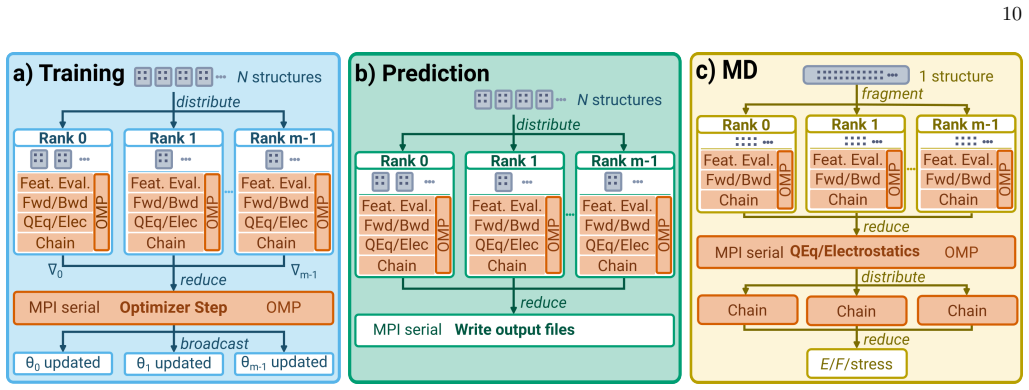
- [Sec. III B 2 / Fig. 4] In the LAMMPS MD path, 3G/4G electrostatics and QEq are not MPI-distributed: the full local-plus-ghost atom list is assembled on the root MPI task, where 'a single, global charge equilibration and electrostatics calculation' is performed. The 4G benchmarks supporting the scaling claim are single-node: Fig. 5a is OpenMP-only at 96,000 atoms, and Fig. 5b is 2G-only MPI strong scaling up to 12 million atoms. No multi-node 4G benchmark is presented. The conclusion that RuNNer 2.0 achieves linear/quasi-linear scaling 'across all HDNNP generations' is therefore broader than the evidence. Please either add multi-node 4G strong-scaling data or explicitly restrict the claim to single-node/OpenMP 4G operation and note the root-rank memory/time bottleneck.
- [Sec. III F / Abstract] The O(N log^2 N) complexity claim is not proven; it rests on the empirical CG-iteration observation of Gubler et al. [62], as the text itself acknowledges. In this paper, Fig. 5e tests 4G systems only up to 2,592 atoms, and Fig. 5a (96,000 atoms) is a single-node timing decomposition without a scaling fit or CG iteration counts. Because this is the paper's headline claim, please report CG iteration counts and total QEq time versus N over at least the 10^3-10^5 atom range, and state explicitly in the abstract/conclusions that the asymptotic complexity is empirical for realistic systems rather than a worst-case bound.
- [Sec. III C 1 / Fig. 7] The claim that 4G-HDNNPs can be trained 'with the same efficiency as their local counterparts' is not established for large single structures. The paper itself notes that storing dq/dr scales O(N^2) and that the Coulomb matrix inverse is cached, both quadratic in atoms per structure. The training benchmark in Fig. 7 uses 96-atom water structures, for which the quadratic memory cost is negligible. Please either benchmark 4G training on a structure large enough to expose the quadratic memory/derivative cost, or limit the claim to per-epoch timings for small/medium structures.
minor comments (3)
- [SI Sec. 1 A 1 b] The text states that tanh^3(1) is approximately 0.50; the correct value is approximately 0.442. Please correct.
- [Eq. (10) vs SI Eq. (13)] The smooth spectral projection is written with different notation and normalization in the main text and the SI. The main-text equation omits the 1/n_lambda normalization and the grid-spacing factor used in the SI. Please align the two definitions.
- [Fig. 5(e)] The x-axis tick labels in Fig. 5(e) are illegible in the version I received (e.g., '1 2 4 8 163264'). Please ensure the final figure renders distinct numeric tick values for each subpanel.
Circularity Check
No significant circularity: the paper's central contribution is a measured software implementation, and its complexity claims rest on a separately published solver paper plus new benchmarks.
full rationale
The paper's central claims are performance and scaling results for a new software implementation. The O(N log^2 N) QEq scaling is attributed to Gubler et al. [62], a separately published, code- and data-backed study; the present paper also benchmarks the plane-wave/CG solver against Ewald and against n2p2/PANNA (Fig. 5e) and reports OpenMP scaling at 96,000 atoms. The LAMMPS 4G path does serialize global QEq on the root task, but that is an architectural limitation that would undercut scaling, not a circular reduction. The Au/MgO example trains 2G/4G models on the same DFT data and compares against held-out DFT points, so the agreement is a validation, not a definitional tautology. No fitted parameter is relabeled as a prediction, no uniqueness theorem is imported from the authors, and no term is defined in terms of the quantity it is supposed to explain. Self-citations (e.g., Gubler et al., Ko et al., Behler) are present but are external publications with independent content; they do not constitute the argument.
Assumptions & free parameters
free parameters (3)
- Element-specific Gaussian charge widths sigma (O, Mg, Al, Au) =
4.289, 2.872, 3.477, 3.288 Bohr
- Smooth spectral projection grid (n_g, L) =
Not specified; e.g. x_j = L j/n_g
- Benchmark cutoff radius =
10.0 Bohr (Au/MgO), 12 Bohr (water training)
assumptions (4)
- domain assumption The QEq energy is a second-order expansion with environment-dependent electronegativity and hardness (Rappe et al.)
- domain assumption Coulomb interactions are represented by Gaussian charge densities with element-specific widths sigma (Eq. 12)
- domain assumption The number of CG iterations grows slowly with system size so that the plane-wave QEq solver has effective O(N log^2 N) scaling
- standard math FFT-based Poisson solvers for periodic cells give the correct electrostatic potential
Cite this review
Pith. "Pith review of RuNNer 2.0: A Software Suite for High-Dimensional Neural Network Potentials." pith.science (2026). https://pith.science/paper/F7OOKAAT
@misc{pith2026260717978,
  author       = {Pith},
  title        = {Pith review of: RuNNer 2.0: A Software Suite for High-Dimensional Neural Network Potentials},
  year         = {2026},
  howpublished = {\url{https://pith.science/paper/F7OOKAAT}},
  note         = {Machine review of arXiv:2607.17978}
}
abstract
We present RuNNer 2.0, the "Ruhr University Neural Network energy representation", a highly optimized software suite for training and evaluating high-dimensional neural network potentials (HDNNPs) of the second, third, and fourth generation. Long-range electrostatics and charge equilibration (QEq) for the description of non-local charge transfer in fourth-generation (4G) HDNNPs are accelerated by quasi-linear-scaling plane-wave methods, reducing QEq computational complexity from $\mathcal{O}(N^3)$ to $\mathcal{O}(N\log^2 N)$ such that linear or quasi-linear scaling is achieved across all HDNNP generations. An optimized memory management strategy eliminates the training overhead traditionally associated with long-range interactions, allowing 4G-HDNNPs to be trained with the same efficiency as their local counterparts. Developed in modern Fortran (2003/2008 standards), combined with a hybrid MPI/OpenMP parallelization scheme, RuNNer 2.0 has been designed to run efficiently in any CPU environment, from cost-effective local workstations to massive HPC clusters. Its modular library architecture facilitates straightforward binding to external simulation software; native interfaces to LAMMPS and the Atomic Simulation Environment (ASE) provide full access to all its features, including built-in committee-based uncertainty quantification. The high efficiency and scalability of the RuNNer 2.0 ecosystem are demonstrated through detailed benchmarks.
Figures


Figures from the paper (8 more)


Forward citations
Cited by 1 Pith paper
-
AccelNet: Exact backward-compatible acceleration of polynomial angular descriptors through Cartesian moment factorization
Polynomial angular descriptors in aenet and n2p2 potentials can be evaluated exactly from one-neighbor Cartesian moments, removing the quadratic pair loop and accelerating trained models without retraining.
Reference graph
Works this paper leans on
-
[62]
A. M. Tokita and J. Behler, Tutorial: How to train a neural network potential, J. Chem. Phys.159, 121501 (2023)
2023
-
[1]
THEOR Y A. Atomic F eatures RuNNer 2.0implements two main classes of mappings from an atom’s local chemical environment to a fixed-length feature vector: atom-centered symmetry functions (ACSFs) [42] and the overlap matrix (OM) [48, 49]. Both classes depend on a smooth cutoff function that enforces strict locality by suppressing contributions from atoms b...
-
[2]
Cutoff Functions All feature maps inRuNNer 2.0are multiplied by a cutoff functionf cut(rij), which smoothly decays to zero at the cutoff radius,f cut(rij ≥r cut) = 0. An optional inner cutoff radiusf(r ij ≤r inner) = 1 shifts the onset of the decay away from the atom, which can be useful for feature sets targeting a specific distance range and for ignorin...
-
[3]
Atom-Centered Symmetry Functions Atom-centered symmetry functions (ACSFs) [42] map the local environment of atomionto a vector of scalars that are invariant under rotation, translation, and permutation of same-species neighbors [42]. Each componentG µ of the feature vector depends on one or more hyperparameters controlling the spatial resolution and angul...
-
[4]
Overlap Matrix Descriptors Overlap matrix descriptors [48, 49] encode the local chemical environment of atomithrough the eigenvalue spectrum of a matrix of atomic orbital overlap integrals, providing a continuously differentiable, rotationally invariant feature set using a typical basis in quantum chemistry. Element information enters through the element-...
-
[5]
Feature Modifiers The additive terms of any ACSF can be multiplied in an element-specific way by a scalar prefactor that encodes additional physical information not captured by interatomic distances and angles alone. a. Spin prefactor.For magnetic systems, the local spin moments i of each atom is discretized tos i ∈ {−1,0,+1} by applying a threshold whose...
-
[6]
The scaling factors are written to ascaling.datafile and reloaded unchanged during prediction
Feature Scaling Before training, each feature vector componentG i,µ is linearly mapped to a standard range of values based on the training set, eGi,µ = Gi,µ − ¯Gµ Gmaxµ −G minµ ,(21) where ¯Gµ,G max µ , andG min µ are the dataset mean, maximum, and minimum of featureµacross all atoms of the relevant species. The scaling factors are written to ascaling.dat...
-
[7]
Feed-Forward Neural Networks Each atomic sub-network inRuNNer 2.0is a fully connected, feed-forward neural network withLlayers. Given the scaled descriptor vector eGi as input, the output of layerlis z(l) =W (l) a(l−1) +b (l),(22) a(l) =σ (l) z(l) ,(23) with weight matrixW (l) ∈R nl×nl−1 , bias vectorb (l) ∈R nl , and activation functionσ (l) applied elem...
Show all 110 references
-
[8]
Activation Functions RuNNer 2.0provides a series of activation functions. a. Hyperbolic tangent.σ(x) = tanh(x) is the default activation. It maps the input to (−1,1), is smooth every- where, and saturates for|x|≳2.65. Thescaled hyperbolic tangentσ(x) = 1.59223 tanh(x) uses the...
-
[9]
Weight Initialization Suitable initial weights are important for avoiding saturated activations at the start of training.RuNNer 2.0 supports three initialization strategies. a. Nguyen-Widrow.The Nguyen–Widrow method [75] distributes the weight vectors of each hidden neuron suc...
-
[10]
During training, possible zeroth order reference values for the atomic energiesε 0, e.g
Atomic Energy Decomposition In 2G-HDNNPs, the total energy predicted byRuNNer 2.0is the sum of atomic contributions. During training, possible zeroth order reference values for the atomic energiesε 0, e.g. the energies of free atoms, may be subtracted from the target total ene...
-
[11]
Atomic Forces Atomic forces are obtained as the analytic gradient of the total energy with respect to atomic positions, Fj =− ∂E ∂rj =− NX i NµX µ ∂Ei ∂ eGi,µ ∂ eGi,µ ∂rj .(28) The outer sum extends over all atomsiwhose descriptor depends on the positionr j
-
[12]
Stress Tensor We define the stress tensorσsuch that its elements are given by σµν = 1 Ω ∂E ∂ϵµν ϵ=0 ,(29) 7 where Ω is the cell volume andϵis the strain tensor. Hence, the derivative of the energy with respect to the lattice vectors is dE dA = ΩσA −T ,(30) whereA −T is the inv...
-
[13]
Third-Generation HDNNPs In 3G-HDNNPs, each atom carries an environment-dependent partial chargeq i predicted by an atomic neural network. The total energy separates into a short-range part and a Coulomb part, E=E short({ eGi}) +E elec({qi},{R i}).(31) Since both contributions ...
-
[14]
force trick
Fourth-Generation HDNNPs and Charge Equilibration In 4G-HDNNP [22], the charge distribution is determined via charge equilibration by minimizing the electrostatic energy with respect to the atomic charges subject to total charge conservation. Two species-specific networks pred...
-
[15]
Ewald Summation For periodic systems, the Coulomb energy of a charge distribution{q i}with Gaussian charge widthsσ i is evaluated using Ewald summation [60]. The total interaction is split into a real-space sum that converges rapidly in direct space and a reciprocal-space sum ...
-
[16]
The charge density is interpolated onto the grid, the Poisson equation is solved in Fourier space, and the result is interpolated back to the particle positions
Particle–Particle–Particle–Mesh Method As an alternative to the classical Ewald summation, which may become computationally demanding for large systems,RuNNer 2.0implements a particle–particle–particle–mesh (PPPM) solver [78] that offloads the reciprocal- space contribution to...
-
[17]
Ziegler–Biersack–Littmark Potential Short-range nuclear repulsion between atomic cores can be added to any HDNNP model through the Ziegler– Biersack–Littmark (ZBL) potential [55]. The ZBL energy for a pair of atomsiandjseparated byr ij is Eij ZBL = ZiZj rij Φ(x)f cut(rij),(37)...
-
[18]
Hirshfeld-Based Dispersion Van der Waals dispersion interactions extending beyond the local atomic environments are accounted for via the Tkatchenko–Scheffler scheme [44], which scales free-atomC 6 coefficients by the environment-dependent Hirshfeld volume ratio [79]. Each ato...
-
[19]
Let ˆys andy s denote the predicted and reference values for samples, and letSbe the number of samples in the current batch
Loss Functions RuNNer 2.0supports three loss functions for measuring discrepancies between predicted and reference values. Let ˆys andy s denote the predicted and reference values for samples, and letSbe the number of samples in the current batch. Themean squared error(MSE) us...
-
[20]
Optimization Algorithms a. Gradient Descent.The standard gradient descent optimizer updates parameters along the mean negative gradient, θt+1 =θ t −α ¯gt ,(48) whereαis the learning rate and ¯gt =n −1 s Pns s=1 ∇Ls is the gradient averaged overn s streams (MPI tasks). b. SGD w...
-
[21]
Dataset Generation and HDNNP T raining The water dataset used for all performance benchmarks was drawn from the dataset of Thiemannet al.[84]
METHODS A. Dataset Generation and HDNNP T raining The water dataset used for all performance benchmarks was drawn from the dataset of Thiemannet al.[84]. We retained only the pure liquid water configurations, yielding 140 structures of 96 atoms each. All structures were recalc...
2025
-
[22]
After using this tool, the authors reviewed and edited the content as needed and take full responsibility for the content of the published article
USE OF GENERA TIVE AI During the preparation of this work the authors used Anthropic’s Claude in order to generate analysis and visual- ization scripts, and to improve wording. After using this tool, the authors reviewed and edited the content as needed and take full responsib...
-
[23]
Behler, Perspective: Machine learning potentials for atomistic simulations, J
J. Behler, Perspective: Machine learning potentials for atomistic simulations, J. Chem. Phys.145, 170901 (2016). 19
2016
-
[24]
V. L. Deringer, M. A. Caro, and G. Cs´ anyi, Machine learning interatomic potentials as emerging tools for materials science, Adv. Mater.31, 1902765 (2019)
2019
-
[25]
O. T. Unke, S. Chmiela, H. E. Sauceda, M. Gastegger, I. Poltavsky, K. T. Sch¨ utt, A. Tkatchenko, and K.-R. M¨ uller, Machine learning force fields, Chem. Rev.121, 10142 (2021)
2021
-
[26]
Friederich, F
P. Friederich, F. H¨ ase, J. Proppe, and A. Aspuru-Guzik, Machine-learned potentials for next-generation matter simulations, Nat. Mater20, 750 (2021)
2021
-
[27]
Behler and G
J. Behler and G. Cs´ anyi, Machine learning potentials for extended systems - a perspective, Eur. Phys. J. B94, 142 (2021)
2021
-
[28]
K¨ aser, L
S. K¨ aser, L. I. Vazquez-Salazar, M. Meuwly, and K. T¨ opfer, Neural network potentials for chemistry: concepts, applications and prospects, Digital Discovery2, 28 (2023)
2023
-
[29]
Behler and M
J. Behler and M. Parrinello, Generalized neural-network representation of high-dimensional potential-energy surfaces, Phys. Rev. Lett.98, 146401 (2007)
2007
-
[30]
A. P. Bart´ ok, M. C. Payne, R. Kondor, and G. Cs´ anyi, Gaussian approximation potentials: The accuracy of quantum mechanics, without the electrons, Phys. Rev. Lett.104, 136403 (2010)
2010
-
[31]
H. Wang, L. Zhang, J. Han, and W. E, Deepmd-kit: A deep learning package for many-body potential energy representation and molecular dynamics, Comput. Phys. Commun.228, 178 (2018)
2018
-
[32]
A. V. Shapeev, Moment tensor potentials: a class of systematically improvable interatomic potentials, Multiscale Model. Simul.14, 1153 (2016)
2016
-
[33]
A. P. Thompson, L. P. Swiler, C. R. Trott, S. M. Foiles, and G. J. Tucker, Spectral neighbor analysis method for automated generation of quantum-accurate interatomic potentials, J. Comp. Phys.285, 316 (2015)
2015
-
[34]
Drautz, Atomic cluster expansion for accurate and transferable interatomic potentials, Phys
R. Drautz, Atomic cluster expansion for accurate and transferable interatomic potentials, Phys. Rev. B99, 014104 (2019)
2019
-
[35]
E. C.-Y. Yuan, Y. Liu, J. Chen, P. Zhong, S. Raja, T. Kreiman, S. Vargas, W. Xu, M. Head-Gordon, C. Yang, S. M. Blau, B. Cheng, A. Krishnapriyan, and T. Head-Gordon, Foundation models for atomistic simulation of chemistry and materials, Nat. Rev. Chem.10, 212 (2026)
2026
-
[36]
Batatia, P
I. Batatia, P. Benner, Y. Chiang, A. M. Elena, D. P. Kovacs, J. Riebesell, X. R. Advincula, M. Asta, W. J. Baldwin, N. Bernstein, A. Bhowmik, S. M. Blau, V. Carare, J. P. Darby, S. De, F. D. Pia, V. L. Deringer, R. Elijosius, Z. El-Machachi, E. Fako, A. C. Ferrari, A. Genreith...
2025
-
[37]
B. Wood, M. Dzamba, X. Fu, M. Gao, M. Shuaibi, L. Barroso-Luque, K. Abdelmaqsoud, V. Gharakhanyan, J. Kitchin, D. Levine, K. Michel, A. Sriram, T. Cohen, A. Das, S. Sahoo, A. Rizvi, Z. Ulissi, and L. Zitnick, Uma: A family of universal models for atoms (Curran Associates, Inc....
2025
-
[38]
Nomura, S
K.-i. Nomura, S. Hattori, S. Ohmura, I. Kanemasu, K. Shimamura, N. Dasgupta, A. Nakano, R. K. Kalia, and P. Vashishta, Allegro-fm: Toward an equivariant foundation model for exascale molecular dynamics simulations, The Journal of Physical Chemistry Letters16, 6637 (2025)
2025
-
[39]
D. M. Anstine and O. Isayev, Machine learning interatomic potentials and long-range physics, J. Phys. Chem. A127, 2417 (2023)
2023
-
[40]
Behler, Four Generations of High-Dimensional Neural Network Potentials, Chem
J. Behler, Four Generations of High-Dimensional Neural Network Potentials, Chem. Rev.121, 10037 (2021)
2021
-
[41]
Morawietz, V
T. Morawietz, V. Sharma, and J. Behler, A neural network potential-energy surface for the water dimer based on environment-dependent atomic energies and charges, J. Chem. Phys.136, 064103 (2012)
2012
-
[42]
Artrith, T
N. Artrith, T. Morawietz, and J. Behler, High-dimensional neural-network potentials for multicomponent systems: Appli- cations to zinc oxide, Phys. Rev. B83, 153101 (2011)
2011
-
[43]
S. A. Ghasemi, A. Hofstetter, S. Saha, and S. Goedecker, Interatomic potentials for ionic systems with density functional accuracy based on charge densities obtained by a neural network, Phys. Rev. B92, 045131 (2015)
2015
-
[44]
T. W. Ko, J. A. Finkler, S. Goedecker, and J. Behler, A fourth-generation high-dimensional neural network potential with accurate electrostatics including non-local charge transfer, Nat Commun12, 398 (2021)
2021
-
[45]
T. W. Ko, J. A. Finkler, S. Goedecker, and J. Behler, General-Purpose Machine Learning Potentials Capturing Nonlocal Charge Transfer, Acc. Chem. Res.54, 808 (2021)
2021
-
[46]
A. K. Rapp´ e and I. Goddard, W. A., Charge equilibration for molecular dynamics simulations, J. Phys. Chem.95, 3358 (1991)
1991
-
[47]
Khorshidi and A
A. Khorshidi and A. A. Peterson, Amp: A modular approach to machine learning in atomistic simulations, Comp. Phys. Comm.207, 310 (2016)
2016
-
[48]
Artrith and A
N. Artrith and A. Urban, An implementation of artificial neural-network potentials for atomistic materials simulations: Performance for TiO2, Computational Materials Science114, 135 (2016)
2016
-
[49]
J. S. Smith, O. Isayev, and A. E. Roitberg, ANI-1: an extensible neural network potential with DFT accuracy at force field computational cost, Chem. Sci.8, 3192 (2017)
2017
-
[50]
K. Yao, J. E. Herr, D. W. Toth, R. Mckintyre, and J. Parkhill, The tensormol-0.1 model chemistry: a neural network augmented with long-range physics, Chem. Sci.9, 2261 (2018)
2018
-
[51]
K. Lee, D. Yoo, W. Jeong, and S. Han, Simple-nn: An efficient package for training and executing neural-network inter- atomic potentials, Comp. Phys. Comm.242, 95 (2019). 20
2019
-
[52]
Singraber, J
A. Singraber, J. Behler, and C. Dellago, Library-based LAMMPS implementation of high-dimensional neural network potentials, J. Chem. Theory Comput.15, 1827 (2019)
2019
-
[53]
Y. Shao, M. Hellstr¨ om, P. D. Mitev, L. Knijff, and C. Zhang, Pinn: A python library for building atomic neural networks of molecules and materials, J. Chem. Inf. Model.60, 1184 (2020)
2020
-
[54]
Pellegrini, R
F. Pellegrini, R. Lot, Y. Shaidu, and E. K¨ u¸ c¨ ukbenli, PANNA 2.0: Efficient neural network interatomic potentials and new architectures, J. Chem. Phys.159, 084117 (2023)
2023
-
[55]
van der Heide, J
T. van der Heide, J. Kullgren, P. Broqvist, V. Bacic, T. Frauenheim, and B. Aradi, Fortnet, a software package for training behler-parrinello neural networks, Comp. Phys. Comm.284, 108580 (2023)
2023
-
[56]
Behler, Constructing high-dimensional neural network potentials: A tutorial review, Int
J. Behler, Constructing high-dimensional neural network potentials: A tutorial review, Int. J. Quantum Chem.115, 1032 (2015)
2015
-
[57]
Behler, First Principles Neural Network Potentials for Reactive Simulations of Large Molecular and Condensed Systems, Angew
J. Behler, First Principles Neural Network Potentials for Reactive Simulations of Large Molecular and Condensed Systems, Angew. Chem. Int. Ed.56, 12828 (2017)
2017
-
[58]
Prus and J
B. Prus and J. Behler, Molecular dynamics simulations ofγ-belite(010)-water interfaces with high-dimensional neural network potentials (2025), arXiv:2512.09702 [cond-mat.mtrl-sci]
2025 arXiv
-
[59]
Walsh, Crystal structure of MOF-5 (2005),https://github.com/WMD-group/Crystal_structures/blob/master/MOFs/ MOF-5/MOF5.cif, accessed: 2026-06-10
A. Walsh, Crystal structure of MOF-5 (2005),https://github.com/WMD-group/Crystal_structures/blob/master/MOFs/ MOF-5/MOF5.cif, accessed: 2026-06-10
2005
-
[60]
Eckhoff and J
M. Eckhoff and J. Behler, From molecular fragments to the bulk: Development of a neural network potential for mof-5, J. Chem. Theory Comput.15, 3793 (2019)
2019
-
[61]
Eckhoff and J
M. Eckhoff and J. Behler, Insights into lithium manganese oxide-water interfaces using machine learning potentials, J. Chem. Phys.155, 244703 (2021)
2021
-
[63]
Behler, Representing potential energy surfaces by high-dimensional neural network potentials, J
J. Behler, Representing potential energy surfaces by high-dimensional neural network potentials, J. Phys.: Condens. Matter 26, 183001 (2014)
2014
-
[64]
Behler, Atom-centered symmetry functions for constructing high-dimensional neural network potentials, J
J. Behler, Atom-centered symmetry functions for constructing high-dimensional neural network potentials, J. Chem. Phys. 134, 074106 (2011)
2011
-
[65]
Muhli, X
H. Muhli, X. Chen, A. P. Bart´ ok, P. Hern´ andez-Le´ on, G. Cs´ anyi, T. Ala-Nissila, and M. A. Caro, Machine learning force fields based on local parametrization of dispersion interactions: Application to the phase diagram of c 60, Phys. Rev. B 104, 054106 (2021)
2021
-
[66]
Tkatchenko and M
A. Tkatchenko and M. Scheffler, Accurate molecular Van Der Waals interactions from ground-state electron density and free-atom reference data, Phys. Rev. Lett.102, 073005 (2009)
2009
-
[67]
T. W. Ko, J. A. Finkler, S. Goedecker, and J. Behler, Accurate Fourth-Generation Machine Learning Potentials by Electrostatic Embedding, Journal of Chemical Theory and Computation 10.1021/acs.jctc.2c01146 (2023)
2023 doi
-
[68]
Eckhoff and M
M. Eckhoff and M. Reiher, Lifelong Machine Learning Potentials, Journal of Chemical Theory and Computation19, 3509 (2023)
2023
-
[69]
Eckhoff and J
M. Eckhoff and J. Behler, High-dimensional neural network potentials for magnetic systems using spin-dependent atom- centered symmetry functions, npj Comput. Mater.7, 170 (2021)
2021
-
[70]
Sadeghi, S
A. Sadeghi, S. A. Ghasemi, B. Schaefer, S. Mohr, M. A. Lill, and S. Goedecker, Metrics for measuring distances in configuration spaces, J. Chem. Phys.139, 184118 (2013)
2013
-
[71]
Parsaeifard, D
B. Parsaeifard, D. Sankar De, A. S. Christensen, F. A. Faber, E. Kocer, S. De, J. Behler, O. Anatole von Lilienfeld, and S. Goedecker, An assessment of the structural resolution of various fingerprints commonly used in machine learning, Mach. Learn.: Sci. Technol.2, 015018 (2021)
2021
-
[72]
Tao and L
S. Tao and L. Zhu, Eosnet: Embedded overlap structures for graph neural networks in predicting material properties, J. Phys. Chem. Lett.16, 717 (2025)
2025
-
[73]
N. C. Handy and I. Schaefer, Henry F., On the evaluation of analytic energy derivatives for correlated wave functions, The Journal of Chemical Physics81, 5031 (1984)
1984
-
[74]
P. P. Poier, L. Lagard` ere, J.-P. Piquemal, and F. Jensen, Molecular dynamics using nonvariational polarizable force fields: Theory, periodic boundary conditions implementation, and application to the bond capacity model, Journal of Chemical Theory and Computation15, 6213 (20...
2019 doi
-
[75]
K. N. Lausch, R. El Haouari, D. Trzewik, and J. Behler, Impact of the damping function in dispersion-corrected density functional theory on the properties of liquid water, J. Chem. Phys.163, 034101 (2025)
2025
-
[76]
Grimme, J
S. Grimme, J. Antony, S. Ehrlich, and H. Krieg, A consistent and accurate ab initio parametrization of density functional dispersion correction (DFT-D) for the 94 elements H-Pu, J. Chem. Phys.132, 154104 (2010)
2010
-
[77]
J. F. Ziegler, J. P. Biersack, and U. Littmark,The Stopping and Range of Ions in Solids(Pergamon Press, New York, 1985)
1985
- [78]
-
[79]
T. B. Blank and S. D. Brown, Adaptive, global, extended kalman filters for training feed-forward neural networks, J. Chemometrics8, 391 (1994)
1994
-
[80]
A. H. Larsen, J. J. Mortensen, J. Blomqvist, I. E. Castelli, R. Christensen, M. Du lak, J. Friis, M. N. Groves, B. Hammer, C. Hargus, E. D. Hermes, P. C. Jennings, P. B. Jensen, J. Kermode, J. R. Kitchin, E. L. Kolsbjerg, J. Kubal, K. Kaasbjerg, S. Lysgaard, J. B. Maronsson, T...
2017
-
[81]
Singraber, T
A. Singraber, T. Morawietz, J. Behler, and C. Dellago, Parallel multistream training of high-dimensional neural network potentials, J. Chem. Theory Comput.15, 3075 (2019)
2019
-
[82]
P. P. Ewald, Die Berechnung optischer und elektrostatischer Gitterpotentiale, Ann. Phys.369, 253 (1921)
1921
-
[83]
Essmann, L
U. Essmann, L. Perera, M. L. Berkowitz, T. Darden, H. Lee, and L. G. Pedersen, A smooth particle mesh Ewald method, J. Chem. Phys.103, 8577 (1995)
1995
-
[84]
Gubler, J
M. Gubler, J. A. Finkler, M. R. Sch¨ afer, J. Behler, and S. Goedecker, Accelerating fourth-generation machine learning potentials using quasi-linear scaling particle mesh charge equilibration, J. Chem. Theory Comput.20, 7264 (2024)
2024
-
[85]
Schran, K
C. Schran, K. Breziˇ na, and O. Marsalek, Committee neural network potentials control generalization errors and enable active learning, J. Chem. Phys.153, 104105 (2020)
2020
-
[86]
Plimpton, Fast parallel algorithms for short-range molecular dynamics, Journal of Computational Physics117, 1 (1995)
S. Plimpton, Fast parallel algorithms for short-range molecular dynamics, Journal of Computational Physics117, 1 (1995)
1995
-
[87]
Sch¨ afer, runner-interface: Generic Python interfaces to the RuNNer code
Moritz R. Sch¨ afer, runner-interface: Generic Python interfaces to the RuNNer code. (2026)
2026
-
[88]
A. Stukowski, Visualization and analysis of atomistic simulation data with OVITO-the Open Visualization Tool, MOD- ELLING AND SIMULATION IN MATERIALS SCIENCE AND ENGINEERING18, 10.1088/0965-0393/18/1/015012 (2010)
2010 doi
-
[89]
Alexander L. M. Knoll, Redouan El Haouari, and Gunnar Schmitz, runnerase-core: Shared core library for the Python interface to the Ruhr university Neural Network energy representation (RuNNer). (2026)
2026
-
[90]
Sch¨ afer, runnerase-prediction: Prediction calculators for the Ruhr University Neural Network energy represen- tation (RuNNer)
Moritz R. Sch¨ afer, runnerase-prediction: Prediction calculators for the Ruhr University Neural Network energy represen- tation (RuNNer). (2026)
2026
-
[91]
Alexander L. M. Knoll, runnerase-training: Training calculators for the Ruhr University Neural Network energy represen- tation (RuNNer). (2026)
2026
-
[92]
Sch¨ afer, and Alexander L
Jasper Kr¨ ahe, Moritz R. Sch¨ afer, and Alexander L. M. Knoll, runnerase-workflows: Collection of routines for applying the Ruhr University Neural Network energy representation (RuNNer). (2026)
2026
-
[93]
Henry Wang, runnerase-feature-calculation: Feature calculators for the Ruhr University Neural Network energy represen- tation (RuNNer). (2026)
2026
-
[94]
Alexander L. M. Knoll, runnerase: A collection of packages for training, evaluating, and analyzing machine learning potentials with RuNNer, the Ruhr University Neural Network energy representation. (2026)
2026
-
[95]
Kocer, A
E. Kocer, A. Singraber, J. A. Finkler, B. Misof, T. W. Ko, C. Dellago, and J. Behler, Iterative charge equilibration for fourth-generation high-dimensional neural network potentials, J. Chem. Phys.162, 124106 (2025)
2025
-
[96]
A. L. M. Knoll, Improved iterative charge equilibration solver in n2p2, GitHub pull request #209 toCompPhysVienna/n2p2, commit6b41f10(2024)
2024
-
[97]
Nguyen and B
D. Nguyen and B. Widrow, Improving the learning speed of 2-layer neural networks by choosing initial values of the adaptive weights, in1990 IJCNN International Joint Conference on Neural Networks, Vol. 3 (IEEE, 1990) pp. 21–26
1990
-
[98]
Glorot and Y
X. Glorot and Y. Bengio, Understanding the difficulty of training deep feedforward neural networks, inProceedings of the Thirteenth International Conference on Artificial Intelligence and Statistics (AISTATS), Proceedings of Machine Learning Research, Vol. 9 (PMLR, 2010) pp. 249–256
2010
-
[99]
Eckhoff, F
M. Eckhoff, F. Sch¨ onewald, M. Risch, C. A. Volkert, P. E. Bl¨ ochl, and J. Behler, Closing the gap between theory and experiment for lithium manganese oxide spinels using a high-dimensional neural network potential, Phys. Rev. B102, 174102 (2020)
2020
-
[100]
R. W. Hockney and J. W. Eastwood,Computer Simulation Using Particles(Adam Hilger, Bristol, 1988)
1988
-
[101]
F. L. Hirshfeld, Bonded-atom fragments for describing molecular charge densities, Theor. Chim. Acta44, 129 (1977)
1977
-
[102]
G. V. Puskorius and L. A. Feldkamp, Multi-stream extended kalman filter training for static and dynamic neural networks, Systems, Man, and Cybernetics, 1997. Computational Cybernetics and Simulation., 1997 IEEE International Conference on3, 2006 (1997)
1997
-
[103]
M. J. Winter, WebElements: the periodic table on the web,https://www.webelements.com, accessed 2026
2026
-
[104]
Hermann, M
J. Hermann, M. St¨ ohr, S. G´ oger, S. Chaudhuri, B. Aradi, R. J. Maurer, and A. Tkatchenko, libmbd: A general-purpose package for scalable quantum many-body dispersion calculations, The Journal of Chemical Physics159, 174802 (2023)
2023
-
[105]
W. M. Haynes, ed.,CRC Handbook of Chemistry and Physics, 97th ed. (CRC Press/Taylor & Francis, Boca Raton, FL,
-
[107]
F. L. Thiemann, C. Schran, P. Rowe, E. A. M¨ uller, and A. Michaelides, Water Flow in Single-Wall Nanotubes: Oxygen Makes It Slip, Hydrogen Makes It Stick, ACS Nano16, 10775 (2022)
2022
-
[108]
Hammer, L
B. Hammer, L. B. Hansen, and J. K. Nørskov, Improved adsorption energetics within density-functional theory using revised perdew-burke-ernzerhof functionals, Phys. Rev. B59, 7413 (1999)
1999
-
[109]
V. Blum, R. Gehrke, F. Hanke, P. Havu, V. Havu, X. Ren, K. Reuter, and M. Scheffler, Ab initio molecular simulations with numeric atom-centered orbitals, Comp. Phys. Comm.180, 2175 (2009)
2009
-
[110]
Marek, V
A. Marek, V. Blum, R. Johanni, V. Havu, B. Lang, T. Auckenthaler, A. Heinecke, H.-J. Bungartz, and H. Lederer, The ELPA library: scalable parallel eigenvalue solutions for electronic structure theory and computational science, Journal of Physics: Condensed Matter26, 213201 (2014)
2014
-
[2016]
internet Version 2017
2017
Reviewed August 1, 2026 · model on record in the stance chip above.
Discussion (0). Continue with ORCID to comment.