REVIEW 3 major objections 4 minor 1 cited by
Coaching feedback beats scalar rewards for post-training language models on open-ended tasks.
Reviewed by Pith at T0; open to challenge. T0 means a machine referee read the full paper against a public rubric. the ladder, T0–T4 →
T0 review · deepseek-v4-flash
2026-08-01 15:57 UTC pith:BPTH4LXY
load-bearing objection Novel training loop, but the flagship claim is held hostage by top-3 checkpoint averaging, a contradictory cell, and an unreported cross-evaluator check. the 3 major comments →
LLM-as-a-Coach: Experiential Learning for Non-Verifiable Tasks
The pith
A machine-rendered reading of the paper's core claim, the machinery that carries it, and where it could break.
Core claim
On open-ended tasks, response quality has no ground truth, so post-training usually asks a judge model to score responses against rubrics and optimizes only that score. The paper's central claim is that this scalar bottleneck is the problem, and that a better policy emerges when the same feedback model acts as a coach: it writes down transferable guidance about each on-policy response, a teacher model is conditioned on that guidance, and the policy is trained to match the teacher's distribution through token-level reverse-KL distillation. Under this objective the policy never receives a scalar reward; the learning signal is the full distributional shift induced by the coaching text. The pape
What carries the argument
The load-bearing mechanism is experiential knowledge plus on-policy context distillation. For each training prompt, the policy samples a response; a coach model evaluates it against rubrics and extracts a few sentences of reusable strategy. That text is prepended to the context of a teacher model, and the policy is trained by minimizing the token-level reverse KL divergence between its own distribution and the teacher's context-conditioned distribution, averaged over the policy's own samples. This turns dense textual feedback into dense per-token supervision. The paper estimates that this textual channel carries roughly 17,600 bits per sample, versus 3.3 bits for a discrete 1-10 score, and a
Load-bearing premise
The paper's comparisons rest on the assumption that the model used as evaluator is a fair, unbiased judge of response quality for both RL and EL outputs; the same model also serves as the coach in several EL runs, and the cross-check with a stronger independent evaluator is mentioned but not reported.
What would settle it
Have human raters, blinded to training method, compare EL and RL outputs on the same held-out and unseen tasks. Concretely, choose 200 prompts from the held-out set, generate one response from each method, and ask at least three human annotators to state a pairwise preference. If EL is not preferred at a rate at least matching its benchmark advantage, the central comparative claim fails.
If this is right
- If the results hold, post-training pipelines for subjective and creative tasks can treat rubric-based evaluation as a source of dense supervision rather than a scalar loss.
- Because EL generalizes better to unseen benchmarks, it offers a direct way to reduce reward hacking in domains without a verifier.
- The coach can be the policy itself, so the method works even when no stronger model is available; iterative teacher updates add further gains when general-domain prompts are mixed in to prevent forgetting.
- The distinction between judge and coach is about the learning signal, not the evaluator's capability, so any existing judge-style evaluator can be reused as a coach.
Where Pith is reading between the lines
- A control the paper does not run: prepend high-entropy but task-irrelevant text as the teacher context. If gains persist, bandwidth alone is not the active ingredient; the semantic content of the experience matters.
- If human raters confirm the preference, the result supports a broader design principle: for multi-dimensional quality, match the teacher's distribution rather than maximize a proxy score.
- The coach/student split suggests a division of labor that could let a strong coach model improve many small policy models through text alone, lowering the cost of post-training for less-resourced settings.
- The bandwidth figure is a theoretical ceiling, not usable information; future work could measure the mutual information between experiential knowledge and target quality, and test how short the extracted knowledge can be before gains disappear.
Editorial analysis
A structured set of objections, weighed in public.
Referee Report
Summary. The paper proposes Experiential Learning (EL), a post-training method for non-verifiable open-ended tasks. Instead of compressing an LLM judge's rubric-based evaluation into a scalar reward, EL repurposes the feedback model as an LLM-as-a-Coach that extracts textual 'experiential knowledge' from each on-policy response. This knowledge conditions a teacher model, and the policy is trained by on-policy token-level reverse-KL distillation toward the context-conditioned teacher. The authors evaluate EL against rubric-based GRPO on WildChat-IF held-out test and four unseen benchmarks, using Qwen3-8B and OLMo-3-7B with either the frozen policy or GPT-4o as feedback. They report that EL mostly outperforms RL, generalizes better beyond the training distribution, and mitigates reward hacking, supported by ablations on iterative teachers, teacher context formats, and a toy distribution-matching analysis.
Significance. If the central empirical claim holds, EL is a useful contribution: it provides a practical, bandwidth-rich alternative to scalar-reward RL for non-verifiable tasks, with a simple training pipeline and potential reduction of reward overoptimization. The paper also honestly hedges the bandwidth intuition and the toy analysis in footnotes. However, the headline claim of 'consistently outperforming' rubric-based RL is not yet backed by the reported measurement protocol. The top-3 checkpoint selection, the absence of variance or seeds, and the undisclosed 'stronger proprietary evaluator' cross-check are all load-bearing for a comparative claim. The central idea is plausible and worth publishing after the evidence is strengthened.
major comments (3)
- [§3.2, Table 2] The main results are averages over the 'top-3 performing checkpoints' with no selection rule, no seeds, and no standard deviations. Margins are often 0.3–1.1 points (e.g., WildChat Qwen3-8B+Qwen3-8B: RL 79.2 vs EL 80.0; OLMo-3-7B+GPT-4o ArenaHard-v2: 22.5 vs 25.1). Without error bars or a fixed checkpoint rule (e.g., last checkpoint), the reader cannot determine whether the reported ordering is an artifact of noisy training. In fact, one cell contradicts 'consistently outperforms': Qwen3-8B+GPT-4o on AlpacaEval v2 has RL 38.2 vs EL 37.4. Please report variance over seeds, all checkpoints, or a principled selection procedure, and qualify the generalization claim accordingly.
- [§3.1] The paper states: 'We additionally cross-checked the main conclusions with a stronger proprietary evaluator and observed consistent relative trends' — but provides no numbers, benchmark, protocol, or even which evaluator was used. This is the only evidence against the concern that GPT-4o, which also serves as coach in several EL runs, rewards outputs stylistically aligned with GPT-4o. Because the central claim is comparative across feedback models, this omitted cross-check is load-bearing. Please include the actual cross-check results, or otherwise provide an independent (e.g., non-GPT-4o) evaluation on at least one held-out and one unseen benchmark.
- [§3.3, Figure 3] The generalization claim is based on a single training-set subset of 1000 examples and one run, with no variance or significance test. The figure shows EL has smaller training-set gain but larger test-set gain; however, given the checkpoint-selection issue in §3.2, this could also be an artifact of choosing checkpoints that favor EL on test. To support 'EL generalizes better', provide checkpoint curves or multiple seeds showing that the cross-over is stable.
minor comments (4)
- [§2.4, footnote 2] The bandwidth comparison is clearly labeled as an upper-bound intuition, which is good. However, the footnote comes after the calculation; consider moving it before the 17,600-bit claim to avoid overstatement.
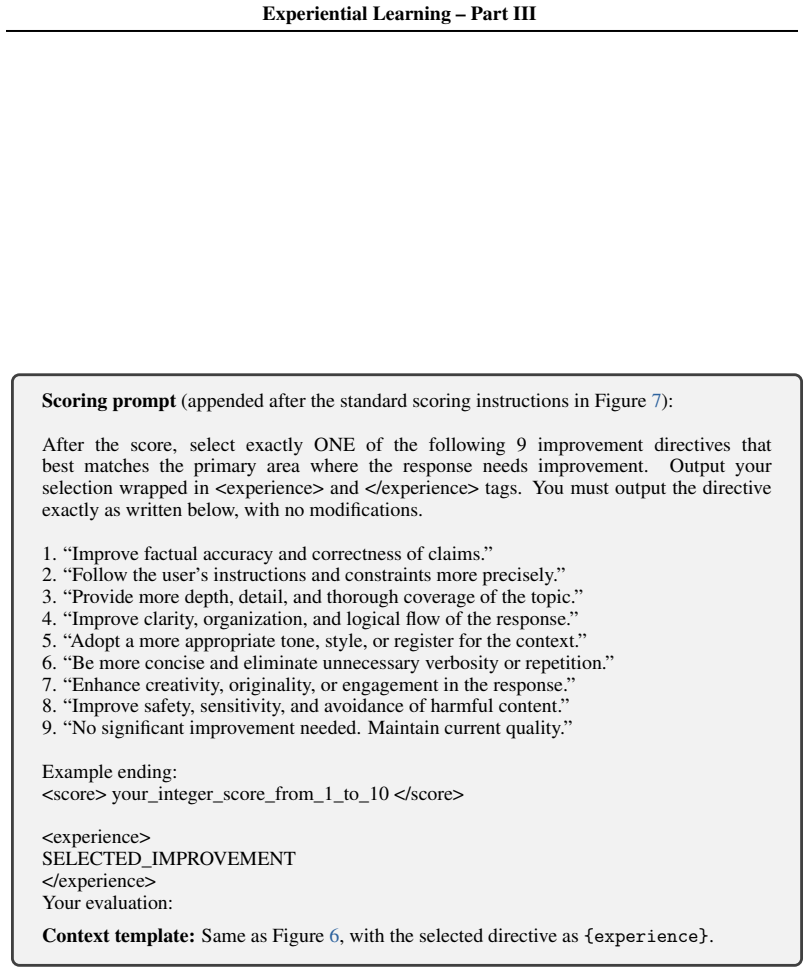
- [§3.4, Table 4 and Appendix A.2] The Multiple-Choice ablation lists 9 directives, but the text says '10 context choices' because the empty option is counted. Clarify this in the main paper, not just in the appendix.
- [Eq. (2)] The notation DKL(πθ(·|x, y<t) ∥ π_teacher(·|e, x, y<t)) is clear, but consider adding a brief remark that the teacher is also conditioned on previous student tokens, to avoid confusion with the teacher's unconditional distribution.
- [§1, Figure 1 caption] Figure 1 says 'over 5,000× the bandwidth of a scalar reward' and the text also mentions 'over 1,000×' relative to bf16. This is consistent, but the visual may mislead; consider labeling both comparisons explicitly.
Circularity Check
No significant circularity; the derivation is self-contained and the central claim is an empirical comparison against external benchmarks.
full rationale
The paper's central claim is an empirical comparison: EL (reverse-KL distillation toward a coach-conditioned teacher, Eq. 2) outperforms rubric-based RL (GRPO on a scalar reward, Eq. 1) on held-out and unseen open-ended tasks. No parameter in Eq. (2) is fitted to the benchmarks used for the comparison; the coach is either the frozen policy itself or GPT-4o, and the teacher is a policy checkpoint, with no fitted coefficients. The toy distribution-matching analysis in §3.5 explicitly labels the 'distributional guidance' arm as 'an idealized proxy for EL' and disclaims that it is 'not intended as a faithful simulation of the full RL and EL training pipelines, nor as a proof of a fundamental limitation shared by all scalar-reward methods' — this is a stated illustration rather than a load-bearing derivation, and its limitations are acknowledged in the text. The paper invokes several prior works by the same authors ([YDW+26] for on-policy context distillation, [YDD+26] as Part II, [MWZ+26, LL25] for OPD teachers), but the core method is defined directly in Eq. (2) and Algorithm 1, and the empirical advantage does not rest on the truth of those citations; they are implemented building blocks, not evidence for the headline result. The only load-bearing external validation is the claim that a 'stronger proprietary evaluator' showed 'consistent relative trends' (§3.1); this is an unreported external cross-check, which is a measurement-reporting weakness rather than circularity, since GPT-4o judging EL outputs trained using GPT-4o as coach is a possible confound, not a definitional reduction of the result into its inputs. No equation in the paper reduces to a fitted value, no prediction is derived from a fitted parameter, and no uniqueness argument is imported from self-citations. The comparison is externally benchmarked (AlpacaEval-v2, WildBench, ArenaHard, CreativeWritingV3), so the claim has independent grounding even if the evaluation protocol has statistical weaknesses.
Axiom & Free-Parameter Ledger
free parameters (5)
- Training hyperparameters (lr=1e-6, batch 256, 8 rollouts, 3 epochs) =
lr=1e-6, batch=256, rollouts=8, epochs=3
- Reverse-KL top-256 token truncation =
top 256 tokens, unnormalized
- Tulu3 mixing ratio for iterative teacher =
1:0.25 WildChat:Tulu3
- Bandwidth example context length and vocabulary size =
L=1024, |V|=150,000
- Checkpoint selection =
top-3 by evaluation score
axioms (5)
- domain assumption GPT-4o rubric-conditioned judgments are a valid, unbiased measure of response quality for both RL and EL outputs.
- domain assumption Experiential knowledge extracted by the coach carries usable transferable supervision, and the teacher distribution π_teacher(·|e,x) is a good training target.
- domain assumption The initial frozen policy checkpoint is an appropriate teacher for on-policy context distillation.
- domain assumption Reverse KL over the top-256 tokens is a sufficient surrogate for full token-level divergence.
- domain assumption WildChat-IF and Tulu3 SFT mixtures adequately represent non-verifiable open-ended instruction tasks.
invented entities (1)
-
Experiential knowledge
no independent evidence
read the original abstract
Reinforcement learning (RL) on open-ended tasks compresses an LLM's rubric-based evaluation into a scalar reward, discarding rich textual feedback and conflating responses with distinct quality profiles. We propose Experiential Learning (EL), which repurposes the feedback model from an LLM-as-a-Judge into an LLM-as-a-Coach. The coach distills its assessment of each on-policy response into transferable experiential knowledge, which conditions a teacher model and is internalized by the policy through on-policy context distillation. Compared with scalar rewards, this higher-bandwidth feedback channel provides dense supervision and preserves fine-grained preferences among high-quality responses. Across two policy families, with feedback from the policy itself or a proprietary model, EL consistently outperforms rubric-based RL on held-out and unseen open-ended tasks. Notably, EL generalizes better beyond the training distribution, and mitigates reward hacking. These findings establish experiential knowledge as a richer and more generalizable learning signal for post-training on non-verifiable tasks.
Figures




Forward citations
Cited by 1 Pith paper
-
Flux-OPD: On-Policy Distillation with Evolving Contexts
Evolving contexts improve open-ended on-policy distillation when injected as conflict-weighted corrections into a stable context-free teacher rather than used as direct targets.
Reference graph
Works this paper leans on
-
[1]
arXiv preprint arXiv:2507.19457 , year=
Gepa: Reflective prompt evolution can outperform reinforcement learning , author=. arXiv preprint arXiv:2507.19457 , year=
-
[2]
Textgrad: Automatic" differentiation" via text , author=. arXiv preprint arXiv:2406.07496 , year=
-
[3]
arXiv preprint arXiv:2511.07919 , year=
Feedback descent: Open-ended text optimization via pairwise comparison , author=. arXiv preprint arXiv:2511.07919 , year=
-
[4]
arXiv preprint arXiv:2506.03106 , year=
Critique-grpo: Advancing llm reasoning with natural language and numerical feedback , author=. arXiv preprint arXiv:2506.03106 , year=
-
[5]
arXiv preprint arXiv:2603.10165 , year=
Openclaw-rl: Train any agent simply by talking , author=. arXiv preprint arXiv:2603.10165 , year=
-
[6]
arXiv preprint arXiv:2602.12125 , year=
Learning beyond teacher: Generalized on-policy distillation with reward extrapolation , author=. arXiv preprint arXiv:2602.12125 , year=
-
[7]
Advances in neural information processing systems , volume=
Reflexion: Language agents with verbal reinforcement learning , author=. Advances in neural information processing systems , volume=
-
[8]
Proceedings of the AAAI Conference on Artificial Intelligence , volume=
Expel: Llm agents are experiential learners , author=. Proceedings of the AAAI Conference on Artificial Intelligence , volume=
-
[9]
arXiv preprint arXiv:2510.08558 , year=
Agent learning via early experience , author=. arXiv preprint arXiv:2510.08558 , year=
-
[10]
Google AI , volume=
Welcome to the era of experience , author=. Google AI , volume=
-
[11]
arXiv preprint arXiv:2603.16856 , year=
Online experiential learning for language models , author=. arXiv preprint arXiv:2603.16856 , year=
-
[12]
arXiv preprint arXiv:2606.11627 , year=
When Context Returns: Toward Robust Internalization in On-Policy Distillation , author=. arXiv preprint arXiv:2606.11627 , year=
-
[13]
arXiv preprint arXiv:2606.26790 , year=
OPID: On-Policy Skill Distillation for Agentic Reinforcement Learning , author=. arXiv preprint arXiv:2606.26790 , year=
-
[14]
arXiv preprint arXiv:2605.10781 , year=
Rebellious student: Reversing teacher signals for reasoning exploration with self-distilled rlvr , author=. arXiv preprint arXiv:2605.10781 , year=
-
[15]
arXiv preprint arXiv:2604.17535 , year=
Opsdl: On-policy self-distillation for long-context language models , author=. arXiv preprint arXiv:2604.17535 , year=
-
[16]
arXiv preprint arXiv:2604.24005 , year=
Tcod: Exploring temporal curriculum in on-policy distillation for multi-turn autonomous agents , author=. arXiv preprint arXiv:2604.24005 , year=
-
[17]
arXiv preprint arXiv:2605.07725 , year=
Sod: Step-wise on-policy distillation for small language model agents , author=. arXiv preprint arXiv:2605.07725 , year=
-
[18]
arXiv preprint arXiv:2603.11178 , year=
PACED: Distillation and on-policy self-distillation at the frontier of student competence , author=. arXiv preprint arXiv:2603.11178 , year=
-
[19]
arXiv preprint arXiv:2603.05433 , year=
Crisp: Compressed reasoning via iterative self-policy distillation , author=. arXiv preprint arXiv:2603.05433 , year=
-
[20]
arXiv preprint arXiv:2604.01193 , year=
Embarrassingly simple self-distillation improves code generation , author=. arXiv preprint arXiv:2604.01193 , year=
-
[21]
arXiv preprint arXiv:2603.24472 , year=
Why Does Self-Distillation (Sometimes) Degrade the Reasoning Capability of LLMs? , author=. arXiv preprint arXiv:2603.24472 , year=
-
[22]
arXiv preprint arXiv:2604.02288 , year=
Unifying group-relative and self-distillation policy optimization via sample routing , author=. arXiv preprint arXiv:2604.02288 , year=
-
[23]
arXiv preprint arXiv:2604.10674 , year=
Skill-sd: Skill-conditioned self-distillation for multi-turn llm agents , author=. arXiv preprint arXiv:2604.10674 , year=
-
[24]
arXiv preprint arXiv:2604.03128 , year=
Self-distilled rlvr , author=. arXiv preprint arXiv:2604.03128 , year=
-
[25]
ICML 2026 Workshop on Foundations of Deep Generative Models: Understanding Memorization, Generalization, and Reasoning , year=
Rethinking On-Policy Distillation of Large Language Models: Phenomenology, Mechanism, and Recipe , author=. ICML 2026 Workshop on Foundations of Deep Generative Models: Understanding Memorization, Generalization, and Reasoning , year=
2026
-
[26]
Continual Adaptation at Scale: Towards Sustainable AI Workshop , year=
Aligning Language Models from User Interactions , author=. Continual Adaptation at Scale: Towards Sustainable AI Workshop , year=
-
[27]
Proceedings of the 2023 conference on empirical methods in natural language processing , pages=
G-eval: NLG evaluation using gpt-4 with better human alignment , author=. Proceedings of the 2023 conference on empirical methods in natural language processing , pages=
2023
-
[28]
Advances in neural information processing systems , volume=
Judging llm-as-a-judge with mt-bench and chatbot arena , author=. Advances in neural information processing systems , volume=
-
[29]
arXiv preprint arXiv:2606.30406 , year=
MOPD: Multi-Teacher On-Policy Distillation for Capability Integration in LLM Post-Training , author=. arXiv preprint arXiv:2606.30406 , year=
-
[30]
arXiv preprint arXiv:2606.19327 , year=
Rethinking Reward Supervision: Rubric-Conditioned Self-Distillation , author=. arXiv preprint arXiv:2606.19327 , year=
-
[31]
arXiv preprint arXiv:2606.12507 , year=
Rubric-Guided Self-Distillation: Post-Training Without Rubric Verifiers , author=. arXiv preprint arXiv:2606.12507 , year=
-
[32]
arXiv preprint arXiv:2602.12275 , year=
On-Policy Context Distillation for Language Models , author=. arXiv preprint arXiv:2602.12275 , year=
-
[33]
Advances in Neural Information Processing Systems , volume=
Reward reasoning models , author=. Advances in Neural Information Processing Systems , volume=
-
[34]
arXiv preprint arXiv:2408.11791 , year=
Critique-out-loud reward models , author=. arXiv preprint arXiv:2408.11791 , year=
-
[35]
Eq-bench creative writing benchmark v3 , author=
-
[36]
Forty-second International Conference on Machine Learning , year=
From Crowdsourced Data to High-quality Benchmarks: Arena-Hard and Benchbuilder Pipeline , author=. Forty-second International Conference on Machine Learning , year=
-
[37]
The Thirteenth International Conference on Learning Representations , year=
WildBench: Benchmarking LLMs with Challenging Tasks from Real Users in the Wild , author=. The Thirteenth International Conference on Learning Representations , year=
-
[38]
Alpacaeval: An automatic evaluator of instruction-following models , author=
-
[39]
NeurIPS 2025 Workshop on Efficient Reasoning , year=
Rubrics as Rewards: Reinforcement Learning Beyond Verifiable Domains , author=. NeurIPS 2025 Workshop on Efficient Reasoning , year=
2025
-
[40]
arXiv preprint arXiv:2411.15124 , year=
Tulu 3: Pushing frontiers in open language model post-training , author=. arXiv preprint arXiv:2411.15124 , year=
-
[41]
The Twelfth International Conference on Learning Representations , year=
WildChat: 1M ChatGPT Interaction Logs in the Wild , author=. The Twelfth International Conference on Learning Representations , year=
-
[42]
arXiv preprint arXiv:2512.13961 , year=
Olmo 3 , author=. arXiv preprint arXiv:2512.13961 , year=
-
[43]
First Workshop on Foundations of Reasoning in Language Models , year=
Language Models That Think, Chat Better , author=. First Workshop on Foundations of Reasoning in Language Models , year=
-
[44]
arXiv preprint arXiv:2603.04597 , year=
Bootstrapping exploration with group-level natural language feedback in reinforcement learning , author=. arXiv preprint arXiv:2603.04597 , year=
-
[45]
Findings of the Association for Computational Linguistics: ACL 2025 , pages=
Infiniteicl: Breaking the limit of context window size via long short-term memory transformation , author=. Findings of the Association for Computational Linguistics: ACL 2025 , pages=
2025
-
[46]
Complex & Intelligent Systems , volume=
ETHOS: a multi-label hate speech detection dataset , author=. Complex & Intelligent Systems , volume=. 2022 , publisher=
2022
-
[47]
A Survey on In-context Learning
Dong, Qingxiu and Li, Lei and Dai, Damai and Zheng, Ce and Ma, Jingyuan and Li, Rui and Xia, Heming and Xu, Jingjing and Wu, Zhiyong and Chang, Baobao and Sun, Xu and Li, Lei and Sui, Zhifang. A Survey on In-context Learning. Proceedings of the 2024 Conference on Empirical Methods in Natural Language Processing. 2024. doi:10.18653/v1/2024.emnlp-main.64
-
[48]
HateCheck: Functional tests for hate speech detection models , author=. Proceedings of the 59th annual meeting of the association for computational linguistics and the 11th international joint conference on natural language processing (volume 1: long papers) , pages=
-
[49]
Findings of the association for computational linguistics: EMNLP 2020 , pages=
TweetEval: Unified benchmark and comparative evaluation for tweet classification , author=. Findings of the association for computational linguistics: EMNLP 2020 , pages=
2020
-
[50]
Conference on health, inference, and learning , pages=
Medmcqa: A large-scale multi-subject multi-choice dataset for medical domain question answering , author=. Conference on health, inference, and learning , pages=. 2022 , organization=
2022
-
[51]
arXiv preprint arXiv:2505.09666 , year=
System Prompt Optimization with Meta-Learning , author=. arXiv preprint arXiv:2505.09666 , year=
-
[52]
arXiv preprint arXiv:2510.18874 , year=
Retaining by doing: The role of on-policy data in mitigating forgetting , author=. arXiv preprint arXiv:2510.18874 , year=
-
[53]
arXiv preprint arXiv:2509.04259 , year=
Rl's razor: Why online reinforcement learning forgets less , author=. arXiv preprint arXiv:2509.04259 , year=
-
[54]
arXiv preprint arXiv:2311.07911 , year=
Instruction-following evaluation for large language models , author=. arXiv preprint arXiv:2311.07911 , year=
-
[55]
arXiv preprint arXiv:2503.14476 , year=
Dapo: An open-source llm reinforcement learning system at scale , author=. arXiv preprint arXiv:2503.14476 , year=
-
[56]
arXiv preprint arXiv:2509.25052 , year=
Cogito, Ergo Ludo: An Agent that Learns to Play by Reasoning and Planning , author=. arXiv preprint arXiv:2509.25052 , year=
-
[57]
arXiv preprint arXiv:2504.11442 , year=
TextArena , author=. arXiv preprint arXiv:2504.11442 , year=
-
[58]
arXiv preprint arXiv:2510.01857 , year=
Learning a Dense Reasoning Reward Model from Expert Demonstration via Inverse Reinforcement Learning , author=. arXiv preprint arXiv:2510.01857 , year=
-
[59]
Advances in neural information processing systems , volume=
Generative adversarial imitation learning , author=. Advances in neural information processing systems , volume=
-
[60]
2024 , journal =
HybridFlow: A Flexible and Efficient RLHF Framework , author =. 2024 , journal =
2024
-
[61]
arXiv preprint arXiv:2501.12948 , year=
Deepseek-r1: Incentivizing reasoning capability in llms via reinforcement learning , author=. arXiv preprint arXiv:2501.12948 , year=
-
[62]
arXiv preprint arXiv:2502.03387 , year=
Limo: Less is more for reasoning , author=. arXiv preprint arXiv:2502.03387 , year=
-
[63]
arXiv preprint arXiv:2506.04178 , year=
OpenThoughts: Data Recipes for Reasoning Models , author=. arXiv preprint arXiv:2506.04178 , year=
-
[64]
Proceedings of the 2025 Conference on Empirical Methods in Natural Language Processing , pages=
s1: Simple test-time scaling , author=. Proceedings of the 2025 Conference on Empirical Methods in Natural Language Processing , pages=
2025
-
[65]
arXiv preprint arXiv:2507.06261 , year=
Gemini 2.5: Pushing the frontier with advanced reasoning, multimodality, long context, and next generation agentic capabilities , author=. arXiv preprint arXiv:2507.06261 , year=
-
[66]
International conference on machine learning , pages=
Trust region policy optimization , author=. International conference on machine learning , pages=. 2015 , organization=
2015
-
[67]
1998 , publisher=
Reinforcement learning: An introduction , author=. 1998 , publisher=
1998
-
[68]
arXiv preprint arXiv:2508.05629 , year=
On the generalization of sft: A reinforcement learning perspective with reward rectification , author=. arXiv preprint arXiv:2508.05629 , year=
-
[69]
arXiv e-prints , pages=
Knowledge distillation of black-box large language models , author=. arXiv e-prints , pages=
-
[70]
arXiv preprint arXiv:2412.19437 , year=
Deepseek-v3 technical report , author=. arXiv preprint arXiv:2412.19437 , year=
-
[71]
arXiv preprint arXiv:2505.09388 , year=
Qwen3 technical report , author=. arXiv preprint arXiv:2505.09388 , year=
-
[72]
The twelfth international conference on learning representations , year=
On-policy distillation of language models: Learning from self-generated mistakes , author=. The twelfth international conference on learning representations , year=
-
[73]
arXiv preprint arXiv:2402.03300 , year=
Deepseekmath: Pushing the limits of mathematical reasoning in open language models , author=. arXiv preprint arXiv:2402.03300 , year=
-
[74]
the method of paired comparisons , author=
Rank analysis of incomplete block designs: I. the method of paired comparisons , author=. Biometrika , volume=. 1952 , publisher=
1952
-
[75]
Proceedings of the AAAI conference on artificial intelligence , volume=
Seqgan: Sequence generative adversarial nets with policy gradient , author=. Proceedings of the AAAI conference on artificial intelligence , volume=
-
[76]
Advances in neural information processing systems , volume=
Generative adversarial nets , author=. Advances in neural information processing systems , volume=
-
[77]
arXiv preprint arXiv:2501.17161 , year=
Sft memorizes, rl generalizes: A comparative study of foundation model post-training , author=. arXiv preprint arXiv:2501.17161 , year=
-
[78]
arXiv preprint arXiv:2407.21783 , year=
The llama 3 herd of models , author=. arXiv preprint arXiv:2407.21783 , year=
-
[79]
An Yang and Baosong Yang and Beichen Zhang and Binyuan Hui and Bo Zheng and Bowen Yu and Li Chengyuan and Dayiheng Liu and Fei Huang and Haoran Wei and others , year=
-
[80]
Introducing GPT-5 , url =
discussion (0)
Sign in with ORCID, Apple, or X to comment. Anyone can read and Pith papers without signing in.