REVIEW 2 major objections 1 minor 2 cited by
Rubric-conditioned self-distillation converts criterion-level rubrics into token-level guidance on student trajectories for reasoning models.
Reviewed by Pith at T0; open to challenge. T0 means a machine referee read the full paper against a public rubric. the ladder, T0–T4 →
T0 review · grok-4.3
2026-06-26 21:12 UTC pith:RA254SOW
load-bearing objection The paper's two-stage rubric pipeline adds a plausible way to turn criteria into token-level signals for self-distillation, but the abstract's thin evidence on the 1-point gains makes it hard to judge if the method actually improves reliability over GRPO or OPSD. the 2 major comments →
Rethinking Reward Supervision: Rubric-Conditioned Self-Distillation
The pith
A machine-rendered reading of the paper's core claim, the machinery that carries it, and where it could break.
Core claim
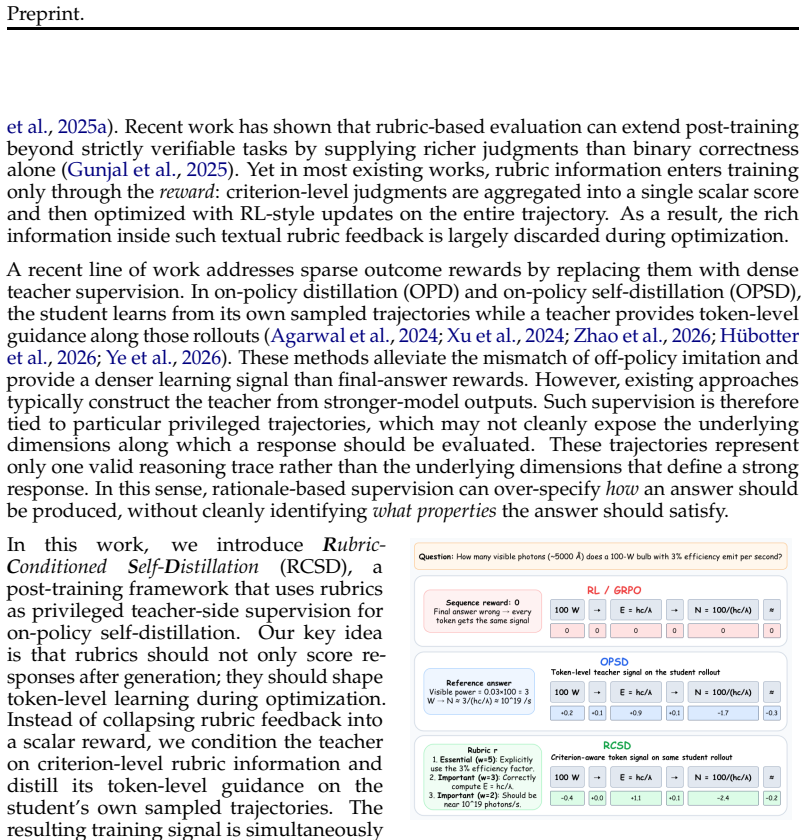
Rubric-Conditioned Self-Distillation incorporates rubrics as structured, fine-grained feedback for on-policy self-distillation. The teacher model is conditioned on criterion-level rubrics and supplies token-level guidance on the student's sampled trajectories. This avoids treating any single reference rationale as the sole supervision target and supplies more precise signals than scalar reward optimization.
What carries the argument
Rubric-conditioned teacher that supplies token-level guidance on student trajectories from criterion-level rubrics
Load-bearing premise
Conditioning the teacher on criterion-level rubrics produces reliable, unbiased token-level guidance on the student's trajectories without the rubrics themselves adding new noise or bias.
What would settle it
Measure performance on the same science reasoning benchmarks after deliberately supplying incomplete or biased rubrics to the teacher and check whether scores fall below the GRPO baseline.
If this is right
- Rubric-level criteria become usable as token-level supervision without requiring complete reference rationales.
- Credit assignment over the reasoning process becomes finer-grained than scalar reward signals allow.
- The two-stage pipeline separates rubric generation from rubric-guided reasoning training.
- On-policy self-distillation avoids off-policy distribution shift from fixed reference answers.
Where Pith is reading between the lines
- The approach may reduce sensitivity to rationale quality in existing distillation datasets if rubrics can be generated independently.
- Token-level rubric guidance could be tested for compatibility with verifiable outcome rewards in a combined objective.
- Task-specific rubric generation might transfer to non-science domains if the first stage generalizes beyond the evaluated benchmarks.
Editorial analysis
A structured set of objections, weighed in public.
Referee Report
Summary. The paper proposes Rubric-Conditioned Self-Distillation, a two-stage framework for post-training reasoning LMs. Stage one trains a model to generate task-specific rubrics; stage two conditions a teacher on those rubrics to supply token-level guidance over the student's on-policy trajectories. This is positioned as avoiding noisy single-reference CoT targets and the information loss of scalar rewards. On a suite of science reasoning benchmarks the method is reported to outperform GRPO by 1.0 points and OPSD by 0.9 points on average.
Significance. If the empirical claims hold after proper controls, the work supplies a concrete mechanism for converting criterion-level rubrics into per-token credit assignment, which could be a useful middle ground between pure RLVR and expensive rationale distillation. No machine-checked proofs, parameter-free derivations, or open reproducible artifacts are described.
major comments (2)
- [Abstract / two-stage pipeline] Abstract (framework description): the central claim that rubric-conditioned token-level guidance is more reliable than scalar rewards or single rationales depends on the generated rubrics being neutral and complete. Because rubric generation is itself a learned process from the same model family, any systematic omissions or stylistic biases become part of the conditioning context; the manuscript provides no external validation, inter-annotator agreement, or ablation that isolates rubric quality from the final performance gain.
- [Abstract] Abstract (experimental claims): average improvements of +1.0 over GRPO and +0.9 over OPSD are stated without reference to dataset sizes, number of runs, error bars, or statistical tests. These quantities are load-bearing for any claim of superiority; their absence prevents evaluation of whether the reported margins are robust.
minor comments (1)
- [Abstract] The abstract refers to "a diverse suite of science reasoning benchmarks" but does not name them or cite the exact evaluation protocol; this should be expanded in the main text for reproducibility.
Simulated Author's Rebuttal
We thank the referee for the constructive feedback on the framework and experimental reporting. We address the major comments point by point below, indicating where revisions will be made.
read point-by-point responses
-
Referee: [Abstract / two-stage pipeline] Abstract (framework description): the central claim that rubric-conditioned token-level guidance is more reliable than scalar rewards or single rationales depends on the generated rubrics being neutral and complete. Because rubric generation is itself a learned process from the same model family, any systematic omissions or stylistic biases become part of the conditioning context; the manuscript provides no external validation, inter-annotator agreement, or ablation that isolates rubric quality from the final performance gain.
Authors: We agree that rubric quality is central to the reliability of the token-level guidance and that learned rubric generation from the same model family could introduce biases. The two-stage pipeline is intended to produce task-specific criteria that guide credit assignment more granularly than scalar rewards. The original manuscript does not include external validation or inter-annotator agreement. In revision we will add an ablation that varies rubric quality (e.g., human-written vs. model-generated) and a limitations paragraph discussing potential stylistic biases. revision: yes
-
Referee: [Abstract] Abstract (experimental claims): average improvements of +1.0 over GRPO and +0.9 over OPSD are stated without reference to dataset sizes, number of runs, error bars, or statistical tests. These quantities are load-bearing for any claim of superiority; their absence prevents evaluation of whether the reported margins are robust.
Authors: The reported averages aggregate performance across the science reasoning benchmarks detailed in the experimental section. The manuscript does not currently report the number of runs, error bars, or statistical tests. In the revised version we will expand the experimental section to include these details (dataset sizes, number of evaluation seeds, standard deviations, and significance tests where appropriate) so that the margins can be properly assessed. revision: yes
Circularity Check
No circularity: empirical claims rest on benchmark comparisons, not derivations or self-referential fits
full rationale
The paper describes a two-stage empirical pipeline (rubric generation followed by rubric-conditioned distillation) and reports average gains of 1.0 and 0.9 points over GRPO and OPSD on science reasoning benchmarks. No equations, first-principles derivations, fitted parameters renamed as predictions, or load-bearing self-citations appear in the abstract or described framework. The central claim is an empirical performance result obtained by training and evaluating models; it does not reduce by construction to any internal definition or input. The assumption that generated rubrics supply neutral guidance is an untested modeling choice, not a circular reduction. This is the expected finding for a purely empirical methods paper with no mathematical derivation chain.
Axiom & Free-Parameter Ledger
axioms (1)
- domain assumption Teacher models can be conditioned on rubrics to produce accurate token-level guidance
read the original abstract
Post-training of reasoning language models is commonly driven by supervised distillation and reinforcement learning with verifiable rewards. Distillation often relies on chain-of-thought annotations that are expensive to obtain and may themselves be noisy, incomplete, or partially incorrect; even when the final solution is correct, an imperfect rationale can interfere with learning. Reinforcement learning with verified rewards, on the other hand, typically compresses evaluative feedback into a scalar signal, obscuring which aspects of a response should be improved. We propose \textbf{Rubric-Conditioned Self-Distillation}, a framework that incorporates rubrics as structured, fine-grained feedback for on-policy self-distillation. Our method conditions the teacher model on criterion-level rubrics and uses it to provide token-level guidance on the student's own sampled trajectories. This design avoids treating a single reference rationale as the sole supervision target. Instead, rubrics specify what a strong response should satisfy, enabling more fine-grained credit assignment over the reasoning process than scalar reward optimization. We instantiate this framework with a two-stage pipeline that first learns to generate task-specific rubrics and then trains a rubric-guided reasoner. We evaluate on a diverse suite of science reasoning benchmarks and results show that rubric-conditioned self-distillation effectively converts rubric-level criteria into token-level guidance over the reasoning process, surpassing GRPO by 1.0 points and OPSD by 0.9 points on average.
Figures


Forward citations
Cited by 2 Pith papers
-
LLM-as-a-Coach: Experiential Learning for Non-Verifiable Tasks
Training a language model by distilling a coach's written experiential knowledge beats training on a scalar rubric score for open-ended tasks, with better out-of-distribution transfer.
-
Recursive Self-Improvement in AI: From Bounded Self-Refinement to Autonomous Research Loops
A survey of 1,250 papers organizes AI self-improvement along two axes—what is improved and loop closure—finding that demonstrated self-improvement strength tracks a verification hierarchy from formal verifiers down to...
Reference graph
Works this paper leans on
-
[1]
Bose-Einstein Derivation(5): Essential Criteria: The response must clearly derive the Bose-Einstein distribution formula for phonon occupation number n(ω) using the given dispersion relationω(k) =ck
-
[2]
Temperature Dependence(4): Important Criteria: The response should correctly ex- press the temperature dependence ofn(ω) as n(ω) = 1/(e¯hω/kT− 1), demonstrating the exponential dependence on temperature and frequency
-
[3]
Frequency-Dependent Behavior(5): Essential Criteria: The response must explicitly explain how the occupation number n(ω) changes with temperature for different ω values, emphasizing the inverse relationship betweenn(ω)and temperature
-
[4]
Physical Interpretation(4): Important Criteria: The response should include a clear explanation of the physical meaning of the Bose-Einstein distribution in the context of phonon statistics and thermal equilibrium
-
[5]
High/Low Temperature Behavior(3): Optional Criteria: The response may include a brief discussion on the behavior of n(ω) at high and low temperatures, such as the classical limit or zero-point energy effects
-
[6]
Frequency Dependence Omission(-1): Negative Criteria: The response must not omit the dependence of the occupation number on the frequencyω, as this is a critical aspect of the temperature dependence
-
[7]
Temperature Independence Error(-1): Negative Criteria: The response must not incorrectly state that the occupation number is independent of temperature, which would contradict the Bose-Einstein distribution
-
[8]
Dispersion Relation Usage(4): Important Criteria: The response should correctly use the dispersion relation ω(k) =ck to connect the phonon frequency with wavevector kin the derivation
-
[9]
Bose-Einstein Application(4): Important Criteria: The response must demonstrate the correct application of Bose-Einstein statistics to phonons, including the proper handling of the occupation number formula
-
[10]
19 Preprint
Frequency-Temperature Interaction(3): Optional Criteria: The response may include a clear explanation of how the occupation number changes with frequency for different temperature values, enhancing the understanding of the system. 19 Preprint. Soda-Lime Titration Example
-
[11]
Mass Conversion(5): Essential Criteria: The response must accurately convert the mass of soda lime to the masses of NaOH and CaO components using the given percentages
-
[12]
Mole Calculation(5): Essential Criteria: The response must correctly compute the moles of NaOH and CaO from their respective masses using their molar masses
-
[13]
Reaction Equations(4): Important Criteria: The response should accurately identify and write the balanced chemical equations for the neutralization reactions of NaOH and CaO with HCl
-
[14]
Stoichiometric Ratio(4): Important Criteria: The response must correctly apply stoichiometric ratios from the balanced equations to relate moles of NaOH and CaO to moles of HCl required for neutralization
-
[15]
Total Moles Calculation(5): Essential Criteria: The response should correctly calcu- late the total moles of HCl required by summing the moles from both NaOH and CaO neutralization steps
-
[16]
Volume Calculation(5): Essential Criteria: The response must accurately determine the volume of 0.500M HCl needed using the total moles and the given molarity, converting to the correct units
-
[17]
Step-by-Step Explanation(4): Important Criteria: The response should present a clear, step-by-step explanation of the calculation process for both NaOH and CaO neutralization, ensuring logical flow
-
[18]
Application Context(3): Optional Criteria: The response may include a brief dis- cussion of the significance of the neutralization reactions in real-world applications, though it is not required
-
[19]
Component Omission(-1): Negative Criteria: The response must not omit the neutralization of either NaOH or CaO components, as both are required for accurate calculation
-
[20]
Reference Rubrics (RaR-Science) Phonon / Bose–Einstein Example
Molar Mass Accuracy(-1): Negative Criteria: The response must not use incorrect molar masses for NaOH or CaO, as this would lead to wrong results. Reference Rubrics (RaR-Science) Phonon / Bose–Einstein Example
-
[21]
Bose-Einstein Distribution(5): Essential Criteria: The response must explicitly state and correctly use the Bose-Einstein distribution formula for n(ω), such as n(ω) =1/(exp(¯hω/(k BT))−1), linkingωandTin the derivation
-
[22]
Dispersion Relation Use(4): Important Criteria: The answer should correctly in- corporate the given dispersion relation ω(k) =ck to connect the frequency ω to the wave vectorkin the context of the phonon system
-
[23]
Temperature Analysis(5): Essential Criteria: The response must analyze how the phonon occupation number n(ω) varies with temperature for a fixed frequency and explain differences in behavior at variousωvalues
-
[24]
Mathematical Derivation(4): Important Criteria: The answer should include clear and logically structured derivations that break down the mathematical steps required to arrive at the temperature dependence ofn(ω)
-
[25]
Frequency Trends(3): Optional Criteria: The response may provide a concrete example or detailed explanation illustrating that at lower frequencies the occupation number is more sensitive to changes in temperature than at higher frequencies
-
[26]
Clarity and Conciseness(3): Optional Criteria: The answer should be clear and concise, avoiding unnecessary elaboration while still covering all key elements of the derivation and conclusion
-
[27]
Soda-Lime Titration Example 20 Preprint
Exclusion of Loss Effects(-1): Pitfall Criteria: The response should not include irrelevant factors such as frictional or damping losses, which are not part of the ideal derivation using Bose-Einstein statistics. Soda-Lime Titration Example 20 Preprint
-
[28]
Separate Reactions(5): Essential Criteria: The response must separately address the neutralization reactions for both NaOH and CaO components, calculating the moles of acid required for each reaction
-
[29]
Stoichiometry Accuracy(5): Essential Criteria: The answer should correctly apply stoichiometric relationships to determine the moles of HCl needed for the complete neutralization of both compounds
-
[30]
Molarity Application(4): Important Criteria: The response must demonstrate how the molarity of 0.500M HCl is used to convert the required moles of acid into the corresponding volume in cm3 with proper unit conversions
-
[31]
Step-by-Step Work(4): Important Criteria: The answer should provide a clear, logical sequence of calculations that lead to the final volume, ensuring transparency in each intermediary step
-
[32]
Final Volume Accuracy(5): Essential Criteria: The response must explicitly state the correct final volume of 0.500M HCl required (133.04 cm3) for complete neutralization
-
[33]
Unit Consistency(2): Optional Criteria: The explanation should include correct unit conversions, especially showing how volumes are converted (e.g., L to cm3), to enhance clarity and precision
-
[34]
Failure analysis.These examples illustrate two recurring weaknesses of the learned rubrics relative to the reference rubrics
Reaction Assumptions(-2): Pitfall Criteria: The response should mention that the reactions are assumed to go to completion without interference, and neglecting to state such assumptions is a common oversight. Failure analysis.These examples illustrate two recurring weaknesses of the learned rubrics relative to the reference rubrics. First, the learned rub...
discussion (0)
Sign in with ORCID, Apple, or X to comment. Anyone can read and Pith papers without signing in.