REVIEW 3 major objections 5 minor 69 references
This paper computes, for the first time, the complete emission spectrum of massive vector (Proca) fields from spinning Kerr black holes, giving polarization-resolved greybody factors and the resulting mass and spin loss rates.
Reviewed by Pith at T0; open to challenge. T0 means a machine referee read the full paper against a public rubric. the ladder, T0–T4 →
T0 review · deepseek-v4-flash
2026-08-01 15:31 UTC pith:H5BKJFQM
load-bearing objection First credible Proca Hawking spectra for Kerr; the physics is likely right, but App. A's flux normalization and missing convergence tests need referee pressure before the numbers are taken as final. the 3 major comments →
Hawking emission of massive vector fields by Kerr black holes
The pith
A machine-rendered reading of the paper's core claim, the machinery that carries it, and where it could break.
Core claim
The paper claims to determine, for the first time, the gravitational emission of massive vector fields by Kerr black holes without restricting spin or field mass. Using a separation of variables that reduces the Proca equation to coupled radial and angular equations, it computes the absorption probability for each (l, m) mode and each of the three polarizations (S = -1, 0, +1) across the full spin range and for masses up to Mμ around 3. The resulting greybody factors reproduce the known massless limits—massless vector for the two transverse polarizations and a scalar for the longitudinal one—and show that the longitudinal mode dominates emission for slowly spinning black holes, the transvers
What carries the argument
The load-bearing object is the separation of the Proca equation on the Kerr background through a polarization tensor built from the spacetime's principal tensor, which reduces the field to coupled radial and angular equations with an angular eigenvalue ν. The numerical pipeline solves the angular equation as a spectral problem for ν, integrates the radial equation outward from the horizon with purely ingoing boundary conditions, and matches to plane-wave form at large radius to extract transmission coefficients; the energy fluxes come from the full Proca stress tensor, yielding the absorption probability Γ_lmS and the emission spectrum.
Load-bearing premise
The flux decomposition assumes the asymptotic ingoing and outgoing energy fluxes are correctly separated by matching the numerical solution to plane waves with the stated normalizations, and a normalization error in the longitudinal mode's divergent prefactor would shift every finite-mass greybody factor and loss function.
What would settle it
Integrate the radial equation for the S = +1 mode at very small Mμ and verify numerically that |R_in|^2 scales to cancel the (μ^2/ν^2 + 1) divergence as μ → 0; if the cancellation fails, the claimed massless-scalar limit is wrong. Alternatively, recompute the loss functions with a higher spectral truncation (kmax > 17) or a different matching radius and check whether the ~7% superradiant peak moves by more than the stated tolerance.
If this is right
- The evaporation rates of Kerr black holes into massive spin-1 particles (W/Z bosons, effectively massive gluons) can now be computed, refining predictions for primordial black hole lifetimes and spin evolution.
- The standard criterion that a black hole only emits particles with mass below its temperature breaks down for rapid rotation: efficient emission persists to μ/T_H of order 100 near extremality.
- Superradiant amplification for massive vectors exceeds the massless vector case, reaching ~7% for the S = -1 polarization near extremality, which alters the spin-down history.
- The mass and spin loss functions differ from the massless vector case because the longitudinal polarization adds a mass-loss channel while spin extraction stays similar, so massive vectors change both the evaporation rate and the spin evolution of rotating holes.
- The scalar and transverse polarization modes contribute differently as spin grows, so the total spectrum cannot be approximated by scaling a single massless result.
Where Pith is reading between the lines
- The same separation-and-flux machinery could be extended to massive spin-2 fields or to charged rotating black holes, where longitudinal modes might show analogous mass-dependent amplification.
- The finding that near-extremal black holes emit particles with μ much larger than the black-hole temperature suggests that heavy Standard Model or beyond-Standard-Model particles could appear in primordial black hole burst signals, changing the expected photon-to-neutrino ratios.
- The massless limit for the S = +1 mode relies on a divergent prefactor that the paper does not cancel analytically; an independent analytic check of that limit would determine whether the claimed scalar-mode spectrum is exact or only numerically approximate.
- One could test the computed greybody factors by comparing the superradiant amplification curve against independent semi-analytic approximations for massive vectors, or against the known massless vector result after lifting the mass cutoff.
Editorial analysis
A structured set of objections, weighed in public.
Referee Report
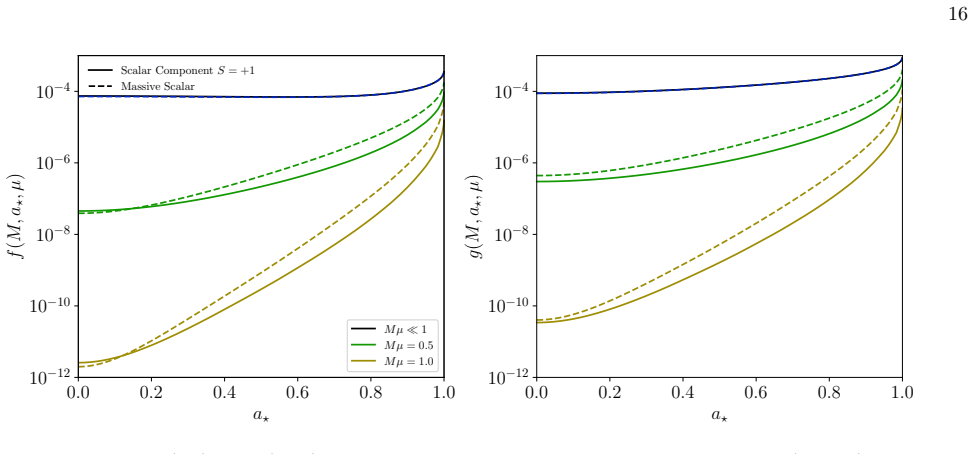
Summary. The paper presents a numerical computation of the greybody factors, Hawking emission spectra, and Page mass/spin-loss functions for a massive vector (Proca) field on a Kerr black hole background. The authors use the FKKS-Dolan separation of variables, solving the angular eigenvalue problem in a spherical-harmonic basis with a truncation and the radial equation by shooting from the horizon to a large matching radius, then extract transmission coefficients from the asymptotic wave amplitudes. They validate their framework by recovering massless Maxwell results for the two transverse polarizations and massless scalar results for the longitudinal polarization in the Mμ → 0 limit, and then present results for finite masses, including polarization-dependent superradiant amplification (with maximum ~7% for the S = −1 mode near extremality), a modified Boltzmann-suppression criterion at high spin, and a comparison of the scalar Proca component with a free massive scalar. The central claim is that this is the first complete computation of Proca Hawking emission from Kerr black holes.
Significance. If correct, this work fills a genuine gap in the literature: no previous computation of Proca Hawking emission from Kerr existed, despite the relevance for primordial black hole evaporation into massive Standard Model vectors (W, Z) and effectively massive gluons. The paper provides the first polarization-resolved greybody factors, spectra, and Page functions for massive spin-1 fields, and uncovers a qualitatively new feature—enhanced superradiant amplification for one vector polarization—that is physically interesting. The numerical framework is benchmarked against known massless results (Page/Teukolsky-Press for Maxwell, massless scalar limits) and against a massive scalar computation in App. C, which are strong consistency checks. However, the central mapping from the radial amplitudes to physical energy fluxes (App. A) is under-derived, and no convergence study is presented for the truncation and matching parameters. The quantitative claims therefore require additional verification before the results can be regarded as definitive.
major comments (3)
- [App. A, Eqs. (A17)–(A22)] The derivation of the flux formula is load-bearing and incomplete. The step from Eq. (A19) to Eq. (A22) asserts that |D0R|^2 - |D†0R|^2 evaluates on the asymptotic solution (34) to a common prefactor (pω/2)(μ²/ν²+1) multiplying both |R_in|^2 and |R_out|^2. This is not demonstrated: the definitions/actions of D0 and D†0 on e^{±ipr}, the constants C±, and the fate of the ν→0 limit for S=+1 (where μ²/ν² diverges) are not given. Although the prefactor cancels in Eq. (38), the equality of the ingoing/outgoing prefactors is exactly what converts |R_out|²/|R_in|² into a physical absorption probability. Please provide the explicit asymptotic evaluation and a direct numerical check of Eq. (A22) by integrating the full energy-momentum tensor for representative (ω, μ, a*) for each polarization.
- [Sec. III, angular and radial truncation] The numerical results depend on several controlled truncation parameters—kmax=17 in the angular matrix (16), integration start x=10^-3, matching at xmax with α≈100, and the S=0 branch continuation in μ—but no convergence tests or error estimates are reported. Since the central claims (the ~7% superradiant amplification, the Page functions, and the μ/TH ~ 100 emission window) are quantitative, the paper must show that eigenvalues, Γ_lmS, and the Page functions (41) are stable under varying kmax, α, x_start, and l_max. Please add a convergence study, including the tolerance in the determinant root-finding and the ODE integrator.
- [Sec. IV, Eq. (41)] The Page functions f and g are defined in Eq. (41) without the 1/(2π) factor that appears in the spectrum Eq. (39) and without the usual normalization factors (e.g., f = -M² dM/dt in Page's convention). If Eq. (41) is meant to represent the standard Page functions, the normalization is inconsistent with Eq. (39); if it is a different dimensionless rate, this should be stated explicitly. The comparisons in Figs. 7 and 8 and in App. C depend on this normalization, so the definition needs clarification.
minor comments (5)
- [Eq. (14)] The expansion S(θ) = Σ b_k Y^m_l(θ,ϕ) is notationally inconsistent: the ϕ-dependence has already been factored out in Eq. (9), so the expansion should be in Y^m_l(θ,0) (or in spherical harmonics without ϕ).
- [Eq. (39)] The value of l_min is not specified in the text immediately after Eq. (39). State explicitly that l_min = 0 for S=+1 and l_min = 1 for S=-1,0.
- [Sec. IV, ymax definition] The expression ymax = Mμ - 1.5 log(1-a*) is confusing because log(1-a*) is negative for a* < 1; presumably the intended quantity is Mμ + 1.5|log(1-a*)|. Please clarify.
- [Captions of Figs. 10 and 11] Typo: 'funciton' should be 'function' in both captions.
- [Eqs. (20)–(24)] The notation λ^s is used for spin-weighted spheroidal eigenvalues but s is not defined for the scalar case; define the spin parameter s explicitly.
Circularity Check
No significant circularity; core computation is self-contained and externally benchmarked.
full rationale
The paper's central claim is a numerical computation of Proca greybody factors and Hawking spectra: the angular eigenvalues are obtained by solving det M = 0 (Sec. III A), the radial equation (28) is integrated from the horizon with the purely ingoing boundary condition (32), and the asymptotic coefficients R_in/R_out are read off from (34). The greybody factor (38) is then the standard ratio 1 - |R_out|^2/|R_in|^2, and the spectra (39) and Page functions (41) are formed from this Gamma with no fitted parameters. The only potentially delicate step is the flux-to-asymptotic-amplitude mapping in App. A: Eq. (A22) equates dE/dt|infinity to (p omega/2)(1 + mu^2/nu^2)(|R_in|^2 - |R_out|^2), with normalization constants C_+/- not fully specified. This is a load-bearing assumption whose verification would strengthen the paper (and the S=+1 massless-limit prefactor needs explicit cancellation), but it is a correctness/robustness concern, not a circular reduction: the predicted spectra are not inserted into their own derivation, and no fitted parameter is renamed as a prediction. Self-citations ([22-24,26,28,63]) appear as introductory motivation or as corroboration alongside external benchmarks (Page, Teukolsky-Press, Schwarzschild results); they do not carry the argument. The massless vector limit is checked against Page's Maxwell results and the scalar channel against the massless scalar equation, providing independent anchors. Accordingly, no step in the claimed derivation chain reduces by construction to its inputs.
Axiom & Free-Parameter Ledger
free parameters (3)
- xmax matching coefficient α =
α ≈ 100
- angular truncation order kmax =
kmax = 17
- mass continuation step for S=0 branch
axioms (4)
- domain assumption FKKS-Dolan (LFKKS ansatz) separation of Proca on Kerr: Eqs. (6)-(11) reduce the Proca equation to coupled radial/angular ODEs.
- domain assumption Semi-classical Hawking emission formula, Eq. (39): d²N/dωdt = (1/2π) Σ Γ/(e^{(ω−mΩ)/TH}−1), with greybody factors from the scattering problem.
- domain assumption The three polarization branches S = −1, 0, +1 identified by parity and allowed l (Tab. I) exhaust the physical transverse and longitudinal modes.
- ad hoc to paper Numerical convergence: kmax = 17 truncation, integration from x = 10^-3, matching at xmax = α(2−τ)^(1/3)/(r+p)^(2/3) with α ≈ 100, give converged eigenvalues and greybody factors.
read the original abstract
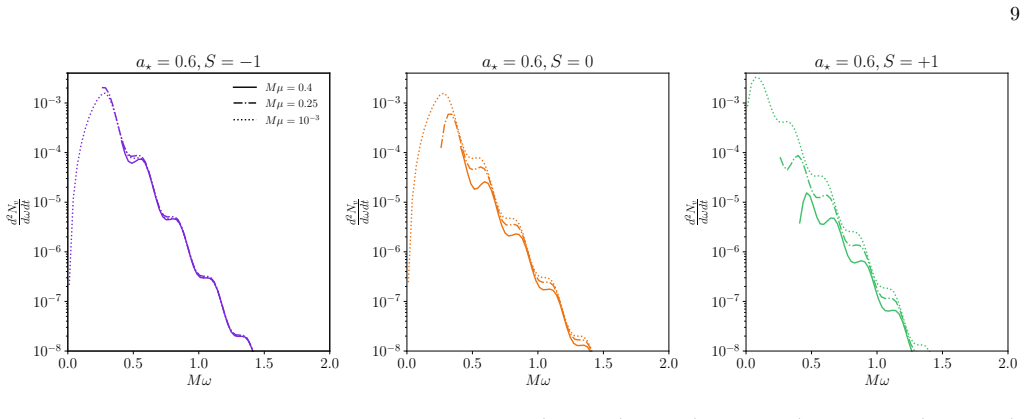
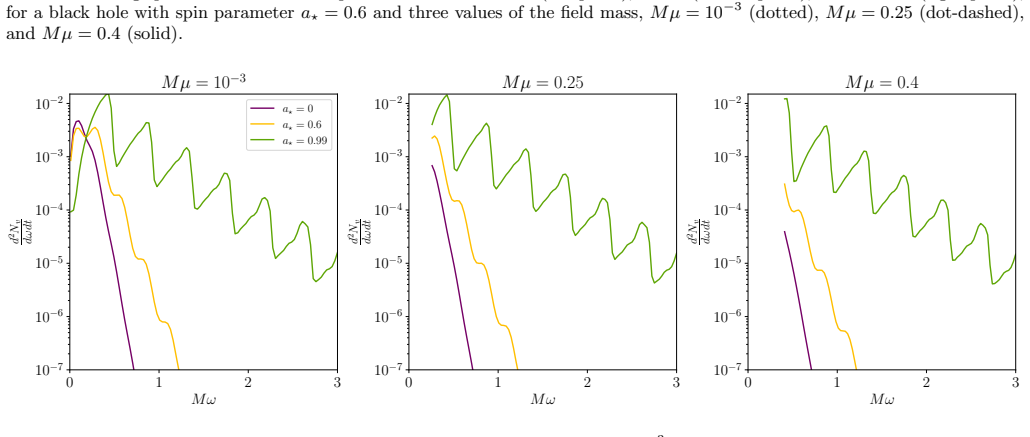
We compute, for the first time, the Hawking emission spectrum of massive vector (Proca) fields by spinning Kerr black holes, determining the associated greybody factors and the resulting mass and spin loss functions. We show, in particular, that the scalar (longitudinal) polarization of the Proca field has a spectrum approaching that of a free scalar field in the massless limit (in which it becomes a pure gauge mode), although we find substantial differences for finite mass. The contribution of the two vector (transverse) polarization modes coincides, as expected, with the one obtained by Page for the Maxwell field in the massless limit. The black hole's evaporation rate is dominated by the scalar mode for slowly spinning black holes and by the two vector modes as the black hole approaches extremality. As for other fields, we find that Proca Hawking emission is Boltzmann-suppressed for Hawking temperatures $T_H\lesssim |\mu-\Omega_H|$, where $\mu$ is the field mass and $\Omega_H$ is the angular velocity of the black hole's horizon. This implies that highly spinning black holes can efficiently emit massive vector fields at temperatures parametrically below the field's mass. Finally, we also find that superradiant emission is more pronounced for massive vector fields, with a maximum amplification factor of $\simeq 7\%$ (compared to $\simeq 4\%$ for massless photons).
Figures





Reference graph
Works this paper leans on
-
[1]
Massless and Schwarzschild limits In order to identify the different polarization branches and construct suitable initial guesses for the numerical solver, it is useful to consider both the massless and Schwarzschild limits of the angular eigenvalue problem. In the massless limit, the angular eigenvalues associated with the vector-type polarizations can b...
-
[2]
Energy flux and transmission coefficients The greybody factors can be obtained by considering a scattering problem. Specifically, one sends a wave from spatial infinity towards the black hole and determines the fractions that are reflected back to infinity and transmit- ted through the potential barrier into the event horizon. By time-reversal symmetry, t...
arXiv 2025
-
[3]
S. W. Hawking, Commun. Math. Phys.43, 199 (1975), [Erratum: Commun.Math.Phys. 46, 206 (1976)]
1975
-
[4]
B. Carr, A. J. Iovino, G. Perna, V. Vaskonen, and H. Veerm¨ ae, Riv. Nuovo Cim.49, 225 (2026), arXiv:2601.06024 [astro-ph.CO]
arXiv 2026
-
[5]
A. Escriv` a, F. Kuhnel, and Y. Tada, (2022), 10.1016/B978-0-32-395636-9.00012-8, arXiv:2211.05767 [astro-ph.CO]
Pith/arXiv arXiv 2022
-
[6]
S. W. Hawking, Nature248, 30 (1974)
1974
-
[7]
X. Boluna, S. Profumo, J. Bl´ e, and D. Hennings, JCAP 04, 024 (2024), arXiv:2307.06467 [astro-ph.HE]
Pith/arXiv arXiv 2024
-
[8]
T. N. Ukwatta, D. R. Stump, J. T. Linnemann, J. H. MacGibbon, S. S. Marinelli, T. Yapici, and K. Tollefson, Astropart. Phys.80, 90 (2016), arXiv:1510.04372 [astro- ph.HE]
Pith/arXiv arXiv 2016
-
[9]
Albertet al.(HA WC), JCAP04, 026 (2020), arXiv:1911.04356 [astro-ph.HE]
A. Albertet al.(HA WC), JCAP04, 026 (2020), arXiv:1911.04356 [astro-ph.HE]
Pith/arXiv arXiv 2020
-
[10]
Engel, A
K. Engel, A. Peisker, P. Harding, J. Wood, I. Martinez- Castellanos, A. Albert, and K. Tollefson (HA WC), PoS ICRC2019, 516 (2021)
2021
-
[11]
K. L. Engel,All-Sky Search for Very-High-Energy Emis- sion from Primordial Black Holes and Gamma-Ray Bursts with the HA WC Observatory, Ph.D. thesis, Maryland U., College Park (2023)
2023
-
[12]
Aharonianet al.(H.E.S.S.), JCAP04, 040 (2023), arXiv:2303.12855 [astro-ph.HE]
F. Aharonianet al.(H.E.S.S.), JCAP04, 040 (2023), arXiv:2303.12855 [astro-ph.HE]
Pith/arXiv arXiv 2023
-
[13]
Ackermannet al.(Fermi-LAT), Astrophys
M. Ackermannet al.(Fermi-LAT), Astrophys. J.857, 49 (2018), arXiv:1802.00100 [astro-ph.HE]
Pith/arXiv arXiv 2018
-
[14]
C. Yang, S. Wang, M.-L. Zhao, and X. Zhang, JCAP10, 083 (2024), arXiv:2408.10897 [astro-ph.HE]
Pith/arXiv arXiv 2024
-
[15]
Z. Caoet al.(LHAASO), Phys. Rev. Lett.135, 181005 (2025), arXiv:2505.24586 [astro-ph.HE]
arXiv 2025
-
[16]
P. Dave and I. Taboada (IceCube), PoSICRC2019, 863 (2021), arXiv:1908.05403 [astro-ph.HE]
Pith/arXiv arXiv 2021
-
[17]
M. J. Baker, J. Iguaz Juan, A. Symons, and A. Thamm, JHEP06, 042 (2026), arXiv:2512.19603 [hep-ph]
arXiv 2026
-
[18]
M. J. Baker, J. Iguaz Juan, A. Symons, and A. Thamm, Phys. Rev. Lett.136, 061002 (2026), arXiv:2505.22722 [hep-ph]
arXiv 2026
-
[19]
M. J. Baker, J. Iguaz Juan, A. Symons, and A. Thamm, Phys. Rev. Lett.135, 111002 (2025), arXiv:2503.10755 [hep-ph]
arXiv 2025
-
[20]
C. Ewasiuk and S. Profumo, Phys. Rev. D111, 015008 (2025), arXiv:2409.11359 [hep-ph]
Pith/arXiv arXiv 2025
-
[21]
K. Federico and S. Profumo, Phys. Rev. D111, 063006 (2025), arXiv:2411.17038 [hep-ph]
Pith/arXiv arXiv 2025
-
[22]
V. De Romeri, Y. F. Perez-Gonzalez, and A. Tolino, JCAP04, 018 (2025), arXiv:2405.00124 [hep-ph]
Pith/arXiv arXiv 2025
-
[23]
Y. F. Perez-Gonzalez, Phys. Rev. D108, 083014 (2023), arXiv:2307.14408 [astro-ph.HE]
Pith/arXiv arXiv 2023
-
[24]
M. Calz` a and J. G. Rosa, JHEP11, 044 (2025), arXiv:2312.09261 [hep-ph]
Pith/arXiv arXiv 2025
-
[25]
M. Calz` a and J. G. Rosa, JHEP08, 012 (2024), arXiv:2311.12930 [gr-qc]
Pith/arXiv arXiv 2024
-
[26]
M. Calz` a, J. G. Rosa, and F. Serrano, JHEP05, 140 (2024), arXiv:2306.09430 [hep-ph]
Pith/arXiv arXiv 2024
-
[27]
M. J. Baker and A. Thamm, JHEP01, 063 (2023), arXiv:2210.02805 [hep-ph]
Pith/arXiv arXiv 2023
-
[28]
M. Calz` a and J. G. Rosa, JHEP12, 090 (2022), arXiv:2210.06500 [gr-qc]
Pith/arXiv arXiv 2022
-
[29]
M. J. Baker and A. Thamm, SciPost Phys.12, 150 (2022), arXiv:2105.10506 [hep-ph]
Pith/arXiv arXiv 2022
-
[30]
M. Calz` a, J. March-Russell, and J. G. Rosa, Phys. Rev. Lett.133, 261003 (2024), arXiv:2110.13602 [astro-ph.CO]
Pith/arXiv arXiv 2024
-
[31]
A. P. Klipfel and D. I. Kaiser, Phys. Rev. Lett.135, 121003 (2025), arXiv:2503.19227 [hep-ph]
arXiv 2025
-
[32]
A. P. Klipfel, P. Fisher, and D. I. Kaiser, Phys. Rev. D 112, 103007 (2025), arXiv:2506.14041 [astro-ph.CO]
arXiv 2025
-
[33]
L. A. Anchordoqui, F. Halzen, and D. Lust, Phys. Rev. D112, 083034 (2025), arXiv:2505.23414 [hep-ph]
arXiv 2025
-
[34]
L. F. T. Airoldi, G. F. S. Alves, Y. F. Perez-Gonzalez, G. M. Salla, and R. Z. Funchal, Phys. Rev. Lett.136, 041002 (2026), arXiv:2505.24666 [hep-ph]
arXiv 2026
-
[35]
L. F. T. Airoldi, G. F. S. Alves, Y. F. Perez-Gonzalez, G. M. Salla, and R. Z. Funchal, Phys. Rev. D113, 023052 (2026), arXiv:2505.24652 [astro-ph.HE]
arXiv 2026
-
[36]
Y. F. Perez-Gonzalez, Phys. Rev. D111, 083015 (2025), arXiv:2502.04430 [astro-ph.CO]
Pith/arXiv arXiv 2025
-
[37]
A. P. Klipfel and D. I. Kaiser, (2026), arXiv:2605.26204 [hep-ph]
Pith/arXiv arXiv 2026
-
[38]
J. M. Cornwall, Phys. Rev. D26, 1453 (1982)
1982
-
[39]
J. H. MacGibbon and B. R. Webber, Phys. Rev. D41, 3052 (1990)
1990
-
[40]
A. C. Aguilar, D. Binosi, and J. Papavassiliou, Front. Phys. (Beijing)11, 111203 (2016), arXiv:1511.08361 [hep- ph]. 18
Pith/arXiv arXiv 2016
-
[41]
D. V. Gal’tsov, G. V. Pomerantseva, and G. A. Chizhov, Sov. Phys. J.27, 697 (1984)
1984
-
[42]
R. A. Konoplya, Phys. Rev. D73, 024009 (2006), arXiv:gr- qc/0509026
arXiv 2006
-
[43]
R. A. Konoplya, A. Zhidenko, and C. Molina, Phys. Rev. D75, 084004 (2007), arXiv:gr-qc/0602047
Pith/arXiv arXiv 2007
-
[44]
J. G. Rosa and S. R. Dolan, Phys. Rev. D85, 044043 (2012), arXiv:1110.4494 [hep-th]
Pith/arXiv arXiv 2012
-
[45]
C. Herdeiro, M. O. P. Sampaio, and M. Wang, Phys. Rev. D85, 024005 (2012), arXiv:1110.2485 [gr-qc]
Pith/arXiv arXiv 2012
-
[46]
M. Wang, M. O. P. Sampaio, and C. Herdeiro, Phys. Rev. D87, 044011 (2013), arXiv:1212.2197 [gr-qc]
Pith/arXiv arXiv 2013
-
[47]
Herdeiro, M
C. Herdeiro, M. O. P. Sampaio, and M. Wang, Springer Proc. Math. Stat.60, 283 (2014)
2014
-
[48]
Herdeiro, M
C. Herdeiro, M. O. P. Sampaio, and M. Wang, in13th Marcel Grossmann Meeting on Recent Developments in Theoretical and Experimental General Relativity, Astro- physics, and Relativistic Field Theories(2015) pp. 1974– 1976
2015
-
[49]
S. A. Teukolsky, Phys. Rev. Lett.29, 1114 (1972)
1972
-
[50]
S. A. Teukolsky, Astrophys. J.185, 635 (1973)
1973
-
[51]
S. A. Teukolsky and W. H. Press, Astrophys. J.193, 443 (1974)
1974
-
[52]
P. Pani, V. Cardoso, L. Gualtieri, E. Berti, and A. Ishibashi, Phys. Rev. Lett.109, 131102 (2012), arXiv:1209.0465 [gr-qc]
Pith/arXiv arXiv 2012
-
[53]
P. Pani, V. Cardoso, L. Gualtieri, E. Berti, and A. Ishibashi, Phys. Rev. D86, 104017 (2012), arXiv:1209.0773 [gr-qc]
Pith/arXiv arXiv 2012
-
[54]
V. P. Frolov, P. Krtouˇ s, D. Kubizˇ n´ ak, and J. E. Santos, Phys. Rev. Lett.120, 231103 (2018), arXiv:1804.00030 [hep-th]
Pith/arXiv arXiv 2018
-
[55]
S. R. Dolan, Phys. Rev. D98, 104006 (2018), arXiv:1806.01604 [gr-qc]
Pith/arXiv arXiv 2018
-
[56]
J. Percival and S. R. Dolan, Phys. Rev. D102, 104055 (2020), arXiv:2008.10621 [gr-qc]
Pith/arXiv arXiv 2020
-
[57]
K. M. Vispute and R. Karmakar, (2026), arXiv:2606.13217 [gr-qc]
Pith/arXiv arXiv 2026
-
[58]
R. H. Boyer and R. W. Lindquist, J. Math. Phys.8, 265 (1967)
1967
-
[59]
V. P. Frolov, P. Krtous, and D. Kubiznak, Living Rev. Rel.20, 6 (2017), arXiv:1705.05482 [gr-qc]
Pith/arXiv arXiv 2017
-
[60]
V. P. Frolov, P. Krtous, and D. Kubiznak, Phys. Rev. D 97, 104071 (2018), arXiv:1712.08070 [gr-qc]
Pith/arXiv arXiv 2018
-
[61]
Lunin, JHEP12, 138 (2017), arXiv:1708.06766 [hep- th]
O. Lunin, JHEP12, 138 (2017), arXiv:1708.06766 [hep- th]
Pith/arXiv arXiv 2017
-
[62]
P. Krtouˇ s, V. P. Frolov, and D. Kubizˇ n´ ak, Nucl. Phys. B934, 7 (2018), arXiv:1803.02485 [hep-th]
Pith/arXiv arXiv 2018
-
[63]
D. R. Brill, P. L. Chrzanowski, C. Martin Pereira, E. D. Fackerell, and J. R. Ipser, Phys. Rev. D5, 1913 (1972)
1913
-
[64]
F. Hancock and H. Witek, Phys. Rev. D112, 044033 (2025), arXiv:2506.06554 [gr-qc]
Pith/arXiv arXiv 2025
-
[65]
J. G. Rosa, Phys. Rev. D95, 064017 (2017), arXiv:1612.01826 [gr-qc]
Pith/arXiv arXiv 2017
-
[66]
A. Cheek, L. Heurtier, Y. F. Perez-Gonzalez, and J. Turner, Phys. Rev. D105, 015022 (2022), arXiv:2107.00013 [hep-ph]
Pith/arXiv arXiv 2022
-
[67]
W. H. Zurek, Phys. Rev. Lett.49, 1683 (1982)
1982
-
[68]
D. N. Page, Phys. Rev. Lett.50, 1013 (1983)
1983
-
[69]
D. N. Page, JCAP09, 028 (2013), arXiv:1301.4995 [hep- th]
Pith/arXiv arXiv 2013
discussion (0)
Sign in with ORCID, Apple, or X to comment. Anyone can read and Pith papers without signing in.