REVIEW 2 major objections 1 minor 5 cited by
Massive vector fields on Schwarzschild black holes acquire a longitudinal mode and break even-odd parity degeneracy in absorption.
Reviewed by Pith at T0; open to challenge. T0 means a machine referee read the full paper against a public rubric. the ladder, T0–T4 →
T0 review · grok-4.3
2026-06-27 06:23 UTC pith:QDADXUP7
load-bearing objection The paper numerically computes absorption cross sections for massive Proca fields on Schwarzschild, isolating longitudinal modes and even-parity scalar branches that break massless degeneracy, but supplies almost no numerical validation or implementation details. the 2 major comments →
Absorption cross section of a Schwarzschild black hole for a massive vector field
The pith
A machine-rendered reading of the paper's core claim, the machinery that carries it, and where it could break.
Core claim
Working in the FKKS basis, the conserved flux of the normalized Proca field directly yields the usual definitions of absorption cross section in terms of reflection and transmission coefficients. The mass term adds a longitudinal mode and produces a scalar-type branch in the even parity transverse modes, breaking the degeneracy with the odd parity sector that holds for massless fields. These effects are illustrated in the numerically computed transmission and absorption spectra over arbitrary frequencies.
What carries the argument
The FKKS basis decomposition of the Proca field on Schwarzschild spacetime, which separates the field into modes allowing direct computation of reflection and transmission coefficients from conserved flux.
Load-bearing premise
The FKKS basis remains a valid decomposition for the Proca field on Schwarzschild spacetime that permits clean separation into modes whose conserved flux directly yields standard reflection/transmission coefficients.
What would settle it
A direct numerical solution of the Proca wave equation on Schwarzschild for fixed mass and frequency whose computed flux at infinity and horizon fails to reproduce the reflection coefficient obtained from the FKKS mode analysis.
If this is right
- The absorption cross section receives separate contributions from longitudinal and transverse modes.
- Even and odd parity sectors no longer share the same transmission coefficients due to the scalar-type branch.
- Numerical spectra reveal mass-dependent modifications at all frequencies.
- The analysis applies directly to the transmission properties of ultralight vector bosons around black holes.
Where Pith is reading between the lines
- These parity-breaking effects could influence the growth rates of vector boson clouds around rotating black holes.
- Similar mode splitting may appear in the quasinormal mode spectrum of massive vector fields.
- Future calculations could extend this to Kerr black holes to assess observational signatures in gravitational waves.
Editorial analysis
A structured set of objections, weighed in public.
Referee Report
Summary. The manuscript computes the absorption cross section of a Schwarzschild black hole for a massive vector (Proca) field over arbitrary frequencies. Working in the FKKS basis, the authors show that the conserved flux of the normalized field yields the standard definitions of reflection and transmission coefficients, which are then evaluated numerically. They report new mass-induced features, including an additional longitudinal degree of freedom and a scalar-type branch in the even-parity transverse modes that breaks the odd/even parity degeneracy present in the massless case, and illustrate these in the transmission and absorption spectra.
Significance. If the central numerical results hold, the work is significant for studies of ultralight bosonic fields in black hole spacetimes, as it extends the known massless vector absorption spectrum and identifies qualitative changes due to the mass term. The explicit connection between the FKKS decomposition and standard flux-derived coefficients, if verified, would provide a useful technical foundation for related calculations involving massive fields.
major comments (2)
- [Abstract, paragraph on working in the FKKS basis] Abstract, paragraph on working in the FKKS basis: the claim that the FKKS basis yields independent radial equations for the Proca field whose conserved flux directly produces the usual reflection/transmission coefficients requires explicit verification. The mass term can modify asymptotic behavior and potentially couple components, so it is not automatic that the Wronskian or current normalization carries over unchanged from the massless case; this underpins the reported new spectral features.
- [Numerical computation] Numerical results (throughout): no details are given on the integration method, radial grid, convergence tests, error bars, or direct comparison to the known massless vector limit. Without these, the claimed breaking of odd/even degeneracy and the longitudinal-mode contributions cannot be assessed for robustness.
minor comments (1)
- [Abstract] The abstract refers to 'arbitrary frequencies' but does not specify the frequency range actually computed or any analytic limits recovered at low or high frequency.
Simulated Author's Rebuttal
We thank the referee for the careful reading and constructive comments. We address the major points below and will incorporate clarifications and additional material in a revised version.
read point-by-point responses
-
Referee: [Abstract, paragraph on working in the FKKS basis] Abstract, paragraph on working in the FKKS basis: the claim that the FKKS basis yields independent radial equations for the Proca field whose conserved flux directly produces the usual reflection/transmission coefficients requires explicit verification. The mass term can modify asymptotic behavior and potentially couple components, so it is not automatic that the Wronskian or current normalization carries over unchanged from the massless case; this underpins the reported new spectral features.
Authors: We agree that an explicit verification strengthens the foundation. Section 2 of the manuscript derives the decoupled radial equations in the FKKS basis for the massive Proca field and shows that the mass term does not induce mixing between the chosen components; the conserved current is constructed from the Proca Lagrangian and reduces to the standard Wronskian form at both horizons and infinity. To address the concern directly, the revised manuscript will add an appendix that recomputes the asymptotic fluxes including the mass-dependent terms, confirms the absence of cross-component contributions, and verifies that the reflection/transmission coefficients retain their usual definitions. This will make the connection fully explicit. revision: yes
-
Referee: [Numerical computation] Numerical results (throughout): no details are given on the integration method, radial grid, convergence tests, error bars, or direct comparison to the known massless vector limit. Without these, the claimed breaking of odd/even degeneracy and the longitudinal-mode contributions cannot be assessed for robustness.
Authors: We acknowledge that the numerical implementation details were insufficiently documented. The revised manuscript will include a dedicated subsection (likely Section 4.1) specifying the integration technique (a combination of series solutions near the horizon and asymptotic matching at infinity), the radial grid resolution and spacing, convergence criteria with respect to grid size and truncation, estimated numerical errors, and a direct comparison plot of the massive results against the massless vector absorption cross section in the m o0 limit. These additions will allow independent assessment of the reported parity breaking and longitudinal-mode effects. revision: yes
Circularity Check
No significant circularity; derivation is self-contained numerical computation
full rationale
The paper works in the externally defined FKKS basis and shows that the conserved flux of the normalized Proca field yields the standard absorption cross-section formulas in terms of reflection and transmission coefficients. It then performs numerical evaluation over frequencies, highlighting new features from the mass term such as the longitudinal mode and even-parity scalar branch. No steps reduce by construction to fitted inputs, self-definitions, or load-bearing self-citations; the central results follow from direct application of standard flux methods to the decomposed modes without circular reduction.
Axiom & Free-Parameter Ledger
axioms (2)
- domain assumption The Proca field obeys the massive vector wave equation derived from the Proca Lagrangian in Schwarzschild geometry.
- domain assumption The FKKS basis diagonalizes the vector perturbation equations sufficiently to allow independent mode analysis and flux conservation.
read the original abstract
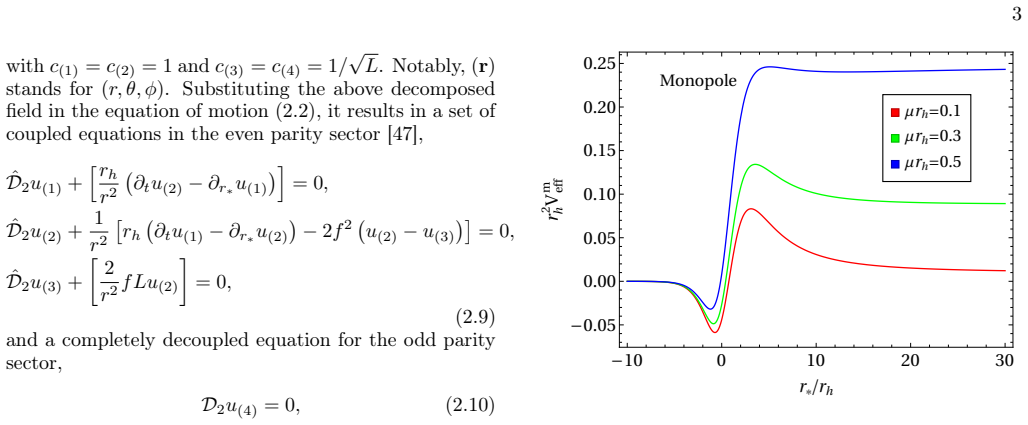
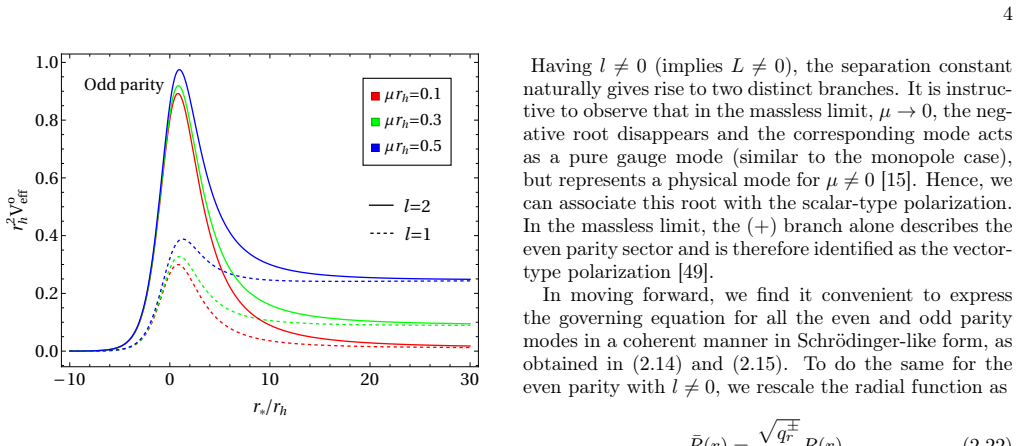
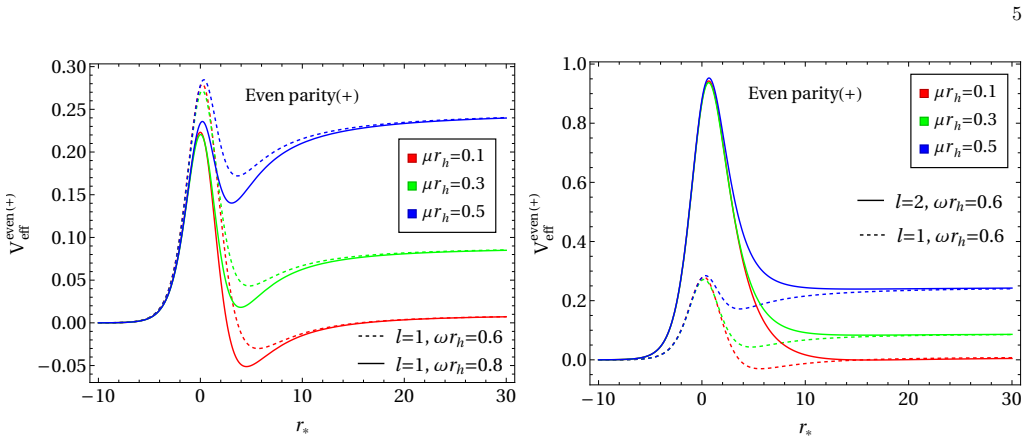
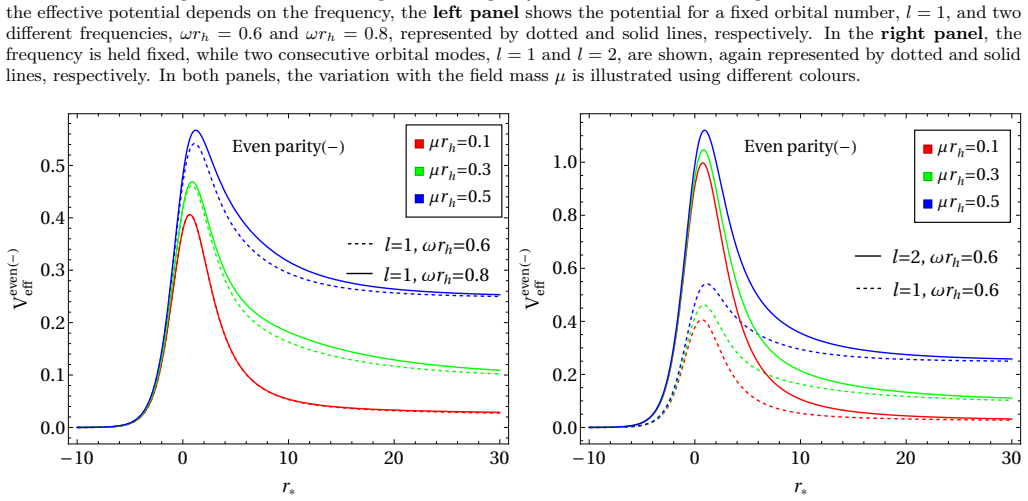
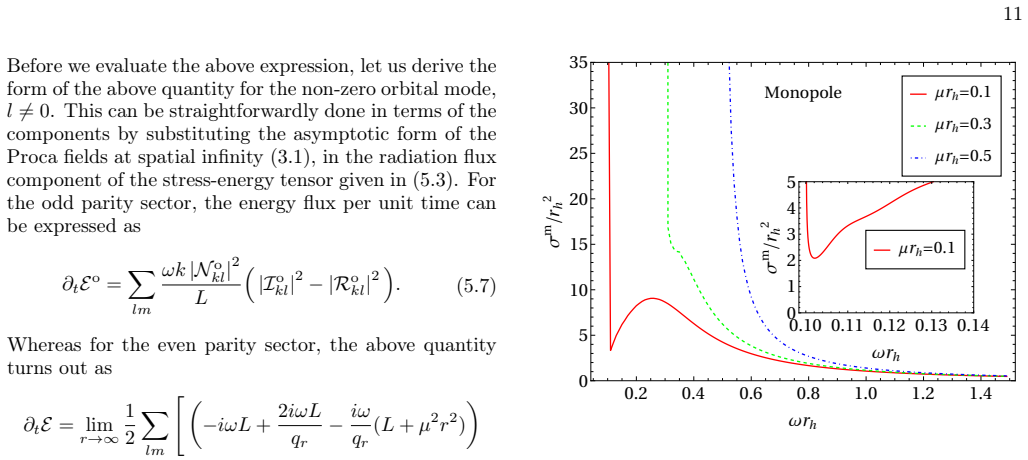
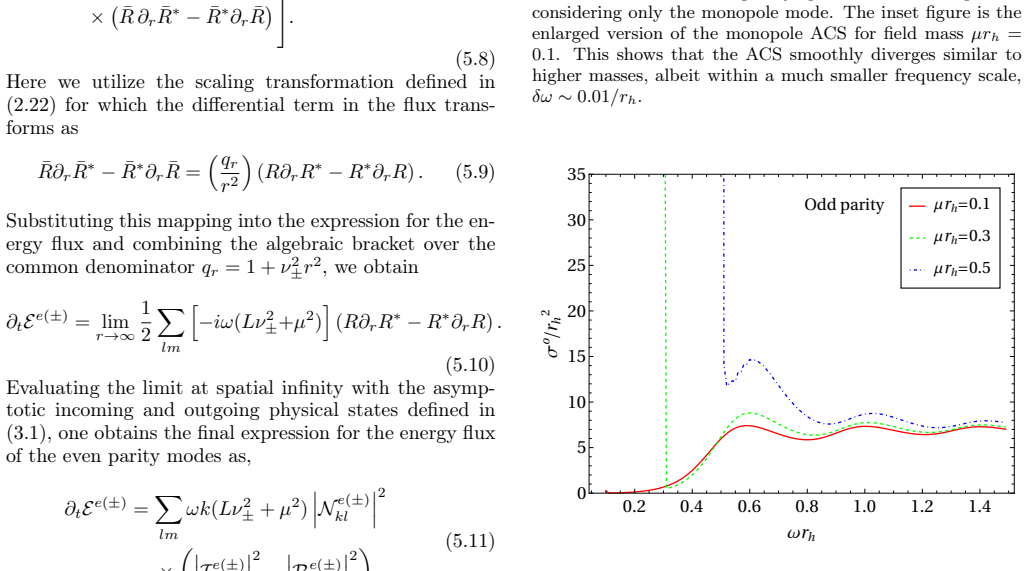
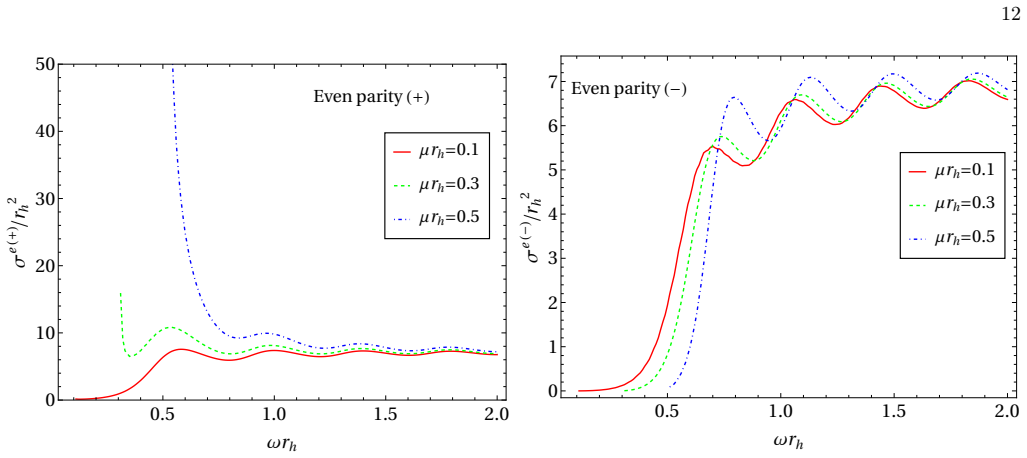
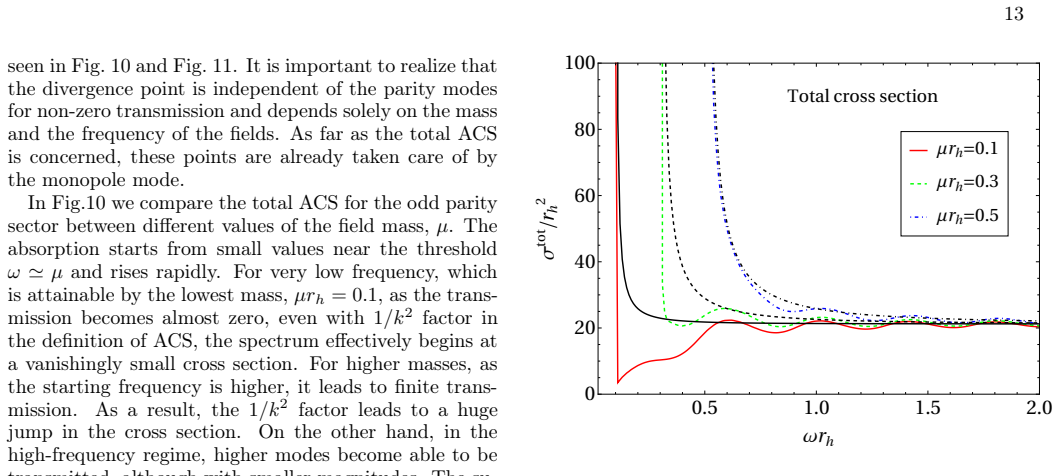
In the present work, we study the absorption cross section of a Schwarzschild black hole for a massive vector field over arbitrary frequencies. Working in the Frolov-Krtou\v{s}-Kubiz\v{n}\'ak-Santos (FKKS) basis, we show how the conserved flux of the normalized Proca field naturally leads to the usual definitions of the absorption cross section in terms of the reflection and transmission coefficients. We then numerically compute these quantities over arbitrary frequencies. In contrast to the massless (photon) case, massive vector bosons exhibit new features arising from the field mass. In particular, the mass term introduces a longitudinal degree of freedom in addition to the transverse modes. Furthermore, it leads to a scalar-type branch in the even parity transverse modes, thereby breaking the usual degeneracy with the odd parity sector found in the massless case. We illustrate how these characteristics manifest themselves in the transmission and absorption spectrum. Given the recent developments in the study of ultralight bosonic fields in black hole spacetimes, the present analysis of the transmission properties of massive vector bosons bears particular significance.
Figures
Forward citations
Cited by 5 Pith papers
-
Hawking emission of massive vector fields by Kerr black holes
First computation of massive vector (Proca) Hawking emission spectra from Kerr black holes, including polarization-dependent greybody factors, Page functions, and mass-enhanced superradiance up to ~7%.
-
Kerr black holes with vector dark matter hair
Massive vector dark matter forms a r^{-3/2} density spike around a Kerr black hole and, for co-rotating low-frequency modes, extracts mass and angular momentum through superradiant scattering.
-
Learning to Balance Motor Thermal Safety and Quadrupedal Locomotion Performance with Residual Policy
A thermal residual policy on a pre-trained quadruped locomotion controller prevents motor overheating under payload while preserving performance, lasting over 13 minutes on a Unitree A1 versus ~5 minutes for the nomin...
-
Learning to Balance Motor Thermal Safety and Quadrupedal Locomotion Performance with Residual Policy
A two-stage RL method adds a residual policy on a thermal model to let a quadruped maintain performance while preventing motor overheating, shown in simulation and on a Unitree A1 carrying 3 kg for over 13 minutes ver...
-
Learning to Balance Motor Thermal Safety and Quadrupedal Locomotion Performance with Residual Policy
A two-stage RL framework with a thermal-aware residual policy enables a Unitree A1 quadruped to achieve over 13 minutes of stable locomotion under 3 kg payload versus 5 minutes before overheating with the nominal poli...
Reference graph
Works this paper leans on
-
[1]
Cosmology in generalized Proca theories
A. De Felice, L. Heisenberg, R. Kase, S. Mukohyama, S. Tsujikawa, and Y.-l. Zhang, JCAP06, 048 (2016), arXiv:1603.05806 [gr-qc]
work page internal anchor Pith review Pith/arXiv arXiv 2016
-
[2]
The Physics of Heavy Z' Gauge Bosons
P. Langacker, Rev. Mod. Phys.81, 1199 (2009), arXiv:0801.1345 [hep-ph]
work page internal anchor Pith review Pith/arXiv arXiv 2009
-
[3]
Dark Sectors and New, Light, Weakly-Coupled Particles
R. Essiget al., inSnowmass 2013: Snowmass on the Mississippi(2013) arXiv:1311.0029 [hep-ph]
work page internal anchor Pith review Pith/arXiv arXiv 2013
- [4]
-
[5]
Light hidden-sector U(1)s in string compactifications
M. Goodsell and A. Ringwald, Fortsch. Phys.58, 716 (2010), arXiv:1002.1840 [hep-th]
work page internal anchor Pith review Pith/arXiv arXiv 2010
-
[6]
A. E. Nelson and J. Scholtz, Phys. Rev. D84, 103501 (2011), arXiv:1105.2812 [hep-ph]
work page internal anchor Pith review Pith/arXiv arXiv 2011
-
[7]
Exploring the String Axiverse with Precision Black Hole Physics
A. Arvanitaki and S. Dubovsky, Phys. Rev. D83, 044026 (2011), arXiv:1004.3558 [hep-th]
work page internal anchor Pith review Pith/arXiv arXiv 2011
-
[8]
B. P. Abbottet al.(LIGO Scientific, Virgo), Phys. Rev. Lett.116, 061102 (2016), arXiv:1602.03837 [gr-qc]
work page internal anchor Pith review Pith/arXiv arXiv 2016
-
[9]
First M87 Event Horizon Telescope Results. I. The Shadow of the Supermassive Black Hole
K. Akiyamaet al.(Event Horizon Telescope), Astrophys. J. Lett.875, L1 (2019), arXiv:1906.11238 [astro-ph.GA]
work page internal anchor Pith review Pith/arXiv arXiv 2019
-
[10]
K. Akiyamaet al.(Event Horizon Telescope), Astrophys. J.Lett.930,L12(2022),arXiv:2311.08680[astro-ph.HE]
work page internal anchor Pith review Pith/arXiv arXiv 2022
-
[11]
The rotation curve of spiral galaxies and its cosmological implications
E. Battaner and E. Florido, Fund. Cosmic Phys.21, 1 (2000), arXiv:astro-ph/0010475
work page internal anchor Pith review Pith/arXiv arXiv 2000
-
[12]
Dynamical constraints on a dark matter spike at the Galactic Centre from stellar orbits
T. Lacroix, Astron. Astrophys.619, A46 (2018), arXiv:1801.01308 [astro-ph.GA]
work page internal anchor Pith review Pith/arXiv arXiv 2018
-
[13]
Z.-Q. Shen, G.-W. Yuan, C.-Z. Jiang, Y.-L. S. Tsai, Q. Yuan, and Y.-Z. Fan, Mon. Not. Roy. Astron. Soc. 527, 3196 (2023), arXiv:2303.09284 [astro-ph.GA]
-
[14]
R. Karmakar, D. Maity, and K. M. Vispute, (2025), arXiv:2512.06807 [gr-qc]
-
[15]
Black-hole hair from vector dark matter accretion
F. Hancock and H. Witek, (2025), arXiv:2506.06554 [gr- qc]
work page internal anchor Pith review Pith/arXiv arXiv 2025
-
[16]
N. Kitajima and K. Nakayama, JCAP07, 014 (2023), arXiv:2303.04287 [hep-ph]
- [17]
-
[18]
D. Traykova, R. Vicente, K. Clough, T. Helfer, E. Berti, P. G. Ferreira, and L. Hui, Phys. Rev. D108, L121502 (2023), arXiv:2305.10492 [gr-qc]
-
[19]
N. Oshita, Phys. Rev. D109, 104028 (2024), arXiv:2309.05725 [gr-qc]
-
[20]
R. A. Konoplya and A. Zhidenko, JCAP09, 068 (2024), arXiv:2406.11694 [gr-qc]
work page internal anchor Pith review Pith/arXiv arXiv 2024
- [21]
-
[22]
N. Oshita and V. Cardoso, Phys. Rev. D111, 104043 (2025), arXiv:2407.02563 [gr-qc]
- [23]
-
[24]
Chandrasekhar and S
S. Chandrasekhar and S. L. Detweiler, Proc. Roy. Soc. Lond. A344, 441 (1975)
1975
-
[25]
T.ReggeandJ.A.Wheeler,Phys.Rev.108,1063(1957)
1957
-
[26]
F. J. Zerilli, Phys. Rev. Lett.24, 737 (1970)
1970
-
[27]
S. A. Teukolsky, Phys. Rev. Lett.29, 1114 (1972)
1972
-
[28]
S. A. Teukolsky, Astrophys. J.185, 635 (1973)
1973
-
[29]
W. H. Press and S. A. Teukolsky, Astrophys. J.185, 649 (1973)
1973
-
[30]
Chandrasekhar, Proc
S. Chandrasekhar, Proc. Roy. Soc. Lond. A343, 289 (1975)
1975
-
[31]
Effect of Scalar Mass in the Absorption and Emission Spectra of Schwarzschild Black Hole
E. Jung and D. K. Park, Class. Quant. Grav.21, 3717 (2004), arXiv:hep-th/0403251
work page internal anchor Pith review Pith/arXiv arXiv 2004
-
[32]
Fermion scattering by a Schwarzschild black hole
S. Dolan, C. Doran, and A. Lasenby, Phys. Rev. D74, 064005 (2006), arXiv:gr-qc/0605031
work page internal anchor Pith review Pith/arXiv arXiv 2006
-
[33]
Fermion absorption cross section of a Schwarzschild black hole
C. Doran, A. Lasenby, S. Dolan, and I. Hinder, Phys. Rev. D71, 124020 (2005), arXiv:gr-qc/0503019
work page internal anchor Pith review Pith/arXiv arXiv 2005
-
[34]
Matsas, Phys
L.C.B.Crispino, E.S.Oliveira, A.Higuchi, andG.E.A. Matsas, Phys. Rev. D75, 104012 (2007)
2007
-
[35]
L. C. B. Crispino, S. R. Dolan, and E. S. Oliveira, Phys. Rev. Lett.102, 231103 (2009), arXiv:0905.3339 [gr-qc]
work page internal anchor Pith review Pith/arXiv arXiv 2009
-
[36]
A. Arbey and J. Auffinger, Eur. Phys. J. C79, 693 (2019), arXiv:1905.04268 [gr-qc]
-
[37]
A. Arbey and J. Auffinger, Eur. Phys. J. C81, 910 (2021), arXiv:2108.02737 [gr-qc]
- [38]
- [39]
-
[40]
Hawking radiation for a Proca field in D-dimensions
C. Herdeiro, M. O. P. Sampaio, and M. Wang, Phys. Rev. D85, 024005 (2012), arXiv:1110.2485 [gr-qc]
work page internal anchor Pith review Pith/arXiv arXiv 2012
-
[41]
D. V. Gal’tsov, G. V. Pomerantseva, and G. A. Chizhov, Sov. Phys. J.27, 697 (1984)
1984
-
[42]
R. A. Konoplya, Phys. Rev. D73, 024009 (2006), arXiv:gr-qc/0509026
work page internal anchor Pith review Pith/arXiv arXiv 2006
-
[43]
J. G. Rosa and S. R. Dolan, Phys. Rev. D85, 044043 (2012), arXiv:1110.4494 [hep-th]
work page internal anchor Pith review Pith/arXiv arXiv 2012
-
[45]
V. P. Frolov, P. Krtouš, D. Kubizňák, and J. E. Santos, Phys. Rev. Lett.120, 231103 (2018), arXiv:1804.00030 [hep-th]
work page internal anchor Pith review Pith/arXiv arXiv 2018
-
[46]
R. Karmakar, Phys. Lett. B870, 139951 (2025), arXiv:2408.05310 [gr-qc]
-
[47]
S. Bunjusuwan and C.-H. Chen, (2025), arXiv:2508.19761 [gr-qc]
work page internal anchor Pith review Pith/arXiv arXiv 2025
-
[48]
Classical electrodynamics,
J. D. Jackson and R. F. Fox, “Classical electrodynamics,” (1999)
1999
-
[49]
T. V. Fernandes, D. Hilditch, J. P. S. Lemos, and V. Car- doso,Phys.Rev.D105,044017(2022),arXiv:2112.03282 18 [gr-qc]
work page Pith review arXiv 2022
-
[50]
X.-H. Ge, M. Matsumoto, and K. Zhang, Phys. Rev. D 112, 046024 (2025), arXiv:2502.15627 [hep-th]
work page Pith review arXiv 2025
-
[51]
L. Hui, D. Kabat, X. Li, L. Santoni, and S. S. C. Wong, JCAP06, 038 (2019), arXiv:1904.12803 [gr-qc]
work page internal anchor Pith review Pith/arXiv arXiv 2019
-
[52]
Sanchez, Physical Review D18, 1030 (1978)
N. Sanchez, Physical Review D18, 1030 (1978)
1978
-
[53]
Quasinormal modes of massive vector fields on the Kerr spacetime
J. Percival and S. R. Dolan, Phys. Rev. D102, 104055 (2020), arXiv:2008.10621 [gr-qc]
work page Pith review arXiv 2020
-
[54]
C. L. Benone and L. C. Crispino, Physical Review D99 (2019), 10.1103/physrevd.99.044009
-
[55]
L. C. S. Leite, S. R. Dolan, and L. C. B. Crispino, Phys. Lett. B774, 130 (2017), arXiv:1707.01144 [gr-qc]
work page internal anchor Pith review Pith/arXiv arXiv 2017
-
[56]
D. N. Page, Phys. Rev. D13, 198 (1976)
1976
-
[57]
C. L. Benone, E. S. de Oliveira, S. R. Dolan, and L. C. B. Crispino, Phys. Rev. D89, 104053 (2014), arXiv:1404.0687 [gr-qc]
work page internal anchor Pith review Pith/arXiv arXiv 2014
-
[58]
Unruh, Physical Review D14, 3251 (1976)
W. Unruh, Physical Review D14, 3251 (1976)
1976
-
[59]
Greiner and J
W. Greiner and J. Reinhardt,Field quantization (Springer Science & Business Media, 2013)
2013
-
[60]
Padmanabhan,Gravitation: foundations and frontiers (Cambridge University Press, 2010)
T. Padmanabhan,Gravitation: foundations and frontiers (Cambridge University Press, 2010)
2010
-
[61]
D. J. Griffiths and D. F. Schroeter,Introduction to quan- tum mechanics(Cambridge university press, 2018)
2018
-
[62]
Abramowitz and I
M. Abramowitz and I. A. Stegun,Handbook of Mathe- matical Functions with Formulas, Graphs, and Mathe- matical Tables, National Bureau of Standards Applied Mathematics Series, Vol. 55 (U.S. Government Printing Office, Washington, D.C., 1964) reprinted by Dover Pub- lications, 1965
1964
-
[63]
V. Cardoso and R. Vicente, Phys. Rev. D100, 084001 (2019), arXiv:1906.10140 [gr-qc]
-
[64]
S. R. Das, G. W. Gibbons, and S. D. Mathur, Phys. Rev. Lett.78, 417 (1997), arXiv:hep-th/9609052
work page internal anchor Pith review Pith/arXiv arXiv 1997
-
[65]
Liao, J.-H
H. Liao, J.-H. Chen, and Y.-J. Wang, Chin. Phys. B21, 080402 (2012)
2012
-
[66]
V. P. Frolov, P. Krtouš, D. Kubizňák, and J. E. San- tos, Physical Review Letters120(2018), 10.1103/phys- revlett.120.231103
-
[67]
Separation of Maxwell equations in Kerr-NUT-(A)dS spacetimes
P. Krtouš, V. P. Frolov, and D. Kubizňák, Nucl. Phys. B934, 7 (2018), arXiv:1803.02485 [hep-th]
work page internal anchor Pith review Pith/arXiv arXiv 2018
- [68]
-
[69]
C. M. Harris and P. Kanti, JHEP10, 014 (2003), arXiv:hep-ph/0309054
work page internal anchor Pith review Pith/arXiv arXiv 2003
- [70]
- [71]
-
[72]
B. E. Taylor, C. M. Chambers, and W. A. Hiscock, Phys. Rev. D58, 044012 (1998), arXiv:gr-qc/9801044
work page internal anchor Pith review Pith/arXiv arXiv 1998
-
[73]
Chandrasekhar,The mathematical theory of black holes(1985)
S. Chandrasekhar,The mathematical theory of black holes(1985)
1985
-
[74]
Goldstein, C
H. Goldstein, C. Poole, and J. Safko,Classical Mechan- ics, Addison-Wesley series in physics (Addison Wesley, 2002)
2002
discussion (0)
Sign in with ORCID, Apple, or X to comment. Anyone can read and Pith papers without signing in.