REVIEW 4 major objections 5 minor 29 references
Fine-tuning small LLMs for cybersecurity QA consistently degrades their vocabulary and parametric knowledge, and the effect depends on the tuning regime.
Reviewed by Pith at T0; open to challenge. T0 means a machine referee read the full paper against a public rubric. the ladder, T0–T4 →
T0 review · deepseek-v4-flash
2026-08-01 14:30 UTC pith:FJGE7L7Q
load-bearing objection Honest pilot with a useful diagnostic framing, but the abstention story is inferred and the n=5 single-run data won't support the screening claims yet. the 4 major comments →
Find Before You Fine-Tune: A Diagnostic Study of Small LLMs for Cybersecurity QA
The pith
A machine-rendered reading of the paper's core claim, the machinery that carries it, and where it could break.
Core claim
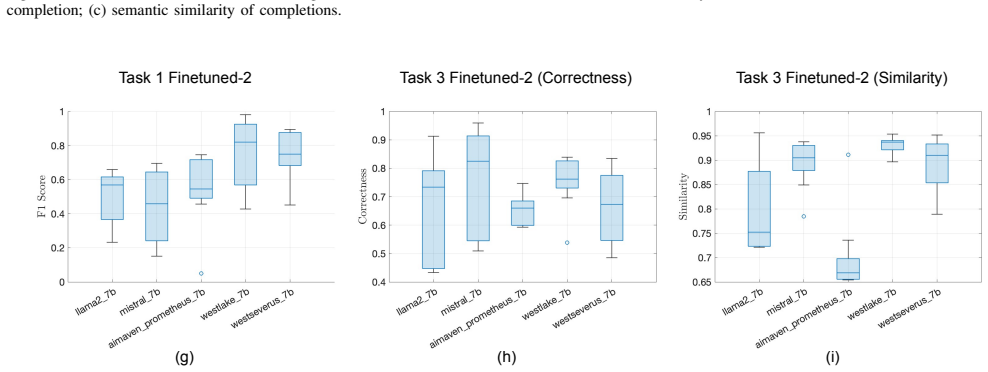
The central discovery is that the effect of fine-tuning on small LLMs for cybersecurity QA is regime-specific but directionally predictable, and that a pre-tuning diagnostic can map it. Across five 7B open-weight models, both fine-tuning regimes lowered keyword-recognition F1 and MCQ accuracy relative to the pre-trained baseline. Knowledge-focused tuning produced moderate, rank-preserving degradation, with a Spearman correlation of 0.70 for knowledge rankings. Instruction-focused tuning, which explicitly trained the model to abstain when uncertain, drove measured MCQ accuracy toward near zero and inverted knowledge rankings (Spearman -0.60), but the paper argues this collapse is abstention r
What carries the argument
The central mechanism is FiT, a task-oriented decomposition of QA suitability into three scores: keyword-recognition F1 (vocabulary), multiple-choice accuracy (parametric knowledge), and a retrieval-augmented completion task scored for answer correctness and semantic similarity (contextualization). The analysis device is Spearman rank correlation between pre-trained and post-tuned scores across the five models, which separates 'rank-preserving degradation' from 'ranking inversion' and thereby makes the regime-specific trade-off visible.
Load-bearing premise
The load-bearing assumption is that the observed differences between pre-trained and fine-tuned models are caused by the fine-tuning regime itself, not by run-to-run variance, distribution shift between training and evaluation data, or the modest dataset sizes, since each regime was run once per model and no significance tests were reported.
What would settle it
A concrete falsifier: run the same two fine-tuning regimes multiple times (e.g., five seeds) on the same five models with the same hyperparameters, and report the distribution of MCQ accuracy and Spearman correlations. If the between-seed variance is comparable to or larger than the observed drops (e.g., a 0.20 accuracy fall) or the Spearman values cross zero across seeds, the directional claims are not supported. Additionally, if an instruction-tuned model with the abstention prompt removed restores MCQ accuracy to pre-trained levels, the abstention interpretation is confirmed; if accuracy st
If this is right
- Practitioners can use pre-tuning FiT scores as a screen: weak models on vocabulary stay weak after tuning, so expensive fine-tuning of those candidates can be avoided.
- If instruction-focused tuning is planned, teams should expect closed-book knowledge scores to collapse through abstention and should evaluate such models in their retrieval-grounded configuration, not on standalone knowledge probes.
- In dynamic, low-data domains like cybersecurity, a well-chosen pre-trained model paired with strong retrieval is often safer than fine-tuning, since fine-tuning degrades parametric capabilities without improving contextual correctness.
- Retrieval-grounded contextualization is robust to fine-tuning, meaning investment in retrieval quality yields more than investment in fine-tuning for answer correctness.
- The FiT diagnosis makes the direction of post-tuning change predictable enough to guide model selection before adaptation cost is paid.
Where Pith is reading between the lines
- If the abstention interpretation is right, an instruction-tuned model's low closed-book MCQ score may actually be a safety feature in RAG deployments; a direct test would be comparing MCQ performance with and without an 'answer even if unsure' prompt.
- The rank-inversion result suggests that leaderboard-style pre-tuning comparison is regime-dependent: a model that looks best before tuning can look worst after instruction tuning, so any model-selection benchmark should specify the downstream adaptation regime.
- Because the semantic-similarity score is near-saturated across all models (around 0.85–0.93), the contextualization measure may need harder or more sensitive test items before it can discriminate among models; the same FiT design at larger scale or with adversarial distractors could test this.
- The single-run, no-significance-test design means the numeric patterns are directional; a replication with multiple seeds and significance testing would establish whether the Spearman values are stable.
Editorial analysis
A structured set of objections, weighed in public.
Referee Report
Summary. FiT (Find before Fine-Tune) is a three-task diagnostic framework: keyword recognition (Task 1), MCQ knowledge (Task 2), and RAG-based contextualization (Task 3). The paper applies it to five 7B open-weight models before and after two QLoRA fine-tuning regimes: knowledge-focused (Finetuned-1, trained on Talos-derived QA pairs) and instruction-focused (Finetuned-2, trained on a split of the Task-3 corpus with abstain instructions). Table II reports consistent drops in Tasks 1 and 2 under both regimes; Finetuned-1 preserves pre-trained rankings (Table IV: ρ=0.60 Task 1, 0.70 Task 2) while Finetuned-2 inverts the knowledge ranking (ρ=-0.60), which the authors interpret as induced abstention. Task 3 scores remain stable across regimes. The paper concludes that pre-adaptation FiT scores can screen models and that a well-chosen pretrained model with RAG is often safer than fine-tuning. Limitations are candidly listed in Section VI.F, including single runs, n=50/100/50 datasets, and no significance tests.
Significance. The paper addresses a real operational problem—model selection before costly fine-tuning—and its task decomposition is sensible and more process-oriented than fixed leaderboards. The metrics in Eqs. (1)–(3) are measured independently of the fine-tuning outcomes, so the study is not circular in the strong sense. The SME validation and the explicit threat-to-validity section are commendable. If the empirical patterns survive additional scrutiny, the distinction between parametric knowledge and retrieval-grounded contextualization, and the regime-dependent trade-off, would be a useful contribution. However, the load-bearing claims currently rest on a small, single-run sample, and the abstention mechanism is inferred rather than observed. The practical guidance in Section VI.E is stronger than the evidence supports.
major comments (4)
- [§V.D, §VI.F, Table IV] Section V.D and Section VI.F state that each fine-tuning regime was run once per model and that no significance tests were performed. These are not just side limitations; they bear directly on RQ2 and RQ3. Section VI.A's 'both fine-tuning regimes degrade ... for every model' and Section VI.B's 'knowledge rankings invert' are causal/directional claims drawn from Table II and Table IV. With one run per condition and n=5 models for the Spearman correlations, the observed ρ values (0.60, 0.70, −0.60) cannot distinguish a stable regime effect from run-to-run variance; the paper itself calls them 'descriptive of direction rather than statistically significant.' Please provide repeated runs (at least 3–5 seeds) with mean±SD or confidence intervals, and either add a permutation test or explicitly withdraw the predictive 'anticipate the direction' conclusion in RQ3 and the abstract.
- [§VI.C, Eq. (2)] The claim that the Finetuned-2 Task-2 collapse is 'abstention, not knowledge loss' is underdetermined by the reported evidence. Eq. (2) scores any non-gold answer as an error; no output-level analysis, abstention counts, or examples are given. The two arguments offered—the training data instructed abstention and Task-3 correctness is retained—do not discriminate. A model that genuinely lost parametric knowledge could still pass Task 3 because the necessary CVE/version facts are supplied in the retrieved context, and Finetuned-2 was trained on a split of the same synthetic Task-3 corpus (Section V.A), so Task-3 retention partly reflects in-distribution overlap. Please report the distribution of Task-2 responses (correct vs. wrong option vs. abstain), and ideally test a Finetuned-2 variant without the abstain instruction. Until then, the 'abstention-driven inversion' and the associated dep
- [§VI.F, §V.A] The Finetuned-1 result is confounded by distribution shift. Task 2 is the MMLU computer-security subset, while Finetuned-1 is trained on QA pairs generated from Cisco Talos. The observed Task-2 drop could be caused by the shift in question style/topic between the training data and the MMLU probe, rather than by fine-tuning-induced degradation of parametric knowledge. To support the 'knowledge-focused tuning causes moderate degradation' claim, please add a knowledge probe matched to the fine-tuning domain (e.g., a held-out set of Talos-style questions) or a control model fine-tuned on unrelated domain data. The current disclosure of this limitation in Section VI.F does not remove the confound from the central claim.
- [§VI.B, Table IV, Conclusion] The RQ3 claim that 'pre-fine-tuning FiT scores anticipate the direction of post-tuning change' is stronger than the data allow. Task 3's row is explicitly not interpretable (the score range is 0.69–0.79), Task 1 correlations are modest, and the Task 2 correlation becomes negative under Finetuned-2. A high pre-trained knowledge score only 'anticipates' the direction if the regime is already known; it does not identify which model will be best. Please rephrase the contribution as a regime-dependent description rather than a predictive screen, or add out-of-sample prediction evidence.
minor comments (5)
- [Table II] The caption says 'TASK3: RAGAS SEMANTIC SIMILARITY (SIM) AND ANSWER CORRECTNESS (COR' with a missing closing parenthesis; also use consistent capitalization ('Task 1', 'Task 2', 'Task 3').
- [Figures 3–5] The captions contain stray subfigure labels and repeated parenthetical items, e.g., '(b) (c)' at the end of Fig. 3's caption and '(d) (b) (c)' in Fig. 4's caption. These appear to be formatting errors and should be cleaned up.
- [Reference [22]] Reference [22] is listed as 'National vulnerability database' but the source is Cisco Talos. The title appears to be a copy-paste error from the NIST reference and should be corrected.
- [§VI.D] The phrase 'range0.69–0.79' is missing a space after 'range'; this should read 'range 0.69–0.79'.
- [§I] The claim that FiT is 'the first framework' to diagnose small LLM suitability before adaptation is not fully supported by the related-work discussion. The authors should clarify what 'first' means relative to benchmarks like CYBERBENCH and how FiT differs beyond reporting static performance.
Circularity Check
No significant circularity; empirical diagnostics are independent of the post-tuning outcomes.
full rationale
The paper's derivation chain is empirical rather than definitional. FiT scores are defined independently (Eq. 1 keyword F1, Eq. 2 MCQ accuracy, Eq. 3 RAGAS against SME references) and measured before and after fine-tuning; no parameter is fitted to the outcome being predicted. The rank correlations in Table IV are descriptive in-sample statistics explicitly flagged as non-significant over five models ('the Spearman values in Table IV are computed over five models and are descriptive of direction rather than statistically significant'), so the RQ3 'anticipation' claim is not a fitted prediction forced by construction. The only overlapping-author citation is [5] (Ranade, Piplai, Mittal), used for background ('The application of pre-trained LLMs in specialized domains has been an active research area [5]'), not as load-bearing evidence. Section VI.C's abstention explanation is an interpretation of the Task-2 collapse supported by training-data composition and Task-3 retention; the paper itself concedes Task-2 conflates abstention with wrong answers and reports no significance tests. This is an evidential/statistical weakness, not circularity. No equation reduces to its own input and no claim is imported from a self-cited uniqueness or ansatz result.
Axiom & Free-Parameter Ledger
axioms (5)
- domain assumption RAGAS answer correctness and semantic similarity are valid proxies for contextualization quality in this setting.
- domain assumption MCQ accuracy (Eq. 2) conflating wrong answers and abstentions is a usable 'parametric knowledge' proxy.
- ad hoc to paper Single-run QLoRA fine-tuning with fixed hyperparameters represents the two 'regimes' faithfully.
- domain assumption The 50 Task-1 prompts, 100 MMLU items, 50 Task-3 questions, and 50 generated QA pairs are representative of cybersecurity QA.
- ad hoc to paper Synthetic infrastructure-specific data (S_d) behaves like real sensitive infrastructure data for the contextualization task.
invented entities (1)
-
FiT (Find before Fine-Tune) diagnostic framework
no independent evidence
Cite this review
Pith. "Pith review of Find Before You Fine-Tune: A Diagnostic Study of Small LLMs for Cybersecurity QA." pith.science (2026). https://pith.science/paper/FJGE7L7Q
@misc{pith2026260718725,
  author       = {Pith},
  title        = {Pith review of: Find Before You Fine-Tune: A Diagnostic Study of Small LLMs for Cybersecurity QA},
  year         = {2026},
  howpublished = {\url{https://pith.science/paper/FJGE7L7Q}},
  note         = {Machine review of arXiv:2607.18725}
}
read the original abstract
Large Language Models (LLMs) are increasingly fine-tuned for critical-domain Question-Answering (QA), yet choosing which small model to adapt, before paying the cost of adaptation, remains difficult. Fine-tuning can improve domain alignment, but it may also erode prior knowledge, weaken instruction-following, or increase hallucination, especially when labeled data are scarce or rapidly evolving as in cybersecurity. We present FiT (Find before Fine-Tune), a task-oriented diagnostic framework that characterizes small LLMs along three capabilities required for cybersecurity QA: vocabulary recognition, parametric knowledge, and contextualization of retrieved information. Using FiT, we conduct an empirical study of five open-weight 7-billion-parameter models under two fine-tuning regimes. We find that fine-tuning does not uniformly help: it consistently degrades vocabulary and parametric knowledge in small models, and the two regimes trade off differently. Knowledge-focused tuning causes moderate, rank-preserving degradation, whereas instruction-focused tuning collapses measured knowledge through induced abstention, inverting the knowledge ranking while leaving retrieval-grounded contextualization essentially intact. We quantify these regime-specific patterns with rank-correlation analysis and show that pre-fine-tuning FiT scores anticipate the direction of post-tuning change. Our results suggest that task-oriented diagnosis can screen out unsuitable models, avoid unnecessary fine-tuning, and support safer deployment of small LLMs in cybersecurity QA pipelines.
Figures


Reference graph
Works this paper leans on
-
[1]
Hallucinat- ing law: Legal mistakes with large language models are per- vasive
M. Dahl, V . Magesh, M. Suzgun, and D. E. Ho, “Hallucinat- ing law: Legal mistakes with large language models are per- vasive.” https://hai.stanford.edu/news/hallucinating-law-legal-mistakes- large-language-models-are-pervasive, 2024
2024
-
[2]
Retrieval- augmented generation for knowledge-intensive nlp tasks,
P. Lewis, E. Perez, A. Piktus, F. Petroni, V . Karpukhin, N. Goyal, H. Küttler, M. Lewis, W.-t. Yih, T. Rocktäschel,et al., “Retrieval- augmented generation for knowledge-intensive nlp tasks,”Advances in Neural Information Processing Systems, vol. 33, pp. 9459–9474, 2020
2020
-
[3]
Cyberbench: A multi-task benchmark for evaluating large language models in cybersecurity,
Z. Liu, J. Shi, and J. F. Buford, “Cyberbench: A multi-task benchmark for evaluating large language models in cybersecurity,” 2024
2024
-
[4]
Securebert: A domain- specific language model for cybersecurity,
E. Aghaei, X. Niu, W. Shadid, and E. Al-Shaer, “Securebert: A domain- specific language model for cybersecurity,” inInternational Conference on Security and Privacy in Communication Systems, pp. 39–56, Springer, 2022
2022
-
[5]
Generating fake cyber threat intelligence using transformer-based models,
P. Ranade, A. Piplai, S. Mittal, A. Joshi, and T. Finin, “Generating fake cyber threat intelligence using transformer-based models,” in2021 International Joint Conference on Neural Networks (IJCNN), pp. 1–9, IEEE, 2021
2021
-
[6]
Attention is all you need,
A. Vaswani, N. Shazeer, N. Parmar, J. Uszkoreit, L. Jones, A. N. Gomez, Ł. Kaiser, and I. Polosukhin, “Attention is all you need,”Advances in neural information processing systems, vol. 30, 2017
2017
-
[7]
Recent advances in natural language processing via large pre-trained language models: A survey,
B. Min, H. Ross, E. Sulem, A. P. B. Veyseh, T. H. Nguyen, O. Sainz, E. Agirre, I. Heintz, and D. Roth, “Recent advances in natural language processing via large pre-trained language models: A survey,”ACM Computing Surveys, vol. 56, no. 2, pp. 1–40, 2023
2023
-
[8]
Survey on factuality in large language models: Knowledge, retrieval and domain-specificity,
C. Wang, X. Liu, Y . Yue, X. Tang, T. Zhang, C. Jiayang, Y . Yao, W. Gao, X. Hu, Z. Qi,et al., “Survey on factuality in large language models: Knowledge, retrieval and domain-specificity,”arXiv preprint arXiv:2310.07521, 2023
Pith/arXiv arXiv 2023
-
[9]
Overcoming catastrophic forgetting in neural networks,
J. Kirkpatrick, R. Pascanu, N. Rabinowitz, J. Veness, G. Desjardins, A. A. Rusu, K. Milan, J. Quan, T. Ramalho, A. Grabska-Barwinska, et al., “Overcoming catastrophic forgetting in neural networks,”Pro- ceedings of the national academy of sciences, vol. 114, no. 13, pp. 3521– 3526, 2017
2017
-
[10]
Parameter-efficient transfer learning for nlp,
N. Houlsby, A. Giurgiu, S. Jastrzebski, B. Morrone, Q. De Laroussilhe, A. Gesmundo, M. Attariyan, and S. Gelly, “Parameter-efficient transfer learning for nlp,” inInternational conference on machine learning, pp. 2790–2799, PMLR, 2019
2019
-
[11]
The power of scale for parameter-efficient prompt tuning,
B. Lester, R. Al-Rfou, and N. Constant, “The power of scale for parameter-efficient prompt tuning,”arXiv preprint arXiv:2104.08691, 2021
Pith/arXiv arXiv 2021
-
[12]
M. Valipour, M. Rezagholizadeh, I. Kobyzev, and A. Ghodsi, “Dylora: Parameter efficient tuning of pre-trained models using dynamic search- free low-rank adaptation,”arXiv preprint arXiv:2210.07558, 2022
Pith/arXiv arXiv 2022
-
[13]
Qlora: Efficient finetuning of quantized llms,
T. Dettmers, A. Pagnoni, A. Holtzman, and L. Zettlemoyer, “Qlora: Efficient finetuning of quantized llms,”Advances in Neural Information Processing Systems, vol. 36, 2024
2024
-
[14]
Unipelt: A unified framework for parameter-efficient language model tuning,
Y . Mao, L. Mathias, R. Hou, A. Almahairi, H. Ma, J. Han, W.-t. Yih, and M. Khabsa, “Unipelt: A unified framework for parameter-efficient language model tuning,”arXiv preprint arXiv:2110.07577, 2021
Pith/arXiv arXiv 2021
-
[15]
L. Yang, S. Zhang, L. Qin, Y . Li, Y . Wang, H. Liu, J. Wang, X. Xie, and Y . Zhang, “Glue-x: Evaluating natural language understanding models from an out-of-distribution generalization perspective,”arXiv preprint arXiv:2211.08073, 2022
Pith/arXiv arXiv 2022
-
[16]
Promptbench: Towards evaluating the robustness of large language models on adversarial prompts,
K. Zhu, J. Wang, J. Zhou, Z. Wang, H. Chen, Y . Wang, L. Yang, W. Ye, N. Z. Gong, Y . Zhang,et al., “Promptbench: Towards evaluating the robustness of large language models on adversarial prompts,”arXiv preprint arXiv:2306.04528, 2023
Pith/arXiv arXiv 2023
-
[17]
Kola: Carefully benchmarking world knowledge of large language models,
J. Yu, X. Wang, S. Tu, S. Cao, D. Zhang-Li, X. Lv, H. Peng, Z. Yao, X. Zhang, H. Li,et al., “Kola: Carefully benchmarking world knowledge of large language models,”arXiv preprint arXiv:2306.09296, 2023
Pith/arXiv arXiv 2023
-
[18]
Large language models encode clinical knowledge,
K. Singhal, S. Azizi, T. Tu, S. S. Mahdavi, J. Wei, H. W. Chung, N. Scales, A. Tanwani, H. Cole-Lewis, S. Pfohl,et al., “Large language models encode clinical knowledge,”Nature, vol. 620, no. 7972, pp. 172– 180, 2023
2023
-
[19]
Not what you’ve signed up for: Compromising real-world llm- integrated applications with indirect prompt injection,
K. Greshake, S. Abdelnabi, S. Mishra, C. Endres, T. Holz, and M. Fritz, “Not what you’ve signed up for: Compromising real-world llm- integrated applications with indirect prompt injection,” inProceedings of the 16th ACM Workshop on Artificial Intelligence and Security, pp. 79– 90, 2023
2023
-
[20]
Measuring massive multitask language understanding
CAIS, “Measuring massive multitask language understanding.” hugging- face.co/datasets/cais/mmlu, 2024
2024
-
[21]
National vulnerability database
NIST, “National vulnerability database.” nist.gov, 2024
2024
-
[22]
National vulnerability database
Cisco, “National vulnerability database.” talosintelligence.com, 2024
2024
-
[23]
Ragas: Au- tomated evaluation of retrieval augmented generation,
S. Es, J. James, L. Espinosa-Anke, and S. Schockaert, “Ragas: Au- tomated evaluation of retrieval augmented generation,”arXiv preprint arXiv:2309.15217, 2023
Pith/arXiv arXiv 2023
-
[24]
Bleu: a method for automatic evaluation of machine translation,
K. Papineni, S. Roukos, T. Ward, and W.-J. Zhu, “Bleu: a method for automatic evaluation of machine translation,” inProceedings of the 40th annual meeting of the Association for Computational Linguistics, pp. 311–318, 2002
2002
-
[25]
A package for automatic evaluation of summaries,
L. C. Rouge, “A package for automatic evaluation of summaries,” in Proceedings of Workshop on Text Summarization of ACL, Spain, vol. 5, 2004
2004
-
[26]
Likert scales and data analyses,
I. E. Allen and C. A. Seaman, “Likert scales and data analyses,”Quality progress, vol. 40, no. 7, pp. 64–65, 2007
2007
-
[27]
Interrater reliability: the kappa statistic,
M. L. McHugh, “Interrater reliability: the kappa statistic,”Biochemia medica, vol. 22, no. 3, pp. 276–282, 2012
2012
-
[28]
Parameter-efficient fine-tuning of large- scale pre-trained language models,
N. Ding, Y . Qin, G. Yang, F. Wei, Z. Yang, Y . Su, S. Hu, Y . Chen, C.-M. Chan, W. Chen,et al., “Parameter-efficient fine-tuning of large- scale pre-trained language models,”Nature Machine Intelligence, vol. 5, no. 3, pp. 220–235, 2023
2023
-
[29]
The art of abstention: Selective prediction and error regularization for natural language processing,
J. Xin, R. Tang, Y . Yu, and J. Lin, “The art of abstention: Selective prediction and error regularization for natural language processing,” inProceedings of the 59th Annual Meeting of the Association for Computational Linguistics and the 11th International Joint Conference on Natural Language Processing (Volume 1: Long Papers), pp. 1040– 1051, 2021. (a) ...
2021
discussion (0)
Sign in with ORCID, Apple, or X to comment. Anyone can read and Pith papers without signing in.