REVIEW 6 major objections 5 minor 88 references
ABot-World-0 claims that interactive video world modeling—controllable, persistent, long-horizon rollout—is feasible on a single desktop GPU.
Reviewed by Pith at T0; open to challenge. T0 means a machine referee read the full paper against a public rubric. the ladder, T0–T4 →
T0 review · deepseek-v4-flash
2026-08-01 13:09 UTC pith:TDKY3QEK
load-bearing objection A real engineering milestone on the systems side, but the controllability evaluation rests on a self-published benchmark and needs independent verification. the 6 major comments →
ABot-World-0: Infinite Interactive World Rollout on a Single Desktop GPU
The pith
A machine-rendered reading of the paper's core claim, the machinery that carries it, and where it could break.
Core claim
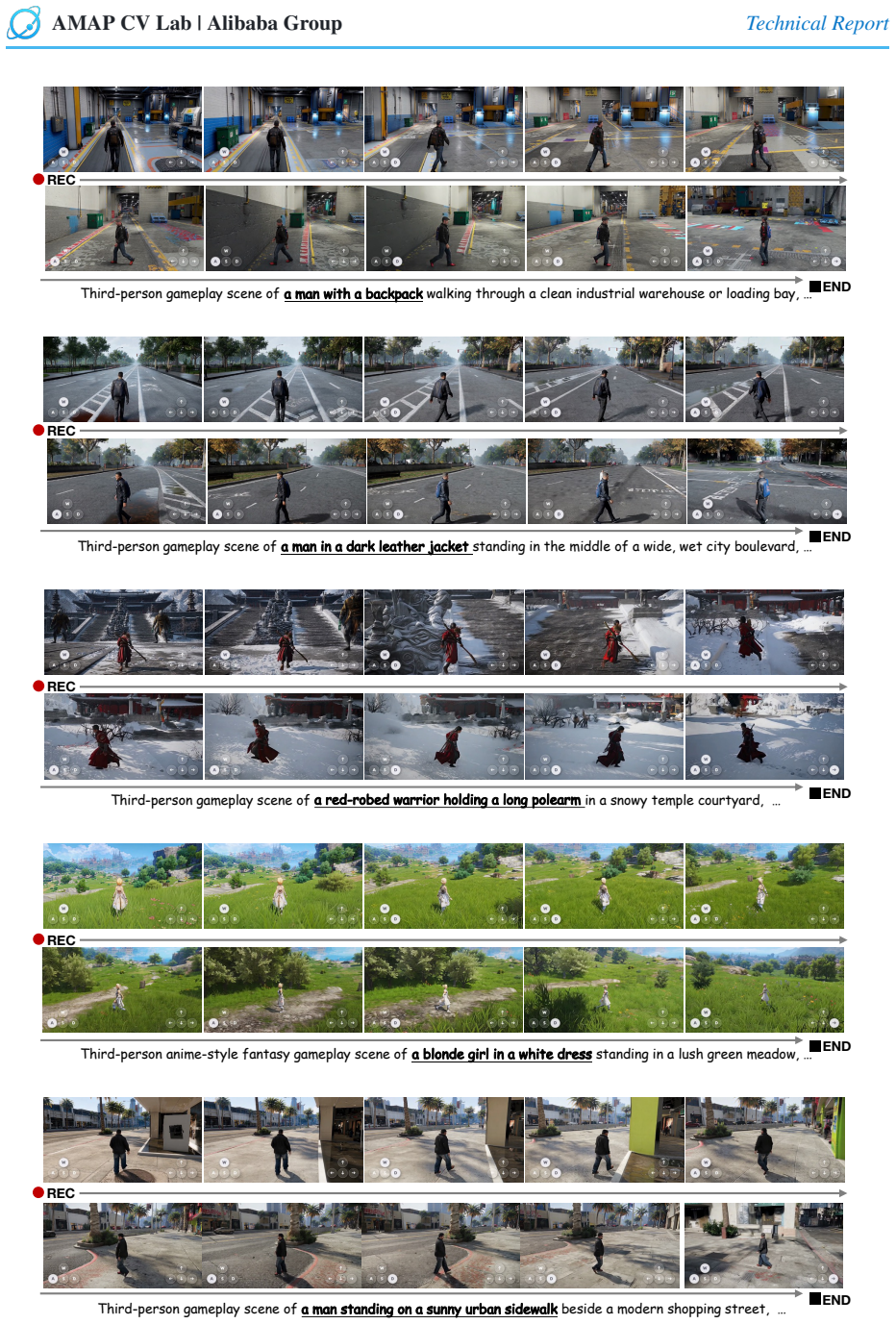
The central claim is that controllability and real-time deployment can coexist in a single video world model. The model is trained on a corpus combining game recordings, simulation renders, and internet videos, all converted to a shared eight-key action space (W/A/S/D for movement, I/J/K/L for rotation). A bidirectional teacher that generates full action-conditioned clips is progressively distilled into a causal chunk-wise student through teacher forcing and ODE distillation, then stabilized by LongForcing, which matches the student's long self-rollout distribution against an extended-horizon teacher. With a lightweight VAE decoder, efficient attention, bounded KV caching, memory-aware sched
What carries the argument
LongForcing, a distribution-matching distillation stage: the causal student is rolled out over long self-generated trajectories and supervised at the distribution level by an extended-horizon bidirectional teacher, correcting accumulated autoregressive drift. It is carried by a specific control channel—eight raw keyboard actions packed four frames at a time into 32-dimensional tokens and added into the DiT patch embeddings—and by reference-character memory tokens with fixed negative temporal positions that keep a character's identity persistent across third-person rollouts.
Load-bearing premise
The load-bearing premise is that keyboard actions derived from three very different sources—exact game API logs, deterministic simulation trajectories, and noisy pose-estimated internet videos—are consistent enough for one model to learn genuinely controllable dynamics across first- and third-person viewpoints.
What would settle it
Record ground-truth keyboard actions during human play on a held-out game not used in training, feed those exact actions to the model, and compare generated camera and character motion to the real recording over a minute-long rollout; if strict action-following collapses on this out-of-distribution test, the controllability and generalization claim fails even if the frame-rate numbers hold.
If this is right
- A 720P interactive world model can run at up to 16 FPS with a 1.2 s action-to-first-frame latency and peak VRAM around 19 GiB on a single desktop GPU.
- Long-horizon stability can be tackled at training time via distribution matching on the student's own rollouts rather than only by anchoring generation near the initial frame.
- A single raw-keyboard interface can drive both first-person scene roaming and third-person character control in one model.
- Real-time deployment requires system-level co-design: faster attention alone was insufficient (out of memory), and feasibility arrived only after lightweight VAE decoding, low-bit DiT, and memory-aware scheduling were combined.
Where Pith is reading between the lines
- The paper does not isolate how much internet pseudo-labels contribute; an ablation dropping internet data would clarify whether the diversity or the labeling noise dominates the controllability result.
- If keyboard conditioning transfers across environments, the same interface could serve as a low-cost local environment for embodied-agent training—an application the paper gestures toward but does not evaluate.
- Long-horizon evidence is presented as timestamped checkpoints; a quantitative drift metric over continuous hour-scale rollouts would let future systems compare stability directly.
- More aggressive low-bit formats push throughput but likely trade visual fidelity; quantization-aware training, which the paper lists as future work, could recover quality in that regime.
Editorial analysis
A structured set of objections, weighed in public.
Referee Report
Summary. The paper presents ABot-World-0, an action-conditioned causal video world model aimed at real-time, long-horizon interactive rollout on a single desktop GPU. It describes a multi-source data infrastructure (AAA games, simulations, internet video) with agent-driven collection (WorldExplorer), quality filtering, and unified action/text annotation. The model is a bidirectional teacher fine-tuned from a pretrained video generator with raw-keyboard action injection and reference-character memory, then distilled into a causal few-step student via teacher forcing, ODE distillation, and a proposed LongForcing stage. A deployment stack combines LightVAE, low-bit DiT inference, SageAttention2, Fast-RoPE, and bounded KV caching. The paper reports 720P streaming at up to 16 FPS, 1.2 s action-to-first-frame latency, and ≤19.3 GiB peak VRAM on an RTX 5090, with competitive WorldRoamBench scores and qualitative hour/day-scale rollouts.
Significance. If the reported results hold, this is a substantial systems contribution: it is among the first open descriptions of a desktop-scale interactive world model that combines raw keyboard control, bidirectional-to-causal distillation, and low-bit streaming inference in one system. The full-stack co-design is thoughtfully presented, and Table 2 gives a plausible component-level breakdown. However, the quantitative evidence is currently weak in three load-bearing places: the headline FPS is measured without quality evaluation at that precision; the only controllability benchmark has substantial author overlap with the paper's team; and the LongForcing ablation compares against an undocumented in-house adaptation. The paper would be valuable if these issues are addressed with additional experiments and external/standardized evaluation.
major comments (6)
- [§4.4.3 / Table 2] The headline 'up to 16 FPS' corresponds to the MXFP4 row (15.831 FPS), while the text states that FP8 is the 'default quality-oriented operating point' (13.269 FPS). No quality metrics (FVD, action fidelity, WorldRoamBench scores) are reported for MXFP6/MXFP4, so the reader cannot tell whether the faster configuration preserves controllability and visual quality. The FP8 row is also not labeled as the configuration used in Table 3. Please report per-precision quality numbers or restrict the throughput claim to FP8.
- [§5.1 / Table 3 / Ref. [84]] WorldRoamBench is the sole quantitative controllability evaluation, but its author list [84] overlaps substantially with this paper's contributor list (Benchmark Team: Zhicheng Liu, Zhe Gao, Tingbing Xu, Jiacheng Sui, Wenjin Yang; data/model teams include Zhaoxu Sun, Mingchao Sun, Hongyu Pan, Fan Jiang). The benchmark appears unpublished, no protocol details are provided, the seven metrics in Table 3 are undefined, and no error bars or confidence intervals are given. This creates a circularity risk for the central controllability claim. Please evaluate on a public benchmark, make WorldRoamBench public with code, or provide an independent third-party evaluation.
- [§5.2 / Figure 10] The LongForcing ablation compares against an 'adapted Causal-Forcing-style baseline' rather than the published Causal Forcing [43]. The adaptation is described only in one sentence, with no hyperparameters, no teacher horizon lengths, no schedule, and no variance over rollouts. Since both variants use student self-rollouts and final-stage DMD, the reported difference may reflect tuning of the baseline rather than the proposed method. Please release the baseline implementation, specify all training settings, and include multiple seeds/error bars.
- [§4.3.3] LongForcing is a core technical contribution, but no formal objective is given. There is no equation analogous to Eq. (11), no definition of the 'extended horizon' (length, portion of rollout, schedule), no description of how student self-rollouts are sampled, and no loss formulation for the distribution matching. As written, the method is not reproducible and the claim that it 'mitigates accumulated distribution shift' is not backed by a concrete algorithm. Please provide pseudocode or a full objective with the teacher-matching term.
- [§3.4 / Eqs. (4)–(6)] The unified 8-dimensional keyboard action space is a central design choice, but the paper provides no evidence that pressing a given key has consistent semantics across AAA game API controls, simulation-derived binarized trajectories, and internet pose-estimated pseudo-labels. Thresholds for binarization are not specified, and no per-source consistency statistics are given. If internet pseudo-labels systematically misalign with game/simulation semantics, the model may learn a spurious action-to-dynamics mapping, making WorldRoamBench success uninformative. Please report per-source action-label noise, a source-wise controllability analysis, or an ablation without internet pseudo-labels.
- [§5.1.2 / Figs. 5–7] The hour- and day-scale stress tests are presented as qualitative keyframe strips. No quantitative long-horizon metrics, continuous trajectory analysis, or baseline comparisons are provided; the abstract and conclusion claim 'infinite' and 'no observable collapse' based only on sampled checkpoints. Please add quantitative drift/quality metrics over time (e.g., action fidelity, FVD, scene-consistency scores) or soften the 'infinite rollout' framing to 'demonstrated up to 24 h in sampled keyframes.'
minor comments (5)
- [Table 3] The column names 'Strict Acc.', 'Partial Acc.', 'Traj. Score', 'Aesthetic', 'Imaging', 'Mechanics', 'Memory' are not defined; also specify which precision/operating point was used for these results and report confidence intervals or significance tests.
- [Table 2] The VRAM values are non-monotonic: adding Fast-RoPE to the FP8 configuration increases peak VRAM from 15.925 to 19.281 GiB. Please explain measurement methodology and why this optimization increases memory, so readers can interpret the envelope.
- [§4.3.2 / Eq. (11)] The stop-gradient operator 'sg' and the ODE integration notation Φ are used without definition. Since distillation equations are load-bearing, please define these symbols explicitly.
- [§3.2.5 / §3.4] The binarization thresholds for simulation and internet action projection are not given. Please report the threshold values and the resulting per-key statistics, as this directly affects action semantics.
- [Abstract / GitHub] The GitHub URL is provided but the repository appears to contain no release information. State whether code, model weights, and benchmark evaluation scripts will be released, and under what license.
Circularity Check
No derivation step reduces to its inputs by construction; the main caveats are an in-house evaluation benchmark and an adapted baseline, which are external-validity concerns rather than circularity.
full rationale
The paper's derivation chain is a systems/training pipeline, not a mathematical derivation from first principles to a prediction. The action representation (Eq. 4-6), action injection (Eq. 7), ODE distillation objective (Eq. 11), and LongForcing are internally consistent: each quantity is defined from previous quantities without equating the claimed result to the input. The FPS, latency, and VRAM numbers in Tables 1-2 are measured system-performance outcomes, not fitted parameters renamed as predictions. The teacher/student procedure is a standard distillation setup; LongForcing is an empirical training objective, and its claimed benefit is supported by an ablation, not by a definition. The most significant concern is that the quantitative controllability evaluation uses WorldRoamBench [84], whose author list overlaps substantially with this report's team, and the only LongForcing comparison is against 'a Causal-Forcing-style baseline [43] adapted to our interactive world model' (Section 5.2), which is an in-house adaptation rather than the published method. These are legitimate external-validity and benchmarking-governance concerns, but they do not exhibit the specific reduction required for circularity: the benchmark scores are measurements of model outputs, and the baseline comparison is a training-method comparison. The paper also explicitly acknowledges the key data assumption in Section 3.2.5 ('These pseudo-labels carry estimation noise absent from game and simulation ground truth'), which is an honest statement of label noise rather than a hidden circular fit. Overall, no load-bearing step is equivalent to its inputs by construction; the score reflects the self-authored evaluation benchmark as a caveat, not as demonstrated circularity.
Axiom & Free-Parameter Ledger
free parameters (5)
- Chunk length L (12 video frames / 3 latent frames) =
12 frames
- Student denoising steps after ODE distillation =
not stated (few-step)
- Action binarization threshold for internet data =
not stated
- FP8 vs. MXFP4 operating point =
FP8 default; MXFP4 for 16 FPS
- Extended-horizon length in LongForcing =
not stated
axioms (5)
- domain assumption Pretrained Wan2.2 backbone supplies strong visual and motion priors
- domain assumption Causal ODE distillation and DMD preserve teacher quality
- domain assumption WorldRoamBench is a valid measure of open-world controllability and long-horizon stability
- domain assumption Raw 8-key action space (W/A/S/D, I/J/K/L) is a sufficient interface for both scene roaming and character control
- domain assumption Proprietary multi-source data is collected at the stated scale and quality
read the original abstract
We present ABot-World-0, an action-conditioned video world model for real-time, long-horizon closed-loop interaction, supported by a multi-source data infrastructure spanning AAA games, simulation engines, and internet videos to learn controllable world dynamics. WorldExplorer performs agent-driven collection guided by training feedback, while a unified pipeline applies 14 deterministic quality checks, VLM-based assessment, and synchronized action and text annotation. We progressively distill a bidirectional action-conditioned teacher into a causal student through teacher forcing and ODE distillation, and introduce LongForcing to align long student self-rollouts with an extended-horizon teacher, mitigating accumulated distribution shift and autoregressive drift. Raw keyboard actions provide a unified control interface for scene roaming and third-person character interaction, while reference-character memory provides persistent appearance cues for identity consistency during third-person rollouts. For deployment, we co-design a streaming inference stack with a lightweight VAE decoder, efficient attention, memory-aware scheduling, and low-bit DiT inference. Across optimized low-bit configurations, ABot-World-0 streams 720P video at up to 16 FPS on a single NVIDIA RTX 5090 desktop GPU, with 1.2s action-to-first-frame latency and approximately 19GiB peak VRAM. Experiments on WorldRoamBench and extended interactive rollouts demonstrate competitive controllability and coherent long-horizon world evolution.
Figures




Reference graph
Works this paper leans on
-
[1]
Learning to simulate dynamic environments with GameGAN
Seung Wook Kim, Yuhao Zhou, Jonah Philion, Antonio Torralba, and Sanja Fidler. Learning to simulate dynamic environments with GameGAN. InProceedings of the IEEE/CVF Conference on Computer Vision and Pattern Recognition (CVPR), 2020
2020
-
[2]
Dennis, Ashley Edwards, Jack Parker-Holder, Yuge Shi, Edward Hughes, Matthew Lai, Aditi Mavalankar, Richie Steigerwald, Chris Apps, et al
Jake Bruce, Michael D. Dennis, Ashley Edwards, Jack Parker-Holder, Yuge Shi, Edward Hughes, Matthew Lai, Aditi Mavalankar, Richie Steigerwald, Chris Apps, et al. Genie: Generative interactive environments. InInternational Conference on Machine Learning (ICML), 2024
2024
-
[3]
Genie 3.https://deepmind.google/models/genie/, 2025
Google DeepMind. Genie 3.https://deepmind.google/models/genie/, 2025
2025
-
[4]
Diffusion models are real-time game engines
Dani Valevski, Yaniv Leviathan, Moab Arar, and Shlomi Fruchter. Diffusion models are real-time game engines. InInternational Conference on Learning Representations (ICLR), 2025
2025
-
[5]
Oasis: A universe in a transformer.https://oasis-model.github
Decart and Etched. Oasis: A universe in a transformer.https://oasis-model.github. io/, 2024. †Denotes the Tech Lead of each team. ABot-World-0 Page 27 of 33 AMAP CV Lab | Alibaba GroupTechnical Report
2024
-
[6]
Cosmos world foundation model platform for physical AI.arXiv preprint arXiv:2501.03575, 2025
NVIDIA, Niket Agarwal, et al. Cosmos world foundation model platform for physical AI.arXiv preprint arXiv:2501.03575, 2025
Pith/arXiv arXiv 2025
-
[7]
RELIC: Interactive video world model with long-horizon memory.arXiv preprint arXiv:2512.04040, 2025
Yicong Hong, Yiqun Mei, Chongjian Ge, Yiran Xu, Yang Zhou, Sai Bi, Yannick Hold-Geoffroy, Mike Roberts, Matthew Fisher, Eli Shechtman, Kalyan Sunkavalli, Feng Liu, Zhengqi Li, and Hao Tan. RELIC: Interactive video world model with long-horizon memory.arXiv preprint arXiv:2512.04040, 2025
arXiv 2025
-
[8]
Video diffusion models.Advances in neural information processing systems, 35:8633–8646, 2022
Jonathan Ho, Tim Salimans, Alexey Gritsenko, William Chan, Mohammad Norouzi, and David J Fleet. Video diffusion models.Advances in neural information processing systems, 35:8633–8646, 2022
2022
-
[9]
Make-A-Video: Text-to-video generation without text-video data.arXiv preprint arXiv:2209.14792, 2022
Uriel Singer, Adam Polyak, Thomas Hayes, Xi Yin, Jie An, Songyang Zhang, Qiyuan Hu, Harry Yang, Oron Ashual, Oran Gafni, et al. Make-A-Video: Text-to-video generation without text-video data.arXiv preprint arXiv:2209.14792, 2022
Pith/arXiv arXiv 2022
-
[10]
Wenyi Hong, Ming Ding, Wendi Zheng, Xinghan Liu, and Jie Tang. CogVideo: Large-scale pre- training for text-to-video generation via transformers.arXiv preprint arXiv:2205.15868, 2022
Pith/arXiv arXiv 2022
-
[11]
Align your latents: High-resolution video synthesis with latent diffusion models
Andreas Blattmann, Robin Rombach, Huan Ling, Tim Dockhorn, Seung Wook Kim, Sanja Fidler, and Karsten Kreis. Align your latents: High-resolution video synthesis with latent diffusion models. InProceedings of the IEEE/CVF conference on computer vision and pattern recognition, pages 22563–22575, 2023
2023
-
[12]
Phenaki: Variable length video generation from open domain textual descriptions
Ruben Villegas, Mohammad Babaeizadeh, Pieter-Jan Kindermans, Hernan Moraldo, Han Zhang, Mohammad Taghi Saffar, Santiago Castro, Julius Kunze, and Dumitru Erhan. Phenaki: Variable length video generation from open domain textual descriptions. InInternational Conference on Learning Representations (ICLR), 2023
2023
-
[13]
VideoPoet: A large language model for zero-shot video generation
Dan Kondratyuk, Lijun Yu, Xiuye Gu, José Lezama, Jonathan Huang, Grant Schindler, Rachel Hor- nung, Vighnesh Birodkar, Jimmy Yan, Ming-Chang Chiu, et al. VideoPoet: A large language model for zero-shot video generation. InInternational Conference on Machine Learning (ICML), 2024
2024
-
[14]
Weijie Kong, Qi Tian, Zijian Zhang, Rox Min, Zuozhuo Dai, Jin Zhou, Jiangfeng Xiong, Xin Li, Bo Wu, Jianwei Zhang, et al. HunyuanVideo: A systematic framework for large video generative models.arXiv preprint arXiv:2412.03603, 2024
Pith/arXiv arXiv 2024
-
[15]
Movie Gen: A cast of media foundation models.arXiv preprint arXiv:2410.13720, 2024
Adam Polyak, Amit Zohar, Andrew Brown, Andros Tjandra, Animesh Sinha, Ann Lee, Apoorv Vyas, Bowen Shi, Chih-Yao Ma, Ching-Yao Chuang, et al. Movie Gen: A cast of media foundation models.arXiv preprint arXiv:2410.13720, 2024
Pith/arXiv arXiv 2024
-
[16]
Wan: Open and advanced large-scale video generative models.arXiv preprint arXiv:2503.20314, 2025
Team Wan. Wan: Open and advanced large-scale video generative models.arXiv preprint arXiv:2503.20314, 2025
Pith/arXiv arXiv 2025
-
[17]
Genie 2: A large-scale foundation world model
Jack Parker-Holder, Philip Ball, Jake Bruce, Vibhavari Dasagi, Kristian Holsheimer, Christos Ka- planis, Alexandre Moufarek, Guy Scully, Jeremy Shar, Jimmy Shi, et al. Genie 2: A large-scale foundation world model. Google DeepMind Blog, 2024
2024
-
[18]
White, Sam Devlin, Cecily Morrison, and Katja Hofmann
Anssi Kanervisto, Dave Bignell, Linda Yilin Wen, Martin Grayson, Raluca Georgescu, Sergio Val- carcel Macua, Shan Zheng Tan, Tabish Rashid, Tim Pearce, Yuhan Cao, Abdelhak Lemkhenter, Chentian Jiang, Gavin Costello, Gunshi Gupta, Marko Tot, Shu Ishida, Tarun Gupta, Udit Arora, Ryen W. White, Sam Devlin, Cecily Morrison, and Katja Hofmann. World and human ...
2025
-
[19]
Introducing GWM-1
Runway. Introducing GWM-1. Runway Research, 2025. ABot-World-0 Page 28 of 33 AMAP CV Lab | Alibaba GroupTechnical Report
2025
-
[20]
The Waymo World Model: A new frontier for autonomous driving simulation
Chiyu Max Jiang, Xander Masotto, and Bo Sun. The Waymo World Model: A new frontier for autonomous driving simulation. Waymo Blog, 2026
2026
-
[21]
VDT: General-purpose video diffusion transformers via mask modeling
Haoyu Lu, Guoxing Yang, Nanyi Fei, Yuqi Huo, Zhiwu Lu, Ping Luo, and Mingyu Ding. VDT: General-purpose video diffusion transformers via mask modeling. InInternational Conference on Learning Representations, 2024
2024
-
[22]
Latte: Latent diffusion transformer for video generation.arXiv preprint arXiv:2401.03048, 2024
Xin Ma, Yaohui Wang, Gengyun Jia, Xinyuan Chen, Ziwei Liu, Yuan-Fang Li, Cunjian Chen, and Yu Qiao. Latte: Latent diffusion transformer for video generation.arXiv preprint arXiv:2401.03048, 2024
Pith/arXiv arXiv 2024
-
[23]
Guoqing Ma, Haoyang Huang, Kun Yan, Liangyu Chen, Nan Duan, Shengming Yin, Changyi Wan, Ranchen Ming, Xiaoniu Song, Xing Chen, et al. Step-Video-T2V technical report: The practice, challenges, and future of video foundation model.arXiv preprint arXiv:2502.10248, 2025
Pith/arXiv arXiv 2025
-
[24]
Zhuoyi Yang, Jiayan Teng, Wendi Zheng, Ming Ding, Shiyu Huang, Jiazheng Xu, Yuanming Yang, Wenyi Hong, Xiaohan Zhang, Guanyu Feng, et al. CogVideoX: Text-to-video diffusion models with an expert transformer.arXiv preprint arXiv:2408.06072, 2024
Pith/arXiv arXiv 2024
-
[25]
VideoCrafter2: Overcoming data limitations for high-quality video diffusion models
Haoxin Chen, Yong Zhang, Xiaodong Cun, Menghan Xia, Xintao Wang, Chao Weng, and Ying Shan. VideoCrafter2: Overcoming data limitations for high-quality video diffusion models. InProceedings of the IEEE/CVF Conference on Computer Vision and Pattern Recognition (CVPR), 2024
2024
-
[26]
Chenfei Wu, Lun Huang, Qianxi Zhang, Binyang Li, Lei Ji, Fan Yang, Guillermo Sapiro, and Nan Duan. GODIV A: Generating open-domain videos from natural descriptions.arXiv preprint arXiv:2104.14806, 2021
Pith/arXiv arXiv 2021
-
[27]
Long video generation with time-agnostic VQGAN and time-sensitive transformer
Songwei Ge, Thomas Hayes, Harry Yang, Xi Yin, Guan Pang, David Jacobs, Jia-Bin Huang, and Devi Parikh. Long video generation with time-agnostic VQGAN and time-sensitive transformer. In European Conference on Computer Vision, pages 102–118. Springer, 2022
2022
-
[28]
VideoGPT: Video generation using VQ-V AE and transformers.arXiv preprint arXiv:2104.10157, 2021
Wilson Yan, Yunzhi Zhang, Pieter Abbeel, and Aravind Srinivas. VideoGPT: Video generation using VQ-V AE and transformers.arXiv preprint arXiv:2104.10157, 2021
Pith/arXiv arXiv 2021
-
[29]
Diffusion Forcing: Next-token prediction meets full-sequence diffusion
Boyuan Chen, Diego Martí Monsó, Yilun Du, Max Simchowitz, Russ Tedrake, and Vincent Sitz- mann. Diffusion Forcing: Next-token prediction meets full-sequence diffusion. InAdvances in Neural Information Processing Systems (NeurIPS), 2024
2024
-
[30]
Yang Jin, Zhicheng Sun, Ningyuan Li, Kun Xu, Kun Xu, Hao Jiang, Nan Zhuang, Quzhe Huang, Yang Song, Yadong Mu, and Zhouchen Lin. Pyramidal flow matching for efficient video generative modeling.arXiv preprint arXiv:2410.05954, 2024
arXiv 2024
-
[31]
Freeman, Frédo Durand, Eli Shechtman, and Xun Huang
Tianwei Yin, Qiang Zhang, Richard Zhang, William T. Freeman, Frédo Durand, Eli Shechtman, and Xun Huang. From slow bidirectional to fast autoregressive video diffusion models. InProceedings of the IEEE/CVF Conference on Computer Vision and Pattern Recognition (CVPR), pages 22963– 22974, 2025
2025
-
[32]
Xun Huang, Zhengqi Li, Guande He, Mingyuan Zhou, and Eli Shechtman. Self Forcing: Bridging the train-test gap in autoregressive video diffusion.arXiv preprint arXiv:2506.08009, 2025
Pith/arXiv arXiv 2025
-
[33]
Kunhao Liu, Wenbo Hu, Jiale Xu, Ying Shan, and Shijian Lu. Rolling Forcing: Autoregressive long video diffusion in real time.arXiv preprint arXiv:2509.25161, 2025
Pith/arXiv arXiv 2025
-
[34]
Flow matching for generative modeling.arXiv preprint arXiv:2210.02747, 2022
Yaron Lipman, Ricky TQ Chen, Heli Ben-Hamu, Maximilian Nickel, and Matt Le. Flow matching for generative modeling.arXiv preprint arXiv:2210.02747, 2022
Pith/arXiv arXiv 2022
-
[35]
Xingchao Liu, Chengyue Gong, and Qiang Liu. Flow straight and fast: Learning to generate and transfer data with rectified flow.arXiv preprint arXiv:2209.03003, 2022. ABot-World-0 Page 29 of 33 AMAP CV Lab | Alibaba GroupTechnical Report
Pith/arXiv arXiv 2022
-
[36]
Progressive autoregressive video diffusion models, 2025
Desai Xie, Zhan Xu, Yicong Hong, Hao Tan, Difan Liu, Feng Liu, Arie Kaufman, and Yang Zhou. Progressive autoregressive video diffusion models, 2025
2025
-
[37]
SkyReels-V2: Infinite-length film generative model.arXiv preprint arXiv:2504.13074, 2025
Guibin Chen, Dixuan Li, Sen Yang, Bin Zhu, Bohan Tan, Mingyu Wang, et al. SkyReels-V2: Infinite-length film generative model.arXiv preprint arXiv:2504.13074, 2025
Pith/arXiv arXiv 2025
-
[38]
AR-Diffusion: Asynchronous video generation with auto-regressive diffusion, 2025
Mingzhen Sun, Weining Wang, Gen Li, Jiawei Liu, Jiahui Sun, Wanquan Feng, Shanshan Lao, SiYu Zhou, Qian He, and Jing Liu. AR-Diffusion: Asynchronous video generation with auto-regressive diffusion, 2025
2025
-
[39]
StreamDiT: Real-time streaming text-to-video generation, 2026
Akio Kodaira, Tingbo Hou, Ji Hou, Markos Georgopoulos, Felix Juefei-Xu, Masayoshi Tomizuka, and Yue Zhao. StreamDiT: Real-time streaming text-to-video generation, 2026
2026
-
[40]
FIFO-Diffusion: Generating infinite videos from text without training
Jihwan Kim, Junoh Kang, Jinyoung Choi, and Bohyung Han. FIFO-Diffusion: Generating infinite videos from text without training. InAdvances in Neural Information Processing Systems (NeurIPS), 2024
2024
-
[41]
LongLive: Real-time interactive long video generation
Shuai Yang, Wei Huang, Ruihang Chu, Yicheng Xiao, Yuyang Zhao, Xianbang Wang, Muyang Li, Enze Xie, Yingcong Chen, Yao Lu, et al. LongLive: Real-time interactive long video generation. arXiv preprint arXiv:2509.22622, 2025
Pith/arXiv arXiv 2025
-
[42]
Self-Forcing++: Towards minute-scale high-quality video generation, 2025
Justin Cui, Jie Wu, Ming Li, Tao Yang, Xiaojie Li, Rui Wang, Andrew Bai, Yuanhao Ban, and Cho-Jui Hsieh. Self-Forcing++: Towards minute-scale high-quality video generation, 2025
2025
-
[43]
Hongzhou Zhu, Min Zhao, Guande He, Hang Su, Chongxuan Li, and Jun Zhu. Causal Forcing: Au- toregressive diffusion distillation done right for high-quality real-time interactive video generation. InInternational Conference on Machine Learning (ICML), 2026. arXiv:2602.02214
Pith/arXiv arXiv 2026
-
[44]
Context Forcing: Consistent autoregressive video generation with long context, 2026
Shuo Chen, Cong Wei, Sun Sun, Ping Nie, Kai Zhou, Ge Zhang, Ming-Hsuan Yang, and Wenhu Chen. Context Forcing: Consistent autoregressive video generation with long context, 2026
2026
-
[45]
HiAR: Efficient autoregressive long video generation via hierarchical denoising, 2026
Kai Zou, Dian Zheng, Hongbo Liu, Tiankai Hang, Bin Liu, and Nenghai Yu. HiAR: Efficient autoregressive long video generation via hierarchical denoising, 2026
2026
-
[46]
Streaming autoregressive video generation via Diagonal Distillation
Jinxiu Liu, Xuanming Liu, Kangfu Mei, Yandong Wen, Ming-Hsuan Yang, and Weiyang Liu. Streaming autoregressive video generation via Diagonal Distillation. InICLR, 2026
2026
-
[47]
LoL: Longer than longer, scaling video generation to hour.arXiv preprint arXiv:2601.16914, 2026
Justin Cui, Jie Wu, Ming Li, Tao Yang, Xiaojie Li, Rui Wang, Andrew Bai, Yuanhao Ban, and Cho-Jui Hsieh. LoL: Longer than longer, scaling video generation to hour.arXiv preprint arXiv:2601.16914, 2026
arXiv 2026
-
[48]
Jung Yi, Wooseok Jang, Paul Hyunbin Cho, Jisu Nam, Heeji Yoon, and Seungryong Kim. Deep Forcing: Training-free long video generation with deep sink and participative compression.arXiv preprint arXiv:2512.05081, 2025
arXiv 2025
-
[49]
Zengqun Zhao, Yanzuo Lu, Ziquan Liu, Jifei Song, Jiankang Deng, and Ioannis Patras. Relax Forc- ing: Relaxed KV-Memory for consistent long video generation.arXiv preprint arXiv:2603.21366, 2026
arXiv 2026
-
[50]
Youngrae Kim, Qixin Hu, C-C Jay Kuo, and Peter A Beerel. MemRoPE: Training-free infinite video generation via evolving memory tokens.arXiv preprint arXiv:2603.12513, 2026
arXiv 2026
-
[51]
Yukang Chen, Luozhou Wang, Wei Huang, Shuai Yang, Bohan Zhang, Yicheng Xiao, Ruihang Chu, Weian Mao, Qixin Hu, Shaoteng Liu, et al. LongLive-2.0: An NVFP4 parallel infrastructure for long video generation.arXiv preprint arXiv:2605.18739, 2026. ABot-World-0 Page 30 of 33 AMAP CV Lab | Alibaba GroupTechnical Report
Pith/arXiv arXiv 2026
-
[52]
Jia Li, Xiaomeng Fu, Xurui Peng, Weifeng Chen, Youwei Zheng, Tianyu Zhao, Jiexi Wang, Fangmin Chen, Xing Wang, and Hayden Kwok-Hay So. Train short, inference long: Training-free horizon extension for autoregressive video generation.arXiv preprint arXiv:2602.14027, 2026
arXiv 2026
-
[53]
Xiaofeng Mao, Shaohao Rui, Kaining Ying, Bo Zheng, Chuanhao Li, Mingmin Chi, and Kaipeng Zhang. PackForcing: Short video training suffices for long video sampling and long context infer- ence.arXiv preprint arXiv:2603.25730, 2026
arXiv 2026
-
[54]
The Matrix: Infinite-horizon world generation with real-time moving control.Advances in Neural Information Processing Systems, 38:87318–87344, 2026
Ruili Feng, Han Zhang, Zhilei Shu, Zhantao Yang, Longxiang Tang, Zhicai Wang, Andy Zheng, Jie Xiao, Zhiheng Liu, Ruihang Chu, et al. The Matrix: Infinite-horizon world generation with real-time moving control.Advances in Neural Information Processing Systems, 38:87318–87344, 2026
2026
-
[55]
Xianglong He, Chunli Peng, Zexiang Liu, Boyang Wang, Yifan Zhang, Qi Cui, Fei Kang, Biao Jiang, Mengyin An, Yangyang Ren, et al. Matrix-game 2.0: An open-source real-time and streaming interactive world model.arXiv preprint arXiv:2508.13009, 2025
Pith/arXiv arXiv 2025
-
[56]
MotionCtrl: A unified and flexible motion controller for video generation
Zhouxia Wang, Ziyang Yuan, Xintao Wang, Yaowei Li, Tianshui Chen, Menghan Xia, Ping Luo, and Ying Shan. MotionCtrl: A unified and flexible motion controller for video generation. InACM SIGGRAPH 2024 Conference Papers, pages 1–11, 2024
2024
-
[57]
ReCamMaster: Camera-controlled generative rendering from a single video
Jianhong Bai, Menghan Xia, Xiao Fu, Xintao Wang, Lianrui Mu, Jinwen Cao, Zuozhu Liu, Haoji Hu, Xiang Bai, Pengfei Wan, et al. ReCamMaster: Camera-controlled generative rendering from a single video. InProceedings of the IEEE/CVF International Conference on Computer Vision, pages 14834–14844, 2025
2025
-
[58]
Zhening Huang, Hyeonho Jeong, Xuelin Chen, Yulia Gryaditskaya, Tuanfeng Y Wang, Joan Lasenby, and Chun-Hao Huang. SpaceTimePilot: Generative rendering of dynamic scenes across space and time.arXiv preprint arXiv:2512.25075, 2025
arXiv 2025
-
[59]
Generative camera dolly: Extreme monocular dynamic novel view synthesis
Basile Van Hoorick, Rundi Wu, Ege Ozguroglu, Kyle Sargent, Ruoshi Liu, Pavel Tokmakov, Achal Dave, Changxi Zheng, and Carl V ondrick. Generative camera dolly: Extreme monocular dynamic novel view synthesis. InEuropean Conference on Computer Vision, pages 313–331. Springer, 2024
2024
-
[60]
Hao He, Yinghao Xu, Yuwei Guo, Gordon Wetzstein, Bo Dai, Hongsheng Li, and Ceyuan Yang. CameraCtrl: Enabling camera control for text-to-video generation.arXiv preprint arXiv:2404.02101, 2024
Pith/arXiv arXiv 2024
-
[61]
Hongfei Zhang, Kanghao Chen, Zixin Zhang, Harold Haodong Chen, Yuanhuiyi Lyu, Yuqi Zhang, Shuai Yang, Kun Zhou, and Yingcong Chen. DualCamCtrl: Dual-branch diffusion model for geometry-aware camera-controlled video generation.arXiv preprint arXiv:2511.23127, 2025
arXiv 2025
-
[62]
Stable Virtual Camera: Generative view synthesis with diffusion models
Jensen Zhou, Hang Gao, Vikram V oleti, Aaryaman Vasishta, Chun-Han Yao, Mark Boss, Philip Torr, Christian Rupprecht, and Varun Jampani. Stable Virtual Camera: Generative view synthesis with diffusion models. InProceedings of the IEEE/CVF International Conference on Computer Vision, pages 12405–12414, 2025
2025
-
[63]
Cameras as relative positional encoding.Advances in Neural Information Processing Systems, 38:15984–16009, 2026
Ruilong Li, Brent Yi, Junchen Liu, Hang Gao, Yi Ma, and Angjoo Kanazawa. Cameras as relative positional encoding.Advances in Neural Information Processing Systems, 38:15984–16009, 2026
2026
-
[64]
ReRoPE: Repurposing RoPE for relative camera control.arXiv preprint arXiv:2602.08068, 2026
Chunyang Li, Yuanbo Yang, Jiahao Shao, Hongyu Zhou, Katja Schwarz, and Yiyi Liao. ReRoPE: Repurposing RoPE for relative camera control.arXiv preprint arXiv:2602.08068, 2026
arXiv 2026
-
[65]
BulletTime: Decoupled control of time and camera pose for video generation
Yiming Wang, Qihang Zhang, Shengqu Cai, Tong Wu, Jan Ackermann, Zhengfei Kuang, Yang Zheng, Frano Rajiˇc, Siyu Tang, and Gordon Wetzstein. BulletTime: Decoupled control of time and camera pose for video generation. InProceedings of the IEEE/CVF Conference on Computer Vision and Pattern Recognition, pages 18319–18330, 2026. ABot-World-0 Page 31 of 33 AMAP ...
2026
-
[66]
Autoregressive adversarial post-training for real-time interactive video genera- tion.Advances in Neural Information Processing Systems, 38:41061–41086, 2026
Shanchuan Lin, Ceyuan Yang, Hao He, Jianwen Jiang, Yuxi Ren, Xin Xia, Yang Zhao, Xuefeng Xiao, and Lu Jiang. Autoregressive adversarial post-training for real-time interactive video genera- tion.Advances in Neural Information Processing Systems, 38:41061–41086, 2026
2026
-
[67]
LTX-Video: Realtime video latent diffusion
Yoav HaCohen, Nisan Chiprut, Benny Brazowski, Daniel Shalem, Dudu Moshe, Eitan Richardson, Eran Levin, Guy Shiran, Nir Zabari, Ori Gordon, et al. LTX-Video: Realtime video latent diffusion. arXiv preprint arXiv:2501.00103, 2024
Pith/arXiv arXiv 2024
-
[68]
Freeman, and Taesung Park
Tianwei Yin, Michaël Gharbi, Richard Zhang, Eli Shechtman, Frédo Durand, William T. Freeman, and Taesung Park. One-step diffusion with distribution matching distillation. InProceedings of the IEEE/CVF Conference on Computer Vision and Pattern Recognition (CVPR), 2024
2024
-
[69]
Improved distribution matching distillation for fast image synthesis.Advances in neural information processing systems, 37:47455–47487, 2024
Tianwei Yin, Michaël Gharbi, Taesung Park, Richard Zhang, Eli Shechtman, Fredo Durand, and William T Freeman. Improved distribution matching distillation for fast image synthesis.Advances in neural information processing systems, 37:47455–47487, 2024
2024
-
[70]
Consistency models
Yang Song, Prafulla Dhariwal, Mark Chen, and Ilya Sutskever. Consistency models. InInternational Conference on Machine Learning, pages 32211–32252. PMLR, 2023
2023
-
[71]
MAGI-1: Autoregressive video generation at scale.arXiv preprint arXiv:2505.13211, 2025
Hansi Teng, Hongyu Jia, Lei Sun, Lingzhi Li, Maolin Li, Mingqiu Tang, Shuai Han, Tianning Zhang, WQ Zhang, Weifeng Luo, et al. MAGI-1: Autoregressive video generation at scale.arXiv preprint arXiv:2505.13211, 2025
Pith/arXiv arXiv 2025
-
[72]
Joonghyuk Shin, Zhengqi Li, Richard Zhang, Jun-Yan Zhu, Jaesik Park, Eli Shechtman, and Xun Huang. MotionStream: Real-time video generation with interactive motion controls.arXiv preprint arXiv:2511.01266, 2025
arXiv 2025
-
[73]
Haocheng Xi, Shuo Yang, Yilong Zhao, Muyang Li, Han Cai, Xingyang Li, Yujun Lin, Zhuoyang Zhang, Jintao Zhang, Xiuyu Li, et al. Quant VideoGen: Auto-regressive long video generation via 2-bit KV-Cache quantization.arXiv preprint arXiv:2602.02958, 2026
Pith/arXiv arXiv 2026
-
[74]
Sam Ade Jacobs, Masahiro Tanaka, Chengming Zhang, Minjia Zhang, Shuaiwen Leon Song, Samyam Rajbhandari, and Yuxiong He. DeepSpeed Ulysses: System optimizations for enabling training of extreme long sequence transformer models.arXiv preprint arXiv:2309.14509, 2023
Pith/arXiv arXiv 2023
-
[75]
Swift- Fusion: Scalable sequence parallelism for distributed inference of diffusion transformers on GPUs
Jiacheng Yang, Jun Wu, Yaoyao Ding, Zhiying Xu, Yida Wang, and Gennady Pekhimenko. Swift- Fusion: Scalable sequence parallelism for distributed inference of diffusion transformers on GPUs. InProceedings of the ACM Conference on AI and Agentic Systems, CAIS ’26, pages 1037–1050, New York, NY , USA, 2026. Association for Computing Machinery
2026
-
[76]
Yunjing AMAP: AI-powered 3D reconstruction and digital twin platform.https: //yunjing.amap.com/, 2023
AMAP, Alibaba. Yunjing AMAP: AI-powered 3D reconstruction and digital twin platform.https: //yunjing.amap.com/, 2023. Accessed: 2026-07
2023
-
[77]
ABot-3DWorld 0: A universal world model to explore any 3D space
Mingchao Sun, Luyang Tang, Yu Liu, Xu Yan, Zhan Li, Yunwei Zhang, Fei Yu, Zengye Ge, Yumin Liu, Jiacheng Zhang, et al. ABot-3DWorld 0: A universal world model to explore any 3D space. arXiv preprint arXiv:2607.11673, 2026
Pith/arXiv arXiv 2026
-
[78]
DeepVerse: 4D autoregressive video generation as a world model.arXiv preprint arXiv:2506.01103, 2025
Junyi Chen, Haoyi Zhu, Xianglong He, Yifan Wang, Jianjun Zhou, Wenzheng Chang, Yang Zhou, Zizun Li, Zhoujie Fu, Jiangmiao Pang, and Tong He. DeepVerse: 4D autoregressive video generation as a world model.arXiv preprint arXiv:2506.01103, 2025
Pith/arXiv arXiv 2025
-
[79]
TAEHV: Tiny AutoEncoder for Hunyuan Video
Ollin Boer Bohan. TAEHV: Tiny AutoEncoder for Hunyuan Video. GitHub repository, 2025
2025
-
[80]
FramePack: Practical video diffusion with frame context packing
Lvmin Zhang. FramePack: Practical video diffusion with frame context packing. GitHub repository, 2025
2025
discussion (0)
Sign in with ORCID, Apple, or X to comment. Anyone can read and Pith papers without signing in.