REVIEW 5 major objections 5 minor 37 references
This paper claims that matching scale-resolved graph energy, defined by graph-Laplacian frequency bands, is a practical mechanism for improving autoregressive mesh-based forecasting of chaotic flows, and demonstrates this with three scalabl
Reviewed by Pith at T0; open to challenge. T0 means a machine referee read the full paper against a public rubric. the ladder, T0–T4 →
T0 review · deepseek-v4-flash
2026-08-02 09:03 UTC pith:SWJOGJTK
load-bearing objection Useful and mostly sound extension of BSP to graph Laplacians, but the reported gains rest on test-set hyperparameter selection and thin evaluation; deserves peer review with a demand for a proper validation split. the 5 major comments →
Scale-Aware Learning of Chaotic Dynamics on Unstructured Meshes via Binned Spectral Losses
The pith
A machine-rendered reading of the paper's core claim, the machinery that carries it, and where it could break.
Core claim
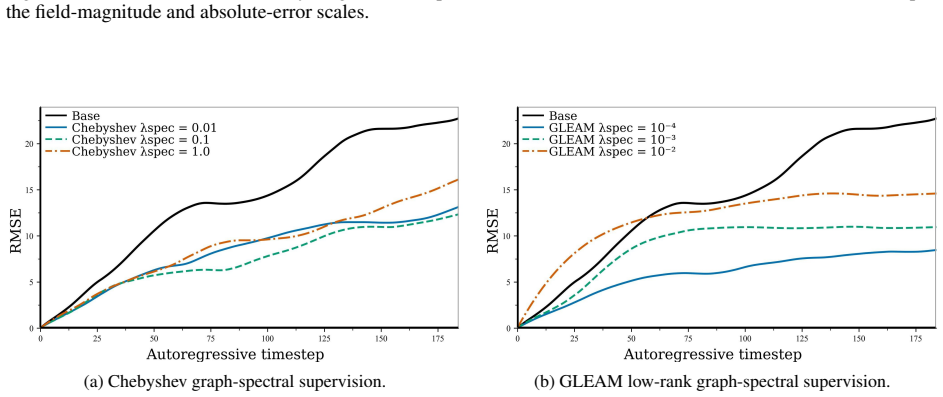
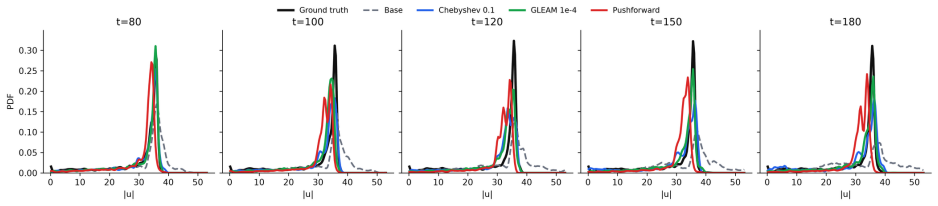
On the paper's own terms, the central discovery is that replacing Fourier band-power matching with graph-Laplacian band-power matching is an effective training signal for surrogate forecasting of chaotic dynamics on unstructured meshes. Exact Graph BSP uses the full eigenspace as a reference, Chebyshev BSP substitutes sparse polynomial filters to avoid eigendecomposition, and GLEAM applies low-rank retained-subspace supervision across multilevel graph hierarchies. The experiments show that these losses reduce long-horizon autoregressive drift and better preserve distributional and spectral content of pressure and velocity fields than deterministic pointwise training.
What carries the argument
The central object is the symmetric normalized graph Laplacian of the mesh, whose eigenvectors serve as generalized Fourier modes and whose eigenvalues order graph frequencies by Dirichlet energy. Bands of eigenvalues define projectors that measure how much field energy sits at each spatial scale. The paper compares predicted and target band energies with a relative ratio loss, and approximates the expensive exact projectors with Chebyshev polynomial graph filters; GLEAM instead builds a low-rank spectral embedding (regularized by eigenvalue weighting, so pairwise distances approximate effective resistance) and adds Fiedler-guided pairwise contrast terms across coarse hierarchy levels.
Load-bearing premise
The load-bearing premise is that graph-Laplacian eigenvalues on an unstructured CFD mesh order physically meaningful spatial scales, so that penalizing band-energy mismatch targets the scale content that drives chaotic rollout drift rather than arbitrary graph harmonics.
What would settle it
Take a mesh on which the graph-Laplacian eigenvectors are known not to correspond to physical spatial scales—say a highly anisotropic or weakly connected mesh—and show that adding Chebyshev BSP or GLEAM fails to reduce or even worsens rollout spectral error compared with the pointwise baseline. A cleaner version: on a structured grid encoded as a graph, compare graph-band and Fourier-band energy matching; if the two lead to different training behavior, the physical interpretation of the bands is suspect.
If this is right
- If the central claim is right, spectral losses can be added as a modular auxiliary objective to existing graph-based simulators without changing their architecture.
- Long-horizon autoregressive forecasting of chaotic CFD on unstructured meshes can be stabilized by scale-aware supervision, not just by better pointwise training or rollout exposure.
- The cost–fidelity hierarchy offers a practical recipe: exact BSP as a reference diagnostic, Chebyshev BSP for fine-level band control, GLEAM for cheap multilevel supervision on coarse graphs.
- The results suggest that spectral bias in graph neural networks (the tendency to smooth over large scales) can be counteracted by explicit band-energy penalties.
- Methods that rely on Fourier or structured-grid assumptions can now be ported to irregular geometries via graph spectral theory.
Where Pith is reading between the lines
- One implicit extension is to combine graph-spectral energy losses with rollout-curriculum training: the paper's BFS comparison suggests pushforward exposure and spectral matching may address different failure modes, and the combination could outperform either alone.
- The graph-band interpretation could be tested more directly on meshes where a physical wavenumber exists (e.g., a structured grid encoded as a graph); if graph bands systematically misalign with Fourier bands, the loss's effectiveness should degrade, which would be a sharp diagnostic.
- The same band-energy mechanism could apply to other graph-mediated PDE surrogates, such as unstructured ocean or climate models, where long-horizon drift of invariants is a known bottleneck.
- The Fiedler-guided pairwise contrast term resembles graph-embedding regularizers; a testable hypothesis is that it mainly helps when error is spatially reorganized (recirculation shifting) rather than merely spread across scales.
Editorial analysis
A structured set of objections, weighed in public.
Referee Report
Summary. The paper proposes a family of graph-spectral losses for autoregressive forecasting of chaotic fluid flows on unstructured meshes. The authors replace the Fourier-band BSP loss of Chakraborty et al. with graph-Laplacian frequency bands, defining an exact Graph BSP loss (Eq. 16), a scalable Chebyshev-filter approximation (Eq. 27), and GLEAM, a multilevel retained-subspace variant with a Fiedler-guided pairwise contrast term (Eqs. 32, 35, 36). They evaluate on EAGLE, a 2D backward-facing step, and the pOnWing benchmark, reporting that the spectral variants improve long-horizon RMSE, spectral-energy metrics, vorticity/pressure PDFs, and pressure-force errors relative to pointwise-trained baselines. The paper also compares against PyNUFFT and Pushforward baselines on BFS. The central claim, stated in §6, is that matching scale-resolved graph energy is a practical mechanism for improving autoregressive mesh-based forecasting on the studied benchmarks.
Significance. If validated, the proposed modular losses would be a genuinely useful contribution: they provide a principled framework for scale-resolved supervision without a Euclidean Fourier basis, and the Chebyshev/GLEAM hierarchy addresses a real computational bottleneck of exact Graph BSP. The manuscript is unusually transparent about implementation details, reports exact eigensystem diagnostics alongside approximate training losses, and makes code available. The mathematical formulation is mostly coherent, and the physical-space improvements (EAGLE RMSE, BFS global/reverse-flow/high-gradient RMSE, pOnWing force error) are evidence that the method is not merely optimizing its own evaluation metric. However, the empirical claims are weakened by test-set hyperparameter selection, single-sequence BFS evaluation without error bars, and the partial circularity of the spectral-error metrics. As it stands, the evidence supports the claim as a proof-of-concept on the specific configurations tested, but not yet as a general practical mechanism with statistically quantified gains.
major comments (5)
- [§4.1, Tables 1–2] The representative EAGLE Chebyshev setting (K=16, M=32, Q=256) is selected because it gives the strongest late-horizon spectral preservation on the 118 test simulations, and the best short-horizon RMSE and best long-horizon RMSE rows are also read off the same tables. No independent validation split is used for this selection. Consequently, the reported improvements over Base could reflect tuning to the test set. Please perform hyperparameter selection on a separate validation split (or via nested cross-validation) and report test metrics only for the selected configuration. This is load-bearing for the central claim because the conclusion explicitly relies on the selected K, M, Q.
- [§4.2, §4.3, Appendix B.3] The BFS spectral weights are chosen by test performance: λCheb=0.1 is described as giving 'the best long-horizon rollout accuracy' and λGLEAM=10^-4 as the strongest in 'the saved hyperparameter sweep'; the pOnWing weights are similarly selected from VGAE/FMGN sweeps. With no separate validation set, the risk of selection-induced gains is substantial, especially since many of the reported curves use min–max envelopes rather than error bars. I request a validation/test split protocol for all hyperparameter choices and, at minimum, multiple seeds or independent test sequences for BFS and pOnWing to quantify variance.
- [§4.4, Tables 2, 8, Appendix B.2.3, Fig. 10(a)] Several headline metrics measure exactly the band-energy mismatch quantities that the proposed losses are trained to minimize: state spectral-energy relative L1 (Table 2), exact normalized-Laplacian spectral-energy relative L1 (Table 8, Fig. 10(a)), and low-band Uy RMSE (Table 3). Improvements on these metrics are partly expected by construction and should not be presented as independent validation of spectral-drift reduction. The paper does include genuinely independent physical-space metrics — EAGLE RMSE, BFS global/reverse/high-gradient RMSE, pOnWing pressure-force error — and these should be made the primary evidence for the empirical claim. Please either demote the spectral metrics to sanity checks or add independent physical diagnostics (e.g., spatial power spectra computed from physical coordinates, vorticity statistics, structure functions) that do not coincide with the training
- [§2.1–2.3, Eq. (11), Appendix E.2, Eq. (60)] The load-bearing premise is that graph-Laplacian eigenvalues on an unstructured CFD mesh order physically meaningful spatial scales, so that penalizing band-energy mismatch penalizes the scale content that drives chaotic rollout drift. This is an assumption: the paper does not demonstrate that the graph-spectral bands correlate with physical wavenumbers or with the scales that actually dominate EAGLE/BFS/pOnWing rollout error. The GLEAM design further assumes the coarsened hierarchy preserves the low/mid-frequency subspaces that matter (Eq. 60). Please provide a concrete validation on at least one benchmark, e.g., by comparing graph-band energies of ground-truth fields against physical-space power spectra, or by ablating the loss with eigenvalue-binning schemes that do not respect smoothness ordering. Without such evidence, the 'scale-aware' interpretation remains plausible but unverifie
- [§4.2, Table 3, Appendix C, Table 9] BFS is evaluated on a single held-out test sequence. Table 3 is computed from 'fresh autoregressive rollouts' of one test segment, and Appendix C explicitly says the BFS comparison uses 'one held-out sequence' with no error bars. The strong BFS improvements (Base global RMSE 11.36 vs. GLEAM 3.10; low-band RMSE 6.62 vs. 0.65) could be driven by a favorable draw of this particular sequence. Please report results over multiple independent sequences or multiple training seeds, with summary statistics over those runs.
minor comments (5)
- [§4.1 and Appendix B.1] The text states the EAGLE dataset has 948 training, 118 validation, and 118 test simulations; Tables 1–2 and the ablation narrative use the 118 test simulations for selection. Clarify whether the 'validation' split was ever used during the study, and if so, where.
- [Fig. 1, Fig. 3, Figs. 6–7] Shaded envelopes are described as min–max ranges; these are not error bars and do not convey statistical uncertainty. Add standard errors or confidence intervals over simulations/seeds, or explicitly relabel the envelopes.
- [§3.1, Eq. (19)] The Bartlett windows φm(λ) as defined do not form a partition of unity and the band normalizer dcheb_m is proposed in two variants (trace-normalized or replaced by N). State which normalizer was used in each experiment; otherwise the reported band energies are not comparable across rows of Tables 1–2.
- [§4.5, Table 5 and Appendix F] The cost table for GLEAM includes 'PℓC' for pairwise terms, but the text says Pℓ is the number of sampled pairs; clarify whether this is per-channel or per-pair cost and define Pℓ consistently.
- [Throughout] Several appendix references in the main text are imprecise (e.g., 'Appendix Fig. 18', 'Appendix B.2.3 support the same interpretation'), and the data/code availability statements could include a version/DOI for the code repository. These are minor presentation issues.
Circularity Check
Spectral-drift improvements are partly by construction because the reported band-energy metric is essentially the quantity minimized by the loss, and headline hyperparameters are selected on the same test rollouts used for final reporting.
specific steps
-
self definitional
[§4.1, Tables 1–2; Eq. (27), §4.4]
"L^{cheb} = 1/(MC) Σ_m Σ_c (1 − (E^{cheb}_u(m,c)+ε_s)/(E^{cheb}_v(m,c)+ε_s))^2 ... The state spectral-energy relative L1 metric measures the relative discrepancy between predicted and target spectral-energy distributions over the state channels, so lower values indicate better preservation of scale-resolved energy."
The training loss is a relative mismatch of Chebyshev band energies; the headline 'spectral-energy relative L1' diagnostic is the same relative mismatch of the same band-energy quantities. A model explicitly trained to equalize those band energies will, by construction, tend to improve that exact metric, so those tables cannot independently evidence 'spectral drift' reduction. The physical-space RMSE and pressure-force metrics are separate and provide independent support.
-
fitted input called prediction
[§4.1, §4.2; Tables 1–2; Fig. 3]
"We therefore use K=16, M=32, and Q=256 as the representative EAGLE Chebyshev BSP setting in the following diagnostics, because it gives the strongest late-horizon spectral preservation... among the tested weights, λCheb=0.1 gives the best long-horizon rollout accuracy... In the saved hyperparameter sweep, the strongest GLEAM rollout uses λGLEAM=10−4."
These hyperparameters and spectral weights are chosen by inspecting the same test rollouts that are later reported as the method's gains. The paper does not state that a separate validation split was used for this selection; EAGLE reports training/validation/test splits, but the ablation tables are computed on the 118 test simulations. Reporting the best member of a test-set sweep as a 'prediction' is a selection artifact rather than independent evidence. This weakens, though does not by itself invalidate, the empirical central claim.
full rationale
The graph-spectral construction itself is not circular: the paper defines band-energy losses from the mesh Laplacian, supplies an eigendecomposition-free Chebyshev approximation, and a multilevel GLEAM variant, with ordinary mathematical assumptions (normalized Laplacian spectrum in [0,2], Parseval, low-rank effective-resistance embeddings). No uniqueness theorem or self-citation is used to force the choice of loss; the prior BSP paper is used only as the structured-grid ancestor, and the contribution is tested against Base, Pushforward, and PyNUFFT baselines. The circularity is confined to evaluation. The 'spectral drift' metric reported as the main scale-resolved evidence is essentially the quantity minimized by the loss, so improvement on it is expected by construction. In addition, the representative Chebyshev and GLEAM hyperparameters are selected using the same test rollouts that produce the reported curves and tables, with only min–max envelopes rather than error bars. That is a test-set selection issue that makes the size of the independent RMSE/force gains uncertain. Physical-space RMSE, pressure-force error, PDFs, and the Pushforward/PyNUFFT comparisons are not derivatives of the loss and give genuine, non-circular evidence, so the paper is not fully circular; but its central empirical claim is partly self-confirming as presented.
Axiom & Free-Parameter Ledger
free parameters (8)
- Spectral weight lambda_Cheb =
0.01 (EAGLE), 0.1 (BFS), 1e-2 (VGAE pOnWing), 1e-4 (FMGN pOnWing)
- Spectral weight lambda_GLEAM =
1e-4 (BFS), 1e-3 (VGAE pOnWing), 1e-4 (FMGN pOnWing)
- Band count M =
32 (EAGLE), 24 (BFS), 32 (pOnWing)
- Chebyshev polynomial order K =
16 (EAGLE), 12 (BFS), 16 (pOnWing)
- Quadrature count Q =
256 (EAGLE), 128 (BFS), 256 (pOnWing)
- GLEAM retained rank r =
32 (BFS), 16 (VGAE pOnWing), 64 (FMGN pOnWing)
- Pairwise contrast weight rho =
0.2
- Stabilization constants epsilon_s, tau, beta =
epsilon_s=1e-6; tau=1e-6 or as specified; beta=0.15
axioms (6)
- standard math Normalized graph Laplacian has spectrum in [0,2] and an orthonormal eigendecomposition L=Phi Lambda Phi^T.
- domain assumption Graph Laplacian eigenvectors are a meaningful analogue of Fourier modes on irregular meshes, and eigenvalue order corresponds to physical scale separation.
- ad hoc to paper Linear eigenvalue binning (Eq. 11) is a valid default binning for physical scale separation.
- domain assumption The graph hierarchy used by GLEAM retains the low/mid-frequency subspaces that dominate rollout error.
- domain assumption Relative band-energy mismatch with stabilization constant epsilon_s is a good proxy for physically damaging spectral drift.
- domain assumption Chebyshev polynomial filters H_m approximate exact band projectors sufficiently well at the chosen K and Q.
invented entities (1)
-
GLEAM (Graph Laplacian Energy Alignment for Meshes)
no independent evidence
read the original abstract
Surrogate modeling for high-dimensional nonlinear dynamical systems that exhibit chaos requires mechanisms that preserve not only pointwise accuracy but also the scale-dependent structure of physical fields. Bandwise spectral power losses, such as the binned spectral loss function, provide such supervision on structured grids, where Fourier modes define a standard frequency decomposition. On irregular meshes, however, no canonical Fourier basis exists, and spectral representations must be constructed from graph operators induced by mesh connectivity and geometry. In this study, we extend the binned spectral power loss for application to unstructured-mesh surrogate modeling of nonlinear dynamical systems. This is obtained by replacing Fourier bands with graph-Laplacian frequency bands, and we provide scalable Chebyshev and multilevel approximations for improving long-horizon rollout fidelity. In its full-spectrum form, our approach uses graph Laplacian eigenspaces to provide a graph analogue of Fourier band-power matching, but incurs the high cost of spectral decomposition. As a scalable approximation, we replace exact band projectors with sparse Chebyshev polynomial graph filters, avoiding explicit eigendecomposition. When utilizing multilevel graph architectures, we introduce Graph Laplacian Energy Alignment for Meshes (GLEAM), which applies retained-subspace scale-aware supervision across graph hierarchies so that coarse and fine representations are regularized during autoregressive rollout. Our results show that the proposed spectral losses improve long-horizon rollout fidelity and preserve statistical invariants for the forecasting of turbulent flows on unstructured meshes, compared to deterministic baselines.
Figures






Reference graph
Works this paper leans on
-
[9]
doi: 10.48550/arXiv.2603.26800. Pantelis Elinas and Edwin V . Bonilla. Addressing over-smoothing in graph neural networks via deep supervision.arXiv preprint arXiv:2202.12508,
-
[11]
doi: 10.48550/arXiv.2210.00612. David K. Hammond, Pierre Vandergheynst, and Rémi Gribonval. Wavelets on graphs via spectral graph theory.Applied and Computational Harmonic Analysis, 30(2):129–150,
-
[14]
doi: 10.48550/arXiv.2307.13533. Nikola Kovachki, Zongyi Li, Burigede Liu, Kamyar Azizzadenesheli, Kaushik Bhattacharya, Andrew Stuart, and Anima Anandkumar. Neural operator: Learning maps between function spaces with applications to pdes.Journal of Machine Learning Research, 24(89):1–97,
-
[17]
doi: 10.48550/arXiv. 2602.18801. 39 Qimai Li, Zhichao Han, and Xiao-Ming Wu. Deeper insights into graph convolutional networks for semi-supervised learning. InProceedings of the AAAI Conference on Artificial Intelligence, volume 32,
-
[18]
Zongyi Li, Nikola Kovachki, Kamyar Azizzadenesheli, Burigede Liu, Kaushik Bhattacharya, Andrew Stuart, and Anima Anandkumar. Neural operator: Graph kernel network for partial differential equations.arXiv preprint arXiv:2003.03485,
Pith/arXiv arXiv 2003
-
[23]
URL https://openreview.net/forum? id=RFfUUtKYOG. Francois G. Meyer and Xilin Shen. Perturbation of the eigenvectors of the graph laplacian: Application to image denoising.arXiv preprint arXiv:1202.6666,
-
[26]
Nasim Rahaman, Aristide Baratin, Devansh Arpit, Felix Draxler, Min Lin, Fred A
doi: 10.48550/arXiv.2010.03409. Nasim Rahaman, Aristide Baratin, Devansh Arpit, Felix Draxler, Min Lin, Fred A. Hamprecht, Yoshua Bengio, and Aaron Courville. On the spectral bias of neural networks. InProceedings of the 36th International Conference on Machine Learning, volume 97 ofProceedings of Machine Learning Research, pages 5301–5310. PMLR,
-
[27]
URL https://proceedings.mlr.press/v97/rahaman19a.html. Neng Shi, Jiayi Xu, Skylar W. Wurster, Hanqi Guo, Jonathan Woodring, Luke P. Van Roekel, and Han-Wei Shen. GNN- Surrogate: A hierarchical and adaptive graph neural network for parameter space exploration of unstructured-mesh ocean simulations.arXiv preprint arXiv:2202.08956,
-
[28]
doi: 10.48550/arXiv.2202.08956. David I. Shuman, Sunil K. Narang, Pascal Frossard, Antonio Ortega, and Pierre Vandergheynst. The emerging field of signal processing on graphs: Extending high-dimensional data analysis to networks and other irregular domains. IEEE Signal Processing Magazine, 30(3):83–98,
work page internal anchor Pith review Pith/arXiv arXiv doi:10.48550/arxiv.2202.08956
-
[30]
Ljubisa Stankovic, Jonatan Lerga, Danilo P
doi: 10.1109/TSIPN.2018.2824239. Ljubisa Stankovic, Jonatan Lerga, Danilo P. Mandic, Milos Brajovic, Milos Dakovic, and Cedric Richard. From time–frequency to vertex–frequency and back.Mathematics, 9(12):1407,
arXiv 2018
-
[31]
doi: 10.3390/math9121407. G. W. Stewart and Ji-guang Sun.Matrix Perturbation Theory. Academic Press,
-
[32]
Alexander Tong, David van Dijk, Jay S
URLhttps://ml4physicalsciences.github.io/2022/files/NeurIPS_ML4PS_2022_15.pdf. Alexander Tong, David van Dijk, Jay S. Stanley, Matthew Amodio, Kristina Yim, Rebecca Muhle, James Noonan, Guy Wolf, and Smita Krishnaswamy. Interpretable neuron structuring with graph spectral regularization.Advances in Intelligent Data Analysis, pages 509–521,
2022
-
[33]
40 Yongyu Wang, Zhiqiang Zhao, and Zhuo Feng
doi: 10.1007/978-3-030-44584-3_40. 40 Yongyu Wang, Zhiqiang Zhao, and Zhuo Feng. Graspel: Graph spectral learning at scale.arXiv preprint arXiv:1911.10373,
Pith/arXiv arXiv 1911
-
[34]
GRASPEL: Graph Spectral Learning at Scale
doi: 10.48550/arXiv.1911.10373. Zaijun Ye, Chen-Song Zhang, and Wansheng Wang. Recurrent neural operators: Stable long-term pde prediction.arXiv preprint arXiv:2505.20721,
work page internal anchor Pith review Pith/arXiv arXiv doi:10.48550/arxiv.1911.10373 1911
-
[35]
doi: 10.48550/arXiv.2505.20721. Reza Zangeneh and Carl F. Ollivier-Gooch. Stability analysis and improvement of the solution reconstruction for cell-centered finite volume methods on unstructured meshes.Journal of Computational Physics, 393:375–405,
-
[36]
Xiaotong Zhang, Han Liu, Xiao-Ming Wu, Xianchao Zhang, and Xinyue Liu
doi: 10.1016/j.jcp.2019.05.002. Xiaotong Zhang, Han Liu, Xiao-Ming Wu, Xianchao Zhang, and Xinyue Liu. Spectral embedding network for attributed graph clustering.Neural Networks, 142:294–306,
-
[37]
doi: 10.1016/j.neunet.2021.05.026. 41
-
[1970]
Michaël Defferrard, Xavier Bresson, and Pierre Vandergheynst
doi: 10.1137/0707001. Michaël Defferrard, Xavier Bresson, and Pierre Vandergheynst. Convolutional neural networks on graphs with fast localized spectral filtering. InAdvances in Neural Information Processing Systems, volume 29,
-
[1977]
doi: 10.1090/S0025-5718-1977-0431719-X. William L. Briggs, Van Emden Henson, and Steve F. McCormick.A Multigrid Tutorial. Society for Industrial and Applied Mathematics, Philadelphia, PA, 2 edition,
-
[1982]
Yadi Cao, Menglei Chai, Minchen Li, and Chenfanfu Jiang
doi: 10.1016/0045-7825(82)90071-8. Yadi Cao, Menglei Chai, Minchen Li, and Chenfanfu Jiang. Efficient learning of mesh-based physical simulation with bi-stride multi-scale graph neural network. InProceedings of the 40th International Conference on Machine Learning, volume 202 ofProceedings of Machine Learning Research, pages 3541–3558. PMLR,
-
[1997]
Michael McCabe, Peter Harrington, Shashank Subramanian, and Jed Brown
doi: 10.1146/annurev.fluid.29.1.473. Michael McCabe, Peter Harrington, Shashank Subramanian, and Jed Brown. Towards stability of autoregressive neural operators.Transactions on Machine Learning Research,
-
[2000]
doi: 10.1137/1.9780898719505. Alexander N. Brooks and Thomas J. R. Hughes. Streamline upwind/petrov-galerkin formulations for convection dominated flows with particular emphasis on the incompressible navier-stokes equations.Computer Methods in Applied Mechanics and Engineering, 32(1–3):199–259,
-
[2011]
Yinan Huang, Wei Lu, Joshua Robinson, Yu Yang, Muhan Zhang, Stefanie Jegelka, and Pan Li
doi: 10.1016/j.acha.2010.04.005. Yinan Huang, Wei Lu, Joshua Robinson, Yu Yang, Muhan Zhang, Stefanie Jegelka, and Pan Li. On the stability of expressive positional encodings for graphs. InInternational Conference on Learning Representations,
-
[2012]
Perturbation of the Eigenvectors of the Graph Laplacian: Application to Image Denoising
doi: 10.48550/arXiv.1202.6666. Hoang Nt and Takanori Maehara. Revisiting graph neural networks: All we have is low-pass filters.arXiv preprint arXiv:1905.09550,
work page internal anchor Pith review Pith/arXiv arXiv doi:10.48550/arxiv.1202.6666 1905
-
[2013]
doi: 10.1109/MSP.2012.2235192. David I. Shuman, Pierre Vandergheynst, Daniel Kressner, and Pascal Frossard. Distributed signal processing via chebyshev polynomial approximation.IEEE Transactions on Signal and Information Processing over Networks, 4 (4):736–751,
arXiv 2012
-
[2015]
URL https://proceedings.mlr. press/v38/lee15a.html. Jiayi Li, Penghao Jiang, Hira Saleem, Zhaonan Wang, Piotr Koniusz, and Flora D. Salim. SGNO: Spectral generator neural operators for stable long horizon pde rollouts.arXiv preprint arXiv:2602.18801,
-
[2016]
Huanshuo Dong, Hao Wu, Hong Wang, Qin-Yi Zhang, and Zhezheng Hao. DSO: Dual-scale neural operators for stable long-term fluid dynamics forecasting.arXiv preprint arXiv:2603.26800,
-
[2017]
doi: 10.48550/arXiv.1710.03197. URLhttps://github.com/pynufft/pynufft. Mario Lino Valencia, Tobias Pfaff, and Nils Thuerey. Learning distributions of complex fluid simulations with diffusion graph networks. InThe Thirteenth International Conference on Learning Representations,
work page internal anchor Pith review Pith/arXiv arXiv doi:10.48550/arxiv.1710.03197
-
[2018]
doi: 10.1016/j.patcog.2018.05.007. Sibo Cheng, Marc Bocquet, Weiping Ding, Tobias Sebastian Finn, Rui Fu, Jinlong Fu, Yike Guo, Eleda Johnson, Siyi Li, Che Liu, Eric Newton Moro, Jie Pan, Matthew Piggott, Cesar Quilodran, Prakhar Sharma, Kun Wang, Dunhui Xiao, Xiao Xue, Yong Zeng, Mingrui Zhang, Hao Zhou, Kewei Zhu, and Rossella Arcucci. Machine learning ...
-
[2019]
Tobias Pfaff, Meire Fortunato, Alvaro Sanchez-Gonzalez, and Peter W
doi: 10.48550/arXiv.1905.09550. Tobias Pfaff, Meire Fortunato, Alvaro Sanchez-Gonzalez, and Peter W. Battaglia. Learning mesh-based simulation with graph networks.arXiv preprint arXiv:2010.03409,
-
[2020]
doi: 10.48550/arXiv.2003.03485. Zongyi Li, Nikola Kovachki, Kamyar Azizzadenesheli, Burigede Liu, Kaushik Bhattacharya, Andrew Stuart, and Anima Anandkumar. Fourier neural operator for parametric partial differential equations.International Conference on Learning Representations,
-
[2021]
URLhttps://openreview.net/forum?id=c8P9NQVtmnO. Jyh-Miin Lin. PyNUFFT: Python non-uniform fast fourier transform for mri.arXiv preprint arXiv:1710.03197,
-
[2022]
Addressing Over-Smoothing in Graph Neural Networks via Deep Supervision
doi: 10.48550/arXiv.2202.12508. Meire Fortunato, Tobias Pfaff, Peter Wirnsberger, Alexander Pritzel, and Peter W. Battaglia. Multiscale meshgraphnets. arXiv preprint arXiv:2210.00612,
work page internal anchor Pith review Pith/arXiv arXiv doi:10.48550/arxiv.2202.12508
-
[2023]
Hojin Kim, Varun Shankar, Venkatasubramanian Viswanathan, and Romit Maulik
URLhttps://openreview.net/forum?id=mfIX4QpsARJ. Hojin Kim, Varun Shankar, Venkatasubramanian Viswanathan, and Romit Maulik. Generalizable data-driven turbulence closure modeling on unstructured grids with differentiable physics.arXiv preprint arXiv:2307.13533,
-
[2024]
doi: 10.1016/j.ocemod. 2024.102335. Chen-Yu Lee, Saining Xie, Patrick Gallagher, Zhengyou Zhang, and Zhuowen Tu. Deeply-supervised nets. In Proceedings of the Eighteenth International Conference on Artificial Intelligence and Statistics, volume 38 of Proceedings of Machine Learning Research, pages 562–570. PMLR,
arXiv 2024
-
[2025]
doi: 10.1016/j.inffus.2025.103255. Fan R. K. Chung.Spectral Graph Theory, volume 92 ofCBMS Regional Conference Series in Mathematics. American Mathematical Society,
arXiv 2025
-
[2026]
38 De Cheng, Yihong Gong, Xiaojun Chang, Weiwei Shi, Alexander G
doi: 10.48550/arXiv.2502.00472. 38 De Cheng, Yihong Gong, Xiaojun Chang, Weiwei Shi, Alexander G. Hauptmann, and Nanning Zheng. Deep feature learning via structured graph laplacian embedding for person re-identification.Pattern Recognition, 82:94–104,
discussion (0)
Sign in with ORCID, Apple, or X to comment. Anyone can read and Pith papers without signing in.