REVIEW 3 major objections 5 minor 201 references
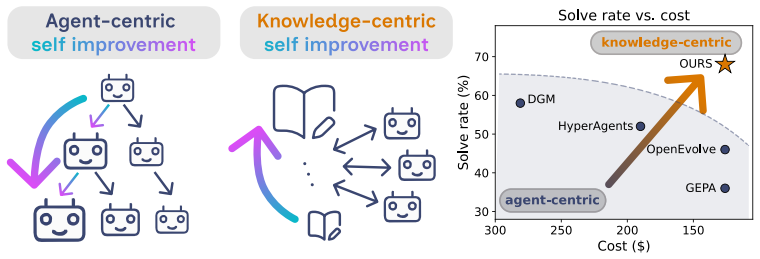
Self-improvement can be driven primarily by a curated knowledge base rather than by the agent itself.
Reviewed by Pith at T0; open to challenge. T0 means a machine referee read the full paper against a public rubric. the ladder, T0–T4 →
2026-08-01 12:17 UTC pith:HRBEWU5X
load-bearing objection A plausible, transparent, and genuinely different mechanism for self-improvement via curated knowledge, but the main-loop causal claim is not yet supported — the held-out transfer results are the cleanest evidence in the paper. the 3 major comments →
Knowledge-Centric Self-Improvement
The pith
A machine-rendered reading of the paper's core claim, the machinery that carries it, and where it could break.
Core claim
The paper's central claim is that a system can improve at tasks without ever improving its agents, and that the persistent improving object should be a curated knowledge base. Agents are kept generic, stateless, and disposable: each one starts with a clean context, receives a distilled knowledge bundle, attempts a task, and contributes evidence back. A three-stage protocol consisting of task-level forum discussion, cross-task forum debate, and distillation converts individual attempts into scoped, evidence-grounded guidance. On the evaluated benchmarks, the paper reports that this protocol outperforms agent-centric self-improvement baselines in solve rate while using less money, that the dis
What carries the argument
The central object is the curated knowledge base shaped by a three-stage protocol: task-level forums, where agents post evidence-grounded claims about what worked and failed; cross-task forums, where claims must take explicit agree, disagree, or synthesize stances toward cited posts and survive only when grounded in concrete evidence; and distillation, which compresses the surviving claims into typed, actionable bundles—'when X, do Y'—that the next generation of fresh agents consumes. The mechanism isolates knowledge as the only changing variable: every agent is re-instantiated with fresh context and no private memory, so improvement across generations is attributed to the knowledge base.
Load-bearing premise
The central claim rests on the assumption that every generation-over-generation gain comes from the knowledge base, because agents are re-instantiated with fresh context; the paper includes no control that retries unsolved tasks for the same number of generations without seed knowledge, so stochastic retrying alone could account for part of the improvement.
What would settle it
Run the same 10-generation loop with a no-knowledge control: fresh agents with identical prompts, tools, and retry budget but an empty or sham seed knowledge base. If this control closes the gap with the knowledge-seeded solve rates on any benchmark, the claimed attribution to curated knowledge fails. On the transfer side, replacing the frozen distilled bundle with task-irrelevant text should recover the no-knowledge baseline if the bundle is the true carrier of value.
If this is right
- Self-improvement no longer requires a persistent, specialized agent; generic disposable agents suffice, shifting the bottleneck from agent architecture to the curated knowledge they consume.
- Solve-rate gains and lower dollar costs on the evaluated benchmarks imply self-improvement can be made cheaper to operate and easier to maintain.
- Because distilled knowledge transfers across LLM families, knowledge produced by one model can be consumed by another, making the improvement portable.
- Frozen knowledge improves zero-shot performance on held-out tasks, so the curated asset has standalone value after the run ends.
- Disagreement in forums is preserved as evidence rather than resolved, which may prevent premature convergence on wrong hypotheses.
Where Pith is reading between the lines
- A direct extension of the paper's design is a no-knowledge retry control that re-attempts unsolved tasks for the same number of generations with empty seed knowledge; the paper does not report one, so the size of the pure retrying component is untested.
- If the knowledge-centric paradigm scales, the cost of self-improvement shifts from inference-time agent complexity to offline curation, so knowledge can be amortized across many tasks and models.
- The protocol's practice of preserving unresolved disagreements as falsified-versus-untried hypotheses suggests a general anti-premature-consensus mechanism for multi-agent systems.
- A natural extension, not studied in the paper, is to fine-tune a base model on the distilled bundles, turning the reusable knowledge artifact into a direct weight update.
Editorial analysis
A structured set of objections, weighed in public.
Referee Report
Summary. The paper proposes knowledge-centric self-improvement: instead of improving the agent, the system maintains a persistent, curated knowledge base that fresh, stateless agents read from and write to. A three-stage protocol (task-level forums, cross-task forums, and distillation) converts agent attempts into typed, evidence-grounded bundles. The authors evaluate this protocol on ARC-AGI-1/2, Polyglot, SWE-bench Pro, and Terminal-Bench 2, comparing against agent-centric self-improvement baselines (DGM, HyperAgents, Meta-Harness) and prompt-optimization baselines (GEPA, OpenEvolve). They report higher or competitive solve rates at lower dollar cost, cross-LLM effectiveness (Haiku 4.5 and GPT-5.4-mini), and positive transfer of a frozen knowledge asset to held-out tasks and to a different LLM family. The central claim is that progress in self-improving agentic systems can be driven primarily by the curated persistent knowledge rather than by the agent design.
Significance. If the central claim is sustained, the paper makes a useful conceptual and practical contribution: it identifies a design axis (what persists) that is complementary to the usual agent-centric optimization, and it provides a cheap, inspectable, and transferable improvement artifact. The paper is unusually transparent: it ships detailed protocol schemas (Appendix E), full task maps (Appendix J), cost accounting (Appendix G), baseline provenance/deviation documentation (Appendix H), and worked examples of disagreement-driven curation (Appendix C). The held-out transfer experiment is a genuine out-of-sample test with a frozen knowledge asset and disjoint task splits, and the cross-LLM transfer is a concrete falsifiable prediction. These strengths are real. However, the evidence currently underdetermines the central attribution claim because the main self-improvement loop lacks a no-knowledge control, and the baseline comparisons are against modified forks with information-parity gates rather than the original published systems.
major comments (3)
- [§3, §4.1, Table 1] The paper's central attribution claim—"any performance gain across generations must come from the accumulated and distilled knowledge" (§3)—is not established by the reported experiments. Section 4.1 runs 10 generations on a 50-task pool, but there is no control condition that repeats the same fresh-agent retry schedule without any knowledge base. Because solved tasks are removed and unsolved tasks are retried by new stochastic agents, cumulative chance success across 10 attempts can be substantial; the paper's own Table 4 shows single-generation no-knowledge solve rates of 13–23% on held-out ARC-AGI-1 tasks. A no-knowledge generation-loop control (same number of generations, same per-task budget, no forums, no distillation, no knowledge injection) on the same 50-task pool is necessary to separate retrying/stochastic effects from knowledge-driven gains. The held-out transfer experiment (
- [§4.1, Appendix H] Table 1a compares against DGM and HyperAgents, but the reported baseline numbers come from forks with substantial modifications: LLM substitution, information-parity gates that remove gold answers and hidden tests from the self-improvement loop, egress isolation, and newly authored benchmark adapters. The claim that "all baselines are rerun under our evaluation protocol" is transparent, but the claim in the abstract and Section 4.1 that the method "outperforms agent-centric baselines" should be qualified as outperforming the authors' modified, information-parity-gated re-runs, not the original published systems. Whether the parity gates preserve the "core optimization algorithm" is an assumption, not a demonstrated fact; for example, DGM's diagnosis loop is described in Appendix H as no longer seeing gold patches and hidden tests, which may be integral to its original self-modification m
- [§4.4, Appendix L, Appendix J] The transfer evidence is weakened by post-hoc design choices that are disclosed but not tested. First, the task-conditioned adapter's item bounds were relaxed after observing benchmark variation (Appendix L: "we relaxed the constraints and allowed the agent to dynamically determine how much knowledge to transfer"), making the adapter a tuned component rather than a fixed property of the frozen knowledge asset. Second, the transfer evaluation set was selected from tasks that both recipient LLMs fail at seed 0 (Appendix J), which inflates headroom and makes the no-knowledge baseline low by construction; this is disclosed, but it means the transfer numbers are conditional on a selection procedure that depends on the recipients' no-knowledge abilities. Third, for Polyglot the transfer split is task-identifier-disjoint but not exercise-disjoint: 7 of 20 evaluation tasks are the same Exercism
minor comments (5)
- [§1] Typographical: "in thisknowledge-centric self-improvementparadigm" is missing spaces around "knowledge-centric" and "paradigm."
- [Table 1/Table 3] The table header "OURShaiku 4.5" and "OURSgpt 5.4−mini" are visually cramped; please add spacing or a line break for readability.
- [Figure 3b] The example labels contain apparent typos ("Count-Dataset-T okens", "T ask-level Insights"). Please proofread figure text.
- [§4.4] The caption for Table 4 says "20 held-out tasks" but the selection procedure in Appendix J says tasks were chosen from the intersection of both recipients' failure sets; please make the selection criterion explicit in the main text so readers do not interpret the held-out set as a random sample of all held-out tasks.
- [§4.2] The comparison with GEPA and OpenEvolve uses matched dollar budgets but different iteration counts; it would be helpful to state explicitly that the prompt-optimization baselines were not extended to other benchmarks for budget reasons, and to note that this comparison is therefore narrower than the agent-centric comparison.
Circularity Check
No significant circularity: benchmark comparisons and held-out transfer are externally grounded; the causal-attribution gap is a missing control, not a self-referential derivation.
full rationale
The solve-rate claims in Table 1 rest on external benchmark outcomes (official ARC exact-match scoring, SWE-bench Pro harness, Polyglot tests, Terminal-Bench 2 verifier), and the reported costs cover all loop phases, so the headline comparison is not a rescaling of the authors' own definitions. The held-out transfer experiment (Section 4.4) is a genuine out-of-sample test: the generation-10 asset is frozen and consumed zero-shot by fresh recipients on disjoint 20-task splits with no recipient-side forum or distillation, and the comparison is against a no-knowledge condition on the same tasks. No parameter is fitted to a subset and then reported as a prediction of a closely related quantity. The paper contains no load-bearing self-citation and no imported uniqueness theorem; its references are independent prior systems, and no argument's force comes from an author-overlapping citation. Two caveats should be weighed as validity concerns rather than circularity. First, Section 3 asserts 'any performance gain across generations must come from the accumulated and distilled knowledge they receive' merely from re-instantiating agents; without a no-knowledge generation control that retries unsolved tasks for the same number of generations, cumulative stochastic retrying is a confound, but this is an omitted control rather than an input-output identity. Second, Appendix J admits the transfer tasks were selected from a seed-0 no-knowledge failure intersection ('the no-knowledge baseline solve rates are low by construction') and that 7 of 20 Polyglot transfer tasks are the same Exercism exercise in a different language; Section L similarly notes the transfer adapter was relaxed after observing benchmark variation. These limit the strength of the transfer claims but do not make the improvement definitionally equal to the knowledge base's own content. I therefore find no significant circularity.
Axiom & Free-Parameter Ledger
free parameters (5)
- generations =
10
- forum_rounds =
1 per-task forum round; 2 cross-task forum rounds per generation
- task_conditioned_adapter_bounds =
0-3 items per list field
- transfer_eval_set =
20 tasks that both recipient LLMs failed at seed-0
- baseline_fork_timeouts =
3600s per task vs 1800s in main runs
axioms (6)
- domain assumption LLM agents produce consistent enough behavior across fresh contexts that generation-over-generation gains can be attributed to the knowledge base.
- ad hoc to paper The information-parity gates and LLM substitutions in the baseline forks preserve the core optimization algorithms of DGM and HyperAgents.
- domain assumption Held-out transfer tasks are representative of the self-improvement task distribution.
- domain assumption Benchmark exact-match and verification protocols are accepted measures of task success.
- domain assumption Removing solved tasks from the active pool does not bias comparisons against baselines.
- ad hoc to paper Forum and distillation prompts elicit evidence-grounded, actionable knowledge rather than generic advice.
Cite this review
Pith. "Pith review of Knowledge-Centric Self-Improvement." pith.science (2026). https://pith.science/paper/HRBEWU5X
@misc{pith2026260719592,
  author       = {Pith},
  title        = {Pith review of: Knowledge-Centric Self-Improvement},
  year         = {2026},
  howpublished = {\url{https://pith.science/paper/HRBEWU5X}},
  note         = {Machine review of arXiv:2607.19592}
}
read the original abstract
Self-improving AI systems typically treat the agent as the object that improves, by optimizing prompts, workflows, harnesses, or even the agent's own code. This agent-centric view can make improvements expensive to maintain and difficult to transfer, because gains become tied to a particular agent design, task distribution, or adaptation run. We study a complementary paradigm: knowledge-centric self-improvement, in which agents remain generic and disposable while the persistent object is a curated knowledge base that agents can leverage for future tasks. We conduct controlled case studies to operationalize this idea via a simple protocol. Agents attempt one task, then contribute evidence-grounded insights to a shared knowledge base via task-level and cross-task forums, followed by knowledge distillation. Because self-improvement is contained in the knowledge rather than the agent, improvement can be more inspectable, transferable, and portable. Across abstract reasoning, coding, and terminal benchmarks, this protocol improves solve rates while reducing dollar cost relative to agent-centric baselines. The resulting distilled knowledge also transfers to held-out tasks and across LLM families, indicating that the improvement is not merely an LLM- or run-specific behavior. These results support a new view of self-improving agentic systems: progress can be driven primarily by the curated persistent knowledge. Code is available at https://github.com/recursive-knowledge/KSI.
Figures


Reference graph
Works this paper leans on
-
[1]
L. A. Agrawal, S. Tan, D. Soylu, N. Ziems, R. Khare, K. Opsahl-Ong, A. Singhvi, H. Shandilya, M. J. Ryan, M. Jiang, C. Potts, K. Sen, A. G. Dimakis, I. Stoica, D. Klein, M. Zaharia, and O. Khattab. Gepa: Reflective prompt evolution can outperform reinforcement learning.arXiv preprint arXiv:2507.19457, 2025
Pith/arXiv arXiv 2025
-
[2]
T. Akiba, M. Shing, Y . Tang, Q. Sun, and D. Ha. Evolutionary Optimization of Model Merging Recipes.Nature Machine Intelligence, 7(2):195–204, 2025. ISSN 2522-5839. doi: 10.1038/s42256-024-00975-8
-
[3]
H. Assumpção, D. Ferreira, L. Campos, and F. Murai. CodeEvolve: An open source evolutionary coding agent for algorithmic discovery and optimization.arXiv preprint arXiv:2510.14150, 2025
Pith/arXiv arXiv 2025
-
[4]
goose: An open source, extensible ai agent, 2025
Block, Inc. goose: An open source, extensible ai agent, 2025. URL https://github.com/ block/goose
2025
-
[5]
S. Borgeaud, A. Mensch, J. Hoffmann, T. Cai, E. Rutherford, K. Millican, G. van den Driessche, J.-B. Lespiau, B. Damoc, A. Clark, D. de Las Casas, A. Guy, J. Menick, R. Ring, T. Hennigan, S. Huang, L. Maggiore, C. Jones, A. Cassirer, A. Brock, M. Paganini, G. Irving, O. Vinyals, S. Osindero, K. Simonyan, J. W. Rae, E. Elsen, and L. Sifre. Improving langua...
Pith/arXiv arXiv 2022
-
[6]
P. Chhikara, D. Khant, S. Aryan, T. Singh, and D. Yadav. Mem0: Building production-ready ai agents with scalable long-term memory.arXiv preprint arXiv:2504.19413, 2025
Pith/arXiv arXiv 2025
-
[7]
F. Chollet. On the measure of intelligence.arXiv preprint arXiv:1911.01547, 2019
Pith/arXiv arXiv 1911
-
[8]
W. L. de Oliveira, M. Bobokhonov, M. Caorsi, A. Podestà, G. Beltramo, L. Crosato, M. Bonotto, F. Cecchetto, H. Espic, D. T. Salajan, S. Taga, L. Pana, and J. Carthy. Arc-agi-2 technical report. arXiv preprint arXiv:2603.06590, 2026
arXiv 2026
-
[9]
X. Deng, J. Da, E. Pan, Y . Y . He, C. Ide, K. Garg, N. Lauffer, A. Park, N. Pasari, C. Rane, K. Sampath, M. Krishnan, S. Kundurthy, S. Hendryx, Z. Wang, V . Bharadwaj, J. Holm, R. Aluri, C. B. C. Zhang, N. Jacobson, B. Liu, and B. Kenstler. Swe-bench pro: Can ai agents solve long-horizon software engineering tasks?arXiv preprint arXiv:2509.16941, 2025
Pith/arXiv arXiv 2025
-
[10]
R. Fang, Y . Liang, X. Wang, J. Wu, S. Qiao, P. Xie, F. Huang, H. Chen, and N. Zhang. Memp: Exploring agent procedural memory.arXiv preprint arXiv:2508.06433, 2025
Pith/arXiv arXiv 2025
-
[11]
Fernando, D
C. Fernando, D. Banarse, H. Michalewski, S. Osindero, and T. Rocktäschel. Promptbreeder: Self-referential self-improvement via prompt evolution. InProceedings of the 41st International Conference on Machine Learning, volume 235 ofICML’24, pages 13481–13544. JMLR.org, 2024
2024
-
[12]
Y . Fu, D.-K. Kim, J. Kim, S. Sohn, L. Logeswaran, K. Bae, and H. Lee. Autoguide: Automated generation and selection of context-aware guidelines for large language model agents.arXiv preprint arXiv:2403.08978, 2024
Pith/arXiv arXiv 2024
-
[13]
Gauthier
P. Gauthier. o1 tops aider’s new polyglot leaderboard.https://aider.chat/2024/12/21/ polyglot.html, Dec. 2024. Accessed: 2026-01-28
2024
-
[14]
S. Hu, C. Lu, and J. Clune. Automated design of agentic systems.arXiv preprint arXiv:2408.08435, 2025
Pith/arXiv arXiv 2025
-
[15]
Terminus-KIRA: Boosting frontier model performance on terminal-bench with minimal harness, 2026
KRAFTON AI and Ludo Robotics. Terminus-KIRA: Boosting frontier model performance on terminal-bench with minimal harness, 2026. URL https://github.com/krafton-ai/ KIRA
2026
-
[16]
Y . Lee, R. Nair, Q. Zhang, K. Lee, O. Khattab, and C. Finn. Meta-harness: End-to-end optimization of model harnesses.arXiv preprint arXiv:2603.28052, 2026. 11
Pith/arXiv arXiv 2026
-
[17]
P. Lewis, E. Perez, A. Piktus, F. Petroni, V . Karpukhin, N. Goyal, H. Küttler, M. Lewis, W. tau Yih, T. Rocktäschel, S. Riedel, and D. Kiela. Retrieval-augmented generation for knowledge- intensive nlp tasks.arXiv preprint arXiv:2005.11401, 2020
Pith/arXiv arXiv 2005
-
[18]
Maharana, D.-H
A. Maharana, D.-H. Lee, S. Tulyakov, M. Bansal, F. Barbieri, and Y . Fang. Evaluating very long-term conversational memory of llm agents. InProceedings of the 62nd Annual Meeting of the Association for Computational Linguistics (V olume 1: Long Papers), pages 13851–13870. Association for Computational Linguistics, 2024
2024
-
[19]
M. A. Merrill, A. G. Shaw, N. Carlini, B. Li, H. Raj, I. Bercovich, L. Shi, J. Y . Shin, T. Walshe, E. K. Buchanan, J. Shen, G. Ye, H. Lin, J. Poulos, M. Wang, M. Nezhurina, J. Jitsev, D. Lu, O. M. Mastromichalakis, Z. Xu, Z. Chen, Y . Liu, R. Zhang, L. L. Chen, A. Kashyap, J.-L. Uslu, J. Li, J. Wu, M. Yan, S. Bian, V . Sharma, K. Sun, S. Dillmann, A. Ana...
Pith/arXiv arXiv 2026
-
[20]
A. Novikov, N. V˜u, M. Eisenberger, E. Dupont, P.-S. Huang, A. Z. Wagner, S. Shirobokov, B. Kozlovskii, F. J. R. Ruiz, A. Mehrabian, M. P. Kumar, A. See, S. Chaudhuri, G. Holland, A. Davies, S. Nowozin, P. Kohli, and M. Balog. Alphaevolve: A coding agent for scientific and algorithmic discovery.arXiv preprint arXiv:2506.13131, 2025
Pith/arXiv arXiv 2025
-
[21]
C. Packer, S. Wooders, K. Lin, V . Fang, S. G. Patil, I. Stoica, and J. E. Gonzalez. Memgpt: Towards llms as operating systems.arXiv preprint arXiv:2310.08560, 2024
Pith/arXiv arXiv 2024
-
[22]
Y . Pu, T. Lin, and H. Chen. PiFlow: Principle-Aware Scientific Discovery with Multi-Agent Collaboration.arXiv preprint arXiv:2505.15047, May 2025
arXiv 2025
-
[23]
A. Sharma. Openevolve: an open-source evolutionary coding agent, 2025. URL https: //github.com/algorithmicsuperintelligence/openevolve
2025
-
[24]
X. Tang, T. Qin, T. Peng, Z. Zhou, D. Shao, T. Du, X. Wei, P. Xia, F. Wu, H. Zhu, G. Zhang, J. Liu, X. Wang, S. Hong, C. Wu, H. Cheng, C. Wang, and W. Zhou. Agent kb: Leveraging cross-domain experience for agentic problem solving.arXiv preprint arXiv:2507.06229, 2025
arXiv 2025
-
[25]
G. Wang, Y . Xie, Y . Jiang, A. Mandlekar, C. Xiao, Y . Zhu, L. Fan, and A. Anandkumar. V oyager: An Open-Ended Embodied Agent with Large Language Models.arXiv preprint arXiv:2305.16291, Oct. 2023
Pith/arXiv arXiv 2023
-
[26]
J. Wang, Z. Hu, and L. Bing. Evolving Prompts In-Context: An Open-ended, Self-replicating Perspective. InF orty-Second International Conference on Machine Learning, June 2025
2025
-
[27]
W. Wang, P. Pi˛ ekos, L. Nanbo, F. Laakom, Y . Chen, M. Ostaszewski, M. Zhuge, and J. Schmid- huber. Huxley-gödel machine: Human-level coding agent development by an approximation of the optimal self-improving machine.arXiv preprint arXiv:2510.21614, 2025
arXiv 2025
-
[28]
X. Wang, B. Li, Y . Song, F. F. Xu, X. Tang, M. Zhuge, J. Pan, Y . Song, B. Li, J. Singh, H. H. Tran, F. Li, R. Ma, M. Zheng, B. Qian, Y . Shao, N. Muennighoff, Y . Zhang, B. Hui, J. Lin, R. Brennan, H. Peng, H. Ji, and G. Neubig. Openhands: An open platform for ai software developers as generalist agents.arXiv preprint arXiv:2407.16741, 2025
Pith/arXiv arXiv 2025
-
[29]
Z. Z. Wang, J. Mao, D. Fried, and G. Neubig. Agent workflow memory.arXiv preprint arXiv:2409.07429, 2024
Pith/arXiv arXiv 2024
-
[30]
D. Wu, H. Wang, W. Yu, Y . Zhang, K.-W. Chang, and D. Yu. Longmemeval: Benchmarking chat assistants on long-term interactive memory.arXiv preprint arXiv:2410.10813, 2024
Pith/arXiv arXiv 2024
-
[31]
R. Wu, X. Wang, J. Mei, P. Cai, D. Fu, C. Yang, L. Wen, X. Yang, Y . Shen, Y . Wang, and B. Shi. Evolver: Self-evolving llm agents through an experience-driven lifecycle.arXiv preprint arXiv:2510.16079, 2026. 12
Pith/arXiv arXiv 2026
-
[32]
Z. Wu, C. Han, Z. Ding, Z. Weng, Z. Liu, S. Yao, T. Yu, and L. Kong. OS-Copilot: Towards Generalist Computer Agents with Self-Improvement, Feb. 2024
2024
-
[33]
C. S. Xia, Z. Wang, Y . Yang, Y . Wei, and L. Zhang. Live-SWE-agent: Can Software Engineering Agents Self-Evolve on the Fly?, Nov. 2025
2025
-
[34]
W. Xu, Z. Liang, K. Mei, H. Gao, J. Tan, and Y . Zhang. A-mem: Agentic memory for llm agents.arXiv preprint arXiv:2502.12110, 2025
Pith/arXiv arXiv 2025
-
[35]
J. Yang, C. E. Jimenez, A. Wettig, K. Lieret, S. Yao, K. R. Narasimhan, and O. Press. SWE- agent: Agent-computer interfaces enable automated software engineering. InThe Thirty-eighth Annual Conference on Neural Information Processing Systems, 2024
2024
-
[36]
L. Yang, Z. Yu, T. Zhang, S. Cao, M. Xu, W. Zhang, J. E. Gonzalez, and B. Cui. Buffer of thoughts: Thought-augmented reasoning with large language models.arXiv preprint arXiv:2406.04271, 2024
Pith/arXiv arXiv 2024
-
[37]
H. Ye, X. He, V . Arak, H. Dong, and G. Song. Meta Context Engineering via Agentic Skill Evolution.arXiv preprint arXiv:2601.21557, Feb. 2026
arXiv 2026
-
[38]
X. Yin, X. Wang, L. Pan, L. Lin, X. Wan, and W. Y . Wang. Gödel Agent: A Self-Referential Agent Framework for Recursively Self-Improvement. In W. Che, J. Nabende, E. Shutova, and M. T. Pilehvar, editors,Proceedings of the 63rd Annual Meeting of the Association for Computational Linguistics (V olume 1: Long Papers), pages 27890–27913, Vienna, Austria, July
-
[39]
Zelikman, Y
E. Zelikman, Y . Wu, J. Mu, and N. Goodman. STaR: Bootstrapping Reasoning With Reasoning. InAdvances in Neural Information Processing Systems, volume 35, pages 15476–15488, Oct. 2022
2022
-
[40]
G. Zhang, M. Fu, G. Wan, M. Yu, K. Wang, and S. Yan. G-memory: Tracing hierarchical memory for multi-agent systems.arXiv preprint arXiv:2506.07398, 2025
Pith/arXiv arXiv 2025
-
[41]
G. Zhang, H. Ren, C. Zhan, Z. Zhou, J. Wang, H. Zhu, W. Zhou, and S. Yan. MemEvolve: Meta-Evolution of Agent Memory Systems.arXiv preprint arXiv:2512.18746, Dec. 2025
Pith/arXiv arXiv 2025
-
[42]
J. Zhang, S. Hu, C. Lu, R. Lange, and J. Clune. Darwin godel machine: Open-ended evolution of self-improving agents.arXiv preprint arXiv:2505.22954, 2025
Pith/arXiv arXiv 2025
- [43]
-
[44]
Q. Zhang, C. Hu, S. Upasani, B. Ma, F. Hong, V . Kamanuru, J. Rainton, C. Wu, M. Ji, H. Li, U. Thakker, J. Zou, and K. Olukotun. Agentic Context Engineering: Evolving Contexts for Self-Improving Language Models.arXiv preprint arXiv:2510.04618, Mar. 2026
Pith/arXiv arXiv 2026
-
[45]
S. Zhang, J. Wang, R. Zhou, J. Liao, Y . Feng, Z. Li, Y . Zheng, W. Zhang, Y . Wen, Z. Li, F. Xiong, Y . Qi, B. Tang, and M. Wen. Memrl: Self-evolving agents via runtime reinforcement learning on episodic memory.arXiv preprint arXiv:2601.03192, 2026
Pith/arXiv arXiv 2026
-
[46]
Y . Zhang, P. Ye, X. Yang, S. Feng, S. Zhang, L. Bai, W. Ouyang, and S. Hu. Nature-Inspired Population-Based Evolution of Large Language Models.arXiv preprint arXiv:2503.01155, Mar. 2025
Pith/arXiv arXiv 2025
-
[47]
A. Zhao, D. Huang, Q. Xu, M. Lin, Y .-J. Liu, and G. Huang. Expel: Llm agents are experiential learners.arXiv preprint arXiv:2308.10144, 2024
Pith/arXiv arXiv 2024
-
[48]
B. Zheng, M. Y . Fatemi, X. Jin, Z. Z. Wang, A. Gandhi, Y . Song, Y . Gu, J. Srinivasa, G. Liu, G. Neubig, and Y . Su. Skillweaver: Web agents can self-improve by discovering and honing skills.arXiv preprint arXiv:2504.07079, 2025
Pith/arXiv arXiv 2025
-
[49]
W. Zhong, L. Guo, Q. Gao, H. Ye, and Y . Wang. Memorybank: Enhancing large language models with long-term memory.arXiv preprint arXiv:2305.10250, 2023
Pith/arXiv arXiv 2023
-
[50]
adaptive rejection sampling
M. Zhuge, W. Wang, L. Kirsch, F. Faccio, D. Khizbullin, and J. Schmidhuber. GPTSwarm: Language Agents as Optimizable Graphs. InF orty-First International Conference on Machine Learning, June 2024. 13 Appendix Contents A. Attempt Runtime Lifecycle . . . . . . . . . . . . . . . . . . . . . . . . . . . . . . . . . . . . . . . . . . . . . . . . . . . . . . . ...
2024
-
[52]
Read each training pair; note dimensions, palette, objects, and what changed input -> output
-
[53]
Within your first few turns, write a first-pass guess to BOTH attempt_1.txt and attempt_2.txt (a copy of the test input is fine as a placeholder) so the workspace always contains a submission
-
[54]
Form one transformation rule that explains every training pair and verify it pair-by-pair before applying
-
[55]
Apply the rule to the test input and overwrite attempt_1.txt and attempt_2.txt with the refined answer (submit two structurally different hypotheses if you can construct them; otherwise submit the same grid into both files)
-
[56]
Read ‘TASK.md‘ in the active task workspace
Validate before exit: python3 /workspace/task/workspace/validate_prediction.py \\ /workspace/task/workspace/attempt_1.txt \\ /workspace/task/workspace/attempt_2.txt """ Listing 7: Illustrative ARC prompt excerpt; abstracted from _build_arc_no_mcp_execution_promptinprompts/__init__.py. SWE-bench Pro.For swebench_pro, the prompt frames each task as reposito...
-
[57]
25d487eb
83302e8f 26. 25d487eb
-
[58]
ea32f347
f76d97a5 27. ea32f347
-
[59]
1fad071e
8efcae92 28. 1fad071e
-
[60]
dc0a314f
1190e5a7 29. dc0a314f
-
[61]
6ecd11f4
57aa92db 30. 6ecd11f4
-
[62]
9ecd008a
a85d4709 31. 9ecd008a
-
[63]
b8825c91
a416b8f3 32. b8825c91
-
[64]
25d8a9c8
890034e9 33. 25d8a9c8
-
[65]
776ffc46 27
694f12f3 34. 776ffc46 27
-
[66]
9172f3a0
a1570a43 35. 9172f3a0
-
[67]
6cf79266
780d0b14 36. 6cf79266
-
[68]
caa06a1f
bdad9b1f 37. caa06a1f
-
[69]
d22278a0
4938f0c2 38. d22278a0
-
[70]
4612dd53
a740d043 39. 4612dd53
-
[71]
b6afb2da
3428a4f5 40. b6afb2da
-
[72]
94f9d214
6455b5f5 41. 94f9d214
-
[73]
aabf363d
f35d900a 42. aabf363d
-
[74]
5ad4f10b
23b5c85d 43. 5ad4f10b
-
[75]
1e0a9b12
ce22a75a 44. 1e0a9b12
-
[76]
b548a754
5582e5ca 45. b548a754
-
[77]
05f2a901
af902bf9 46. 05f2a901
-
[78]
239be575
e48d4e1a 47. 239be575
-
[79]
e8593010
c8f0f002 48. e8593010
-
[80]
8731374e
36d67576 49. 8731374e
-
[81]
e509e548 ARC-AGI-1 Knowledge-Transfer Evaluation Tasks
6b9890af 50. e509e548 ARC-AGI-1 Knowledge-Transfer Evaluation Tasks
This paper was first reviewed by deepseek-v4-flash on August 1, 2026.
discussion (0)
Sign in with ORCID, Apple, or X to comment. Anyone can read and Pith papers without signing in.