REVIEW 5 major objections 5 minor 23 references
Preference post-training works by splitting the learned parameter update into a dominant spectral head and a residual tail that completes the solution.
Reviewed by Pith at T0; open to challenge. T0 means a machine referee read the full paper against a public rubric. the ladder, T0–T4 →
T0 review · deepseek-v4-flash
2026-08-02 14:16 UTC pith:5TIS623F
load-bearing objection A useful spectral decomposition of preference updates, but the central 'functional' claim is undercut by the energy-ordering confound: head vs tail is magnitude vs low-norm, and the paper never controls for that. the 5 major comments →
Preference Tuning as Spectral Update Reorganization
The pith
A machine-rendered reading of the paper's core claim, the machinery that carries it, and where it could break.
Core claim
On the paper's own terms, the central claim is that preference-induced updates exhibit a functional spectral head-tail split. The leading singular directions of the module-level update concentrate the visible behavioral shift from the base model and the solver identity of the training run; the residual tail, though weak alone, is required to recover the full solution, especially out-of-distribution behavior. The paper shows this by reloading each component as a separate LoRA adapter, by swapping heads and tails across runs, and by projecting training steps onto head-only or tail-only subspaces. Endpoint salience is thus separated from learning sufficiency: what dominates the final behavior i
What carries the argument
The central object is the effective update Delta-W from the pre-tuning weights to the tuned checkpoint, expressed for LoRA as the scaled product B times A. Each module-level update is decomposed as U Sigma V^T; the spectral head is the leading r = 16 singular components and the residual tail is the complement. Because the decomposition is additive and each component can be refactorized into LoRA factors via B_c = U_c Sigma_c^{1/2} and A_c = Sigma_c^{1/2} V_c^T, the components become exactly recomposable plug-in modules. This lets the paper isolate, delete, swap, and train on spectral components; entropy effective rank tracks whether update mass is concentrated or dispersed.
Load-bearing premise
The functional roles of head and tail are established on two controlled synthetic DPO runs with programmatically verifiable tasks, and the paper assumes this testbed captures how real preference post-training organizes behavior; the 12-setting generality evidence shows only spectral shape, not behavioral function.
What would settle it
Train a LoRA adapter on a standard benchmark preference dataset, split it at rank 16, and load only the tail; if the tail-only model measurably departs from the base model on in-distribution or TRAP tasks, or if head-only training reaches full accuracy including out-of-distribution, the functional head-tail split does not hold.
If this is right
- If the split is functional, then the endpoint behavior of a tuned model is largely determined by a small number of singular directions, so inspecting the spectrum of the update can predict the direction of the behavioral shift.
- Because head-only training fails out-of-distribution while full training recovers the solution, optimization needs more than the dominant directions; the residual tail plays a supporting role in preserving breadth.
- Cross-run recomposition shows that mixed adapters follow the head's source, so the spectral head encodes run-level solver bias.
- Coherent prompt-preference pairing appears to be an upstream condition for stable update structure; corrupting preference pairs degrades behavior, consistent with the head-tail organization depending on consistent supervision.
Where Pith is reading between the lines
- The paper does not say this, but if the head carries run-level solver bias, then combining the head of one preference run with the tail of another could transplant a desired behavioral style while preserving the breadth of a second run.
- A testable extension is to track the head-to-tail energy ratio during training as an early indicator of coverage loss; the paper's effective-rank curves suggest such a monitor, but no operational threshold is proposed.
- Because the controlled behavioral testbed uses only two synthetic DPO runs, extending the plug-in protocol to GRPO on reasoning benchmarks or to dense fine-tuning would test whether the functional division generalizes; the paper itself flags this as open.
- The result implies that tail-only learning looks useless if judged by endpoint gain alone, but discarding the tail could quietly harm out-of-distribution robustness.
Editorial analysis
A structured set of objections, weighed in public.
Referee Report
Summary. The paper analyzes preference-tuned LoRA adapter updates by singular value decomposition. It defines a spectral head (the top-r singular component of each module-level effective update) and a residual tail, then uses plug-in intervention, cross-run recomposition, training-time projection, and supervision corruption to argue that the head–tail split is functional rather than merely descriptive. The descriptive part is supported by spectral-shape evidence across 12 model/algorithm/supervision settings, while the functional claims rest on two controlled synthetic DPO runs (Run-Direct and Run-Deliberate) on programmatically verifiable tasks. The paper concludes that preference tuning behaves as structured update reorganization: the head carries dominant endpoint behavior and run-level solver bias, the tail is weak alone but needed for learning completeness, and alignment gain/coverage loss may share a structural source.
Significance. If the functional head–tail separation is established, this would be a useful diagnostic reframing of RLHF/DPO update structure, with implications for interpretability and for understanding alignment–coverage tradeoffs. The work has clear strengths: the decomposition of scaled effective LoRA updates is exact, the synthetic task protocols are programmatically verifiable, the tables report exact numerical values, and the 12-setting spectral survey is a solid descriptive result. However, the central functional claim is currently underdetermined. The plug-in and recomposition experiments inject head and tail at their native scales, so the observed asymmetry may be a magnitude artifact; the functional experiments are based on two synthetic runs with no seed sweeps; and the fixed split rank is not tested for sensitivity. These issues must be addressed before the functional interpretation can be accepted.
major comments (5)
- [§5.2 / Appendix A.5 / Table 2] The conclusion that the spectral head is 'not merely the largest-energy fragment' is not supported by the reported procedure. Section 3.2 defines the head as the top-r singular component, and Appendix A.5 says components are refactorized at their native scale; no norm equalization is described. Thus head-only is a high-Frobenius-norm perturbation and tail-only is low-norm, so the plug-in asymmetry in Fig. 3 is exactly what energy dominance predicts. To establish functional identity, the authors should inject head and tail at matched Frobenius norm, and include a control with random spectral slices of equal norm. This control is needed for both the plug-in and recomposition experiments; without it, the central 'functional rather than merely descriptive' claim reduces to a magnitude effect.
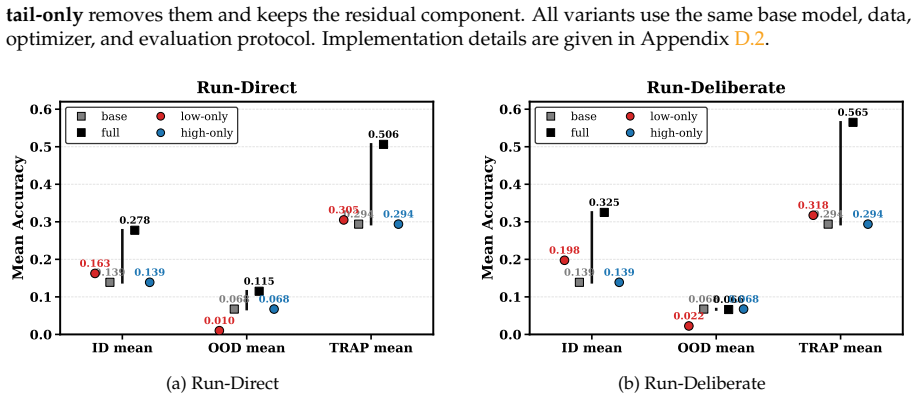
- [§5.2 / Table 2] Even at native scales, Table 2 does not consistently support 'carries the dominant endpoint effect'. In Run-Direct, ID-C accuracy is base 0.161, full 0.226, head-only 0.007; in TRAP-C, base 0.329, full 0.506, head-only 0.212. Head-only is often far below full and sometimes below base. The paper should report a per-metric effect-size measure, e.g., (head - base)/(full - base), and state which metrics support the claim. As written, Fig. 3 and Table 2 support only 'head is a visible, sometimes counterproductive perturbation', not 'head carries the dominant endpoint effect'.
- [§6.1 / Table 3] The cross-run recomposition has the same norm confound. Each mixed adapter contains the full-norm head of one run, so its behavior will resemble that run's head-only variant by magnitude alone. Table 3 shows head(B)+tail(A) is closest to Run-Deliberate head-only (MAD 0.032), but that is the component it literally contains; an equal-norm baseline is missing. Please add norm-matched random spectral slices and/or scale-matched tails, and report recomposition against those baselines.
- [§6.2 / Table 4] The tail-only training results exactly reproduce base in every cell (e.g., 0.1388/0.0675/0.2938 for both runs). This is consistent with the tail having negligible norm and hence a negligible learning signal, rather than with a 'support role'. Report the Frobenius norm of head and tail components and of the projected updates across training. If tail-only updates are numerically near zero, the learning-insufficiency claim is a magnitude artifact and should be reframed.
- [§5.1, §7.2 / Fig. 2] All functional conclusions rest on two synthetic DPO runs with a fixed split rank r=16. The 12-setting survey in Fig. 2 concerns only spectral shape, not functional plug-in behavior. The limitation in §7.2 is candid, but the abstract and conclusion generalize substantially. Please add seed sweeps with error bars and a split-rank sensitivity analysis (e.g., r ∈ {8, 32, 48}), or explicitly restrict the functional claims to the controlled synthetic setting.
minor comments (5)
- [Figure 3] The legend uses 'low'/'high' while the text and Table 2 use 'tail-only'/'head-only'. This mismatch makes the figure hard to read; unify the terminology.
- [Figure 5] The marker legend uses 'low-only'/'high-only' while the text says tail-only/head-only. Please use consistent names.
- [Table 3] The 'Compared to' column contains 'Run-Deliberate low' and similar abbreviations. Use the same variant names as in Table 2 (base/full/head-only/tail-only).
- [Appendix A.7] The projection equations omit the module subscripts ℓ,j that appear in Section 3.2. Adding them would make the local projection operation unambiguous.
- [Figure 4 / §6.1] MAD is a distance, not a similarity; the text says 'similarity' in the figure caption. 'Closeness' or 'distance' would be more accurate.
Circularity Check
No significant circularity: head/tail roles are empirically tested, not definitionally entailed; the energy confound is a validity risk, not a circular reduction.
full rationale
The paper's central derivation chain is not circular. In §3.2 the head and tail are defined purely by sorted singular-value truncation, and the paper explicitly states: "The names head and tail are purely spectral at definition time. We do not assume that they correspond to fixed behavioral categories. Their roles are tested empirically through plug-in intervention, cross-run recomposition, and training-time projection." The functional claims in §5.2 are then inferred from plug-in intervention, cross-run recomposition, and training-time projection rather than from the definitions themselves. The target behaviors (ID/OOD/TRAP accuracy) are measured on programmatically verifiable held-out splits, not fitted from the SVD construction. The strongest concern is an experimental confound rather than a circular one: because head-only and tail-only are injected at their native scales (Appendix A.5), the head has a larger Frobenius norm by construction, so the plug-in asymmetry may partly reflect energy rather than a distinct functional role. This weakens the "not merely the largest-energy fragment" conclusion, but it does not make the claim equivalent to the definition: behavioral effects are not formally determined by the SVD partition, and the paper never defines "endpoint effect" as energy. The limitations in §7.2 and the caveat in §6.3 ("behavioral rather than spectrally closed") further acknowledge what is and is not established. No load-bearing self-citation or imported uniqueness theorem appears; prior SVD/task-vector work is cited only as context. A norm-matching control would strengthen the evidence, but the absence of that control is a correctness-risk issue for the functional claim, not circularity.
Axiom & Free-Parameter Ledger
free parameters (2)
- spectral split rank r =
16
- LoRA rank r0 =
64
axioms (4)
- standard math The effective update ΔW = UΣV^T, and truncation plus complement reconstruct the full update exactly.
- domain assumption The scaled LoRA effective update ΔW = sBA on a frozen backbone fully represents the learned change from preference tuning.
- domain assumption The top-r spectral subspace of each module-level update is a behaviorally meaningful partition at the chosen r.
- domain assumption The synthetic, programmatically verifiable ID/OOD/TRAP task suite captures real preference-tuning alignment and coverage behavior.
read the original abstract
Preference-based post-training is usually understood through endpoint behavior, yet the learned update that produces this behavior remains largely opaque. We study RLHF and related preference optimization through the spectral structure of their induced parameter updates. By decomposing effective LoRA updates and reloading their spectral components as plug-in modules, we turn preference-induced updates into objects that can be isolated, recomposed, and directly intervened on. Across model families, optimization algorithms, and supervision regimes, these updates consistently develop a spectral head--tail organization. A compact head emerges early and carries the dominant endpoint shift, while a heterogeneous residual tail remains. The split is functional rather than merely descriptive. Plug-in intervention shows that the head accounts for the visible behavioral departure from the base model, while the tail is weak in isolation. Cross-run recomposition further shows that mixed adapters follow the source of the head, indicating that the head carries run-level solver bias. This endpoint dominance does not imply learning sufficiency. Head-only learning is non-vacuous but fails to recover the full solution, especially on out-of-distribution behavior. Tail-only learning yields little visible gain, yet the full solution is not recovered without the tail. These findings recast preference post-training as structured update reorganization rather than a monolithic behavioral correction, and suggest that alignment gain and coverage loss are tied to how the learned update itself is organized.
Figures



Reference graph
Works this paper leans on
-
[1]
I. Adewuyi, S. Okibe, and V . Ivanov. The multiple ticket hypothesis: Random sparse subnetworks suffice for rlvr.arXiv preprint arXiv:2602.01599,
-
[6]
D. Guo, D. Yang, H. Zhang, J. Song, P . Wang, Q. Zhu, R. Xu, R. Zhang, S. Ma, X. Bi, et al. Deepseek-r1: Incentivizing reasoning capability in llms via reinforcement learning.arXiv preprint arXiv:2501.12948,
- [7]
-
[8]
G. Ilharco, M. T. Ribeiro, M. Wortsman, S. Gururangan, L. Schmidt, H. Hajishirzi, and A. Farhadi. Editing models with task arithmetic.arXiv preprint arXiv:2212.04089,
-
[9]
A. Jaech, A. Kalai, A. Lerer, A. Richardson, A. El-Kishky, A. Low, A. Helyar, A. Madry, A. Beutel, A. Carney, et al. Openai o1 system card.arXiv preprint arXiv:2412.16720,
-
[10]
URL https: //arxiv.org/abs/2506.08125. K. Liu, D. Yang, Z. Qian, W. Yin, Y. Wang, H. Li, J. Liu, P . Zhai, Y. Liu, and L. Zhang. Reinforcement learning meets large language models: A survey of advancements and applications across the llm lifecycle.arXiv preprint arXiv:2509.16679,
-
[11]
S. Mukherjee, L. Yuan, D. Hakkani-Tur, and H. Peng. Reinforcement learning finetunes small subnetworks in large language models.arXiv preprint arXiv:2505.11711,
-
[12]
C. Qian, D. Liu, H. Wen, Z. Bai, Y. Liu, and J. Shao. Demystifying reasoning dynamics with mutual information: Thinking tokens are information peaks in llm reasoning.arXiv preprint arXiv:2506.02867,
-
[14]
Z. Shao, P . Wang, Q. Zhu, R. Xu, J. Song, X. Bi, H. Zhang, M. Zhang, Y. Li, Y. Wu, et al. Deepseekmath: Pushing the limits of mathematical reasoning in open language models.arXiv preprint arXiv:2402.03300,
-
[16]
Z. Tan, H. Geng, X. Yu, M. Zhang, G. Wan, Y. Zhou, Q. He, X. Xue, H. Zhou, Y. Fan, et al. Scaling behaviors of llm reinforcement learning post-training: An empirical study in mathematical reasoning. arXiv preprint arXiv:2509.25300,
-
[17]
K. Team, A. Du, B. Gao, B. Xing, C. Jiang, C. Chen, C. Li, C. Xiao, C. Du, C. Liao, et al. Kimi k1. 5: Scaling reinforcement learning with llms.arXiv preprint arXiv:2501.12599,
-
[19]
X. Yao, L. Yu, X. Hu, F. Teng, Q. Cui, J. Zhou, and Y. Liu. The debate on rlvr reasoning capability boundary: Shrinkage, expansion, or both? a two-stage dynamic view.arXiv preprint arXiv:2510.04028,
-
[20]
Y. Yue, Z. Chen, R. Lu, A. Zhao, Z. Wang, S. Song, and G. Huang. Does reinforcement learning really incentivize reasoning capacity in llms beyond the base model?arXiv preprint arXiv:2504.13837,
-
[21]
R. Zhang, M. Kaniselvan, and N. Mireshghallah. Reinforcement learning improves traversal of hierarchi- cal knowledge in llms.arXiv preprint arXiv:2511.05933,
-
[22]
16 Table 3: MAD-based similarity summary for within-run and cross-run comparisons
It covers cross-run composition, training-time spectral projection, and supervision corruption. 16 Table 3: MAD-based similarity summary for within-run and cross-run comparisons. Smaller values indicate greater behavioral similarity. Comparison Compared to MAD Within-run Run-Direct: full vs head-only 0.2047 Within-run Run-Direct: tail-only vs base 0.0045 ...
2047
-
[23]
Run Variant ID mean OOD mean TRAP mean Run-Direct base 0.1388 0.0675 0.2938 Run-Direct full 0.2775 0.1150 0.5063 Run-Direct head-only 0.1625 0.0100 0.3050 Run-Direct tail-only 0.1388 0.0675 0.2938 Run-Deliberate base 0.1388 0.0675 0.2938 Run-Deliberate full 0.3250 0.0663 0.5650 Run-Deliberate head-only 0.1975 0.0225 0.3175 Run-Deliberate tail-only 0.1388 ...
1975
-
[2003]
S. Wang, L. Yu, C. Gao, C. Zheng, S. Liu, R. Lu, K. Dang, X. Chen, J. Yang, Z. Zhang, et al. Beyond the 80/20 rule: High-entropy minority tokens drive effective reinforcement learning for llm reasoning. arXiv preprint arXiv:2506.01939, 2025a. Z. Wang, F. Zhou, X. Li, and P . Liu. Octothinker: Mid-training incentivizes reinforcement learning scaling. arXiv...
-
[2017]
Y. Dong, X. Jiang, Y. Tao, H. Liu, K. Zhang, L. Mou, R. Cao, Y. Ma, J. Chen, B. Li, et al. Rl-plus: Countering capability boundary collapse of llms in reinforcement learning with hybrid-policy optimization.arXiv preprint arXiv:2508.00222,
-
[2022]
A. Balashov. Reinforcement learning fine-tunes a sparse subnetwork in large language models.arXiv preprint arXiv:2507.17107,
-
[2023]
J. Schulman, F. Wolski, P . Dhariwal, A. Radford, and O. Klimov. Proximal policy optimization algorithms. arXiv preprint arXiv:1707.06347,
-
[2024]
I. Shenfeld, J. Pari, and P . Agrawal. Rl’s razor: Why online reinforcement learning forgets less.arXiv preprint arXiv:2509.04259,
-
[2025]
H. Chen, N. Razin, K. Narasimhan, and D. Chen. Retaining by doing: The role of on-policy data in mitigating forgetting.arXiv preprint arXiv:2510.18874, 2025a. X. Chen, T. Li, and D. Zou. Reshaping reasoning in llms: A theoretical analysis of rl training dynamics through pattern selection.arXiv preprint arXiv:2506.04695, 2025b. Y.-L. Chen, Y.-R. Wei, C.-Y....
-
[2026]
Y. Bai, A. Jones, K. Ndousse, A. Askell, A. Chen, N. DasSarma, D. Drain, S. Fort, D. Ganguli, T. Henighan, et al. Training a helpful and harmless assistant with reinforcement learning from human feedback. arXiv preprint arXiv:2204.05862,
discussion (0)
Sign in with ORCID, Apple, or X to comment. Anyone can read and Pith papers without signing in.