REVIEW 3 major objections 4 minor 19 references
The causal-emergence signal in this active inference agent lives in the slow 'perspective' latent, not the fast perceptual code, and learning reshapes its composition rather than its magnitude.
Reviewed by Pith at T0; open to challenge. T0 means a machine referee read the full paper against a public rubric. the ladder, T0–T4 →
T0 review · deepseek-v4-flash
2026-08-01 09:34 UTC pith:WBRMVUNP
load-bearing objection A useful, honest caution against reading scalar Φr as learned integration, but the sign-flip claim needs a fixed bipartition before it can be believed. the 3 major comments →
Perspective Latents as an Architectural Condition for Causal Emergence in Active Inference Agents
The pith
A machine-rendered reading of the paper's core claim, the machinery that carries it, and where it could break.
Core claim
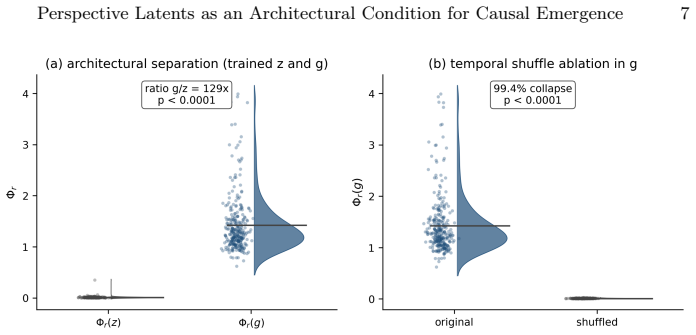
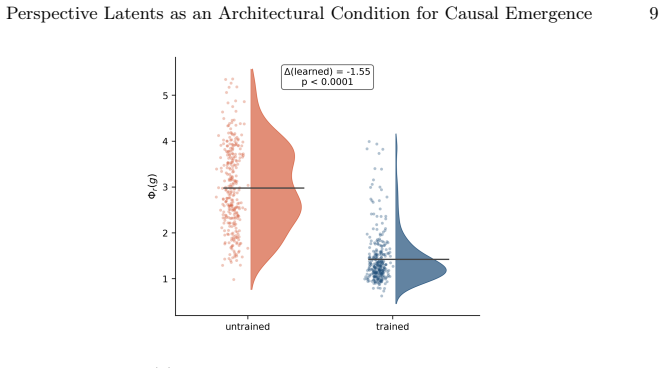
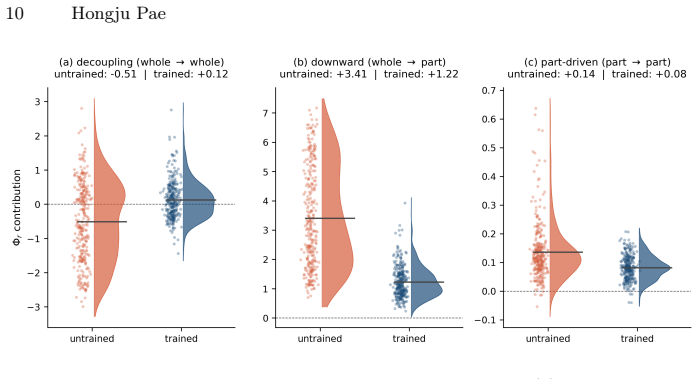
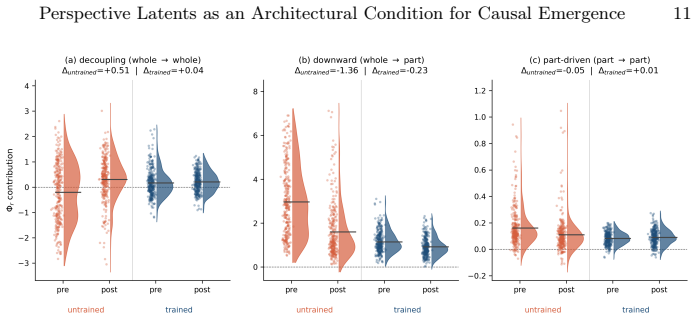
The central finding is that Phi_r-relevant temporal organization in this active inference agent is localized in the slow perspective latent g and is largely supplied by the recurrent architecture itself, not by learning. Training reduces aggregate Phi_r(g), but it reorganizes the atom composition: decoupling flips from negative to positive and stays stable across a regime switch, while downward causation decreases and carries the response to the switch. The paper argues that scalar Phi_r conflates these components and should not be read as a direct measure of learned integration.
What carries the argument
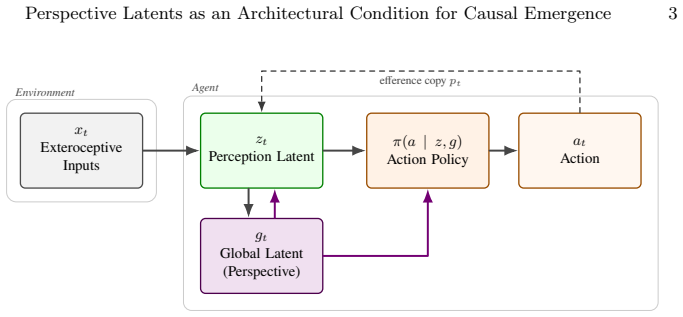
The central object is the perspective latent g, a GRU-gated slow variable in the agent's world-modeling path, updated from the fast perceptual latent and previous action, trained by one-step prediction error and a smoothness regularizer, and shielded from policy gradients by stop-gradient operators. The analysis applies a pointwise PhiID estimate to g: the trajectory is standardized, a thresholded lag-1 Gaussian mutual information matrix is built, a Fiedler bipartition splits the latent dimensions into two nodes, within-partition averages form a two-node trajectory, and local PhiID atoms are computed. The atoms are grouped into decoupling (single whole-to-whole atom), downward causation (thr
Load-bearing premise
The whole interpretation rests on the pointwise Gaussian PhiID estimator—with its Fiedler bipartition, two-node averaging, and median summarization—being faithful enough that the decoupling atom's sign flip reflects a real change in whole-to-whole causal contribution rather than an artifact of the estimator or partition choice.
What would settle it
If the negative-to-positive decoupling flip disappears under a non-Gaussian PhiID estimator, or when within-partition averaging is replaced by a different reduction, the central dissociation would be undercut. The most direct experiment is ablating the stop-gradient separation: a trained agent without architectural decoupling from policy gradients should not show the stable positive decoupling if the paper's claim is right.
If this is right
- Scalar Phi_r should not be used alone as an integration or causal-emergence index, because all three reported effects are invisible to magnitude alone.
- Untrained-architecture baselines should accompany Phi_r measurements, since the recurrent substrate alone can produce high values that look like integration.
- In reward-free active inference, training can lower raw Phi_r while qualitatively changing its composition, so learned organization shows up only at the atom level.
- The perspective latent g is the architectural locus of Phi_r-relevant slow temporal organization, whereas the fast perceptual latent contributes almost none.
- After learning, the whole-to-whole decoupling component is regime-invariant while whole-to-part downward causation adapts to regime change, suggesting a division between stable integration and adaptive engagement.
Where Pith is reading between the lines
- A direct test the paper does not run: remove the stop-gradient separation between g and policy gradients, retrain, and check whether the decoupling sign flip disappears; if it does, the flip is tied to the architectural shielding of the perspective latent.
- The same atom-composition analysis could be applied to reward-driven reinforcement learning agents that show Phi_r growing with training; the untrained-baseline contrast predicts that part of that growth is compositional, not an increase in integration amount.
- If the decoupling flip is produced by predictive smoothing alone, then any recurrent latent trained on temporal prediction would show it; comparing against a recurrent latent lacking the perspective-specific coupling would settle whether perspective-specific organization is needed.
- The post-training regime-invariance of decoupling is a candidate operational signature of a stable 'world model' state that persists while lower-level predictive engagement adjusts.
Editorial analysis
A structured set of objections, weighed in public.
Referee Report
Summary. The paper studies an active-inference agent whose architecture separates a fast perceptual latent z from a slow GRU-based global latent g, with g structurally decoupled from policy gradients. In a reward-free regime-switching gridworld, the author computes a local pointwise Integrated Information Decomposition (Phi_r) and reports three main findings: (1) Phi_r concentrates in g rather than z; (2) aggregate Phi_r(g) is largely architectural and decreases with training; (3) learning reorganizes the atom composition of Phi_r(g), shifting the decoupling atom from negative to positive and making it approximately regime-invariant, while downward causation carries the main regime-dependent change. The paper argues that scalar Phi_r should not be read as a direct index of learned integration and that the atom-level decomposition is needed to see what learning changes.
Significance. If the results hold, the paper offers a useful, sobering counterpoint to the recent use of scalar Phi_r as a measure of learned integration in RL agents: the architectural substrate alone can supply high aggregate Phi_r, and the meaningful learning effect only appears in the composition of PhiID atoms. The control design is strong in conception: within-episode shuffling isolates temporal structure, the untrained baseline isolates learning, and the pre/post regime comparison tests adaptivity. The effects are large and internally consistent, and the manuscript is candid about its limitations, including the need for a partition-stability audit and targeted ablations. Code and data availability further support reproducibility. However, the central compositional claim depends on two assumptions that are not yet validated: the stability of the per-episode Fiedler bipartition across conditions, and the meaningfulness of the sign of the local pointwise PhiID atom groups. The statistical tests also suffer from pseudo-replication. These issues are fixable but currently make the evidence suggestive rather than conclusive.
major comments (3)
- [Sec. 2.3 and 3.2-3.4] The inferential statistics treat 300 episodes from 30 seeds as independent samples. Welch's and paired t-tests over episodes (e.g., Sec. 3.2: t=-25.1; Sec. 3.3: t=8.6; Sec. 3.4: t=6.6) ignore nesting of episodes within seeds, making p-values anti-conservative. The large effect sizes likely survive a seed-level analysis, but the quantitative support and especially the regime-invariance claim for decoupling (Sec. 3.4, p=0.23) need re-analysis at the seed level or with a mixed-effects model before being accepted.
- [Sec. 2.4 Eq. (3); Sec. 3.3-3.4] The decoupling atom is defined on a two-node reduction whose bipartition is chosen per episode by the Fiedler vector of the thresholded MI matrix. Cross-cohort comparisons (untrained vs trained, pre- vs post-switch) therefore compare whole-to-whole contributions computed over potentially different partitions. A sign flip in decoupling could reflect a change in which g dimensions are grouped into A vs B rather than a change in whole-to-whole causal contribution. The manuscript itself lists a partition-stability audit as future work, but the cross-condition comparisons in Secs. 3.3-3.4 presuppose partition comparability. Please report partition stability across cohorts/conditions, use a fixed a priori partition, or show the sign flip survives on a common partition.
- [Sec. 2.4, Eqs. (2-4)] The atom-level interpretation, especially the sign and relative magnitude of the decoupling atom, rests entirely on the local pointwise Gaussian PhiID estimator with within-partition averaging and median summarization. The paper correctly notes that this differs from the non-negative Rosas-style construction, but it does not validate whether the sign of these local atoms is a faithful measure of whole-to-whole causal contribution in this setting. A synthetic benchmark with known ground-truth atoms, or a comparison against a non-negative PhiID formulation, is needed before the sign flip can be read as a mechanism rather than an estimator artifact.
minor comments (4)
- [Sec. 3.1] The same paired t-value (43.6) is reported for the localization comparison and the shuffle collapse. These are different pairs of distributions; please verify that both statistics are correct or clarify why they coincide.
- [Sec. 2.4] A forced-split diagnostic on the joint [z,g] trajectory is described but no results are reported for it. Either present the diagnostic or remove it from the methods text.
- [Sec. 3.2-3.4] Means and SDs are reported at the episode level, which conflates within-seed and between-seed variance. Reporting seed-level means and confidence intervals would make the magnitude of the effects easier to assess.
- [Sec. 3.4] The claim that trained decoupling is 'almost unchanged' across the regime switch is a null result with p=0.23. Given the pseudo-replication concern, please report a seed-level effect size and a confidence interval, or an equivalence test, to support the claim of invariance.
Circularity Check
No significant circularity: the analysis is measurement-based on a fixed inherited architecture, and self-citations are background rather than load-bearing.
full rationale
The paper's derivation chain is not circular. The agent architecture is inherited from the author's prior work [11], but the Φr measurements are new and no parameter is fitted to the reported predictions. The localization of Φr in g is explicitly acknowledged as partly architectural (Section 3.1: 'this localization, however, is partly predictable from the architecture itself'), so it is not presented as a nontrivial derived result. The aggregate result, untrained > trained, actually contradicts the initial expectation from [15], so it is not forced by the input. The atom-level results—decoupling sign shift and downward-causation decrease—are empirical cohort comparisons, not identities. Self-citations [11,12,10] motivate the 'perspective latent' framing and supply the implementation, but the quantitative claims do not reduce to those citations; no uniqueness theorem or ansatz is imported to force the outcome. The main caveat is methodological: the Fiedler bipartition is recomputed per trajectory (Eq. 3), so cross-cohort atom comparisons presuppose partition comparability, and the paper itself lists a 'partition-stability audit' as future work. This is a validity threat, not a circular reduction. The explicit limitation that the design cannot separate perspective-specific organization from learned recurrence in general further undercuts interpretive generality but does not make the measurements circular.
Axiom & Free-Parameter Ledger
free parameters (5)
- Loss weights wsmooth, wactor, wentropy =
0.25, 0.25, 0.001
- EMA coefficient β =
0.98
- MI significance threshold =
Bonferroni-corrected α=0.05
- Replay episode length and warmup =
T=500, warmup 80 steps
- Regime-switch timing =
t=320
axioms (4)
- domain assumption Gaussian copula mutual information with lag-1 correlations captures the temporal dependency structure of the latent trajectory
- domain assumption Fiedler bisection and within-partition averaging preserve the Φr-relevant causal structure
- domain assumption The pointwise/local ΦID estimator with negative values and median summarization is interpretable as causal emergence anatomy
- ad hoc to paper The stop-gradient decoupling makes g driven purely by prediction error rather than policy gradients
invented entities (1)
-
Slow global latent g ('perspective latent')
no independent evidence
read the original abstract
A recent line of work measures causal emergence in reinforcement learning agents through Integrated Information Decomposition, reporting that $\Phi_r$ grows with training and tracks reward improvement. For active inference, this raises the question of how reward-free predictive organization relates to such information-theoretic signatures. I test this within an active inference agent whose architecture separates a fast perception latent $z$ from a slow global latent $g$, where $g$ is driven by prediction error and structurally decoupled from policy gradients. In a reward-free environmental regime-switching protocol, $\Phi_r$ concentrates in $g$; its aggregate magnitude is largely architectural and decreases with training. The substantive effect of learning becomes legible only at the atom-compositional level: decoupling flips sign from negative to positive and becomes regime-invariant under environmental change, while downward causation carries the regime-dependent adjustment. These results identify $g$ as the architectural locus of $\Phi_r$-relevant temporal organization in an active inference agent, and argue against reading scalar $\Phi_r$ as a direct index of learned integration.
Figures
Reference graph
Works this paper leans on
-
[1]
PLOS Compu- tational Biology19(10), 1–45 (2023)
Albantakis, L., Barbosa, L., Findlay, G., Grasso, M., Haun, A.M., Marshall, W., Mayner, W.G.P., Zaeemzadeh, A., Boly, M., Juel, B.E., Sasai, S., Fujii, K., David, I., Hendren, J., Lang, J.P., Tononi, G.: Integrated information theory (IIT) 4.0: Formulating the properties of phenomenal existence in physical terms. PLOS Compu- tational Biology19(10), 1–45 (...
-
[2]
Czechoslovak Mathematical Journal 23(2), 298–305 (1973), http://eudml.org/doc/12723
Fiedler, M.: Algebraic connectivity of graphs. Czechoslovak Mathematical Journal 23(2), 298–305 (1973), http://eudml.org/doc/12723
1973
-
[3]
Neural Computation29(1), 1–49 (01 2017)
Friston, K., FitzGerald, T., Rigoli, F., Schwartenbeck, P., Pezzulo, G.: Ac- tive inference: A process theory. Neural Computation29(1), 1–49 (01 2017). https://doi.org/10.1162/NECO_a_00912
-
[4]
Proceedings of the National Academy of Sciences110(49), 19790–19795 (2013)
Hoel, E.P., Albantakis, L., Tononi, G.: Quantifying causal emergence shows that macro can beat micro. Proceedings of the National Academy of Sciences110(49), 19790–19795 (2013). https://doi.org/10.1073/pnas.1314922110
-
[5]
Routledge (2001), translated fromLogische Untersuchungen I-II
Husserl, E.: Logical Investigations I-II. Routledge (2001), translated fromLogische Untersuchungen I-II
2001
-
[6]
Human Brain Mapping38(3), 1541–1573 (2017)
Ince, R.A., Giordano, B.L., Kayser, C., Rousselet, G.A., Gross, J., Schyns, P.G.: A statistical framework for neuroimaging data analysis based on mutual information estimated via a gaussian copula. Human Brain Mapping38(3), 1541–1573 (2017). https://doi.org/https://doi.org/10.1002/hbm.23471
-
[7]
Mediano, P.A.M., Rosas, F., Carhart-Harris, R.L., Seth, A.K., Barrett, A.B.: Beyond integrated information: A taxonomy of information dynamics phenomena (2019), https://arxiv.org/abs/1909.02297
Pith/arXiv arXiv 2019
-
[8]
Proceedings of the National Academy of Sciences122(39), e2423297122 (2025)
Mediano, P.A.M., Rosas, F.E., Luppi, A.I., Carhart-Harris, R.L., Bor, D., Seth, A.K., Barrett, A.B.: Toward a unified taxonomy of information dynamics via integrated information decomposition. Proceedings of the National Academy of Sciences122(39), e2423297122 (2025). https://doi.org/10.1073/pnas.2423297122
-
[9]
Routledge (2013), translated fromPhénoménologie de la perception
Merleau-Ponty, M.: Phenomenology of Perception. Routledge (2013), translated fromPhénoménologie de la perception
2013
-
[10]
Pae, H.: Body-grounded perspective formation and conative attunement in artificial agents (2026), https://arxiv.org/abs/2605.16728 14 Hongju Pae
Pith/arXiv arXiv 2026
-
[11]
Proceedings of the AAAI Symposium Series8(1), 309–315 (May 2026)
Pae, H.: Minimal computational preconditions for subjective perspective in artificial agents. Proceedings of the AAAI Symposium Series8(1), 309–315 (May 2026). https://doi.org/10.1609/aaaiss.v8i1.42559
-
[12]
Pae, H.: Same world, differently given: History-dependent perceptual reorganization in artificial agents (2026), https://arxiv.org/abs/2604.04637
Pith/arXiv arXiv 2026
-
[13]
MIT Press (2022)
Parr, T., Pezzulo, G., Friston, K.J.: Active Inference: The Free Energy Principle in Mind, Brain, and Behavior. MIT Press (2022)
2022
-
[14]
Biological Psychology186, 108741 (2024)
Pezzulo, G., Parr, T., Friston, K.: Active inference as a theory of sentient behavior. Biological Psychology186, 108741 (2024). https://doi.org/10.1016/j.biopsycho.2023.108741
arXiv 2024
-
[15]
Pigozzi, F., Levin, M.: The causally emergent alignment hypothesis: Causal emer- gence aligns with and predicts final reward in reinforcement learning agents (2026), https://arxiv.org/abs/2605.06746
Pith/arXiv arXiv 2026
-
[16]
PLOS Computational Biology 16(12), 1–22 (12 2020)
Rosas, F.E., Mediano, P.A.M., Jensen, H.J., Seth, A.K., Barrett, A.B., Carhart- Harris, R.L., Bor, D.: Reconciling emergences: An information-theoretic approach to identify causal emergence in multivariate data. PLOS Computational Biology 16(12), 1–22 (12 2020). https://doi.org/10.1371/journal.pcbi.1008289
-
[17]
The Biological Bulletin215(3), 216–242 (2008)
Tononi, G.: Consciousness as integrated information: a provisional manifesto. The Biological Bulletin215(3), 216–242 (2008). https://doi.org/10.2307/25470707
doi:10.2307/25470707 2008
-
[18]
Williams, P.L., Beer, R.D.: Nonnegative decomposition of multivariate information (2010), https://arxiv.org/abs/1004.2515
Pith/arXiv arXiv 2010
-
[19]
Bradford Book/MIT Press (2005)
Zahavi, D.: Subjectivity and Selfhood: Investigating the First-Person Perspective. Bradford Book/MIT Press (2005)
2005
discussion (0)
Sign in with ORCID, Apple, or X to comment. Anyone can read and Pith papers without signing in.