REVIEW 3 major objections 3 minor 66 references
Magnetic fields around merging black holes can boost proton collisions to 10^17–10^20 eV, placing binary mergers among the candidate sources of the most energetic cosmic rays.
Reviewed by Pith at T0; open to challenge. T0 means a machine referee read the full paper against a public rubric. the ladder, T0–T4 →
T0 review · deepseek-v4-flash
2026-08-01 07:35 UTC pith:4LSQH5XW
load-bearing objection Useful parameter scan of the magnetized BSW mechanism, but the UHECR-source claim fails on the escape-energy budget: E_cm at the horizon is not energy at infinity. the 3 major comments →
Ultra-High-Energy Particle Production in Binary Mergers Endowed with Magnetic Fields
The pith
A machine-rendered reading of the paper's core claim, the machinery that carries it, and where it could break.
Core claim
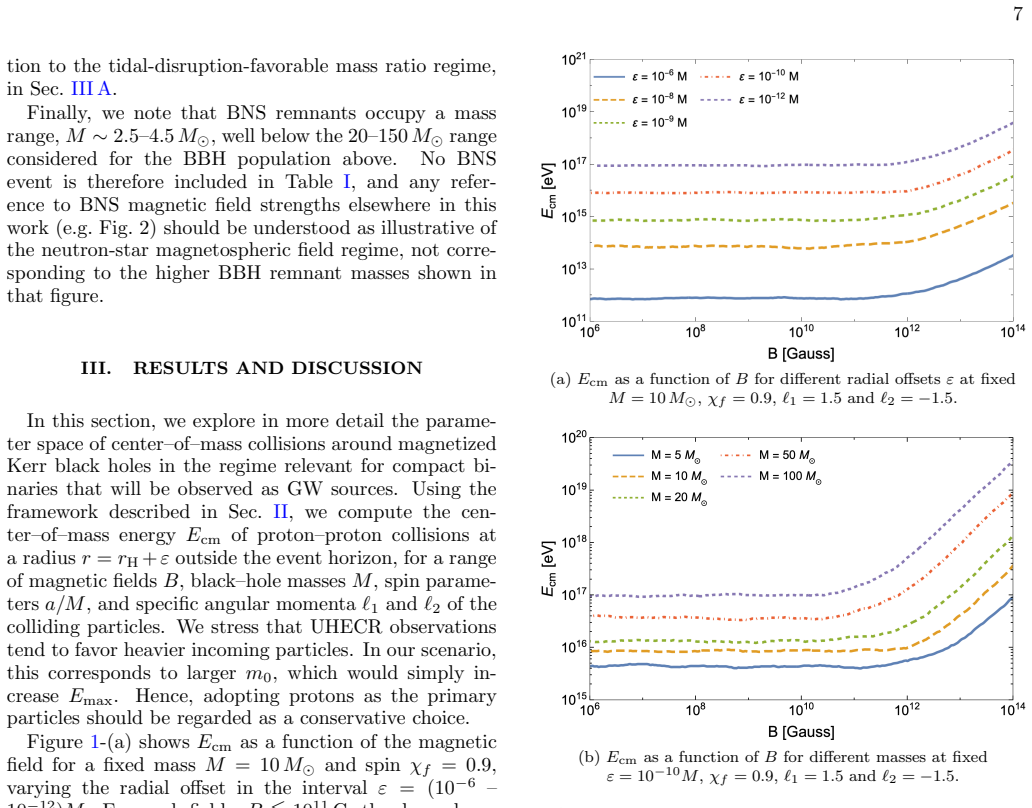
The central claim is that a magnetic field anchored in the merger environment transforms the Banados–Silk–West (BSW) effect from a fine-tuned theoretical curiosity into a generic acceleration channel. Solving the modified geodesic equations for charged particles in Kerr spacetime with a uniform magnetic field, the authors find that collisions within 10^-10 M of the horizon produce center-of-mass energies up to ~10^20 eV for remnant masses 20–150 M_sun and spins χ_f ~0.7–0.9. The field acts as an amplifier: the energy scales as E_max = m_0 c^2 (M/M_sun) F(χ_f, B, ℓ_1, ℓ_2), with the amplification function F growing roughly as B^0.3–0.5 in the magnetic-dominated regime B > 10^13 G, reaching fa
What carries the argument
The central object is the Banados–Silk–West (BSW) effect—the near-horizon collision of two particles whose near-critical angular momenta produce unbounded center-of-mass energies in an extremal Kerr spacetime—extended to a magnetized Kerr black hole. The carrying mechanism is the modified geodesic equation with a Lorentz force, using the uniform-field four-potential A_ϕ = B g_ϕϕ/2, which shifts the effective potential and creates new families of critical orbits that remove the fine-tuning on spin. The paper introduces a dimensionless amplification function F(χ_f, B, ℓ_1, ℓ_2) that encodes how much the magnetic field raises the maximum E_cm as a function of spin, field strength, and the angul
Load-bearing premise
The results rest on treating the near-horizon magnetic field as locally uniform with four-potential A_ϕ = B g_ϕϕ/2 all the way down to 10^-10 M from the horizon at field strengths up to 10^14 G, a description whose validity the paper asserts but does not demonstrate at field strengths where the magnetic force overwhelms gravity.
What would settle it
Compute whether a uniform field with A_ϕ = B g_ϕϕ/2 is consistent with a force-free magnetosphere around a spinning black hole at radii r = r_H + 10^-10 M: if the actual field geometry deviates from uniform on the scale of the proton Larmor radius (which is orders of magnitude smaller than M), the resonant angular-momentum tuning that produces the 10^20 eV energies is destroyed. Alternatively, trace the collision products' trajectories to infinity in the same spacetime; if the outgoing particles are gravitationally redshifted below 10^18 eV before escaping, the claimed UHECR energies never rea
If this is right
- If the mechanism operates as claimed, magnetized BH–NS binaries and post-merger black holes from neutron star coalescences join AGN jets and gamma-ray bursts as viable UHECR sources, with an energy scale set directly by the remnant mass and spin.
- The BSW effect no longer requires near-extremal spin: with B ≳ 10^12 G, ultra-high-energy collisions occur for χ_f ≳ 0.7, so the mechanism should operate across most of the observed merger population rather than in rare fine-tuned configurations.
- The predicted correlation between gravitational-wave remnant parameters and UHECR energies—such as the ~1.6×10^20 eV maximum for the most massive, highest-spin event—provides event-by-event targets for joint gravitational-wave and cosmic-ray searches.
- The three identified acceleration regimes imply that even neutron-star-scale fields (10^12–10^13 G) double to quintuple the collision energy, making magnetic enhancement a generic feature of mergers involving neutron stars rather than an exotic occurrence.
- The approximate linear scaling E_max ∝ M favors the most massive stellar-origin remnants (M ≳ 100 M_sun) as the sources of the highest-energy cosmic rays near 10^20 eV, a trend already visible across the 34-event catalog.
Where Pith is reading between the lines
- If pre-merger UHECR production is prompt and directional, the highest-energy cosmic rays might be traceable to individual past mergers within their magnetic-deflection horizon, making the UHECR sky a fossil record of binary coalescences—an extension the paper does not explicitly develop.
- Because the collision energy scales with the rest mass of the projectile, heavier nuclei would yield even higher E_max than the conservative proton case; the scenario thereby naturally predicts a heavy or mixed composition at the highest energies, which can be checked against cosmic-ray observatory composition measurements.
- The same machinery, applied to intermediate-mass black holes merging with neutron stars, would push maximum energies beyond 10^20 eV; this is an unexplored prediction that follows directly from the paper's scaling relations but is not stated in it.
- A direct test of the central assumption is to compare the uniform-field results with general-relativistic magnetohydrodynamic simulations of post-merger magnetospheres: if the near-horizon field is not approximately uniform on the collision scale, the predicted amplification and therefore the UHECR energies would be reduced.
Editorial analysis
A structured set of objections, weighed in public.
Referee Report
Summary. The paper studies proton–proton collisions in the immediate vicinity of magnetized Kerr black holes as a possible UHECR production site via the BSW effect. It solves the equations of motion for charged test particles in a Kerr spacetime with a uniform magnetic field (four-potential A_phi = B g_phi_phi/2), fixes the conserved energy per particle to E_i/m0=1, scans black hole mass, spin, magnetic field, and angular momenta, and computes the local center-of-mass energy E_cm. It reports E_cm up to ~10^20 eV for M~100 M_sun, χ~0.9, B~10^14 G, identifies three magnetic-field regimes, and applies the results to 34 LIGO-Virgo-KAGRA remnants with χ_f>0.7, giving event-by-event predictions.
Significance. The paper is systematic and transparent: it writes down the equations of motion (Eqs. 12–16), states its assumptions (equatorial orbits, uniform field, E_i/m0=1), and provides a parameter scan tied to a specific GW catalog. If the claimed connection were valid, it would link binary-merger observations to UHECR production and offer testable correlations between remnant spin/mass and maximum particle energy. The authors also correctly identify that the standard BSW mechanism is fine-tuned and that magnetic fields can broaden the parameter space. However, the central astrophysical conclusion does not follow from the calculation, because the computed E_cm is a local invariant, not the energy of particles escaping to infinity.
major comments (3)
- [Secs. II.B, II.F, IV; Abstract] The paper's central claim that magnetized binaries are 'promising sources of UHECRs' is not supported by the computed quantity. With the stationary four-potential A_phi = B g_phi_phi/2 and A_t=0 (Sec. II.B) and E_i/m0=1 (Sec. II.F), the conserved canonical energy of each proton is m_p c^2; the total energy of the two-particle system at infinity is 2 m_p c^2. The high E_cm is a local invariant near the horizon, not an energy available to escaping debris. Any outgoing product has energy at infinity bounded by the total conserved energy plus a possible small Penrose-type negative-energy contribution, i.e., at most a few GeV, not 10^20 eV. The paper explicitly defers escape modeling (Sec. IV), but the deferred step is not a technical detail: within the stated model, the UHECR-source claim cannot follow. The citation of Refs. [27–30] does not address this because the A_phi-only field has no e
- [Eq. (18)] The claimed linear mass scaling E_max = m0 c^2 (M/M_sun) F(χ_f, B, ℓ1, ℓ2) conflicts with the standard BSW scaling, in which E_cm/m0 is independent of M for fixed dimensionless angular momenta and spin. In a magnetized Kerr spacetime the only dimensionless magnetic parameter is q B M / m0, so any M-dependence in E_cm/m0 must come through that combination, not through an explicit factor M/M_sun attributed to 'the geometric nature of the gravitational acceleration mechanism' (Sec. II.E). Since Table I uses this scaling to assign event-by-event energies, the catalog predictions require re-derivation. The text should either justify Eq. (18) from the equations of motion or replace it with the correct dimensionless scaling.
- [Sec. II.B, Fig. 1] The uniform-field potential is specified as A_phi = B g_phi_phi/2 with a single non-vanishing component; this is not the standard uniform-field solution in Kerr, which also has A_t = B g_t_phi/2. Moreover, at B~10^14 G the Larmor radius of a 10^20 eV proton is ~10 m, far smaller than the gravitational radius ~10^5 m, so the Lorentz force dominates the trajectory and the BSW effect (a gravitational geodesic resonance) is not the relevant mechanism. The paper does not demonstrate that the local uniform-field approximation is valid from the ISCO down to ε=10^-10 M, nor that the collision products can leave the strong-field region. This affects the interpretation of the 'magnetic-dominated' regime and the claimed order-of-magnitude enhancement.
minor comments (3)
- [Table I caption] The caption states 34 events with χ_f>0.7, but the table includes GW170817 with χ_f≤0.89 (upper limit, not a measurement) and log10 E = '–'. Clarify whether this BNS event is counted in the 34 and why it satisfies the selection criterion.
- [Eq. (19)] Equation (19) writes E_max in terms of M/100M_sun and χ_f/0.9, but the amplification function F is not given in closed form; it would aid reproducibility to state whether F is evaluated at the fiducial B=10^14 G and which (ℓ1, ℓ2) values are used.
- [Sec. III] The numerical optimization over (ℓ1, ℓ2) is described only as 'systematically vary[ing] the angular momenta'; the grid spacing and convergence criteria are not given, which matters because Figs. 1 and 3 exhibit 'bumpiness' attributed to grid-sampling artifacts.
Circularity Check
No significant circularity: the energy predictions are computed parameter-scan outputs, not fitted inputs; self-citations are not load-bearing and the main limitation (escape modeling) is a physical correctness issue rather than a circular derivation.
full rationale
The derivation chain is self-contained. The paper defines a magnetized Kerr test-particle setup via Eq. (9), adopts the explicit four-potential A_phi = B g_phi_phi/2, solves for the four-velocity components (12)-(14), and evaluates the center-of-mass invariant (16) as a function of (M, chi_f, B, epsilon, l1, l2). The claimed E_cm ~ 1e18-1e20 eV and the Table I entries are outputs of this explicit calculation, after a systematic scan/optimization over angular momenta, not quantities fitted to UHECR data. Eq. (18) is a scaling rewrite of the same E_cm expression rather than a separate fitted law; it contains no new empirical input. The strong-field regime B ~ 1e12-1e14 G is an input assumption, motivated by the authors' prior Letter [37] and by GRMHD/merger literature, but the present paper does not rely on [37] to supply the collision-energy result itself, and [37] is an independent published calculation rather than a self-referential uniqueness or ansatz theorem. The most serious weakness is the openly acknowledged omission in Sec. IV: 'We have focused on collision energies near the horizon without detailed modeling of particle escape...' This prevents the local E_cm from being translated into escaping UHECR energies, especially given E_i/m0 = 1 and A_t = 0, but this is a physical/correctness gap in the UHECR-source inference, not a case where a prediction reduces to its inputs by definition. No circular step of any enumerated kind is present.
Axiom & Free-Parameter Ledger
free parameters (4)
- Magnetic field strength B =
10^14 G (fiducial)
- Radial offset ε =
10^-10 M
- Particle angular momenta ℓ1, ℓ2 =
optimized (e.g., 1.5, -1.5 in fiducial runs)
- Particle energy ratios E_i/m0 =
1
axioms (5)
- standard math Kerr metric describes the remnant spacetime (Boyer-Lindquist coordinates)
- standard math Charged particles obey the Lorentz-force equation (Eq. 9)
- domain assumption Magnetic fields of order 10^12–10^14 G exist in the near-horizon region of merger remnants
- ad hoc to paper Uniform magnetic field with A_ϕ = B g_ϕϕ/2 is a valid local approximation for the entire region of interest
- domain assumption Collision debris can escape to be observed as UHECRs
read the original abstract
We study the production of ultra-high-energy particles via the Ba\~nados--Silk--West (BSW) mechanism in the pre-merger phase of binary systems detected by LIGO-Virgo-KAGRA. By solving the geodesic equations for charged particles in magnetized Kerr spacetime with fields of $B \sim 10^{12}$--$10^{14}$~G, we demonstrate that collisions near the horizon can achieve center-of-mass energies $E_{\mathrm{cm}} \sim 10^{18}$-- $10^{20}$~eV, placing them firmly in the ultra-high-energy cosmic-ray (UHECR) range. We systematically explore the parameter space of merger remnants, varying black hole mass ($M \sim 20$--$150\,M_\odot$, characteristic of the binary black hole population), dimensionless spin ($\chi_f \sim 0.7$--$0.9$), magnetic field strength, and particle angular momenta. Our analysis reveals three distinct acceleration regimes: a gravity-dominated regime ($B < 10^{12}$~G) with negligible magnetic enhancement; a transition regime ($10^{12}~\text{G} \lesssim B \lesssim 10^{13}~\text{G}$) where gravitational and magnetic effects compete; and a magnetic-dominated regime ($B > 10^{13}$~G) where fields amplify collision energies by nearly an order of magnitude. For the 34 gravitational-wave events with high remnant spins ($\chi_f > 0.7$), we compute the maximum achievable energies, finding that systems with $\chi_f \gtrsim 0.85$ and $M \gtrsim 100\,M_\odot$ can reach $E_{\mathrm{max}} \sim 10^{20}$~eV. Our results establish magnetized binary mergers, particularly black hole--neutron star systems and postmerger black hole remnants formed in binary neutron star coalescences, as promising sources of UHECRs and provide quantitative predictions linking gravitational-wave observables to particle acceleration efficiency.
Figures


Reference graph
Works this paper leans on
-
[1]
Fenˆ omenos Extremos do Universo
andℓ 2 (particle 2). The collisions occur near the horizon atr=r H +εwithε= 10 −10Mfor a magnetised Kerr black hole of massM= 50M ⊙, spin parameterχ f = 0.9, and magnetic fieldB= 10 12 G. White dashed lines indicateℓ 1 = 0 and ℓ2 = 0, while the red dashed diagonal marksℓ 1 =ℓ 2, along which the configuration is symmetric under the exchange of the two part...
2025
-
[2]
A. Aabet al.(Pierre Auger), Measurement of the cosmic- ray energy spectrum above 2.5×10 18 eV using the Pierre Auger Observatory, Phys. Rev. D102, 062005 (2020), arXiv:2008.06486 [astro-ph.HE]
Pith/arXiv arXiv 2020
-
[3]
T. Abu-Zayyadet al., The Cosmic-Ray Energy Spectrum Observed with the Surface Detector of the Telescope Ar- ray Experiment, ApJL768, L1 (2013), arXiv:1205.5067 [astro-ph.HE]
Pith/arXiv arXiv 2013
-
[4]
K. Kotera and A. V. Olinto, The Astrophysics of Ultrahigh-Energy Cosmic Rays, ARAA49, 119 (2011), arXiv:1101.4256 [astro-ph.HE]
Pith/arXiv arXiv 2011
-
[5]
L. A. Anchordoqui, Ultra-high-energy cosmic rays, Physics Reports801, 1 (2019), arXiv:1807.09645 [astro- ph.HE]
Pith/arXiv arXiv 2019
-
[6]
Greisen, End to the Cosmic-Ray Spectrum?, PRL16, 748 (1966)
K. Greisen, End to the Cosmic-Ray Spectrum?, PRL16, 748 (1966). 15
1966
-
[7]
G. T. Zatsepin and V. A. Kuz’min, Upper Limit of the Spectrum of Cosmic Rays, Soviet Journal of Experimen- tal and Theoretical Physics Letters4, 78 (1966)
1966
-
[8]
E. Mayotte, Measurement and Interpretation of UHECR Mass Composition at the Pierre Auger Ob- servatory, arXiv e-prints , arXiv:2507.10292 (2025), arXiv:2507.10292 [astro-ph.HE]
Pith/arXiv arXiv 2025
-
[9]
A. Halimet al.(Pierre Auger Collaboration), Inference of the Mass Composition of Cosmic Rays with Ener- gies from 1018.5 to 1020 eV Using the Pierre Auger Ob- servatory and Deep Learning, PRL134, 021001 (2025), arXiv:2406.06315 [astro-ph.HE]
Pith/arXiv arXiv 2025
-
[10]
F. Fraschetti, On the acceleration of ultra-high- energy cosmic rays, Philosophical Transactions of the Royal Society of London Series A366, 4417 (2008), arXiv:0809.3057 [astro-ph]
Pith/arXiv arXiv 2008
-
[11]
A. R. Bell, The acceleration of cosmic rays in shock fronts - I., MNRAS182, 147 (1978)
1978
-
[12]
A. R. Bell, Cosmic ray acceleration, Astroparticle Physics 43, 56 (2013), arXiv:1301.7041 [astro-ph.HE]
Pith/arXiv arXiv 2013
-
[13]
A. Spitkovsky, Particle acceleration in relativistic colli- sionless shocks: Fermi process at last?, Astrophys. J. Lett.682, L5 (2008), arXiv:0802.3216 [astro-ph]
Pith/arXiv arXiv 2008
-
[14]
D. Caprioli and A. Spitkovsky, Simulations of ion ac- celeration at non-relativistic shocks. i. acceleration ef- ficiency, Astrophys. J.783, 91 (2014), arXiv:1310.2943 [astro-ph.HE]
Pith/arXiv arXiv 2014
-
[15]
N. W. Schween, F. Schulze, and B. Reville, Sapphire++: A particle transport code combining a spherical har- monic expansion and the discontinuous Galerkin method, Journal of Computational Physics523, 113690 (2025), arXiv:2501.05110 [astro-ph.HE]
Pith/arXiv arXiv 2025
-
[16]
A. Shirin T, B. Reville, N. W. Schween, F. Schulze, and J. G. Kirk, Spectral curvature and breaks from Fermi ac- celeration at oblique shocks, MNRAS544, L160 (2025), arXiv:2511.01635 [astro-ph.HE]
arXiv 2025
-
[17]
R. J. Protheroe and T. Stanev, Cut-offs and pile-ups in shock acceleration spectra, Astroparticle Physics10, 185 (1999), arXiv:astro-ph/9808129 [astro-ph]
Pith/arXiv arXiv 1999
-
[18]
L. N. Padilha and R. C. Dos Anjos, Oblique Shocks at Supernova Remnants in Massive Star Clusters: A Model for the Cosmic-Ray Knee Observed by LHAASO, ApJ 1002, 97 (2026), arXiv:2604.07977 [astro-ph.HE]
Pith/arXiv arXiv 2026
-
[19]
C. H. Coimbra Araujo and R. C. Anjos, Rotating black holes with magnetic fields as accelerators of charged par- ticles, inInternational Conference on Black Holes as Cosmic Batteries: UHECRs and Multimessenger Astron- omy. 12-15 September 2018. Foz do Igua¸ cu(2018) p. 5
2018
-
[20]
C. H. Coimbra-Ara´ ujo and R. C. Anjos, Acceleration of charged particles from near-extremal rotating black holes embedded in magnetic fields, Classical and Quan- tum Gravity38, 015007 (2021), arXiv:2005.13599 [gr-qc]
Pith/arXiv arXiv 2021
-
[21]
C. H. Coimbra-Ara´ ujo and R. C. dos Anjos, Ultra-High- Energy Particles at the Border of Kerr Black Holes Trig- gered by Magnetocentrifugal Winds, Galaxies10, 84 (2022)
2022
-
[22]
M. Ba˜ nados, J. Silk, and S. M. West, Kerr Black Holes as Particle Accelerators to Arbitrarily High Energy, PRL 103, 111102 (2009), arXiv:0909.0169 [hep-ph]
Pith/arXiv arXiv 2009
-
[23]
J. M. Bardeen, W. H. Press, and S. A. Teukolsky, Ro- tating Black Holes: Locally Nonrotating Frames, Energy Extraction, and Scalar Synchrotron Radiation, ApJ178, 347 (1972)
1972
-
[24]
T. Jacobson and T. P. Sotiriou, Spinning Black Holes as Particle Accelerators, PRL104, 021101 (2010), arXiv:0911.3363 [gr-qc]
Pith/arXiv arXiv 2010
-
[25]
S.-W. Wei, Y.-X. Liu, H. Guo, and C.-E. Fu, Charged spinning black holes as particle accelerators, PRD82, 103005 (2010), arXiv:1006.1056 [hep-th]
Pith/arXiv arXiv 2010
-
[26]
V. P. Frolov, Weakly magnetized black holes as parti- cle accelerators, PRD85, 024020 (2012), arXiv:1110.6274 [gr-qc]
Pith/arXiv arXiv 2012
-
[27]
T. Igata, T. Harada, and M. Kimura, Effect of a weak electromagnetic field on particle acceleration by a rotat- ing black hole, PRD85, 104028 (2012), arXiv:1202.4859 [gr-qc]
Pith/arXiv arXiv 2012
-
[28]
M. Bejger, T. Piran, M. Abramowicz, and F. H ˚ akanson, Collisional Penrose Process near the Horizon of Ex- treme Kerr Black Holes, PRL109, 121101 (2012), arXiv:1205.4350 [astro-ph.HE]
Pith/arXiv arXiv 2012
-
[29]
O. B. Zaslavskii, Energetics of particle collisions near dirty rotating extremal black holes: Banados-Silk-West effect versus Penrose process, PRD86, 084030 (2012), arXiv:1205.4410 [gr-qc]
Pith/arXiv arXiv 2012
-
[30]
Harada, H
T. Harada, H. Nemoto, and U. Miyamoto, Upper limits of particle emission from high-energy collision and reaction near a maximally rotating kerr black hole, Phys. Rev. D 86, 024027 (2012)
2012
-
[31]
J. D. Schnittman, Revised Upper Limit to Energy Ex- traction from a Kerr Black Hole, PRL113, 261102 (2014), arXiv:1410.6446 [astro-ph.HE]
Pith/arXiv arXiv 2014
-
[32]
O. B. Zaslavskii, Unbounded energies of debris from head-on particle collisions near black holes, Modern Physics Letters A30, 1550076 (2015), arXiv:1411.0267 [gr-qc]
Pith/arXiv arXiv 2015
-
[33]
E. Berti, R. Brito, and V. Cardoso, Ultrahigh-Energy Debris from the Collisional Penrose Process, PRL114, 251103 (2015), arXiv:1410.8534 [gr-qc]
Pith/arXiv arXiv 2015
-
[34]
O. B. Zaslavskii, Ultrahigh energy particle collisions near the black hole horizon in the strong magnetic field, Modern Physics Letters A29, 1450112 (2014), arXiv:1403.6286 [gr-qc]
Pith/arXiv arXiv 2014
-
[35]
D. Ehlert, F. Oikonomou, and E. Peretti, Ultra- high-energy cosmic rays from ultra-fast outflows of active galactic nuclei, MNRAS539, 2435 (2025), arXiv:2411.05667 [astro-ph.HE]
Pith/arXiv arXiv 2025
-
[36]
G. R. Farrar, Binary Neutron Star Mergers as the Source of the Highest Energy Cosmic Rays, PRL134, 081003 (2025), arXiv:2405.12004 [astro-ph.HE]
Pith/arXiv arXiv 2025
-
[37]
G. R. Farrar, Ultra-High-energy Cosmic Ray Production in Binary Neutron Star Mergers, ApJL994, L7 (2025), arXiv:2506.22625 [astro-ph.HE]
arXiv 2025
-
[38]
J. P. Pereira, C. H. Coimbra-Ara´ ujo, R. C. dos An- jos, and J. G. Coelho, Binary Coalescences as Sources of Ultrahigh-Energy Cosmic Rays, PRL132, 091401 (2024), arXiv:2307.06200 [astro-ph.HE]
Pith/arXiv arXiv 2024
-
[39]
R. Abbottet al.(LIGO Scientific Collaboration and Virgo Collaboration), GWTC-2: Compact Binary Co- alescences Observed by LIGO and Virgo during the First Half of the Third Observing Run, Phys. Rev. X11, 021053 (2021), arXiv:2010.14527 [gr-qc]
Pith/arXiv arXiv 2021
-
[40]
R. Abbottet al.(LIGO Scientific Collaboration and Virgo Collaboration), GWTC-3: Compact Binary Co- alescences Observed by LIGO and Virgo during the Sec- ond Part of the Third Observing Run, Phys. Rev. X13, 041039 (2023), arXiv:2111.03606 [gr-qc]. 16
Pith/arXiv arXiv 2023
-
[41]
R. Abbottet al.(LIGO Scientific Collaboration, Virgo Collaboration, and KAGRA Collaboration), Population of Merging Compact Binaries Inferred Using Gravita- tional Waves through GWTC-3, Phys. Rev. X13, 011048 (2023), arXiv:2111.03634 [astro-ph.HE]
Pith/arXiv arXiv 2023
-
[42]
M. Zilh˜ ao, V. Cardoso, C. Herdeiro, L. Lehner, and U. Sperhake, Collisions of charged black holes, PRD85, 124062 (2012), arXiv:1205.1063 [gr-qc]
Pith/arXiv arXiv 2012
-
[43]
M. Obergaulinger, M. A. Aloy, and E. M¨ uller, Local simulations of the magnetized Kelvin-Helmholtz insta- bility in neutron-star mergers, A&A515, A30 (2010), arXiv:1003.6031 [astro-ph.SR]
Pith/arXiv arXiv 2010
-
[44]
B. Giacomazzo, J. Zrake, P. C. Duffell, A. I. MacFadyen, and R. Perna, Producing Magnetar Magnetic Fields in the Merger of Binary Neutron Stars, ApJ809, 39 (2015), arXiv:1410.0013 [astro-ph.HE]
Pith/arXiv arXiv 2015
-
[45]
K. Kiuchi, Y. Sekiguchi, K. Kyutoku, M. Shibata, K. Taniguchi, and T. Wada, High resolution magnetohy- drodynamic simulation of black hole-neutron star merger: Mass ejection and short gamma ray bursts, PRD92, 064034 (2015), arXiv:1506.06811 [astro-ph.HE]
Pith/arXiv arXiv 2015
-
[46]
M. Ruiz, R. N. Lang, V. Paschalidis, and S. L. Shapiro, Binary Neutron Star Mergers: A Jet Engine for Short Gamma-Ray Bursts, ApJL824, L6 (2016), arXiv:1604.02455 [astro-ph.HE]
Pith/arXiv arXiv 2016
-
[47]
Palenzuela, R
C. Palenzuela, R. Aguilera-Miret, F. Carrasco, R. Ciolfi, J. V. Kalinani, W. Kastaun, B. Mi˜ nano, and D. Vigan` o, Turbulent magnetic field amplification in binary neutron star mergers, Phys. Rev. D106, 023013 (2022)
2022
-
[48]
D. Radice, S. Bernuzzi, and A. Perego, The Dynamics of Binary Neutron Star Mergers and GW170817, Annual Review of Nuclear and Particle Science70, 95 (2020), arXiv:2002.03863 [astro-ph.HE]
Pith/arXiv arXiv 2020
-
[49]
R. Aguilera-Miret, J.-E. Christian, S. Rosswog, and C. Palenzuela, Robustness of Magnetic Field Amplifica- tion in Neutron Star Mergers, MNRAS542, 3067 (2025), arXiv:2504.10604 [astro-ph.HE]
arXiv 2025
-
[50]
R. Ciolfi, The key role of magnetic fields in binary neu- tron star mergers, General Relativity and Gravitation52, 59 (2020), arXiv:2003.07572 [astro-ph.HE]
Pith/arXiv arXiv 2020
-
[51]
Margalit and B
B. Margalit and B. D. Metzger, Constraining the Maxi- mum Mass of Neutron Stars from Multi-messenger Ob- servations of GW170817, ApJL850, L19 (2017)
2017
-
[52]
Shibata and K
M. Shibata and K. Hotokezaka, Merger and Mass Ejec- tion of Neutron-Star Binaries, Annual Review of Nuclear and Particle Science69, 41 (2019)
2019
-
[53]
V. P. Frolov, Weakly magnetized black holes as particle accelerators, PRD85, 024020 (2012)
2012
-
[54]
O. B. Zaslavskii, Acceleration of particles by black holes: General considerations, PRD82, 083004 (2010)
2010
-
[55]
Kiuchi, K
K. Kiuchi, K. Kyutoku, Y. Sekiguchi, and M. Shibata, Global simulations of strongly magnetized remnant mas- sive neutron stars formed in binary neutron star mergers, Phys. Rev. D97, 124039 (2018)
2018
-
[56]
F. Foucart, A. Chernoglazov, M. Boyle, T. Hinderer, M. Miller, J. Moxon, M. A. Scheel, N. Deppe, M. D. Duez, F. H´ ebert, L. E. Kidder, W. Throwe, and H. P. Pfeiffer, High-accuracy waveforms for black hole-neutron star systems with spinning black holes, PRD103, 064007 (2021), arXiv:2010.14518 [gr-qc]
Pith/arXiv arXiv 2021
-
[57]
Falcke and L
H. Falcke and L. Rezzolla, Fast radio bursts: the last crack of doom, A&A562, A137 (2014)
2014
-
[58]
B. P. Abbottet al., Multi-messenger Observations of a Binary Neutron Star Merger, ApJL848, L12 (2017)
2017
-
[59]
E. W. Leaver, An analytic representation for the quasi- normal modes of kerr black holes, Proceedings of the Royal Society of London. A. Mathematical and Physical Sciences402, 285 (1985)
1985
-
[60]
E. Berti, V. Cardoso, and A. O. Starinets, Quasinormal modes of black holes and black branes, Classical and Quantum Gravity26, 163001 (2009), arXiv:0905.2975 [gr-qc]
Pith/arXiv arXiv 2009
-
[61]
D. Reitze, R. X. Adhikari, S. Ballmer, B. Barish, L. Bar- sotti, G. Billingsley, D. A. Brown, Y. Chen, D. Coyne, R. Eisenstein, M. Evans, P. Fritschel, E. D. Hall, A. Laz- zarini, G. Lovelace, J. Read, B. S. Sathyaprakash, D. Shoemaker, J. Smith, C. Torrie, S. Vitale, R. Weiss, C. Wipf, and M. Zucker, Cosmic Explorer: The U.S. Contribution to Gravitationa...
Pith/arXiv arXiv 2019
-
[62]
M. Maggiore, C. Van Den Broeck, N. Bartolo, E. Bel- gacem, D. Bertacca, M. A. Bizouard, M. Branch- esi, S. Clesse, S. Foffa, J. Garc ´ ıa-Bellido, S. Grimm, J. Harms, T. Hinderer, S. Matarrese, C. Palomba, M. Peloso, A. Ricciardone, and M. Sakellariadou, Science case for the Einstein telescope, JCAP2020, 050 (2020), arXiv:1912.02622 [astro-ph.CO]
Pith/arXiv arXiv 2020
-
[63]
G. A. Anastasi and Pierre Auger Collaboration, Auger- Prime: The Pierre Auger Observatory upgrade, Nuclear Instruments and Methods in Physics Research A1044, 167497 (2022)
2022
-
[64]
A. V. Olinto, J. Krizmanic, J. H. Adams, R. Aloisio, L. A. Anchordoqui, A. Anzalone, M. Bagheri, D. Bargh- ini, M. Battisti, D. R. Bergman,et al., The poemma (probe of extreme multi-messenger astrophysics) obser- vatory, J. Cosmology Astropart. Phys.2021, 007 (2021), arXiv:2012.07945 [astro-ph.HE]
Pith/arXiv arXiv 2021
-
[65]
GRAND Collaboration, J. Alvarez-Mu˜ niz, R. Alves Batista, A. Balagopal V., J. Bonˇ cius, M. Bustamante, W. Carvalho, D. Charrier, I. Cog- nard, V. Decoene,et al., The giant radio array for neutrino detection (grand): Science and design, Science China Physics, Mechanics, and Astronomy63, 219501 (2020), arXiv:1810.09994 [astro-ph.HE]
Pith/arXiv arXiv 2020
-
[66]
S. C. de L´ eonet al.(CREDO Collaboration), Cosmic-ray extremely distributed observatory, Symmetry12, 1835 (2020)
2020
discussion (0)
Sign in with ORCID, Apple, or X to comment. Anyone can read and Pith papers without signing in.