REVIEW 3 major objections 4 minor 74 references
This paper derives a finite-temperature quantisation condition that connects lattice energy levels to thermal scattering amplitudes, with a kinematic function that stays finite at all energies.
Reviewed by Pith at T0; open to challenge. T0 means a machine referee read the full paper against a public rubric. the ladder, T0–T4 →
T0 review · deepseek-v4-flash
2026-08-01 05:03 UTC pith:INGWDEFJ
load-bearing objection The central quantization condition has an internal unitarity mismatch: Eq. (4.35) cannot hold for real energies at finite T, so Eq. (4.36) is not its real form. the 3 major comments →
Resonances at finite temperature from the lattice
The pith
A machine-rendered reading of the paper's core claim, the machinery that carries it, and where it could break.
Core claim
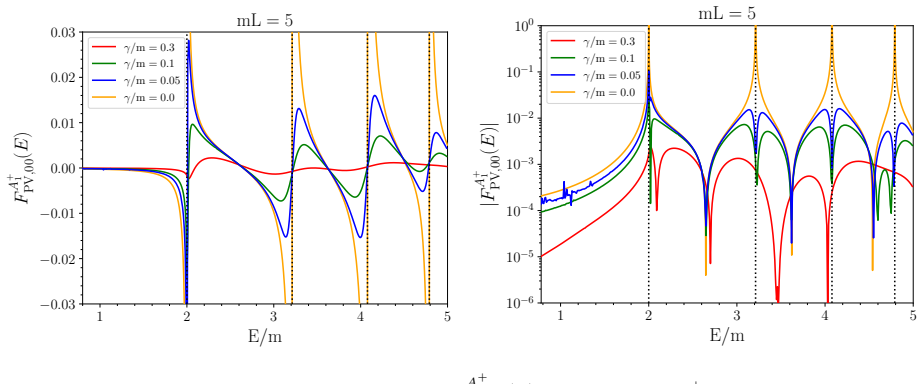
The authors show that thermal scattering cannot be defined with on-shell vacuum particles: a known theorem forces such an S-matrix to be trivial, and KMS symmetry introduces negative-energy hole states. They therefore define asymptotic states from thermoparticles and derive a thermal optical theorem with a two-thermoparticle phase space that has non-vanishing contributions below the vacuum threshold and at negative energies. Repeating the vacuum finite-volume logic with thermoparticle propagators, they find that the leading finite-volume corrections are contained in a kinematic function F(E,P;L,β) whose vacuum poles at non-interacting two-particle energies are regularised into finite peaks b
What carries the argument
The central object is the thermoparticle—a thermally damped, stable particle-like excitation whose spectral function ρ_TP(ω,p) has a broadened peak around the vacuum mass shell. Because ρ_TP vanishes below the vacuum mass threshold, thermoparticle propagators dominate the large-time behaviour of thermal correlators at low temperature. The derivation's engine is a skeleton expansion of the finite-volume thermal two-point function with thermoparticle propagators; the two-thermoparticle loop sum replaces the continuous energy integrals of the vacuum derivation, and its finite-volume part defines the kinematic function F(E,P;L,β). F is the finite-temperature analogue of the vacuum finite-volume
Load-bearing premise
The whole derivation hangs on thermoparticle dominance: at the temperatures of interest the thermal spectral density must be dominated by one narrow thermoparticle peak, so that the effective partial-wave expansion and the suppression of Bethe-Salpeter kernel singularities both hold.
What would settle it
Measure the thermal spectral function of the relevant hadron at T roughly equal to its vacuum mass, or at the temperatures of interest. If the single-thermoparticle component no longer dominates—multiple comparable peaks, strongly momentum-dependent peak shifts, or a broad flat continuum—the skeleton expansion fails and Eq. (4.35) will not describe the finite-volume levels. A direct check in a scalar toy theory would compare the predicted finite peaks of F with energy levels from lattice simulation at several volumes.
If this is right
- Energy levels computed on a finite L_τ × L³ lattice constrain the two-thermoparticle scattering amplitude M_TP, making resonance mass and width at finite temperature, M_p(β) and Γ(β), extractable in principle.
- Because F remains finite at all energies for T>0, the non-interacting two-particle pole singularities of the vacuum formalism disappear; the vacuum limit is approached smoothly as L_τ→∞.
- The two-thermoparticle phase space contains thermal contributions below E=2m and for E<0, so the scattering amplitude is constrained by data in regions that have no vacuum analogue.
- The same condition can be used to measure finite-temporal-size (finite-L_τ) corrections to vacuum lattice analyses, since any practical lattice simulation has T=1/L_τ>0.
- Solving the condition frame by frame for different total momenta P gives independent constraints on the K-matrix, compensating for the loss of boost invariance.
Where Pith is reading between the lines
- A natural next check is to compute F using a damping factor extracted directly from lattice two-point correlators, rather than the illustrative exponential form, and verify quantitatively that the finite-peak structure persists.
- If thermal spectral functions broaden or split into several comparable components, the single-thermoparticle approximation breaks down; a defining signature would be that energy levels stop obeying Eq. (4.35) with the assumed F—so the formalism itself provides a diagnostic for where thermal resonances cease to be well-defined.
- For QCD, the rho meson is an obvious first target: the formalism predicts that its extracted mass and width shift with temperature, with kinematic broadening of F separable from genuine resonance pole movement only by comparing amplitudes across volumes and frames.
- The framework could in principle be extended to resonances decaying to non-identical or spinful particles, and to three-particle channels, by adapting the same thermoparticle skeleton expansion.
Editorial analysis
A structured set of objections, weighed in public.
Referee Report
Summary. The paper develops a finite-temperature generalization of the two-particle Lüscher quantization condition. It models asymptotic thermal states as thermoparticles, derives a thermal optical theorem and a two-thermoparticle phase space, then performs a skeleton expansion of the finite-volume thermal correlator on L_tau x L^3. The central result is Eq. (4.35), det[F^{-1} + M_TP] = 0, with F finite at all energies due to thermal broadening, and the claimed equivalent real form Eq. (4.36). The paper evaluates F_PV numerically for an exponential damping model and proposes a step-by-step procedure to extract temperature-dependent resonance mass and width from lattice data.
Significance. If valid, the framework would be a substantial step toward first-principles extraction of in-medium resonance properties and toward controlling finite-L_tau systematics in vacuum lattice analyses. The derivation chain is explicit, the optical theorem and phase-space calculation are worked out in detail, and the numerical evaluation of the kinematic function is a useful illustration. The paper also honestly identifies its main dynamical assumptions. However, the central quantization condition is internally inconsistent: it has no real solutions at finite temperature, so the proposed extraction procedure cannot be implemented as written. This prevents the result from being used and places the paper's main claim in doubt.
major comments (3)
- [Sec. 4.4, Eqs. (4.35)-(4.36)] The central condition cannot be satisfied by real E. From Eq. (4.27), F = F_PV - i F_delta with F_delta = (1 - e^{-beta E}) rho_TP; from Eq. (3.16), M_TP = (K_TP^{-1} - i rho_TP)^{-1}. For real E and real K_TP, a single partial wave gives Im[F^{-1}+M_TP] = F_delta/(F_PV^2 + F_delta^2) + rho_TP/(K_TP^{-2} + rho_TP^2) > 0 whenever rho_TP != 0. Thus det[...] has no real zeros, while the finite-volume energies in Eq. (4.6) are real. Eq. (4.36) is not equivalent: equivalence would require Im F = +rho_TP, not -(1-e^{-beta E})rho_TP. This is an algebraic mismatch in the KMS/phase-space normalization, not a dynamical approximation; it also affects the beta -> infinity limit through the sign of Im F.
- [Sec. 4.4, Eq. (4.36)] Because Eq. (4.35) is not the correct pole condition, the paper must show directly that the finite-volume correlator C_{L,beta} in Eq. (4.34) has poles at the solutions of det[F_PV^{-1} + K_TP] = 0. The alternative form is merely stated. The geometric resummation in Eq. (4.30) organizes powers of F and M_TP; if [F^{-1}+M_TP] never vanishes, the pole mechanism is absent. A corrected derivation is needed before the real condition can be used for fits.
- [Secs. 3.3 and 4.3] The validity of the effective expansion (3.13) and of the subleading treatment of kernel singularities are assumed, with the paper itself stating that the first is "a purely dynamical question" and that the second "should also hold true at sufficiently small temperatures." Since these assumptions control which diagrams contribute at leading finite-volume order, the paper should specify the temperature range or provide a numerical/small-parameter check. Without this, the advertised extraction of M_rho(beta), Gamma(beta) is an approximation whose domain is undefined.
minor comments (4)
- [Sec. 2, Eq. (2.2)] The notation fW(omega, p) is nonstandard; W appears to denote the Fourier transform of a Wightman function. Please define it explicitly or use a more transparent notation.
- [Sec. 3.4, Fig. 1] For gamma/m = 0 the spectral function is a delta function, so the plotted curve must be a limiting/schematic representation. State how the gamma=0 curve was produced.
- [Sec. 4.5] Typo: "rho_PT" should read "rho_TP" in the sentence defining the spectral function.
- [Appendix A, Eq. (A.1)] The principal-value regulator epsilon is fixed to 1e-6 after the integrals are evaluated numerically. A sensitivity study for epsilon, analogous to the Lambda_n study in Fig. 10, would support the claim that corrections are negligible.
Circularity Check
No significant circularity; the quantization condition is a conditional skeleton-expansion derivation, and the cited self-papers only motivate the illustrative damping ansatz.
full rationale
The central relation det[F^{-1}+M_TP]=0 (Eq. 4.35) is derived from a standard skeleton expansion under an explicitly stated thermoparticle-dominance assumption, not by fitting a parameter to the quantity that is later called a prediction. The finiteness of F at finite T is presented transparently as a consequence of the smooth, broadened thermoparticle spectral function: the text states that the regularisation is 'a direct consequence of the thermoparticle states, whose spectral functions are broadened around the vacuum singularity' (Conclusions), and Sec. 4.6 similarly attributes the absence of poles to the off-real-axis propagator poles encoded in rho_TP. This is a conditional implication of the framework's input rather than a hidden identification of output with input. The thermoparticle framework is motivated by external axiomatic results (Bros-Buchholz, Narnhofer-Thirring), and the exponential damping ansatz is explicitly adopted from prior lattice studies, some of which are by the same authors; however, those citations only motivate the numerical illustrations and do not force the formal derivation. The algebraic/sign concern in the reader's take about real solutions of Eq. (4.35) is a potential correctness issue, not a circularity of the derivation chain.
Axiom & Free-Parameter Ledger
free parameters (4)
- gamma (thermal width parameter of the damping factor) =
gamma = T
- alpha (amplitude of the damping factor) =
alpha = 1
- Exponential form of D_{m,beta}(x) = alpha e^{-gamma |x|} =
exponential functional form
- |q_TP| (most-probable thermoparticle momentum) =
not computed
axioms (8)
- domain assumption Thermoparticle dominance: at low T the thermal spectral density is dominated by the thermoparticle component delta(s - m^2) Dtilde_{m,beta}(u) (Eq. 2.4), so two-thermoparticle loops carry the leading finite-volume effects.
- domain assumption The effective partial-wave expansion around the most-probable momentum |q_TP| (Eq. 3.13) is accurate enough for the unitarity relation and the kinematic function.
- domain assumption Endcap and Bethe-Salpeter kernel singularities are sub-leading in the Matsubara contour sum (Eq. 4.16).
- domain assumption Left-hand cut (t/u-channel exchange) contributions are negligible in the kernels.
- domain assumption Bros-Buchholz thermal spectral representation (Eq. 2.3) and KMS structure, including negative-energy states.
- domain assumption A single analytic thermoparticle propagator exists whose i*epsilon limits recover retarded and advanced propagators (footnote 4).
- domain assumption The thermal optical theorem is truncated to n = 2 thermoparticle intermediate states.
- domain assumption Narnhofer-Thirring: on-shell asymptotic thermal states give a trivial S-matrix, so off-shell thermoparticles are the correct scattering basis (Ref [72]).
invented entities (1)
-
Thermoparticle scattering states (as applied here to two-particle scattering and finite volume)
no independent evidence
read the original abstract
The properties of hadronic resonances at finite temperature constitute an important probe of the thermal QCD medium. In this work we use the concept of thermoparticles, which characterise thermally-modified but stable particle-like states, to define the notion of two-particle scattering at finite temperature, and establish a unitarity relation for the thermal scattering amplitude. We derive a finite-temperature generalisation of the vacuum two-particle quantisation condition via a skeleton expansion of the finite-volume correlation function. Solving this condition at the finite-volume energy levels of the system constrains the form of the thermal scattering amplitude, and hence the properties of resonances. In contrast to the vacuum case, the kinematic function containing the leading finite-volume corrections is finite at all energies, reflecting the fact that thermoparticles have broadened spectral peaks due to their interactions with the thermal medium. Since all lattice simulations involve a finite temporal extent, our approach can also be used to study finite-temporal size effects in vacuum analyses.
Figures




Reference graph
Works this paper leans on
-
[1]
J. I. Kapusta and C. Gale,Finite-temperature Field Theory: Principles and applications, Cambridge Monographs on Mathematical Physics. Cambridge University Press, 2011
2011
-
[2]
M. Urban, M. Buballa, R. Rapp and J. Wambach,Modifications of the rho meson from the virtual pion cloud in hot and dense matter,Nucl. Phys. A673(2000) 357 [nucl-th/9910004]
Pith/arXiv arXiv 2000
-
[3]
C. Jung, F. Rennecke, R.-A. Tripolt, L. von Smekal and J. Wambach,In-Medium Spectral Functions of Vector- and Axial-Vector Mesons from the Functional Renormalization Group, Phys. Rev. D95(2017) 036020 [1610.08754]
Pith/arXiv arXiv 2017
-
[4]
A. Dobado, A. Gomez Nicola, F. J. Llanes-Estrada and J. R. Pelaez,Thermal rho and sigma mesons from chiral symmetry and unitarity,Phys. Rev. C66(2002) 055201 [hep-ph/0206238]
Pith/arXiv arXiv 2002
-
[5]
A. G´ omez Nicola, J. R. de Elvira and A. Vioque-Rodr ´ ıguez,The pion-kaon scattering amplitude and theK ∗ 0 (700)andK ∗(892)resonances at finite temperature,JHEP08(2023) 148 [2304.08786]
Pith/arXiv arXiv 2023
-
[6]
F. Gao and M. Ding,Thermal properties ofπandρmeson,Eur. Phys. J. C80(2020) 1171 [2006.05909]
Pith/arXiv arXiv 2020
-
[7]
R. A. Briceno, J. J. Dudek and R. D. Young,Scattering processes and resonances from lattice QCD,Rev. Mod. Phys.90(2018) 025001 [1706.06223]
Pith/arXiv arXiv 2018
-
[8]
M. T. Hansen and S. R. Sharpe,Lattice QCD and Three-particle Decays of Resonances,Ann. Rev. Nucl. Part. Sci.69(2019) 65 [1901.00483]
Pith/arXiv arXiv 2019
-
[9]
M. Mai, U.-G. Meißner and C. Urbach,Towards a theory of hadron resonances,Phys. Rept. 1001(2023) 1 [2206.01477]
Pith/arXiv arXiv 2023
-
[10]
L¨ uscher,Volume dependence of the energy spectrum in massive quantum field theories
M. L¨ uscher,Volume dependence of the energy spectrum in massive quantum field theories. ii. scattering states,Communications in Mathematical Physics105(1986) 153
1986
-
[11]
L¨ uscher,Two particle states on a torus and their relation to the scattering matrix, Nuclear Physics B354(1991) 531
M. L¨ uscher,Two particle states on a torus and their relation to the scattering matrix, Nuclear Physics B354(1991) 531
1991
-
[12]
Rummukainen and S
K. Rummukainen and S. A. Gottlieb,Resonance scattering phase shifts on a nonrest-frame lattice,Nuclear Physics B450(1995) 397
1995
-
[13]
C. H. Kim, C. T. Sachrajda and S. R. Sharpe,Finite-volume effects for two-hadron states in moving frames,Nuclear Physics B727(2005) 218 [hep-lat/0510022]
Pith/arXiv arXiv 2005
-
[14]
S. He, X. Feng and C. Liu,Two particle states and the s-matrix elements in multi-channel scattering,Journal of High Energy Physics2005(2005) 011 [hep-lat/0504019]
Pith/arXiv arXiv 2005
-
[15]
Fu,Rummukainen–gottlieb’s formula on two-particle system with different mass,Physical Review D85(2012) 014506
Z. Fu,Rummukainen–gottlieb’s formula on two-particle system with different mass,Physical Review D85(2012) 014506. 29
2012
-
[16]
Leskovec and S
L. Leskovec and S. Prelovˇ sek,Scattering phase shifts for two particles of different mass and non-zero total momentum in lattice qcd,Physical Review D85(2012) 114507
2012
-
[17]
G¨ ockeler, R
M. G¨ ockeler, R. Horsley, M. Lage, U. Meißner, P. E. L. Rakow, A. Rusetsky, G. Schierholz and J. M. Zanotti,Scattering phases for meson and baryon resonances on general moving-frame lattices,Physical Review D86(2012) 094513
2012
-
[18]
M. T. Hansen and S. R. Sharpe,Multiple-channel generalization of Lellouch-Luscher formula, Phys. Rev. D86(2012) 016007 [1204.0826]
Pith/arXiv arXiv 2012
-
[19]
R. A. Brice˜ nno,Two-particle multichannel systems in a finite volume with arbitrary spin, Physical Review D89(2014) 074507 [1401.3312]
Pith/arXiv arXiv 2014
-
[20]
M. T. Hansen and S. R. Sharpe,Relativistic, model-independent, three-particle quantization condition,Phys. Rev. D90(2014) 116003 [1408.5933]
Pith/arXiv arXiv 2014
-
[21]
M. T. Hansen and S. R. Sharpe,Expressing the three-particle finite-volume spectrum in terms of the three-to-three scattering amplitude,Phys. Rev. D92(2015) 114509 [1504.04248]
Pith/arXiv arXiv 2015
-
[22]
M. Mai, B. Hu, M. Doring, A. Pilloni and A. Szczepaniak,Three-body Unitarity with Isobars Revisited,Eur. Phys. J. A53(2017) 177 [1706.06118]
Pith/arXiv arXiv 2017
-
[23]
M. Mai and M. D¨ oring,Three-body Unitarity in the Finite Volume,Eur. Phys. J. A53 (2017) 240 [1709.08222]
Pith/arXiv arXiv 2017
-
[24]
M. D¨ oring, H. W. Hammer, M. Mai, J. Y. Pang,§. A. Rusetsky and J. Wu,Three-body spectrum in a finite volume: the role of cubic symmetry,Phys. Rev. D97(2018) 114508 [1802.03362]
Pith/arXiv arXiv 2018
-
[25]
T. D. Blanton, F. Romero-L´ opez and S. R. Sharpe,Implementing the three-particle quantization condition including higher partial waves,JHEP03(2019) 106 [1901.07095]
Pith/arXiv arXiv 2019
-
[26]
M. T. Hansen, F. Romero-L´ opez and S. R. Sharpe,Generalizing the relativistic quantization condition to include all three-pion isospin channels,JHEP07(2020) 047 [2003.10974]
Pith/arXiv arXiv 2020
-
[27]
T. D. Blanton and S. R. Sharpe,Three-particle finite-volume formalism forπ +π+K+ and related systems,Phys. Rev. D104(2021) 034509 [2105.12094]
Pith/arXiv arXiv 2021
-
[28]
Z. T. Draper, M. T. Hansen, F. Romero-L´ opez and S. R. Sharpe,Three relativistic neutrons in a finite volume,JHEP07(2023) 226 [2303.10219]
Pith/arXiv arXiv 2023
-
[29]
Z. T. Draper and S. R. Sharpe,Three-particle formalism for multiple channels: theηππ+ KKπsystem in isosymmetric QCD,JHEP07(2024) 083 [2403.20064]
Pith/arXiv arXiv 2024
-
[30]
S. M. Dawid, A. W. Jackura and A. P. Szczepaniak,Finite-volume quantization condition from the N/D representation,Phys. Lett. B864(2025) 139442 [2411.15730]
Pith/arXiv arXiv 2025
-
[31]
W. Schaaf and S. R. Sharpe,Implementing the three-neutron quantization condition, 2512.24508
-
[32]
M. T. Hansen, F. Romero-L´ opez and S. R. Sharpe,Finite-volume formalism forN ππat maximal isospin,JHEP02(2026) 221 [2509.24778]. 30
arXiv 2026
-
[33]
S. M. Dawid, F. Romero-L´ opez and S. R. Sharpe,Comparison of integral equations used to studyT + cc for a stable D ∗,JHEP09(2025) 058 [2505.05466]
arXiv 2025
-
[34]
S. M. Dawid, Z. T. Draper, A. D. Hanlon, B. H¨ orz, C. Morningstar, F. Romero-L´ opez, S. R. Sharpe and S. Skinner,QCD Predictions for Physical Multimeson Scattering Amplitudes, Phys. Rev. Lett.135(2025) 021903 [2502.14348]
Pith/arXiv arXiv 2025
-
[35]
R. A. Brice˜ no, M. T. Hansen, A. W. Jackura, R. G. Edwards and C. E. Thomas,Isotensor πππscattering with aρresonant subsystem from QCD,2510.24894. [36]Hadron Spectrumcollaboration,Energy dependence of theρresonance inππelastic scattering from lattice QCD,Phys. Rev. D87(2013) 034505 [1212.0830]
arXiv 2013
-
[37]
D. J. Wilson, J. J. Dudek, R. G. Edwards and C. E. Thomas,Resonances in coupledπK, ηK scattering from lattice QCD,Phys. Rev. D91(2015) 054008 [1411.2004]
Pith/arXiv arXiv 2015
-
[38]
D. J. Wilson, R. A. Briceno, J. J. Dudek, R. G. Edwards and C. E. Thomas,Coupled ππ, K¯Kscattering inP-wave and theρresonance from lattice QCD,Phys. Rev. D92(2015) 094502 [1507.02599]
Pith/arXiv arXiv 2015
-
[39]
R. A. Briceno, J. J. Dudek, R. G. Edwards and D. J. Wilson,Isoscalarππ, K K, ηηscattering and theσ, f0, f2 mesons from QCD,Phys. Rev. D97(2018) 054513 [1708.06667]
Pith/arXiv arXiv 2018
-
[40]
D. J. Wilson, R. A. Briceno, J. J. Dudek, R. G. Edwards and C. E. Thomas,The quark-mass dependence of elasticπKscattering from QCD,Phys. Rev. Lett.123(2019) 042002 [1904.03188]. [41]Hadron Spectrumcollaboration,Isospin-1/2Dπscattering and the lightestD ∗ 0 resonance from lattice QCD,JHEP07(2021) 123 [2102.04973]
Pith/arXiv arXiv 2019
-
[42]
P. Boyle, F. Erben, V. G¨ ulpers, M. T. Hansen, F. Joswig, M. Marshall, N. P. Lachini and A. Portelli,Physical-mass calculation ofρ(770)andK ∗(892)resonance parameters viaππ andKπscattering amplitudes from lattice QCD,Phys. Rev. D111(2025) 054510 [2406.19193]. [43]Hadron Spectrumcollaboration,D 1 andD 2 resonances in coupled-channel scattering amplitudes ...
Pith/arXiv arXiv 2025
-
[44]
B. Hu, R. Molina, M. D¨ oring, M. Mai and A. Alexandru,Chiral extrapolations of theρ(770) meson inN f = 2 + 1lattice QCD simulations,Phys. Rev. D96(2017) 034520 [1704.06248]
Pith/arXiv arXiv 2017
-
[45]
C. W. Andersen, J. Bulava, B. H¨ orz and C. Morningstar,ElasticI= 3/2p-wave nucleon-pion scattering amplitude and the∆(1232)resonance fromN f = 2 + 1lattice QCD,Phys. Rev. D 97(2018) 014506 [1710.01557]
Pith/arXiv arXiv 2018
-
[46]
J. Bulava, A. D. Hanlon, B. H¨ orz, C. Morningstar, A. Nicholson, F. Romero-L´ opez, S. Skinner, P. Vranas and A. Walker-Loud,Elastic nucleon-pion scattering atm π = 200MeV from lattice QCD,Nucl. Phys. B987(2023) 116105 [2208.03867]. [47]Baryon Scattering (BaSc)collaboration,Lattice QCD study ofπΣ- ¯KNscattering and theΛ(1405)resonance,Phys. Rev. D109(202...
Pith/arXiv arXiv 2023
-
[49]
L. Leskovec, C. B. Lang, M. Padmanath and S. Prelovsek,A lattice QCD study of pion-nucleon scattering in the Roper channel,Few Body Syst.59(2018) 95 [1806.02363]
Pith/arXiv arXiv 2018
-
[50]
C. Alexandrou, J. Finkenrath, T. Leontiou, S. Meinel, M. Pflaumer and M. Wagner,Shallow Bound States and Hints for Broad Resonances with Quark Content ¯b¯cudinB ¯DandB ∗ ¯D Scattering from Lattice QCD,Phys. Rev. Lett.132(2024) 151902 [2312.02925]. [51]GWQCDcollaboration,Three-Body Dynamics of thea1(1260)Resonance from Lattice QCD,Phys. Rev. Lett.127(2021)...
Pith/arXiv arXiv 2024
-
[52]
H. Yan, M. Mai, M. Garofalo, U.-G. Meißner, C. Liu, L. Liu and C. Urbach,ωMeson from Lattice QCD,Phys. Rev. Lett.133(2024) 211906 [2407.16659]
Pith/arXiv arXiv 2024
-
[53]
S. M. Dawid, Z. T. Draper, A. D. Hanlon, B. H¨ orz, C. Morningstar, F. Romero-L´ opez, S. R. Sharpe and S. Skinner,Two- and three-meson scattering amplitudes with physical quark masses from lattice QCD,Phys. Rev. D112(2025) 014505 [2502.17976]
Pith/arXiv arXiv 2025
-
[54]
N. P. Landsman,Nonshell Unstable Particles in Thermal Field Theory,Annals Phys.186 (1988) 141
1988
-
[55]
Bros and D
J. Bros and D. Buchholz,Particles and propagators in relativistic thermo field theory,Z. Phys. C55(1992) 509
1992
-
[56]
D. Buchholz,On the manifestations of particles, inInternational Conference on Mathematical Physics Towards the 21st Century, 11, 1993,hep-th/9511023
Pith/arXiv arXiv 1993
-
[57]
J. Bros and D. Buchholz,Asymptotic dynamics of thermal quantum fields,Nucl. Phys. B 627(2002) 289 [hep-ph/0109136]
Pith/arXiv arXiv 2002
-
[58]
R. Haag, N. M. Hugenholtz and M. Winnink,On the Equilibrium states in quantum statistical mechanics,Commun. Math. Phys.5(1967) 215
1967
-
[59]
R. F. Streater and A. S. Wightman,PCT, spin and statistics, and all that. Redwood City, USA: Addison-Wesley, 1989
1989
-
[60]
Haag,Local quantum physics: Fields, particles, algebras
R. Haag,Local quantum physics: Fields, particles, algebras. Berlin, Germany: Springer, 1992
1992
-
[61]
N. N. Bogolyubov, A. A. Logunov, A. I. Oksak and I. T. Todorov,General Principles of Quantum Field Theory. Dordrecht, Netherlands: Kluwer, 1990
1990
-
[62]
J. Bros and D. Buchholz,Axiomatic analyticity properties and representations of particles in thermal quantum field theory,Ann. Inst. H. Poincare Phys. Theor.64(1996) 495 [hep-th/9606046]
Pith/arXiv arXiv 1996
-
[63]
V. P. Nair and R. D. Pisarski,Spectral functions at nonzero temperature,Phys. Rev. D113 (2026) 074022 [2504.05383]
Pith/arXiv arXiv 2026
-
[64]
P. Lowdon and O. Philipsen,On the (in)consistency of perturbation theory at finite temperature,JHEP08(2024) 167 [2405.02009]. 32
Pith/arXiv arXiv 2024
-
[65]
P. Ali, P. Lowdon and O. Philipsen,Towards a consistent perturbation theory at finite temperature,2606.14863
-
[66]
P. Lowdon and O. Philipsen,Goldstone bosons at nonzero temperature,Phys. Rev. D112 (2025) L061701 [2501.17120]
arXiv 2025
-
[67]
P. Lowdon and O. Philipsen,Goldstone bosons across thermal phase transitions,JHEP02 (2026) 090 [2507.14348]
arXiv 2026
-
[68]
P. Lowdon and O. Philipsen,Pion spectral properties above the chiral crossover of QCD, JHEP10(2022) 161 [2207.14718]
Pith/arXiv arXiv 2022
-
[69]
D. Bala, O. Kaczmarek, P. Lowdon, O. Philipsen and T. Ueding,Pseudo-scalar meson spectral properties in the chiral crossover region of QCD,JHEP05(2024) 332 [2310.13476]
Pith/arXiv arXiv 2024
-
[70]
Bros,Thermal aspects in quantum field theory,Annales Henri Poincare4(2003) S863
J. Bros,Thermal aspects in quantum field theory,Annales Henri Poincare4(2003) S863
2003
-
[71]
M. L. Bellac,Thermal Field Theory, Cambridge Monographs on Mathematical Physics. Cambridge University Press, 3, 2011
2011
-
[72]
Narnhofer, M
H. Narnhofer, M. Requardt and W. E. Thirring,Quasiparticles at Finite Temperatures, Commun. Math. Phys.92(1983) 247
1983
-
[73]
C. Lorc´ e and P. Lowdon,Universality of the Poincar´ e gravitational form factor constraints, Eur. Phys. J. C80(2020) 207 [1908.02567]
Pith/arXiv arXiv 2020
-
[74]
M. E. Peskin and D. V. Schroeder,An Introduction to quantum field theory. Addison-Wesley, Reading, USA, 1995, 10.1201/9780429503559
-
[75]
Cubature: Adaptive Multidimensional Integration in C
S. G. Johnson, “Cubature: Adaptive Multidimensional Integration in C.” https://github.com/stevengj/cubature, 2026
2026
-
[76]
Montvay and G
I. Montvay and G. Munster,Quantum fields on a lattice, Cambridge Monographs on Mathematical Physics. Cambridge University Press, 3, 1997
1997
-
[77]
M. T. Hansen and T. Peterken,Discretization effects in finite-volume2→2scattering, 2408.07062
-
[78]
A. B. a. Raposo and M. T. Hansen,Finite-volume scattering on the left-hand cut,JHEP08 (2024) 075 [2311.18793]
Pith/arXiv arXiv 2024
-
[79]
J. J. Dudek, R. G. Edwards, M. J. Peardon, D. G. Richards and C. E. Thomas,Toward the excited meson spectrum of dynamical QCD,Phys. Rev. D82(2010) 034508 [1004.4930]
Pith/arXiv arXiv 2010
-
[80]
Lowdon,Euclidean thermal correlation functions in local QFT,Phys
P. Lowdon,Euclidean thermal correlation functions in local QFT,Phys. Rev. D106(2022) 045028 [2201.12180]. 33
Pith/arXiv arXiv 2022
discussion (0)
Sign in with ORCID, Apple, or X to comment. Anyone can read and Pith papers without signing in.