REVIEW 5 minor 198 references
Quasiparticle interference has matured into a quantitative probe of quantum materials — able to map both occupied and unoccupied electronic states, at sub-100 mK temperatures and in magnetic fields, and to read the symmetry of superconducti
Reviewed by Pith at T0; open to challenge. T0 means a machine referee read the full paper against a public rubric. the ladder, T0–T4 →
T0 review · deepseek-v4-flash
2026-08-01 04:33 UTC pith:J6SRMECZ
load-bearing objection A comprehensive, honest review of QPI that deserves to become a standard reference; the central argument holds, and the main weakness (inelastic tunneling) is openly acknowledged.
Quasiparticle interference as a tool to study quantum materials
The pith
A machine-rendered reading of the paper's core claim, the machinery that carries it, and where it could break.
Core claim
The paper's central claim is that QPI is now a quantitative, complementary technique to ARPES and quantum oscillations, with three unique advantages: it probes occupied and unoccupied states, works below 100 mK and in high magnetic fields, and is one of only two techniques able to provide momentum-resolved information about the symmetry of a superconducting order parameter. The argument rests on the T-matrix description of impurity scattering, which shows that the Fourier-transformed differential conductance is governed by scattering vectors connecting states on constant-energy contours, modulated by internal selection rules. In superconductors, coherence factors make QPI phase-sensitive: ti
What carries the argument
The central machinery is the T-matrix (or Green's function) description of a point impurity in a periodic potential, combined with the low-temperature relation dI/dV ∝ ρ_s(eV) for elastic tunneling. The T-matrix formalism yields the QPI response as a product of two Green's functions, so scattering vectors q connecting states with substantial spectral weight at the same energy dominate; the velocity selection rule further favors states with antiparallel group velocities. Selection rules are encoded in matrix elements: spin selection suppresses scattering between opposite spin states; time-reversal-odd impurity potentials cancel in the Born approximation; spin-orbit scattering introduces a σ·(
Load-bearing premise
The analysis relies on the relation dI/dV ∝ ρ_s(eV), which holds only if the tip density of states and tunneling matrix element are energy independent and elastic tunneling dominates; the paper itself notes that inelastic spin-fluctuation tunneling can be large in correlated materials and may limit sharp QPI features near the Fermi energy.
What would settle it
A direct test would be to measure QPI in a strongly correlated material at base temperature and compare the energy dependence of sharp QPI features with a model that includes only elastic single-particle scattering. If inelastic spin-fluctuation tunneling is significant, the QPI contrast near the Fermi energy should deviate from the predicted dI/dV = C ρ_s(eV) form and show replica features or anomalous broadening; alternatively, verifying the predicted setpoint constraint (Eq. 12) by recording maps at different setpoint voltages would confirm or refute the setpoint-effect interpretation.
If this is right
- If QPI is quantitative, it can be used as a routine band-structure tool at energy scales and temperatures inaccessible to ARPES, including unoccupied states and sub-100 mK regimes.
- The selection rules imply that QPI can map spin-orbital texture in Rashba systems, topological insulators, and Weyl semimetals, and can distinguish sign-changing from sign-preserving superconducting order parameters via coherence-factor contrast.
- The setpoint effect produces non-dispersive artifacts; the paper's Eq. (12) gives a testable constraint — any finite-q modulation at one energy must be compensated within the setpoint window.
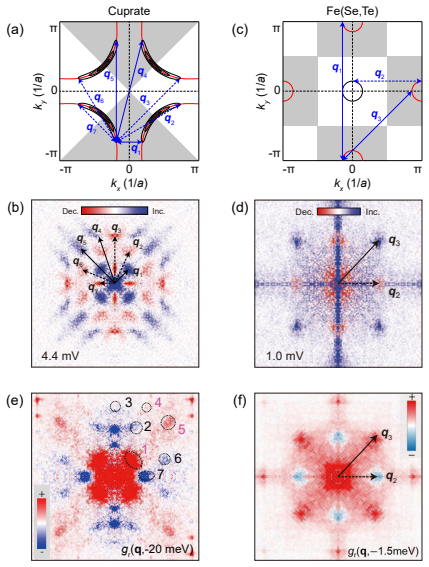
- Phase-referenced QPI, comparing modulations at ±V, provides a field-free method to extract the sign structure of the superconducting gap, which has been demonstrated in cuprates and Fe(Se,Te).
Where Pith is reading between the lines
- If inelastic tunneling from spin fluctuations is as large as the paper suggests in correlated materials, then sharp QPI features near the Fermi energy may be systematically broadened; this would mean the 'disentangling' the conclusion calls for must include a bosonic background, not just single-particle bands.
- The velocity selection rule could be tested more directly: in a system with known Fermi surface, one could predict which scattering vectors are suppressed (parallel group velocities) and verify their absence, as was done in bilayer graphene.
- A natural extension is to use the setpoint-effect constraint (Eq. 12) as a diagnostic for mirage features: any QPI feature that disappears under the conductance-ratio normalization is likely setpoint-induced, which could help re-evaluate reports of checkerboard electronic crystals.
- Combining spin-polarized or superconducting tips with QPI could yield separate maps of spin and orbital character, turning the technique into a spin-resolved band-structure probe beyond current ARPES capabilities.
Editorial analysis
A structured set of objections, weighed in public.
Referee Report
Summary. This review article surveys quasiparticle interference (QPI) imaging with scanning tunneling microscopy as a probe of the low-energy electronic structure of quantum materials. It covers the experimental basis of QPI, the elastic-tunneling approximation underlying Eq. (3), the setpoint effect and its correction, the T-matrix scattering formalism, selection rules from spin, orbital, spin-orbit, and superconducting coherence factors, numerical modeling approaches from joint density of states to continuum Wannier-based simulations, and a broad range of applications from noble-metal surfaces to topological insulators, graphene, cuprates, iron-based superconductors, heavy-fermion systems, and putative triplet superconductors. The review argues that QPI has matured into a quantitative technique that complements ARPES and quantum oscillations and can provide momentum-resolved information about superconducting order-parameter symmetry. I checked the key internal derivation of Eq. (12) from Eq. (11); it is correct within the stated constant-current setpoint model, and the ratio and Feenstra-function normalizations in Eqs. (13)–(15) are also internally consistent.
Significance. If taken at face value, this review provides a valuable, up-to-date synthesis of a technique that has grown from a surface-state curiosity into a quantitative probe of correlated electron systems. Its strengths are the clear derivation of the T-matrix QPI response, the systematic catalog of selection rules, the emphasis on the continuum Wannier transformation for realistic STM modeling, and the candid discussion of limitations. The authors explicitly acknowledge the most serious caveat — inelastic spin-fluctuation tunneling, which can reach 30–50% conductance changes and may produce replica features (Secs. III B and VII C). Because this limitation is stated rather than hidden, it does not overturn the review's central claim, though it tempers the word 'routine' in the abstract. The paper also benefits from references to publicly available simulation code (Refs. 68–69) and from cross-checks against ARPES and quantum-oscillation data in several materials.
minor comments (5)
- [Sec. V A] The sentence 'mathematically it is not possible to derive the JDOS expression Eq. (36) under any algebraic approximation' refers to the wrong equation: Eq. (36) is the T-matrix QPI response, not the JDOS expression. The intended reference should be Eq. (84) or (85). This is a typo, but it will confuse readers who try to verify the claim.
- [Abstract vs. Secs. V D, VII C, VII E] The abstract states that 'recent theoretical progress now enables routine modelling of QPI,' but the text itself notes that the impurity potential is the least controlled parameter (Sec. V D), that inelastic tunneling may limit sharp QPI features near the Fermi energy (Sec. VII C), and that calculated QPI often lacks quantitative agreement because of impurity distributions and self-energy effects (Sec. VII E). I suggest softening 'routine' to 'increasingly routine' or adding a qualifier such as 'for a range of quantum materials,' to match the body of the review.
- [Sec. VII C] The discussion of inelastic tunneling is honest but stops short of giving the reader a practical criterion for when Eq. (3) can be trusted. A short quantitative statement — for example, an order-of-magnitude threshold for the inelastic-to-elastic conductance ratio, or an energy window in which the elastic approximation is expected to hold — would make the caveat more actionable without requiring new theory.
- [Sec. III E, Eq. (14)] The conductance ratio Z(r,V) is stated to 'largely cancel' the setpoint normalization. Under the model assumptions used to derive Eq. (11), the cancellation is exact, because the setpoint denominator is independent of the sign of V. The qualifier 'largely' is unnecessarily weak and could be replaced by 'exactly within the stated model assumptions.'
- [Sec. VI E 2] The magnetic-field BQPI analysis is described as phenomenological and lacking microscopic support (Refs. 51–52 issue). This is a fair self-critique, but the following paragraph already points to the two-band theory of Ref. 51 as a more robust route. Consider making that connection explicit in the earlier discussion, since it directly addresses the stated limitation.
Circularity Check
No significant circularity: the review's claims rest on standard tunneling theory and external experimental results, with explicit caveats.
full rationale
The paper is a review and does not derive a new prediction from fitted inputs. Its central mapping, Eq. (3) g(V) ∝ ρ_s(eV), is presented as a standard consequence of the Bardeen/Tersoff–Hamann tunneling expression (Eq. (1)) under stated assumptions (energy-independent tip DOS and matrix element, elastic tunneling), and the paper explicitly identifies these assumptions and later flags (Sec. VII C) that inelastic spin-fluctuation tunneling can be large and complicate QPI interpretation. No parameter is fitted to data and then renamed a prediction; the octet-model gap extraction uses measured scattering-vector dispersions and is cross-checked against ARPES, not derived from itself. The many self-citations (e.g., Refs. 32, 47, 65, 89, 98, 135, 171) are supporting published experimental and modelling results, and the theoretical framework (Green's functions, T-matrix, continuum Wannier transformation) is set out in the text with equations rather than imported as an unverified premise. There is no uniqueness theorem or ansatz smuggled in via self-citation. The acknowledged inelastic-tunneling caveat weakens the breadth of the central claim but does not make the argument circular.
Axiom & Free-Parameter Ledger
free parameters (3)
- Wannier orbital radius =
not specified
- Impurity potential V(r) =
not specified
- Phenomenological broadening η =
not specified
axioms (4)
- domain assumption Elastic tunneling dominates; tip DOS and tunneling matrix element are energy independent (Eq. 3)
- domain assumption Point-like impurity and Born or T-matrix approximation for scattering
- domain assumption Host time-reversal symmetry for the cancellation rule
- domain assumption Single-band spin-singlet superconductor for Table I
read the original abstract
To understand the properties of quantum materials a detailed knowledge of the material's low energy electronic structure is key. Details of the electronic structure drive the ground state through electronic instabilities, electronic correlation effects, new electronic orders or just the absence of electronic states near the Fermi energy - making a realistic and detailed understanding crucial to be able to control and design properties of quantum materials. The past 25 years have seen a significant improvement in experimental techniques to observe the true electronic structure, in particular in techniques such as Angle resolved photoemission spectroscopy (ARPES) where energy resolutions of 2meV are routinely achievable now, which however is limited to zero magnetic field and only provides information about the occupied states. Scanning tunneling microscopy (STM) achieves a significantly better energy resolution <100${\mu}$eV and can operate at temperatures well below 50mK and in magnetic fields. While per se a real-space technique, by imaging quasiparticle interference (QPI) STM can also provide information about the electronic structure. This technique has been used over the past decades to study a wide range of quantum materials to understand correlated electron behaviour. Recent theoretical progress now enables routine modelling of QPI, a key requirement to interpret the complex data. Here, we review the principles of QPI, its origin, experimental detection, and the physical insight gained from the study of QPI and possible future directions for this technique.
Figures






Reference graph
Works this paper leans on
-
[1]
Since Bogoliubov quasiparticles are coherent superpositions of electron-like and hole-like exci- tations,E(k) is particle-hole symmetric about the Fermi level
Superconducting-gap dispersions In the presence of a momentum-dependent order parameter ∆(k), the energy dispersion of the Bogoliubov quasiparticlesE(k) is given by E(k) =± p ξ(k) 2 + ∆(k)2,(92) whereξ(k) denotes the normal-state band dispersion, with the Fermi level at zero. Since Bogoliubov quasiparticles are coherent superpositions of electron-like and...
2003
-
[2]
Phase-sensitive BQPI While the analysis of BQPI patterns within the framework of the octet model provides information on the gap amplitude|∆(k)|, it remains challenging to determine the phase structure of the superconducting order parameter. For example, a highly anisotropics- wave order parameter with a constant phase in momentum space may produce BQPI p...
2009
-
[3]
The crystal structure is closely related to that of the cuprate high-temperature superconductors
Sr 2RuO4 The strontium ruthenates adopt a perovskite crystal structure and form a Ruddlesden- Popper series of compounds with composition Sr n+1RunO3n+1. The crystal structure is closely related to that of the cuprate high-temperature superconductors. For this reason, the discovery of superconductivity in then= 1 member Sr 2RuO4[143] generated signifi- ca...
-
[4]
There are reports of QPI[154, 155], yet the interpretation is complicated by the surface cut
UTe 2 Most recently, the unconventional superconductor uranium ditelluride has been ex- tensively studied by STM. There are reports of QPI[154, 155], yet the interpretation is complicated by the surface cut. Some of the reported QPI has been recorded with a su- perconducting tip [154], which further complicates the interpretation. The QPI has been interpr...
-
[5]
At the same time, many heavy fermion materials exhibit complex phase diagrams at low temperatures, with Fermi liquid behaviour often only setting at temperatures well below 10 K
Heavy fermion materials The electronic structure of heavy fermion materials is particularly challenging to study: the flat bands and large quasiparticle masses up to one thousand times the free electron mass observed in many of these means that a very high energy resolution is required to resolve the band structure, often exceeding the energy resolution a...
-
[6]
URu 2Si2 is a heavy fermion superconductor, with a large electronic contribution to the specific heat
Heavy band formation and surface states in URu 2Si2 The first heavy fermion material for which QPI was observed is URu 2Si2. URu 2Si2 is a heavy fermion superconductor, with a large electronic contribution to the specific heat. Quantum oscillations show effective masses in the bulk between 8m e and 25me[158, 159] and a hidden order phase [160, 161], i.e. ...
-
[7]
Superconductivity in CeCoIn 5 In subsequent studies of the heavy-fermion superconductor CeCoIn 5, also information about the symmetry of the superconducting order parameter was obtained,[139, 165] however without a full mapping of the momentum-space structure of the superconducting gap as was achieved in the cuprate and iron-based superconductors. Because...
-
[8]
In the Ruddlesden-Popper strontium oxides, a natural cleavage plane exists between the strontium oxide layers which results in a charge neutral surface
Correlated oxides QPI has been applied to a range of transition metal oxides apart from the cuprate superconductors, notably Sr 2RuO4[32], Sr 2RhO4[88], Sr 3Ru2O7[166] and Sr 4Ru3O10[66] as well as the delafossite oxides [89, 167, 168]. In the Ruddlesden-Popper strontium oxides, a natural cleavage plane exists between the strontium oxide layers which resu...
-
[9]
Quantitative description of QPI The present review shows that the theoretical understanding of QPI has almost reached a quantitative level, where corrections due to, e.g., correlation effects or spin-orbit scat- tering become relevant and their effect can be characterized. Finer details of the QPI can be analysed in terms of their origin from comparison w...
-
[10]
In a few cases, Fermi liquid effects [87–89] are accounted for, assuming, e.g., anE 2 dependence of lifetime broadening
Capturing electronic correlation effects Modelling of QPI so far typically starts from a single particle description, either in the form of a tight-binding model or from DFT. In a few cases, Fermi liquid effects [87–89] are accounted for, assuming, e.g., anE 2 dependence of lifetime broadening. For cor- related materials, typically a phenomenological band...
-
[11]
Spin and orbital selective tips The discussion so far has focused on tips which are point-like metallic tips, and assumed to have a featureless density of states. These assumptions make the interpretation of the QPI significantly easier, however one can also use modified tips to make them sensitive for specific states, probing particular aspects of the el...
-
[12]
With a superconducting tip, the resolution 79 is not limited by the Fermi broadening of the tip, but by the sharpness of the coherence peak
Superconducting tips In tunneling spectra, for example for measuring Andreev bound states [173], supercon- ducting tips offer superior energy resolution. With a superconducting tip, the resolution 79 is not limited by the Fermi broadening of the tip, but by the sharpness of the coherence peak. Such increased energy resolution is also desirable for QPI, ho...
2022
-
[13]
M. F. Crommie, C. P. Lutz, and D. M. Eigler, Imaging standing waves in a two-dimensional electron gas, Nature363, 524 (1993)
1993
-
[14]
Hasegawa and P
Y. Hasegawa and P. Avouris, Direct observation of standing wave formation at surface steps using scanning tunneling spectroscopy, Phys. Rev. Lett.71, 1071 (1993)
1993
-
[15]
M. F. Crommie, C. P. Lutz, and D. M. Eigler, Confinement of Electrons to Quantum Corrals on a Metal Surface, Science262, 218 (1993)
1993
-
[16]
E. J. Heller, M. F. Crommie, C. P. Lutz, and D. M. Eigler, Scattering and absorption of 84 surface electron waves in quantum corrals, Nature369, 464 (1994)
1994
-
[17]
J. E. Hoffman, K. McElroy, D.-H. Lee, K. M. Lang, H. Eisaki, S. Uchida, and J. C. Davis, Imaging Quasiparticle Interference in Bi 2Sr2CaCu2O8+δ, Science297, 1148 (2002)
2002
-
[18]
J. E. Hoffman, Spectroscopic scanning tunneling microscopy insights into Fe-based super- conductors, Reports on Progress in Physics74, 124513 (2011)
2011
-
[19]
Avraham, J
N. Avraham, J. Reiner, A. Kumar-Nayak, N. Morali, R. Batabyal, B. Yan, and H. Bei- denkopf, Quasiparticle Interference Studies of Quantum Materials, Adv. Mater.30, 1707628 (2018)
2018
-
[20]
De Almeida Marques,Imaging emergent correlated phases in the strontium ruthenates, Ph.D
C. De Almeida Marques,Imaging emergent correlated phases in the strontium ruthenates, Ph.D. thesis, University of St Andrews (2022)
2022
-
[21]
Giaever, Energy Gap in Superconductors Measured by Electron Tunneling, Phys
I. Giaever, Energy Gap in Superconductors Measured by Electron Tunneling, Phys. Rev. Lett.5, 147 (1960)
1960
-
[22]
Bardeen, Tunnelling from a Many-Particle Point of View, Phys
J. Bardeen, Tunnelling from a Many-Particle Point of View, Phys. Rev. Lett.6, 57 (1961)
1961
-
[23]
Binnig and H
G. Binnig and H. Rohrer, Scanning tunneling microscopy, Helvetica Physica Acta55, 726 (1982)
1982
-
[24]
Tersoff and D
J. Tersoff and D. R. Hamann, Theory and application for the scanning tunneling micro- scope, Phys. Rev. Lett.50, 1998 (1983)
1998
-
[25]
N. D. Lang, Spectroscopy of single atoms in the scanning tunneling microscope, Phys. Rev. B34, 5947 (1986)
1986
-
[26]
C. R. Ast, B. J¨ ack, J. Senkpiel, M. Eltschka, M. Etzkorn, J. Ankerhold, and K. Kern, Sensing the quantum limit in scanning tunnelling spectroscopy, Nat. Commun.7, 13009 (2016)
2016
-
[27]
U. R. Singh, M. Enayat, S. C. White, and P. Wahl, Construction and performance of a dilution-refrigerator based spectroscopic-imaging scanning tunneling microscope, Rev. Sci. Instrum.84, 013708 (2013)
2013
-
[28]
Y. J. Song, A. F. Otte, V. Shvarts, Z. Zhao, Y. Kuk, S. R. Blankenship, A. Band, F. M. Hess, and J. A. Stroscio, Invited review article: A 10 mK scanning probe microscopy facility, Rev. Sci. Instrum.81, 121101 (2010). 85
2010
-
[29]
Assig, M
M. Assig, M. Etzkorn, A. Enders, W. Stiepany, C. R. Ast, and K. Kern, A 10 mK scanning tunneling microscope operating in ultra high vacuum and high magnetic fields, Rev. Sci. Instrum.84, 033903 (2013)
2013
-
[30]
Machida, Y
T. Machida, Y. Kohsaka, and T. Hanaguri, A scanning tunneling microscope for spectro- scopic imaging below 90 mK in magnetic fields up to 17.5 T, Rev. Sci. Instrum.89, 093707 (2018)
2018
-
[31]
Fern´ andez-Lomana, B
M. Fern´ andez-Lomana, B. Wu, F. Mart ´ ın-Vega, R. S´ anchez-Barquilla, R.´Alvarez Mon- toya, J. M. Castilla, J. Navarrete, J. R. Marijuan, E. Herrera, H. Suderow, and I. Guil- lam´ on, Millikelvin scanning tunneling microscope at 20/22 T with a graphite enabled stick-slip approach and an energy resolution below 8µeV: Application to conductance quantizat...
2021
-
[32]
L. J. Lauhon and W. Ho, Single-molecule vibrational spectroscopy and microscopy: CO on Cu (001) and Cu (110), Phys. Rev. B60, R8525 (1999)
1999
-
[33]
A. J. Heinrich, J. A. Gupta, C. P. Lutz, and D. M. Eigler, Single-Atom Spin-Flip Spec- troscopy, Science306, 466 (2004)
2004
-
[34]
J. R. Kirtley and D. J. Scalapino, Inelastic-tunneling model for the linear conductance background in the high-T c superconductors, Phys. Rev. Lett.65, 798 (1990)
1990
-
[35]
Zhang, V
Y. Zhang, V. W. Brar, F. Wang, C. Girit, Y. Yayon, M. Panlasigui, A. Zettl, and M. F. Crommie, Giant phonon-induced conductance in scanning tunnelling spectroscopy of gate- tunable graphene, Nature Phys4, 627 (2008)
2008
-
[36]
S. Loth, C. P. Lutz, and A. J. Heinrich, Spin-polarized spin excitation spectroscopy, New J. Phys.12, 125021 (2010)
2010
-
[37]
J. A. Gupta, C. P. Lutz, A. J. Heinrich, and D. M. Eigler, Strongly coverage-dependent excitations of adsorbed molecular hydrogen, Physical Review B71, 10.1103/Phys- RevB.71.115416 (2005)
doi:10.1103/phys- 2005
-
[38]
Trainer, C
C. Trainer, C. Yim, C. Heil, L. Farrar, V. Tsurkan, A. Loidl, and P. Wahl, Probing Magnetic Exchange Interactions with Helium, Phys. Rev. Lett.127, 166803 (2021). 86
2021
-
[39]
Petersen, P
L. Petersen, P. T. Sprunger, P. Hofmann, E. Lægsgaard, B. G. Briner, M. Doering, H.-P. Rust, A. M. Bradshaw, F. Besenbacher, and E. W. Plummer, Direct imaging of the two- dimensional Fermi contour: Fourier-transform STM, Phys. Rev. B57, R6858(R) (1998)
1998
-
[40]
C. A. Marques, L. C. Rhodes, I. Benediˇ ciˇ c, M. Naritsuka, A. B. Naden, Z. Li, A. C. Komarek, A. P. Mackenzie, and P. Wahl, Atomic-scale imaging of emergent order at a magnetic field–induced lifshitz transition, Sci. Adv.8, eabo7757 (2022)
2022
-
[41]
M. J. Lawler, K. Fujita, J. Lee, A. R. Schmidt, Y. Kohsaka, C. K. Kim, H. Eisaki, S. Uchida, J. C. Davis, J. P. Sethna, and E.-A. Kim, Intra-unit-cell electronic nematicity of the high-T c copper-oxide pseudogap states, Nature466, 347 (2010)
2010
-
[42]
Li, W.-D
J. Li, W.-D. Schneider, and R. Berndt, Local density of states from spectroscopic scanning- tunneling-microscope images: Ag (111), Phys. Rev. B56, 7656 (1997)
1997
-
[43]
A. J. Macdonald, Y.-S. Tremblay-Johnston, S. Grothe, S. Chi, P. Dosanjh, S. Johnston, and S. A. Burke, Dispersing artifacts in FT-STS: a comparison of set point effects across acquisition modes, Nanotechnology27, 414004 (2016)
2016
-
[44]
Kreisel, C
A. Kreisel, C. A. Marques, L. C. Rhodes, X. Kong, T. Berlijn, R. Fittipaldi, V. Granata, A. Vecchione, P. Wahl, and P. J. Hirschfeld, Quasi-particle interference of the van Hove singularity in Sr 2RuO4, npj Quantum Mater.6, 100 (2021)
2021
-
[45]
Hanaguri, Y
T. Hanaguri, Y. Kohsaka, J. C. Davis, C. Lupien, I. Yamada, M. Azuma, M. Takano, K. Ohishi, M. Ono, and H. Takagi, Quasiparticle interference and superconducting gap in Ca2 –x Nax CuO2Cl2, Nat. Phys.3, 865 (2007)
2007
-
[46]
Kohsaka, C
Y. Kohsaka, C. Taylor, P. Wahl, A. Schmidt, J. Lee, K. Fujita, J. W. Alldredge, K. McEl- roy, J. Lee, H. Eisaki, S. Uchida, D.-H. Lee, and J. C. Davis, How Cooper pairs vanish approaching the Mott insulator in Bi 2Sr2CaCu2O8+δ, Nature454, 1072 (2008)
2008
-
[47]
Hanaguri, C
T. Hanaguri, C. Lupien, Y. Kohsaka, D.-H. Lee, M. Azuma, M. Takano, H. Tak- agi, and J. C. Davis, A ‘checkerboard’ electronic crystal state in lightly hole-doped Ca2 –x Nax CuO2Cl2, Nature430, 1001 (2004)
2004
-
[48]
R. M. Feenstra, Tunneling spectroscopy of the (110) surface of direct-gap III-V semicon- ductors, Phys. Rev. B50, 4561 (1994). 87
1994
-
[49]
S. Chi, C. A. Marques, W. N. Hardy, R. Liang, P. Dosanjh, D. A. Bonn, S. A. Burke, and P. Wahl, Quasiparticle Interference in LiFeAs: Signature of Inelastic Tunneling through Spin Fluctuations, Phys. Rev. B113, 235148 (2026)
2026
-
[50]
E. N. Economou,Green ’s Functions in Quantum Physics, Springer Series in Solid-State Sciences, Vol. 7 (Springer Berlin Heidelberg, Berlin, Heidelberg, 2006)
2006
-
[51]
Pinon, V
S. Pinon, V. Kaladzhyan, and C. Bena, Surface Green’s functions and boundary modes using impurities: Weyl semimetals and topological insulators, Phys. Rev. B101, 115405 (2020)
2020
-
[52]
Crommie, C
M. Crommie, C. Lutz, D. Eigler, and E. Heller, Quantum corrals, Physica D: Nonlinear Phenomena83, 98 (1995), quantum Complexity in Mesoscopic Systems
1995
-
[53]
Roushan, J
P. Roushan, J. Seo, C. V. Parker, Y. S. Hor, D. Hsieh, D. Qian, A. Richardella, M. Z. Hasan, R. J. Cava, and A. Yazdani, Topological surface states protected from backscat- tering by chiral spin texture, Nature460, 1106 (2009)
2009
-
[54]
Zhang, P
T. Zhang, P. Cheng, X. Chen, J.-F. Jia, X. Ma, K. He, L. Wang, H. Zhang, X. Dai, Z. Fang, X. Xie, and Q.-K. Xue, Experimental Demonstration of Topological Surface States Protected by Time-Reversal Symmetry, Phys. Rev. Lett.103, 266803 (2009)
2009
-
[55]
Alpichshev, J
Z. Alpichshev, J. G. Analytis, J.-H. Chu, I. R. Fisher, Y. L. Chen, Z. X. Shen, A. Fang, and A. Kapitulnik, STM Imaging of Electronic Waves on the Surface of Bi 2Te3: Topologically Protected Surface States and Hexagonal Warping Effects, Phys. Rev. Lett.104, 016401 (2010)
2010
-
[56]
Hanaguri, K
T. Hanaguri, K. Igarashi, M. Kawamura, H. Takagi, and T. Sasagawa, Momentum-resolved Landau-level spectroscopy of Dirac surface state in Bi 2Se3, Phys. Rev. B82, 081305(R) (2010)
2010
-
[57]
Beidenkopf, P
H. Beidenkopf, P. Roushan, J. Seo, L. Gorman, I. Drozdov, Y. S. Hor, R. J. Cava, and A. Yazdani, Spatial fluctuations of helical Dirac fermions on the surface of topological insulators, Nat. Phys.7, 939 (2011)
2011
-
[58]
Alpichshev, R
Z. Alpichshev, R. R. Biswas, A. V. Balatsky, J. G. Analytis, J.-H. Chu, I. R. Fisher, and A. Kapitulnik, STM Imaging of Impurity Resonances on Bi 2Se3, Phys. Rev. Lett.108, 88 206402 (2012)
2012
-
[59]
Kohsaka, T
Y. Kohsaka, T. Machida, K. Iwaya, M. Kanou, T. Hanaguri, and T. Sasagawa, Spin-orbit scattering visualized in quasiparticle interference, Phys. Rev. B95, 115307 (2017)
2017
-
[60]
Str´ o˙ zecka, A
A. Str´ o˙ zecka, A. Eiguren, and J. I. Pascual, Quasiparticle Interference around a Magnetic Impurity on a Surface with Strong Spin-Orbit Coupling, Phys. Rev. Lett.107, 186805 (2011)
2011
-
[61]
Pereg-Barnea and M
T. Pereg-Barnea and M. Franz, Magnetic-field dependence of quasiparticle interference peaks in ad-wave superconductor with weak disorder, Phys. Rev. B78, 020509(R) (2008)
2008
-
[62]
Maltseva and P
M. Maltseva and P. Coleman, Model for nodal quasiparticle scattering in a disordered vortex lattice, Phys. Rev. B80, 144514 (2009)
2009
-
[63]
P. J. Hirschfeld, D. Altenfeld, I. Eremin, and I. I. Mazin, Robust determination of the superconducting gap sign structure via quasiparticle interference, Phys. Rev. B92, 184513 (2015)
2015
-
[64]
Yamakawa and H
Y. Yamakawa and H. Kontani, Quasiparticle interference in Fe-based superconductors based on a five-orbital tight-binding model, Phys. Rev. B92, 045124 (2015)
2015
-
[65]
Hanaguri, Y
T. Hanaguri, Y. Kohsaka, M. Ono, M. Maltseva, P. Coleman, I. Yamada, M. Azuma, M. Takano, K. Ohishi, and H. Takagi, Coherence Factors in a High-Tc Cuprate Probed by Quasi-Particle Scattering Off Vortices, Science323, 923 (2009)
2009
-
[66]
Q. Gu, S. Wan, Q. Tang, Z. Du, H. Yang, Q.-H. Wang, R. Zhong, J. Wen, G. D. Gu, and H.-H. Wen, Directly visualizing the sign change of d-wave superconducting gap in Bi2Sr2CaCu2O8+δ by phase-referenced quasiparticle interference, Nat. Commun.10, 1603 (2019)
2019
-
[67]
Jolie, J
W. Jolie, J. Lux, M. P¨ ortner, D. Dombrowski, C. Herbig, T. Knispel, S. Simon, T. Michely, A. Rosch, and C. Busse, Suppression of Quasiparticle Scattering Signals in Bilayer Graphene Due to Layer Polarization and Destructive Interference, Phys. Rev. Lett.120, 106801 (2018)
2018
-
[68]
McElroy, R
K. McElroy, R. W. Simmonds, J. E. Hoffman, D.-H. Lee, J. Orenstein, H. Eisaki, S. Uchida, and J. C. Davis, Relating atomic-scale electronic phenomena to wave-like quasiparticle 89 states in superconducting Bi 2Sr2CaCu2O8+δ, Nature422, 592 (2003)
2003
-
[69]
R. S. Markiewicz, Bridgingkandqspace in the cuprates: Comparing angle-resolved photoemission and STM results, Phys. Rev. B69, 214517 (2004)
2004
-
[70]
P. G. Derry, A. K. Mitchell, and D. E. Logan, Quasiparticle interference from magnetic impurities, Phys. Rev. B92, 035126 (2015)
2015
-
[71]
J. C. Slater and G. F. Koster, Simplified LCAO Method for the Periodic Potential Problem, Phys. Rev.94, 1498 (1954)
1954
-
[72]
A. A. Mostofi, J. R. Yates, G. Pizzi, Y.-S. Lee, I. Souza, D. Vanderbilt, and N. Marzari, An updated version of wannier90: A tool for obtaining maximally-localised Wannier functions, Computer Physics Communications185, 2309 (2014)
2014
-
[73]
Pizzi, V
G. Pizzi, V. Vitale, R. Arita, S. Bl¨ ugel, F. Freimuth, G. G´ eranton, M. Gibertini, D. Gresch, C. Johnson, T. Koretsune, J. Iba˜ nez-Azpiroz, H. Lee, J.-M. Lihm, D. Marchand, A. Mar- razzo, Y. Mokrousov, J. I. Mustafa, Y. Nohara, Y. Nomura, L. Paulatto, S. Ponc´ e, T. Pon- weiser, J. Qiao, F. Th¨ ole, S. S. Tsirkin, M. Wierzbowska, N. Marzari, D. Vander...
2020
-
[74]
Choubey, T
P. Choubey, T. Berlijn, A. Kreisel, C. Cao, and P. J. Hirschfeld, Visualization of atomic- scale phenomena in superconductors: Application to FeSe, Phys. Rev. B90, 134520 (2014)
2014
-
[75]
Kreisel, P
A. Kreisel, P. Choubey, T. Berlijn, W. Ku, B. Andersen, and P. Hirschfeld, Interpretation of Scanning Tunneling Quasiparticle Interference and Impurity States in Cuprates, Phys. Rev. Lett.114, 217002 (2015)
2015
-
[76]
Kreisel, R
A. Kreisel, R. Nelson, T. Berlijn, W. Ku, R. Aluru, S. Chi, H. Zhou, U. R. Singh, P. Wahl, R. Liang, W. N. Hardy, D. A. Bonn, P. J. Hirschfeld, and B. M. Andersen, Towards a quantitative description of tunneling conductance of superconductors: Application to LiFeAs, Phys. Rev. B94, 224518 (2016)
2016
-
[77]
Chandrasekaran, L
A. Chandrasekaran, L. C. Rhodes, E. A. Morales, C. A. Marques, P. D. C. King, P. Wahl, and J. J. Betouras, On the engineering of higher-order Van Hove singularities in two dimensions, Nat. Commun.15, 9521 (2024). 90
2024
-
[78]
C. A. Marques, P. A. E. Murgatroyd, R. Fittipaldi, W. Osmolska, B. Edwards, I. Benediˇ ciˇ c, G.-R. Siemann, L. C. Rhodes, S. Buchberger, M. Naritsuka, E. Abarca-Morales, D. Hal- liday, C. Polley, M. Leandersson, M. Horio, J. Chang, R. Arumugam, M. Lettieri, V. Granata, A. Vecchione, P. D. C. King, and P. Wahl, Spin-orbit coupling induced Van Hove singula...
2024
-
[79]
Armitage, N
O. Armitage, N. Kushwaha, A. Rajan, L. C. Rhodes, S. Buchberger, B. K. Saika, S. Mo, M. D. Watson, P. D. C. King, and P. Wahl, Electronic structure of monolayer CrTe 2: An antiferromagnetic two-dimensional van der Waals material, Phys. Rev. B112, 245416 (2025)
2025
-
[80]
P. Wahl, L. C. Rhodes, and C. A. Marques, calcQPI: A versatile tool to simulate quasi- particle interference, SciPost Physics Codebases , 61 (2025)
2025
discussion (0)
Sign in with ORCID, Apple, or X to comment. Anyone can read and Pith papers without signing in.