REVIEW 5 major objections 6 minor 59 references
A speaker-blind adversarial objective keeps depression detection accurate across new patients, lifting F1 to 94.2%.
Reviewed by Pith at T0; open to challenge. T0 means a machine referee read the full paper against a public rubric. the ladder, T0–T4 →
T0 review · deepseek-v4-flash
2026-08-01 05:08 UTC pith:YLXQO2EA
load-bearing objection Competent DANN-for-depression study with an over-claimed headline result; the DG gain is a single-run, test-selected comparison that the paper's own McNemar test cannot support. the 5 major comments →
Multimodal Domain Generalization for Depression Detection: An Attention-Based BiLSTM Network with Domain-Adversarial Training
The pith
A machine-rendered reading of the paper's core claim, the machinery that carries it, and where it could break.
Core claim
The central claim is that patient independence can be engineered by making the latent representation z blind to speaker identity while keeping it informative about depression. The multimodal extractor maps each 30-second audio-text segment to z; a depression head reads the label from z; and a domain discriminator tries to predict which training speaker produced z. A gradient reversal layer inverts the discriminator's gradients during backpropagation, turning the setup into a joint minimization of depression loss plus domain-confusion loss. With each participant defined as a domain, the model attains 93.2% accuracy, 93.2% precision, 96.2% recall, and 94.2% F1 on the Androids-Corpus interview
What carries the argument
The load-bearing object is the domain discriminator with a gradient reversal layer attached to the latent representation z. The layer behaves as identity in the forward pass and flips gradient signs in backpropagation, so the feature extractor is adversarially pushed to produce representations the discriminator cannot attribute to a speaker, while the depression head still reads pathology from the same z. The per-participant definition of a domain is what turns ordinary speaker variability into a formal domain-shift problem.
Load-bearing premise
The method assumes the latent representation can be made uninformative about who is speaking without also losing the acoustic and linguistic traces that mark depression, and that speakers in the training corpus stand in for genuinely unseen patients.
What would settle it
Take the trained feature extractor to a dataset recorded under different conditions, in another language, or with different interviewers: if accuracy collapses toward chance while the same-corpus accuracy stays high, the patient-independence claim is an artifact of the protocol. A more direct check is to train a separate probe that predicts depression from z after the adversarial step and compare how much depression signal survived.
If this is right
- If the claim holds, a depression detector can be trained without access to target-patient data, needing only a diverse pool of source speakers.
- Because the learned representation suppresses speaker identity, the scheme doubles as a privacy measure that makes it harder to trace audio-text features back to a specific individual.
- The ablation results imply that the two modalities are both necessary: audio-only accuracy falls to 73.4% and text-only to 85.3%, versus 93.2% for the full multimodal model.
- The low false-negative rate (4.7% across the full 5-fold sweep) suggests the model could serve as a screening device that rarely misses a depressed speaker, with false positives at 9.6%.
- The gain is obtained despite reserving 20% of training data for validation, indicating that domain generalization, not extra data, accounts for the improvement.
Where Pith is reading between the lines
- The strongest unmeasured version of the claim is cross-corpus generalization: the evaluation holds out speakers from the same Italian interview protocol, so accuracy would likely drop if interviewers, recording conditions, or languages changed. A direct cross-dataset test is the natural next experiment.
- The paper itself reports in the domain-generalization effect section that McNemar's test does not reject the null hypothesis at p<0.05, so the 2.5-point accuracy gain is an observed effect size rather than a statistically confirmed difference; a larger held-out sample is needed to settle it.
- The adversarial objective could silently discard depression-relevant signal if speaker identity and depressive state are correlated in the corpus. A probe that re-trains a depression head on z with the discriminator frozen would reveal whether the gain is true invariance or simply regularization.
- The per-speaker-as-domain recipe transfers to other audio-text mental-health screening tasks and low-resource languages, where pretrained multilingual text encoders plus raw spectral features are the only available option.
Editorial analysis
A structured set of objections, weighed in public.
Referee Report
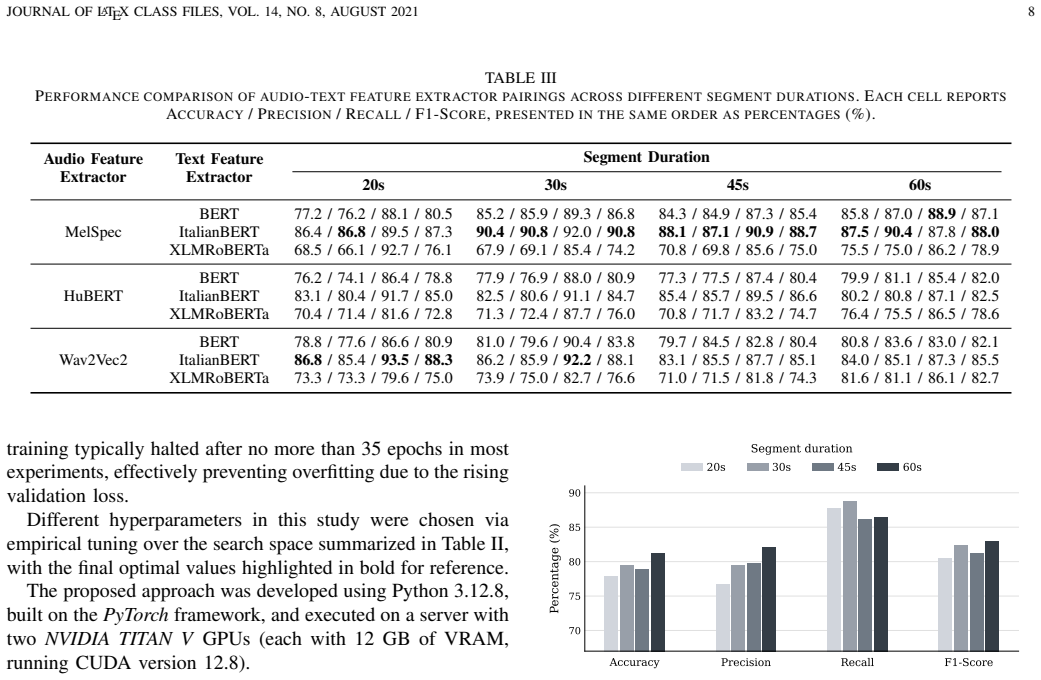
Summary. The paper proposes a multimodal (audio+text) depression detection system that combines BiLSTM encoders, intra- and cross-modal attention, segment-level fusion, and a DANN-style gradient reversal layer that treats each speaker as a domain. On the Androids-Corpus interview subset with 5-fold CV, the authors select MelSpec audio features and ItalianBERT text features with 30-second segments as the best baseline, then report that adding the domain-adversarial component increases accuracy by 2.5% and F1 by 3.3%, yielding 93.2% accuracy, 93.2% precision, 96.2% recall, and 94.2% F1. They claim state-of-the-art performance and provide ablations of modality and architectural components.
Significance. If the reported results were obtained under a sound evaluation protocol, the paper would be a solid engineering contribution: the architecture is clearly described, the public code (footnote 1) supports reproducibility, and the systematic comparison across 36 feature-extractor/duration combinations in Table III is a useful practical resource. The core idea of using adversarial speaker-invariance for depression detection is plausible and relevant. However, the experimental validation as presented does not support the quantitative claims, and the benchmark comparison is not adequately controlled.
major comments (5)
- [§VI-A, Table III] The feature-extractor pair and segment duration are selected by ranking test-fold accuracy/F1 from the same 5-fold CV later used for final evaluation. The 20% validation split (V-B) is used only for early stopping and scheduling, not for model selection. Thus the 'No DG' baseline in Table VI and its DG-augmented variant are both evaluated on the data that selected the winner among 36 configurations. This winner-picking inflates the reported 90.4/90.8 baseline and the subsequent 93.2/94.2 results, and it invalidates the comparison with benchmarks that did not perform such selection. A nested CV or an explicit held-out model-selection split is required before the reported numbers can be interpreted.
- [§VI-B, Table VI] The central DG-vs-no-DG comparison is reported as mean ± std across folds from a single run (§V-B), whereas Table III is from three runs. With fold-level standard deviations of 5–9 points, the 2.5% accuracy and 3.3% F1 differences are within one standard deviation. The paper's own McNemar test does not reject the null hypothesis (p > 0.05). Thus the central claim of a consistent DG gain is not statistically supported. The authors should provide multiple-seed results with confidence intervals and a significance test that accounts for participant-level clustering.
- [§VI-C, Table IV] The benchmark comparison mixes studies that use reading-only, interview-only, or both (R∧I), and that differ in splits and preprocessing. Some rows are even flagged as non-comparable in §II-A/Table I, yet they appear in Table IV without an explicit caveat. The statement 'surpassing all existing benchmarks' is therefore not justified. The comparison should be restricted to interview-only studies that use the same (or at least comparable) CV splits, or the protocol differences should be explicitly listed and the claim softened.
- [§II-C, §II-A] The abstract and §I claim 'the first patient-independent multimodal depression detection framework that incorporates domain generalization'. This is difficult to sustain given the authors' own discussion of [40], which applies GRL to multimodal DG for depression detection. The distinction that [40] targets interviewer bias while this work targets inter-speaker variability is a contribution, but it is incremental; the novelty claim should be repositioned (e.g., first to treat each patient as a domain in this setting) rather than claiming priority over all multimodal DG.
- [§III, §IV-D, Eq. (12)] The adversarial loss assumes that making the latent representation z uninformative about speaker identity does not discard depression-relevant cues. No measurement is provided of how much pathological signal is removed (e.g., domain-divergence versus depression-class separability, or a performance curve as λ varies). Since the test folds come from the same corpus and recording conditions, the experiment also does not demonstrate generalization to genuinely unseen domains. The paper should acknowledge this limitation more directly and ideally include a λ-sensitivity analysis and/or a cross-corpus evaluation.
minor comments (6)
- [§V-B, Table III] Table III reports values without standard deviations even though §V-B says the results in VI-A are the mean ± std over three independent runs. Add standard deviations or clarify the discrepancy.
- [§V-C] Hyperparameter tuning is described only as 'empirical tuning' over Table II. Specify which split was used to choose these hyperparameters and whether they were fixed before seeing the test folds.
- [§VI-B] The statement 'achieving p < 0.05 requires substantial disagreement' is vague. Report the actual p-value or a confidence interval for the difference.
- [Fig. 8] The 'cumulative confusion matrix' sums confusion matrices across folds; clarify that it is an aggregate, not a single model's predictions.
- [Abstract] There are typos such as 'integratebidirectional' and 'towardnunseen' that should be corrected.
- [§VII] The limitations section mentions lack of fine-tuning and single-dataset evaluation, but does not mention the model-selection-on-test-set issue; add this as a limitation.
Circularity Check
No circularity: the reported gains are empirical comparisons, not derivations that reduce to their inputs.
full rationale
The paper makes no first-principles derivation; its central claim is an empirical comparison on Androids-Corpus. The domain-adversarial objective (Eq. 12) is a standard DANN loss, adopted from Ganin et al. [19], and the reported 2.5% accuracy / 3.3% F1 improvement is a measured difference between the selected baseline and the DG-augmented model (Tables III and VI), not a quantity defined in terms of itself. The only author self-citation is [24] (Ntalampiras), used solely as a benchmark competitor in Table IV and related work, not as load-bearing support for the framework; it does not create a circularity chain. The acknowledged limitations in Section VII (no encoder fine-tuning, single dataset, interpretability) are external validity concerns. A genuine methodological weakness exists: the best feature-extractor pair and segment duration in Section VI-A appear to be selected using the test-fold metrics, which can inflate the reported numbers and makes the DG comparison and benchmark claims vulnerable to selection bias. However, that is a statistical validity / model-selection issue, not a reduction-by-construction or renamed-fit circularity under the definitions used here; it would require nested cross-validation to fix but does not make the 93.2%/94.2% result equivalent to the paper's inputs by definition.
Axiom & Free-Parameter Ledger
free parameters (2)
- GRL scaling coefficient λ =
0.5
- Segment duration for fixed-length chunks =
30 seconds
axioms (3)
- domain assumption Each participant is treated as a distinct domain, and held-out participants in the same corpus are representative unseen target domains.
- domain assumption Confusing a speaker-identity discriminator via GRL preserves depression-relevant information in the latent representation.
- domain assumption Automatic Whisper-large-v3 transcripts and pretrained audio/text encoders provide inputs of sufficient fidelity for the task.
read the original abstract
Automatic depression detection with deep learning has shown promise but often suffers from limited generalization due to domain shift arising from inter-speaker variability. To address this critical issue, we present the first patient-independent multimodal depression detection framework that incorporates domain generalization (DG), jointly leveraging both acoustic and textual modalities. The proposed model integrates bidirectional Long Short-Term Memory (BiLSTM) with intra- and cross-modal attention mechanisms, accompanied by segment-level fusion for decision-making. Generalization is further enhanced by applying a gradient reversal layer inspired by Domain-Adversarial Training of Neural Networks (DANN), which promotes domain-invariant representations by adversarially limiting the model's ability to identify individual speakers, effectively reducing patient-specific bias. Conducting experiments on the Androids-Corpus dataset with a 5-fold cross-validation (CV) protocol, various pairings of audio and text feature extractors were evaluated over different segment durations, determining MelSpec and ItalianBERT as the optimal baseline at a 30-second segment duration. The addition of DG to this baseline yields a 2.5% increase in accuracy and 3.3% in F1-score, achieving 93.2% accuracy, 93.2% precision, 96.2% recall, and 94.2% F1-score, surpassing all existing benchmarks. Extensive ablation studies assess the impact of multimodal fusion, deep architectural choices, and DG, highlighting their combined contribution to robust and generalizable depression detection.
Figures




Reference graph
Works this paper leans on
-
[1]
Global prevalence of depression and elevated depressive symptoms among adolescents: A systematic re- view and meta-analysis,
S. Shorey, E. D. Ng, and C. H. Wong, “Global prevalence of depression and elevated depressive symptoms among adolescents: A systematic re- view and meta-analysis,”British journal of clinical psychology, vol. 61, no. 2, pp. 287–305, 2022
2022
-
[2]
Suicidal risk among adolescent psychiatric inpatients: the role of insomnia, depression, and social-personal factors,
V . Baldini, M. Gnazzo, M. Maragno, R. Biagetti, C. Stefanini, F. Canulli, G. Varallo, C. Donati, G. Neri, A. Fiorilloet al., “Suicidal risk among adolescent psychiatric inpatients: the role of insomnia, depression, and social-personal factors,”European Psychiatry, vol. 68, no. 1, p. e42, 2025
2025
-
[3]
MuLHiTA: A Novel Multiclass Classifi- cation Framework With Multibranch LSTM and Hierarchical Temporal Attention for Early Detection of Mental Stress,
L. Xia, Y . Feng, Z. Guo, J. Ding, Y . Li, Y . Li, M. Ma, G. Gan, Y . Xu, J. Luo, Z. Shi, and Y . Guan, “MuLHiTA: A Novel Multiclass Classifi- cation Framework With Multibranch LSTM and Hierarchical Temporal Attention for Early Detection of Mental Stress,”IEEE Transactions on Neural Networks and Learning Systems, vol. 34, no. 12, pp. 9657–9670, Dec. 2023....
2023
-
[4]
Automatic depression recognition by intelligent speech signal processing: A sys- tematic survey,
P. Wu, R. Wang, H. Lin, F. Zhang, J. Tu, and M. Sun, “Automatic depression recognition by intelligent speech signal processing: A sys- tematic survey,”CAAI Transactions on Intelligence Technology, vol. 8, no. 3, pp. 701–711, 2023
2023
-
[5]
Disentanglement of Prosody Representations via Diffusion Models and Scheduled Gradient Reversal,
L. Qu, C. Weber, W. Wang, J. Jin, Y . Gao, T. Li, and S. Wermter, “Disentanglement of Prosody Representations via Diffusion Models and Scheduled Gradient Reversal,”IEEE Transactions on Neural Networks and Learning Systems, vol. 36, no. 8, pp. 15 043–15 054, Aug. 2025
2025
-
[6]
Discovery of shared latent nonlinear effective connectivity for eeg-based depression detection,
W. Yuan, X. Zhang, X. Zhang, S. Wang, T. Wang, T. Zhang, Q. Zhao, and B. Hu, “Discovery of shared latent nonlinear effective connectivity for eeg-based depression detection,”IEEE Transactions on Neural Networks and Learning Systems, vol. 36, no. 6, pp. 10 663–10 677, 2025
2025
-
[7]
Speech as a biomarker for depression,
S. Koops, S. G. Brederoo, J. N. de Boer, F. G. Nadema, A. E. V oppel, and I. E. Sommer, “Speech as a biomarker for depression,”CNS & Neurological Disorders-Drug Targets-CNS & Neurological Disorders), vol. 22, no. 2, pp. 152–160, 2023
2023
-
[8]
Unraveling the associations between voice pitch and major depressive disorder: a multisite genetic study,
Y . Di, E. Rahmani, J. Mefford, J. Wang, V . Ravi, A. Gorla, A. Alwan, K. S. Kendler, T. Zhu, and J. Flint, “Unraveling the associations between voice pitch and major depressive disorder: a multisite genetic study,” Molecular Psychiatry, vol. 30, no. 6, pp. 2686–2695, 2025
2025
-
[9]
Linguistic markers of depression and emergent self-stigma in online self-disclosures: A mixed-methods study on chinese social media,
L. Gu, M. Li, and Y . Li, “Linguistic markers of depression and emergent self-stigma in online self-disclosures: A mixed-methods study on chinese social media,”Journal of Affective Disorders, p. 120765, 2025
2025
-
[10]
A review on methods and applications in multimodal deep learning,
S. Jabeen, X. Li, M. S. Amin, O. Bourahla, S. Li, and A. Jabbar, “A review on methods and applications in multimodal deep learning,” ACM Transactions on Multimedia Computing, Communications and Applications, vol. 19, no. 2s, pp. 1–41, 2023
2023
-
[11]
Qui ˜nonero-Candela, M
J. Qui ˜nonero-Candela, M. Sugiyama, A. Schwaighofer, and N. D. Lawrence,Dataset shift in machine learning. Mit Press, 2022
2022
-
[12]
A brief review of domain adaptation,
A. Farahani, S. V oghoei, K. Rasheed, and H. R. Arabnia, “A brief review of domain adaptation,”Advances in data science and information engineering: proceedings from ICDATA 2020 and IKE 2020, pp. 877– 894, 2021
2020
-
[13]
Domain general- ization: A survey,
K. Zhou, Z. Liu, Y . Qiao, T. Xiang, and C. C. Loy, “Domain general- ization: A survey,”IEEE transactions on pattern analysis and machine intelligence, vol. 45, no. 4, pp. 4396–4415, 2022
2022
-
[14]
Domain Generalization in Computational Pathology: Survey and Guidelines,
M. Jahanifar, M. Raza, K. Xu, T. T. L. Vuong, R. Jewsbury, A. Shephard, N. Zamanitajeddin, J. T. Kwak, S. E. A. Raza, F. Minhas, and N. Ra- jpoot, “Domain Generalization in Computational Pathology: Survey and Guidelines,”ACM Comput. Surv., vol. 57, no. 11, pp. 285:1–285:37, Jun. 2025
2025
-
[15]
Towards Out-Of-Distribution Generalization: A Survey,
Z. Shen, J. Liu, Y . He, X. Zhang, R. Xu, H. Yu, and P. Cui, “Towards Out-Of-Distribution Generalization: A Survey,”ArXiv, Aug. 2021
2021
-
[16]
Generalizing across domains via cross-gradient training,
S. Shankar, V . Piratla, S. Chakrabarti, S. Chaudhuri, P. Jyothi, and S. Sarawagi, “Generalizing across domains via cross-gradient training,” arXiv preprint arXiv:1804.10745, 2018
Pith/arXiv arXiv 2018
-
[17]
Generalizing to Unseen Domains: A Survey on Domain Generalization,
J. Wang, C. Lan, C. Liu, Y . Ouyang, T. Qin, W. Lu, Y . Chen, W. Zeng, and P. S. Yu, “Generalizing to Unseen Domains: A Survey on Domain Generalization,”IEEE Transactions on Knowledge and Data Engineering, vol. 35, no. 8, pp. 8052–8072, Aug. 2023
2023
-
[18]
Generalization in neural networks: A broad survey,
C. Rohlfs, “Generalization in neural networks: A broad survey,”Neuro- computing, vol. 611, p. 128701, Jan. 2025
2025
-
[19]
Domain-adversarial training of neural networks,
Y . Ganin, E. Ustinova, H. Ajakan, P. Germain, H. Larochelle, F. Lavi- olette, M. March, and V . Lempitsky, “Domain-adversarial training of neural networks,”Journal of machine learning research, vol. 17, no. 59, pp. 1–35, 2016. JOURNAL OF LATEX CLASS FILES, VOL. 14, NO. 8, AUGUST 2021 11
2016
-
[20]
Machine learning for multimodal mental health detection: a systematic review of passive sensing approaches,
L. S. Khoo, M. K. Lim, C. Y . Chong, and R. McNaney, “Machine learning for multimodal mental health detection: a systematic review of passive sensing approaches,”Sensors, vol. 24, no. 2, p. 348, 2024
2024
-
[21]
Enhancing multimodal depression detection with intra-and inter-sample contrastive learning,
M. Li, Y . Wei, Y . Zhu, S. Wei, and B. Wu, “Enhancing multimodal depression detection with intra-and inter-sample contrastive learning,” Information Sciences, vol. 684, p. 121282, 2024
2024
-
[22]
The androids corpus: A new publicly available benchmark for speech based depression detection,
F. Tao, A. Esposito, and A. Vinciarelli, “The androids corpus: A new publicly available benchmark for speech based depression detection,” Depression, vol. 47, pp. 11–9, 2023
2023
-
[23]
Avengers assemble: Amalgama- tion of non-semantic features for depression detection,
O. C. Phukan, S. R. Behera, S. Singh, M. Singh, V . Rajan, A. B. Buduru, R. Sharma, and S. Prasanna, “Avengers assemble: Amalgama- tion of non-semantic features for depression detection,”arXiv preprint arXiv:2409.14312, 2024
Pith/arXiv arXiv 2024
-
[24]
Interpretable probabilistic identification of depression in speech,
S. Ntalampiras, “Interpretable probabilistic identification of depression in speech,”Sensors, vol. 25, no. 4, p. 1270, 2025
2025
-
[25]
Cross-data multilevel attention for depression detection: Analyzing the interplay between read and spontaneous speech,
F. Tao, X. Ge, W. Ma, A. Esposito, and A. Vinciarelli, “Cross-data multilevel attention for depression detection: Analyzing the interplay between read and spontaneous speech,” in2024 IEEE International Conference on Bioinformatics and Biomedicine (BIBM). IEEE, 2024, pp. 1169–1176
2024
-
[26]
Mixture of experts for recognizing depression from interview and reading tasks,
L. Ilias and D. Askounis, “Mixture of experts for recognizing depression from interview and reading tasks,”arXiv preprint arXiv:2502.20213, 2025
Pith/arXiv arXiv 2025
-
[27]
Adaptive Knowledge Fusion Model for Depression Recognition,
L. Zhou, X. Zhang, S. Guan, and X. Luo, “Adaptive Knowledge Fusion Model for Depression Recognition,”IEEE Transactions on Computa- tional Social Systems, 2025
2025
-
[28]
Depression detection from speech data using deep learning–based optimized temporal–frequency–channel attention with interpretable acoustic–prosodic mapping,
K. Rezaee, “Depression detection from speech data using deep learning–based optimized temporal–frequency–channel attention with interpretable acoustic–prosodic mapping,”Journal of Affective Disor- ders, p. 121077, 2026
2026
-
[29]
Depression detection in read and sponta- neous speech: A Multimodal approach for lesser-resourced languages,
K. Daly and O. Olukoya, “Depression detection in read and sponta- neous speech: A Multimodal approach for lesser-resourced languages,” Biomedical Signal Processing and Control, vol. 108, p. 107959, 2025
2025
-
[30]
F. Tao, W. Ma, X. Ge, A. Esposito, and A. Vinciarelli, “The relationship between speech features changes when you get depressed: Feature cor- relations for improving speed and performance of depression detection,” arXiv preprint arXiv:2307.02892, 2023
Pith/arXiv arXiv 2023
-
[31]
Revealing confounding biases: A novel benchmarking approach for aggregate-level performance metrics in health assessments,
R. Polle, S. Fara, A. Georgescu, S. Goria, and N. Cummins, “Revealing confounding biases: A novel benchmarking approach for aggregate-level performance metrics in health assessments,”Accepted for Interspeech 2024, Kos Island, Greece, 2024
2024
-
[32]
FAD3QN: A Brain-Inspired Deep Reinforcement Learning Model for Speech Depression Detection,
D. Li, J. Yao, Z. Wang, and Y . Yi, “FAD3QN: A Brain-Inspired Deep Reinforcement Learning Model for Speech Depression Detection,”IEEE Transactions on Computational Social Systems, 2025
2025
-
[33]
Using emotionally rich speech segments for depres- sion prediction,
J. Yu and H. Kaya, “Using emotionally rich speech segments for depres- sion prediction,” inICASSP 2025-2025 IEEE International Conference on Acoustics, Speech and Signal Processing (ICASSP). IEEE, 2025, pp. 1–5
2025
-
[34]
Probing mental health information in speech foundation models,
M. de Gennes, A. Lesage, M. Denais, X.-N. Cao, S. Chang, P. Van Re- moortere, C. Dakhlia, and R. Riad, “Probing mental health information in speech foundation models,”arXiv preprint arXiv:2409.19042, 2024
Pith/arXiv arXiv 2024
-
[35]
Cross-Language Depression Detection Based on Multi-Domain Feature Alignment,
M. Wang, S. Kato, W. Gu, J. Yan, and F. Ren, “Cross-Language Depression Detection Based on Multi-Domain Feature Alignment,” in 2025 47th Annual International Conference of the IEEE Engineering in Medicine and Biology Society (EMBC). IEEE, 2025, pp. 1–7
2025
-
[36]
Depression detection from speech signals using a multiple temporal-frequency scale Channel Attention Mechanism,
M. Wang, S. Kato, W. Gu, F. Ren, and J. Yan, “Depression detection from speech signals using a multiple temporal-frequency scale Channel Attention Mechanism,”Biomedical Signal Processing and Control, vol. 113, p. 108873, 2026
2026
-
[37]
Assessing privacy risks of attribute inference attacks against speech-based depression detection system,
B. Alsenani, A. Esposito, A. Vinciarelli, and T. Guha, “Assessing privacy risks of attribute inference attacks against speech-based depression detection system,”ECAI, 2024
2024
-
[38]
A cross-attention layer coupled with mul- timodal fusion methods for recognizing depression from spontaneous speech,
L. Ilias and D. Askounis, “A cross-attention layer coupled with mul- timodal fusion methods for recognizing depression from spontaneous speech,” inProc. Interspeech 2024, 2024, pp. 912–916
2024
-
[39]
Punctual or Continu- ous? Analyzing Depression Traces in Language and Paralanguage with Multiple Instance Learning,
R. Alsarrani, A. Esposito, and A. Vinciarelli, “Punctual or Continu- ous? Analyzing Depression Traces in Language and Paralanguage with Multiple Instance Learning,” inProceedings of the 27th International Conference on Multimodal Interaction. Canberra Australia: ACM, Oct. 2025, pp. 614–623
2025
-
[40]
Mitigating Interviewer Bias in Multi- modal Depression Detection: An Approach with Adversarial Learning and Contextual Positional Encoding,
E. Zhang and C. Poellabauer, “Mitigating Interviewer Bias in Multi- modal Depression Detection: An Approach with Adversarial Learning and Contextual Positional Encoding,” inFindings of the Association for Computational Linguistics: EMNLP 2025, 2025, pp. 12 169–12 188
2025
-
[41]
Multimodal measurement of depression using deep learning models,
L. Yang, D. Jiang, X. Xia, E. Pei, M. C. Oveneke, and H. Sahli, “Multimodal measurement of depression using deep learning models,” inProceedings of the 7th annual workshop on audio/visual emotion challenge, 2017, pp. 53–59
2017
-
[42]
Measuring depression symptom severity from spoken language and 3d facial expressions,
A. Haque, M. Guo, A. S. Miner, and L. Fei-Fei, “Measuring depression symptom severity from spoken language and 3d facial expressions,” arXiv preprint arXiv:1811.08592, 2018
Pith/arXiv arXiv 2018
-
[43]
Detecting depression with audio/text sequence modeling of interviews
T. Al Hanai, M. M. Ghassemi, and J. R. Glass, “Detecting depression with audio/text sequence modeling of interviews.” inInterspeech, 2018, pp. 1716–1720
2018
-
[44]
Multi- modal fusion of bert-cnn and gated cnn representations for depression detection,
M. Rodrigues Makiuchi, T. Warnita, K. Uto, and K. Shinoda, “Multi- modal fusion of bert-cnn and gated cnn representations for depression detection,” inProceedings of the 9th International on Audio/Visual Emotion Challenge and Workshop, 2019, pp. 55–63
2019
-
[45]
Audibert: A deep transfer learning multimodal classification framework for depression screening,
E. Toto, M. Tlachac, and E. A. Rundensteiner, “Audibert: A deep transfer learning multimodal classification framework for depression screening,” inProceedings of the 30th ACM international conference on information & knowledge management, 2021, pp. 4145–4154
2021
-
[46]
Automatic depression detection: An emo- tional audio-textual corpus and a gru/bilstm-based model,
Y . Shen, H. Yang, and L. Lin, “Automatic depression detection: An emo- tional audio-textual corpus and a gru/bilstm-based model,” inICASSP 2022-2022 IEEE International Conference on Acoustics, Speech and Signal Processing (ICASSP). IEEE, 2022, pp. 6247–6251
2022
-
[47]
Bidirectional multimodal block-recurrent transformers for depression detection,
X. Jia, X. Zhao, B. Tang, and R. Jiang, “Bidirectional multimodal block-recurrent transformers for depression detection,” in2024 IEEE International Conference on Bioinformatics and Biomedicine (BIBM). IEEE, 2024, pp. 3323–3328
2024
-
[48]
Intervoxnet: a novel dual-modal audio-text fusion network for automatic and efficient depression detection from interviews,
H. Ding, Z. Du, Z. Wang, J. Xue, Z. Wei, K. Yang, S. Jin, Z. Zhang, and J. Wang, “Intervoxnet: a novel dual-modal audio-text fusion network for automatic and efficient depression detection from interviews,”Frontiers in Physics, vol. 12, p. 1430035, 2024
2024
-
[49]
Text-guided multimodal depression detection via cross-modal feature reconstruction and decomposition,
Z. Chen, D. Wang, L. Lou, S. Zhang, X. Zhao, S. Jiang, J. Yu, and J. Xiao, “Text-guided multimodal depression detection via cross-modal feature reconstruction and decomposition,”Information Fusion, vol. 117, p. 102861, 2025
2025
-
[50]
Video-audio domain generalization via con- founder disentanglement,
S. Zhang, X. Feng, W. Fan, W. Fang, F. Feng, W. Ji, S. Li, L. Wang, S. Zhao, Z. Zhaoet al., “Video-audio domain generalization via con- founder disentanglement,” inProceedings of the AAAI conference on artificial intelligence, ser. 37, no. 12, 2023, pp. 15 322–15 330
2023
-
[51]
Domain gen- eralization through audio-visual relative norm alignment in first person action recognition,
M. Planamente, C. Plizzari, E. Alberti, and B. Caputo, “Domain gen- eralization through audio-visual relative norm alignment in first person action recognition,” inProceedings of the IEEE/CVF winter conference on applications of computer vision, 2022, pp. 1807–1818
2022
-
[52]
Simmmdg: A simple and effective framework for multi-modal domain generalization,
H. Dong, I. Nejjar, H. Sun, E. Chatzi, and O. Fink, “Simmmdg: A simple and effective framework for multi-modal domain generalization,”Ad- vances in Neural Information Processing Systems, vol. 36, pp. 78 674– 78 695, 2023
2023
-
[53]
Towards multimodal open-set domain generalization and adaptation through self-supervision,
H. Dong, E. Chatzi, and O. Fink, “Towards multimodal open-set domain generalization and adaptation through self-supervision,” inEuropean Conference on Computer Vision. Springer, 2024, pp. 270–287
2024
-
[54]
A domain adversarial learning framework for major depression disorder diagnosis,
S. Liu, L. An, and Z. Jia, “A domain adversarial learning framework for major depression disorder diagnosis,” inICASSP 2025-2025 IEEE International Conference on Acoustics, Speech and Signal Processing (ICASSP). IEEE, 2025, pp. 1–5
2025
-
[55]
Hubert: Self-supervised speech representation learning by masked prediction of hidden units,
W.-N. Hsu, B. Bolte, Y .-H. H. Tsai, K. Lakhotia, R. Salakhutdinov, and A. Mohamed, “Hubert: Self-supervised speech representation learning by masked prediction of hidden units,”IEEE/ACM transactions on audio, speech, and language processing, vol. 29, pp. 3451–3460, 2021
2021
-
[56]
wav2vec 2.0: A framework for self-supervised learning of speech representations,
A. Baevski, Y . Zhou, A. Mohamed, and M. Auli, “wav2vec 2.0: A framework for self-supervised learning of speech representations,” Advances in neural information processing systems, vol. 33, pp. 12 449– 12 460, 2020
2020
-
[57]
Bert: Pre-training of deep bidirectional transformers for language understanding,
J. Devlin, M.-W. Chang, K. Lee, and K. Toutanova, “Bert: Pre-training of deep bidirectional transformers for language understanding,” inPro- ceedings of the 2019 conference of the North American chapter of the association for computational linguistics: human language technologies, volume 1 (long and short papers), 2019, pp. 4171–4186
2019
-
[58]
Italian bert and electra models,
S. Schweter, “Italian bert and electra models,” Available at https://doi. org/10.5281/zenodo.4263142, 2020, version 1.0.1, Zenodo
-
[59]
Unsu- pervised cross-lingual representation learning at scale,
A. Conneau, K. Khandelwal, N. Goyal, V . Chaudhary, G. Wenzek, F. Guzm´an, E. Grave, M. Ott, L. Zettlemoyer, and V . Stoyanov, “Unsu- pervised cross-lingual representation learning at scale,”arXiv preprint arXiv:1911.02116, 2019. JOURNAL OF LATEX CLASS FILES, VOL. 14, NO. 8, AUGUST 2021 12 Ali Tabaraeiis a Ph.D. candidate in Computer Science at the Univer...
Pith/arXiv arXiv 1911
discussion (0)
Sign in with ORCID, Apple, or X to comment. Anyone can read and Pith papers without signing in.