REVIEW 74 references
Scaling weight decay with the learning-rate schedule keeps the optimization target honest and trains MoE models about 30% faster.
Reviewed by Pith at T0; open to challenge. T0 means a machine referee read the full paper against a public rubric. the ladder, T0–T4 →
T0 review · grok-4.5
2026-07-30 12:50 UTC pith:K3HGYBEO
load-bearing objection Clean Muon theory plus a real MoE speedup, but the headline experiment confounds η² scheduling with simply decaying less.
Scale Weight Decay and Train Better
The pith
A machine-rendered reading of the paper's core claim, the machinery that carries it, and where it could break.
Core claim
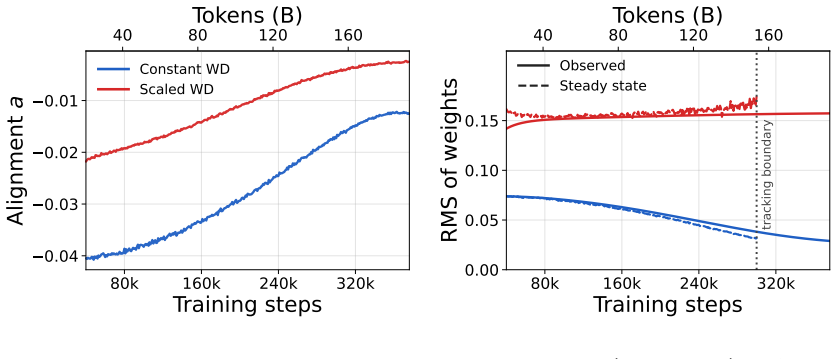
Replacing constant decoupled weight decay λη_t by the scaled rule λη_t²/η_max preserves the asymptotic stationarity guarantees of unregularized SGD and Muon, eliminates the asymptotic bias that constant decay introduces on simple quadratics, keeps weight norms from collapsing, and yields roughly 30% fewer steps to the same validation loss when Muon trains MoE transformers at the largest scale studied.
What carries the argument
Scaled weight decay: the update multiplies the weight by (1 − λ η_t²/η_max) instead of (1 − λ η_t). Because the extra shrink is O(η_t²) it is summable under Robbins–Monro schedules and does not shift the stationary set of the original loss.
Load-bearing premise
That the speed-up, which grows from about 22% at 72M parameters to about 29% at 930M, will keep growing or at least hold when models reach frontier size and token counts.
What would settle it
Train a matched pair of MoE models at a substantially larger scale (or several independent seeds at the current largest scale) with identical hyperparameters except constant versus scaled weight decay; if scaled decay no longer reaches the same validation loss in meaningfully fewer steps, the central practical claim fails.
If this is right
- A one-line change to the decay coefficient can cut pre-training steps by tens of percent without retuning other hyperparameters.
- Constant decoupled weight decay should not be treated as asymptotically faithful to the original loss; scaled decay restores that faithfulness for both SGD and Muon.
- Weight-norm collapse under long cosine schedules is largely an artifact of constant decay and can be avoided by the scaled rule.
- The same scaling principle is expected to transfer to other matrix optimizers (Shampoo, SOAP, Aurora, Muon variants) with only local code changes.
- If the scale trend continues, frontier MoE pre-training budgets can be reduced while keeping the same target loss.
Where Pith is reading between the lines
- Because the method needs no extra compute and almost no new hyperparameters, it is a candidate default for any long-horizon run that already uses decoupled weight decay.
- The same O(η²) shrink idea may stabilize other schedule-dependent regularizers that currently enter at order η and bias late training.
- Post-training stages that inherit a collapsed weight norm from constant-decay pre-training may behave differently if the base model was trained with scaled decay; that interaction is untested.
- Joint retuning of peak learning rate and decay coefficient under the scaled rule could enlarge the observed speed-up beyond the hyperparameter-matched comparison reported here.
Editorial analysis
A structured set of objections, weighed in public.
Circularity Check
No significant circularity: theory targets the unregularized loss by construction of the O(η²) shrink, and the 30% speedup is a direct head-to-head measurement, not a fitted quantity renamed as prediction.
full rationale
The paper’s load-bearing chain does not reduce inputs to outputs by definition. Scaled weight decay is proposed from Robbins–Monro summability (shrink at O(η²_t) rather than O(η_t)); Theorems 3.1–3.4 are standard smooth/strongly-convex and Muon descent arguments showing the extra term is a summable perturbation, so stationarity is w.r.t. the original unregularized f—not a quantity defined from the method’s own fit. Propositions 3.1–3.2 exhibit constant-decay fixed points on explicit quadratics; those fixed points are derived from the update, not smuggled in. The empirical claim (Table 1, Fig. 1) is a direct Muon vs Muon-SW comparison at fixed nominal λ and schedule, not a prediction recovered from a fitted parameter. Section 5’s steady-state r★_t (Eq. 36) is obtained by setting r_{t+1}=r_t in the RMS recursion; the alignment coefficients k≈20.8 and a0≈7.4×10^{-3} are descriptive late-run fits used only to explain why norms plateau vs collapse, and are not used to manufacture the speedup number. Citation of Defazio [22] (same η/η_max rule, different motivation) and of the author’s prior schedule-free work is ordinary related-work attribution, not a load-bearing uniqueness theorem. Confounds about cumulative decay budget are experimental-design issues, not circularity. Score 0; steps empty.
Axiom & Free-Parameter Ledger
free parameters (5)
- weight decay coefficient λ =
0.1
- peak learning rate η_max (per width/horizon) =
0.02 base; 1e-2 to 4.8e-3 across widths in Table 1
- Muon shape scale α =
0.2
- alignment fit coefficients k, a0 for steady-state norm =
k≈20.8 (scaled); a0≈7.4e-3, k'≈40.5 (constant)
- tokens per active parameter =
~600–650
axioms (6)
- standard math Robbins–Monro conditions: Σ η_t = ∞ and Σ η_t² < ∞ for asymptotic stationarity of stochastic approximation.
- domain assumption Objective is L-smooth and bounded below; stochastic gradients have bounded variance of the form E[||g||²|F] ≤ σ² + ρ||∇F||².
- domain assumption Iterates remain bounded in mean square (sup E||x_t||² < ∞) in the nonconvex scaled-decay analysis.
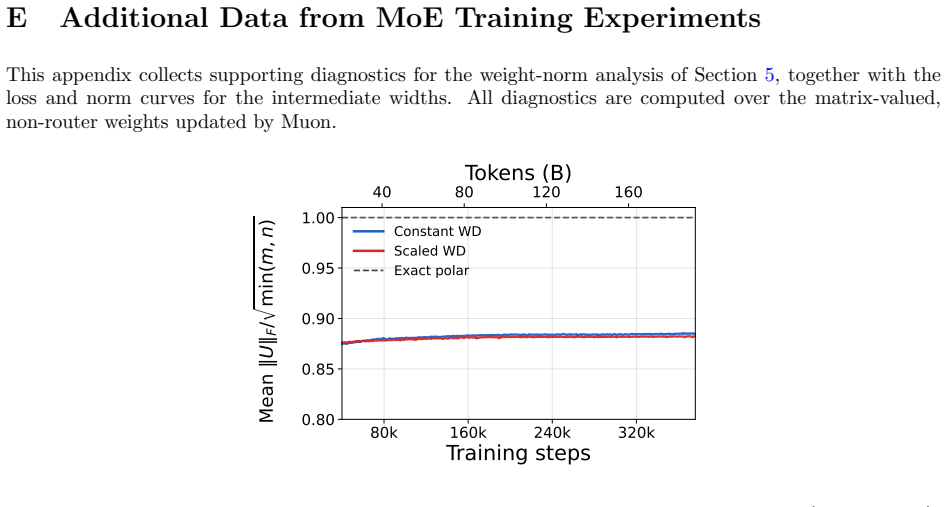
- domain assumption Muon update direction is the polar factor (spectral-norm ball projection) of the momentum buffer, with ||O_t||_op ≤ 1.
- domain assumption μP-MoE width transfer and cube-root LR–horizon rule yield near-optimal peak LRs transferable across the compared methods.
- ad hoc to paper Five Newton–Schulz iterations are a sufficient practical surrogate for exact polar orthogonalization.
invented entities (1)
-
Muon-SW (Muon with scaled weight decay)
independent evidence
read the original abstract
The discovery of scaling laws has motivated training neural networks on ever increasing quantities of data. This is typically done with a constant decoupled weight decay which causes the network weights to shrink steadily over the course of training. Taking inspiration from the Robbins--Monro conditions, we propose to scale weight decay by the fraction of the peak learning rate $\eta/\eta_{\max}$. We prove that this scaled weight decay preserves the asymptotic stationarity guarantees of the corresponding unregularized methods for both stochastic gradient descent and the non-Euclidean spectral optimizer Muon, thereby avoiding the additional asymptotic bias introduced by constant decoupled weight decay. This retains the stability benefits of weight decay without changing the asymptotic optimization target. Using a steady-state analysis, we explain why under standard weight decay the weight norm shrinks steadily as training proceeds, whereas under scaled weight decay it settles to a roughly constant value. When applied to the training of mixture-of-experts models, Muon with scaled weight decay (Muon-SW) consistently outpaces Muon with identical hyperparameters, reaching the same validation loss $\mathbf{30\%}$ faster at our largest scale across models from $72 - 930$ million parameters trained at $\sim 600$ tokens per active parameter. If this trend continues to hold, the method promises to substantially accelerate the pre-training of frontier models while requiring only a few lines of code to implement.
Figures






Reference graph
Works this paper leans on
-
[1]
Guilherme Penedo et al.The FineWeb Datasets: Decanting the Web for the Finest Text Data at Scale
-
[2]
Jared Kaplan et al.Scaling Laws for Neural Language Models. 2020. arXiv:2001.08361 [cs.LG].url: https://arxiv.org/abs/2001.08361
Pith/arXiv arXiv 2020
-
[3]
Jordan Hoffmann et al.Training Compute-Optimal Large Language Models. 2022. arXiv:2203.15556 [cs.CL].url:https://arxiv.org/abs/2203.15556
Pith/arXiv arXiv 2022
-
[4]
Explaining neural scaling laws
Yasaman Bahri et al. “Explaining neural scaling laws”. In:Proceedings of the National Academy of Sciences121.27 (2024), e2311878121.doi:10.1073/pnas.2311878121. eprint:https://www.pnas. org/doi/pdf/10.1073/pnas.2311878121.url:https://www.pnas.org/doi/abs/10.1073/pnas. 2311878121
-
[5]
Alexey Dosovitskiy et al.An Image is Worth 16x16 Words: Transformers for Image Recognition at Scale. 2021. arXiv:2010.11929 [cs.CV].url:https://arxiv.org/abs/2010.11929
Pith/arXiv arXiv 2021
-
[6]
Xiaohua Zhai et al.Scaling Vision Transformers. 2022. arXiv:2106 . 04560 [cs.CV].url:https : //arxiv.org/abs/2106.04560
Pith/arXiv arXiv 2022
-
[7]
Potsawee Manakul et al.Scaling Open Discrete Audio Foundation Models with Interleaved Semantic, Acoustic, and Text Tokens. 2026. arXiv:2602.16687 [cs.SD].url:https://arxiv.org/abs/2602. 16687
arXiv 2026
-
[8]
Sebastian Sartor and Neil Thompson.Neural Scaling Laws in Robotics. 2025. arXiv:2405 . 14005 [cs.RO].url:https://arxiv.org/abs/2405.14005
Pith/arXiv arXiv 2025
-
[9]
Kimi Team et al.Kimi K2: Open Agentic Intelligence. 2026. arXiv:2507.20534 [cs.LG].url:https: //arxiv.org/abs/2507.20534
Pith/arXiv arXiv 2026
-
[10]
5 Team et al.GLM-4.5: Agentic, Reasoning, and Coding (ARC) Foundation Models. 2025. arXiv: 2508.06471 [cs.CL].url:https://arxiv.org/abs/2508.06471
Pith/arXiv arXiv 2025
-
[11]
DeepSeek-AI et al.DeepSeek-V4: Towards Highly Efficient Million-Token Context Intelligence. 2026. arXiv:2606.19348 [cs.CL].url:https://arxiv.org/abs/2606.19348
arXiv 2026
-
[12]
A Simple Weight Decay Can Improve Generalization
Anders Krogh and John Hertz. “A Simple Weight Decay Can Improve Generalization”. In:Advances in Neural Information Processing Systems. Ed. by J. Moody, S. Hanson, and R.P. Lippmann. Vol. 4. Morgan-Kaufmann, 1991.url:https : / / proceedings . neurips . cc / paper _ files / paper / 1991 / file/8eefcfdf5990e441f0fb6f3fad709e21-Paper.pdf
1991
-
[13]
arXiv: 2310.04415 [cs.LG].url:https://arxiv.org/abs/2310.04415
Francesco D’Angelo et al.Why Do We Need Weight Decay in Modern Deep Learning?2024. arXiv: 2310.04415 [cs.LG].url:https://arxiv.org/abs/2310.04415
Pith/arXiv arXiv 2024
-
[14]
Ilya Loshchilov and Frank Hutter.Decoupled Weight Decay Regularization. 2019. arXiv:1711.05101 [cs.LG].url:https://arxiv.org/abs/1711.05101
Pith/arXiv arXiv 2019
-
[15]
Dayal Singh Kalra and Maissam Barkeshli.Why Warmup the Learning Rate? Underlying Mechanisms and Improvements. 2024. arXiv:2406.09405 [cs.LG].url:https://arxiv.org/abs/2406.09405
Pith/arXiv arXiv 2024
-
[16]
Ilya Loshchilov and Frank Hutter.SGDR: Stochastic Gradient Descent with Warm Restarts. 2017. arXiv:1608.03983 [cs.LG].url:https://arxiv.org/abs/1608.03983
Pith/arXiv arXiv 2017
-
[17]
2024.url:https : //kellerjordan.github.io/posts/muon/
Keller Jordan et al.Muon: An optimizer for hidden layers in neural networks. 2024.url:https : //kellerjordan.github.io/posts/muon/
2024
-
[18]
Jingyuan Liu et al.Muon is Scalable for LLM Training. 2025. arXiv:2502 . 16982 [cs.LG].url: https://arxiv.org/abs/2502.16982
Pith/arXiv arXiv 2025
-
[19]
A Stochastic Approximation Method
Herbert Robbins and Sutton Monro. “A Stochastic Approximation Method”. In:The Annals of Math- ematical Statistics22.3 (1951), pp. 400–407.issn: 0003-4851.doi:10.1214/aoms/1177729586.url: http://dx.doi.org/10.1214/aoms/1177729586
arXiv 1951
-
[20]
Noam Shazeer et al.Outrageously Large Neural Networks: The Sparsely-Gated Mixture-of-Experts Layer. 2017. arXiv:1701.06538 [cs.LG].url:https://arxiv.org/abs/1701.06538. 14
Pith/arXiv arXiv 2017
-
[21]
William Fedus, Barret Zoph, and Noam Shazeer.Switch Transformers: Scaling to Trillion Parameter Models with Simple and Efficient Sparsity. 2022. arXiv:2101.03961 [cs.LG].url:https://arxiv. org/abs/2101.03961
Pith/arXiv arXiv 2022
-
[22]
Aaron Defazio.Why Gradients Rapidly Increase Near the End of Training. 2025. arXiv:2506.02285 [cs.LG].url:https://arxiv.org/abs/2506.02285
Pith/arXiv arXiv 2025
-
[23]
Vineet Gupta, Tomer Koren, and Yoram Singer.Shampoo: Preconditioned Stochastic Tensor Optimiza- tion. 2018. arXiv:1802.09568 [cs.LG].url:https://arxiv.org/abs/1802.09568
Pith/arXiv arXiv 2018
-
[24]
Rohan Anil et al.Scalable Second Order Optimization for Deep Learning. 2021. arXiv:2002.09018 [cs.LG].url:https://arxiv.org/abs/2002.09018
Pith/arXiv arXiv 2021
-
[25]
Nikhil Vyas et al.SOAP: Improving and Stabilizing Shampoo using Adam. 2025. arXiv:2409.11321 [cs.LG].url:https://arxiv.org/abs/2409.11321
Pith/arXiv arXiv 2025
-
[26]
Alec Dewulf et al.Aurora: A Leverage-Aware Spectral Optimizer. 2026. arXiv:2606.27715 [cs.LG]. url:https://arxiv.org/abs/2606.27715
Pith/arXiv arXiv 2026
-
[27]
Dion: Distributed Orthonormalized Updates
Kwangjun Ahn et al. “Dion: Distributed Orthonormalized Updates”. In:arXiv preprint: 2504.05295 (2025)
arXiv 2025
-
[28]
Kwangjun Ahn, Noah Amsel, and John Langford.Dion2: A Simple Method to Shrink Matrix in Muon
-
[29]
Noah Amsel et al.The Polar Express: Optimal Matrix Sign Methods and Their Application to the Muon Algorithm. 2026. arXiv:2505.16932 [cs.LG].url:https://arxiv.org/abs/2505.16932
Pith/arXiv arXiv 2026
-
[30]
Anuj Apte et al.Anytime Training with Schedule-Free Spectral Optimization. 2026. arXiv:2605.23061 [cs.LG].url:https://arxiv.org/abs/2605.23061
Pith/arXiv arXiv 2026
-
[31]
Kang An et al.ASGO: Adaptive Structured Gradient Optimization. 2025. arXiv:2503.20762 [cs.LG]. url:https://arxiv.org/abs/2503.20762
arXiv 2025
-
[32]
Ziyue Liu et al.Muon 2: Boosting Muon via Adaptive Second-Moment Preconditioning. 2026. arXiv: 2604.09967 [cs.LG].url:https://arxiv.org/abs/2604.09967
Pith/arXiv arXiv 2026
-
[33]
Ahmed Khaled et al.MuonBP: Faster Muon via Block-Periodic Orthogonalization. 2025. arXiv:2510. 16981 [cs.LG].url:https://arxiv.org/abs/2510.16981
arXiv 2025
-
[34]
Optimization Methods for Large-Scale Machine Learning
L´ eon Bottou, Frank E. Curtis, and Jorge Nocedal. “Optimization Methods for Large-Scale Machine Learning”. In:SIAM Review60.2 (2018), pp. 223–311
2018
-
[35]
Kai Lion et al.Muown: Row-Norm Control for Muon Optimization. 2026. arXiv:2605.10797 [cs.LG]. url:https://arxiv.org/abs/2605.10797
Pith/arXiv arXiv 2026
-
[36]
Naoki Sato, Hiroki Naganuma, and Hideaki Iiduka.Convergence Bound and Critical Batch Size of Muon Optimizer. 2026. arXiv:2507.01598 [cs.LG].url:https://arxiv.org/abs/2507.01598
Pith/arXiv arXiv 2026
-
[37]
On the Convergence Analysis of Muon
Wei Shen et al. “On the Convergence Analysis of Muon”. In:arXiv preprint arXiv:2505.23737(2025)
Pith/arXiv arXiv 2025
-
[38]
Da Chang, Yongxiang Liu, and Ganzhao Yuan.On the Convergence of Muon and Beyond. 2026. arXiv: 2509.15816 [cs.LG].url:https://arxiv.org/abs/2509.15816
Pith/arXiv arXiv 2026
-
[39]
Language Models are Unsupervised Multitask Learners
Alec Radford et al. “Language Models are Unsupervised Multitask Learners”. In: (2019)
2019
-
[40]
Hugo Touvron et al.Llama 2: Open Foundation and Fine-Tuned Chat Models. 2023. arXiv:2307.09288 [cs.CL].url:https://arxiv.org/abs/2307.09288
Pith/arXiv arXiv 2023
-
[41]
Greg Yang et al.Tensor Programs V: Tuning Large Neural Networks via Zero-Shot Hyperparameter Transfer. 2022. arXiv:2203.03466 [cs.LG].url:https://arxiv.org/abs/2203.03466
Pith/arXiv arXiv 2022
-
[42]
Jan Ma la´ snicki et al.µ-Parametrization for Mixture of Experts. 2025. arXiv:2508.09752 [cs.LG]. url:https://arxiv.org/abs/2508.09752
arXiv 2025
-
[43]
Johan Bjorck et al.Scaling Optimal LR Across Token Horizons. 2025. arXiv:2409.19913 [cs.LG]. url:https://arxiv.org/abs/2409.19913
Pith/arXiv arXiv 2025
-
[45]
Twan van Laarhoven.L2 Regularization versus Batch and Weight Normalization. 2017. arXiv:1706. 05350 [cs.LG].url:https://arxiv.org/abs/1706.05350
Pith/arXiv arXiv 2017
-
[46]
Atli Kosson, Bettina Messmer, and Martin Jaggi.Rotational Equilibrium: How Weight Decay Balances Learning Across Neural Networks. 2024. arXiv:2305.17212 [cs.LG].url:https://arxiv.org/abs/ 2305.17212
Pith/arXiv arXiv 2024
-
[47]
Lizhang Chen et al.Cautious Weight Decay. 2026. arXiv:2510.12402 [cs.LG].url:https://arxiv. org/abs/2510.12402
arXiv 2026
-
[48]
2022.url: https://openreview.net/forum?id=J7V_4aauV6B
Zeke Xie, Issei Sato, and Masashi Sugiyama.Understanding and Scheduling Weight Decay. 2022.url: https://openreview.net/forum?id=J7V_4aauV6B
2022
-
[49]
Kaiyue Wen et al.Fantastic Pretraining Optimizers and Where to Find Them II: Hyperball Optimiza- tion. 2026. arXiv:2606.16899 [cs.LG].url:https://arxiv.org/abs/2606.16899
arXiv 2026
-
[50]
Thinking Machines Lab.url:https://thinkingmachines.ai/news/introducing-inkling/
-
[51]
Albert Gu and Tri Dao.Mamba: Linear-Time Sequence Modeling with Selective State Spaces. 2024. arXiv:2312.00752 [cs.LG].url:https://arxiv.org/abs/2312.00752
Pith/arXiv arXiv 2024
-
[52]
Tri Dao and Albert Gu.Transformers are SSMs: Generalized Models and Efficient Algorithms Through Structured State Space Duality. 2024. arXiv:2405.21060 [cs.LG].url:https://arxiv.org/abs/ 2405.21060
Pith/arXiv arXiv 2024
-
[53]
Liliang Ren et al.Samba: Simple Hybrid State Space Models for Efficient Unlimited Context Language Modeling. 2025. arXiv:2406.07522 [cs.CL].url:https://arxiv.org/abs/2406.07522
Pith/arXiv arXiv 2025
-
[54]
Songlin Yang, Jan Kautz, and Ali Hatamizadeh.Gated Delta Networks: Improving Mamba2 with Delta Rule. 2025. arXiv:2412.06464 [cs.CL].url:https://arxiv.org/abs/2412.06464
Pith/arXiv arXiv 2025
-
[55]
Yifei Zuo et al.Parallax: Parameterized Local Linear Attention for Language Modeling. 2026. arXiv: 2605.29157 [cs.LG].url:https://arxiv.org/abs/2605.29157
Pith/arXiv arXiv 2026
-
[56]
Long Ouyang et al.Training language models to follow instructions with human feedback. 2022. arXiv: 2203.02155 [cs.CL].url:https://arxiv.org/abs/2203.02155
Pith/arXiv arXiv 2022
-
[57]
Paul Christiano et al.Deep reinforcement learning from human preferences. 2023. arXiv:1706.03741 [stat.ML].url:https://arxiv.org/abs/1706.03741
Pith/arXiv arXiv 2023
-
[58]
Rafael Rafailov et al.Direct Preference Optimization: Your Language Model is Secretly a Reward Model
-
[59]
Zhihong Shao et al.DeepSeekMath: Pushing the Limits of Mathematical Reasoning in Open Language Models. 2024. arXiv:2402.03300 [cs.CL].url:https://arxiv.org/abs/2402.03300
Pith/arXiv arXiv 2024
-
[60]
DeepSeek-R1 incentivizes reasoning in LLMs through reinforcement learning
Daya Guo et al. “DeepSeek-R1 incentivizes reasoning in LLMs through reinforcement learning”. In: Nature645.8081 (2025), pp. 633–638.issn: 1476-4687.doi:10.1038/s41586- 025- 09422- z.url: http://dx.doi.org/10.1038/s41586-025-09422-z
doi:10.1038/s41586- 2025
-
[61]
Jakub Krajewski et al.Scaling Laws for Fine-Grained Mixture of Experts. 2024. arXiv:2402.07871 [cs.LG].url:https://arxiv.org/abs/2402.07871
Pith/arXiv arXiv 2024
-
[62]
arXiv:2305.18290 [cs.LG].url:https://arxiv.org/abs/2305.18290
-
[63]
Ege Erdil.Inference economics of language models. 2025. arXiv:2506.04645 [cs.LG].url:https: //arxiv.org/abs/2506.04645
Pith/arXiv arXiv 2025
-
[64]
Root Mean Square Layer Normalization
Biao Zhang and Rico Sennrich. “Root Mean Square Layer Normalization”. In:Advances in Neural Information Processing Systems. Ed. by H. Wallach et al. Vol. 32. Curran Associates, Inc., 2019.url: https://proceedings.neurips.cc/paper_files/paper/2019/file/1e8a19426224ca89e83cef47f1e7f53b- Paper.pdf
2019
-
[65]
Jianlin Su et al.RoFormer: Enhanced Transformer with Rotary Position Embedding. 2023. arXiv: 2104.09864 [cs.CL].url:https://arxiv.org/abs/2104.09864
Pith/arXiv arXiv 2023
-
[66]
Changxin Tian et al.Towards Greater Leverage: Scaling Laws for Efficient Mixture-of-Experts Language Models. 2025. arXiv:2507.17702 [cs.CL].url:https://arxiv.org/abs/2507.17702
arXiv 2025
-
[67]
Benchmarking Optimizers for Large Language Model Pretraining
Andrei Semenov, Matteo Pagliardini, and Martin Jaggi. “Benchmarking Optimizers for Large Language Model Pretraining”. In:arXiv preprint arXiv:2509.01440(2025).url:https : / / arxiv . org / abs / 2509.01440
Pith/arXiv arXiv 2025
-
[68]
Simon, and Jeremy Bernstein.A Spectral Condition for Feature Learning
Greg Yang, James B. Simon, and Jeremy Bernstein.A Spectral Condition for Feature Learning. 2024. arXiv:2310.17813 [cs.LG].url:https://arxiv.org/abs/2310.17813
Pith/arXiv arXiv 2024
-
[69]
Greg Yang et al.Tensor Programs VI: Feature Learning in Infinite-Depth Neural Networks. 2023. arXiv:2310.02244 [cs.NE].url:https://arxiv.org/abs/2310.02244
Pith/arXiv arXiv 2023
-
[70]
Noam Shazeer.GLU Variants Improve Transformer. 2020. arXiv:2002.05202 [cs.LG].url:https: //arxiv.org/abs/2002.05202. 16
Pith/arXiv arXiv 2020
-
[71]
Adam Paszke et al.PyTorch: An Imperative Style, High-Performance Deep Learning Library. 2019. arXiv:1912.01703 [cs.LG].url:https://arxiv.org/abs/1912.01703. 17 Technical Appendices and Supplementary Material In this appendix, we provide additional background, experimental details, proofs, and implementation details that supplement the main text. This appe...
Pith/arXiv arXiv 2019
-
[74]
Liliang Ren et al.Rethinking Language Model Scaling under Transferable Hypersphere Optimization
-
[75]
arXiv:2603.28743 [cs.LG].url:https://arxiv.org/abs/2603.28743
-
[2024]
arXiv:2406.17557 [cs.CL].url:https://arxiv.org/abs/2406.17557
-
[2025]
arXiv:2512.16928 [cs.LG].url:https://arxiv.org/abs/2512.16928
discussion (0)
Sign in with ORCID, Apple, or X to comment. Anyone can read and Pith papers without signing in.