REVIEW 3 major objections 7 minor 43 references
EMRI gravitational waves can separate a dark-matter halo’s total mass from how spread out it is around a black hole.
Reviewed by Pith at T0; open to challenge. T0 means a machine referee read the full paper against a public rubric. the ladder, T0–T4 →
T0 review · grok-4.5
2026-07-31 22:35 UTC pith:CQQNFUHK
load-bearing objection Solid orbital-dynamics extension of the dressed-BH program; the “disentangle M0 from r0” claim is oversold relative to the kludge plots and the ADM-mass degeneracy. the 3 major comments →
Gravitational Wave Signatures of Periodic Orbits around a Schwarzschild-like Black Holes Submerged in an Exponential Density Dark Matter Profile
The pith
A machine-rendered reading of the paper's core claim, the machinery that carries it, and where it could break.
Core claim
Around a Schwarzschild-like black hole dressed by an exponential-sphere dark-matter halo, the halo mass M0 and scale radius r0 reshape bound geodesics and EMRI waveforms through non-degenerate channels. Radii and energies of the MBO and ISCO vary non-monotonically with r0 and can reverse trend with M0 depending on halo extent, while periodic-orbit spectra labeled by q = ωφ/ωr − 1 = w + v/z separate the two parameters. Numerical-kludge waveforms show that varying r0 produces a strong monotonic enlargement, longer radial periods, and clear dephasing, whereas comparable M0 variations leave the signal nearly unchanged unless M0 is a sizable fraction of the black-hole mass—so EMRI waveforms can i
What carries the argument
Periodic orbits labeled by the rational frequency ratio q = ωφ/ωr − 1 = w + v/z (zoom, whirl, vertex integers), mapped into time-domain EMRI polarizations via the numerical kludge (geodesic trajectory plus quadrupole formula).
Load-bearing premise
That visible differences in adiabatic, radiation-reaction-free quadrupole waveforms are enough to conclude that halo mass and scale radius can be separated in real detector data.
What would settle it
A parameter-estimation or Fisher-matrix study on LISA-band noise that includes radiation reaction and shows M0 and r0 remain degenerate, or long inspirals in which the reported r0-driven dephasing is erased once energy and angular momentum evolve.
If this is right
- Space-based EMRI detections could constrain not only whether dark matter is present near a supermassive black hole but how its mass is radially distributed.
- Halo scale radius imprints more strongly on waveform phase and radial period than total halo mass does at fixed modest M0/M.
- MBO/ISCO and (E,L) phase-space maps for exponential halos cannot be collapsed to a single effective-mass shift relative to Schwarzschild.
- Comparisons across dark-matter density profiles can use the same periodic-orbit and kludge pipeline to test which environmental signatures are profile-specific.
- Natural next steps the paper itself flags—spinning backgrounds, radiation reaction, and measurement forecasts—become the direct path from this geometric distinction to actual LISA constraints.
Where Pith is reading between the lines
- If the r0-dominated dephasing survives radiation reaction, multi-year EMRI tracks could break the usual mass-distance and environmental degeneracies that plague shorter signals.
- The non-monotonic dip of characteristic radii below Schwarzschild values at intermediate r0 suggests a sweet spot where a moderately compact halo is most distinguishable from pure vacuum.
- Template banks that only rescale central mass would systematically mis-model extended halos; separate M0–r0 dimensions may be required for unbiased recovery.
- The same mass-versus-extent split should be checked for other phenomenological halos (Dehnen, Hernquist) to see whether exponential profiles are uniquely separable or part of a broader environmental pattern.
Editorial analysis
A structured set of objections, weighed in public.
Referee Report
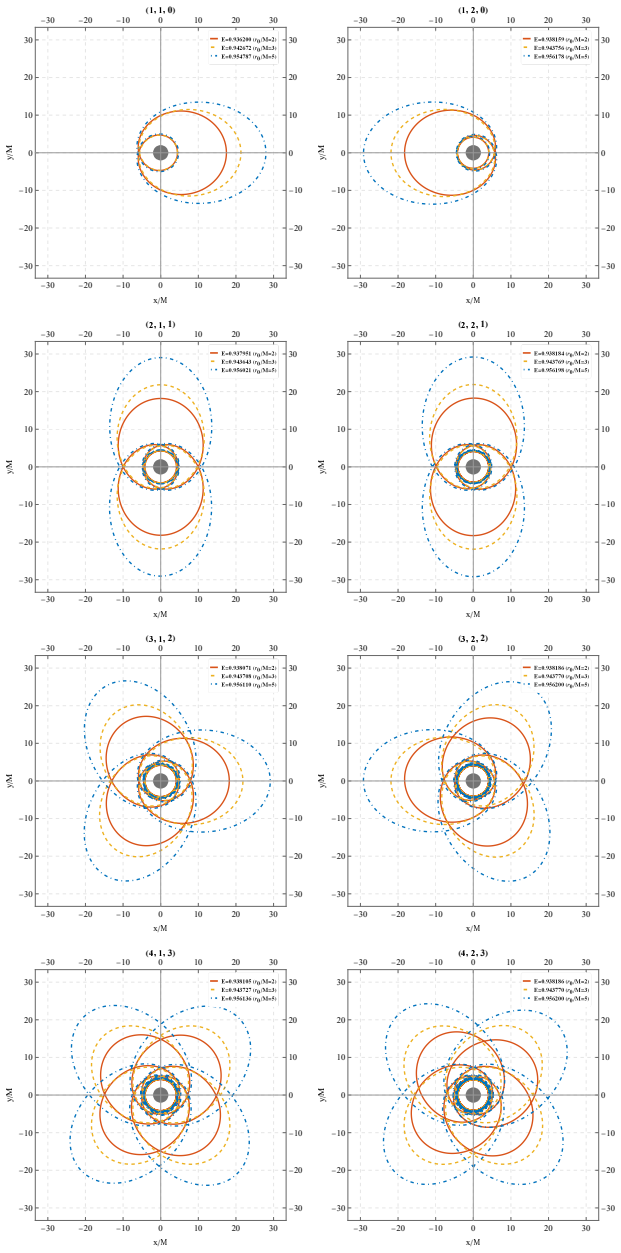
Summary. The paper studies timelike geodesics, periodic (zoom–whirl) orbits, and numerical-kludge quadrupole waveforms for a test particle around a Schwarzschild-like black hole dressed by an exponential-sphere dark matter halo (metric taken from ref. [43]), characterized by halo mass M0 and scale radius r0. The authors derive the effective potential, MBO/ISCO conditions, and the rational frequency ratio q = w + v/z, tabulate periodic-orbit energies and angular momenta, and compute EMRI waveforms h+, h× for representative (z,w,v) orbits. They find non-monotonic dependence of MBO/ISCO radii on r0, and claim that r0 and M0 act through distinguishable channels: r0 strongly enlarges orbits and dephases the waveform, while M0 has a weak effect unless M0/M ≳ 0.4. They conclude EMRIs could in principle disentangle the halo's total mass from its spatial extent. The geodesic analysis is standard and internally consistent; the waveform-level conclusions are qualitative, based on visual comparison of kludge waveforms without noise, radiation reaction, or any parameter-estimation analysis.
Significance. If the central claim held, it would be of real interest for LISA-band environmental-effect science: separating halo mass from halo extent is the key step toward using EMRIs as probes of dark matter distributions. The geodesic/MBO/ISCO/periodic-orbit analysis is a clean, standard application of established tools, the reported non-monotonic ISCO/MBO behavior is mildly novel, and the calculations involve no fitted constants — observables are derived from the metric, so there is no circularity by construction. However, the headline "disentangling" claim currently rests on visual waveform differences evaluated in an astrophysically extreme parameter corner and without controlling for the best-measured EMRI parameter (total mass), so the demonstrated significance is that of a phenomenological feasibility sketch rather than an established observational prospect. The work is reproducible in principle and its numerical tables and figures support the stated qualitative trends.
major comments (3)
- [§5.1, §5.3, §6; Eq. (2.12)] The disentangling claim is undermined by an unresolved total-mass degeneracy. The metric's ADM mass is M_ADM = M_BH + M0 (stated in §2), yet the symbol M used in M0/M and r0/M is never identified as either M_BH or M_ADM. All waveform comparisons in Fig. 5.1 vary M0 at fixed M, so they simultaneously change the total mass — the single best-measured EMRI parameter (redshifted mass is typically constrained to ~10^-4–10^-5). The observed insensitivity of the waveform to M0/M ≲ 0.1 may therefore be absorbable into a redefinition of M_ADM rather than reflecting a genuinely distinct channel. A concrete, cheap test is available within the paper's existing machinery: compare the (M0/M=0.1, r0/M=1) waveform against a Schwarzschild waveform with mass M_BH+M0. If the phase difference is negligible, the small-M0 effect is a pure mass renormalization and §5.3's 'genuinely different channels' claim mus
- [§5, Figs. 5.1–5.2; Abstract] The evidence for separability is purely visual: curves 'overlap' or 'dephase' in plotted time series, with no overlap/mismatch calculation, no noise curve, and no Fisher or parameter-estimation study marginalizing over (M, m, E, L, ι, ζ, D_L). Dephasing visible by eye over ~10^3 time units says little about measurability once the waveform can be re-fit by adjusting the other intrinsic parameters. The claim 'EMRI waveforms can disentangle the total mass of a dark matter halo from its spatial extent' (Abstract, §6) requires at least a minimal quantification: e.g., the accumulated orbital-phase difference between adjacent parameter points versus the ~1/SNR phase resolution of a LISA-band observation, or a kludge-level Fisher matrix. Without this, the conclusion should be downgraded to a statement that the parameters produce qualitatively different kinematic effects.
- [§3–§5, parameter choices] The demonstrated strong r0-sensitivity occurs only for r0/M = 1–5, i.e. r0 ~ 10^-6 pc for the adopted M = 10^7 M_sun primary. Realistic exponential-sphere halos around SMBHs have scale radii of order kpc, corresponding to r0/M ~ 10^10–10^11; in that regime the halo is essentially constant-density across the orbit and the enclosed halo mass scales as (r_orbit/r0)^3 M0, making both the ISCO shifts and the waveform dephasing utterly negligible for any astrophysically allowed M0. The paper never discusses which values of r0/M are physically realizable. Since the Abstract and §6 frame the result as 'a strong-field probe of the dark matter distribution around supermassive black holes,' the manuscript must include an explicit discussion of the astrophysically relevant regime and what (if anything) survives there — or restrict its claims to the strong-field phenomenology of this metric family.
minor comments (7)
- [§1, penultimate paragraph] The sentence 'the short-distance quantum-gravity modification considered in the present work finds a natural place' describes the Bonanno–Reuter analysis of ref. [42], not the present dark-matter-halo study; it appears to be text carried over from the companion paper and should be removed or rewritten.
- [§2, Eq. (2.10)] The lower integration limit is written as M_BH, a mass, inside a radial integral over r̃. Presumably the intended expression is M_BH plus the integral from 0 to r of 4π r̃²ρ(r̃) dr̃; please correct the notation.
- [§2, Eqs. (2.4)–(2.8)] As printed, Eqs. (2.4) and (2.5) are identical; with A = B this forces ρ = −p_r, i.e. a dark-energy-like radial equation of state. The manuscript should state this explicitly and comment on the energy-condition status (e.g. NEC/WEC) of the ESM matter, since it bears on the physical viability emphasized in §2.
- [§3, Figs. 3.2–3.3] The non-monotonic dip of r_MBO and r_ISCO below their Schwarzschild values near r0/M ~ 1.5–2 is counterintuitive given that the halo only adds positive enclosed mass (A(r) ≤ A_Schw(r) at fixed r). A brief analytic or heuristic explanation (which term in the circular-orbit/inflection conditions drives the dip) would substantially strengthen §3.
- [Figs. 4.2–4.5, 5.1–5.2] Several figures appear to retain raw notebook artifacts (e.g. an 'Out[ ]=' label preceding Figs. 4.2 and 5.2) and some axis labels render as garbled glyphs in the arXiv PDF. The time axis τ in Figs. 5.1–5.2 is given no units (presumably M). Figures should be regenerated with clean, labeled axes.
- [§5.2, final sentence] Leaving 'how r0 reshapes the effective potential at fixed M0' entirely to future work is unsatisfying given that the r0-response is the paper's dominant effect; at least a qualitative account tied to the mass profile (2.10) should be attempted here.
- [§1, final paragraph] 'Geometrized Planck units' with k_B = ℏ = 1 is inappropriate for a classical gravitational-wave calculation; geometric units G = c = 1 suffice.
Circularity Check
No significant circularity: geodesic and kludge waveforms are computed from an externally motivated metric ansatz; the M0–r0 disentangling claim is an interpretation of those numerics, not a fit or self-definition.
full rationale
The load-bearing chain is standard and open: a phenomenological exponential density (Eq. 2.9) is inserted into the Einstein equations for a static spherical ansatz to obtain m(r) and A(r) (Eqs. 2.10–2.12); timelike geodesics, Veff, MBO/ISCO, and the rational ratio q are then derived from that metric without fitting M0 or r0 to any waveform or orbital data; EMRI polarizations follow from the numerical-kludge quadrupole formula on those geodesics. The claim that r0 and M0 leave distinguishable imprints is a comparative reading of the computed orbits and h+, h× curves (Figs. 4.1–5.2, §5.3), not a quantity defined in terms of the claimed separation or forced by a prior fit. Citation [43] supplies the metric family (different lead author); self-citation [42] is parallel methodology on a different spacetime and is not used as a uniqueness theorem or to forbid alternatives. No step reduces a ‘prediction’ to its own input by construction. (Separability under marginalization over total mass is a correctness/astrophysics concern, not circularity.)
Axiom & Free-Parameter Ledger
free parameters (3)
- M0/M (halo mass ratio) =
scanned; illustrative values up to ~0.4–0.5
- r0/M (halo scale radius) =
scanned; illustrative values 1–5
- EMRI mass and distance scales (M, m, DL, ι, ζ) =
M~1e7 Msun, m~10 Msun, DL=200 Mpc, ι=ζ=π/4
axioms (5)
- domain assumption Einstein gravity with a static spherically symmetric metric A(r)=B(r)=1-2m(r)/r dressed by the ESM density ρ=ρ0 e^{-r/r0}.
- domain assumption Test-particle timelike geodesics with conserved E, L fully describe the inspiral trajectory over one radial cycle (adiabatic / no radiation-reaction backreaction).
- domain assumption Numerical kludge: geodesic trajectory plus quadrupole formula yields adequate EMRI polarizations for qualitative comparison.
- standard math Periodic orbits are classified by the rational q=ωφ/ωr−1=w+v/z (Levin–Perez-Giz).
- domain assumption ESM exponential density is a viable phenomenological model for the dark-matter halo near the black hole.
read the original abstract
We study a Schwarzschild-like black hole embedded in an exponential-sphere (ESM) dark matter halo, characterized by a halo mass $M_0$ and a scale radius $r_0$. We first show that the halo's effect on the marginally bound orbit (MBO) and innermost stable circular orbit (ISCO) is richer than a simple shift: the characteristic radii and energies vary non-monotonically with $r_0$, dipping below their Schwarzschild values before recovering, while the angular momenta decrease monotonically; as a function of $M_0$, the response can even reverse sign depending on how extended the halo is, with only the ISCO energy remaining monotonic throughout. We classify periodic orbits by the rational frequency ratio $q=\omega_\phi/\omega_r-1=w+v/z$ and find that $r_0$ and $M_0$ leave clearly distinguishable imprints on the orbit spectrum. Using the numerical kludge framework, we compute the corresponding extreme-mass-ratio-inspiral (EMRI) waveforms and show that varying $r_0$ produces a strong, monotonic effect enlarging the orbits, lengthening the radial period, and introducing a clear dephasing while comparable variations in $M_0$ leave the signal nearly unchanged unless $M_0$ becomes a sizable fraction of the black hole mass. Together, these results indicate that EMRI waveforms can, in principle, disentangle the total mass of a dark matter halo from its spatial extent, offering a strong-field probe of the dark matter distribution around supermassive black holes.
Figures




Reference graph
Works this paper leans on
-
[1]
Einstein, Die Grundlage der allgemeinen Relativität stheorie, Ann
A. Einstein, Die Grundlage der allgemeinen Relativität stheorie, Ann. Phys. (Berlin) 354, 769 (1916)
1916
-
[2]
Schwarzschild, Über das Gravitationsfeld eines Mass enpunktes nach der Einsteinschen Theorie, Sitzungsber
K. Schwarzschild, Über das Gravitationsfeld eines Mass enpunktes nach der Einsteinschen Theorie, Sitzungsber. Preuss. Akad. Wiss. Berlin, 189 (1916)
1916
-
[3]
R. P. Kerr, Gravitational field of a spinning mass as an exa mple of algebraically special metrics, Phys. Rev. Lett. 11, 237 (1963)
1963
-
[4]
B. P. Abbott et al. (LIGO Scientific and Virgo Collaborations), Observation of Gravitational Waves from a Binary Black Hole Merger, Phys. Rev. Lett. 116, 061102 (2016)
2016
-
[5]
B. P. Abbott et al. (LIGO Scientific and Virgo Collaborations), GW151226: Obse rvation of Gravitational Waves from a 22-Solar-Mass Binary Black Hole Coalescence, Phys. R ev. Lett. 116, 241103 (2016)
2016
-
[6]
Akiyama et al
K. Akiyama et al. (Event Horizon Telescope Collaboration), First M87 Event H orizon Telescope Results. I. The Shadow of the Supermassive Black Hole, Astrophys. J. Lett. 875, L1 (2019)
2019
-
[7]
Akiyama et al
K. Akiyama et al. (Event Horizon Telescope Collaboration), First Sagittari us A∗ Event Horizon Telescope Results. I. The Shadow of the Supermassive Black Hole in the Center of t he Milky Way, Astrophys. J. Lett. 930, L12 (2022)
2022
-
[8]
C. M. Will, The Confrontation between General Relativit y and Experiment, Living Rev. Relativ. 17, 4 (2014)
2014
-
[9]
Psaltis et al
D. Psaltis et al. (Event Horizon Telescope Collaboration), Gravitational T est beyond the First Post-Newtonian Order with the Shadow of the M87 Black Hole, Phys. Rev. Lett. 125, 141104 (2020)
2020
-
[10]
P. Amaro-Seoane et al. (LISA Collaboration), Laser Interferometer Space Antenna , arXiv:1702.00786 [astro- ph.IM] (2017)
Pith/arXiv arXiv 2017
-
[11]
Hu and Y.-L
W.-R. Hu and Y.-L. Wu, The Taiji Program in Space for grav itational wave physics and the nature of gravity, Natl. Sci. Rev. 4, 685 (2017)
2017
-
[12]
Y. Gong, J. Luo, and B. Wang, Concepts and status of Chine se space gravitational wave detection projects, Nat. Astron. 5, 881 (2021)
2021
-
[13]
S. A. Hughes, The evolution of circular, non-equatoria l orbits of Kerr black holes due to gravitational-wave emission, Class. Quantum Grav. 18, 4067 (2001)
2001
-
[14]
Amaro-Seoane, Relativistic dynamics and extreme ma ss ratio inspirals, Living Rev
P. Amaro-Seoane, Relativistic dynamics and extreme ma ss ratio inspirals, Living Rev. Relativ. 21, 4 (2018)
2018
-
[15]
Babak, J
S. Babak, J. Gair, A. Sesana, E. Barausse, C. F. Sopuerta , C. P. L. Berry, E. Berti, P. Amaro-Seoane, A. Petiteau, and A. Klein, Science with the space-based interferometer L ISA. V. Extreme mass-ratio inspirals, Phys. Rev. D 95, 103012 (2017)
2017
-
[16]
Glampedakis and D
K. Glampedakis and D. Kennefick, Zoom and whirl: Eccentr ic equatorial orbits around spinning black holes and their evolution under gravitational radiation reaction, P hys. Rev. D 66, 044002 (2002)
2002
-
[17]
Ruangsri and S
U. Ruangsri and S. A. Hughes, Census of transient orbita l resonances encountered during binary inspiral, Phys. Rev. D 89, 084036 (2014)
2014
-
[18]
Barack et al
L. Barack et al. , Black holes, gravitational waves and fundamental physics : a roadmap, Class. Quantum Grav. 36, 143001 (2019)
2019
-
[19]
Grossman and J
R. Grossman and J. Levin, Dynamics of black hole pairs. I I. Spherical orbits and the homoclinic limit of zoom- whirliness, Phys. Rev. D 79, 043017 (2009)
2009
-
[20]
Misra and J
V. Misra and J. Levin, Rational orbits around charged bl ack holes, Phys. Rev. D 82, 083001 (2010)
2010
-
[21]
Levin and G
J. Levin and G. Perez-Giz, A periodic table for black hol e orbits, Phys. Rev. D 77, 103005 (2008)
2008
-
[22]
Levin, Energy level diagrams for black hole orbits, C lass
J. Levin, Energy level diagrams for black hole orbits, C lass. Quantum Grav. 26, 235010 (2009)
2009
-
[23]
Bambhaniya, D
P. Bambhaniya, D. N. Solanki, D. Dey, A. B. Joshi, P. S. Jo shi, and V. Patel, Periodic orbits in the field of a spherically symmetric naked singularity, Eur. Phys. J. C 81, 205 (2021)
2021
-
[24]
Rana and A
P. Rana and A. Mangalam, Astrophysically relevant boun d trajectories around a Kerr black hole, Class. Quantum Grav. 36, 045009 (2019)
2019
-
[25]
Chen and J
J. Chen and J. Yang, Periodic orbits and gravitational w aveforms in quantum-corrected black hole spacetimes, Eur. Phys. J. C 85, 726 (2025). 17
2025
-
[26]
Li and X.-M
Y.-Z. Li and X.-M. Kuang, The bound orbits and gravitati onal waveforms of timelike particles around renormal- ization group improved Kerr black holes, Eur. Phys. J. C 86, 261 (2026)
2026
-
[27]
Hua, Z.-T
Z. Hua, Z.-T. He, J.-Q. Lai, J. Jiao, and Y. Tian, Taxonom y of periodic orbits and gravitational waves in a non-rotating Destounis-Suvorov-Kokkotas black hole spac etime, Phys. Lett. B 876, 140402 (2026)
2026
-
[28]
Zhang and T
C. Zhang and T. Zhu, Periodic orbits and their gravitati onal wave radiations in γ-metric, Eur. Phys. J. C 86, 350 (2026)
2026
-
[29]
Lu and T
S. Lu and T. Zhu, Gravitational radiations from periodi c orbits around Einstein–Æther black holes, Phys. Dark Univ. 50, 102141 (2025)
2025
-
[30]
E. L. B. Junior, J. T. S. S. Junior, F. S. N. Lobo, M. E. Rodr igues, D. Rubiera-Garcia, L. F. D. da Silva, and H. A. Vieira, Periodical orbits and waveforms with spontane ous Lorentz symmetry-breaking in Kalb–Ramond gravity, Eur. Phys. J. C 85, 557 (2025)
2025
-
[31]
Wang, X.-C
C.-H. Wang, X.-C. Meng, Y.-P. Zhang, T. Zhu, and S.-W. We i, Equatorial periodic orbits and gravitational waveforms in a black hole free of Cauchy horizon, J. Cosmol. A stropart. Phys. 07, 021 (2025)
2025
-
[32]
N. Heidari, A. A. Araújo Filho, I. P. Lobo, and V. B. Bezer ra, Gravitational Wave Signatures from Periodic Orbits around a Non–commutative Schwarzschild Black Hole, arXiv:2606.26182 [gr-qc] (2026)
Pith/arXiv arXiv 2026
-
[33]
B. Shokirov, A. Mirzakulov, T. Xamidov, and S. Shaymato v, Gravitational Wave Signatures of Schwarzschild Black Hole in a Generalized Dehnen-Type (1, 4, γ) Dark Matter Halo, arXiv:2607.00812 [gr-qc] (2026)
Pith/arXiv arXiv 2026
-
[34]
N. Heidari and A. A. Araújo Filho, Gravitational wave si gnatures and periodic orbits of a charged black hole in a Hernquist dark matter halo, arXiv:2604.11863 [gr-qc] (20 26)
-
[35]
Alloqulov, T
M. Alloqulov, T. Xamidov, S. Shaymatov, and B. Ahmedov, Gravitational waveforms from periodic orbits around a Schwarzschild black hole embedded in a Dehnen-type dark ma tter halo, Eur. Phys. J. C 85, 798 (2025)
2025
-
[36]
Haroon and T
S. Haroon and T. Zhu, Periodic orbits and their gravitat ional wave radiations in a black hole with a dark matter halo, Phys. Rev. D 112, 044046 (2025)
2025
-
[37]
Xamidov, S
T. Xamidov, S. Shaymatov, Q. Wu, and T. Zhu, Gravitation al wave signatures from periodic orbits around a Schwarzschild-Bertotti-Robinson black hole, arXiv:2602 .09453 [gr-qc] (2026)
2026
-
[38]
Ahmed, Q
F. Ahmed, Q. Wu, S. G. Ghosh, and T. Zhu, Gravitational wa ve signatures from periodic orbits around a non- commutative inspired black hole surrounded by quintessenc e, J. Cosmol. Astropart. Phys. 02, 004 (2026)
2026
-
[39]
U. Uktamov, A. Övgün, R. C. Pantig, and B. Ahmedov, Spinn ing particle dynamics, epicyclic frequencies, and transient QPO signatures in Schwarzschild spacetime, arXi v:2607.11993 [gr-qc] (2026)
Pith/arXiv arXiv 2026
-
[40]
Babak, H
S. Babak, H. Fang, J. R. Gair, K. Glampedakis, and S. A. Hu ghes, Kludge gravitational waveforms for a test-body orbiting a Kerr black hole, Phys. Rev. D 75, 024005 (2007)
2007
-
[41]
Poisson and C
E. Poisson and C. M. Will, Gravity: Newtonian, Post-Newtonian, Relativistic (Cambridge University Press, Cambridge, 2014)
2014
-
[42]
Periodic Orbits and Gra vitational Wave Signatures around the Bonanno–Reuter Regular Black Hole
Alipour, Mohammad Reza, et al. "Periodic Orbits and Gra vitational Wave Signatures around the Bonanno–Reuter Regular Black Hole." arXiv preprint arXiv:2607.18627 (202 6)
-
[43]
Schwarzschild-like Black Holes S ubmerged in an Exponential Density Dark Matter Profile
K. Boshkayev, et al. "Schwarzschild-like Black Holes S ubmerged in an Exponential Density Dark Matter Profile." arXiv preprint arXiv:2607.15490 (2026). 18
Pith/arXiv arXiv 2026
discussion (0)
Sign in with ORCID, Apple, or X to comment. Anyone can read and Pith papers without signing in.