REVIEW 2 major objections 1 minor 2 cited by
A generalized Dehnen dark matter halo around a Schwarzschild black hole enlarges periodic orbits and lowers gravitational wave amplitudes from extreme mass ratio inspirals.
Reviewed by Pith at T0; open to challenge. T0 means a machine referee read the full paper against a public rubric. the ladder, T0–T4 →
T0 review · grok-4.3
2026-07-02 09:03 UTC pith:2VQDT5NS
load-bearing objection This applies an existing numerical-kludge pipeline to a (1,4,γ) Dehnen halo around Schwarzschild and reports the expected trends on orbits and mHz waveforms, but leaves the kludge's accuracy in the globally modified metric untested. the 2 major comments →
Gravitational Wave Signatures of Schwarzschild Black Hole in a Generalized Dehnen-Type (1,4,γ) Dark Matter Halo
The pith
A machine-rendered reading of the paper's core claim, the machinery that carries it, and where it could break.
Core claim
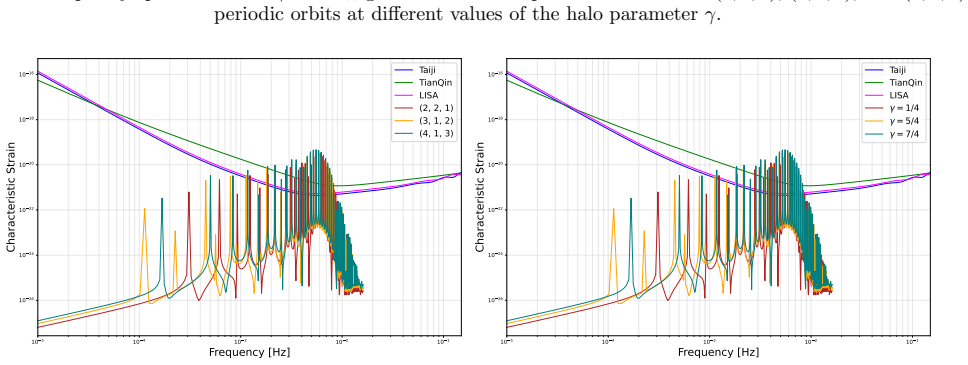
The generalized Dehnen-type (1,4,gamma) dark matter halo modifies timelike geodesic motion by increasing the radii and angular momenta of the marginally bound orbit and innermost stable circular orbit as gamma increases, and produces gravitational wave signals from periodic orbits that have lower amplitudes and longer periods, with spectra mainly in the millihertz range where some peaks exceed the sensitivity of LISA, Taiji, and TianQin.
What carries the argument
The numerical kludge approach applied to periodic orbits in the modified Schwarzschild metric with Dehnen halo, used to generate orbital trajectories and gravitational wave polarizations.
Load-bearing premise
The assumption that the numerical kludge method accurately captures the gravitational wave emission when the spacetime is modified by the dark matter halo.
What would settle it
Detection of EMRI signals showing no shift in orbital periods or amplitudes compared to standard Schwarzschild predictions for the same black hole mass, or signals that deviate in a way inconsistent with the predicted halo-induced changes.
Editorial analysis
A structured set of objections, weighed in public.
Referee Report
Summary. The manuscript examines timelike geodesic motion and periodic orbits around a Schwarzschild-like black hole embedded in a generalized Dehnen-type (1,4,γ) dark matter halo, reporting that increasing γ enlarges the marginally bound orbit and innermost stable circular orbit radii, increases the associated angular momenta, and raises the ISCO energy. It then uses the numerical kludge approach to compute gravitational waveforms for stellar-mass compact objects on periodic orbits, finding that larger values of γ, ρ_s, and r_s produce larger orbits, longer periods, and lower waveform amplitudes whose spectra lie mainly in the millihertz band with some characteristic-strain peaks above the sensitivity curves of LISA, Taiji, and TianQin, suggesting possible observable imprints on EMRI signals.
Significance. If the numerical-kludge results are shown to be reliable in the modified metric, the work would provide a concrete example of how a specific DM halo profile can alter EMRI waveforms in a manner potentially distinguishable by future space-based detectors, adding to the literature on environmental effects in extreme-mass-ratio systems.
major comments (2)
- [Abstract] Abstract and the waveform section: the central claim that the Dehnen halo produces distinguishable EMRI signals rests on numerical-kludge waveforms, yet no derivation or test is supplied showing that the kludge error bounds (geodesic motion plus quadrupole/octupole moments under vacuum or perturbative assumptions) remain controlled when the metric is altered globally at all radii by the halo, changing both the effective potential and asymptotic structure.
- [Abstract] Abstract: the reported trends in waveform amplitude and period are generated by varying the same three halo parameters (γ, ρ_s, r_s) that define the background; without an external benchmark, analytic limit comparison, or parameter-free prediction, it is unclear whether the reported spectral differences are unique to this halo or could be mimicked by other environmental effects at comparable levels.
minor comments (1)
- [Abstract] The abstract states qualitative trends but supplies no error budgets, comparison against analytic limits, or quantitative measures of distinguishability from other effects.
Simulated Author's Rebuttal
We thank the referee for the careful reading and constructive comments. We respond to each major comment below, indicating where revisions will be incorporated.
read point-by-point responses
-
Referee: [Abstract] Abstract and the waveform section: the central claim that the Dehnen halo produces distinguishable EMRI signals rests on numerical-kludge waveforms, yet no derivation or test is supplied showing that the kludge error bounds (geodesic motion plus quadrupole/octupole moments under vacuum or perturbative assumptions) remain controlled when the metric is altered globally at all radii by the halo, changing both the effective potential and asymptotic structure.
Authors: The numerical kludge computes exact geodesics in the given metric and approximates the waveform via multipole moments of the source trajectory. The halo modifies the effective potential and thus the orbits, which is the primary effect under study; the wave-generation step remains the standard quadrupole/octupole prescription. While we did not supply a dedicated error-bound derivation for this globally modified metric, the method has been applied to other non-vacuum backgrounds in the EMRI literature. In revision we will add an explicit discussion of the method’s assumptions and limitations in the modified spacetime, together with a statement that a full error analysis lies beyond the present scope. revision: partial
-
Referee: [Abstract] Abstract: the reported trends in waveform amplitude and period are generated by varying the same three halo parameters (γ, ρ_s, r_s) that define the background; without an external benchmark, analytic limit comparison, or parameter-free prediction, it is unclear whether the reported spectral differences are unique to this halo or could be mimicked by other environmental effects at comparable levels.
Authors: The manuscript’s benchmark is the vacuum Schwarzschild limit recovered when the halo parameters vanish (γ, ρ_s, r_s → 0). All reported trends are shown relative to this limit. The work does not assert that the spectral features are unique to the (1,4,γ) profile; it demonstrates that this specific halo produces measurable shifts in orbital periods, amplitudes, and characteristic-strain peaks within the millihertz band. Other environments could produce analogous shifts, but the parameter dependence is tied to the Dehnen halo model. We will revise the abstract to state the results as effects within this model rather than as uniquely distinguishable signatures. revision: yes
- A dedicated derivation or numerical validation of the numerical-kludge error bounds for a globally modified metric at all radii.
Circularity Check
No circularity: direct numerical computation of halo-modified geodesics and kludge waveforms
full rationale
The paper defines a Schwarzschild-like metric with an added Dehnen (1,4,γ) halo term depending on parameters γ, ρ_s, r_s. It then computes timelike geodesics, effective potentials, MBO/ISCO locations, and periodic orbits directly from that metric. Waveforms are obtained via the numerical kludge method applied to those orbits. The reported trends (larger orbits, longer periods, lower amplitudes with increasing halo parameters) are explicit functions of the metric modification and are not equivalent to the inputs by construction. No self-definitional steps, fitted parameters renamed as predictions, load-bearing self-citations, uniqueness theorems, or smuggled ansatze appear in the derivation chain. The work is a parameter study whose outputs are computed consequences rather than tautological restatements of the halo profile.
Axiom & Free-Parameter Ledger
free parameters (3)
- γ
- ρ_s
- r_s
axioms (2)
- domain assumption The spacetime metric is a Schwarzschild solution modified by the Dehnen halo density profile.
- domain assumption The numerical kludge method produces sufficiently accurate waveforms for the modified metric.
read the original abstract
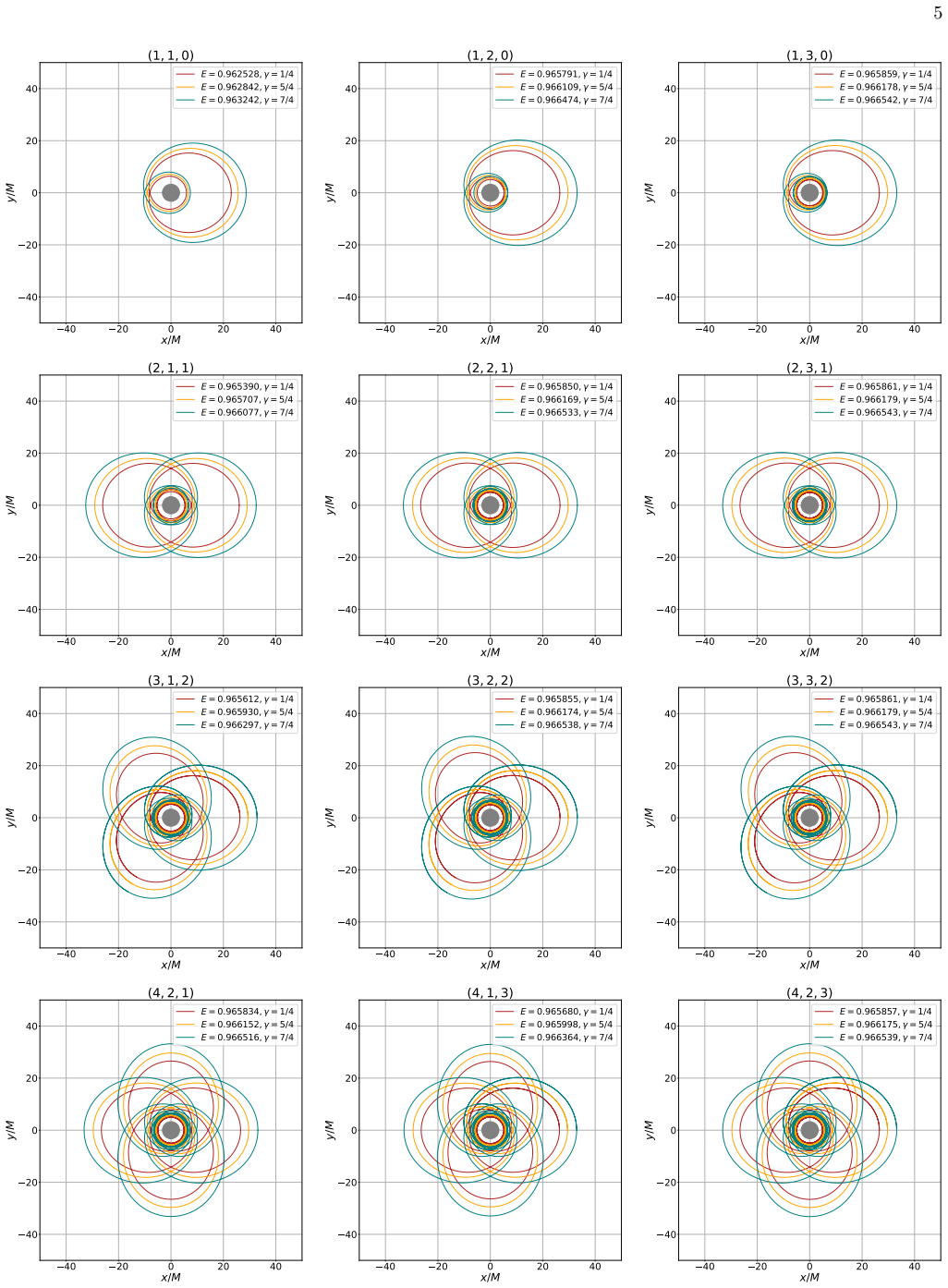
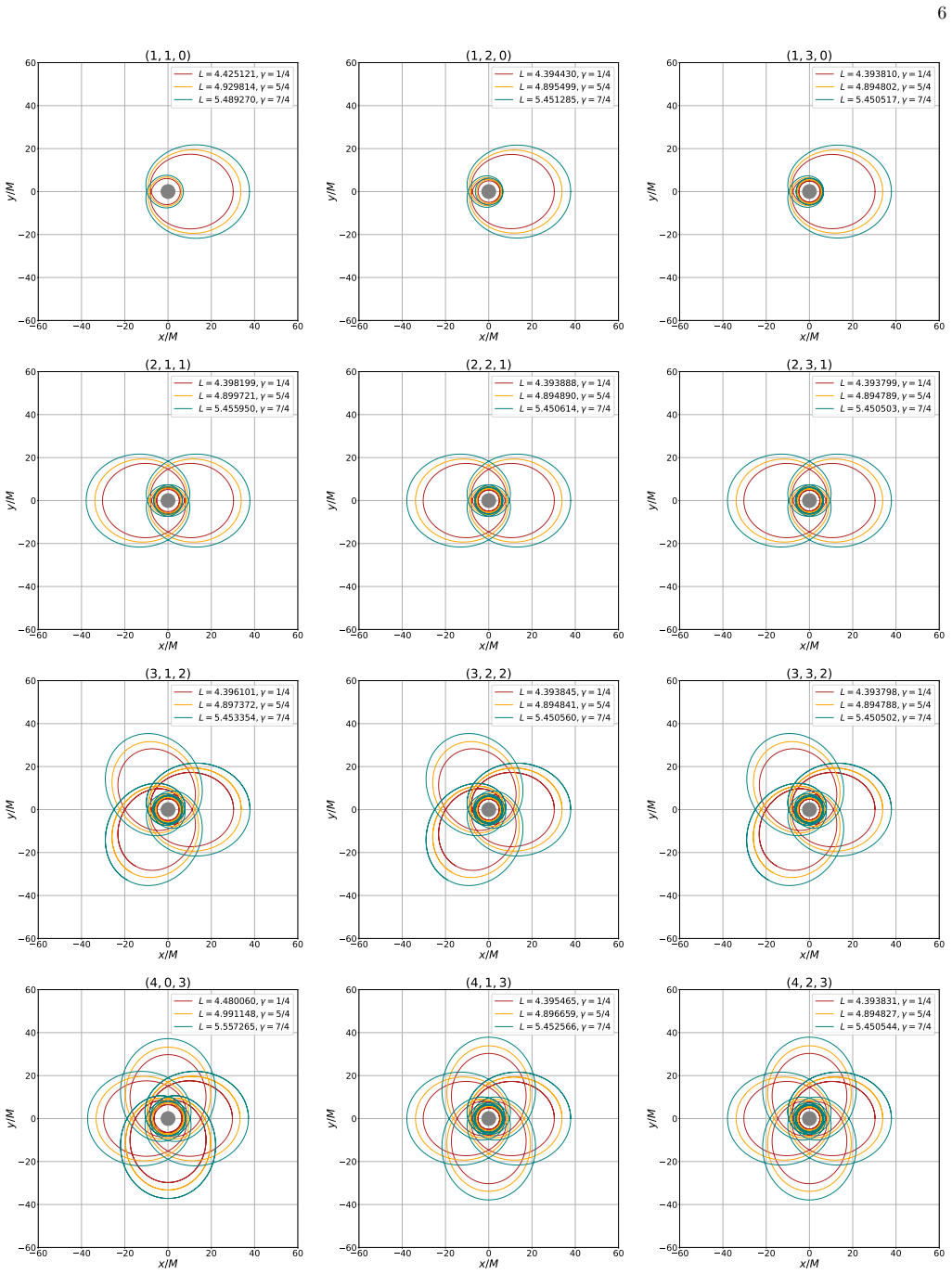
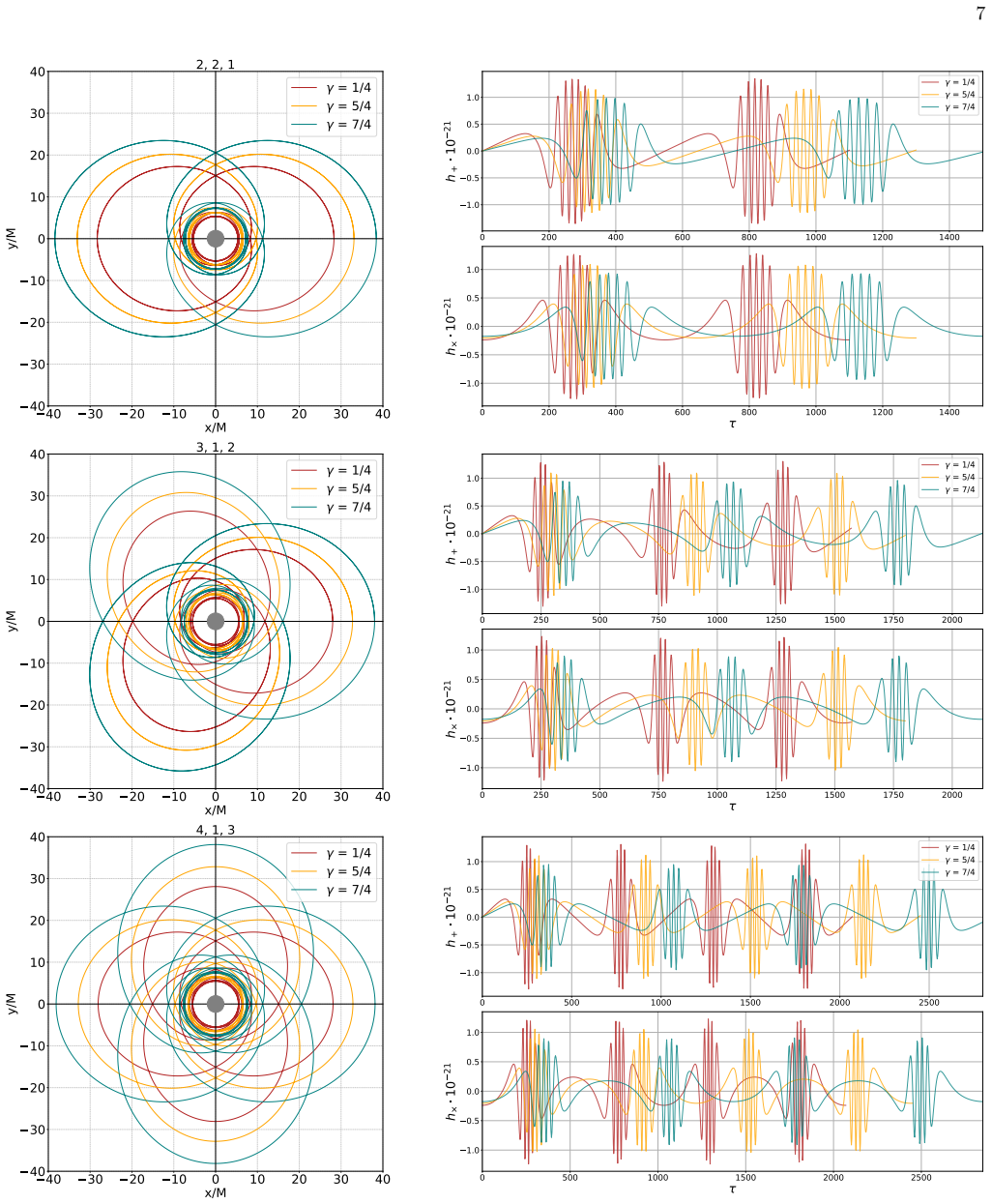
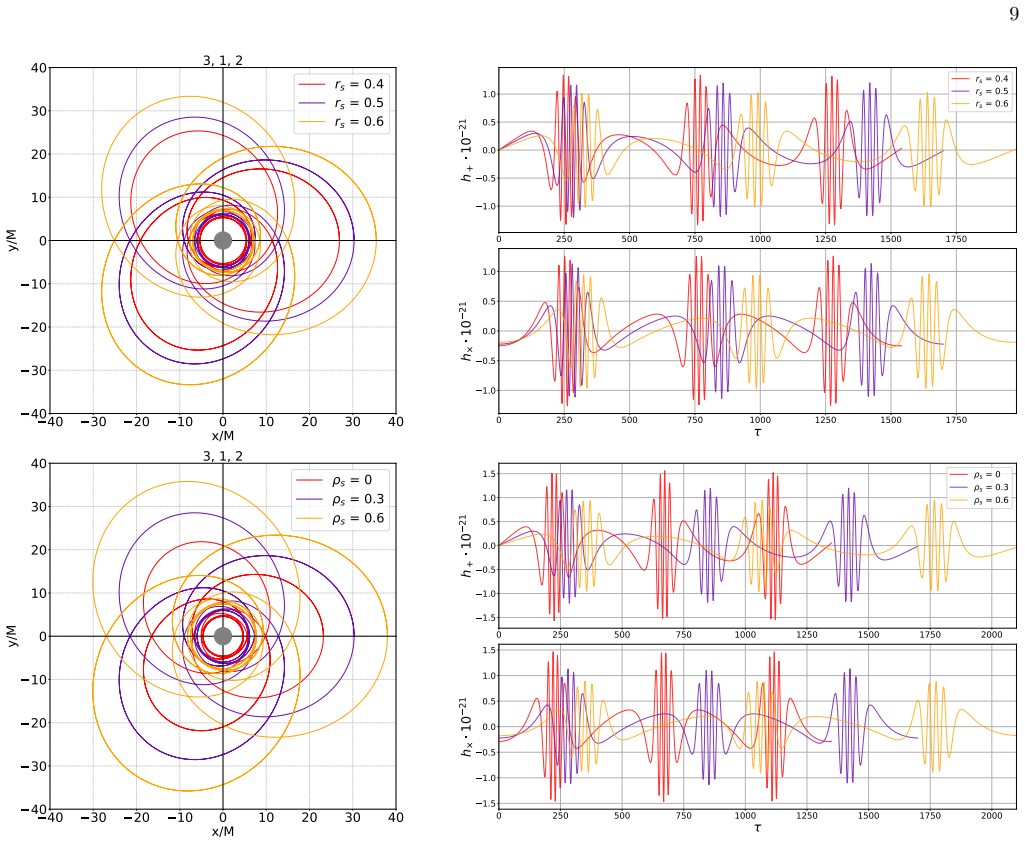
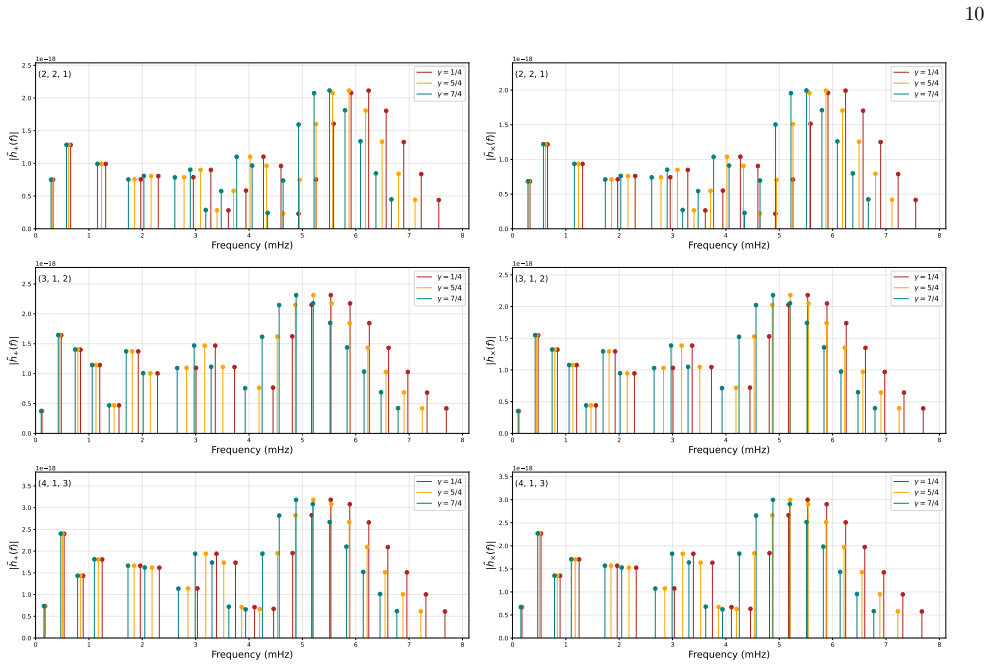
In this paper, we investigate timelike geodesic motion, periodic orbits, and the associated gravitational-wave signals around a Schwarzschild-like black hole (BH) embedded in a generalized Dehnen-type dark matter (DM) halo. We show that the Dehnen-type $(1,4,\gamma)$ DM halo profile modifies test-particle dynamics, with increasing the parameter of density profile, $\gamma$, leading to larger marginally bound orbit (MBO) and innermost stable circular orbit (ISCO) radii and angular momenta, together with a higher ISCO energy. These findings provide further insight into the role of the DM distribution in modifying the orbital dynamics, energy, and angular momentum of timelike test particles near the BH. Furthermore, we investigate the gravitational-wave signals produced by a stellar-mass compact object moving along periodic orbits around a supermassive BH embedded in a generalized Dehnen-type DM halo. Using the numerical kludge approach, we calculate the orbital trajectories and the corresponding gravitational-wave polarizations. We find that increasing the halo parameters $\gamma$, $\rho_s$, and $r_s$ produces larger periodic orbits, longer orbital periods, and lower waveform amplitudes. The resulting spectra lie mainly in the millihertz frequency range, while several characteristic-strain peaks lie above the sensitivity curves of future space-based gravitational-wave detectors such as LISA, Taiji, and TianQin. These results suggest that the surrounding DM halo may leave observable imprints on extreme mass-ratio inspiral (EMRI) gravitational-wave signals.
Figures
Forward citations
Cited by 2 Pith papers
-
Gravitational Wave Signatures of Periodic Orbits around a Schwarzschild-like Black Holes Submerged in an Exponential Density Dark Matter Profile
EMRI waveforms around an ESM-dressed Schwarzschild black hole respond strongly and monotonically to halo scale radius r0, but only weakly to halo mass M0 unless M0 is a large fraction of the black-hole mass.
-
Periodic Orbits and Gravitational Wave Signatures around the Bonanno--Reuter Regular Black Hole
In the Bonanno–Reuter regular black hole, increasing the asymptotically-safe parameter α/M² contracts the bound and periodic orbits and produces a leftward phase shift with mildly boosted peaks in EMRI gravitational w...
Reference graph
Works this paper leans on
-
[1]
K. Schwarzschild, Sitzungsberichte der Königlich Preussischen Akademie der Wissenschaften , 189 (1916)
work page 1916
-
[2]
S. M. Blinder, arXiv e-prints , arXiv:1512.02061 (2015), arXiv:1512.02061 [physics.pop-ph]
work page internal anchor Pith review Pith/arXiv arXiv 2015
-
[3]
R. P. Kerr, Phys. Rev. Lett.11, 237 (1963)
work page 1963
-
[4]
B. P. Abbott and et al. (Virgo and LIGO Scientific Collaborations), Phys. Rev. Lett.116, 061102 (2016), arXiv:1602.03837 [gr-qc]
work page internal anchor Pith review Pith/arXiv arXiv 2016
-
[5]
B. P. Abbott and et al. (Virgo and LIGO Scientific Collaborations), Phys. Rev. Lett.116, 241102 (2016), arXiv:1602.03840 [gr-qc]
work page internal anchor Pith review Pith/arXiv arXiv 2016
-
[6]
First M87 Event Horizon Telescope Results. I. The Shadow of the Supermassive Black Hole
K. Akiyama and et al. (Event Horizon Tele- scope Collaboration), Astrophys. J.875, L1 (2019), arXiv:1906.11238 [astro-ph.GA]
work page internal anchor Pith review Pith/arXiv arXiv 2019
-
[7]
First M87 Event Horizon Telescope Results. VI. The Shadow and Mass of the Central Black Hole
K. Akiyama and et al. (Event Horizon Tele- scope Collaboration), Astrophys. J.875, L6 (2019), arXiv:1906.11243 [astro-ph.GA]
work page internal anchor Pith review Pith/arXiv arXiv 2019
-
[8]
K. Akiyama and et al. (Event Horizon Telescope Col- laboration), Astrophys. J. Lett.930, L12 (2022)
work page 2022
-
[9]
K. Akiyama and et al. (Event Horizon Telescope Col- laboration), Astrophys. J. Lett.930, L14 (2022)
work page 2022
-
[10]
C. M. Will, Living Rev. Rel.17, 4 (2014), arXiv:1403.7377 [gr-qc]
work page internal anchor Pith review Pith/arXiv arXiv 2014
-
[11]
Gravitational Test Beyond the First Post-Newtonian Order with the Shadow of the M87 Black Hole
D. Psaltiset al.(Event Horizon Telescope), Phys. Rev. Lett.125, 141104 (2020), arXiv:2010.01055 [gr-qc]
work page Pith review arXiv 2020
-
[12]
Evidence for dark matter in the inner Milky Way
F. Iocco, M. Pato, and G. Bertone, Nature Phys.11, 245 (2015), arXiv:1502.03821 [astro-ph.GA]
work page internal anchor Pith review Pith/arXiv arXiv 2015
-
[13]
A New Era in the Quest for Dark Matter
G. Bertone and T. M. P. Tait, Nature562, 51 (2018), arXiv:1810.01668 [astro-ph.CO]
work page internal anchor Pith review Pith/arXiv arXiv 2018
-
[14]
V. C. Rubin and J. Ford, W. Kent, Astrophys. J.159, 379 (1970)
work page 1970
-
[15]
The Extended Rotation Curve and the Dark Matter Halo of M33
E. Corbelli and P. Salucci, Mon. Not. Roy. Astron. Soc. 311, 441 (2000), arXiv:astro-ph/9909252 [astro-ph]
work page internal anchor Pith review Pith/arXiv arXiv 2000
- [16]
-
[17]
Particle Dark Matter: Evidence, Candidates and Constraints
G. Bertone, D. Hooper, and J. Silk, Phys. Rep.405, 279 (2005), arXiv:hep-ph/0404175 [hep-ph]
work page internal anchor Pith review Pith/arXiv arXiv 2005
-
[18]
J. G. de Swart, G. Bertone, and J. van Dongen, Nature Astron.1, 0059 (2017), arXiv:1703.00013 [astro-ph.CO]
work page internal anchor Pith review Pith/arXiv arXiv 2017
-
[19]
R. H. Wechsler and J. L. Tinker, Annu. Rev. Astron. Astrophys.56, 435 (2018), arXiv:1804.03097 [astro- ph.GA]
work page internal anchor Pith review Pith/arXiv arXiv 2018
-
[20]
D. Merritt, A. W. Graham, B. Moore, J. Diemand, and B. Terzi´ c, Astron. J.132, 2685 (2006), arXiv:astro- ph/0509417 [astro-ph]
-
[21]
A. A. Dutton and A. V. Macci` o, Mon. Not. R. Astron. Soc.441, 3359–3374 (2014)
work page 2014
-
[22]
The Structure of Dark Matter Haloes in Dwarf Galaxies
A. Burkert, Astrophys. J. Lett.447, L25 (1995), arXiv:astro-ph/9504041 [astro-ph]
work page internal anchor Pith review Pith/arXiv arXiv 1995
- [23]
-
[24]
Shukirgaliyev, B., Otebay, A., Sobolenko, M., Ishchenko, M., Borodina, O., Panamarev, T., Myrza- kul, S., Kalambay, M., Naurzbayeva, A., Abdikamalov, E., Polyachenko, E., Banerjee, S., Berczik, P., Spurzem, R., and Just, A., Astron. Astrophys.654, A53 (2021)
work page 2021
- [25]
- [26]
-
[27]
JCAP02, 014 (2025) https://doi.org/10.1088/ 1475-7516/2025/02/014 arXiv:2411.01145 [gr-qc]
A. Al-Badawi, S. Shaymatov, and Y. Sekhmani, J. Cosmol. Astropart. Phys.2025, 014 (2025), arXiv:2411.01145 [gr-qc]
-
[28]
U. Uktamov, S. Shaymatov, B. Ahmedov, and C. Yuan, Eur. Phys. J. C85, 1432 (2025), arXiv:2505.20031 [gr- qc]
- [29]
-
[30]
Galactic Dark Matter in the Phantom Field
M.-H. Li and K.-C. Yang, Phys. Rev. D86, 123015 (2012), arXiv:1204.3178 [astro-ph.CO]
work page internal anchor Pith review Pith/arXiv arXiv 2012
- [31]
-
[32]
S. Shaymatov, D. Malafarina, and B. Ahmedov, Phys. Dark Universe34, 100891 (2021), arXiv:2004.06811 [gr- qc]
-
[33]
S. Shaymatov, P. Sheoran, and S. Siwach, Phys. Rev. D105, 104059 (2022), arXiv:2110.10610 [gr-qc]
-
[34]
X. Hou, Z. Xu, M. Zhou, and J. Wang, J. Cosmol. As- tropart. Phys.2018, 015 (2018), arXiv:1804.08110 [gr- qc]
work page internal anchor Pith review Pith/arXiv arXiv 2018
- [36]
- [37]
- [38]
-
[39]
A. Al-Badawi and S. Shaymatov, Chin. Phys. C49, 055101 (2025), arXiv:2501.15397 [gr-qc]
- [40]
-
[41]
M. Alloqulov, T. Xamidov, S. Shaymatov, and B. Ahmedov, Eur. Phys. J. C85, 798 (2025), arXiv:2504.05236 [gr-qc]
-
[42]
T. Xamidov, U. Uktamov, S. Shaymatov, and B. Ahme- dov, Phys. Dark Universe47, 101805 (2025)
work page 2025
-
[43]
Y. Chen, P.-P. Wang, B. Wang, R. Luo, and C.-G. Shao, Universe12, 48 (2026), arXiv:2603.07158 [astro- ph.CO]
-
[44]
T. Xamidov, S. Shaymatov, Q. Wu, and T. Zhu, Eur. Phys. J. C85, 1193 (2025), arXiv:2507.13147 [gr-qc]
-
[45]
Laser Interferometer Space Antenna
P. Amaro-Seoane and et al. (Laser Interferometer Space Antenna), “Laser interferometer space antenna,” (2017), arXiv:1702.00786 [astro-ph.IM]
work page internal anchor Pith review Pith/arXiv arXiv 2017
-
[46]
W.-R. Hu and Y.-L. Wu, Natl. Sci. Rev.4, 685 (2017), https://academic.oup.com/nsr/article- pdf/4/5/685/31566708/nwx116.pdf
work page 2017
-
[47]
S. A. Hughes, Class. Quantum Gravity18, 4067–4073 (2001)
work page 2001
-
[48]
Relativistic Dynamics and Extreme Mass Ratio Inspirals
P. Amaro-Seoane, Living Rev. Rel.21, 4 (2018), arXiv:1205.5240 [astro-ph.CO]
work page internal anchor Pith review Pith/arXiv arXiv 2018
-
[49]
Science with the space-based interferometer LISA. V: Extreme mass-ratio inspirals
S. Babak, J. Gair, A. Sesana, E. Barausse, C. F. Sop- uerta, C. P. L. Berry, E. Berti, P. Amaro-Seoane, A. Pe- titeau, and A. Klein, Phys. Rev. D95, 103012 (2017), arXiv:1703.09722 [gr-qc]
work page internal anchor Pith review Pith/arXiv arXiv 2017
-
[50]
K. Glampedakis and D. Kennefick, Phys. Rev. D66, 044002 (2002), arXiv:gr-qc/0203086 [gr-qc]
work page internal anchor Pith review Pith/arXiv arXiv 2002
- [51]
-
[52]
J. R. Gair, M. Vallisneri, S. L. Larson, and J. G. Baker, Class. Quantum Gravity30, 184001 (2013)
work page 2013
- [53]
-
[54]
Dark matter: an efficient catalyst for intermediate-mass-ratio-inspiral events
X.-J. Yue, W.-B. Han, and X. Chen, Astrophys. J.874, 34 (2019), arXiv:1802.03739 [gr-qc]
work page internal anchor Pith review Pith/arXiv arXiv 2019
- [55]
-
[56]
N. Dai, Y. Gong, Y. Zhao, and T. Jiang, Phys. Rev. D 110, 084080 (2024), arXiv:2301.05088 [gr-qc]
work page Pith review arXiv 2024
-
[57]
J. Levin and G. Perez-Giz, Phys. Rev. D77(2008), 10.1103/physrevd.77.103005
-
[58]
R. Grossman and J. Levin, Phys. Rev. D79(2009), 10.1103/physrevd.79.043017
-
[59]
V. Misra and J. Levin, Phys. Rev. D82(2010), 10.1103/physrevd.82.083001
- [60]
-
[61]
P. Bambhaniya, D. N. Solanki, D. Dey, A. B. Joshi, P. S. Joshi, and V. Patel, Eur. Phys. J. C81, 205 (2021), arXiv:2007.12086 [gr-qc]
-
[62]
Astrophysically relevant bound trajectories around a Kerr black hole
P. Rana and A. Mangalam, Class. Quantum Gravity36, 045009 (2019), arXiv:1901.02730 [gr-qc]
work page internal anchor Pith review Pith/arXiv arXiv 2019
-
[63]
Zoom-Whirl Orbits in Black Hole Binaries
J. Healy, J. Levin, and D. Shoemaker, Phys. Rev. Lett. 103, 131101 (2009), arXiv:0907.0671 [gr-qc]
work page internal anchor Pith review Pith/arXiv arXiv 2009
- [64]
-
[65]
General classification of charged test particle circular orbits in Reissner--Nordstr\"om spacetime
D. Pugliese, H. Quevedo, and R. Ruffini, Eur. Phys. J. C77, 206 (2017), arXiv:1304.2940 [gr-qc]
work page internal anchor Pith review Pith/arXiv arXiv 2017
-
[66]
G. Z. Babar, A. Z. Babar, and Y.-K. Lim, Phys. Rev. D96, 084052 (2017), arXiv:1710.09581 [gr-qc]
work page internal anchor Pith review Pith/arXiv arXiv 2017
- [67]
- [68]
- [69]
- [70]
- [71]
-
[72]
Z.-Y. Tu, T. Zhu, and A. Wang, Phys. Rev. D108, 024035 (2023)
work page 2023
- [73]
-
[74]
S.-W. Wei, J. Yang, and Y.-X. Liu, Phys. Rev. D99, 104016 (2019), arXiv:1904.03129 [gr-qc]
work page internal anchor Pith review Pith/arXiv arXiv 2019
- [75]
- [76]
-
[77]
Z.-L. Wei, J. Zhang, Y. Xie, and P.-L. Yin, Eur. Phys. J. C85, 698 (2025)
work page 2025
-
[78]
M. Alloqulov, S. Shaymatov, B. Ahmedov, and T. Zhu, Eur. Phys. J. C86, 117 (2026)
work page 2026
-
[79]
J. Sharipov, T. Xamidov, Q. Wu, S. Shaymatov, and T. Zhu, (2025), arXiv:2511.10043 [gr-qc]
-
[80]
Can environmental effects spoil precision gravitational-wave astrophysics?
E. Barausse, V. Cardoso, and P. Pani, Phys. Rev. D 89, 104059 (2014), arXiv:1404.7149 [gr-qc]
work page internal anchor Pith review Pith/arXiv arXiv 2014
-
[81]
V. Cardoso, K. Destounis, F. Duque, R. P. Macedo, and A. Maselli, Phys. Rev. D105, L061501 (2022), arXiv:2109.00005 [gr-qc]
discussion (0)
Sign in with ORCID, Apple, or X to comment. Anyone can read and Pith papers without signing in.