REVIEW 2 major objections 6 minor 30 references
A boost selects a different nonhydrodynamic singularity to limit hydrodynamics, and at large boost that singularity comes from the rest-frame near-light-cone spectrum.
Reviewed by Pith at T0; open to challenge. T0 means a machine referee read the full paper against a public rubric. the ladder, T0–T4 →
T0 review · grok-4.5
2026-07-31 11:20 UTC pith:SNCHS6SZ
load-bearing objection Clean geometric point: a boost can select a different singularity for the hydro radius of convergence, and the ultra-relativistic limit diagnoses near-light-cone spectral structure, with a sharp RTA vs holography contrast. the 2 major comments →
Near-Light-Cone Nonhydrodynamic Structure from Boosted Hydrodynamics
The pith
A machine-rendered reading of the paper's core claim, the machinery that carries it, and where it could break.
Core claim
A longitudinal boost changes which nonhydrodynamic singularity limits the small-momentum hydrodynamic expansion. The boosted radius of convergence is set by the image of the rest-frame point where the map from rest-frame momentum to boosted momentum ceases to be invertible, not necessarily by the boosted image of the rest-frame limiting point. At large boost that selected point is driven to the large-momentum near-light-cone region of the rest-frame spectrum, and the Lorentz-rescaled convergence scale is controlled by the theory’s microscopic spectral approach to the light cone—finite offset in RTA kinetic theory, vanishing offset in holography.
What carries the argument
The loss-of-invertibility condition dk/dq = γ[1 + v Ω′(q)] = 0 on the rest-frame hydrodynamic branch. Its zeros select the critical rest-frame points q*(v) whose boosted images are the branch points that set the boosted convergence radius kc(v); at large boost this forces Ω′(q*) → −1 and drives q* into the near-light-cone asymptotics.
Load-bearing premise
On the analytically continued rest-frame hydrodynamic branch there is no finite-momentum point where the local slope already equals minus one, so the critical point must run to infinite momentum as the boost approaches the speed of light.
What would settle it
Find or construct a causal, stable relativistic spectrum whose analytically continued hydrodynamic branch has a finite-momentum point with slope exactly −1; then the large-boost critical point would stay finite rather than probing the near-light-cone region, and the claimed diagnostic would fail. Alternatively, compute kc(v)/γ for another microscopic theory and check whether it approaches a constant, zero, or a different scaling.
If this is right
- Boosted hydrodynamic radius of convergence is a dynamical probe of near-light-cone nonhydrodynamic physics, not a pure kinematic rescaling of the rest-frame radius.
- In RTA-like kinetic theories the Lorentz-rescaled convergence scale approaches a nonzero constant fixed by the microscopic relaxation rate.
- In holographic charge diffusion the same rescaled scale vanishes, so hydrodynamics loses predictive window faster after Lorentz factors are removed.
- Increasing boost velocity continuously scans different regions of the rest-frame spectral curve, focusing the large-boost test on light-cone approach.
- Subleading large-boost corrections can resolve how different microscopic spectra approach the light cone and mark the momentum window where hydrodynamics remains predictive on a moving medium.
Where Pith is reading between the lines
- The same selection mechanism should apply to other longitudinal channels (sound, shear) whenever a rest-frame branch can be parametrically mapped and inverted; transverse boosts are expected not to give the same near-light-cone diagnostic.
- Comparing kc/γ across weakly coupled kinetic models, effective field theories, and strongly coupled duals could classify light-cone approach patterns beyond the two extremes shown here.
- If a theory’s light-cone offset scales with a tunable microscopic parameter, the ultra-relativistic kc/γ limit offers a clean extraction of that parameter from boosted-frame data alone.
Editorial analysis
A structured set of objections, weighed in public.
Referee Report
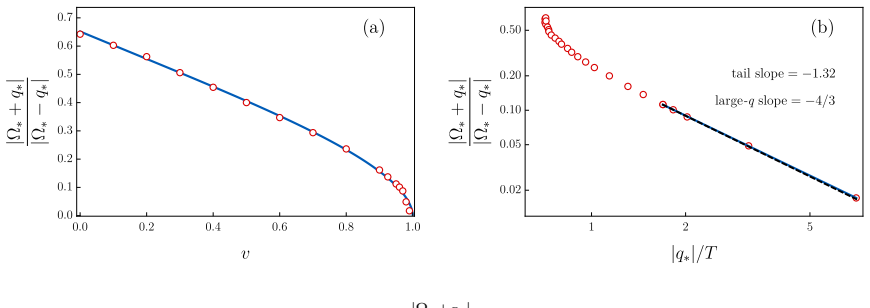
Summary. The paper shows that under a longitudinal boost the singularity limiting the small-momentum hydrodynamic expansion need not be the boosted image of the rest-frame (RF) convergence-limiting point qc. Instead, the boosted dispersion relation ω(k) acquires a square-root branch point wherever the parametric map q ↦ k(q;v) = γ[q + vΩ(q)] loses invertibility, i.e. where dk/dq = γ[1 + vΩ′(q)] = 0 (Eq. (1)), and Appendix B shows this is generically equivalent to the double-root condition F = ∂ωF = 0. As v → 1 the selected point q*(v) is driven toward Ω′(q*) → −1, and — provided no finite-momentum point on the analytically continued RF hydrodynamic branch realizes a lightlike slope — to large |q| along the near-light-cone asymptotics. Two examples are worked out. In resummed RTA diffusion theory, Appendix D proves no finite lower-half-plane solution of Ω′(q)+1 = 0 exists, forcing Im z* → −∞ and yielding the analytic, parameter-free limit τkc(v)/γ(v) → 1 (Eqs. (10)–(13)), independently confirmed by a large-order Taylor-series/root-estimator analysis (Appendix E, Table 1, agreement within 0.8%). In holographic Maxwell diffusion on AdS5-Schwarzschild, mode-collision tracking at complex boosted momentum gives kc(v)/(Tγ(v)) → 0, with the RF light-cone approach checked via the ratio |Ω*+q*|/|Ω*−q*| (Fig. 5).
Significance. If correct, the result reframes the hydrodynamic convergence problem: the boost becomes a tunable diagnostic that scans the RF spectral curve, and the γ-rescaled convergence radius in the large-boost limit probes how microscopic nonhydrodynamic structure approaches the light-cone. Several strengths deserve explicit credit. The central mechanism (Jacobian condition, equivalence to the double-root characterization, square-root local form) is derived cleanly and covariantly. The RTA large-boost limit τkc/γ → 1 is an analytic, parameter-free result with a transparent kinetic interpretation (ballistic front damped at rate 1/τ), and it is independently verified by a completely different method — high-order Taylor coefficients plus Darboux singularity analysis — with sub-percent agreement in Table 1; this closes the logical gap of whether the Jacobian branch point is really the convergence-limiting singularity. The holographic application yields a concrete, falsifiable scaling prediction tied to the known large-q QNM asymptotics Ω_n ~ ±q + C n q^{−1/3}. The transverse-boost contrast (§4) and the careful Appendix C discussion of fixed-k spectra versus analytic continuation add clarity.
major comments (2)
- [§3, Fig. 4(b)] The claim kc(v)/(Tγ(v)) → 0 in panel (b) rests on 'smooth fits to the numerical data' that 'guide the extrapolation toward the ultra-relativistic limit', but no fit ansatz, fit window, residual, or uncertainty is reported. At the moderate boosts accessible, a decay toward a small nonzero constant, or toward zero with a power law, may be hard to distinguish. Since the vanishing-offset scenario is one of the paper's two headline conclusions (and the advertised contrast with RTA), the authors should state the fit functional forms, give fit-parameter uncertainties, and demonstrate robustness under variation of the boost range used. If the data genuinely cannot exclude a small nonzero asymptote, the wording should reflect that.
- [§3, Figs. 4–5 (cf. Appendix D)] The holographic analogue of the RTA argument is necessarily numerical, but the load-bearing step — that as v → 1 the critical point runs to Im q* → −∞ along the near-light-cone direction rather than terminating at a finite-q point with Ω′(q) = −1 — is supported only by mode tracking and by Fig. 5, where the ratio |Ω*+q*|/|Ω*−q*| has slope −1.32 against the expected −4/3 guide at 'moderate' |q*|/T. For RTA this obstruction is excluded analytically in Appendix D; for holography the reader is told only the accessible range. This is a correctness-risk concern, not an inconsistency: I ask the authors to (i) state explicitly the ranges of v and |q*|/T reached, (ii) show whether the −1.32 slope is drifting toward −4/3 with increasing |q*| (e.g. a running local slope), and (iii) comment on any numerical evidence bearing on the absence of a finite-q lightlike-slope point on the continued Maxwell
minor comments (6)
- [§1, Eq. (2)] Eq. (2) is typeset as 'Ω′(q*) = −1/v → −1', which reads oddly; writing 'Ω′(q*) = −1/v, which tends to −1 as v → 1' would avoid confusion.
- [Fig. 1] Fig. 1 is central to the paper's intuition but the axis labels (ω, k, ω′, k′, q, Ω) and the relation between panels (a) and (b) are hard to parse at first reading; a sentence in the caption defining the primed axes and what the 'other branch' curve represents would help.
- [Appendix E, Table 1] The root-estimator fits (Eq. (E15)) fix the log n/n coefficient at 3/2 from the square-root exponent. It would strengthen the check to report the sensitivity of k_Taylor to the fit window [n_min, n_max] (e.g. variation with n_min), since at v = 0.956 the oscillatory modulation is strong and near-cancellations in the pair prefactor (Eq. (E9)) could bias the envelope fit.
- [§3, Figs. 3–5] The numerical precision of the QNM data underlying Figs. 3–5 (grid size, tolerance, convergence in |q*|) is not stated; a brief remark would aid reproducibility. The package of Ref. [18] is cited but the continuation procedure to complex k (Fig. 3) deserves one more sentence on method.
- [§2 (after Eq. (13)); title page] 'The finite RTA relaxation time dampens this ballistic signal' — 'damps' is meant. Also check the affiliations block for stray spacing artifacts ('f¨ ur', 'Helmholtzzentrum f¨ ur').
- [§1, footnote 1] Footnote 1 cites Refs. [8, 9] for constraints on boosted relaxation spectra; given the proximity of those works to the present setup, a one-sentence statement of what is new here relative to Ref. [8] (and to the moderate-boost shear-channel study of Ref. [19]) would help readers place the result.
Circularity Check
No significant circularity: boosted convergence radii are computed from independent spectral inputs (RTA Boltzmann / holographic Maxwell QNMs), not fitted or defined into the claimed limits.
full rationale
The load-bearing chain is kinematic plus spectral: the boosted hydrodynamic branch is the parametric image (ω(q;v), k(q;v)) of a rest-frame branch Ω(q); the small-k expansion of ω(k) fails where the map q↦k ceases to be invertible (dk/dq = γ[1+vΩ'(q)] = 0), which Appendix B equates to the generic double-root condition on F. That Jacobian condition and the large-boost drive Ω'(q*)→−1 are standard analytic geometry, not definitions of the microscopic offset. For RTA, Appendix A re-derives the boosted spectral equation from the covariant RTA Boltzmann equation; the RF branch Ω(q)=−i/τ+iq cot(τq) is then an input, and the ultra-relativistic limit τkc/γ→1 is an output of solving Ω'(q*)=−1/v and showing (Appendix D) there is no finite lower-half-plane root, so Im q*→−∞ and k*/γ→−i/τ. Appendix E independently recovers the same kc from large-order Taylor coefficients via Darboux asymptotics—an external consistency check, not a fit recycled as prediction. For holography the spectral input is the standard AdS5-Schwarzschild Maxwell QNM problem; kc(v) is located by numerical mode-collision tracking under complex-k continuation, and kc/(Tγ)→0 plus light-cone approach are numerical outputs, not parameters tuned to that conclusion. Self-citations (e.g. Abbasi–Rischke resummed RTA) supply a starting curve that is also re-derived here; they do not force the boost-selection mechanism or the rescaled limits. No fitted-input-called-prediction, no load-bearing uniqueness import, and no renaming of a known empirical pattern as a first-principles result.
Axiom & Free-Parameter Ledger
axioms (7)
- domain assumption Hydrodynamic mode expansions in complex momentum have a finite radius of convergence set by the nearest nonhydrodynamic singularity of the retarded correlator spectral curve F(Ω,q)=0.
- domain assumption The systems considered are causal and stable, so boosts do not create instabilities; the question is convergence, not onset of instability.
- domain assumption Hydrodynamic fluctuation effects (branch cuts, long-time tails) are parametrically suppressed in classical large-N holography and large-occupancy RTA.
- domain assumption RTA resummed diffusion spectral equation (4) and RF branch Ω(q)=−i/τ+iq cot(τq) correctly capture the longitudinal diffusion sector.
- domain assumption Longitudinal U(1) Maxwell QNMs on AdS5-Schwarzschild encode holographic charge diffusion and its nonhydrodynamic partners via the master field equation (15).
- ad hoc to paper On the analytically continued RF hydrodynamic branch of the examples, there is no finite-momentum point with Ω'(q)=−1; q*(v) runs to infinity as v→1.
- standard math Standard complex analysis: loss of local invertibility of q↦k produces square-root branch points in ω(k); Cauchy–Hadamard/root tests and Darboux asymptotics relate Taylor coefficients to nearest singularities.
read the original abstract
Hydrodynamics provides a universal description of many-body systems at long wavelengths. Its long-lived collective excitations, known as hydrodynamic modes, admit long-wavelength expansions whose convergence is encoded in the analytic structure of retarded correlators of conserved quantities in thermal equilibrium. We show that a boost can change which nonhydrodynamic singularity limits such an expansion. In the large-boost limit, the relevant singularity originates in the large-momentum, near-light-cone region of the rest-frame spectrum. After factoring out the Lorentz-factor growth, the rescaled convergence scale is controlled by the microscopic spectral structure of the theory. We explicitly demonstrate this in two examples: relaxation-time kinetic theory and holography.
Figures



Reference graph
Works this paper leans on
-
[1]
W. Florkowski, M. P. Heller and M. Spalinski, Rept. Prog. Phys.81, no.4, 046001 (2018) [arXiv:1707.02282 [hep-ph]]
Pith/arXiv arXiv 2018
-
[2]
Hydrodynamics of electrons in graphene,
A. Lucas and K. C. Fong, “Hydrodynamics of electrons in graphene,” J. Phys. Condens. Matter30, 053001 (2018), [arXiv:1710.08425 [cond-mat.str-el]]
Pith/arXiv arXiv 2018
-
[3]
Nearly perfect fluidity: From cold atomic gases to hot quark-gluon plasmas,
T. Sch¨ afer and D. Teaney, “Nearly perfect fluidity: From cold atomic gases to hot quark-gluon plasmas,” Rept. Prog. Phys.72, 126001 (2009), [arXiv:0904.3107 [hep-ph]]
Pith/arXiv arXiv 2009
-
[4]
Hydrodynamic gradient expansion in gauge theory plasmas,
M. P. Heller, R. A. Janik and P. Witaszczyk, “Hydrodynamic gradient expansion in gauge theory plasmas,” Phys. Rev. Lett.110, 211602 (2013), arXiv:1302.0697 [hep-th]
Pith/arXiv arXiv 2013
-
[5]
Short-lived modes from hydrodynamic dispersion relations,
B. Withers, “Short-lived modes from hydrodynamic dispersion relations,” JHEP06, 059 (2018), arXiv:1803.08058 [hep-th]
Pith/arXiv arXiv 2018
-
[6]
Convergence of the gradient expansion in hydrodynamics,
S. Grozdanov, P. K. Kovtun, A. O. Starinets and P. Tadi´ c, “Convergence of the gradient expansion in hydrodynamics,” Phys. Rev. Lett.122, 251601 (2019), arXiv:1904.01018 [hep-th]
Pith/arXiv arXiv 2019
-
[7]
Convergence of hydrodynamic modes: Insights from kinetic theory and holography,
M. P. Heller, A. Serantes, M. Spali´ nski, V. Svensson, and B. Withers, “Convergence of hydrodynamic modes: Insights from kinetic theory and holography,” SciPost Phys.10, 123 (2021), [arXiv:2012.15393 [hep-th]]
Pith/arXiv arXiv 2021
-
[8]
How Lorentz Boosts Reshape Relaxation Spectra,
L. Gavassino, “How Lorentz Boosts Reshape Relaxation Spectra,” Phys. Rev. Lett. 137, no.2, 022301 (2026) [arXiv:2601.03081 [gr-qc]]
Pith/arXiv arXiv 2026
-
[9]
The Lorentzian geometry of relaxation,
L. Gavassino, “The Lorentzian geometry of relaxation,” [arXiv:2607.10148 [nucl-th]]
-
[10]
P. Kovtun and L. G. Yaffe, Phys. Rev. D68, 025007 (2003) [arXiv:hep-th/0303010 [hep-th]]
Pith/arXiv arXiv 2003
-
[11]
Hydrodynamic long-time tails from Anti de Sitter space,
S. Caron-Huot and O. Saremi, “Hydrodynamic long-time tails from Anti de Sitter space,” JHEP11, 013 (2010), arXiv:0909.4525 [hep-th]
Pith/arXiv arXiv 2010
-
[12]
Theory of diffusive fluctuations,
X. Chen-Lin, L. V. Delacr´ etaz and S. A. Hartnoll, “Theory of diffusive fluctuations,” Phys. Rev. Lett.122, 091602 (2019), arXiv:1811.12540 [hep-th]
Pith/arXiv arXiv 2019
-
[13]
Retarded correlators in kinetic theory: branch cuts, poles and hydrodynamic onset transitions,
P. Romatschke, “Retarded correlators in kinetic theory: branch cuts, poles and hydrodynamic onset transitions,” Eur. Phys. J. C76, 352 (2016), arXiv:1512.02641 [hep-th]. 23
Pith/arXiv arXiv 2016
-
[14]
Analytic structure of nonhydrodynamic modes in kinetic theory,
A. Kurkela and U. A. Wiedemann, “Analytic structure of nonhydrodynamic modes in kinetic theory,” Eur. Phys. J. C79, 776 (2019), arXiv:1712.04376 [hep-ph]
Pith/arXiv arXiv 2019
-
[15]
Three-point functions from a Schwinger-Keldysh effective action, resummed in derivatives,
N. Abbasi and D. H. Rischke, “Three-point functions from a Schwinger-Keldysh effective action, resummed in derivatives,” JHEP05, 241 (2025), arXiv:2410.07929 [hep-th]
Pith/arXiv arXiv 2025
-
[16]
Quasinormal modes and holography,
P. K. Kovtun and A. O. Starinets, “Quasinormal modes and holography,” Phys. Rev. D72, 086009 (2005), arXiv:hep-th/0506184 [hep-th]
Pith/arXiv arXiv 2005
-
[17]
U(1) current from the AdS/CFT: diffusion, conductivity and causality,
Y. Bu, M. Lublinsky and A. Sharon, “ U(1) current from the AdS/CFT: diffusion, conductivity and causality,” JHEP04, 136 (2016) [arXiv:1511.08789 [hep-th]]
Pith/arXiv arXiv 2016
-
[18]
A. Jansen, “Overdamped modes in Schwarzschild-de Sitter and a Mathematica package for the numerical computation of quasinormal modes,” Eur. Phys. J. Plus132, 546 (2017), arXiv:1709.09178 [gr-qc]
Pith/arXiv arXiv 2017
-
[19]
Causality constraints and anisotropic states,
R. E. Hoult, “Causality constraints and anisotropic states,” [arXiv:2512.24819 [hep-th]]
-
[20]
A Bohr-Sommerfeld quantization formula for quasinormal frequencies of AdS black holes,
G. Festuccia and H. Liu, “A Bohr-Sommerfeld quantization formula for quasinormal frequencies of AdS black holes,” Adv. Sci. Lett.2, 221 (2009), arXiv:0811.1033 [gr-qc]
Pith/arXiv arXiv 2009
-
[21]
Damping of hard excitations in strongly coupledN= 4 plasma,
J. F. Fuini, C. F. Uhlemann and L. G. Yaffe, “Damping of hard excitations in strongly coupledN= 4 plasma,” JHEP12, 042 (2016), arXiv:1610.03491 [hep-th]
Pith/arXiv arXiv 2016
-
[22]
Rigorous bounds on transport from causality,
M. P. Heller, A. Serantes, M. Spalinski and B. Withers, “Rigorous bounds on transport from causality,” Phys. Rev. Lett.130, no.26, 261601 (2023), doi:10.1103/PhysRevLett.130.261601 [arXiv:2212.07434 [hep-th]]
Pith/arXiv arXiv 2023
-
[23]
Bounds on transport from hydrodynamic stability,
L. Gavassino, “Bounds on transport from hydrodynamic stability,” Phys. Lett. B840, 137854 (2023), doi:10.1016/j.physletb.2023.137854 [arXiv:2301.06651 [hep-th]]
arXiv 2023
-
[24]
Causality and classical dispersion relations,
R. E. Hoult and P. Kovtun, “Causality and classical dispersion relations,” Phys. Rev. D109, 046018 (2024), [arXiv:2309.11703 [hep-th]]
Pith/arXiv arXiv 2024
-
[25]
Instability of 5D Gauss-Bonnet black branes,
A. Buchel, R. E. Hoult and P. Kovtun, “Instability of 5D Gauss-Bonnet black branes,” [arXiv:2606.19049 [hep-th]]
-
[26]
Relativistic dispersion spectra across Lorentz boosted frames: spurious modes and causality,
S. Bhattacharyya, S. Mitra, S. Roy and R. Singh, “Relativistic dispersion spectra across Lorentz boosted frames: spurious modes and causality,” JHEP05, 215 (2026) [arXiv:2512.12450 [hep-th]]
Pith/arXiv arXiv 2026
-
[27]
Reconstruction of spectra and an algorithm based on the theorems of Darboux and Puiseux,
S. Grozdanov and T. Lemut, “Reconstruction of spectra and an algorithm based on the theorems of Darboux and Puiseux,” JHEP02, 131 (2023), [arXiv:2209.02788 [hep-th]]. 24
Pith/arXiv arXiv 2023
-
[28]
Singularity analysis of generating functions,
P. Flajolet and A. M. Odlyzko, “Singularity analysis of generating functions,” SIAM J. Discrete Math.3, 216 (1990)
1990
-
[29]
Deducing the properties of singularities of functions from their Taylor series coefficients,
C. Hunter and B. Guerrieri, “Deducing the properties of singularities of functions from their Taylor series coefficients,” SIAM J. Appl. Math.39, 248 (1980)
1980
-
[30]
L. V. Ahlfors,Complex Analysis, 3rd ed. (McGraw–Hill, New York, 1979). 25
1979
discussion (0)
Sign in with ORCID, Apple, or X to comment. Anyone can read and Pith papers without signing in.