REVIEW 4 major objections 8 minor 47 references
Short-time Pauli propagation plus positivity extension recovers long-time correlators and spectra without operator explosion.
Reviewed by Pith at T0; open to challenge. T0 means a machine referee read the full paper against a public rubric. the ladder, T0–T4 →
T0 review · grok-4.5
2026-07-31 05:45 UTC pith:V7AW55I4
load-bearing objection Solid methods stack: short-time Pauli propagation plus PSD/low-rank extension (and CAMPS) actually delivers usable few-mode structure factors on 2D Heisenberg, with scoped limits the authors mostly own. the 4 major comments →
Efficient computation of real-time correlators using Pauli Propagation
The pith
A machine-rendered reading of the paper's core claim, the machinery that carries it, and where it could break.
Core claim
Accurate short-time Pauli-propagation trajectories, truncated on coefficient and weight, combined with positive-semidefinite (or rank-1 Prony-style) time extension, produce two-point correlators whose spectra retain the relevant dynamical information of 1D and 2D Heisenberg systems while avoiding the exponential growth of Pauli strings at late times.
What carries the argument
Positive-semidefinite Toeplitz extension of short-time correlators (equivalently a low-rank Vandermonde / few-frequency Prony fit): because CAA is positive, a rank-r signal is fixed by a short noiseless window and can be continued to late times, correcting some truncation error and super-resolving the spectrum.
Load-bearing premise
The early truncated data must already be accurate enough, and the momentum-space signal low-rank enough, that a few time samples uniquely determine the physical frequencies.
What would settle it
On a system with a known continuum spectrum (for example the 1D Heisenberg antiferromagnet spinon continuum), check whether rank-1 or low-rank PSD extension from a short Pauli window recovers the continuum boundaries and weight rather than a few spurious discrete peaks.
If this is right
- Structure factors on large lattices become accessible whenever a ground or thermal state can supply cheap Pauli expectations and the spectrum is few-frequency.
- Operator growth need only be controlled inside a short light-cone window; late-time cost is replaced by a low-rank fit.
- Clifford-augmented MPS ground states pair naturally with Pauli sums because Cliffords map Paulis to Paulis without increasing string count.
- The same short-time-plus-extension pipeline can be fed by any method that produces early correlator samples, not only Pauli propagation.
Where Pith is reading between the lines
- When the low-rank assumption fails, the same short-time Pauli data could still seed other analytic continuations or memory-kernel methods rather than Prony fits.
- Hybrid workflows that hand short-time operator trajectories to a quantum device for expectation values, then extend classically, are a direct corollary of the cost split the paper demonstrates.
- Finite-size collapse of soft modes and staggered moments in 2D antiferromagnets can be read off from very short windows, suggesting systematic scaling studies at lower cost than full real-time evolution.
Editorial analysis
A structured set of objections, weighed in public.
Referee Report
Summary. The manuscript proposes a classical pipeline for real-time two-point correlators: (i) Heisenberg-picture evolution of the operator via Pauli propagation (PP) with coefficient (ε) and weight (w) truncation, (ii) expectation values taken against approximate ground states (product state, DMRG MPS, or CAMPS), and (iii) extension of the short-time signal to late times using the positive-semidefinite Toeplitz/Vandermonde method of Ref. [18], exploiting the observation that momentum-space correlators are often low-rank (few frequencies). The method is demonstrated on the 1D ferromagnetic Heisenberg chain (N=8 exact, N=64 vs the analytic 1-magnon dispersion), the 1D antiferromagnet (N=64, vs TDVP), and the 2D antiferromagnet on 8×8 with CAMPS ground state (D=240), where a rank-1 Prony extraction from 7 time points yields a spectrum resembling linear spin-wave theory. Supporting material includes an improved 8×8 calculation (App. B), exact Betts-cluster ED cross-checks (Fig. S2), a cost analysis (App. C), and a 100×100 ferromagnet reconstruction from an 8×8 patch (App. D).
Significance. If the results hold, this is a useful and timely contribution. Real-time correlators beyond 1D are a recognized bottleneck for tensor-network methods, and the combination of PP short-time dynamics with positivity-based super-resolution is a genuinely promising strategy that is, in its low-rank regime, essentially parameter-light: the extracted frequencies are read from data via a uniqueness result (Carathéodory–Toeplitz–Pisarenko) rather than inserted by hand. The manuscript deserves credit for an unusually honest benchmarking strategy: exact N=8 checks, the analytic N=64 FM magnon reference, a TDVP comparison for the 1D AFM, and exact Betts-cluster ED for the 2D AFM. It is also commendably candid about failure modes — the low-rank assumption fails for the 1D AFM spinon continuum (§III.A.2), and the minimal acceptable truncation is flagged as open. The CAMPS-plus-PP combination for expectation values (App. A) is a nice, transferable technical observation. The 100×100 FM result (App. D), while for a trivial ground state, concretely demonstrates the locality-based scaling argument. The work is reproducible in principle (PauliOperators.jl, ITensor) and makes falsifiable claims.
major comments (4)
- [§III.C, Fig. 6; App. B, Fig. S2] The headline 2D result never separates the three error sources that could shift the extracted magnon frequencies: PP truncation (w=5, ε=1e-4), CAMPS ground-state error (D=240), and finite-size effects. The one exact cross-check, Fig. S2(a), shows the improved 8×8 points lying 'systematically below' the exact Betts-cluster arch, and the text attributes this to 'a combination of a decreased finite-size effect and errors introduced by the Pauli propagation' — i.e., the sign and magnitude of the truncation error are unknown. Since the physical effects the paper claims to resolve (e.g., the finite-size softening at M, ω_M≈0.83 in Fig. S2(b)) are of comparable size to plausible truncation-induced frequency shifts, this ambiguity is load-bearing for the central claim that the extended correlators 'retain the relevant dynamical and spectral information.' A convergence study at 2–3 representative
- [§III.B (Carathéodory–Toeplitz–Pisarenko discussion); Fig. 6(c)] The uniqueness theorem invoked to justify extension (rank-r PSD Toeplitz determined by 2r numbers) holds exactly only for noiseless data, yet it is applied to 7 PP data points carrying unquantified truncation and ground-state error. The manuscript provides no robustness analysis of the extraction: how the fitted rank-1 frequency degrades with noise level, sample count, or time step. A controlled synthetic test — take exact short-time S(k,t) (available from ED/Betts clusters or the analytic FM), add noise of estimated PP magnitude, and report the distribution of extracted ω — would both validate the method's noise tolerance and supply the frequency error bars that are currently absent everywhere (see next comment). Without it, the statement that rank-1 extraction 'recovers a peak' is a weak test: a single damped sinusoid is extractable from almost any approximately oscillatory 7-point tra
- [Fig. 5b, 6d, S1d, S2a; §III.C] No quantitative uncertainties are reported for any extracted frequency in the paper (Figs. 5(b), 6(d), S1(d), S2). Moreover, the only quantitative 2D validation is against linear spin-wave theory with the overall scale A treated as a free fit parameter, and the fitted value moves substantially between datasets: A=8.9 (Fig. 6d), A=9.2 (Fig. S1d), versus A=10.8 for the exact Betts-cluster arch (Fig. S2a). This ~15–20% variation in A across truncations is itself a measure of the systematic error and should be surfaced in the text, with per-momentum deviations tabulated, rather than left implicit in figure annotations. As written, 'agrees well with the predictions of linear spin wave theory' (§III.C) is supported only at the level of qualitative band shape.
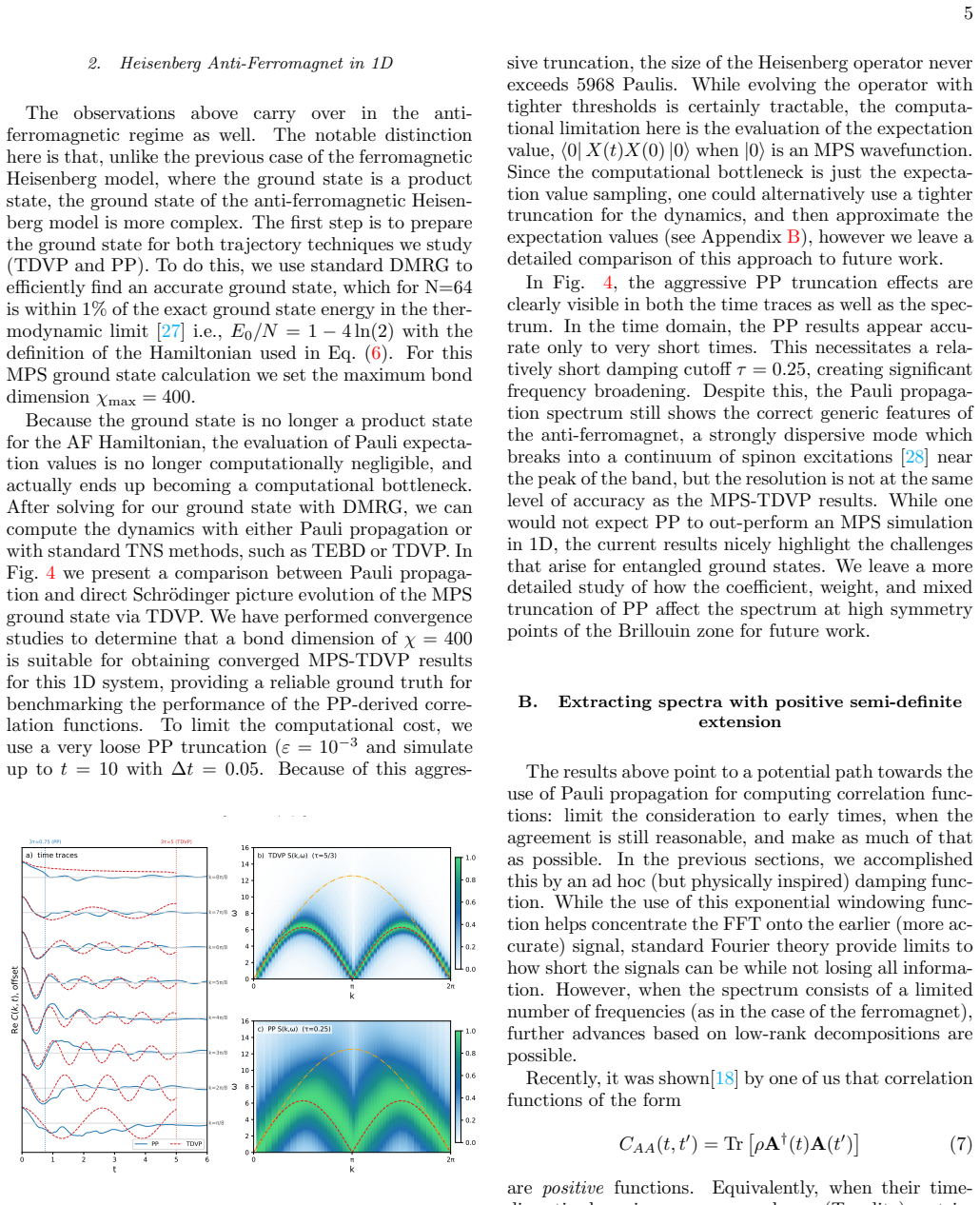
- [§III.A, Fig. 4] The ad hoc damping window e^{-t/τ} is used with very different τ values for methods being compared: Fig. 4 uses τ=0.25 for PP but τ=5/3 for TDVP, so the broader PP linewidths in panel (c) versus (b) reflect the window choice, not the method. The text should state explicitly that only peak positions (not widths) are meaningful in such comparisons, and justify the rule S(r,t) accurate to t≈3τ with a quantitative check (e.g., at N=8, where exact long-time data exist, show the extracted frequency as a function of τ). Relatedly, the Trotter step Δt=0.05 is fixed throughout with no discussion of Trotter error, which enters the short-time data that seed all extensions.
minor comments (8)
- [References] Refs. [3] and [24] are the same paper (Rall et al., PR A 99, 062337); merge.
- [§III] Notation shifts between C_AB(t), C(j,t) (Eq. A1), and S(r,t) without a defining sentence; the transverse specialization A=B=X is mentioned only in passing in §III. A short paragraph fixing conventions would help.
- [Fig. 5 caption] Fig. 5 caption says 'comparing exact (ED)' for the N=64 ferromagnet, but the reference is the analytic 1-magnon result (the FM ground state is a product state); 'ED' is misleading at N=64.
- [Figs. 6, S1] Fig. 6(c) and S1(c): the 'input: 7 points' gray box is easy to miss; consider marking the PP-computed points with distinct markers and stating t_max=0.3 explicitly in the caption. The offset values printed next to traces (e.g., 8.6 at X) are the extracted frequencies — say so.
- [Discussion; §III.C] Typo in Discussion: 'tensor state network methods' should read 'tensor network state methods'. Also 'naïvely' is misspelled as 'na ¨ ıvely' in §III.C (typesetting artifact).
- [App. B] App. B: the extrapolation δ→0 in discarded weight is described, but no fit quality or extrapolated values are shown; since this is the paper's only error-removal procedure, a small table or inset would strengthen it. Also clarify why the final Fig. S1 uses D=800 rather than the δ→0, D-converged value.
- [§III.A.2] §III.A.2: the statement that the N=64 DMRG ground state is 'within 1% of the exact ground state energy' should give the actual numbers; 1% is loose by DMRG standards at χ=400 and the reader may wonder whether the energy accuracy or the state accuracy is meant.
- [App. C] A brief comment on the cost of the CAMPS ground-state optimization relative to the PP evolution would help assess the overall efficiency claim; App. C quantifies PP cost but not the state-preparation cost, which the text acknowledges is the bottleneck.
Circularity Check
No load-bearing circularity: PP+PSD pipeline is methodological reuse with external benchmarks; spin-wave A is a display fit, not an input renamed as prediction.
specific steps
-
self citation load bearing
[§III.B; Ref. [18]]
"Recently, it was shown[18] by one of us that correlation functions of the form CAA(t,t′)=Tr[ρA†(t)A(t′)] are positive functions. ... a rank-r PSD Toeplitz matrix can be uniquely determined from 2r noiseless numbers per the foundational work of Carathéodory[19], Toeplitz[20], and Pisarenko[21]."
The extension engine is justified by a same-author PRL plus classical uniqueness. This is methodological self-citation, not a closed loop: PP supplies the short-time samples independently, and spectra are still checked against ED/TDVP/analytic benchmarks. Score impact is minor (not load-bearing for the dynamical claim).
full rationale
The paper's chain is: truncated short-time Pauli propagation of local operators → evaluation on a prepared ground state (product/DMRG/CAMPS) → optional PSD/Prony extension of the resulting C(k,t) traces → spectra compared to ED, TDVP, analytic 1-magnon, Betts clusters, and linear spin-wave form. The positivity/low-rank extension is taken from prior work by an overlapping author [18] and classical Carathéodory–Toeplitz–Pisarenko uniqueness, but it is used as a signal-processing tool on independently generated PP data; frequencies are read out of those data, not inserted by definition. Overlay fits of the LSWT amplitude A (Fig. 6d, S1) are comparison curves only and do not generate the PP correlators. Independent checks (exact 1D FM, TDVP 1D AFM, Betts ED, large-lattice FM product-state reconstruction) keep the central claim externally falsifiable. Minor self-citation of the PSD method and PauliOperators.jl is normal tool reuse, not a self-definitional or uniqueness-forced loop. Correctness concerns about truncation vs. rank-1 bias are outside circularity.
Axiom & Free-Parameter Ledger
free parameters (7)
- coefficient cutoff ε =
problem-dependent (e.g. 1e-4, 1e-5, 1e-3)
- Pauli weight cutoff w =
problem-dependent (e.g. w=4–20; 2D w=5 or 4)
- ad hoc damping time τ =
e.g. τ=1, 0.25, 2.5, 5/3
- PSD/Prony rank r =
typically r=1 in Figs. 5–6
- Trotter step Δt =
0.05
- MPS/CAMPS bond dimension D (and DMRG χ) =
e.g. χ=400 (1D); D=240 CAMPS; improved D up to 2000 / readout 800
- spin-wave amplitude A in ω=A√(1-γ_k²) =
A≈8.9–10.8 depending on panel
axioms (6)
- standard math Heisenberg-picture evolution A(t)=e^{iHt}A e^{-iHt} expanded in Pauli strings with Trotterized Pauli rotations is a valid representation of the dynamics.
- domain assumption Coefficient and/or weight truncation of the Pauli sum yields controlled early-time approximations sufficient for spectral features of interest.
- standard math Correlators C_AA(t,t')=Tr[ρ A†(t)A(t')] are positive; discretized Toeplitz forms are PSD and, at low rank, uniquely extendable from O(r) samples (Carathéodory–Toeplitz–Pisarenko).
- domain assumption Equilibrium dynamical structure factors of the studied magnets are often dominated by a small number of characteristic frequencies (low effective rank), especially in the FM and 2D AFM magnon regime.
- domain assumption CAMPS/DMRG approximate ground states are accurate enough that ⟨Ψ|P|Ψ⟩ for retained Paulis does not destroy the extracted spectrum.
- ad hoc to paper Optional exponential window e^{-t/τ} only broadens spectra in a controlled Lorentzian way without shifting the features used for claims.
read the original abstract
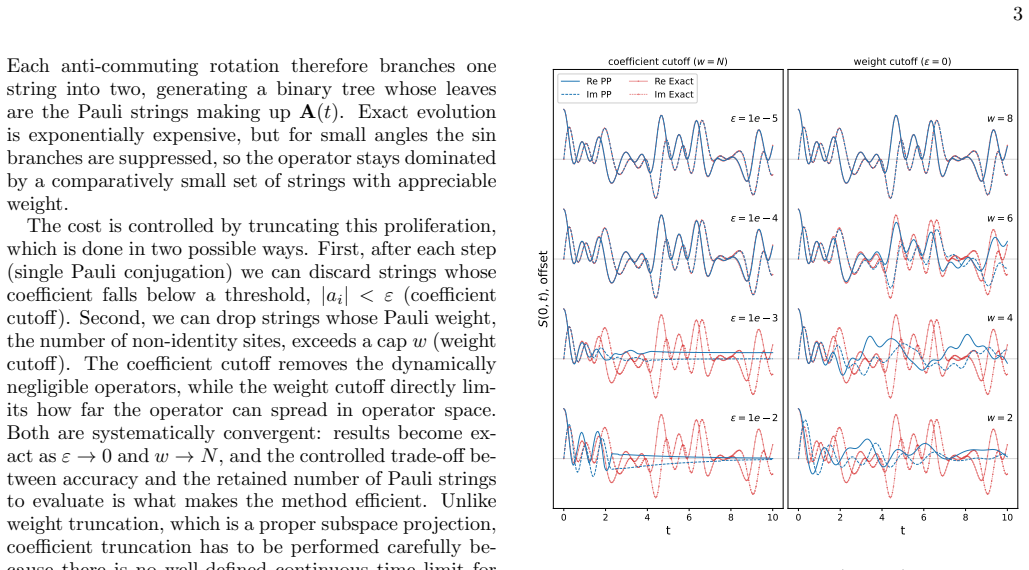
Pauli propagation has shown promise for classically simulating quantum dynamics by evolving observables directly in the Heisenberg picture. In this work, we investigate its use for computing real-time two-point time-ordered correlators in one- and two-dimensional quantum systems. One major limitation of Pauli propagation is the rapid growth in the number of Pauli strings beyond short times. We overcome this limitation by combining accurate short-time Pauli-propagation data with time extension methods based on a positivity condition and the observation that the dynamics are often dominated by a small number of characteristic frequencies. This combined approach extends correlation functions far beyond the directly accessible time window while avoiding the exponential proliferation of Pauli operators. We demonstrate that the resulting correlators retain the relevant dynamical and spectral information. Our results broaden the regime in which classical methods can reliably probe the real-time dynamics of interacting quantum many-body systems.
Figures




Reference graph
Works this paper leans on
-
[1]
Heisenberg Ferromagnet in 1D We apply this idea to the 1D Heisenberg model, now withN= 64 sites, and consider coefficient cutoff, weight cutoff, as well as their combination. At this system size, it rapidly becomes prohibitively expensive to work with- out any cutoff in terms of both the maximal number of Paulis and cumulative time taken for the calculati...
-
[2]
Heisenberg Anti-Ferromagnet in 1D The observations above carry over in the anti- ferromagnetic regime as well. The notable distinction here is that, unlike the previous case of the ferromagnetic Heisenberg model, where the ground state is a product state, the ground state of the anti-ferromagnetic Heisen- berg model is more complex. The first step is to p...
-
[3]
E. H. Lieb and D. W. Robinson, The finite group velocity of quantum spin systems, Communications in Mathemat- ical Physics28, 251–257 (1972)
1972
-
[4]
M. B. Hastings and T. Koma, Spectral gap and exponen- tial decay of correlations, Commun. Math. Phys.265, 781 (2006), arXiv:math-ph/0507008
Pith/arXiv arXiv 2006
-
[5]
P. Rall, D. Liang, J. Cook, and W. Kretschmer, Sim- ulation of qubit quantum circuits via pauli propaga- tion, Physical Review A99, 10.1103/physreva.99.062337 (2019)
-
[6]
Y. Kim, A. Eddins, S. Anand, K. X. Wei, E. van den Berg, S. Rosenblatt, H. Nayfeh, Y. Wu, M. Zaletel, K. Temme, and A. Kandala, Evidence for the utility of quantum computing before fault tolerance, Nature618, 500 (2023)
2023
-
[7]
T. Beguˇ si´ c and G. K.-L. Chan, Fast classical simulation of evidence for the utility of quantum computing before fault tolerance (2023), arXiv:2306.16372 [quant-ph]
Pith/arXiv arXiv 2023
-
[8]
Beguˇ si´ c, J
T. Beguˇ si´ c, J. Gray, and G. K.-L. Chan, Fast and con- verged classical simulations of evidence for the utility of quantum computing before fault tolerance, Science Ad- vances10, eadk4321 (2024)
2024
-
[9]
Tindall, M
J. Tindall, M. Fishman, E. M. Stoudenmire, and D. Sels, Efficient Tensor Network Simulation of IBM’s Eagle Kicked Ising Experiment, PRX Quantum5, 010308 (2024)
2024
-
[10]
Fontana, M
E. Fontana, M. S. Rudolph, R. Duncan, I. Rungger, and C. C ˆ ırstoiu, Classical simulations of noisy varia- tional quantum circuits, npj Quantum Information11, 84 (2025)
2025
-
[11]
Schuster, C
T. Schuster, C. Yin, X. Gao, and N. Y. Yao, A Polynomial-Time Classical Algorithm for Noisy Quan- tum Circuits, Phys. Rev. X15, 041018 (2025)
2025
-
[12]
A. Angrisani, A. Schmidhuber, M. S. Rudolph, M. Cerezo, Z. Holmes, and H.-Y. Huang, Classically esti- mating observables of noiseless quantum circuits (2025), arXiv:2409.01706 [quant-ph]
arXiv 2025
-
[13]
Angrisani, A
A. Angrisani, A. A. Mele, M. S. Rudolph, M. Cerezo, and Z. Holmes, Simulating Quantum Circuits with Arbitrary Local Noise Using Pauli Propagation, PRX Quantum7, 020313 (2026)
2026
-
[14]
T. Beguˇ si´ c and G. Kin-Lic Chan, Real-Time Opera- tor Evolution in Two and Three Dimensions via Sparse Pauli Dynamics, PRX Quantum6, 020302 (2025), arXiv:2409.03097 [quant-ph]
Pith/arXiv arXiv 2025
-
[15]
C. Shrikhande, A. Bachhar, A. R. Jimenez, E. F. Valeev, and N. J. Mayhall, Pauli propagation enables fast clas- sical simulation of strongly correlated quantum systems (2026), arXiv:2511.21651 [quant-ph]
Pith/arXiv arXiv 2026
-
[16]
R. D. Somma, R. King, R. Kothari, T. E. O’Brien, and R. Babbush, Shadow hamiltonian simulation, Nature Communications16, 2690 (2025)
2025
- [17]
-
[18]
A. Chakraborty, B. Sambasivam, K. Shirali, H. Nelson, M. Ramˆ oa, S. E. Economou, and E. Barnes, An efficient algorithm for approximate shadow hamiltonian simula- tion, arXiv preprint arXiv:2607.11882 (2026)
Pith/arXiv arXiv 2026
-
[19]
S.-H. Chiew, A. Angrisani, and Z. Holmes, The com- plexity of dynamical correlators: Operator shadows and exponential learning separations, arXiv preprint arXiv:2607.15493 (2026)
Pith/arXiv arXiv 2026
-
[20]
A. F. Kemper, C. Yang, and E. Gull, Denoising and Extension of Response Functions in the Time Domain, Physical Review Letters132, 160403 (2024)
2024
-
[21]
C. Carath´ eodory, ¨Uber den variabilit¨ atsbereich der fourier’schen konstanten von positiven harmonischen funktionen, Rendiconti Del Circolo Matematico di Palermo (1884-1940)32, 193 (1911)
1940
-
[22]
O. Toeplitz, ¨Uber die fourier’sche entwickelung posi- tiver funktionen: (aus einem an herrn carath´ eodory gerichteten briefe), Rendiconti del Circolo Matematico di Palermo (1884-1940)32, 191 (1911)
1940
-
[23]
V. F. Pisarenko, The retrieval of harmonics from a co- variance function, Geophysical Journal International33, 347 (1973)
1973
-
[24]
M. S. Rudolph, T. Jones, Y. Teng, A. Angrisani, and Z. Holmes, Pauli Propagation: A Computational Framework for Simulating Quantum Systems (2025), arXiv:2505.21606 [quant-ph]
Pith/arXiv arXiv 2025
-
[25]
X. Qian, J. Huang, and M. Qin, Augmenting Density Ma- 9 trix Renormalization Group with Clifford Circuits, Phys. Rev. Lett.133, 190402 (2024)
2024
-
[26]
P. Rall, D. Liang, J. Cook, and W. Kretschmer, Simu- lation of qubit quantum circuits via Pauli propagation, Phys. Rev. A99, 062337 (2019)
2019
-
[27]
W.-R. Lee, R. Scott, and V. Scarola, A compact noise-tolerant algorithm for unbiased quantum simu- lation using feynman’siηprescription, arXiv preprint arXiv:2212.14039 (2022)
Pith/arXiv arXiv 2022
-
[28]
K¨ okc¨ u, H
E. K¨ okc¨ u, H. A. Labib, J. Freericks, and A. F. Kemper, A linear response framework for quantum simulation of bosonic and fermionic correlation functions, Nature Com- munications15, 3881 (2024)
2024
-
[29]
Hulth´ en,¨Uber das austauschproblem eines kristalles, Arkiv f¨ or Matematik, Astronomi och Fysik26A, 1 (1938)
L. Hulth´ en,¨Uber das austauschproblem eines kristalles, Arkiv f¨ or Matematik, Astronomi och Fysik26A, 1 (1938)
1938
-
[30]
T. Kulka, M. Panfil, M. Berciu, and K. Wohlfeld, Nature of spinons in 1d spin chains, Physical Review Letters134, 10.1103/stvg-lg9h (2025)
-
[31]
Yang and L
Z. Yang and L. Xie, Frequency-selective vandermonde de- composition of toeplitz matrices with applications, Signal Processing142, 157 (2018)
2018
-
[32]
H. J. Schulz and T. A. L. Ziman, Finite-size scaling for the two-dimensional frustrated quantum heisenberg an- tiferromagnet, Europhysics Letters (EPL)18, 355–360 (1992)
1992
-
[33]
J. Yuet al., Quantum-centric algorithm for sample-based krylov diagonalization (2025), arXiv:2501.09702 [quant- ph]
arXiv 2025
-
[34]
K¨ okc¨ u, R
E. K¨ okc¨ u, R. Wiersema, A. F. Kemper, and B. N. Bakalov, Classification of dynamical Lie algebras gener- ated by spin interactions on undirected graphs, arXiv preprint (2024)
2024
-
[35]
Wiersema, E
R. Wiersema, E. K¨ okc¨ u, A. F. Kemper, and B. N. Bakalov, Classification of dynamical Lie algebras of 2- local spin systems on linear, circular and fully connected topologies, npj Quantum Information10, 110 (2024)
2024
-
[36]
Haegeman, J
J. Haegeman, J. I. Cirac, T. J. Osborne, I. Pizorn, H. Ver- schelde, and F. Verstraete, Time-Dependent Variational Principle for Quantum Lattices, Phys. Rev. Lett.107, 070601 (2011)
2011
-
[37]
A. F. Mello, A. Santini, G. Lami, J. De Nardis, and M. Collura, Clifford Dressed Time-Dependent Varia- tional Principle, Phys. Rev. Lett.134, 150403 (2025)
2025
-
[38]
X. Qian, J. Huang, and M. Qin, Clifford Circuits Aug- mented Time-Dependent Variational Principle, Phys. Rev. Lett.134, 150404 (2025)
2025
-
[39]
X. Qian, J. Huang, and M. Qin, Augmenting a finite- temperature tensor network with Clifford circuits, Phys. Rev. B112, 115150 (2025)
2025
-
[40]
Huang, X
J. Huang, X. Qian, and M. Qin, Clifford circuits aug- mented matrix product states for fermion systems, Phys- ical Review B112, 205106 (2025)
2025
-
[41]
X. Li, X. Qian, and M. Qin, Disentangling kitaev quan- tum spin liquid, arXiv preprint arXiv:2511.20261 (2025)
arXiv 2025
-
[42]
N. J. Mayhall, PauliOperators.jl (2023)
2023
-
[43]
M. Fishman, S. R. White, and E. M. Stoudenmire, The ITensor Software Library for Tensor Network Calcula- tions, https://arxiv.org/abs/2007.14822v2 (2020)
Pith/arXiv arXiv 2007
-
[44]
D. D. Betts, H. Q. Lin, and J. S. Flynn, Improved finite- lattice estimates of the properties of two quantum spin models on the infinite square lattice, Canadian Journal of Physics77, 353 (1999)
1999
-
[45]
P. W. Anderson, An approximate quantum theory of the antiferromagnetic ground state, Phys. Rev.86, 694 (1952)
1952
-
[46]
D. A. Huse, Ground-state staggered magnetization of two-dimensional quantum heisenberg antiferromagnets, Phys. Rev. B37, 2380 (1988)
1988
-
[47]
A. W. Sandvik, Finite-size scaling of the ground-state pa- rameters of the two-dimensional heisenberg model, Phys. Rev. B56, 11678 (1997). Appendix A: Pauli Propagation with Clifford augmented matrix product states (CAMPS) We need a robust and cost-effective method of comput- ing the ground states of both 1D and 2D AFM Heisenberg model to compute the dyna...
1997
discussion (0)
Sign in with ORCID, Apple, or X to comment. Anyone can read and Pith papers without signing in.