REVIEW 3 major objections 3 minor 3 cited by
Molecular tweezer arrays can be loaded to near-unity occupancy by shelving molecules in repulsive excited states and using microwave-assisted collisions to eject one partner at a time.
Reviewed by Pith at T0; open to challenge. T0 means a machine referee read the full paper against a public rubric. the ladder, T0–T4 →
T0 review · deepseek-v4-flash
2026-08-03 01:41 UTC pith:XSJ67JYL
load-bearing objection A smart, internally consistent theoretical proposal for deterministic molecular tweezer loading; the 96% ro-vibrational number is an upper bound set by unmeasured in-house inputs, not a settled prediction. the 3 major comments →
Deterministic loading of molecular arrays by microwave-assisted collisions
The pith
A machine-rendered reading of the paper's core claim, the machinery that carries it, and where it could break.
Core claim
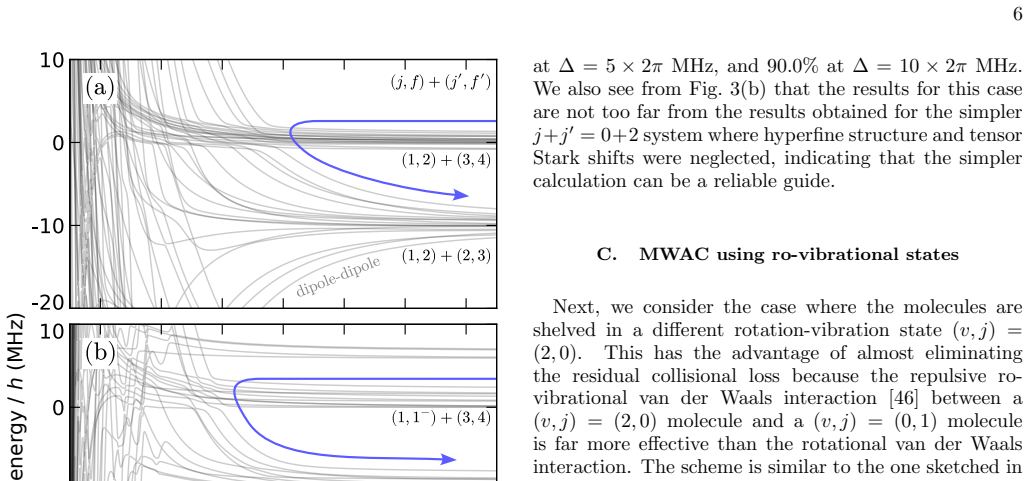
The paper's central discovery is that the collisional loss preventing atomic-style enhanced loading of molecules can be suppressed by shelving one molecule in a rotationally or ro-vibrationally excited state, so that it repels a freshly loaded molecule through a repulsive van der Waals interaction and never reaches short range. A microwave field then creates a dressed-state avoided crossing; crossing it once adiabatically and once diabatically transfers the pair to a lower-energy channel with kinetic energy exactly equal to the microwave detuning. Because the energy release is sharply defined, a single such microwave-assisted collision can eject one molecule and leave the other trapped, usin
What carries the argument
Microwave-assisted collision (MW AC): a microwave field with Rabi frequency Ω and red detuning Δ couples a repulsive van der Waals pair state (e.g., j+j′=1+3, or (v,j)+(v′,j′)=(2,0)+(0,1)) to a resonantly dipolar channel. The avoided crossing at the Condon point is traversed once adiabatically and once diabatically, releasing kinetic energy ℏΔ; the efficiency P_MWAC is the branching ratio of this desired inelastic rate to all loss rates, computed with coupled-channels scattering. The second load-bearing element is the repulsive van der Waals interaction itself, whose strength is set by the tiny energy gap to a lower-lying pair state—especially the ro-vibrational gap between (2,0)+(0,1) and (
Load-bearing premise
The 96% filling prediction depends on the assumption that a molecule shelved in the second vibrationally excited state repels a freshly loaded molecule strongly enough that the pair essentially never collides at short range, and that this shelved state survives for its full 120-millisecond radiative lifetime; if the true loss rate is higher or the lifetime is shortened by blackbody radiation or trap-induced effects, the filling fraction falls toward the 60–87% range of the ro
What would settle it
In a single optical tweezer containing CaF molecules, prepare one molecule in (v=2,j=0), load a second in (v=0,j=1), and measure the two-body loss rate at 5 µK; if the rate coefficient exceeds about 10^-14 cm3/s, the predicted 96% filling fraction is not achievable. Alternatively, cycle the full load–MWAC–eject–shelve sequence and record the distribution of zero, one, and two molecules after many cycles; a plateau below 1/(2−P) would indicate that one of the efficiencies P_MWAC, P_eject, P_bg, or P_spont is overestimated.
If this is right
- Molecular tweezer arrays could reach about 96% single-site occupancy, comparable to the best atomic enhanced-loading demonstrations and well above the current stochastic 30–40% for molecules.
- Because the microwave-assisted collision releases the full detuning as kinetic energy in one step, a single collision can eject one molecule; the scheme does not depend on repeated collisions the way atomic light-assisted loading does.
- In the ro-vibrational scheme the bottleneck moves from collisions to the 120 ms lifetime of the v=2 shelving state, so deeper tweezers and larger detunings than the 5 MHz / 5 µK baseline should remain workable.
- The continuous-mode version of the rotational scheme reaches 87% filling at 20 molecules/s loading without waiting for sequential cycles, and its performance improves at lower loading rates.
- All required operations—laser cooling, gray molasses, optical pumping, microwave dressing, and state transfer—are already demonstrated for laser-coolable molecules such as CaF, so the scheme is realistic with current tools.
Where Pith is reading between the lines
- Editorial inference: if the ro-vibrational repulsion is as strong as computed, the protected pair configuration could double as a low-loss storage state during array rearrangement, removing the need for a separate idle state.
- Editorial inference: the anti-magic tweezer suggestion implies a general design rule—choose a wavelength that maximizes the differential tensor Stark shift between collision partners—so thermal ejection remains deterministic at temperatures where equal-depth traps would fail; this could be tested in a single tweezer.
- Editorial inference: the microwave-assisted collision is an energy-release actuator, not just a loading tool; the same dressed-state crossing could eject a targeted rotational state or perform controlled two-molecule state transfers in quantum simulation experiments.
- Editorial inference: the paper's recursion assumes Poissonian loading and a fixed cycle; a feedback-optimized variant that adapts the loading rate after each shelving outcome could push the equilibrium above 96% in the ro-vibrational scheme.
Editorial analysis
A structured set of objections, weighed in public.
Referee Report
Summary. The manuscript proposes a deterministic loading protocol for molecular tweezer arrays. A laser-cooled molecule in j=1 is co-trapped with a shelved molecule in a higher rotational or ro-vibrational state whose long-range interaction is repulsive. A microwave field dresses the pair and induces an inelastic transition with controlled energy release; after this microwave-assisted collision (MWAC), a single molecule is ejected by thermal asymmetry, push beam, trap lowering, or tensor-Stark shifts. Iterating the load–MWAC–eject–shelve sequence yields a recurrence for the filling fraction, with asymptotic limit 1/(2−P). For CaF, coupled-channels calculations give P_MWAC up to ~99% for ro-vibrational shelving and predicted filling fractions up to 96% (ro-vibrational) or 87% (rotational with active ejection).
Significance. If correct, the scheme would be a practical route to near-unity molecular tweezer filling using demonstrated laser cooling, optical pumping, and microwave control, bringing molecular arrays to the level of atomic enhanced loading. The paper’s strengths are its explicit state assignments for CaF, coupled-channels rate coefficients that include hyperfine and tensor-Stark structure, closed-form recurrences for the filling fraction, and several independent ejection strategies. The results are internally consistent among the rate coefficients, the ejection Monte Carlo, and the recurrence. The main quantitative claim, however, is gated by theoretical inputs from companion work (loss rates) and an assumed v=2 lifetime, so the robustness of the 96% figure needs to be demonstrated before the paper can be taken as a firm prediction.
major comments (3)
- [Sec. VII, Eq. (5)] The asymptotic filling φ∞=1/(2−P) is essentially P for P near 1, so the headline 96% is gated by two unmeasured theoretical inputs. P_bg≈1 rests on ro-vibrational loss coefficients from the companion model (Fig. 5(b), Table I), with largest computed entries ~4×10^-15 cm^3/s; no experimental bound on non-adiabatic or hyperfine-changing loss channels is available. P_spont=exp(−5 ms/120 ms) rests on a zero-temperature v=2 radiative lifetime; blackbody and trap-induced vibrational transfer are not discussed. Please add a sensitivity analysis. For instance, τ_v=2=20 ms would give P_spont=0.78 and φ∞≈82% (for P_MWAC=P_eject≈1); a true loss coefficient of 10^-12 cm^3/s would reduce P_bg to ~0.94 and φ∞ to ~90%, and 10^-11 cm^3/s would bring the scheme near the rotational-scheme performance. The plausibility of such channels should be assessed.
- [Sec. VII / Table I] The sequential-rotational P_bg is not reproduced from the stated inputs. With n=2.4×10^13 cm^-3, t_cycle=5 ms, and k=1×10^-11 cm^3/s (the tabulated leading coefficient for (1,2)+(3,4)), τ_bg=(kn)^-1=4.2 ms and the formula P_bg=(τ/t)[1−exp(−t/τ)] gives 58%, not the quoted 37% (which corresponds to τ≈2 ms). This changes the sequential rotational limit from 60% to about 68% if the other factors are fixed. Please clarify whether an averaged hyperfine loss coefficient of ~2×10^-11 cm^3/s was used and how “density” is defined (peak vs overlap). This matters because Table I and Eq. (5) are the quantitative backbone of the rotational scheme.
- [Sec. V.A / Fig. 8] The ejection Monte Carlo makes two uncontrolled approximations. (i) The post-collision momentum direction is drawn uniformly, equivalent to an isotropic differential cross section, although the MWAC release ℏΔ∼h×10 MHz takes the pair beyond the s-wave regime and the dressed dipolar interaction is generally anisotropic. (ii) The post-MWAC m_f distribution is approximated as uniform for thermal ejection, despite Fig. 7 showing channel probabilities between 0 and 20%. Since P_eject enters the recurrence linearly, these assumptions directly affect the rotational-scheme filling fractions in Fig. 10. Please validate the MC sampling against coupled-channels angular distributions, or at least show that the shaded range in Fig. 8 covers the resulting uncertainty.
minor comments (3)
- [Fig. 10 caption] “equilibrium value of of 1/(2−P)” contains a duplicated “of”.
- [Sec. VII and elsewhere] Densities are written as “2.4×10^13 cm3”; the exponent should be cm^-3.
- [Sec. V.A] The notation “E/k_B = 5 µK” is confusing; the temperature should be denoted T to avoid conflict with the trap depth and energy release.
Circularity Check
No circular reduction: the filling fraction is a closed-form recurrence over independently calculated rate coefficients and lifetimes, not a fit or a self-referential input.
full rationale
The central result φ∞ = 1/(2−P) comes from solving the recurrence in Eq. (4) algebraically (Eq. (5)). The only input is P = P_MWAC P_eject P_bg P_spont (Sec. VII). P_MWAC is a branching ratio of coupled-channels rates (Eq. 1); P_eject is obtained from Monte Carlo dynamics of the trap (Sec. V); P_bg is computed from loss-rate coefficients via the stated survival-time formula; P_spont uses the v=2 radiative lifetime. None of these factors is fitted to the final filling fraction, and the recurrence does not feed back into any of them. The paper does lean on same-group prior work for the repulsive van der Waals framework (Refs. 45, 56) and for the ro-vibrational interaction model (Ref. 46), with the ro-vibrational rates delegated to that companion paper; this is a self-citation dependency and an omitted detail, but not a circular one—the cited model's assumptions do not include the loading result, and the rates are in-principle falsifiable. The 96% estimate is conditional on the unmeasured ro-vibrational loss rates and the assumed 120 ms lifetime; that is a verification/robustness concern, not a by-construction equivalence. No step in the derivation reduces to its own input.
Axiom & Free-Parameter Ledger
free parameters (9)
- Loading rate λ =
20 molecules/s
- Cycle time t_cycle =
5 ms
- Microwave detuning Δ =
10×2π MHz
- Rabi frequency Ω =
1×2π MHz
- Tweezer depth V0 =
5 MHz
- Temperature T =
5 μK
- v=2 lifetime τ =
120 ms
- Hyperfine state selection =
(1,2,±1), (3,4,4), (2,0,1), (0,2,2-)
- Trap frequencies =
ωx=ωy=50×2π kHz, ωz=5×2π kHz
axioms (6)
- domain assumption Coupled-channels scattering theory with renormalized Numerov and absorbing boundary conditions correctly models ultracold molecular collisions.
- domain assumption Short-range encounters between ground-state molecules lead to universal loss.
- standard math Second-order dipole-dipole perturbation theory gives the repulsive van der Waals interactions, with a single dominant pair state.
- domain assumption The ro-vibrational van der Waals interaction and loss rates of the companion paper (Ref [46]) are correct.
- domain assumption The MW AC energy release equals the detuning ℏΔ.
- ad hoc to paper In the ejection Monte Carlo, the collision is isotropic and the post-MW AC m_f distribution is uniform.
read the original abstract
Molecular tweezer arrays offer great prospects for quantum simulation, sensing, and computing, and would benefit from methods that enhance loading efficiency. Whereas light-assisted collisions underpin enhanced loading methods for atomic tweezer arrays, this approach cannot be directly extended to molecular arrays due to collisional loss. We show how this collisional loss can be suppressed by shelving molecules in rotationally or vibrationally excited states, so that a shelved molecule interacts with a newly loaded molecule through a repulsive van der Waals interaction. By introducing microwave assisted collisions, we show how to control the final states and the energy released in a collision between a pair of molecules. Following this controlled collision, one of the two molecules can be ejected, and we explore several strategies for ensuring deterministic ejection. Our schemes rely on currently available techniques for laser-coolable molecules, and we predict achievable filling fractions up to 96%, paving the way for scalable molecular arrays.
Figures




Forward citations
Cited by 3 Pith papers
-
Ro-vibrational van der Waals interaction between ultracold polar molecules
Molecules in (v,j)=(0,1) and (1,0) feel a strong ro-vibrational van der Waals repulsion, C6=d_e^4/(9α_e), that can cut collisional loss by orders of magnitude.
-
Ro-vibrational van der Waals interaction between ultracold polar molecules
Molecules in a (v=0,j=1)+(v=1,j=0) pair feel a giant, repulsive van der Waals interaction that strongly suppresses collisional loss.
-
Tunable two-component ultracold molecular gases with vibrational shielding
Vibrational-state-dependent repulsive shielding can stabilize and independently tune two-component ultracold molecular mixtures.
Reference graph
Works this paper leans on
-
[1]
After a rotational MW AC, we havej+j ′ = 1 + 2 and the collisional loss rate coefficient will be high due to resonant dipolar interactions
Push-beam ejection in the purely rotational scheme Consider the case where the detuning is less than twice the trap depth so that both molecules remain trapped, albeit at a higher energy. After a rotational MW AC, we havej+j ′ = 1 + 2 and the collisional loss rate coefficient will be high due to resonant dipolar interactions. How- ever, the energy release...
-
[2]
Instead of re-cooling thej= 1 11 molecule, we eject it using a push beam resonant with the optical cycling transitionB 2Σ+(j= 0)←X 2Σ+(j= 1)
Push-beam ejection in the ro-vibrational scheme In the ro-vibrational scheme, shelved molecules are in (v, j) = (2,0), while after the MW AC a pair of molecules is in (2,0) + (0,1). Instead of re-cooling thej= 1 11 molecule, we eject it using a push beam resonant with the optical cycling transitionB 2Σ+(j= 0)←X 2Σ+(j= 1). Note that the pair (v, j) + (v ′,...
-
[3]
de-shelved
Trap-lowering ejection in the ro-vibrational scheme Consider the case where the detuning is less than twice the trap depth so that after a MW AC both molecules re- main trapped. In either scheme, one of the molecules is inj= 1 and can be re-cooled on a 1 ms timescale. After this, the tweezer trap depth can be temporarily lowered, resulting in the ejection...
-
[4]
A. M. Kaufman and K.-K. Ni, Nature Phys.17, 1324 (2021)
2021
-
[5]
A. D. Ludlow, M. M. Boyd, J. Ye, E. Peik, and P. O. Schmidt, Rev. Mod. Phys.87, 637 (2015)
2015
-
[6]
Ebadi, T
S. Ebadi, T. T. Wang, H. Levine, A. Keesling, G. Se- meghini, A. Omran, D. Bluvstein, R. Samajdar, H. Pich- ler, W. W. Ho,et al., Nature595, 227 (2021)
2021
-
[7]
A. J. Daley, I. Bloch, C. Kokail, S. Flannigan, N. Pearson, M. Troyer, and P. Zoller, Nature607, 667 (2022)
2022
-
[8]
Gyger, M
F. Gyger, M. Ammenwerth, R. Tao, H. Timme, S. Sni- girev, I. Bloch, and J. Zeiher, Phys. Rev. Res.6, 033104 (2024)
2024
-
[9]
Norcia, H
M. Norcia, H. Kim, W. Cairncross, M. Stone, A. Ryou, M. Jaffe, M. Brown, K. Barnes, P. Battaglino, T. Bo- hdanowicz,et al., PRX Quantum5, 030316 (2024)
2024
-
[10]
Pichard, D
G. Pichard, D. Lim, ´E. Bloch, J. Vaneecloo, L. Boura- chot, G.-J. Both, G. M´ eriaux, S. Dutartre, R. Hostein, J. Paris,et al., Phys. Rev. Appl.22, 024073 (2024)
2024
-
[11]
Lin, H.-S
R. Lin, H.-S. Zhong, Y. Li, Z.-R. Zhao, L.-T. Zheng, T.- R. Hu, H.-M. Wu, Z. Wu, W.-J. Ma, Y. Gao,et al., Phys. Rev. Lett.135, 060602 (2025)
2025
-
[12]
N.-C. Chiu, E. C. Trapp, J. Guo, M. H. Abobeih, L. M. Stewart, S. Hollerith, P. L. Stroganov, M. Kalinowski, A. A. Geim, S. J. Evered,et al., Nature , 1 (2025)
2025
-
[13]
H. J. Manetsch, G. Nomura, E. Bataille, X. Lv, K. H. Leung, and M. Endres, Nature , 1 (2025)
2025
-
[14]
Anderegg, L
L. Anderegg, L. W. Cheuk, Y. Bao, S. Burchesky, W. Ketterle, K.-K. Ni, and J. M. Doyle, Science365, 1156 (2019)
2019
-
[15]
C. M. Holland, Y. Lu, and L. W. Cheuk, Science382, 1143 (2023)
2023
-
[16]
Y. Bao, S. S. Yu, L. Anderegg, E. Chae, W. Ketterle, K.-K. Ni, and J. M. Doyle, Science382, 1138 (2023)
2023
-
[17]
N. B. Vilas, P. Robichaud, C. Hallas, G. K. Li, L. An- deregg, and J. M. Doyle, Nature628, 282 (2024)
2024
-
[18]
Schlosser, G
N. Schlosser, G. Reymond, I. Protsenko, and P. Grangier, Nature411, 1024 (2001)
2001
-
[19]
Schlosser, G
N. Schlosser, G. Reymond, and P. Grangier, Phys. Rev. Lett.89, 023005 (2002)
2002
-
[20]
A. L. Shaw, P. Scholl, R. Finklestein, I. S. Madjarov, B. Grinkemeyer, and M. Endres, Phys. Rev. Lett.130, 193402 (2023)
2023
-
[21]
A. C. Baldock, A. J. Matthies, L. Caldwell, and H. J. Williams, Near-deterministic loading of optical tweezer arrays via repulsive barricade potentials (2026), arXiv:2604.22406 [physics.atom-ph]
Pith/arXiv arXiv 2026
-
[22]
Pause, T
L. Pause, T. Preuschoff, D. Sch¨ affner, M. Schlosser, and G. Birkl, Phys. Rev. Res.5, L032009 (2023)
2023
-
[23]
Gr¨ unzweig, A
T. Gr¨ unzweig, A. Hilliard, M. McGovern, and M. Ander- sen, Nature Phys.6, 951 (2010)
2010
-
[24]
Fuhrmanek, R
A. Fuhrmanek, R. Bourgain, Y. R. Sortais, and A. Browaeys, Phys. Rev. A85, 062708 (2012)
2012
-
[25]
Sompet, A
P. Sompet, A. V. Carpentier, Y. H. Fung, M. McGovern, and M. F. Andersen, Phys. Rev. A88, 051401 (2013)
2013
-
[26]
Fung and M
Y. Fung and M. Andersen, New J. Phys.17, 073011 (2015)
2015
-
[27]
B. J. Lester, N. Luick, A. M. Kaufman, C. M. Reynolds, and C. A. Regal, Phys. Rev. Lett.115, 073003 (2015)
2015
-
[28]
Brown, T
M. Brown, T. Thiele, C. Kiehl, T.-W. Hsu, and C. Regal, Phys. Rev. X9, 011057 (2019)
2019
-
[29]
M. M. Aliyu, L. Zhao, X. Q. Quek, K. C. Yellapragada, and H. Loh, Phys. Rev. Res.3, 043059 (2021)
2021
-
[30]
Ang’Ong’A, C
J. Ang’Ong’A, C. Huang, J. P. Covey, and B. Gadway, Phys. Rev. Res.4, 013240 (2022)
2022
-
[31]
Jenkins, J
A. Jenkins, J. W. Lis, A. Senoo, W. F. McGrew, and A. M. Kaufman, Phys. Rev. X12, 021027 (2022)
2022
-
[32]
S. K. Pampel, M. Marinelli, M. O. Brown, J. P. D’Incao, and C. A. Regal, Phys. Rev. Lett.134, 013202 (2025)
2025
-
[33]
Muzi Falconi, R
A. Muzi Falconi, R. Panza, S. Sbernardori, R. Forti, R. Klemt, O. Abdel Karim, M. Marinelli, and F. Scazza, Phys. Rev. Lett.135, 203402 (2025)
2025
-
[34]
P. D. Gregory, L. M. Fernley, A. L. Tao, S. L. Bromley, J. Stepp, Z. Zhang, S. Kotochigova, K. R. Hazzard, and S. L. Cornish, Nat. Phys.20, 415 (2024)
2024
-
[35]
D. K. Ruttley, T. R. Hepworth, A. Guttridge, and S. L. Cornish, Nature637, 827 (2025)
2025
-
[36]
L. R. Picard, A. J. Park, G. E. Patenotte, S. Gebretsad- kan, D. Wellnitz, A. M. Rey, and K.-K. Ni, Nature637, 821 (2025)
2025
-
[37]
E. F. Walraven, M. R. Tarbutt, and T. Karman, Phys. Rev. Lett.132, 183401 (2024)
2024
-
[38]
S. Bali, D. Hoffmann, and T. Walker, Europhys. Lett. 27, 273 (1994)
1994
-
[39]
Takekoshi, L
T. Takekoshi, L. Reichs¨ ollner, A. Schindewolf, J. M. Hut- son, C. R. Le Sueur, O. Dulieu, F. Ferlaino, R. Grimm, and H. C. N¨ agerl, Phys. Rev. Lett.113, 205301 (2014)
2014
-
[40]
K. K. Voges, P. Gersema, M. M. zum Alten Borgloh, T. A. Schulze, T. Hartmann, A. Zenesini, and S. Os- pelkaus, Phys. Rev. Lett.125, 083401 (2020)
2020
-
[41]
M. Guo, X. Ye, J. He, M. L. Gonz´ alez-Mart ´ ınez, R. Vex- iau, G. Qu´ em´ ener, and D. Wang, Phys. Rev. X8, 041044 (2018)
2018
-
[42]
X. Ye, M. Guo, M. L. Gonz´ alez-Mart ´ ınez, G. Qu´ em´ ener, and D. Wang, Sci. Adv.4, eaaq0083 (2018)
2018
-
[43]
P. D. Gregory, M. D. Frye, J. A. Blackmore, E. M. Bridge, R. Sawant, J. M. Hutson, and S. L. Cornish, Nat. Com- mun.10, 3104 (2019)
2019
-
[44]
L. W. Cheuk, L. Anderegg, Y. Bao, S. Burchesky, S. Y. Scarlett, W. Ketterle, K.-K. Ni, and J. M. Doyle, Phys. Rev. Lett.125, 043401 (2020)
2020
-
[45]
Karman and J
T. Karman and J. M. Hutson, Phys. Rev. Lett.121, 163401 (2018)
2018
-
[46]
Lassabli` ere and G
L. Lassabli` ere and G. Qu´ em´ ener, Phys. Rev. Lett.121, 16 163402 (2018)
2018
-
[47]
Anderegg, S
L. Anderegg, S. Burchesky, Y. Bao, S. S. Yu, T. Karman, E. Chae, K.-K. Ni, W. Ketterle, and J. M. Doyle, Science 373, 779 (2021)
2021
-
[48]
E. F. Walraven and T. Karman, Phys. Rev. A109, 043310 (2024)
2024
-
[49]
K. Feng, H. Yang, H. J. J´ o´ zwiak, and T. Karman, Ro-vibrational van der waals interaction between ul- tracold polar molecules (2026), arXiv:2607.25774 [cond- mat.quant-gas]
Pith/arXiv arXiv 2026
-
[50]
Y. Lu, S. J. Li, C. M. Holland, and L. W. Cheuk, Nat. Phys.20, 389 (2024)
2024
-
[51]
C. M. Holland, Y. Lu, S. J. Li, C. L. Welsh, and L. W. Cheuk, Phys. Rev. X15, 031018 (2025)
2025
-
[52]
Y. Lu, C. M. Holland, C. L. Welsh, X.-Y. Chen, and L. W. Cheuk, Probing coherent many-body spin dy- namics in a molecular tweezer array quantum simulator (2026), arXiv:2603.19090 [cond-mat.quant-gas]
arXiv 2026
-
[53]
C. M. Holland, C. L. Welsh, Y. Lu, D. Wellnitz, X.- Y. Chen, A. M. Rey, and L. W. Cheuk, Creating and probing spin-squeezed states of molecules (2026), arXiv:2606.02500 [physics.atom-ph]
Pith/arXiv arXiv 2026
-
[54]
N. J. Fitch and M. R. Tarbutt, inAdv. At. Mol. Opt. Phys., Vol. 70 (Elsevier, 2021) pp. 157–262
2021
-
[55]
Caldwell, J
L. Caldwell, J. Devlin, H. Williams, N. Fitch, E. Hinds, B. Sauer, and M. Tarbutt, Phys. Rev. Lett.123, 033202 (2019)
2019
-
[56]
J. J. Burau, K. Mehling, M. D. Frye, M. Chen, P. Aggar- wal, J. M. Hutson, and J. Ye, Phys. Rev. A110, L041306 (2024)
2024
-
[57]
B. R. Johnson, J. Chem. Phys.69, 4678 (1978)
1978
-
[58]
L. M. Janssen, A. van der Avoird, and G. C. Groenen- boom, Phys. Rev. Lett.110, 063201 (2013)
2013
-
[59]
E. F. Walraven and T. Karman, Phys. Rev. A112, 032810 (2025)
2025
-
[60]
M. A. Anderson, M. D. Allen, and L. M. Ziurys, Astro- phys. J.424, 503 (1994)
1994
-
[61]
Q. Guan, S. L. Cornish, and S. Kotochigova, Phys. Rev. A103, 043311 (2021)
2021
discussion (0)
Sign in with ORCID, Apple, or X to comment. Anyone can read and Pith papers without signing in.