REVIEW 3 major objections 5 minor 38 references
Perspective-view self-play can train a camera-based driving policy directly, without privileged observations, and transfers zero-shot to new layouts better than its vectorized counterpart.
Reviewed by Pith at T0; open to challenge. T0 means a machine referee read the full paper against a public rubric. the ladder, T0–T4 →
T0 review · deepseek-v4-flash
2026-08-01 00:53 UTC pith:TJIK2KKU
load-bearing objection A genuinely new simulator-plus-training result that makes image-based self-play practical at scale, but the claim that the privileged/distillation stage is unnecessary is not actually tested against a distilled camera-student baseline. the 3 major comments →
Pictura: Perspective-View Self-Play at Scale for Driving
The pith
A machine-rendered reading of the paper's core claim, the machinery that carries it, and where it could break.
Core claim
The discovery is that self-play at 50 billion agent steps can run directly on perspective images, with no privileged observations and no distillation stage. The resulting policy, Alberti, learns to drive from what its cameras see, develops occlusion-aware caution on its own, and transfers zero-shot to layouts derived from real-world driving logs more safely than privileged vectorized agents. The paper explicitly frames alignment with real camera imagery as a separate future step; its zero-shot evidence comes from re-rendering logged layouts through the same rasterizer.
What carries the argument
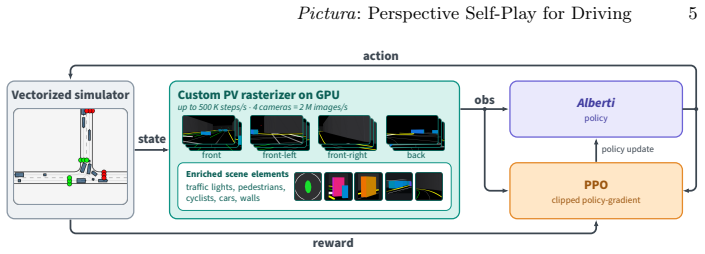
The load-bearing mechanism is Pictura's GPU rasterizer, which renders each agent's four-camera egocentric view as flat-shaded geometric primitives on the compute cores inside the training loop, sustaining about 500K agent-steps per second (2M images/s). This makes the perspective view cheap enough to be the RL observation itself, so perception and control are learned jointly under the constraint that the policy can only act on what a camera could see. The policy pools rendered views with per-camera cross-attention queries before a shared actor-critic trunk trained with standard reinforcement learning.
Load-bearing premise
The claim rests on the premise that a flat-shaded rasterized projection of simulator state is equivalent, for learning and transfer, to what a real camera image would show; if that visual grounding does not carry over to real frames, the deployment value is unproven.
What would settle it
Freeze Alberti and run it on real camera frames, or photorealistic renders, of the same road layouts without fine-tuning or domain adaptation. If collision and goal-completion metrics collapse relative to the re-rendered-layout evaluation while a same-architecture policy trained on those real frames succeeds, the central claim that perspective-view self-play closes the representation gap is falsified.
If this is right
- Privileged observations and student distillation are not required for self-play driving; a camera-input policy can be trained directly at scale.
- A policy trained only on rendered perspective views slows at occluded corners and where its sight ends, re-accelerating when the road is clear — behavior that emerges without explicit occlusion reward shaping.
- Zero-shot transfer to real-world logged layouts improves as the rasterizer maps different map sources into a common visual vocabulary, whereas vectorized observations expose metric distributions that shift between map sources.
- Render resolution buys goal completion and distance per infraction at the cost of throughput; a resolution curriculum late in training should capture most of the gain cheaply.
- Because rendering occupies only about 10% of training time on the compute-core rasterizer, further scaling of image-based self-play is not bottlenecked by rendering.
Where Pith is reading between the lines
- Editorial inference: the red-light violation gap suggests traffic-light resolution is the next bottleneck; a higher-resolution crop around signals or a dedicated signal detector could close it without full-image cost.
- Editorial inference: the zero-shot result is about the rasterizer harmonizing map sources, not about real camera images; whether the learned grounding survives the jump to real frames remains the decisive test.
- Editorial inference: the counterfactual deletion probes imply a natural evaluation protocol — measuring whether a policy's value and braking responses vanish for fully occluded agents — that could be adopted by other sim-to-real pipelines.
- Editorial inference: because the policy is trained from scratch on cheap renders, the same pipeline could be pointed at other sensor views, such as a single wide camera or fisheye, to test how much of the benefit comes from field-of-view coverage versus perspective projection itself.
Editorial analysis
A structured set of objections, weighed in public.
Referee Report
Summary. The paper presents Pictura, a GPU-accelerated multi-agent driving simulator with a custom CUDA rasterizer that renders each agent's egocentric perspective view at every simulation step at high throughput (500K agent-steps/s, 2M images/s on one H100). Using Pictura, the authors train Alberti, a from-scratch PPO policy that observes four rendered camera views and no privileged vectorized state, over 50B agent steps. They compare against privileged vectorized baselines in-domain on CARLA maps and zero-shot on WOMD layouts re-rendered through Pictura. Alberti approaches the vectorized baselines on off-road and goal metrics in-domain, but has higher collision and red-light violation rates; on zero-shot WOMD it outperforms both vectorized baselines. The paper also analyzes visual grounding via counterfactual probes and closed-loop blind-corner takeovers, and provides detailed renderer efficiency, memory, and wall-clock ablations.
Significance. If the central claim holds, the paper could remove a common design requirement—privileged vectorized self-play followed by distillation—from large-scale driving RL. The engineering contributions are substantial: a compute-core rasterizer integrated into the RL loop, throughput far above prior perspective simulators, careful ablation of resolution and wall-clock trade-offs, and a large-scale 50B-step demonstration. The counterfactual and blind-corner analyses are a valuable step toward understanding what image-based policies ground on. However, the significance hinges on two unverified premises: that a distilled camera-student would not beat direct image-RL, and that the rendered perspective view is representative enough of real camera images to support deployment. Both are acknowledged or omitted rather than resolved.
major comments (3)
- [Sec. 1 / Tab. 1a] The central claim that the privileged/distillation stage is 'unnecessary' (Sec. 1, para. 4) is not tested against the actual alternative. All comparisons in Tab. 1 are against vectorized privileged agents (Vectorized, Vectorized†); no camera-input student distilled from either baseline is trained or evaluated. Sec. 5.2 argues qualitatively (citing LEAD) that distillation inherits non-causal behavior, but no distillation experiment is reported. Without such a baseline, the paper establishes that direct image-RL is feasible and competitive, but cannot exclude that a distilled student would achieve better safety metrics (especially collision and red-light) on the same observations. Please add a distilled camera-student baseline (e.g., BC from the privileged teacher or RL with distilled rewards) or soften the 'unnecessary' claim.
- [Sec. 1 / Sec. C.2] The zero-shot claim is limited by two factors. First, WOMD layouts are re-rendered through Pictura's rasterizer; no real camera images are used, and Sec. 1 defers alignment to real imagery as 'a complementary, orthogonal step.' Thus the experiments demonstrate transfer to new maps/agents in the same rendered observation space, not transfer to real camera observations. Second, Sec. C.2 reports that the vectorized baseline's polyline subdivision span was chosen by a sweep over the zero-shot test set ('A sweep over that span puts the best zero-shot performance at 5m'), i.e., test-set selection. This is not a strict zero-shot evaluation for the vectorized baseline. While the selection favors the baseline, the comparison is not the result of a fixed protocol, and sensitivity to this hyperparameter is not reported. Please state these limitations explicitly or scope the claim to the rendered do
- [Sec. 5.1 / Tab. 1a] In-domain, the 'approaches' claim is only partially supported. At medium density, Alberti has collision 0.060 vs 0.037 (Vectorized†) and red-light 0.058 vs 0.009; km/infr. is 11.61 vs 26.99. These are safety-critical gaps, not minor. The explanation (small traffic-light pixels) is plausible but does not change the fact that a practical camera-based policy is not yet demonstrated in-domain. Please either improve these metrics (e.g., resolution/architecture/augmentation targeted at small objects) or report the claim as 'approaches on off-road and goal metrics, with substantial gaps in collision and red-light.'
minor comments (5)
- [Sec. 3.2 / Eq. (2)] The sentence 'the ego state S_i and the conditioning C_i stay vector inputs, matching what is observable on-board at test time' is questionable: C_i contains reward and dynamics sampling coefficients (Tab. 2) that are not on-board observable. Please clarify how C_i is set at deployment.
- [Sec. 5.1 / Sec. A.3] The paper says Alberti uses 'the same training recipe and hyperparameters as the vectorized agent,' but Alberti was trained on 32 H100s while vectorized baselines used 4 H100s. This is not a problem for the transition-matched comparison, but it should be stated that compute differs.
- [Fig. 5a] The throughput comparison pulls RAP and HUGSIM numbers from [25]; consider adding error bars or confidence intervals since these are single reported values.
- [Sec. 5.2 / Fig. 8] Please describe how the 16 scenes and 88K removals were sampled; reporting standard deviations across scenes would strengthen the aggregate result.
- [Sec. 1 / Abstract] The abstract says 'first large-scale driving self-play policy trained directly from perspective images' and the conclusion says 'to our knowledge, the first self-play driving policy trained from rendered camera views.' Please verify this claim against the cited related work (e.g., Gigapixel, RAP) and soften if needed.
Circularity Check
No significant circularity; central claims are anchored by controlled baselines and an external WOMD benchmark.
full rationale
This is an empirical systems paper, not a derivation, and I find no step where a prediction reduces to a fitted input or to a self-citation chain. Alberti is trained by plain PPO on rendered observations in CARLA-style maps; the headline claims are measured either in-domain on newly generated scenarios or zero-shot on WOMD layouts. The zero-shot protocol re-renders WOMD through Pictura, but this is a deliberate evaluation design for testing map/agent-state generalization, not a way of injecting WOMD statistics into training: no WOMD data is used during training, and the rasterizer is a fixed deterministic function rather than a fitted model. The self-citations (RAP [11] for visual design, DrivoR [16] for architecture, Gigaflow [8] for reward/recipe) support implementation choices and training conventions, not the central claim that perspective-view self-play is practical. The central comparisons are against vectorized baselines trained under the same recipe, including a like-for-like variant that removes privileged auxiliary features. Section 5.2's grounding analysis is an empirical probe of the trained policy's responses to visible versus occluded agents, not a derivation of the training outcome from its own assumptions. The acknowledged limitation that real-camera alignment is left to future work is a scope boundary, not a circular step. No fitted parameter is renamed as a prediction, and no uniqueness theorem or self-citation is invoked to force a conclusion. The paper is self-contained against external benchmarks, so it receives a 0.
Axiom & Free-Parameter Ledger
free parameters (5)
- Reward and dynamics conditioning distributions (C_reward, C_dynamics) =
Ranges in Tab. 2, e.g., α_collision ~ U(0,3), α_off-road ~ U(0,3), C_throttle ~ Umix(0.8,1.25)
- PPO/GAE recipe hyperparameters =
Tab. 5: clip 0.2, entropy 0.01, advantage filter 0.01×running max, rollout 128, minibatch 65,536, LR 5e-4 cosine
- Default render resolution and camera rig =
96×54 per camera, 4 cameras (Tab. 3)
- WOMD polyline subdivision span (vectorized baseline) =
5 m
- Alberti architecture dimensions =
Tab. 4: 5-layer ConvNet (128 ch), 16 learned queries/camera, 4×512 MLP backbone
axioms (5)
- domain assumption Rasterized non-photorealistic perspective views carry sufficient information for learning driving and for later transfer to real images after alignment.
- domain assumption The conditioning vector C_i (reward weights and dynamics multipliers) is available at test time and is not a privileged observation.
- domain assumption Self-play against copies of itself at sufficient scale yields robust, transferable driving behavior.
- domain assumption The hand-defined infraction metrics (at-fault collision, off-road, red-light, goals) are a valid proxy for driving quality.
- domain assumption Re-rendering WOMD layouts through Pictura constitutes a valid zero-shot distribution shift for driving policies.
read the original abstract
Self-play in simulation produces robust driving policies at scale. Demonstrations of such behavior have been made using privileged vectorized observations such as exact poses and velocities, even for occluded agents. This assumes that perception is solved and introduces a representation gap with the partial observation of a deployed agent driving from the perspective view of egocentric cameras. A common fix, distilling the privileged policy into a camera-input student, leaves the student imitating decisions its own view cannot justify. Instead, we establish perspective-view self-play as a practical training regime. We introduce Pictura, a GPU-accelerated multi-agent driving simulator that renders each agent's egocentric view at every step, mitigating the representation gap at its source. Pictura sustains up to 500K agent-steps/s (2M images/s) on a single H100. Using Pictura, we train Alberti by self-play with plain PPO. It is the first large-scale driving self-play policy trained directly from perspective images, without privileged observations. Training spans 50B agent steps for ~35M km of driving. It approaches the driving performance of its privileged vectorized counterpart, and transfers zero-shot to Waymo Open Motion Dataset layouts re-rendered in Pictura, where it outperforms privileged vectorized agents. Project page: https://valeoai.github.io/Pictura/
Figures



Reference graph
Works this paper leans on
-
[1]
In: ICRA (2022) 4
Amini, A., Wang, T., Gilitschenski, I., Schwarting, W., Liu, Z., Han, S., Karaman, S., Rus, D.: VISTA 2.0: An open, data-driven simulator for multimodal sensing and policy learning for autonomous vehicles. In: ICRA (2022) 4
2022
-
[2]
arXiv preprint arXiv:2106.11810 (2021) 4, 19, 20
Caesar, H., Kabzan, J., Tan, K.S., Fong, W.K., Wolff, E.M., Lang, A.H., Fletcher, L., Beijbom, O., Omari, S.: nuPlan: A closed-loop ml-based planning benchmark for autonomous vehicles. arXiv preprint arXiv:2106.11810 (2021) 4, 19, 20
Pith/arXiv arXiv 2021
-
[3]
In: ICCV (2021) 4
Chen, D., Koltun, V., Krähenbühl, P.: Learning to drive from a world on rails. In: ICCV (2021) 4
2021
-
[4]
In: CoRL (2019) 4
Chen, D., Zhou, B., Koltun, V., Krähenbühl, P.: Learning by cheating. In: CoRL (2019) 4
2019
-
[5]
com/Emerge-Lab/PufferDrive2, 4, 5
Cornelisse, D., Cheng, S., Mandavilli, P., Hunt, J., Joseph, K., Doulazmi, W., Charraut, V., Gupta, A., Suarez, J., Vinitsky, E.: PufferDrive: A fast and friendly driving simulator for training and evaluating RL agents (2025),https://github. com/Emerge-Lab/PufferDrive2, 4, 5
2025
-
[6]
arXiv preprint arXiv:2606.19370 (2026) 3
Cornelisse, D., Hunt, J., Zhang, Z., Doulazmi, W., Joseph, K., Fisac, J.F., Vinitsky, E.: Human-like autonomy emerges from self-play and a pinch of human data. arXiv preprint arXiv:2606.19370 (2026) 3
Pith/arXiv arXiv 2026
-
[7]
Reinforcement Learning Journal1 (2024) 3
Cornelisse, D., Vinitsky, E.: Human-compatible driving agents through data- regularized self-play reinforcement learning. Reinforcement Learning Journal1 (2024) 3
2024
-
[8]
In: ICML (2025) 2, 3, 5, 8, 18, 20
Cusumano-Towner, M.F., Hafner, D., Hertzberg, A., Huval, B., Petrenko, A., Vinitsky, E., Wijmans, E., Killian, T.W., Bowers, S., Sener, O., Krähenbühl, P., Koltun, V.: Robust autonomy emerges from self-play. In: ICML (2025) 2, 3, 5, 8, 18, 20
2025
-
[9]
In: CoRL (2017) 3, 4, 5
Dosovitskiy, A., Ros, G., Codevilla, F., López, A.M., Koltun, V.: CARLA: an open urban driving simulator. In: CoRL (2017) 3, 4, 5
2017
-
[10]
In: ICCV (2021) 3, 4, 10, 26
Ettinger, S., Cheng, S., Caine, B., Liu, C., Zhao, H., Pradhan, S., Chai, Y., Sapp, B., Qi, C.R., Zhou, Y., Yang, Z., Chouard, A., Sun, P., Ngiam, J., Vasudevan, V., McCauley, A., Shlens, J., Anguelov, D.: Large scale interactive motion forecasting for autonomous driving : The waymo open motion dataset. In: ICCV (2021) 3, 4, 10, 26
2021
-
[11]
In: ICLR (2026) 3, 4, 6, 8, 14 16 Y
Feng, L., Gao, Y., Zablocki, É., Li, Q., Li, W., Liu, S., Cord, M., Alahi, A.: RAP: 3d rasterization augmented end-to-end planning. In: ICLR (2026) 3, 4, 6, 8, 14 16 Y. Yin et al
2026
-
[12]
In: NeurIPS Datasets and Benchmarks (2023) 4
Gulino, C., Fu, J., Luo, W., Tucker, G., Bronstein, E., Lu, Y., Harb, J., Pan, X., Wang, Y., Chen, X., Co-Reyes, J.D., Agarwal, R., Roelofs, R., Lu, Y., Montali, N., Mougin, P., Yang, Z., White, B., Faust, A., McAllister, R., Anguelov, D., Sapp, B.: Waymax: An accelerated, data-driven simulator for large-scale autonomous driving research. In: NeurIPS Data...
2023
-
[13]
In: CVPR (2023) 1
Hu, Y., Yang, J., Chen, L., Li, K., Sima, C., Zhu, X., Chai, S., Du, S., Lin, T., Wang, W., Lu, L., Jia, X., Liu, Q., Dai, J., Qiao, Y., Li, H.: Planning-oriented autonomous driving. In: CVPR (2023) 1
2023
-
[14]
In: ICCV (2023) 4
Jia, X., Gao, Y., Chen, L., Yan, J., Liu, P.L., Li, H.: DriveAdapter: Breaking the coupling barrier of perception and planning in end-to-end autonomous driving. In: ICCV (2023) 4
2023
-
[15]
In: ICLR (2025) 2, 4
Kazemkhani, S., Pandya, A., Cornelisse, D., Shacklett, B., Vinitsky, E.: Gpudrive: Data-driven, multi-agent driving simulation at 1 million FPS. In: ICLR (2025) 2, 4
2025
-
[16]
In: CVPR (2026) 1, 4, 8
Kirby, E., Boulch, A., Xu, Y., Yin, Y., Puy, G., Zablocki, É., Bursuc, A., Gidaris, S., Marlet, R., Bartoccioni, F., Cao, A.Q., Samet, N., Vu, T.H., Cord, M.: Driving on registers. In: CVPR (2026) 1, 4, 8
2026
-
[17]
In: NeurIPS (2017) 3
Lanctot, M., Zambaldi, V., Gruslys, A., Lazaridou, A., Tuyls, K., Pérolat, J., Silver, D., Graepel, T.: A unified game-theoretic approach to multiagent reinforcement learning. In: NeurIPS (2017) 3
2017
-
[18]
IEEE Trans
Li, Q., Peng, Z., Feng, L., Zhang, Q., Xue, Z., Zhou, B.: MetaDrive: Composing diverse driving scenarios for generalizable reinforcement learning. IEEE Trans. Pattern Anal. Mach. Intell.45(3), 3461–3475 (2023) 4
2023
-
[19]
In: ECCV (2024) 4
Li, X., Zhang, Y., Ye, X.: DrivingDiffusion: Layout-guided multi-view driving scenarios video generation with latent diffusion model. In: ECCV (2024) 4
2024
-
[20]
In: ECCV (2024) 4
Ljungbergh, W., Tonderski, A., Johnander, J., Caesar, H., Åström, K., Felsberg, M., Petersson, C.: NeuroNCAP: Photorealistic closed-loop safety testing for autonomous driving. In: ECCV (2024) 4
2024
-
[21]
In: CVPR (2026) 2, 4, 14
Nguyen, L., Fauth, M., Jaeger, B., Dauner, D., Igl, M., Geiger, A., Chitta, K.: Lead: Minimizing learner-expert asymmetry in end-to-end driving. In: CVPR (2026) 2, 4, 14
2026
-
[22]
In: NIPS (1988) 1
Pomerleau, D.A.: Alvinn: An autonomous land vehicle in a neural network. In: NIPS (1988) 1
1988
-
[23]
In: CVPR (2026) 3
Rahimi, A., Gerard, V., Zablocki, É., Cord, M., Alahi, A.: MAD: motion appearance decoupling for efficient driving world models. In: CVPR (2026) 3
2026
-
[24]
arXiv preprint arXiv:2506.09042 (2025) 4
Ren, X., Lu, Y., Cao, T., Gao, R., Huang, S., Sabour, A., Shen, T., Pfaff, T., Wu, J.Z., Chen, R., Kim, S.W., Gao, J., Leal-Taixé, L., Chen, M., Fidler, S., Ling, H.: Cosmos-drive-dreams: Scalable synthetic driving data generation with world foundation models. arXiv preprint arXiv:2506.09042 (2025) 4
Pith/arXiv arXiv 2025
-
[25]
arXiv preprint arXiv:2606.19641 (2026) 2, 3, 4, 8, 9, 14
Rowe, L., Girgis, R., de Schaetzen, R., Cornelisse, D., Grandhi, A., Heide, F., Vinitsky, E., Pal, C., Paull, L.: Scaling self-play for end-to-end driving. arXiv preprint arXiv:2606.19641 (2026) 2, 3, 4, 8, 9, 14
Pith/arXiv arXiv 2026
-
[26]
In: ICLR (2016) 8
Schulman, J., Moritz, P., Levine, S., Jordan, M.I., Abbeel, P.: High-dimensional continuous control using generalized advantage estimation. In: ICLR (2016) 8
2016
-
[27]
arXiv preprint arXiv:1707.06347 (2017) 8
Schulman, J., Wolski, F., Dhariwal, P., Radford, A., Klimov, O.: Proximal policy optimization algorithms. arXiv preprint arXiv:1707.06347 (2017) 8
Pith/arXiv arXiv 2017
-
[28]
ACM Transactions on Graphics (2023) 4, 9 Pictura: Perspective Self-Play for Driving 17
Shacklett, B., Rosenzweig, L.G., Xie, Z., Sarkar, B., Szot, A., Wijmans, E., Koltun, V., Batra, D., Fatahalian, K.: An extensible, data-oriented architecture for high- performance, many-world simulation. ACM Transactions on Graphics (2023) 4, 9 Pictura: Perspective Self-Play for Driving 17
2023
-
[29]
Science (2018) 3
Silver, D., Hubert, T., Schrittwieser, J., Antonoglou, I., Lai, M., Guez, A., Lanctot, M., Sifre, L., Kumaran, D., Graepel, T., Lillicrap, T.P., Simonyan, K., Hassabis, D.: A general reinforcement learning algorithm that masters chess, shogi, and go through self-play. Science (2018) 3
2018
-
[30]
arXiv preprint arXiv:2406.12905 (2024) 5
Suarez, J.: PufferLib: Making reinforcement learning libraries and environments play nice. arXiv preprint arXiv:2406.12905 (2024) 5
Pith/arXiv arXiv 2024
-
[31]
In: ICCV Au- tonomous Driving Workshop (2019) 3
Tang, Y.: Towards learning multi-agent negotiations via self-play. In: ICCV Au- tonomous Driving Workshop (2019) 3
2019
-
[32]
Communications of the ACM (1995) 3
Tesauro, G.: Temporal difference learning and td-gammon. Communications of the ACM (1995) 3
1995
-
[33]
In: CVPR (2024) 4
Wen, Y., Zhao, Y., Liu, Y., Jia, F., Wang, Y., Luo, C., Zhang, C., Wang, T., Sun, X., Zhang, X.: Panacea: Panoramic and controllable video generation for autonomous driving. In: CVPR (2024) 4
2024
-
[34]
arXiv preprint arXiv:2606.17386 (2026) 2, 4
Xiong, Z., Li, W., Wu, Z., Rangesh, A., Bonde, S., Hall, G., Tang, C., Hu, Y., Zhan, W.: TerraTransfer: Learning end-to-end driving policies without expert demonstrations. arXiv preprint arXiv:2606.17386 (2026) 2, 4
Pith/arXiv arXiv 2026
-
[35]
In: NeurIPS (2025) 3
Yang, J., Chitta, K., Gao, S., Chen, L., Shao, Y., Jia, X., Li, H., Geiger, A., Yue, X., Chen, L.: ReSim: Reliable world simulation for autonomous driving. In: NeurIPS (2025) 3
2025
-
[36]
In: ECCV (2024) 3
Zhang, C., Biswas, S., Wong, K., Fallah, K., Zhang, L., Chen, D., Casas, S., Urtasun, R.: Learning to drive via asymmetric self-play. In: ECCV (2024) 3
2024
-
[37]
In: ICCV (2021) 4
Zhang, Z., Liniger, A., Dai, D., Yu, F., Van Gool, L.: End-to-end urban driving by imitating a reinforcement learning coach. In: ICCV (2021) 4
2021
-
[38]
IEEE Transactions on Pattern Analysis and Machine Intelligence (2026) 4, 8 18 Y
Zhou, H., Lin, L., Wang, J., Lu, Y., Bai, D., Liu, B., Wang, Y., Geiger, A., Liao, Y.: HUGSIM: A real-time, photo-realistic and closed-loop simulator for autonomous driving. IEEE Transactions on Pattern Analysis and Machine Intelligence (2026) 4, 8 18 Y. Yin et al. A Simulator and Training Details This section details the per-agent reward and conditioning...
2026
discussion (0)
Sign in with ORCID, Apple, or X to comment. Anyone can read and Pith papers without signing in.