REVIEW 4 major objections 4 minor 1 cited by
The paper claims that a camera-only driving policy, trained with no logged expert trajectories, can match or beat published end-to-end driving baselines by distilling a self-play vector-state teacher into a vision student with action and lo
Reviewed by Pith at T0; open to challenge. T0 means a machine referee read the full paper against a public rubric. the ladder, T0–T4 →
T0 review · deepseek-v4-flash
2026-08-02 11:02 UTC pith:PONEVWXW
load-bearing objection A sensible self-play-to-pixels recipe with unusually honest ablations, but the headline benchmark win is not established because the baselines may not have been run under the paper's redefined closed-loop metric. the 4 major comments →
TerraTransfer: Learning End-to-End Driving Policies Without Expert Demonstrations
The pith
A machine-rendered reading of the paper's core claim, the machinery that carries it, and where it could break.
Core claim
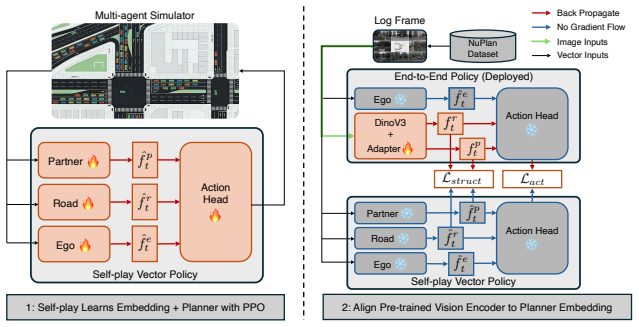
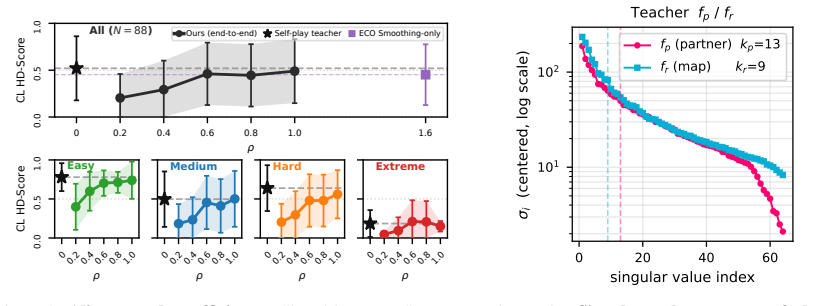
The central claim is that driving competence and visual perception can be learned separately and then joined without any expert demonstration. A single policy is pretrained by multi-agent self-play in a vectorized simulator, with one parameter set controlling all agents and per-episode reward randomization, producing a teacher whose features are sharply low-rank (roughly 9 informative dimensions for map features, 13 for partners). The teacher is frozen, and a vision student—a pretrained image backbone with two linear adapters, inheriting the teacher's ego encoder and planning head—is aligned to it using forward KL divergence between action distributions plus a batch-relational structural los
What carries the argument
The key machinery is a two-phase decoupling: (1) a self-play vector policy pretrained with PPO under per-episode reward randomization, which supplies both the frozen planning head and a low-rank latent geometry; and (2) an alignment phase in which a vision encoder is trained, supervised solely by the frozen teacher, through an action KL term plus a batch-relational low-rank structural loss. The structural loss projects mean-centered student and teacher feature batches into the teacher's top-k right singular subspace (k=9 for map, k=13 for partners), computes cosine-similarity matrices between scenes, and penalizes their difference in Frobenius norm; this focuses the student on reproducing wh
Load-bearing premise
The paper's headline comparison rests on the assumption that the baseline rows in the benchmark table were scored with the same redefined closed-loop HD-Score as the proposed policy, which the paper does not explicitly state; if those numbers come from the native open-loop metric, the comparison is not like-for-like.
What would settle it
Run a published baseline checkpoint through the paper's Appendix B closed-loop scorer on the same 88 scenarios and check whether the resulting aggregate matches the table; if the baseline score is unchanged from the native open-loop value or the margin flips, the central comparative claim fails.
If this is right
- If the claim holds, the standard fleet-scale log-collection and labeling pipeline for end-to-end driving can be bypassed; only paired (image, scene-state) frames and a frozen self-play teacher are needed.
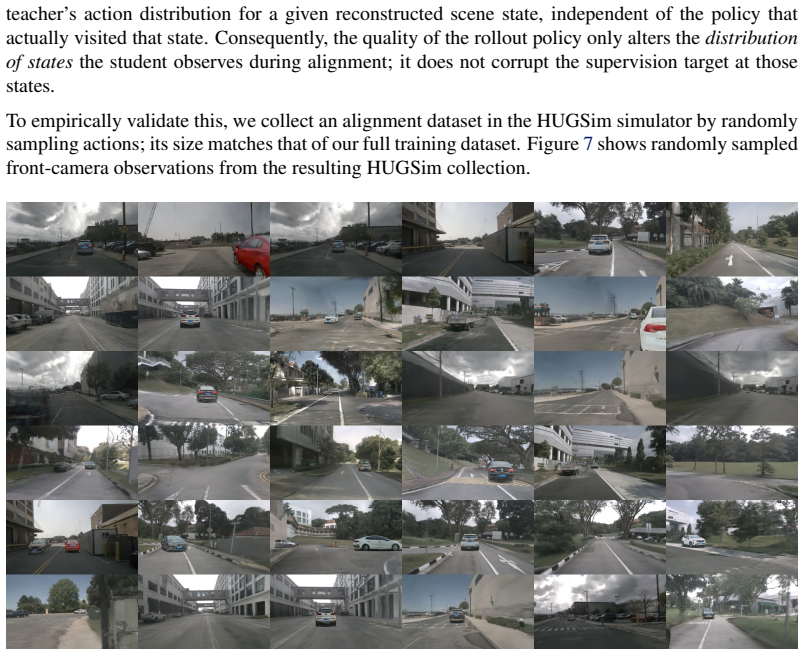
- Because alignment targets are teacher action distributions rather than recorded actions, the paired data can be collected by any rollout policy, including random actions; state coverage, not demonstration quality, determines the result (a point the paper tests in its appendix).
- The cost of learning to drive shifts upstream into self-play, which is one-time and reusable: the same frozen teacher can supervise multiple vision frontends, sensor stacks, and alignment datasets.
- The low-rank structure of teacher features makes the structural-loss rank an empirical choice rather than a hyperparameter; matching only the informative subspace is what preserves closed-loop performance.
- Closed-loop evaluation with the paper's redefined scores should replace native plan-based scores when comparing single-step policies, since realized-rollout TTC, comfort, and arc-length route completion better reflect actual driving.
Where Pith is reading between the lines
- The headline margin over prior methods depends on whether the baselines were re-scored under the same closed-loop metric definitions; if they were not, the comparison may overstate the advance until an apples-to-apples rerun is done.
- Because the teacher never sees brake lights, hand signals, or other fine-grained visual cues (the paper lists these as limitations), transferring the same recipe to real roads will likely require a small amount of real-world fine-tuning; self-play alone may not cover such cues.
- The batch-relational low-rank loss should transfer to other teacher-student modality gaps (e.g., LiDAR-to-camera or map-to-image) wherever the teacher features are low-rank; testing the loss in those settings would show whether the low-rank assumption is the active ingredient.
- The Extreme-tier gap suggests that conservative collision avoidance can suppress route completion; a reward or curriculum that explicitly rewards progress in adversarial scenes might close that gap without eroding safety.
Editorial analysis
A structured set of objections, weighed in public.
Referee Report
Summary. The paper proposes TerraTransfer, a two-phase pipeline for end-to-end driving that avoids expert demonstrations. Phase 1 trains a single vector-state driving policy by multi-agent self-play in an in-house simulator (TerraZero), conditioning on ego state, road elements, and partner sets, with PPO and randomized reward weights. Phase 2 freezes this teacher and aligns a vision-based student to it using a paired image/scene-state dataset: the student shares the teacher's ego encoder, MLP, and actor head, and is supervised by a forward-KL action loss and a batch-relational low-rank structural loss computed on the teacher's feature subspace. The paper evaluates on the HUGSim photorealistic closed-loop benchmark and reports an aggregate closed-loop HD-Score of 0.490 for the vision student versus 0.452 for the strongest published baseline (ECO Smoothing-only), 0.360 for LTF, and 0.520 for the privileged self-play teacher. It also presents alignment-data-efficiency experiments and an empirical low-rank analysis of teacher features.
Significance. If the headline comparison is valid, this is a noteworthy advance: it demonstrates that a vision-based end-to-end policy can be trained without any logged-trajectory supervision, using self-play in a vectorized simulator followed by cross-modal alignment, and that the resulting policy approaches a privileged teacher and outperforms imitation-based pipelines on a photorealistic closed-loop benchmark. The paper's strengths include a clear method description, extensive ablations (loss decomposition, structural rank, vision backbone, alignment data policy), a detailed appendix defining the closed-loop metric, and a concrete low-rank motivation for the structural loss. The core risk is not the alignment method itself but the comparability of the headline baseline numbers, as discussed in the major comments.
major comments (4)
- [§4.2 / Table 1 / Appendix B] The headline claim rests on comparing 'Ours' (0.490) with published baselines such as ECO (0.452) in Table 1 under a 'Closed-loop HD-Score (§4.1)'. However, Appendix B changes the metric: TTC moves from a binary check on a planned 7-pose trajectory to a fractional sweep over realized velocity-propagated boxes (Eqs. 10-12); COM switches from planned to realized poses (Eq. 13); and R_c becomes an arc-length fraction without the native 0.9 discount (Eq. 14). The paper never states that the UniAD/VAD/LTF/ECO rows were recomputed under Appendix B; the caption's 'published' wording suggests they are native HUGSim/paper scores. §B.2 even states that the redefined TTC and COM are 'not directly comparable' to their native counterparts. If the baseline rows are native scores, the 0.490 vs 0.452 margin is not a like-for-like comparison and the central claim is unsupported. Please state explicitly w
- [§4.1 / Appendix B, Table 3] There is an internal inconsistency about which subscores are redefined. §4.1 states that only TTC and COM are changed ('while leaving the rest of the HD-Score computation unchanged'), but Appendix B (Table 3) also replaces native R_c — a camera-pose-index fraction with a 0.9 discount — with an arc-length fraction min(1, max_t s_t/S) without the discount. This matters because R_c multiplies the aggregate (Eq. 9) and is the largest driver of the teacher's low Extreme score (Table 4). The manuscript should state the exact set of redefined components in §4.1 to avoid misdescribing the protocol.
- [§4.2 / Table 1] Even under a shared metric, the 0.038 aggregate margin over ECO is reported without confidence intervals or a paired significance test across the 88 scenarios. Figure 3 shows ±1 per-scene std for some curves, but Table 1 has no error bars, and per-scenario scores are not reported. A bootstrap or paired test would establish that the aggregate difference is not within noise. Please add per-scenario standard errors and significance tests for the All row and per-tier comparisons.
- [§3.2 / Appendix A.2] The student at inference is described as receiving 'ego kinematics and a navigation signal' (Fig. 2), while the teacher's ego observation also includes sampled vehicle geometry, dynamics coefficients, and a per-episode reward-weight vector (Appendix A.2). Since the ego encoder is inherited and frozen, the input dimensionality must match. The paper does not specify what values are fed for these extra dimensions at evaluation time, nor how reward weights are chosen for the student. This is a reproducibility gap in the method description and could affect behavior if the policy conditions on reward preferences.
minor comments (4)
- [Fig. 12 caption] 'Hugsim' should be 'HUGSim' for consistency.
- [Figure 3 caption] The caption says bands are ±1 per-scene std; state whether this is across scenarios, seeds, or both, and what N is per tier.
- [§4.3] The sentence 'roughly 40% of ECO's nuPlan frames' is correct but slightly confusing because the comparison uses ρ=0.6 of the 1.83M alignment set. Consider clarifying the calculation in the text.
- [Appendix B, Eq. (11)] The notation for the union of two conditions in Eq. (11) is dense; specifying that OBB intersections are checked at the same propagated time step δ would improve readability.
Circularity Check
No significant circularity: the teacher/student distillation is self-contained; the Table 1 metric-protocol mismatch is a correctness risk, not a circular step.
full rationale
The derivation chain is self-contained. Phase 1 trains the teacher by PPO in TerraZero with reward terms (Eqs. 3-4) that do not include the HUGSim HD-Score. Phase 2 freezes that teacher and trains the vision student with an action KL term and a low-rank structural loss on the frozen teacher's features (Eqs. 5-6). At every paired frame the student's supervision is the teacher's action distribution on the reconstructed scene state, not the evaluation metric, so the closed-loop result 0.490 is not a fitted parameter renamed as a prediction. The rank cutoffs k_p=13 and k_r=9 are empirical diagnostics of the frozen teacher (§4.4) and are explicitly ablated (Table 7), so the structural target is not chosen on the evaluation outcome. The only notable self-citation, SPACeR [19], appears in Related Work as a prior self-play method and is not load-bearing. The genuine caveat is that Table 1's caption says 'Closed-loop HD-Score (§4.1)' while Appendix B redefines TTC, COM, and R_c for the authors' single-step policy, and the paper never states that UniAD/VAD/LTF/ECO rows were recomputed under that protocol; if those rows are native HUGSim published scores, the 0.490 vs 0.452 margin compares different metrics. That is an evaluation-validity/correctness risk, not a circularity: no equation in the paper makes the claimed result equal to its inputs.
Axiom & Free-Parameter Ledger
free parameters (6)
- Structural ranks kp=13, kr=9 =
kp=13, kr=9 (80% cumulative energy of teacher spectra)
- Structural loss weight lambda =
0.5
- Alignment batch size B =
1024
- Closed-loop metric parameters =
HTTC=1.0s, stride=0.2s, Nbg=100, WCOM=1.0s, keyframe stride=0.5s
- Self-play reward weight ranges =
Table 2 ranges, e.g. collision U(0,3), comfort U(0,0.1), etc.
- Dynamics coefficient ranges =
C ~ U(0.5,1.5) for throttle/steer/accel/vel
axioms (5)
- domain assumption The optimal action depends on scene state, not on the modality used to perceive it.
- domain assumption TerraZero's vectorized self-play produces a policy whose competence transfers to photorealistic closed-loop driving.
- domain assumption nuPlan log frames can be reconstructed into scene-state observations aligned with the teacher's input.
- domain assumption The closed-loop HD-Score in Appendix B is a fair common metric for all rows of Table 1.
- domain assumption DINOv3 features are linearly adaptable to road and partner features.
invented entities (1)
-
TerraZero in-house vectorized simulator
no independent evidence
read the original abstract
End-to-end autonomous driving has achieved state-of-the-art performance on benchmarks and real-world deployments. Its standard training recipe, however, is expensive across all stages: collecting and labeling millions of driving frames is costly, and closed-loop RL on images is bottlenecked by the per-step cost of photorealistic rendering plus a forward pass through a large vision backbone. Self-play in vectorized simulators changes the economics: millions of rollout steps per second, and a state distribution naturally rich in collisions, near-misses, and recoveries that no driving log contains. Our approach exploits this asymmetry by decoupling learning to drive from learning to see. We pretrain a single policy by self-play, then align its latent space with a pretrained vision backbone, through the action KL divergence and a batch-relational low-rank structural loss. The action target comes from the self-play policy, so alignment never supervises against a logged trajectory: a paired dataset of (image, scene-state) frames suffices, with no need for the curated expert demonstrations that imitation pretraining is built on. On photorealistic 3D Gaussian splatting closed-loop scenarios, the resulting end-to-end policy matches or exceeds prior end-to-end methods.
Figures





Forward citations
Cited by 1 Pith paper
-
Pictura: Perspective-View Self-Play at Scale for Driving
Perspective-image self-play at 50B agent steps produces a driving policy that approaches privileged-vector performance in-domain and transfers better to re-rendered Waymo layouts.
Reference graph
Works this paper leans on
-
[1]
Paden, M
B. Paden, M. ˇC´ap, S. Z. Yong, D. Yershov, and E. Frazzoli. A survey of motion planning and control techniques for self-driving urban vehicles.IEEE Transactions on Intelligent V ehicles, 1(1):33–55, 2016
2016
-
[2]
P. Sun, H. Kretzschmar, X. Dotiwalla, A. Chouard, V . Patnaik, P. Tsui, J. Guo, Y . Zhou, Y . Chai, B. Caine, V . Vasudevan, W. Han, J. Ngiam, H. Zhao, A. Timofeev, S. Ettinger, M. Krivokon, A. Gao, A. Joshi, Y . Zhang, J. Shlens, Z. Chen, and D. Anguelov. Scalability in perception for autonomous driving: Waymo open dataset. InProceedings of the IEEE/CVF ...
2020
-
[3]
H. Caesar, J. Kabzan, K. S. Tan, W. K. Fong, E. Wolff, A. Lang, L. Fletcher, O. Beijbom, and S. Omari. nuPlan: A closed-loop ML-based planning benchmark for autonomous vehicles. arXiv preprint arXiv:2106.11810, 2021
Pith/arXiv arXiv 2021
-
[4]
M. Bojarski, D. D. Testa, D. Dworakowski, B. Firner, B. Flepp, P. Goyal, L. D. Jackel, M. Mon- fort, U. Muller, J. Zhang, X. Zhang, J. Zhao, and K. Zieba. End to end learning for self-driving cars.arXiv preprint arXiv:1604.07316, 2016
Pith/arXiv arXiv 2016
-
[5]
Codevilla, E
F. Codevilla, E. Santana, A. M. L ´opez, and A. Gaidon. Exploring the limitations of behavior cloning for autonomous driving. InProceedings of the IEEE/CVF International Conference on Computer Vision (ICCV), 2019
2019
-
[6]
Caesar, V
H. Caesar, V . Bankiti, A. H. Lang, S. V ora, V . E. Liong, Q. Xu, A. Krishnan, Y . Pan, G. Baldan, and O. Beijbom. nuScenes: A multimodal dataset for autonomous driving. InProceedings of the IEEE/CVF Conference on Computer Vision and Pattern Recognition (CVPR), 2020
2020
-
[7]
Y . Hu, J. Yang, L. Chen, K. Li, C. Sima, X. Zhu, S. Chai, S. Du, T. Lin, W. Wang, L. Lu, X. Jia, Q. Liu, J. Dai, Y . Qiao, and H. Li. Planning-oriented autonomous driving. InProceedings of the IEEE/CVF Conference on Computer Vision and Pattern Recognition (CVPR), 2023
2023
-
[8]
Jiang, S
B. Jiang, S. Chen, Q. Xu, B. Liao, J. Chen, H. Zhou, Q. Zhang, W. Liu, C. Huang, and X. Wang. V AD: Vectorized scene representation for efficient autonomous driving. InProceedings of the IEEE/CVF International Conference on Computer Vision (ICCV), 2023
2023
-
[9]
Chitta, A
K. Chitta, A. Prakash, B. Jaeger, Z. Yu, K. Renz, and A. Geiger. TransFuser: Imitation with transformer-based sensor fusion for autonomous driving.IEEE Transactions on Pattern Anal- ysis and Machine Intelligence, 45(11):12878–12895, 2023
2023
-
[10]
Dauner, M
D. Dauner, M. Hallgarten, T. Li, X. Weng, Z. Huang, Z. Yang, H. Li, I. Gilitschenski, B. Ivanovic, M. Pavone, A. Geiger, and K. Chitta. NA VSIM: Data-driven non-reactive au- tonomous vehicle simulation and benchmarking. InAdvances in Neural Information Process- ing Systems (NeurIPS) Datasets and Benchmarks Track, 2024
2024
-
[11]
H. Zhou, L. Lin, J. Wang, Y . Lu, D. Bai, B. Liu, Y . Wang, A. Geiger, and Y . Liao. HUGSIM: A real-time, photo-realistic and closed-loop simulator for autonomous driving.arXiv preprint arXiv:2412.01718, 2024
Pith/arXiv arXiv 2024
-
[12]
Zhang, M
B. Zhang, M. Golchoubian, I. Gilitschenski, B. Ivanovic, and K. Chitta. Endpoint constrained trajectory optimization for driving foundation models. InICCV RealADSim Workshop, 2025
2025
-
[13]
Karkus, M
P. Karkus, M. Igl, Y . Chen, K. Chitta, J. Packer, B. Douillard, T. Tian, A. Naumann, G. Garcia- Cobo, S. Tan, A. Degirmenci, A. Popov, N. Smolyanskiy, U. Muller, B. Ivanovic, and M. Pavone. Beyond behavior cloning in autonomous driving: a survey of closed-loop training techniques.IEEE Transactions on Pattern Analysis and Machine Intelligence, 2025
2025
-
[14]
Dosovitskiy, G
A. Dosovitskiy, G. Ros, F. Codevilla, A. Lopez, and V . Koltun. CARLA: An open urban driving simulator. InProceedings of the Conference on Robot Learning (CoRL), 2017. 9
2017
-
[15]
D. Chen, B. Zhou, V . Koltun, and P. Kr¨ahenb¨uhl. Learning by cheating. InProceedings of the Conference on Robot Learning (CoRL), 2019
2019
-
[16]
Zhang, A
Z. Zhang, A. Liniger, D. Dai, F. Yu, and L. Van Gool. End-to-end urban driving by imitating a reinforcement learning coach. InProceedings of the IEEE/CVF International Conference on Computer Vision (ICCV), 2021
2021
-
[17]
P. Wu, X. Jia, L. Chen, J. Yan, H. Li, and Y . Qiao. Trajectory-guided control prediction for end- to-end autonomous driving: A simple yet strong baseline. InAdvances in Neural Information Processing Systems (NeurIPS), 2022
2022
-
[18]
M. Cusumano-Towner, D. Hafner, A. Hertzberg, B. Huval, A. Petrenko, E. Vinitsky, E. Wij- mans, T. Killian, S. Bowers, O. Sener, P. Kr¨ahenb¨uhl, and V . Koltun. Robust autonomy emerges from self-play.arXiv preprint arXiv:2502.03349, 2025
Pith/arXiv arXiv 2025
-
[19]
Chang, A
W.-J. Chang, A. Rangesh, K. Joseph, M. Strong, M. Tomizuka, Y . Hu, and W. Zhan. SPACeR: Self-play anchoring with centralized reference models. InProceedings of the International Conference on Learning Representations (ICLR), 2026
2026
-
[20]
H. Seong, J.-K. Lee, H. Myeong, Y . Shin, H.-M. Cho, D. H. Kim, P. Desai, and M. Surana. Post-training and test-time scaling of generative agent behavior models for interactive au- tonomous driving.arXiv preprint arXiv:2512.13262, 2025
arXiv 2025
-
[21]
Y . Guo, D. Ye, S. Chen, A. Liu, and X. Liu. CorrectionPlanner: Self-correction planner with reinforcement learning in autonomous driving.arXiv preprint arXiv:2603.15771, 2026
arXiv 2026
-
[22]
Konstantinidis, M
F. Konstantinidis, M. Sackmann, U. Hofmann, and C. Stiller. Toward efficient and robust behavior models for multi-agent driving simulation. InProceedings of the IEEE International Conference on Robotics and Automation (ICRA), 2026
2026
-
[23]
Ahmadi, H
E. Ahmadi, H. Schofield, B. Khamidehi, F. Arasteh, J. Shan, L. Mou, K. Rezaee, and D. Bai. RLFTSim: Realistic and controllable multi-agent traffic simulation via reinforcement learning fine-tuning. InProceedings of the IEEE/CVF Conference on Computer Vision and Pattern Recognition (CVPR), 2026
2026
-
[24]
O. Sim ´eoni, H. V . V o, M. Seitzer, F. Baldassarre, M. Oquab, C. Jose, V . Khalidov, M. Szafraniec, S. Yi, M. Ramamonjisoa, F. Massa, D. Haziza, L. Wehrstedt, J. Wang, T. Darcet, T. Moutakanni, L. Sentana, C. Roberts, A. Vedaldi, J. Tolan, J. Brandt, C. Couprie, J. Mairal, H. J´egou, P. Labatut, and P. Bojanowski. DINOv3.arXiv preprint arXiv:2508.10104, 2025
Pith/arXiv arXiv 2025
-
[25]
W. Wu, X. Feng, Z. Gao, and Y . Kan. SMART: Scalable multi-agent real-time motion gen- eration via next-token prediction. InAdvances in Neural Information Processing Systems (NeurIPS), 2024
2024
-
[26]
G. Hess, C. Lindstr ¨om, M. Fatemi, C. Petersson, and L. Svensson. SplatAD: Real-time lidar and camera rendering with 3d gaussian splatting for autonomous driving. InProceedings of the IEEE/CVF Conference on Computer Vision and Pattern Recognition (CVPR), 2025
2025
-
[27]
H. Gao, S. Chen, B. Jiang, B. Liao, Y . Shi, X. Guo, Y . Pu, H. Yin, X. Li, X. Zhang, Y . Zhang, W. Liu, Q. Zhang, and X. Wang. RAD: Training an end-to-end driving policy via large-scale 3DGS-based reinforcement learning. InAdvances in Neural Information Processing Systems (NeurIPS), 2025
2025
-
[28]
J. Suarez. PufferLib: Making reinforcement learning libraries and environments play nice. arXiv preprint arXiv:2406.12905, 2024
Pith/arXiv arXiv 2024
-
[29]
Kaufmann, L
E. Kaufmann, L. Bauersfeld, A. Loquercio, M. M ¨uller, V . Koltun, and D. Scaramuzza. Champion-level drone racing using deep reinforcement learning.Nature, 620(7976):982–987, 2023. 10
2023
- [30]
-
[31]
Radford, J
A. Radford, J. W. Kim, C. Hallacy, A. Ramesh, G. Goh, S. Agarwal, G. Sastry, A. Askell, P. Mishkin, J. Clark, G. Krueger, and I. Sutskever. Learning transferable visual models from natural language supervision. InProceedings of the International Conference on Machine Learning (ICML), 2021
2021
-
[32]
C. Jia, Y . Yang, Y . Xia, Y .-T. Chen, Z. Parekh, H. Pham, Q. V . Le, Y .-H. Sung, Z. Li, and T. Duerig. Scaling up visual and vision-language representation learning with noisy text su- pervision. InProceedings of the International Conference on Machine Learning (ICML), 2021
2021
-
[33]
J. Li, D. Li, S. Savarese, and S. Hoi. BLIP-2: Bootstrapping language-image pre-training with frozen image encoders and large language models. InProceedings of the International Conference on Machine Learning (ICML), 2023
2023
-
[34]
A. A. Rusu, S. G. Colmenarejo, C ¸ . G ¨ulc ¸ehre, G. Desjardins, J. Kirkpatrick, R. Pascanu, V . Mnih, K. Kavukcuoglu, and R. Hadsell. Policy distillation. InProceedings of the Inter- national Conference on Learning Representations (ICLR), 2016
2016
-
[35]
Parisotto, J
E. Parisotto, J. Ba, and R. Salakhutdinov. Actor-mimic: Deep multitask and transfer reinforce- ment learning. InProceedings of the International Conference on Learning Representations (ICLR), 2016
2016
-
[36]
Y . W. Teh, V . Bapst, W. M. Czarnecki, J. Quan, J. Kirkpatrick, R. Hadsell, N. Heess, and R. Pascanu. Distral: Robust multitask reinforcement learning. InAdvances in Neural Infor- mation Processing Systems (NeurIPS), 2017
2017
-
[37]
S. Schmitt, J. J. Hudson, A. ˇZ´ıdek, S. Osindero, C. Doersch, W. M. Czarnecki, J. Z. Leibo, H. K¨uttler, A. Zisserman, K. Simonyan, and S. M. A. Eslami. Kickstarting deep reinforcement learning.arXiv preprint arXiv:1803.03835, 2018
Pith/arXiv arXiv 2018
-
[38]
J. Lee, J. Hwangbo, L. Wellhausen, V . Koltun, and M. Hutter. Learning quadrupedal locomo- tion over challenging terrain.Science Robotics, 5(47):eabc5986, 2020
2020
-
[39]
T. Miki, J. Lee, J. Hwangbo, L. Wellhausen, V . Koltun, and M. Hutter. Learning robust per- ceptive locomotion for quadrupedal robots in the wild.Science Robotics, 7(62):eabk2822, 2022
2022
-
[40]
Kumar, Z
A. Kumar, Z. Fu, D. Pathak, and J. Malik. RMA: Rapid motor adaptation for legged robots. In Robotics: Science and Systems (RSS), 2021
2021
-
[41]
Loquercio, E
A. Loquercio, E. Kaufmann, R. Ranftl, M. M ¨uller, V . Koltun, and D. Scaramuzza. Learning high-speed flight in the wild.Science Robotics, 6(59):eabg5810, 2021
2021
-
[42]
T. Chen, J. Xu, and P. Agrawal. A system for general in-hand object re-orientation. InPro- ceedings of the Conference on Robot Learning (CoRL), 2021
2021
-
[43]
Z. Wu, R. Song, V . Mundheda, L. E. Navarro-Serment, C. Schoenborn, and J. Schneider. TADPO: Reinforcement learning goes off-road. InProceedings of the IEEE International Conference on Robotics and Automation (ICRA), 2026. URLhttps://arxiv.org/abs/ 2603.05995
Pith/arXiv arXiv 2026
-
[44]
Hinton, O
G. Hinton, O. Vinyals, and J. Dean. Distilling the knowledge in a neural network. InNeurIPS Deep Learning and Representation Learning Workshop, 2015
2015
-
[45]
Philion, A
J. Philion, A. Kar, and S. Fidler. Learning to evaluate perception models using planner-centric metrics. InProceedings of the IEEE/CVF Conference on Computer Vision and Pattern Recog- nition (CVPR), 2020. 11
2020
-
[46]
Li and X
W.-X. Li and X. Yang. Transcendental idealism of planner: Evaluating perception from plan- ning perspective for autonomous driving. InProceedings of the International Conference on Machine Learning (ICML), 2023
2023
-
[47]
Tung and G
F. Tung and G. Mori. Similarity-preserving knowledge distillation. InProceedings of the IEEE/CVF International Conference on Computer Vision (ICCV), pages 1365–1374, 2019
2019
-
[48]
Zaheer, S
M. Zaheer, S. Kottur, S. Ravanbakhsh, B. Poczos, R. R. Salakhutdinov, and A. J. Smola. Deep sets. InAdvances in Neural Information Processing Systems (NeurIPS), 2017
2017
-
[49]
J. Schulman, F. Wolski, P. Dhariwal, A. Radford, and O. Klimov. Proximal policy optimization algorithms.arXiv preprint arXiv:1707.06347, 2017
Pith/arXiv arXiv 2017
-
[50]
J. Schulman, P. Moritz, S. Levine, M. Jordan, and P. Abbeel. High-dimensional continuous control using generalized advantage estimation.arXiv preprint arXiv:1506.02438, 2015
Pith/arXiv arXiv 2015
-
[51]
Gavish and D
M. Gavish and D. L. Donoho. The optimal hard threshold for singular values is4/ √ 3.IEEE Transactions on Information Theory, 60(8):5040–5053, 2014
2014
-
[52]
O. Roy and M. Vetterli. The effective rank: A measure of effective dimensionality. In2007 15th European Signal Processing Conference, pages 606–610. IEEE, 2007. 12 Supplementary Contents A Self-Play Policy Details . . . . . . . . . . . . . . . . . . . . . . . . . . . . . . . . . . . . . . . . . . . . . . . . . . . . . . . . . . . . . . 14 B Closed-Loop HD...
arXiv 2007
discussion (0)
Sign in with ORCID, Apple, or X to comment. Anyone can read and Pith papers without signing in.