REVIEW 2 major objections 3 minor 95 references
Anomalous initial states in thermalizing nonintegrable systems store their late-time memory in a compact low-depth Krylov-space core, while generic states do not.
Reviewed by Pith at T0; open to challenge. T0 means a machine referee read the full paper against a public rubric. the ladder, T0–T4 →
T0 review · deepseek-v4-flash
2026-08-01 00:51 UTC pith:ASDDPFL3
load-bearing objection Sharp new Krylov diagnostic, but the PXP scar numbers rest on an unstated choice about degenerate gap handling that needs to be resolved before the headline claim is solid. the 2 major comments →
Krylov-Space Memory Cores
The pith
A machine-rendered reading of the paper's core claim, the machinery that carries it, and where it could break.
Core claim
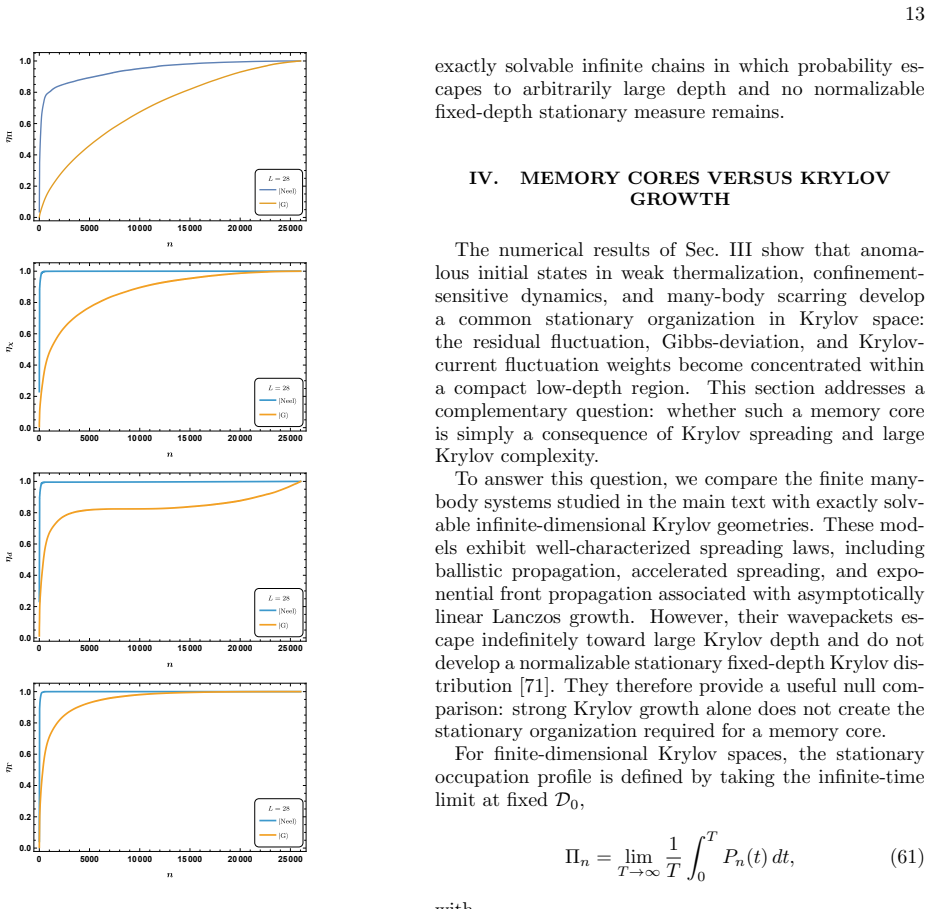
The paper claims that for atypical initial states in otherwise thermalizing nonintegrable systems, the stationary long-time probability distribution in Krylov space separates into a compact low-depth memory core — where residual temporal fluctuations, deviation from the Gibbs reference, and probability-current fluctuations all concentrate — and a much broader stationary occupation halo that carries probability but little residual activity. The core is quantified by n_mc, the smallest depth containing 95% of the weight of each of three diagnostics; for example, the weakly thermalizing |X+> state has n_mc = 32 while its occupation cloud reaches depth 2053, and the scarred PXP Néel state has n_
What carries the argument
The paper's central object is the Krylov basis generated by the Lanczos algorithm, in which the Hamiltonian becomes a one-dimensional hopping chain and the initial state starts at site 0. On that chain it defines three depth-resolved stationary diagnostics: χ_n (long-time variance of occupation), d_n (deviation from the energy-matched Gibbs state restricted to the cyclic subspace), and Γ_n (variance of the probability current across the bond between n−1 and n). The last has a compact closed form under a nondegenerate-active-gap condition, Γ_n = 2 b_n^2 [Π_n Π_{n−1} − |<n|ρ_diag|n−1>|^2]. The memory core is defined as the smallest depth n_mc containing 95% of the weight of each diagnostic; th
Load-bearing premise
The compact spectral formulas for the diagnostics, especially Γ_n, hold only under the nondegenerate-active-gap condition (Eq. 22); the PXP model has exact chiral symmetry and zero modes that may violate this condition, and the text says a gap-resolved version (Eq. A14) should be used when it fails but never states which version was actually implemented in Section III C.
What would settle it
Compute Γ_n for the PXP Néel state directly from a long-time average of the squared current (Eq. 38) without assuming nondegenerate gaps, and compare with the compact formula (Eq. 39) over the first few hundred bonds; a discrepancy for the state's own dynamics would mean the reported n_mc = 109 is not supported. Alternatively, check whether the total weights X, N, G remain appreciable at system sizes beyond L = 28; if they decay with L, the core is a finite-size effect.
If this is right
- Anomalous relaxation in different microscopic settings — weak thermalization, confinement, and scarring — shares a common low-depth stationary organization in Krylov space.
- Krylov complexity alone is insufficient to detect this memory: a system can have large spreading and no stationary core, as the exactly solvable escaping geometries show.
- The core–halo separation provides an operational, state-selective diagnostic for locating nonthermal memory in otherwise thermalizing systems.
- Finite-size data are consistent with the core depth growing at most linearly with system size while the cyclic dimension grows much faster, so the core is subextensive.
- The three diagnostics are complementary: occupation supplies the probability background, but fluctuation, Gibbs mismatch, and current activity must co-localize to define a core.
Where Pith is reading between the lines
- The same memory-core framework could be tested on other types of anomalous dynamics, such as disorder-driven localization or prethermalization, where a compact residual region may or may not appear.
- The determinant form of Γ_n suggests that the core region is characterized by suppressed nearest-neighbor coherence in the diagonal ensemble; this could be connected to entanglement or operator-growth structure.
- A direct time-domain computation of Γ_n for the PXP Néel state, without any gap assumption, would settle whether the reported n_mc = 109 is an artifact of the compact formula or a genuine feature.
- State-selective cores could serve as numerical probes for identifying scarred eigenstates in larger systems where exact diagonalization is infeasible.
Editorial analysis
A structured set of objections, weighed in public.
Referee Report
Summary. The paper introduces a stationary, depth-resolved framework for organizing anomalous initial-state memory in the Krylov basis. For a finite Hamiltonian and initial state it defines the diagonal-ensemble occupation Π_n, the long-time occupation variance χ_n, the Gibbs-deviation profile d_n, and a new bond-resolved current-fluctuation activity Γ_n. A 'Krylov-space memory core' is identified as the smallest interval containing 95% of the weight of all three residual diagnostics, provided the total weights are appreciable. Numerically, the authors report compact cores for weakly thermalizing, confinement-sensitive, and PXP-scarred initial states in otherwise thermalizing nonintegrable models, with generic reference states lacking comparable compact co-localized signals. An auxiliary integrable comparison and exactly solvable infinite Krylov chains are used to argue that the core is not a trivial consequence of integrability or Krylov growth.
Significance. If the numerical claims hold, the paper offers a genuinely new unifying perspective: anomalous dynamics produced by different physical mechanisms (weak thermalization, confinement, many-body scarring) leave the same stationary, depth-resolved signature in Krylov space, distinct from Krylov complexity and from the occupation profile alone. The analytic derivation of χ_n and Γ_n under the nondegenerate-active-gap condition is clean and internally consistent, and the bounds (27), (41), and the determinant form (A22) are useful physical constraints. The careful treatment of exact energy degeneracies through active spectral projectors is a strength, as is the effort to provide finite-size tables across three models. However, the manuscript ships no code or data, and one of the central numerical applications (PXP) suffers from an unresolved ambiguity about which spectral formula was actually evaluated; these issues must be fixed before the central claim can be verified.
major comments (2)
- [Sec. III C, Eqs. (22),(39), App. A/C] The PXP Néel state violates the nondegenerate-active-gap condition (22). The chiral symmetry C=(-1)^{N_exc} anticommutes with H and leaves |Z2> invariant (L=28 has 14 excitations), so every active nonzero energy E has an active partner -E; together with active E=0, the ordered pairs (E,0) and (0,-E) share the same gap. The text never states whether χ_n and Γ_n for PXP were computed with the compact forms (25)/(39) or with the gap-resolved sum Eq. (A14)/direct long-time averaging. If the compact forms were used, the reported n_Γ^(0.95)=92 and n_mc=109, and the scarred current-activity claim, are not justified. Please state the exact prescription used and, if necessary, recompute these quantities.
- [Sec. III, App. C/D] The central numerical claim is not independently checkable from the manuscript as written. No code or data are provided; the active-spectral construction is described only verbally; the claimed tolerance stability ("corrections of at most ±3") is not demonstrated; and Tables I–VI contain no error bars or numerical uncertainty estimates for the threshold depths. Given that the core–halo distinction is the main result, please release the numerical code/data or provide a detailed pseudocode for the active-spectral construction, together with a table of stability checks for each system size and tolerance choice.
minor comments (3)
- [Sec. IV A] The notation P_n in Eq. (66) for the integrated transient occupation is easily confused with the probability occupation P_n(t) used throughout the paper. Consider renaming this integrated quantity (e.g., I_n) to avoid ambiguity, especially since the paper emphasizes that P_n is nonzero for the constant-chain example while Π_n=0.
- [App. C] Equation (C17) subtracts the zero-mode counts to obtain 26021, but the text states that the sublattice imbalance gives 'at least' 133 and 58 zero modes. The equality 26211-(133+58)+1=26021 should be phrased as conditional on the numerically observed saturation of the imbalance bounds, not as an exact symmetry result.
- [App. D] The finite-size tables list n_mc and D0, but do not state the ε_E and ε_ω tolerance values used for each L. Please include these values and, for each table, indicate whether the compact formulas or the gap-resolved formulas were used, so that the scaling analysis can be reproduced.
Circularity Check
No significant circularity; the memory-core diagnostics are operationally defined and empirically discriminating, and no load-bearing result reduces to its inputs.
full rationale
The paper's central construction is operational rather than definitional. The stationary occupation Πn is the diagonal-ensemble expectation (Eq. 19); χn is the long-time variance of the Krylov projector (Eq. 24); dn is the deviation from an energy-matched Gibbs reference (Eqs. 32–33); Γn is the long-time variance of the Krylov current, with Eq. (39) derived explicitly from that definition in Appendix A under the stated nondegenerate-active-gap condition. The memory-core depth nmc is a threshold statistic over these independently defined profiles (Eq. 48), not a fitted parameter. The paper explicitly states that the framework is an operational test, not a prediction that a core must exist: "The formalism therefore provides an operational test, not a prediction that a core must exist." The numerical contrast between anomalous states (nmc = 32, 36, 41, 57, 109) and generic/random controls (nmc comparable to the full cyclic dimension) shows that the diagnostic discriminates rather than merely rediscovering its construction. The self-citations [21,62,63] are contextual and do not carry a load-bearing uniqueness theorem or ansatz; the derivations in this paper are self-contained. The only substantive technical concern is whether the PXP Γn computation used the gap-resolved Eq. (A14) when Eq. (22) may fail due to chiral symmetry. That is a numerical-implementation ambiguity and a correctness question, not circularity: both formulas follow from the same physical definition, and the paper identifies the condition under which each applies. No step reduces the reported memory-core result to its inputs.
Axiom & Free-Parameter Ledger
free parameters (2)
- cumulative fraction q =
0.95
- energy-grouping and spectral-weight tolerances (ε_E, ε_ω) =
1e-11, 1e-14
axioms (6)
- standard math Lanczos recursion generates an orthonormal Krylov basis in which H_K is tridiagonal (Eqs. 3-7).
- standard math The infinite-time average of Krylov occupation equals the diagonal ensemble in the active energy subspace (Eqs. 12-19).
- ad hoc to paper The nondegenerate-active-gap condition (Eq. 22) holds in the numerical systems, or the gap-resolved formula (Eq. A14) was used when it fails.
- domain assumption The energy-matched Gibbs state on the cyclic subspace (Eqs. 29-31) is an informative equilibrium benchmark for nonintegrable systems.
- domain assumption Finite-size data (L=10-14 for Ising, L=20-28 for PXP) are representative, and the observed trends support n_mc = O(L) with n_mc/D0 → 0.
- domain assumption Energy grouping with stated tolerances resolves the active spectrum well enough that D0 and the cumulative depths are stable.
invented entities (1)
-
Krylov-space memory core
no independent evidence
read the original abstract
We introduce Krylov-space memory cores as stationary, depth-resolved structures that reveal how anomalous initial-state memory is organized inside the Krylov space of otherwise thermalizing nonintegrable systems. The stationary occupation profile identifies where late-time probability is concentrated along the Krylov chain, while complementary diagnostics of residual equilibration fluctuations, deviation from the Gibbs reference, and long-time Krylov-current fluctuations determine the physical character of that region. Across weak thermalization, confinement-induced anomalous dynamics, and many-body scarring, anomalous initial states develop compact low-depth memory cores that carry appreciable residual fluctuations, Gibbs mismatch, and persistent current-fluctuation activity. These cores are often embedded within substantially broader stationary occupation halos. Generic reference states, by contrast, do not exhibit a comparable combination of signal strength and spatial compactness. An auxiliary integrable comparison further shows that compact Krylov memory is state selective rather than a generic consequence of integrability. Krylov-space memory cores therefore provide a stationary framework for identifying where structured quantum memory resides and how it remains dynamically encoded.
Figures




Reference graph
Works this paper leans on
-
[1]
Residual equilibration-fluctuation profile χn for the chaotic mixed-field Ising chain
× 10-6 0 10 20 30 40 50 0.0000 0.0002 0.0004 0.0006 0.0008 0.0010 Figure 3. Residual equilibration-fluctuation profile χn for the chaotic mixed-field Ising chain. The states|X+⟩and |Z+⟩carry appreciable low-depth fluctuation weight. The efficiently thermalizing state|Y+⟩and the random controls have much weaker signals whose cumulative weight is dis- tribu...
2000
-
[2]
The former concerns temporal fluctuations around a stationary state; the latter concerns whether that stationary state agrees with an appropriate equilib- rium reference
Krylov-resolved Gibbs deviation Equilibration and thermalization answer different questions. The former concerns temporal fluctuations around a stationary state; the latter concerns whether that stationary state agrees with an appropriate equilib- rium reference. For the nonintegrable systems studied in the main text, we use the Gibbs state of the cyclic ...
-
[3]
They do not directly measure whether probability continues to 5 move between neighboring Krylov depths
Krylov-current fluctuation activity The previous two diagnostics are site resolved. They do not directly measure whether probability continues to 5 move between neighboring Krylov depths. The nearest- neighbor form of Eq. (9) provides an exact continuity equation, ∂tPn(t) =J n(t)−J n+1(t),(34) withJ 0 =J D0 = 0. The current through the bond join- ing site...
2000
-
[4]
Residual equilibration-fluctuation profile χn in the confinement regime
× 10-8 3.5 × 10⁻⁸ 0 10 20 30 40 50 0.000 0.001 0.002 0.003 0.004 Figure 8. Residual equilibration-fluctuation profile χn in the confinement regime. The N´ eel state has the sharpest low-depth fluctuation structure; the domain-wall and bubble states retain broader confinement-sensitive signals. The ran- dom control has a much weaker profile spread over the...
2000
-
[5]
Krylov-current fluctuation activity Γ n in the confinement regime
× 10-8 0 10 20 30 40 50 0.000 0.002 0.004 0.006 0.008 0.010 Figure 10. Krylov-current fluctuation activity Γ n in the confinement regime. The N´ eel state supports a sharp low- depth activity profile. The domain-wall and bubble states remain dynamically active over broader intervals, whereas the random control has a much weaker signal. produces state-sele...
2000
-
[6]
This defines a semi-infinite Jacobi problem with uniform hopping
Constant Lanczos coefficients: ballistic spreading We begin with a Krylov chain with constant Lanczos coefficients, an =a, b n =b, n≥1,(68) where the constant diagonal termaonly produces an overall phase and may be set to zero. This defines a semi-infinite Jacobi problem with uniform hopping. The exact amplitudes are φn(t) = (−i)ne−iat (n+ 1)J n+1(2bt) bt...
-
[7]
How- ever, this faster spreading still does not produce a sta- tionary memory profile
Square-root growth: accelerating wavepacket We next consider a Krylov chain with vanishing diag- onal coefficients and square-root hopping, an = 0, b n =λ √n.(74) The exact amplitudes are coherent-state wavefunc- tions [30], φn(t) =e −λ2t2/2 (−iλt)n √ n! ,(75) giving Pn(t) =e −λ2t2 (λ2t2)n n! .(76) For every fixedn,P n(t)→0 ast→ ∞, and hence Πn = 0, χn = ...
-
[8]
It is often used as a model for rapid complexity growth [28]
Linear growth: maximal Krylov spreading As a third example we study a Krylov chain with Lanc- zos coefficients an = 0, b n =α p n(n+h−1), h, α >0.(79) 15 This model possesses an exactSU(1,1) structure and provides an analytically tractable realization of hyper- bolic spreading in Krylov space [30]. It is often used as a model for rapid complexity growth [...
2000
-
[9]
Residual fluctuation profile χn for the integrable Ising chain (L= 14,g=−1.05,h= 0)
× 10-6 10 20 30 40 50 0.0000 0.0005 0.0010 0.0015 0.0020 Figure 20. Residual fluctuation profile χn for the integrable Ising chain (L= 14,g=−1.05,h= 0). The homogeneous states show concentrated early-depth fluctuations, while the random reference has weaker residual fluctuation weight. The physical interpretation differs from the anomalous noninte- grable...
2000
-
[10]
W eakly thermalizing Ising state We first consider|X+⟩in the chaotic mixed-field Ising chain, J= 1, g=−1.05, h= 0.5.(D3) The full Hilbert-space dimension is 2 L. The reflection- even sector has dimension dimH Ising R=+1(L) = 1 2 2L + 2⌈L/2⌉ ,(D4) but the exact cyclic dimensionD 0 is determined by the active spectral measure and need not equal the entire s...
-
[11]
Finite-size data for the weakly thermalizing Ising state|X+⟩
Confinement-sensitive bubble state We next consider the bubble state in the confinement regime, J= 1, g= 0.5, h= 0.1.(D5) 22 LdimH Ising D 0 X N Gn (0.95) Π n (0.95) χ n (0.95) d n (0.95) Γ n mc 10 1024 528 9.76×10 −3 2.406×10 −2 1.58×10 −1 205 27 15 30 30 11 2048 1056 1.08×10 −2 1.78×10 −2 1.78×10 −1 365 19 20 24 24 12 4096 2080 8.89×10 −3 2.05×10 −2 1.6...
2048
-
[12]
The full constrained Hilbert-space dimension is dimH per PXP(L) =F L−1 +F L+1,(D6) whereF m denotes the Fibonacci sequence
Scarred PXP N´ eel state Finally, we consider the periodic PXP chain initialized in|Z 2⟩. The full constrained Hilbert-space dimension is dimH per PXP(L) =F L−1 +F L+1,(D6) whereF m denotes the Fibonacci sequence. The exact cyclic dimensionD 0 is obtained by grouping degener- ate energies and retaining the distinct eigenspaces with nonzero N´ eel-state sp...
-
[13]
More generally, the data are compatible with nmc =O(L), nmc D0 − →0,(D8) provided the observed trends persist
Finite-size interpretation The three tables support a common finite-size hierar- chy, nmc ≪n (0.95) Π , n mc ≪ D0.(D7) for the anomalous states at the largest accessible sizes. More generally, the data are compatible with nmc =O(L), nmc D0 − →0,(D8) provided the observed trends persist. The present sizes do not determine a unique asymp- totic exponent, an...
-
[14]
J. M. Deutsch, Phys. Rev. A43, 2046 (1991)
2046
- [15]
-
[16]
Bohigas, M
O. Bohigas, M. J. Giannoni, and C. Schmit, Phys. Rev. Lett.52, 1 (1984)
1984
-
[17]
Rigol, V
M. Rigol, V. Dunjko, and M. Olshanii, Nature452, 854 (2008)
2008
-
[18]
D’Alessio, Y
L. D’Alessio, Y. Kafri, A. Polkovnikov, and M. Rigol, Advances in Physics65, 239 (2016)
2016
-
[19]
T. Mori, T. N. Ikeda, E. Kaminishi, and M. Ueda, Jour- nal of Physics B: Atomic, Molecular and Optical Physics 51, 112001 (2018)
2018
-
[20]
M. Alishahiha and M. J. Vasli (2025) arXiv:2501.07243 [hep-th]. 23 LdimH Ising D 0 X N Gn (0.95) Π n (0.95) χ n (0.95) d n (0.95) Γ n mc 10 1024 528 1.00×10 −2 5.85×10 −3 1.26×10 −1 189 76 77 55 77 11 2048 1056 8.67×10 −3 6.06×10 −3 1.28×10 −1 326 81 71 58 81 12 4096 2080 6.27×10 −3 4.28×10 −3 9.72×10 −2 476 106 83 87 106 13 8192 4160 5.11×10 −3 3.52×10 −...
Pith/arXiv arXiv 2025
-
[21]
M. C. Ba˜ nuls, J. I. Cirac, and M. B. Hastings, Phys. Rev. Lett.106, 050405 (2011), arXiv:1007.3957 [quant-ph]
Pith/arXiv arXiv 2011
-
[22]
B. M. McCoy and T. T. Wu, Physical Review D18, 1259 (1978)
1978
-
[23]
M. Kormos, M. Collura, G. Tak´ acs, and P. Calabrese, Nature Physics13, 246 (2017), arXiv:1604.03571 [cond- mat.stat-mech]
Pith/arXiv arXiv 2017
-
[24]
A. J. A. James, R. M. Konik, and N. J. Robinson, Physi- cal Review Letters122, 130603 (2019), arXiv:1804.09990 [cond-mat.stat-mech]
Pith/arXiv arXiv 2019
-
[25]
Bernienet al., Nature551, 579 (2017), arXiv:1707.04344 [quant-ph]
H. Bernienet al., Nature551, 579 (2017), arXiv:1707.04344 [quant-ph]
Pith/arXiv arXiv 2017
-
[26]
C. J. Turner, A. A. Michailidis, D. A. Abanin, M. Serbyn, and Z. Papi´ c, Physical Review B98, 155134 (2018)
2018
-
[27]
C. J. Turner, A. A. Michailidis, D. A. Abanin, M. Serbyn, and Z. Papi´ c, Nature Physics14, 745 (2018)
2018
-
[28]
Shiraishi and T
N. Shiraishi and T. Mori, Physical Review Letters119, 030601 (2017)
2017
-
[29]
Mori and N
T. Mori and N. Shiraishi, Physical Review E96, 022153 (2017)
2017
-
[30]
S. Moudgalya, B. A. Bernevig, and N. Regnault, Rept. Prog. Phys.85, 086501 (2022), arXiv:2109.00548 [cond- mat.str-el]
Pith/arXiv arXiv 2022
-
[31]
Calabrese and J
P. Calabrese and J. Cardy, Journal of Statistical Mechan- ics , P04010 (2005)
2005
-
[32]
Eisert, M
J. Eisert, M. Cramer, and M. B. Plenio, Reviews of Modern Physics82, 277 (2010)
2010
-
[33]
Haake,Quantum Signatures of Chaos, 3rd ed
F. Haake,Quantum Signatures of Chaos, 3rd ed. (Springer, 2010)
2010
-
[34]
M. Alishahiha and M. J. Vasli, Eur. Phys. J. C85, 39 (2025), arXiv:2403.06655 [quant-ph]
Pith/arXiv arXiv 2025
-
[35]
H. G. Menzler and R. Jha, Physical Review B110, 125137 (2024), arXiv:2403.14384 [quant-ph]
Pith/arXiv arXiv 2024
-
[36]
Lanczos, J
C. Lanczos, J. Res. Natl. Bur. Stand.45, 255 (1950)
1950
-
[37]
Haydock, Computer Physics Communications20, 11 (1980)
R. Haydock, Computer Physics Communications20, 11 (1980)
1980
-
[38]
T. J. Park and J. C. Light, J. Chem. Phys.85, 5870 (1986)
1986
-
[39]
V. S. Viswanath and G. M¨ uller,The Recursion Method: Application to Many Body Dynamics, Lecture Notes in Physics Monographs (Springer, 1994)
1994
-
[40]
Viswanath, (2008), arXiv:0805.0005 [math.NA]
D. Viswanath, (2008), arXiv:0805.0005 [math.NA]
Pith/arXiv arXiv 2008
-
[41]
D. E. Parker, X. Cao, A. Avdoshkin, T. Scaffidi, and E. Altman, Phys. Rev. X9, 041017 (2019), arXiv:1812.08657 [cond-mat.stat-mech]
Pith/arXiv arXiv 2019
-
[42]
E. Rabinovici, A. S´ anchez-Garrido, R. Shir, and J. Son- ner, JHEP06, 062 (2021), arXiv:2009.01862 [hep-th]
Pith/arXiv arXiv 2021
-
[43]
V. Balasubramanian, P. Caputa, J. M. Magan, and Q. Wu, Phys. Rev. D106, 046007 (2022), arXiv:2202.06957 [hep-th]
Pith/arXiv arXiv 2022
-
[44]
Caputa, J
P. Caputa, J. M. Magan, and D. Patramanis, Phys. Rev. Research4, 013041 (2022)
2022
-
[45]
J. L. F. Barb´ on, E. Rabinovici, R. Shir, and R. Sinha, JHEP10, 264 (2019), arXiv:1907.05393 [hep-th]
Pith/arXiv arXiv 2019
-
[46]
M. Alishahiha and S. Banerjee, SciPost Phys.15, 080 (2023), arXiv:2212.10583 [hep-th]
Pith/arXiv arXiv 2023
-
[47]
A. Dymarsky and M. Smolkin, Phys. Rev. D104, L081702 (2021), arXiv:2104.09514 [hep-th]
Pith/arXiv arXiv 2021
-
[48]
B. Bhattacharjee, X. Cao, P. Nandy, and T. Pathak, JHEP05, 174 (2022), arXiv:2203.03534 [quant-ph]. 24
Pith/arXiv arXiv 2022
-
[49]
A. Avdoshkin, A. Dymarsky, and M. Smolkin, JHEP06, 066 (2024), arXiv:2212.14429 [hep-th]
Pith/arXiv arXiv 2024
-
[50]
H. Camargo, V. Jahnke, K. Kim, and M. Nishida, JHEP 05, 226 (2023), arXiv:2212.14702 [hep-th]
Pith/arXiv arXiv 2023
-
[51]
M. Vasli, K. B. Velni, M. M. Mozaffar, A. Mollabashi, and M. Alishahiha, Eur. Phys. J. C84, 235 (2024), arXiv:2307.08307 [hep-th]
Pith/arXiv arXiv 2024
- [52]
-
[53]
E. Rabinovici, A. S´ anchez-Garrido, R. Shir, and J. Son- ner, JHEP03, 211 (2022), arXiv:2112.12128 [hep-th]
Pith/arXiv arXiv 2022
-
[54]
G. F. Scialchi, A. J. Roncaglia, and D. A. Wisniacki, arXiv:2309.13427 [quant-ph]
-
[55]
F. B. Trigueros and C. J. Lin, SciPost Phys.13, 037 (2022), arXiv:2112.04722 [cond-mat.dis-nn]
Pith/arXiv arXiv 2022
-
[56]
B. L. Espa˜ nol and D. A. Wisniacki, Phys. Rev. E107, 024217 (2023), arXiv:2212.06619 [quant-ph]
Pith/arXiv arXiv 2023
-
[57]
J. Erdmenger, S. Jian, and Z. Xian, JHEP08, 176 (2023), arXiv:2303.12151 [hep-th]
Pith/arXiv arXiv 2023
-
[58]
K. Huh, H. Jeong, and J. Pedraza, JHEP05, 137 (2024), arXiv:2312.12593 [hep-th]
Pith/arXiv arXiv 2024
-
[59]
H. Camargo, K. Huh, V. Jahnke, H. Jeong, K. Kim, and M. Nishida, JHEP08, 241 (2024), arXiv:2405.11254 [hep-th]
Pith/arXiv arXiv 2024
-
[60]
P. Nandy, T. Pathak, and M. Tezuka, Phys. Rev. B111, L060201 (2025), arXiv:2406.11969 [quant-ph]
Pith/arXiv arXiv 2025
-
[61]
B. Bhattacharjee and P. Nandy, Phys. Rev. B111, L060202 (2025), arXiv:2407.07399 [quant-ph]
Pith/arXiv arXiv 2025
-
[62]
V. Balasubramanian, R. Das, J. Erdmenger, and Z. Xian, J. Stat. Mech.2025, 033202 (2025), arXiv:2407.11114 [hep-th]
Pith/arXiv arXiv 2025
-
[63]
M. Baggioli, K. Huh, H. Jeong, K. Kim, and J. Pedraza, Phys. Rev. Res.7, 023028 (2025), arXiv:2407.17054 [hep- th]
Pith/arXiv arXiv 2025
-
[64]
M. Alishahiha, S. Banerjee, and M. Vasli, Eur. Phys. J. C85, 749 (2025), arXiv:2408.10194 [hep-th]
Pith/arXiv arXiv 2025
-
[65]
A. F. Astaneh and N. Vardian, (2025), arXiv:2504.14362 [hep-th]
Pith/arXiv arXiv 2025
-
[66]
A. Bhattacharya and A. Jana, (2024), arXiv:2408.11096 [hep-th]
Pith/arXiv arXiv 2024
-
[67]
K. Huh, H. Jeong, L. P. Zayas, and J. Pedraza, Phys. Rev. D111, L121902 (2025), arXiv:2412.04963 [hep-th]
Pith/arXiv arXiv 2025
-
[68]
M. Baggioli, K. Huh, H. Jeong, X. Jiang, K. Kim, and J. Pedraza, Phys. Rev. D111, L101904 (2025), arXiv:2503.11274 [hep-th]
Pith/arXiv arXiv 2025
-
[69]
A. Faraji Astaneh and N. Vardian, Phys. Rev. D113, 026004 (2026), arXiv:2507.23739 [hep-th]
Pith/arXiv arXiv 2026
-
[70]
Roychowdhury, (2026), arXiv:2605.10786 [hep-th]
D. Roychowdhury, (2026), arXiv:2605.10786 [hep-th]
Pith/arXiv arXiv 2026
-
[71]
P. Nandy, A. S. Matsoukas-Roubeas, P. Mart ´ ınez Az- cona, A. Dymarsky, and A. del Campo, Phys. Rep. 1125–1128, 1 (2025), arXiv:2405.09628 [quant-ph]
Pith/arXiv arXiv 2025
-
[72]
E. Rabinovici, A. S´ anchez-Garrido, R. Shir, and J. Son- ner, (2025), arXiv:2507.06286 [hep-th]
Pith/arXiv arXiv 2025
-
[73]
B. Bhattacharjee, P. Nandy, and T. Pathak, JHEP08, 099 (2023), arXiv:2210.02474 [hep-th]
Pith/arXiv arXiv 2023
-
[74]
B. Pain, D. E. Logan, and S. Roy, Physical Review B 113, 214205 (2026), arXiv:2603.25724 [cond-mat.dis-nn]
Pith/arXiv arXiv 2026
-
[75]
M. Alishahiha and M. J. Vasli, Phys. Rev. D113, 126004 (2026), arXiv:2602.06150 [hep-th]
arXiv 2026
-
[76]
M. Alishahiha, F. T. Tabesh, and M. J. Vasli, (2026), arXiv:2602.19750 [quant-ph]
Pith/arXiv arXiv 2026
- [77]
-
[78]
I. Lesanovsky and H. Katsura, Phys. Rev. A86, 041601 (2012), arXiv:1204.0903 [cond-mat.quant-gas]
Pith/arXiv arXiv 2012
-
[79]
Bhattacharjee, S
B. Bhattacharjee, S. Sur, and P. Nandy, Phys. Rev. B 106, 205150 (2022)
2022
-
[80]
Nandy, B
S. Nandy, B. Mukherjee, A. Bhattacharyya, and A. Banerjee, Journal of Physics: Condensed Matter36, 155601 (2024)
2024
discussion (0)
Sign in with ORCID, Apple, or X to comment. Anyone can read and Pith papers without signing in.