REVIEW 3 major objections 5 minor 128 references
A composite dark-energy model made of a running vacuum and a negative-energy 'cosmon' reproduces DESI's phantom-divide crossing, fits the data better than the standard parameterization, and alleviates the cosmic coincidence problem.
Reviewed by Pith at T0; open to challenge. T0 means a machine referee read the full paper against a public rubric. the ladder, T0–T4 →
T0 review · deepseek-v4-flash
2026-08-01 00:44 UTC pith:JGXDU73Z
load-bearing objection Competent MCMC fit of an old two-component RVM model; the crossing is a post-fit output, and the 'from first principles' claim rests on cited, not demonstrated, phantom matter. the 3 major comments →
ΛXCDM: a running vacuum strategy for crossing the phantom divide
The pith
A machine-rendered reading of the paper's core claim, the machinery that carries it, and where it could break.
Core claim
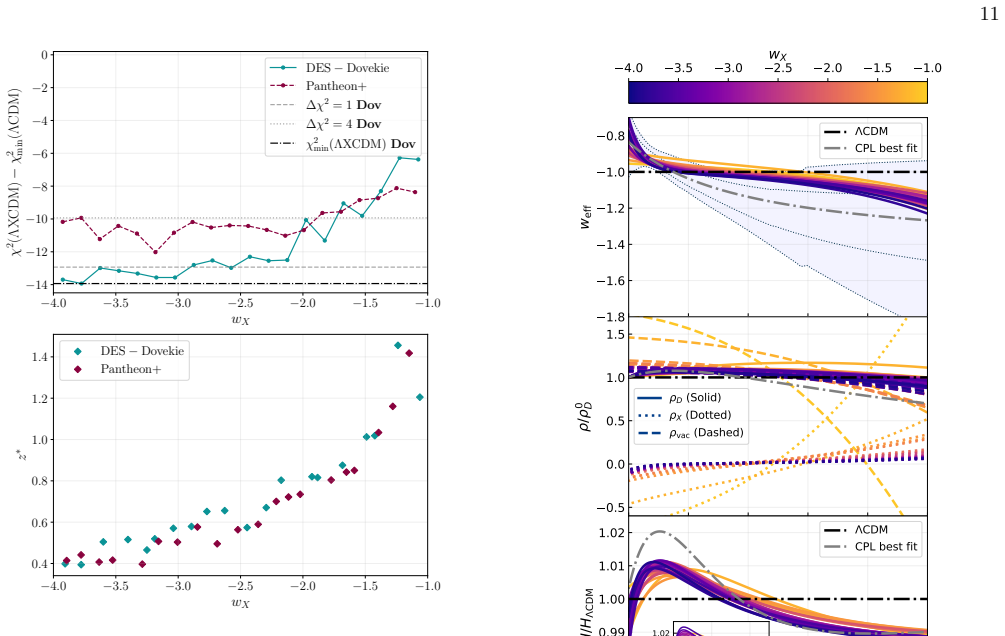
Central claim: the observed dark-energy equation of state is the effective equation of state of a composite fluid—a running vacuum (ρ_vac ∝ H²) plus a 'cosmon' X with constant w_X < −1. Energy exchange makes w_eff = −1 + (1+w_X)Ω_X/Ω_D evolve with redshift. When X is phantom matter (negative energy density today, w_X < −1), Ω_X changes sign, forcing w_eff to cross −1 at redshift z_* ≈ 0.4–0.8 where Ω_X = 0—from phantom in the past to quintessence now. The same conditions bound the future dark-energy/matter ratio at O(1), easing cosmic coincidence.
What carries the argument
The load-bearing object is the effective equation of state of the composite dark-energy fluid, w_eff = −1 + (1+w_X)Ω_X/Ω_D, together with the analytic solution for the cosmon density Ω_X(z). Crossing occurs at the redshift z_* where Ω_X vanishes; this requires both w_X ≠ −1 and a nonzero running-vacuum parameter ν (energy exchange), since for ν = 0 or w_X = −1 no crossing exists. The exchange is controlled by ϵ = ν(1+w_X), and the current phantom-matter character by δ = Ω_X^0(1+w_X). The mechanism works without specifying what X is: a field, a dilaton, or a term from the vacuum effective action of modified gravity.
Load-bearing premise
The mechanism stands or falls on the physical existence of the 'cosmon' as phantom matter—a fluid with constant w_X < −1 and negative energy density that exchanges energy with the vacuum; the paper cites string-theory realizations but does not derive this component from a UV-complete theory.
What would settle it
A precise measurement of the effective dark-energy equation of state that shows no −1 crossing between z ≈ 0.2 and z ≈ 0.9, or a proof that negative-energy fluids with w < −1 cannot exist in a consistent quantum field theory, would falsify the model's core prediction.
If this is right
- If ΛXCDM is correct, the DESI phantom-divide crossing is a real dynamical phenomenon—a signature of energy transfer between vacuum and an extra dark component—not a fitting artifact of the CPL parameterization.
- The model outperforms the standard parameterization statistically: Δχ² about 3–4 lower than CPL and 12–14 lower than ΛCDM, with ΔAIC ≈ 6–8 for ΛXCDM over ΛCDM and ΛCDM excluded at about 2.7–3.0σ.
- The cosmic coincidence problem is eased in the same parameter region: the ratio of dark-energy to matter density remains bounded, r_max = O(1), instead of growing without limit.
- The model predicts a future stopping point where H(z) = 0 followed by recollapse, because the negative-energy cosmon eventually dominates.
- Because the data cannot distinguish w_X below about −2 (profile likelihood plateau), a large family of microphysical realizations of the cosmon all reproduce the same crossing, a form of universality.
Where Pith is reading between the lines
- Editorial inference: the same composite mechanism suggests a bridge to early dark energy: a small (≈1%) negative vacuum contribution at recombination could in principle be tuned to address the Hubble tension, though the paper finds no H0 alleviation with constant w_X.
- Editorial inference: if phantom matter arises from stringy-vacuum bubbles as cited, the model makes a concrete collateral prediction—enhanced formation of massive structures at z ~ 5–10—that deep high-redshift surveys could test; the paper only floats this as a possibility.
- Editorial inference: the plateau in the profile likelihood of w_X implies the data are insensitive to microphysics; a natural extension is to let w_X(z) vary, which the authors suggest might relieve the H0 tension. Testing such an extension would separate the crossing mechanism from the assumption of constant w_X.
- Editorial inference: the crossing mechanism is generic to two-component dark sectors with energy exchange; one could look for the same z_* signature in interacting dark-matter–dark-energy models, though the paper distinguishes its vacuum–cosmon setup from those.
Editorial analysis
A structured set of objections, weighed in public.
Referee Report
Summary. The paper studies the ΛXCDM composite dark-energy model, in which a running vacuum component exchanges energy with a `cosmon' component X. The authors derive the effective equation of state w_eff, locate the phantom-divide crossing redshift z_* (Eq. 25), and fit the model to Planck PR4 CMB, DESI DR2 BAO, and two SNIa compilations (Pantheon+ and DES-Dovekie). They report a preference for a phantom-matter cosmon (w_X<−1, ρ_X^0<0), a crossing at z_*≈0.4–0.55, an improved fit relative to ΛCDM and CPL, and a bounded coincidence ratio r=ρ_D/ρ_m, which they interpret as alleviating the cosmic coincidence problem. The paper argues that the model provides a first-principles explanation of the DESI crossing because the running-vacuum core is QFT motivated and phantom matter appears in stringy versions of the RVM.
Significance. If the theoretical premise were established, the paper would be significant: it would provide a composite, non-parametric dark-energy construction with analytic background equations, a good fit to current cosmological data, and a natural mechanism for the phantom-divide crossing. The numerical analysis is carefully done with public Boltzmann/MCMC tools, the data choices are standard, and the authors are transparent about non-Gaussian posteriors, prior dependence, and the absence of SH0ES and LSS data. The analytic formulas for w_eff, the component densities, and the coincidence ratio are clearly presented. However, the central claim of a first-principles explanation rests on the ad hoc phantom-matter cosmon, which is not derived in the paper, and the crossing redshift is a post-fit function of the fitted parameters rather than an independent prediction. The paper is best read as a phenomenological study of a motivated composite DE model; that weaker framing is defensible, but the current abstract and conclusions claim more.
major comments (3)
- [Secs. 1–2, Eqs. (4)–(9); Sec. 3] The central theoretical claim that ΛXCDM 'from first principles' explains the DESI crossing rests entirely on the phantom-matter cosmon X (ρ_X<0, w_X<−1). X is introduced phenomenologically in Sec. 2; its stringy-RVM justification is only cited (Mavromatos & Solà Peracaula 2021a,b), not derived. The paper explicitly leaves the nature of X unspecified (Sec. 1; Sec. 5). Since negative-energy-density, w_X<−1 components generically require ghost-like degrees of freedom or unbounded potentials, the reader cannot evaluate whether PM is realizable. In Sec. 3 the perturbation implementation sets c_s^2=1, which is not the adiabatic sound speed of the stated barotropic component (c_s^2=w_X<0), thereby sidestepping the stability question. At minimum, this unverified ingredient must be reframed as a phenomenological assumption, or its derivation from the stringy RVM must be supplied.
- [Sec. 2, Eq. (25); Table 1; Fig. 1] The crossing redshift z_* is not an independent prediction. Eq. (25) expresses z_* entirely in terms of the fitted parameters (ν, w_X, Ω_X^0) via ϵ and δ. The signs ν<0, w_X<−1, Ω_X^0<0 that force the phantom-to-quintessence crossing are inferred from the same CMB+BAO+SN data, so 'ΛXCDM naturally performs the crossing as observed by DESI' is a post-fit consistency statement rather than a falsifiable prediction. This is aggravated by the weak constraint on w_X: Table 1 reports only upper bounds w_X<−1.66/−1.96 (95%) with the posterior cut by the prior, and Fig. 1 shows a profile-likelihood plateau for w_X<−2. Consequently z_* has broad 95% ranges (e.g. 0.2–0.9 for one data set), and the match to the DESI crossing redshift should not be presented as a predictive success.
- [Sec. 4, Table 1] The statistical evidence for ΛXCDM over CPL is more modest than the text suggests. Table 1 gives ΔAIC(ΛCDM−CPL)=4.25 and 7.08, and ΔAIC(ΛCDM−ΛXCDM)=6.02 and 7.93; the ΔAIC difference between ΛXCDM and CPL is only 1.77 (Pantheon+) and 0.85 (DES-Dovekie), despite ΛXCDM having one extra parameter. In addition, the quoted 2.68σ/2.97σ exclusions of ΛCDM rely on Wilks' theorem, whose applicability is doubtful here because w_X is prior-limited and the posteriors are non-Gaussian (acknowledged in Sec. 3). The fit is good, but statements such as 'outperforms CPL' and the precise Gaussian significance levels should be softened accordingly.
minor comments (5)
- [Abstract; Table 1] The abstract states a crossing near z≃0.4, but the central values in Table 1 are 0.38 and 0.55 with broad 95% intervals (roughly 0.2–0.9). Please report the crossing redshift with its full uncertainty in the abstract and conclusions.
- [Table 1] The p-value row appears to contain minus signs (e.g. '−0.0162'), which is impossible for a p-value. This is likely a formatting artifact, but it should be corrected.
- [Sec. 3] The text says 'we do not use large-scale structure formation data', but the analysis includes Planck PR4 CMB lensing. Please clarify that no galaxy-clustering or weak-lensing data are used, rather than 'no LSS data'.
- [Sec. 3] The MCMC analysis uses Metropolis-Hastings with a relaxed convergence criterion for ΛXCDM (R−1=0.03). Please include chain lengths, convergence diagnostics, and a data/code availability statement to support reproducibility.
- [Sec. 2, Eq. (16)] The BBN constraint |r_ϵ|≲1% is said to be 'approximately saturated'. Given the sensitivity of light-element abundances to early DE, please state whether the posterior for r_ϵ was checked against an explicit BBN likelihood or only against the cited analytic bound.
Circularity Check
The fit and analytic equations are self-contained; the 'from first principles' status is load-bearing and rests on a self-citation chain (Mavromatos & Solà Peracaula 2021a,b) rather than on a derivation in this paper.
specific steps
-
self citation load bearing
[Abstract; Sec. 4 (Discussion); Sec. 5 (Conclusions)]
"Given that PM appears in stringy versions of the R VM, the ΛXCDM appears to be a composite DDE model with a good chance of explaining the crossing of the phantom divide from first principles. ... there exist theoretical developments in the context of the stringy version of the R VM providing a raison d’être for the notion of PM at a fundamental level (Mavromatos & Solà Peracaula 2021b,a). ... we have left completely unspecified the nature of the cosmon X and we have just assumed that its EoS is constant (wX = const.) and lies somewhere in the deep PM domain."
The paper's 'from first principles' claim is the central theoretical payoff. That claim is not earned by a derivation in this paper: phantom matter (w_X < -1, rho_X < 0) is introduced as an assumption in Sec. 2, and the only fundamental justification offered is a citation to Mavromatos & Solà Peracaula (2021a,b), prior works with overlapping authorship. The paper explicitly concedes that X's nature is unspecified. Thus the load-bearing premise of the 'first principles' interpretation reduces to a self-citation chain rather than an independent, demonstrated result. The analytic equations and the numerical fit remain self-contained; what is circular is labeling an assumed, self-cited ingredient as 'from first principles.'
full rationale
The core derivation is not circular in the strict sense. Equations (1)-(25) form a self-contained construction: w_eff is defined from rho_vac and rho_X; Omega_X(z) and Omega_vac(z) are solved from the assumed conservation and running-vacuum form; the crossing redshift z* is obtained by setting Omega_X=0. This chain does not secretly assume the DESI crossing; in other regions of parameter space the model can fail to cross or cross at different redshifts. The MCMC analysis is a genuine comparison against external CMB, BAO, and SNIa data, with honest priors and with explicit caveats about non-Gaussianity, w_X prior dependence, and the unspecified nature of X. The crossing redshift quoted for the model is a post-fit derived quantity rather than an independent prediction, but the paper does not present it as a withheld-data prediction, so I do not flag it as fitted-input-called-prediction. The main circularity is narrower and load-bearing only for the theoretical interpretation: the 'first principles' status of phantom matter is imported from the authors' own earlier stringy-RVM papers and not derived or tested here. This warrants score 4 rather than 0, but not higher, because the fit, the model equations, and the coincidence-alleviation bound are independent content.
Axiom & Free-Parameter Ledger
free parameters (3)
- ϵ ≡ ν(1+w_X) (running-vacuum coupling combination) =
≈0.024 (Pantheon+), ≈0.026 (DES-Dovekie); implies ν≈−0.013
- w_X (cosmon equation of state) =
prior −4 ≤ w_X ≤ −1; 95% upper bounds <−1.66 (Pan), <−1.96 (Dov)
- δ ≡ Ω_X^0(1+w_X) (normalized cosmon density combination) =
≈0.11 (Pan), ≈0.15 (Dov); implies Ω_X^0≈−0.06/−0.07
axioms (6)
- standard math Flat FLRW background; matter (dust/radiation) is self-conserved
- domain assumption RVM form ρ_vac(H)=ρ_vac^0+(3ν/8π)(H²−H₀²)m_Pl²
- domain assumption Canonical vacuum EoS P_vac=−ρ_vac
- domain assumption Cosmon X has constant EoS w_X and exchanges energy only with the vacuum
- ad hoc to paper Phantom matter (ρ_X<0, w_X<−1) is physically realizable
- domain assumption Dark energy does not cluster; sound speed c_s²=1
invented entities (1)
-
Cosmon X as phantom matter (ρ_X<0, w_X<−1)
no independent evidence
read the original abstract
Composite dynamical dark energy (DDE) has recently been explored as an efficient way to help cure cosmological tensions through the so-called $w$XCDM model {Gomez-Valent:2024tdb,Gomez-Valent:2024ejh}, a toy-model version of the $\Lambda$XCDM model {Grande:2006nn}. The latter is a composite running vacuum model (RVM) that involves a DE component $X$ (`cosmon') of generic nature. We compute the effective equation of state of $\Lambda$XCDM and use state-of-the-art techniques to fit this model to two standard sets of cosmological data, one involving SNIa from Pantheon$+$ and the other SNIa from DES-Dovekie, in addition to BAO data from DESI DR2 and the CMB data from Planck PR4. We do not use large scale structure formation data for this analysis nor the SH0ES calibration of $H_0$. We find that $\Lambda$XCDM naturally performs the crossing of the phantom divide as observed by DESI near $z\simeq 0.4$ using the $w_0w_a$CDM parameterization, a feature well favored by existing model-agnostic analyzes of the same data {Gonzalez-Fuentes:2025lei,Gonzalez-Fuentes:2026rgu}. It turns out that the cosmon $X$ behaves as `phantom matter' (PM) near the present, which in contrast to usual phantom DE satisfies the strong energy condition (as ordinary matter) and furnishes positive pressure ($P_X>-\rho_X>0$) at the expense of negative energy density ($\rho_X<0$). $\Lambda$XCDM provides a better fit than $w_0w_a$CDM and, as a bonus, alleviates the cosmic coincidence problem. Given that PM appears in stringy versions of the RVM, the $\Lambda$XCDM appears to be a composite DDE model with a good chance of explaining the crossing of the phantom divide from first principles, therefore providing theoretical support to the DESI observations inferred from generic parameterizations of the DE.
Figures


Reference graph
Works this paper leans on
-
[1]
Abbott, T. M. C., et al. 2024, Astrophys. J. Lett., 973, L14, 10.3847/2041-8213/ad6f9f
-
[2]
---. 2026. 2602.10065
arXiv 2026
-
[3]
2022, JHEAp, 34, 49, 10.1016/j.jheap.2022.04.002
Abdalla, E., et al. 2022, JHEAp, 34, 49, 10.1016/j.jheap.2022.04.002
-
[4]
Abdul Karim, M., et al. 2025, Phys. Rev. D, 112, 083515, 10.1103/tr6y-kpc6
-
[5]
Adame, A. G., et al. 2025, JCAP, 02, 021, 10.1088/1475-7516/2025/02/021
-
[6]
Ade, P. A. R., et al. 2016, Astron. Astrophys., 594, A13, 10.1051/0004-6361/201525830
-
[7]
Adil, S. A., Mukhopadhyay, U., Sen, A. A., & Vagnozzi, S. 2023, JCAP, 10, 072, 10.1088/1475-7516/2023/10/072
-
[8]
Aghanim, N., et al. 2020, Astron. Astrophys., 641, A6, 10.1051/0004-6361/201833910
-
[9]
Akaike, H. 1974, IEEE Trans. Autom. Control, 19, 716, 10.1109/TAC.1974.1100705
arXiv 1974
-
[10]
Akarsu, \"O ., Barrow, J. D., Escamilla, L. A., & Vazquez, J. A. 2020, Phys. Rev. D, 101, 063528, 10.1103/PhysRevD.101.063528
-
[11]
Akarsu, \"O ., Kumar, S., \"Oz\"ulker, E., & Vazquez, J. A. 2021, Phys. Rev. D, 104, 123512, 10.1103/PhysRevD.104.123512
-
[12]
O ., Perivolaropoulos, L., Y \
Akarsu, \"O ., Perivolaropoulos, L., Y \"u kselci, A. E., & Zhuk, A. 2026. 2606.11062
Pith/arXiv arXiv 2026
-
[13]
Akarsu, \"O ., et al. 2023. 2307.10899
Pith/arXiv arXiv 2023
-
[14]
Alestas, G., Kazantzidis, L., & Perivolaropoulos, L. 2021, Phys. Rev. D, 103, 083517, 10.1103/PhysRevD.103.083517
-
[15]
Alestas, G., et al. 2022, Phys. Rev. D, 105, 063538, 10.1103/PhysRevD.105.063538
-
[16]
Asimakis, P., Basilakos, S., Mavromatos, N. E., & Saridakis, E. N. 2022, Phys. Rev. D, 105, 084010, 10.1103/PhysRevD.105.084010
-
[17]
Bansal, P., & Huterer, D. 2026, Phys. Rev. D, 113, 103539, 10.1103/ydnj-myzb
-
[18]
Basilakos, S., & Sol\`a, J. 2014, Mon. Not. Roy. Astron. Soc., 437, 3331, 10.1093/mnras/stt2135
-
[19]
2010, JCAP, 12, 029, 10.1088/1475-7516/2010/12/029
Bauer, F., Sola, J., & Stefancic, H. 2010, JCAP, 12, 029, 10.1088/1475-7516/2010/12/029
-
[20]
Beltr \'a n Jim \'e nez, J., Heisenberg, L., & Koivisto, T. 2018, Phys. Rev. D, 98, 044048, 10.1103/PhysRevD.98.044048
-
[21]
Berti, M., Bellini, E., Bonvin, C., et al. 2025, Phys. Rev. D, 112, 023518, 10.1103/dj3k-84v4
-
[22]
2011, JCAP, 1107, 034, 10.1088/1475-7516/2011/07/034
Blas, D., Lesgourgues, J., & Tram, T. 2011, JCAP, 1107, 034, 10.1088/1475-7516/2011/07/034
-
[23]
Bouhmadi-L \'o pez, M., Chiang, H.-W., & Ibarra-Uriondo, B. 2026. 2607.05044
Pith/arXiv arXiv 2026
-
[24]
Brout, D., et al. 2022, Astrophys. J., 938, 110, 10.3847/1538-4357/ac8e04
-
[25]
Cai, R.-G., & Wang, S.-J. 2026, Res. Astron. Astrophys., 26, 084011, 10.1088/1674-4527/ae842f
-
[26]
Cai, Y., Ren, X., Qiu, T., Li, M., & Zhang, X. 2026, Natl. Sci. Rev., 13, nwag115, 10.1093/nsr/nwag115
-
[27]
Cai, Y.-F., Capozziello, S., De Laurentis, M., & Saridakis, E. N. 2016, Rept. Prog. Phys., 79, 106901, 10.1088/0034-4885/79/10/106901
-
[28]
2024, JCAP, 10, 048, 10.1088/1475-7516/2024/10/048
Calder\'on, R., et al. 2024, JCAP, 10, 048, 10.1088/1475-7516/2024/10/048
-
[29]
Capozziello, S., & De Laurentis, M. 2011, Phys. Rept., 509, 167, 10.1016/j.physrep.2011.09.003
-
[30]
2022, JCAP, 09, 039, 10.1088/1475-7516/2022/09/039
Carron, J., Mirmelstein, M., & Lewis, A. 2022, JCAP, 09, 039, 10.1088/1475-7516/2022/09/039
-
[31]
Chakraborty, A., Chanda, P. K., Das, S., & Dutta, K. 2025, JCAP, 11, 047, 10.1088/1475-7516/2025/11/047
-
[32]
Chakraborty, A., Ray, T., Das, S., Banerjee, A., & Ganesan, V. 2026, Astrophys. J., 998, 83, 10.3847/1538-4357/ae2ff8
-
[33]
Chevallier, M., & Polarski, D. 2001, Int. J. Mod. Phys., D10, 213, 10.1142/S0218271801000822
-
[34]
Cook, C., & Meyers, J. 2026, Phys. Rev. D, 113, 043519, 10.1103/hylg-qgmj
-
[35]
Das, S., Corasaniti, P. S., & Khoury, J. 2006, Phys. Rev. D, 73, 083509, 10.1103/PhysRevD.73.083509
-
[36]
de Cruz P \'e rez, J., G \'o mez-Valent, A., & Sol \`a Peracaula, J. 2026, Phys. Rev. D, 113, 083521, 10.1103/xchk-xlk1
-
[38]
---. 2021 b , Astropart. Phys., 131, 102604, 10.1016/j.astropartphys.2021.102604
arXiv 2021
-
[39]
2019, 10.21105/astro.1910.00483
Efstathiou, G., & Gratton, S. 2019, 10.21105/astro.1910.00483
Pith/arXiv arXiv 2019
-
[40]
Errahmani, A., Magrach, M., Dahmani, S., Bouali, A., & Ouali, T. 2026, Phys. Lett. B, 872, 140040, 10.1016/j.physletb.2025.140040
arXiv 2026
-
[41]
Favale, A., G \'o mez-Valent, A., & Migliaccio, M. 2024, Phys. Lett. B, 858, 139027, 10.1016/j.physletb.2024.139027
arXiv 2024
-
[42]
Forconi, M., Favale, A., & G \'o mez-Valent, A. 2025, Phys. Rev. D, 112, 023517, 10.1103/rpf5-ldks
-
[43]
Gelman, A., & Rubin, D. B. 1992, Statistical Science, 7, 457, 10.1214/ss/1177011136
arXiv 1992
-
[44]
Goh, L. W. K., & Taylor, A. N. 2025, Mon. Not. Roy. Astron. Soc., 544, 3142, 10.1093/mnras/staf1927
-
[45]
G \'o mez-Valent, A. 2022, Phys. Rev. D, 106, 063506, 10.1103/PhysRevD.106.063506
-
[46]
G\'omez-Valent, A., Favale, A., Migliaccio, M., & Sen, A. A. 2024, Phys. Rev. D, 109, 023525, 10.1103/PhysRevD.109.023525
-
[47]
G \'o mez-Valent, A., & Gonz \'a lez-Fuentes, A. 2026, Phys. Lett. B, 872, 140096, 10.1016/j.physletb.2025.140096
arXiv 2026
-
[48]
G\'omez-Valent, A., Mavromatos, N. E., & Sol\`a Peracaula, J. 2023, Class. Quant. Grav., 41, 015026, 10.1088/1361-6382/ad0fb8
-
[49]
G \' o mez-Valent, A., & Sol \` a Peracaula, J. 2018, Mon. Not. Roy. Astron. Soc., 478, 126, 10.1093/mnras/sty1028
-
[50]
G\'omez-Valent, A., & Sol \`a Peracaula, J. 2024, Astrophys. J., 975, 64, 10.3847/1538-4357/ad7a62
-
[51]
G \'o mez-Valent, A., & Sol \`a Peracaula, J. 2025, Phys. Lett. B, 864, 139391, 10.1016/j.physletb.2025.139391
arXiv 2025
-
[52]
G \'o mez-Valent, A., Zheng, Z., & Amendola, L. 2026. 2604.12032
Pith/arXiv arXiv 2026
-
[53]
G \'o mez-Valent, A., Zheng, Z., Amendola, L., Pettorino, V., & Wetterich, C. 2021, Phys. Rev. D, 104, 083536, 10.1103/PhysRevD.104.083536
-
[54]
2025, JCAP, 12, 049, 10.1088/1475-7516/2025/12/049
Gonz \'a lez-Fuentes, A., & G \'o mez-Valent, A. 2025, JCAP, 12, 049, 10.1088/1475-7516/2025/12/049
-
[55]
2026, JCAP, 07, 040, 10.1088/1475-7516/2026/07/040
---. 2026, JCAP, 07, 040, 10.1088/1475-7516/2026/07/040
-
[56]
Grande, J., Pelinson, A., & Sol\`a, J. 2009, Phys. Rev. D, 79, 043006, 10.1103/PhysRevD.79.043006
-
[57]
2006, JCAP, 08, 011, 10.1088/1475-7516/2006/08/011
Grande, J., Sol\`a, J., & Stefancic, H. 2006, JCAP, 08, 011, 10.1088/1475-7516/2006/08/011
-
[58]
---. 2007, Phys. Lett. B, 645, 236, 10.1016/j.physletb.2006.12.040
-
[59]
Harko, T., Lobo, F. S. N., Nojiri, S., & Odintsov, S. D. 2011, Phys. Rev. D, 84, 024020, 10.1103/PhysRevD.84.024020
-
[60]
1970, Biometrika, 57, 97, 10.1093/biomet/57.1.97
Hastings, W. 1970, Biometrika, 57, 97, 10.1093/biomet/57.1.97
-
[61]
Heisenberg, L., Villarrubia-Rojo, H., & Zosso, J. 2022, Phys. Rev. D, 106, 043503, 10.1103/PhysRevD.106.043503
-
[62]
Jiang, J.-Q., Pedrotti, D., da Costa, S. S., & Vagnozzi, S. 2024, Phys. Rev. D, 110, 123519, 10.1103/PhysRevD.110.123519
-
[63]
Keeley, R. E., & Shafieloo, A. 2023, Phys. Rev. Lett., 131, 111002, 10.1103/PhysRevLett.131.111002
-
[64]
Khoury, J., Lin, M.-X., & Trodden, M. 2025, Phys. Rev. Lett., 135, 181001, 10.1103/w4qb-plk8
-
[65]
Knox, L., & Millea, M. 2020, Phys. Rev. D, 101, 043533, 10.1103/PhysRevD.101.043533
-
[66]
Krishnan, C., Mohayaee, R., Colg \'a in, E. \'O ., Sheikh-Jabbari, M. M., & Yin, L. 2021, Class. Quant. Grav., 38, 184001, 10.1088/1361-6382/ac1a81
-
[67]
2023, Nature, 616, 266, 10.1038/s41586-023-05786-2
Labb\'e, I., et al. 2023, Nature, 616, 266, 10.1038/s41586-023-05786-2
-
[68]
Lee, B.-H., Lee, W., Colg \'a in, E. \'O ., Sheikh-Jabbari, M. M., & Thakur, S. 2022, JCAP, 04, 004, 10.1088/1475-7516/2022/04/004
-
[69]
Lesgourgues, J. 2011. 1104.2932
Pith/arXiv arXiv 2011
-
[70]
Lewis, A. 2019. 1910.13970
Pith/arXiv arXiv 2019
-
[71]
Li, J.-X., & Wang, S. 2025, Eur. Phys. J. C, 85, 1308, 10.1140/epjc/s10052-025-15065-1
-
[72]
Li, T.-N., Giar \`e , W., Du, G.-H., et al. 2026. 2601.07361
Pith/arXiv arXiv 2026
-
[73]
Linder, E. V. 2003, Phys. Rev. Lett., 90, 091301, 10.1103/PhysRevLett.90.091301
-
[74]
Lodha, K., et al. 2025, Phys. Rev. D, 112, 083511, 10.1103/w4c6-1r5j
-
[75]
Marra, V., & Perivolaropoulos, L. 2021, Phys. Rev. D, 104, L021303, 10.1103/PhysRevD.104.L021303
-
[76]
Matei, T. M., Croitoru, C., & Harko, T. 2026, Phys. Dark Univ., 53, 102362, 10.1016/j.dark.2026.102362
arXiv 2026
-
[77]
Mavromatos, N. E., & Sol\`a Peracaula, J. 2021 a , Eur. Phys. J. ST, 230, 2077, 10.1140/epjs/s11734-021-00197-8
-
[78]
---. 2021 b , Eur. Phys. J. Plus, 136, 1152, 10.1140/epjp/s13360-021-02149-6
-
[79]
Menci, N., Adil, S. A., Mukhopadhyay, U., Sen, A. A., & Vagnozzi, S. 2024, JCAP, 07, 072, 10.1088/1475-7516/2024/07/072
-
[80]
Metropolis, N., et al. 1953, J. Chem. Phys., 21, 1087, 10.1063/1.1699114
-
[81]
Montani, G., Navone, I., Dainotti, M. G., & Nagataki, S. 2026, 10.1103/xthk-9854
discussion (0)
Sign in with ORCID, Apple, or X to comment. Anyone can read and Pith papers without signing in.