REVIEW 5 major objections 5 minor 74 references
This paper claims that a person's weight, height, and body mass index can be estimated from a single unconstrained photo using multi-task deep learning, with the best full-body results reaching a mean absolute error of 3.32 BMI points.
Reviewed by Pith at T0; open to challenge. T0 means a machine referee read the full paper against a public rubric. the ladder, T0–T4 →
T0 review · deepseek-v4-flash
2026-08-01 02:22 UTC pith:W7KPCQOJ
load-bearing objection New dataset idea worth tracking, but the empirical claims, especially on height, aren't supported by the numbers as reported. the 5 major comments →
Weight and Height Estimation from a Single Human Image Captured in the Wild
The pith
A machine-rendered reading of the paper's core claim, the machinery that carries it, and where it could break.
Core claim
The paper claims that a single everyday photograph of a person — taken in the wild, with varied pose, background, clothing, and without controlled camera geometry — contains enough visual information to estimate that person's weight, height, and Body Mass Index, and that doing the three estimations jointly (multi-task regression) is more accurate than estimating them separately. On the authors' newly collected dataset of 6,105 social-media images of people sharing weight-loss or weight-gain progress, the multi-task regression network using full-body images reaches a mean absolute error of 3.32 BMI points, 12.60 kg in weight, and 0.08 m in height, outperforming face-only and upper-body inputs
What carries the argument
The central mechanism is hard-parameter-sharing multi-task learning: a shared convolutional backbone with three task-specific regression heads that jointly estimate normalized height, weight, and BMI. Because these quantities are physically correlated, the shared representation is meant to capture body shape and scale cues that benefit all three tasks, outperforming single-task regressors. The accompanying benchmark dataset — 6,105 unconstrained images with self-reported height/weight labels — provides the scale and diversity needed to train such networks, and the paper also experiments with pose-affinity maps, monocular depth maps, and foreground masks as auxiliary input modalities.
Load-bearing premise
The claim rests on the assumption that the self-reported heights and weights attached to the scraped social-media photos are accurate and correctly matched to the person in each image, yet no verification or error model is provided.
What would settle it
Collect a subset of the dataset images, have the same people measured in a controlled setting (or ask them to re-submit measurements), and compare the labels; if self-report error exceeds the reported MAE margins, the benchmark numbers are not reliable. Alternatively, test the trained model on a separate corpus of images with medically verified height/weight and observe whether MAE degrades substantially.
If this is right
- If the authors' multi-task regression result holds, a single full-body photo can estimate BMI to within about 3.3 points (mean absolute error), weight to within 12.6 kg, and height to within 0.08 m — an accuracy range that makes automatic health screening from everyday photos feasible.
- Jointly learning height, weight, and BMI in one network is consistently more accurate than learning them separately, so future systems for physical-attribute estimation should adopt multi-task architectures.
- The new dataset of 6,105 in-the-wild images with self-reported height/weight labels — intended for public release — would give the research community a benchmark for body-based BMI estimation that previously did not exist.
- Using full-body images instead of face-only or upper-body crops improves all three estimations, indicating that body shape carries the most relevant cues for these attributes.
- Coarse BMI classification into WHO categories reaches about 65% accuracy with 81% area under the curve, which is enough for population-level trend monitoring but not for individual medical diagnosis.
Where Pith is reading between the lines
- The reported accuracies are measured on a random split of the same social-media distribution the model was trained on; a truly independent test set (e.g., clinical intake photos) is needed before the numbers can be trusted for real-world deployment.
- The labels are self-reported and the paper describes no verification; under-reported weight or over-reported height would bias both training and evaluation, so a noise-aware model or a verified subset could change results.
- The manuscript contains placeholder sections on transformer architectures, suggesting that more modern attention-based models were contemplated but not evaluated; they might outperform the convolutional backbones tested.
- The method's sensitivity to pose, clothing, and occlusion is not analyzed; a stratified error analysis by these factors would define the operational envelope of the approach.
Editorial analysis
A structured set of objections, weighed in public.
Referee Report
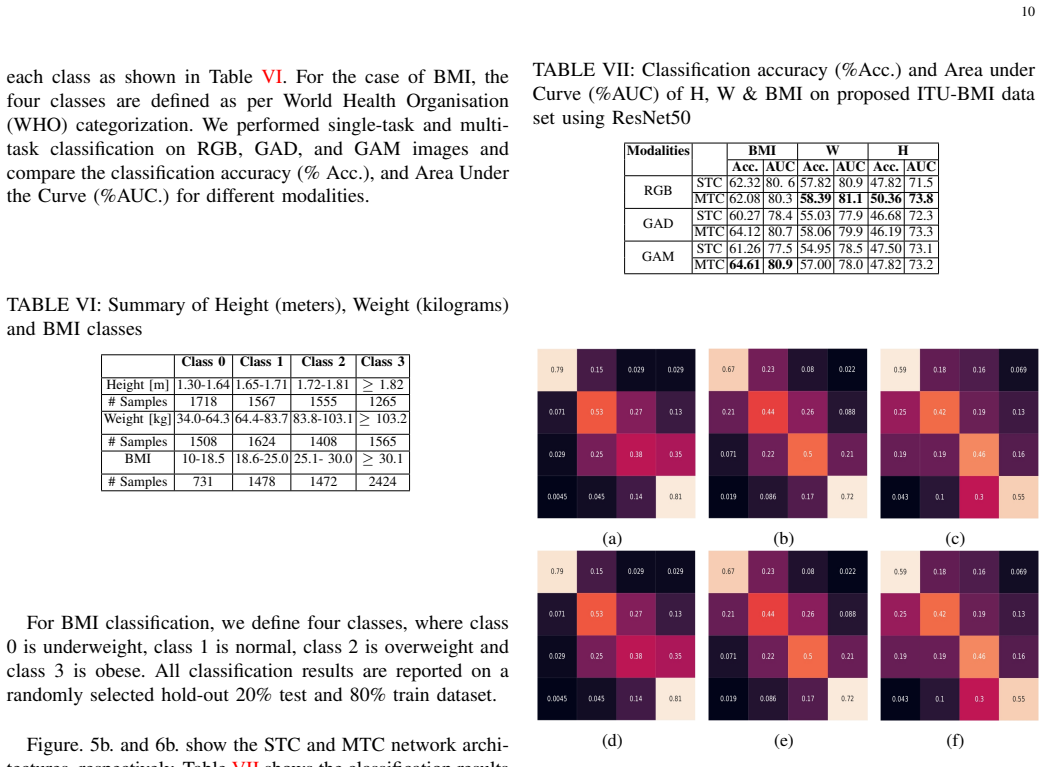
Summary. The paper introduces ITU-BMI, a dataset of 6,105 social-media images labeled with self-reported height, weight, and BMI, and evaluates deep CNN architectures (ResNet-50, DenseNet-121, VGG-16) for regression and classification of these attributes. It compares single-task and multi-task learning on RGB images and on fused GAD/GAM modality images, reporting that multi-task regression (MTR) consistently achieves lower MAE than single-task regression and earlier methods, and that full-body images outperform face-only or upper-body inputs. The manuscript also reports classification accuracy and AUC for BMI, weight, and height.
Significance. If the empirical claims were well supported, the dataset and the multi-task design would be a useful benchmark for in-the-wild body-metric estimation, and the multimodal fusion study would inform practical deployment. The paper's assets are the relatively large in-the-wild image collection, the attempt to combine multiple input modalities, and the systematic comparison of STR/MTR/STC/MTC across several backbones. However, the paper does not yet provide the evidence needed to support the headline claims: there is no trivial baseline, no error bars or significance tests, and no label-verification protocol. The contribution is therefore currently suggestive rather than established.
major comments (5)
- [VI-B, Table II; Fig. 2(a)] The reported height MAE of 0.08 m is not interpretable without a mean-predictor baseline. Given the height distribution in Fig. 2(a) (1.40–2.20 m, peak 1.63–1.73 m), a model that always predicts the training mean can achieve MAE ≈ 0.8σ, which is ≈ 0.08 m when σ ≈ 0.10 m. All height entries in Tables II, III, and V fall in this range, and the near-identical values across input modalities and backbones are consistent with the model predicting the marginal mean rather than image-specific height. The authors should report null baselines for each target on each dataset/split, with confidence intervals, and demonstrate that the reported improvements are statistically significant.
- [IV; all regression/classification tables] The ground-truth height and weight labels are self-reported values scraped from reddit and imgur. The text states that uploaded images come with exact measurements, but no verification protocol is described: there is no manual audit, no exclusion of motivational or deliberately mislabeled posts, and no error model for self-reported measurements. Since every MAE and accuracy value in Tables II–VIII is computed against these labels, systematic bias or random label noise directly affects all conclusions. The authors should provide a label-quality audit on a sample, cross-checks where the same user appears in multiple posts, and a sensitivity analysis under plausible label-noise levels.
- [VI-A; Tables II–V] All results come from a single random 80/20 split, with no repeated splits, cross-validation, or significance tests. Hyperparameters are described as empirically found without a separate validation set. The smallest reported differences — for example, STR vs MTR height of 0.09 vs 0.08 on ITU-BMI B, or the backbone differences in Table V — are within the likely sampling noise of a 537-image test set. The authors should report means and standard deviations across multiple splits and perform paired significance tests for STR vs MTR and for backbone comparisons.
- [VI-A; Table II] The description of ITU-BMI B is ambiguous. The text says the 6,105 images are randomly divided into 80/20 train/test, and then says the 537 full-body images are "taken from test set only" and define ITU-BMI B. If this is literal, no model was trained on ITU-BMI B, making the B row in Table II not a valid evaluation of a model trained on that subset. If the intended meaning is simply that B is a subset of the full corpus, this should be stated and the overlap between ITU-BMI, ITU-BMI B, ITU-BMI U, and ITU-BMI F clarified. The small B-subset size also reinforces the need for confidence intervals.
- [VI-C, Table VII] The text states that "multi-task classification (MTC) has performed better than single-task classification (STC) in all experiments," but Table VII shows RGB BMI accuracy of 62.32 for STC versus 62.08 for MTC, and several other MTC-vs-STC differences are under one percentage point. This contradicts the stated claim. The authors should correct the claim, report whether any of the differences are statistically significant, and qualify the multi-task advantage accordingly.
minor comments (5)
- [V-D, V-E] Subsections V-D and V-E are empty headings ("Transformers for BMI Classification and Regression" and "Transformers for MTC and MTR of BMI, Weight and Height"). Either the content is missing or these headings should be removed. As written, the manuscript is incomplete.
- [VIII] The conclusion says the dataset is "labelled into five categories including under-weight, normal, over-weight, and obese," but four categories are listed and used. Please correct the count.
- [VI-C] The text reports "the heighest correlation is found between height and BMI which is 0.80, and between weight and BMI is 0.58." These values are surprising for a population where BMI is computed from weight and height, and they are not accompanied by a definition of the correlation or a table. Please clarify how these correlations were computed and correct the typo.
- [V-C] The paper says experiments include "RGB and gray scale image representations," but the reported modality results are RGB, GAD, and GAM. No gray-scale-only results appear in any table. Please either report grayscale results or revise the text.
- [VI-B, Table II] The phrase "significantly better" and "significantly larger error" is used repeatedly, but no significance tests are reported anywhere. Please replace these terms with quantitative claims or add statistical tests.
Circularity Check
No circular derivation: the claimed MTR advantage is an empirical comparison, not a quantity forced by construction from the model's inputs or fitted parameters.
full rationale
This is an empirical supervised-learning study, not a derivation chain. Height, weight, and BMI are external labels; the losses in Eqs. (1)-(4) train networks to predict those labels from images, and the reported MAEs in Tables II-VII are measured errors, not outputs of the loss equations. Target normalization in Eq. (1) is invertible and does not make a prediction equal to the training fit. There is no load-bearing self-citation: the paper does not cite the authors' own prior work to justify the central claim, and the comparisons to Jiang et al. and Dantcheva et al. are reported as replicated baselines. The MTL loss weights lambda_1-lambda_6 are tuned rather than ablated, but this is hyperparameter selection, not a fitted parameter renamed as a prediction. The manuscript does contain empty section headers 'D. Transformers for BMI Classification and Regression' and 'E. Transformers for MTC and MTR of BMI, Weight and Height' (Section V), which are omitted content; likewise, the absence of a trivial mean-predictor baseline and significance tests weakens the height-MAE evidence (Section VI-B). These are completeness and rigor issues, not circularity: no result here reduces by construction to its own inputs.
Axiom & Free-Parameter Ledger
free parameters (3)
- Multi-task loss weights λ1..λ6 =
not reported
- Height/weight/BMI classification cut points =
Table VI intervals
- Training hyperparameters (learning rate, decay, batch size, epochs) =
0.001, 0.0008, 16, ≥100
axioms (2)
- domain assumption Social-media self-reported weights and heights are sufficiently accurate ground truth
- domain assumption Absolute height and weight are identifiable from a single uncalibrated 2D image
Cite this review
Pith. "Pith review of Weight and Height Estimation from a Single Human Image Captured in the Wild." pith.science (2026). https://pith.science/paper/W7KPCQOJ
@misc{pith2026260726104,
  author       = {Pith},
  title        = {Pith review of: Weight and Height Estimation from a Single Human Image Captured in the Wild},
  year         = {2026},
  howpublished = {\url{https://pith.science/paper/W7KPCQOJ}},
  note         = {Machine review of arXiv:2607.26104}
}
read the original abstract
A person's physical characteristics such as weight and height are important indicators of his physical and mental health, daily life routines and finances. Body Mass Index (BMI) is a well known measure that encodes the characteristics of both the weight and the height. BMI has been used as a self-monitoring tool, and it has long-term implications on one's life. For example, it may help predicting the risk of various diseases and estimating longevity. Automatic BMI estimation using a single person image in the wild is a challenging task due to wide variations in human pose, camera geometry, personal appearance and distracting backgrounds. In this paper, we explore the performance of deep neural networks using single and multi-task learning by employing different modalities including RGB, depth-maps, pose-affinity maps, and edge-maps to predict BMI, weight, and height from daily life images available on social networking websites. Currently, no full body image dataset for BMI estimation is publicly available, therefore we propose a new dataset consisting of 6105 images with ground truth labels of height, weight and BMI. Our proposed dataset is collected in the wild containing images from various ethnicity and distributed over varying age groups and gender. It consists of frontal, back, full and half body, side poses, mirror selfies with varying backgrounds and scale variations and may contain artifacts hiding partial or full face. Extensive experimentation is performed using full body, half body and face images only using different CNN backbones including VGG, Densenet and ResNet. Our experimental results demonstrate that full body images have produced better results than the other half body and facial images in the wild.
Figures




Reference graph
Works this paper leans on
-
[1]
What else does your biometric data reveal? A survey on soft biometrics.IEEE Transactions on Information Forensics and Security, volume 11, number 3, pages 441–
Dantcheva, Antitza and Elia, Petros and Ross, Arun. What else does your biometric data reveal? A survey on soft biometrics.IEEE Transactions on Information Forensics and Security, volume 11, number 3, pages 441–
-
[2]
Gonzalez-Sosa, Ester and Fierrez, Julian and Vera- Rodriguez, Ruben and Alonso-Fernandez, Fernando. Fa- cial soft biometrics for recognition in the wild: Recent works, annotation, and COTS evaluation.IEEE Transac- tions on Information Forensics and Security, volume 13, number 8, pages 2001–2014. IEEE, 2018
2001
-
[3]
Neal, Tempestt J and Woodard, Damon L. You are not acting like yourself: A study on soft biometric classification, person identification, and mobile device use.IEEE Transactions on Biometrics, Behavior, and Identity Science, volume 1, number 2, pages 109–122. IEEE, 2019
2019
-
[4]
Show me your face and I will tell you your height, weight and body mass index.2018 24th International Conference on Pattern Recognition (ICPR), pages 3555–
Dantcheva, Antitza and Bremond, Francois and Bilinski, Piotr. Show me your face and I will tell you your height, weight and body mass index.2018 24th International Conference on Pattern Recognition (ICPR), pages 3555–
2018
-
[5]
Face-to-bmi: Using computer vision to infer body mass index on social media.Eleventh In- ternational AAAI Conference on Web and Social Media,
Kocabey, Enes and Camurcu, Mustafa and Ofli, Ferda and Aytar, Yusuf and Marin, Javier and Torralba, Antonio and Weber, Ingmar. Face-to-bmi: Using computer vision to infer body mass index on social media.Eleventh In- ternational AAAI Conference on Web and Social Media,
-
[6]
Body Weight Analysis from Human Body Images.IEEE Transactions on Information Forensics and Security
Jiang, Min and Guo, Guodong. Body Weight Analysis from Human Body Images.IEEE Transactions on Information Forensics and Security. IEEE, 2019. 1, 2, 3, 4, 8
2019
-
[7]
Detecting Diabetes Risk from Social Media Activity.Proceedings of the Ninth International Work- shop on Health Text Mining and Information Analysis, pages 1–11, 2018
Bell, Dane and Laparra, Egoitz and Kousik, Aditya and Ishihara, Terron and Surdeanu, Mihai and Kobourov, Stephen. Detecting Diabetes Risk from Social Media Activity.Proceedings of the Ninth International Work- shop on Health Text Mining and Information Analysis, pages 1–11, 2018. 1 12
2018
-
[8]
Obesity and cancer: an update of the global impact.Cancer epidemiology, volume 41, pages 8–15
Arnold, Melina and Leitzmann, Michael and Freisling, Heinz and Bray, Freddie and Romieu, Isabelle and Renehan, Andrew and Soerjomataram, Isabelle. Obesity and cancer: an update of the global impact.Cancer epidemiology, volume 41, pages 8–15. Elsevier, 2016. 1
2016
-
[9]
Lewis, Matthew T and Lujan, Heidi L and Tonson, Anne and Wiseman, Robert W and DiCarlo, Stephen E. Obesity and inactivity, not hyperglycemia, cause exercise intolerance in individuals with type 2 diabetes: Solving the obesity and inactivity versus hyperglycemia causality dilemma.Medical hypotheses, volume 123, pages 110–
-
[10]
Epigenetics in human obesity and type 2 diabetes.Cell metabolism
Ling, Charlotte and R ¨onn, Tina. Epigenetics in human obesity and type 2 diabetes.Cell metabolism. Elsevier,
-
[11]
Asthma and obesity as pre- dictors of severe obstructive sleep apnea in an adolescent pediatric population.The Laryngoscope
Narayanan, Ajay and Yogesh, Ahana and Mitchell, Ron B and Johnson, Romaine F. Asthma and obesity as pre- dictors of severe obstructive sleep apnea in an adolescent pediatric population.The Laryngoscope. Wiley Online Library, 2019. 1
2019
-
[12]
Elucidation of causal direction between asthma and obesity: a bi-directional Mendelian randomization study
Xu, Shujing and Gilliland, Frank D and Conti, David V . Elucidation of causal direction between asthma and obesity: a bi-directional Mendelian randomization study. International journal of epidemiology, 2019. 1
2019
-
[13]
Association of Metabolic Obesity and BMI Status with Severity of Angiographic Coronary Artery Disease in Stable Angina Patients
Uppunda, Deepak and Shetty, Ranjan K and Rao, Pragna and Razak, Abdul and Shetty, Kiran and Chauhan, Shee- tal and Singh, Ajit and others. Association of Metabolic Obesity and BMI Status with Severity of Angiographic Coronary Artery Disease in Stable Angina Patients.. Journal of Clinical & Diagnostic Research, volume 13, number 4, 2019. 1
2019
-
[14]
Kanazawa, Ippei and Notsu, Masakazu and Takeno, Ayumu and Tanaka, Ken-ichiro and Sugimoto, Toshit- sugu. Overweight and underweight are risk factors for vertebral fractures in patients with type 2 diabetes mellitus.Journal of bone and mineral metabolism, volume 37, number 4, pages 703–710. Springer, 2019. 1
2019
-
[15]
Ruffner, Melanie A and Sullivan, Kathleen E and oth- ers. Complications associated with underweight primary immunodeficiency patients: prevalence and associations within the USIDNET Registry.Journal of clinical immunology, volume 38, number 3, pages 283–293. Springer, 2018. 1
2018
-
[16]
Postnatal BMI changes in children with different birthweights: A trial study for detecting early predictive factors for pediatric obesity
Nakagawa, Yuichi and Nakanishi, Toshiki and Satake, Eiichiro and Matsushita, Rie and Saegusa, Hirokazu and Kubota, Akira and Natsume, Hiromune and Shibata, Yukinobu and Fujisawa, Yasuko. Postnatal BMI changes in children with different birthweights: A trial study for detecting early predictive factors for pediatric obesity. Clinical Pediatric Endocrinolog...
2018
-
[17]
OpenPose: realtime multi- person 2D pose estimation using Part Affinity Fields
Cao, Zhe and Hidalgo, Gines and Simon, Tomas and Wei, Shih-En and Sheikh, Yaser. OpenPose: realtime multi- person 2D pose estimation using Part Affinity Fields. arXiv preprint arXiv:1812.08008, 2018. 6, 9
Pith/arXiv arXiv 2018
-
[18]
A computational approach to body mass index prediction from face im- ages.Image and Vision Computing, volume 31, number 5, pages 392–400
Wen, Lingyun and Guo, Guodong. A computational approach to body mass index prediction from face im- ages.Image and Vision Computing, volume 31, number 5, pages 392–400. Elsevier, 2013. 2
2013
-
[19]
Weight es- timation from visual body appearance.2010 Fourth IEEE International Conference on Biometrics: Theory, Applications and Systems (BTAS), pages 1–6
Velardo, Carmelo and Dugelay, Jean-Luc. Weight es- timation from visual body appearance.2010 Fourth IEEE International Conference on Biometrics: Theory, Applications and Systems (BTAS), pages 1–6. IEEE,
2010
-
[20]
Deep face recognition..bmvc, volume 1, number 3, pages 6, 2015
Parkhi, Omkar M and Vedaldi, Andrea and Zisserman, Andrew and others. Deep face recognition..bmvc, volume 1, number 3, pages 6, 2015
2015
-
[21]
Very deep convolutional networks for large-scale image recognition
Simonyan, Karen and Zisserman, Andrew. Very deep convolutional networks for large-scale image recognition. arXiv preprint arXiv:1409.1556, 2014. 9
Pith/arXiv arXiv 2014
-
[22]
How transferable are CNN-based features for age and gender classification?.2016 International Confer- ence of the Biometrics Special Interest Group (BIOSIG), pages 1–6
Ozbulak, Gokhan and Aytar, Yusuf and Ekenel, Hazim Kemal. How transferable are CNN-based features for age and gender classification?.2016 International Confer- ence of the Biometrics Special Interest Group (BIOSIG), pages 1–6. IEEE, 2016
2016
-
[23]
A skeleton-free kinect system for body mass index assess- ment using deep neural networks.2017 IEEE Interna- tional Systems Engineering Symposium (ISSE), pages 1–
Nahavandi, D and Abobakr, A and Haggag, H and Hossny, M and Nahavandi, S and Filippidis, D. A skeleton-free kinect system for body mass index assess- ment using deep neural networks.2017 IEEE Interna- tional Systems Engineering Symposium (ISSE), pages 1–
2017
-
[24]
National Health and Nutrition Examination Survey, Center for Disease.Control and Prevention, 2006. 3
2006
-
[25]
Evaluation of Features from RGB-D Data for Human Body Weight Estimation.IFAC-PapersOnLine, volume 50, number 1, pages 10148–10153
Pfitzner, Christian and May, Stefan and N ¨uchter, An- dreas. Evaluation of Features from RGB-D Data for Human Body Weight Estimation.IFAC-PapersOnLine, volume 50, number 1, pages 10148–10153. Elsevier,
-
[26]
Using computer vision to study the effects of bmi on online popularity and weight-based homophily.International Conference on Social Informatics, pages 129–138
Kocabey, Enes and Ofli, Ferda and Marin, Javier and Torralba, Antonio and Weber, Ingmar. Using computer vision to study the effects of bmi on online popularity and weight-based homophily.International Conference on Social Informatics, pages 129–138. Springer, 2018. 1
2018
-
[27]
Detecting body mass index from a facial photograph in lifestyle intervention.Technologies, volume 6, number 3, pages 83
Barr, Makenzie and Guo, Guodong and Colby, Sarah and Olfert, Melissa. Detecting body mass index from a facial photograph in lifestyle intervention.Technologies, volume 6, number 3, pages 83. Multidisciplinary Digital Publishing Institute, 2018. 2
2018
-
[28]
Support vector regression machines.Advances in neural information processing systems, pages 155–161, 1997
Drucker, Harris and Burges, Christopher JC and Kauf- man, Linda and Smola, Alex J and Vapnik, Vladimir. Support vector regression machines.Advances in neural information processing systems, pages 155–161, 1997
1997
-
[29]
Robust real-time face detection.null, pages 747
Viola, Paul and Jones, Michael. Robust real-time face detection.null, pages 747. IEEE, 2001. 2
2001
-
[30]
Morph: A longitu- dinal image database of normal adult age-progression
Ricanek, Karl and Tesafaye, Tamirat. Morph: A longitu- dinal image database of normal adult age-progression. 7th International Conference on Automatic Face and Gesture Recognition (FGR06), pages 341–345. IEEE,
-
[31]
Locating facial features with active shape models.University of Cape Town, 2007
Milborrow, Stephen. Locating facial features with active shape models.University of Cape Town, 2007
2007
-
[32]
Jahandideh, Rashidedin and Targhi, Alireza Tavakoli and Tahmasbi, Maryam. Physical Attribute Prediction 13 Using Deep Residual Neural Networks.arXiv preprint arXiv:1812.07857, 2018. 2
Pith/arXiv arXiv 2018
-
[33]
On visual BMI analysis from facial images.Image and Vision Computing, volume 89, pages 183–196
Jiang, Min and Shang, Yuanyuan and Guo, Guodong. On visual BMI analysis from facial images.Image and Vision Computing, volume 89, pages 183–196. Elsevier,
-
[34]
A light cnn for deep face representation with noisy labels.IEEE Transactions on Information Foren- sics and Security, volume 13, number 11, pages 2884–
Wu, Xiang and He, Ran and Sun, Zhenan and Tan, Tieniu. A light cnn for deep face representation with noisy labels.IEEE Transactions on Information Foren- sics and Security, volume 13, number 11, pages 2884–
-
[35]
A discriminative feature learning approach for deep face recognition.European conference on computer vision, pages 499–515
Wen, Yandong and Zhang, Kaipeng and Li, Zhifeng and Qiao, Yu. A discriminative feature learning approach for deep face recognition.European conference on computer vision, pages 499–515. Springer, 2016. 2
2016
-
[36]
Arcface: Additive angular margin loss for deep face recognition.Proceedings of the IEEE Conference on Computer Vision and Pattern Recognition, pages 4690–4699, 2019
Deng, Jiankang and Guo, Jia and Xue, Niannan and Zafeiriou, Stefanos. Arcface: Additive angular margin loss for deep face recognition.Proceedings of the IEEE Conference on Computer Vision and Pattern Recognition, pages 4690–4699, 2019. 2
2019
-
[37]
Mask r-cnn.Proceedings of the IEEE international conference on computer vision, pages 2961–2969, 2017
He, Kaiming and Gkioxari, Georgia and Doll ´ar, Piotr and Girshick, Ross. Mask r-cnn.Proceedings of the IEEE international conference on computer vision, pages 2961–2969, 2017. 4, 5, 7, 8
2017
-
[38]
High quality monocular depth estimation via transfer learning.arXiv preprint arXiv:1812.11941, 2018
Alhashim, Ibraheem and Wonka, Peter. High quality monocular depth estimation via transfer learning.arXiv preprint arXiv:1812.11941, 2018. 6, 7
Pith/arXiv arXiv 2018
-
[39]
Perception of health from facial cues.Philosophical Transactions of the Royal Society B: Biological Sciences, volume 371, number 1693, pages 20150380
Henderson, Audrey J and Holzleitner, Iris J and Talamas, Sean N and Perrett, David I. Perception of health from facial cues.Philosophical Transactions of the Royal Society B: Biological Sciences, volume 371, number 1693, pages 20150380. The Royal Society, 2016. 1
2016
-
[40]
BMI and WHR are reflected in female facial shape and texture: a geometric morphometric image analysis.PloS one, volume 12, number 1, pages e0169336
Mayer, Christine and Windhager, Sonja and Schaefer, Katrin and Mitteroecker, Philipp. BMI and WHR are reflected in female facial shape and texture: a geometric morphometric image analysis.PloS one, volume 12, number 1, pages e0169336. Public Library of Science San Francisco, CA USA, 2017. 1
2017
-
[41]
Assessment methods in human body composition.Current opinion in clinical nutrition and metabolic care, volume 11, number 5, pages 566
Lee, Seon Yeong and Gallagher, Dympna. Assessment methods in human body composition.Current opinion in clinical nutrition and metabolic care, volume 11, number 5, pages 566. NIH Public Access, 2008
2008
-
[42]
Still-to-video face match- ing using multiple geodesic flows.IEEE Transactions on Information Forensics and Security, volume 11, number 12, pages 2866–2875
Zhu, Yu and Li, Yan and Mu, Guowang and Shan, Shiguang and Guo, Guodong. Still-to-video face match- ing using multiple geodesic flows.IEEE Transactions on Information Forensics and Security, volume 11, number 12, pages 2866–2875. IEEE, 2016
2016
-
[43]
Unconstrained face detection and open-set face recognition challenge
G ¨unther, Manuel and Hu, Peiyun and Herrmann, Chris- tian and Chan, Chi-Ho and Jiang, Min and Yang, Shufan and Dhamija, Akshay Raj and Ramanan, Deva and Bey- erer, J¨urgen and Kittler, Josef and others. Unconstrained face detection and open-set face recognition challenge. 2017 IEEE International Joint Conference on Biometrics (IJCB), pages 697–706. IEEE, 2017
2017
-
[44]
Learning channel inter-dependencies at multiple scales on dense networks for face recognition
Wang, Qiangchang and Guo, Guodong and Nouyed, Mohammad Iqbal. Learning channel inter-dependencies at multiple scales on dense networks for face recognition. arXiv preprint arXiv:1711.10103, 2017
Pith/arXiv arXiv 2017
-
[45]
Body weight estimation for dose-finding and health monitoring of lying, standing and walking patients based on RGB-D data.Sensors, volume 18, number 5, pages 1311
Pfitzner, Christian and May, Stefan and N ¨uchter, An- dreas. Body weight estimation for dose-finding and health monitoring of lying, standing and walking patients based on RGB-D data.Sensors, volume 18, number 5, pages 1311. Multidisciplinary Digital Publishing Insti- tute, 2018. 3
2018
-
[46]
A method for measuring human body composition using digital images.PloS one, volume 13, number 11, pages e0206430
Affuso, Olivia and Pradhan, Ligaj and Zhang, Chengcui and Gao, Song and Wiener, Howard W and Gower, Barbara and Heymsfield, Steven B and Allison, David B. A method for measuring human body composition using digital images.PloS one, volume 13, number 11, pages e0206430. Public Library of Science San Francisco, CA USA, 2018. 2
2018
-
[47]
Gender and body mass index classification using a microsoft kinect sensor.The Twenty-Eighth International Flairs Confer- ence, 2015
Andersson, Virginia Ortiz and Amaral, Livia S and Tonini, Aline R and Araujo, Ricardo M. Gender and body mass index classification using a microsoft kinect sensor.The Twenty-Eighth International Flairs Confer- ence, 2015. 2
2015
-
[48]
A smartphone application for personal assessments of body composition and phe- notyping.Sensors, volume 16, number 12, pages 2163
Farina, Gian Luca and Spataro, Fabrizio and De Lorenzo, Antonino and Lukaski, Henry. A smartphone application for personal assessments of body composition and phe- notyping.Sensors, volume 16, number 12, pages 2163. Multidisciplinary Digital Publishing Institute, 2016. 2
2016
-
[49]
What Face and Body Shapes Can Tell Us About Height.2019 IEEE/CVF International Conference on Computer Vision Workshop (ICCVW), pages 1819–1827
G ¨unel, Semih and Rhodin, Helge and Fua, Pascal. What Face and Body Shapes Can Tell Us About Height.2019 IEEE/CVF International Conference on Computer Vision Workshop (ICCVW), pages 1819–1827. IEEE, 2019. 3
2019
-
[50]
Face morphology: Can it tell us something about body weight and fat?.Computers in biology and medicine, volume 76, pages 238–249
Pascali, Maria Antonietta and Giorgi, Daniela and Bas- tiani, Luca and Buzzigoli, E and Henr ´ıquez, Pedro and Matuszewski, Bogdan J and Morales, M-A and Colan- tonio, Sara. Face morphology: Can it tell us something about body weight and fat?.Computers in biology and medicine, volume 76, pages 238–249. Elsevier, 2016. 2
2016
-
[51]
Vi- sual BMI estimation from face images using a label distribution based method.Computer Vision and Image Understanding, pages 102985
Jiang, Min and Guo, Guodong and Mu, Guowang. Vi- sual BMI estimation from face images using a label distribution based method.Computer Vision and Image Understanding, pages 102985. Elsevier, 2020. 2
2020
-
[52]
Predicting Body Mass Index From Structural MRI Brain Images Using a Deep Convo- lutional Neural Network.Frontiers in Neuroinformatics, volume 14, pages 10
Vakli, P ´al and De´ak-Meszl´enyi, Regina J and Auer, Tibor and Vidny ´anszky, Zolt ´an. Predicting Body Mass Index From Structural MRI Brain Images Using a Deep Convo- lutional Neural Network.Frontiers in Neuroinformatics, volume 14, pages 10. Frontiers, 2020. 3
2020
-
[53]
BMIMatic: Body mass index derivation from captured images
Ilao, Adomar L and Cardino, Adrian Christopher and Fernandez, Clarence and Saulon, Lawrence. BMIMatic: Body mass index derivation from captured images. Eleventh International Conference on Digital Image Pro- cessing (ICDIP 2019), volume 11179, pages 111790J. International Society for Optics and Photonics, 2019
2019
-
[54]
Pantanowitz, Adam and Cohen, Emmanuel and Gradidge, Philippe and Crowther, Nigel and Aharonson, Vered and Rosman, Benjamin and Rubin, David M. Esti- mation of Body Mass Index from Photographs using Deep Convolutional Neural Networks.arXiv preprint arXiv:1908.11694, 2019
Pith/arXiv arXiv 1908
-
[55]
Obesity and diabetes: an update.Diabetes & Metabolic Syndrome: Clinical Research & Reviews, volume 11, number 1, pages 73–79
Verma, Shalini and Hussain, M Ejaz. Obesity and diabetes: an update.Diabetes & Metabolic Syndrome: Clinical Research & Reviews, volume 11, number 1, pages 73–79. Elsevier, 2017. 1 14
2017
-
[56]
Obesity and cardiac remodeling in adults: mechanisms and clinical implica- tions.Progress in cardiovascular diseases, volume 61, number 2, pages 114–123
Alpert, Martin A and Karthikeyan, Kamalesh and Abdul- lah, Obai and Ghadban, Rugheed. Obesity and cardiac remodeling in adults: mechanisms and clinical implica- tions.Progress in cardiovascular diseases, volume 61, number 2, pages 114–123. Elsevier, 2018. 1
2018
-
[57]
Association of obesity, diabetes, and risk of tuberculosis: two population-based cohorts
Lin, Hsien-Ho and Wu, Chieh-Yin and Wang, Chih-Hui and Fu, Han and L ¨onnroth, Knut and Chang, Yi-Cheng and Huang, Yen-Tsung. Association of obesity, diabetes, and risk of tuberculosis: two population-based cohorts. Clinical Infectious Diseases, volume 66, number 5, pages 699–705. Oxford University Press US, 2018. 1
2018
-
[58]
Densenet: Implementing efficient con- vnet descriptor pyramids
Iandola, Forrest and Moskewicz, Matt and Karayev, Sergey and Girshick, Ross and Darrell, Trevor and Keutzer, Kurt. Densenet: Implementing efficient con- vnet descriptor pyramids. arXiv 2014.arXiv preprint arXiv:1404.1869. 9
Pith/arXiv arXiv 2014
-
[59]
Image quality assessment: from error visibility to structural similarity.IEEE transactions on image processing, volume 13, number 4, pages 600–
Wang, Zhou and Bovik, Alan C and Sheikh, Hamid R and Simoncelli, Eero P. Image quality assessment: from error visibility to structural similarity.IEEE transactions on image processing, volume 13, number 4, pages 600–
-
[60]
Microsoft coco: Common objects in context.European conference on computer vision, pages 740–755
Lin, Tsung-Yi and Maire, Michael and Belongie, Serge and Hays, James and Perona, Pietro and Ramanan, Deva and Doll ´ar, Piotr and Zitnick, C Lawrence. Microsoft coco: Common objects in context.European conference on computer vision, pages 740–755. Springer, 2014. 6
2014
-
[61]
Khan, Soofia and Xanthakos, Stavra A and Hornung, Lindsey and Arce-Clachar, Catalina and Siegel, Robert and Kalkwarf, Heidi J. Relative accuracy of bioelectrical impedance analysis for assessing body composition in children with severe obesity.Journal of pediatric gas- troenterology and nutrition, volume 70, number 6, pages e129–e135. LWW, 2020. 1
2020
-
[62]
Vermeiren, Eline and Ysebaert, Marijke and Van Hooren- beeck, Kim and Bruyndonckx, Luc and Van Dessel, Kristof and Van Helvoirt, Maria and De Guchtenaere, Ann and De Winter, Benedicte and Verhulst, Stijn and Van Eyck, Annelies. Comparison of bioimpedance spec- troscopy and dual energy X-ray absorptiometry for as- sessing body composition changes in obese ...
2021
-
[63]
Bjorkman, Mikko P and Jyvakorpi, Satu K and Strand- berg, Timo E and Pitkala, Kaisu H and Tilvis, Reijo S. The associations of body mass index, bioimpedance spectroscopy-based calf intracellular resistance, single- frequency bioimpedance analysis and physical perfor- mance of older people.Aging clinical and experimen- tal research, volume 32, number 6, pa...
2020
-
[64]
Shannon, Carley A and Brown, Justin R and Del Pozzi, Andrew T. Comparison of Body Composition Prediction Equations with Air Displacement Plethysmography in Overweight and Obese Caucasian Males.International journal of exercise science, volume 12, number 4, pages
-
[65]
Body composition measurement by air displacement plethysmography in pregnancy: Comparison of predicted versus measured thoracic gas volume.Nutrition, volume 60, pages 227–
Pellonper ¨a, Outi and Koivuniemi, Ella and Vahlberg, Tero and Mokkala, Kati and Tertti, Kristiina and R¨onnemaa, Tapani and Laitinen, Kirsi. Body composition measurement by air displacement plethysmography in pregnancy: Comparison of predicted versus measured thoracic gas volume.Nutrition, volume 60, pages 227–
-
[66]
High- Resolution Three-Dimensional Photonic Scan-Derived Equations Improve Body Surface Area Prediction in Diverse Populations.Obesity, volume 28, number 4, pages 706–717
Ashby-Thompson, Maxine and Ji, Ying and Wang, Jack and Yu, Wen and Thornton, John C and Wolper, Carla and Weil, Richard and Chambers, Earle C and Laferr `ere, Blandine and Pi-Sunyer, F Xavier and others. High- Resolution Three-Dimensional Photonic Scan-Derived Equations Improve Body Surface Area Prediction in Diverse Populations.Obesity, volume 28, number...
2020
-
[67]
Three-dimensional optical scanning for clinical body shape assessment comes of age.The American journal of clinical nutrition, volume 110, num- ber 6, pages 1272–1274
Wells, Jonathan CK. Three-dimensional optical scanning for clinical body shape assessment comes of age.The American journal of clinical nutrition, volume 110, num- ber 6, pages 1272–1274. Oxford University Press, 2019. 1
2019
-
[68]
Pasanta, Duanghathai and Tungjai, Montree and Chan- charunee, Sirirat and Sajomsang, Warayuth and Kothan, Suchart. Body mass index and its effects on liver fat content in overweight and obese young adults by proton magnetic resonance spectroscopy technique.World jour- nal of hepatology, volume 10, number 12, pages 924. Baishideng Publishing Group Inc, 2018. 1
2018
-
[69]
Bini, Jason and Bhatt, Shivani and Hillmer, Ansel T and Gallezot, Jean-Dominique and Nabulsi, Nabeel and Pracitto, Richard and Labaree, David and Kapinos, Michael and Ropchan, Jim and Matuskey, David and others. Body Mass Index and Age Effects on Brain 11β- Hydroxysteroid Dehydrogenase Type 1: a Positron Emis- sion Tomography Study.Molecular imaging and b...
2020
-
[70]
Attention is all you need.Advances in neural information processing systems, volume 30, 2017
Vaswani, Ashish and Shazeer, Noam and Parmar, Niki and Uszkoreit, Jakob and Jones, Llion and Gomez, Aidan N and Kaiser, Łukasz and Polosukhin, Illia. Attention is all you need.Advances in neural information processing systems, volume 30, 2017
2017
-
[71]
Dosovitskiy, Alexey and Beyer, Lucas and Kolesnikov, Alexander and Weissenborn, Dirk and Zhai, Xiaohua and Unterthiner, Thomas and Dehghani, Mostafa and Minderer, Matthias and Heigold, Georg and Gelly, Syl- vain and others. An image is worth 16x16 words: Transformers for image recognition at scale.arXiv preprint arXiv:2010.11929, 2020
Pith/arXiv arXiv 2010
-
[72]
Eline Vermeiren, Marijke Ysebaert, Kim Van Hooren- beeck, Luc Bruyndonckx, Kristof Van Dessel, Maria Van Helvoirt, Ann De Guchtenaere, Benedicte De Winter, Stijn Verhulst, and Annelies Van Eyck. Comparison of bioimpedance spectroscopy and dual energy X-ray absorptiometry for assessing body composition changes in obese children during weight loss.European ...
-
[1034]
Western Kentucky University, 2019. 1
2019
-
[3560]
1, 2, 4, 8, 9
IEEE, 2018. 1, 2, 4, 8, 9
2018
discussion (0)
Sign in with ORCID, Apple, or X to comment. Anyone can read and Pith papers without signing in.