REVIEW 2 major objections 3 minor 236 references
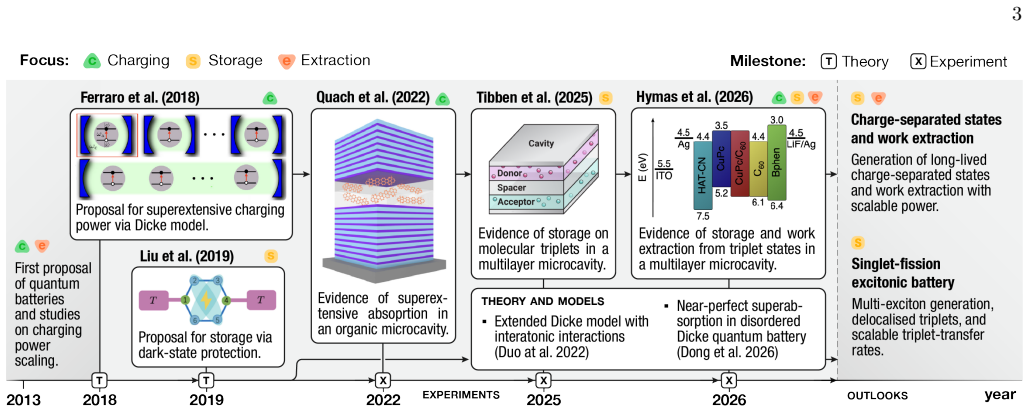
Excitonic quantum batteries overcome nanosecond self-discharge by storing energy in dark molecular states—triplets, fission pairs, or separated charges—as experiments with thousand-fold lifetime extensions show.
Reviewed by Pith at T0; open to challenge. T0 means a machine referee read the full paper against a public rubric. the ladder, T0–T4 →
2026-08-01 15:50 UTC pith:QVDDMPQN
load-bearing objection A genuinely useful review chapter whose central claims rest on published experiments and hold up; the one new model — collective singlet-fission triplet harvesting — is asserted rather than derived and should be flagged as speculative. the 2 major comments →
Molecular triplets and other metastable states for excitonic quantum batteries
The pith
A machine-rendered reading of the paper's core claim, the machinery that carries it, and where it could break.
Core claim
The central claim is that engineering metastability—fast population of a state that is slow to decay—can resolve the superabsorption/superradiance dilemma of organic microcavity quantum batteries. The paper identifies the design principle as: charge through a bright manifold that couples collectively to the cavity, store in a dark manifold that does not couple to radiation, and control the coupling between the two. It reviews the physical mechanisms (intersystem crossing, singlet fission, charge separation), the experimental milestones (a 40.3 µs self-discharge time versus nanoseconds, and a full charge-storage-extraction cycle with cavity-enhanced power scaling as N²), and the theoretical t
What carries the argument
The central objects are the bright and dark manifolds of a Dicke–cavity ensemble of molecular qutrits (S0, S1, T1). The bright state |B⟩ = (1/√N) Σ σ_n⁺|G⟩ couples to the cavity with enhanced coupling g√N, enabling superabsorption; the N−1 orthogonal dark states are decoupled from the field and form a storage reservoir. The paper's conceptual machinery is the 'charge bright, store dark' principle, realised by intersystem crossing (spin–orbit mediated singlet-to-triplet transfer), singlet fission (spin-allowed conversion of one singlet into two triplets), or charge separation (electron–hole separation at a type-II heterojunction). The proposed supertransfer channel L_T^(col) = √Γ Σ_i T_i is t
Load-bearing premise
The central claim rests on the assumption that triplet pairs produced by singlet fission remain delocalised long enough for a collective acceptor channel to capture them with a rate that grows with N; if disorder or phonon-induced localisation makes triplet capture local rather than collective, the supertransfer scaling disappears.
What would settle it
Measure the triplet-capture rate of the proposed donor–acceptor cavity as a function of the number of donor molecules N at fixed acceptor geometry and detuning. If the rate grows linearly with N, supertransfer is confirmed; if it saturates at a value set by individual molecules (or grows as √N at best), the collective supertransfer assumption fails.
If this is right
- If dark-manifold storage works as claimed, excitonic quantum batteries can extend storage from nanoseconds to microseconds or beyond while retaining superextensive charging power, making room-temperature solid-state energy storage realistic.
- The reported cavity-enhanced power scaling (P_cav ∝ N²) implies collective effects can survive the incoherent steps of charge separation and transport, so strong coupling can be exploited all the way to the electrical output of a device, not just in optical spectroscopy.
- A collective triplet acceptor channel, if realised, would give a scalable route from singlet fission to harvested triplets, avoiding the local capture bottleneck of isolated chromophores.
- If triplets with hour-scale lifetimes can be integrated with fast intersystem crossing, the combination points toward storage times meaningful for practical optoelectronic devices.
- The framework—engineering metastability in a driven-dissipative quantum system—extends beyond organic cavities to other platforms, offering a general strategy for quantum energy storage.
Where Pith is reading between the lines
- A testable extension: in the proposed model, the supertransfer enhancement should produce a linear dependence of triplet capture rate on donor number N only while triplet pairs remain delocalised; measuring the capture rate as a function of donor density and magnetic-field-induced localisation would separate collective from hopping-mediated transfer.
- The same charge-bright/store-dark principle could be applied to other collective quantum systems, e.g., trapped-ion or atomic ensembles, by identifying a metastable dark manifold and a controlled coupling to the bright charger; such a cross-platform translation is implicit in the paper's outlook but not worked out.
- If the polariton-triplet hybridisation trade-off generalises (the stronger the charging resonance, the shorter the storage lifetime), then a two-step protocol—fast resonant charging followed by rapid detuning—could avoid the lifetime erosion; the paper does not analyse this, but it follows directly from its lifetime equation.
- The paper's emphasis on ergotropy rather than stored energy suggests a concrete benchmark for future devices: report extractable work, not just population lifetimes; such a standard would make different metastable-state strategies directly comparable.
Editorial analysis
A structured set of objections, weighed in public.
Referee Report
Summary. This review chapter examines strategies for extending the energy-storage lifetime of excitonic quantum batteries, which are limited by superradiant decay of bright singlet excitons. The unifying principle is to charge through a bright manifold and store energy in a dark metastable manifold. The paper reviews three implementations: population of molecular triplets via intersystem crossing or polariton-triplet coupling, generation of triplet pairs via singlet fission, and formation of charge-separated states. It discusses the theory of cavity-exciton interactions, open-system modelling, and recent experiments, notably Refs. [32,33], reporting thousand-fold increases in self-discharge time and superextensive electrical power. The authors also propose a minimal model of collective triplet harvesting via a collective Lindblad channel in Sec. IV B, claiming supertransfer scaling linearly with donor and acceptor numbers.
Significance. If its central claims hold, the review provides a timely and useful synthesis of a fast-moving experimental area, and the design principle (bright charger, dark storage) is clearly articulated. The paper's strengths include a careful pedagogical treatment of Dicke physics and open quantum systems, a comprehensive reference list, and explicit recognition of limitations such as the failure of mean-field theory. The experimental results from Refs. [32,33] (the latter involving the authors) are peer-reviewed and independently supported where cited. However, the novel theoretical element—collective triplet supertransfer—is underdeveloped and currently speculative, which tempers the paper's original contribution. The review will be valuable if the claims are properly qualified and internal inconsistencies resolved.
major comments (2)
- [Sec. IV B, Eq. (49)] The collective triplet-acceptor channel L_T^(col)=√Γ Σ_i T_i is introduced as a proposal, but the subsequent claim that it 'opens to capturing delocalised triplets' and yields supertransfer scaling linearly with N_D and N_A is not derived. The channel does not contain any acceptor degrees of freedom, so the dependence on N_A is undefined; the scaling with N_D presumes identical fixed-phase coupling of all donor sites to a single acceptor mode and full delocalization of the triplet pairs, whereas the same section's Hamiltonian (Eq. (46)) uses short-range exponential triplet hopping and short-range exchange χ_ij. The text acknowledges that disorder and dephasing cause localisation, but the scaling statement is unqualified. Given that this model underpins the 'scalable triplet harvesting' outlook in Sec. VI, the authors should either provide a microscopic derivation (e.g., from a delocalise
- [Sec. I vs Sec. V] The Introduction states that Hymas et al. [33] 'realised the first full charge-discharge cycle of an excitonic quantum battery', but Sec. V ('Charge-separated states') states explicitly that this device is 'not, strictly speaking, a battery' and behaves as a 'cavity-enhanced photodiode' with no controllable charge-store-discharge cycle. This is a direct contradiction on a load-bearing point: the review's narrative of extended storage lifetime rests on the interpretation of this experiment. The authors should harmonise the two statements, either by rephrasing the Introduction to say the device demonstrates superextensive discharge in a photodiode geometry, or by explaining what 'full charge-discharge cycle' means operationally in the Introduction.
minor comments (3)
- [Sec. II B] Duplicated sentences appear in the same paragraph: 'A single confined mode does so for all the emitters at once...' is immediately followed by 'A single confined mode can do so for many emitters at once...' with overlapping content, and similarly 'Sharing a mode in this way also changes how the system loses energy' is followed by 'Sharing a mode in this way also modifies how the system exchanges energy with its environment'. Please merge or rephrase to remove redundancy.
- [Table I] The values of J_D, J_A and ΔE are given without uncertainties or details of the fitting procedure, although they are imported from Ref. [32]. Since the detuning sweep is central to the discussion in Sec. III B, please state the source explicitly and provide error bars if available, or note that these are representative values.
- [Sec. II C] Minor typographical issues: 'can be decomposed it into' should read 'can be decomposed into'; 'significanlty' should be 'significantly'. These occur in the discussion of the cavity field and the Dicke model.
Circularity Check
No significant circularity: the self-cited experiments are independent external evidence, and the collective supertransfer channel is an explicitly proposed ansatz, not a derived prediction.
full rationale
This is a review chapter whose load-bearing experimental claims—a thousand-fold extension of self-discharge time (Ref. [32]) and a full charge–storage–extraction cycle with superextensive electrical power (Ref. [33])—are taken from the authors' own published device papers. Under the stated rules, published, externally falsifiable experimental results count as independent evidence even when self-cited; the paper does not invoke a private uniqueness theorem or a prior theory by the same authors to rule out alternatives. The theoretical core (Dicke bright/dark manifolds, intersystem-crossing rates, triplet-pair spin structure) is standard material re-derived with explicit Hamiltonians, not imported by citation. The one new element, the collective triplet acceptor channel L_T^(col)=√Γ Σ_i T_i in Eq. (49), is explicitly introduced as a proposal ('we propose to consider') rather than as a first-principles result. Its supertransfer scaling is a direct mathematical consequence of the assumed symmetric Lindblad operator, and the paper openly lists the conditions under which it would hold, namely minimising disorder and dephasing to prevent localisation and requiring delocalised triplets. Asserting a consequence of one's own model definition is not circular when the definition is labelled as an ansatz and no fitted parameter is renamed as a prediction. The mismatch that Eq. (49) contains no acceptor-site operators yet the text claims linear N_A scaling is a derivation/correctness gap, not a circular reduction. Therefore no circular step is established.
Axiom & Free-Parameter Ledger
free parameters (2)
- collective triplet capture rate Γ
- singlet fission coupling ν_ij
axioms (5)
- domain assumption Each molecule is a three-level qutrit with at most one excitation (Frenkel exciton reduction).
- domain assumption The open-system dynamics are described by a Born–Markov secular GKSL master equation.
- domain assumption Triplets are optically dark and only the S0–S1 transition couples to the cavity.
- ad hoc to paper The collective triplet capture channel L_T^(col)=√Γ Σ_i T_i is a valid description of acceptor harvesting.
- ad hoc to paper Triplet pairs remain delocalized in extended media long enough for supertransfer to occur.
Cite this review
Pith. "Pith review of Molecular triplets and other metastable states for excitonic quantum batteries." pith.science (2026). https://pith.science/paper/QVDDMPQN
@misc{pith2026260726436,
  author       = {Pith},
  title        = {Pith review of: Molecular triplets and other metastable states for excitonic quantum batteries},
  year         = {2026},
  howpublished = {\url{https://pith.science/paper/QVDDMPQN}},
  note         = {Machine review of arXiv:2607.26436}
}
read the original abstract
Excitonic quantum batteries, based on organic fluorescent molecules embedded in optical microcavities, offer a room-temperature platform for studying collective effects in energy storage and developing applications. Recent experiments have offered evidence of superabsorption, a collective enhancement to the light absorption rate of organic molecules which leads to a scalable power density. However, they have also highlighted the challenge posed by rapid radiative decay of fluorescent molecules, which limits the energy storage lifetime. Current strategies to overcome this trade-off focus on controlling the coupling between the absorbing manifold and that used for energy storage. In this chapter, we review three implementations of this design principle: transferring energy from optically excited states to long-lived dark triplet states, generating triplet pairs and higher-spin states through singlet exciton fission, and forming charge-separated states. We discuss each mechanism from both theoretical and experimental perspectives, with particular emphasis on recent device implementations that have extended storage times by several orders of magnitude. We conclude with a cross-platform outlook on the role of metastable states across coherent and room-temperature implementations, from neutral atom arrays to masers and colour centres.
Figures


Reference graph
Works this paper leans on
-
[1]
Alicki and M
R. Alicki and M. Fannes, Entanglement boost for ex- tractable work from ensembles of quantum batteries, Physical Review E - Statistical, Nonlinear, and Soft Matter Physics87, 1 (2013)
2013
-
[2]
I. H. Deutsch, Harnessing the power of the second quan- tum revolution, PRX Quantum1, 020101 (2020)
2020
-
[3]
Binder, L
F. Binder, L. A. Correa, C. Gogolin, J. Anders, and G. Adesso, eds.,Thermodynamics in the Quantum Regime, Fundamental Theories of Physics, Vol. 195 (Springer International Publishing, Cham, 2018)
2018
-
[4]
Binder, S
F. Binder, S. Vinjanampathy, K. Modi, and J. Goold, Quantum thermodynamics of general quantum pro- cesses, Physical Review E - Statistical, Nonlinear, and Soft Matter Physics91, 032119 (2015)
2015
-
[5]
Campaioli, F
F. Campaioli, F. Pollock, F. Binder, L. C´ eleri, J. Goold, S. Vinjanampathy, and K. Modi, Enhancing the Charg- ing Power of Quantum Batteries, Physical Review Let- ters118, 150601 (2017)
2017
-
[6]
Campaioli, S
F. Campaioli, S. Gherardini, J. Q. Quach, M. Polini, and G. M. Andolina, Colloquium: Quantum batteries, Rev. Mod. Phys.96, 031001 (2024)
2024
-
[7]
Ferraro, F
D. Ferraro, F. Cavaliere, M. G. Genoni, G. Benenti, and M. Sassetti, Opportunities and challenges of quantum batteries, Nature Reviews Physics8, 86 (2026)
2026
-
[8]
Ferraro, M
D. Ferraro, M. Campisi, G. M. Andolina, V. Pellegrini, and M. Polini, High-Power Collective Charging of a Solid-State Quantum Battery, Physical Review Letters 120, 117702 (2018)
2018
-
[9]
R. H. Dicke, Coherence in spontaneous radiation pro- cesses, Phys. Rev.93, 99 (1954)
1954
-
[10]
Gross and S
M. Gross and S. Haroche, Superradiance: An essay on the theory of collective spontaneous emission, Phys. Rep.93, 301 (1982)
1982
-
[11]
J. M. Raimond, M. Brune, and S. Haroche, Manipulat- ing quantum entanglement with atoms and photons in a cavity, Rev. Mod. Phys.73, 565 (2001)
2001
-
[12]
G. M. Andolina, M. Keck, A. Mari, V. Giovannetti, and M. Polini, Quantum versus classical many-body batter- ies, Physical Review B99, 1 (2019)
2019
-
[13]
Juli` a-Farr´ e, T
S. Juli` a-Farr´ e, T. Salamon, A. Riera, M. N. Bera, and M. Lewenstein, Bounds on the capacity and power of quantum batteries, Physical Review Research2, 023113 (2020)
2020
-
[14]
D. Ferraro, M. Campisi, G. M. Andolina, V. Pellegrini, 20 and M. Polini, Reply to the comment on ”high-power collective charging of a solid-state quantum battery” by haowei xu and ju li, arXiv:2412.01830 (2024)
Pith/arXiv arXiv 2024
-
[15]
Nataf and C
P. Nataf and C. Ciuti, No-go theorem for superradiant quantum phase transitions in cavity QED and counter- example in circuit QED, Nat. Commun.1, 72 (2010)
2010
-
[16]
A. F. Kockum, A. Miranowicz, S. De Liberato, S. Savasta, and F. Nori, Ultrastrong coupling between light and matter, Nature Reviews Physics1, 19 (2019)
2019
-
[17]
Crescente, M
A. Crescente, M. Carrega, M. Sassetti, and D. Ferraro, Ultrafast charging in a two-photon Dicke quantum bat- tery, Physical Review B102, 1 (2020)
2020
-
[18]
Gemme, G
G. Gemme, G. M. Andolina, F. M. D. Pellegrino, M. Sassetti, and D. Ferraro, Off-resonant Dicke quan- tum battery: Charging by virtual photons, Batteries9, 197 (2023)
2023
-
[19]
R. G. DeVoe and R. G. Brewer, Observation of su- perradiant and subradiant spontaneous emission of two trapped ions, Phys. Rev. Lett.76, 2049 (1996)
2049
-
[20]
Genway, W
S. Genway, W. Li, C. Ates, B. P. Lanyon, and I. Lesanovsky, Generalized Dicke nonequilibrium dy- namics in trapped ions, Phys. Rev. Lett.112, 023603 (2014)
2014
-
[21]
Aedo and L
I. Aedo and L. Lamata, Analog quantum simulation of generalized Dicke models in trapped ions, Phys. Rev. A 97, 042317 (2018)
2018
-
[22]
J. Wen, Z. Wen, P. Peng, and G.-Q. Li, Dicke–ising quantum battery of an ion chain driven by a mechanical oscillator, Chinese Physics B34, 100302 (2025)
2025
-
[23]
Scheibner, T
M. Scheibner, T. Schmidt, L. Worschech, A. Forchel, G. Bacher, T. Passow, and D. Hommel, Superradiance of quantum dots, Nat. Phys.3, 106 (2007)
2007
-
[24]
Rain` o, M
G. Rain` o, M. A. Becker, M. I. Bodnarchuk, R. F. Mahrt, M. V. Kovalenko, and T. St¨ oferle, Superfluorescence from lead halide perovskite quantum dot superlattices, Nature563, 671 (2018)
2018
-
[25]
Maillette de Buy Wenniger, S
I. Maillette de Buy Wenniger, S. E. Thomas, M. Maffei, S. C. Wein, M. Pont, N. Belabas, S. Prasad, A. Harouri, A. Lema ˆ ıtre, I. Sagnes, N. Somaschi, A. Auff` eves, and P. Senellart, Experimental analysis of energy transfers between a quantum emitter and light fields, Phys. Rev. Lett.131, 260401 (2023)
2023
-
[26]
Bradaˇ c, M
C. Bradaˇ c, M. T. Johnsson, M. van Breugel, B. Q. Baragiola, R. Martin, M. L. Juan, G. K. Brennen, and T. Volz, Room-temperature spontaneous superradiance from single diamond nanocrystals, Nat. Commun.8, 1205 (2017)
2017
-
[27]
Angerer, K
A. Angerer, K. Streltsov, T. Astner, S. Putz, H. Sumiya, S. Onoda, J. Isoya, W. J. Munro, K. Nemoto, J. Schmiedmayer, and J. Majer, Superradiant emission from colour centres in diamond, Nat. Phys.14, 1168 (2018)
2018
-
[28]
Y.-D. Qu, Y. Zhang, P. Ni, C. Shan, D. Hunger, and K. Mølmer, Superradiance from nitrogen-vacancy cen- ters coupled to an ultranarrow optical cavity, Physical Review A111, 033711 (2025)
2025
-
[29]
D. G. Lidzey, D. D. C. Bradley, M. S. Skolnick, T. Vir- gili, S. Walker, and D. M. Whittaker, Strong exciton– photon coupling in an organic semiconductor microcav- ity, Nature395, 53 (1998)
1998
-
[30]
Keeling and S
J. Keeling and S. K´ ena-Cohen, Bose–einstein conden- sation of exciton-polaritons in organic microcavities, Annu. Rev. Phys. Chem.71, 435 (2020)
2020
-
[31]
J. Q. Quach, K. E. McGhee, L. Ganzer, D. M. Rouse, B. W. Lovett, E. M. Gauger, J. Keeling, G. Cerullo, D. G. Lidzey, and T. Virgili, Superabsorption in an or- ganic microcavity: Toward a quantum battery, Science Advances8, 3160 (2022)
2022
-
[32]
D. J. Tibben, E. Della Gaspera, J. van Embden, P. Rei- neck, J. Q. Quach, F. Campaioli, and D. E. G´ omez, Extending the self-discharge time of dicke quantum bat- teries using molecular triplets, PRX Energy4, 023012 (2025)
2025
-
[33]
bright triplets
will be discussed in more detail in Sec. V. B. Polariton-triplet energy transfer In this section, we explain how triplets can be popu- latedviaa direct coupling with the cavity. At moderate to high dye concentrations, molecular aggregation can endow triplet states with a partial singlet charactervia random disorder [198–200]. These “bright triplets” ac- q...
2025
-
[34]
Hymas, J
K. Hymas, J. B. Muir, D. Tibben, J. van Embden, T. Hirai, C. J. Dunn, D. E. G´ omez, J. A. Hutchison, T. A. Smith, and J. Q. Quach, Superextensive electrical power from a quantum battery, Light Sci. Appl.15, 168 (2026)
2026
-
[35]
Ostroverkhova, Organic Optoelectronic Materials: Mechanisms and Applications, Chemical Reviews116, 13279 (2016)
O. Ostroverkhova, Organic Optoelectronic Materials: Mechanisms and Applications, Chemical Reviews116, 13279 (2016)
2016
-
[36]
F. Fassioli, R. Dinshaw, P. C. Arpin, and G. D. Sc- holes, Photosynthetic light harvesting: Excitons and coherence, Journal of the Royal Society Interface11, 10.1098/rsif.2013.0901 (2014)
arXiv 2013
-
[37]
O. V. Mikhnenko, P. W. Blom, and T. Q. Nguyen, Ex- citon diffusion in organic semiconductors, Energy and Environmental Science8, 1867 (2015)
2015
-
[38]
Corry, D
B. Corry, D. Jayatilaka, and P. Rigby, Determining a flu- orophore’s transition dipole moment from fluorescence lifetime measurements in solvents of varying refractive index, Methods Appl. Fluoresc.4, 045001 (2016)
2016
-
[39]
Camposeo, T
A. Camposeo, T. Virgili, F. Lombardi, G. Cerullo, D. Pisignano, and M. Polini, Quantum batteries: A materials science perspective, Adv. Mater.37, 2415073 (2025)
2025
-
[40]
J. Liu, D. Segal, and G. Hanna, Loss-Free Excitonic Quantum Battery, Journal of Physical Chemistry C 123, 18303 (2019)
2019
-
[41]
Gherardini, F
S. Gherardini, F. Campaioli, F. Caruso, and F. C. Binder, Stabilizing open quantum batteries by sequen- tial measurements, Physical Review Research2, 013095 (2020)
2020
-
[42]
F. H. Kamin, F. T. Tabesh, S. Salimi, F. Kheiran- dish, and A. C. Santos, Non-Markovian effects on charg- ing and self-discharging processes of quantum batteries, New J. Phys.22, 083007 (2020)
2020
-
[43]
Bai and J.-H
S.-Y. Bai and J.-H. An, Floquet engineering to reacti- vate a dissipative quantum battery, Phys. Rev. A102, 060201 (2020)
2020
-
[44]
Song, H.-B
W.-L. Song, H.-B. Liu, B. Zhou, W.-L. Yang, and J.- H. An, Remote charging and degradation suppression for the quantum battery, Phys. Rev. Lett.132, 090401 (2024)
2024
-
[45]
Xu, H.-G
K. Xu, H.-G. Li, H.-J. Zhu, and W.-M. Liu, Inhibiting the self-discharging process of quantum batteries in non- Markovian noises, Phys. Rev. E109, 054132 (2024)
2024
-
[46]
A. H. A. Malavazi, R. Sagar, B. Ahmadi, and P. R. Dieguez, Two-time weak-measurement protocol for er- gotropy protection in open quantum batteries, PRX En- ergy4, 023011 (2025)
2025
-
[47]
J. Q. Quach and W. J. Munro, Using Dark States to Charge and Stabilize Open Quantum Batteries, Physi- cal Review Applied14, 1 (2020)
2020
-
[48]
Dou, Y.-Q
F.-Q. Dou, Y.-Q. Lu, Y.-J. Wang, and J.-A. Sun, Ex- tended Dicke quantum battery with interatomic interac- tions and driving field, Physical Review B105, 115405 (2022). 21
2022
-
[49]
Dong, P.-B
X.-L. Dong, P.-B. Li, and Y.-F. Xiao, Near-perfect su- perabsorption in a disordered dicke quantum battery, Phys. Rev. A113, 043701 (2026)
2026
-
[50]
N. J. Hestand and F. C. Spano, Expanded Theory of H- and J-Molecular Aggregates: The Effects of Vibronic Coupling and Intermolecular Charge Transfer, Chemical Reviews118, 7069 (2018)
2018
-
[51]
Davidson, A
S. Davidson, A. Fruchtman, F. A. Pollock, and E. M. Gauger, The dark side of energy transport along exci- tonic wires: On-site energy barriers facilitate efficient, vibrationally mediated transport through optically dark subspaces, Journal of Chemical Physics153, 134701 (2020)
2020
-
[52]
Davidson, F
S. Davidson, F. A. Pollock, and E. Gauger, Eliminating radiative losses in long-range exciton transport, Physi- cal Review X Quantum3, 020354 (2022)
2022
-
[53]
Li and N
J. Li and N. Wu, Collective charging of an organic quan- tum battery, Phys. Rev. E111, 044118 (2025)
2025
-
[54]
N. M. Gallagher, A. Olankitwanit, and A. Rajca, High- spin organic molecules, The Journal of Organic Chem- istry80, 1291 (2015)
2015
-
[55]
Kabe and C
R. Kabe and C. Adachi, Organic long persistent lumi- nescence, Nature550, 384 (2017)
2017
-
[56]
Hirata, Recent advances in materials with room- temperature phosphorescence: Photophysics for triplet exciton stabilization, Adv
S. Hirata, Recent advances in materials with room- temperature phosphorescence: Photophysics for triplet exciton stabilization, Adv. Opt. Mater.5, 1700116 (2017)
2017
-
[57]
E. Soto, F. Leon, M. Romero, V. Castaing, S. Bajo, H. M ´ ıguez, G. Lozano, and J. Campos, A photoex- cited triplet state germylene with a half-life of hours at room temperature, Nature Chemistry 10.1038/s41557- 026-02153-2 (2026)
doi:10.1038/s41557- 2026
-
[58]
C. M. Marian, Understanding and controlling intersys- tem crossing in molecules, Annu. Rev. Phys. Chem.72, 617 (2021)
2021
-
[59]
de Silva, Inverted singlet–triplet gaps and their rele- vance to thermally activated delayed fluorescence, The Journal of Physical Chemistry Letters10, 5674 (2019)
P. de Silva, Inverted singlet–triplet gaps and their rele- vance to thermally activated delayed fluorescence, The Journal of Physical Chemistry Letters10, 5674 (2019)
2019
-
[60]
Y. Wang, H. Wu, and Q. Zhao, Metastability-induced solid-state quantum batteries for powering microwave quantum electronics, arXiv:2410.21900 (2025)
Pith/arXiv arXiv 2025
-
[61]
M. J. Y. Tayebjee, S. N. Sanders, E. Kumarasamy, L. M. Campos, M. Y. Sfeir, and D. R. McCamey, Quintet mul- tiexciton dynamics in singlet fission, Nature Physics13, 182 (2017)
2017
-
[62]
Casanova, Theoretical modeling of singlet fission, Chemical Reviews118, 7164 (2018)
D. Casanova, Theoretical modeling of singlet fission, Chemical Reviews118, 7164 (2018)
2018
-
[63]
A. B. Pun, A. Asadpoordarvish, E. Kumarasamy, M. J. Y. Tayebjee, D. Niesner, D. R. McCamey, S. N. Sanders, L. M. Campos, and M. Y. Sfeir, Ultra-fast in- tramolecular singlet fission to persistent multiexcitons by molecular design, Nature Chemistry11, 821 (2019)
2019
-
[64]
M. B. Smith and J. Michl, Singlet fission, Chem. Rev. 110, 6891 (2010)
2010
-
[65]
M. B. Smith and J. Michl, Recent Advances in Singlet Fission, Annual Review of Physical Chemistry64, 361 (2013)
2013
-
[66]
A. J. Musser, M. Liebel, C. Schnedermann, T. Wende, T. B. Kehoe, A. Rao, and P. Kukura, Evidence for coni- cal intersection dynamics mediating ultrafast singlet ex- citon fission, Nat. Phys.11, 352 (2015)
2015
-
[67]
Miyata, F
K. Miyata, F. S. Conrad-Burton, F. L. Geyer, and X.- Y. Zhu, Triplet pair states in singlet fission, Chem. Rev. 119, 4261 (2019)
2019
-
[68]
M. J. Y. Tayebjee, D. R. McCamey, and T. W. Schmidt, Beyond Shockley–Queisser: Molecular Ap- proaches to High-Efficiency Photovoltaics, Journal of Physical Chemistry Letters6, 2367 (2015)
2015
-
[69]
M. T. Trinh, Y. Zhong, Q. Chen, T. Schiros, S. Jockusch, M. Y. Sfeir, M. Steigerwald, C. Nuck- olls, and X. Zhu, Intra- to intermolecular singlet fission, Journal of Physical Chemistry C119, 1312 (2015)
2015
-
[70]
M. I. Collins, D. R. McCamey, and M. J. Y. Tayebjee, Fluctuating exchange interactions enable quintet mul- tiexciton formation in singlet fission, The Journal of Chemical Physics151, 164104 (2019)
2019
-
[71]
K. E. Smyser and J. D. Eaves, Singlet fission for quan- tum information and quantum computing: the parallel JDE model, Scientific Reports10, 1 (2020)
2020
-
[72]
R. J. Hudson, T. S. C. MacDonald, J. H. Cole, T. W. Schmidt, T. A. Smith, and D. R. McCamey, A frame- work for multiexcitonic logic, Nature Reviews Chem- istry8, 136 (2024)
2024
-
[73]
L. A. Mart ´ ınez-Mart ´ ınez, M. Du, R. F. Ribeiro, S. K´ ena-Cohen, and J. Yuen-Zhou, Polariton-assisted singlet fission in acene aggregates, J. Phys. Chem. Lett. 9, 1951 (2018)
1951
-
[74]
Climent, J
C. Climent, J. Galego, F. J. Garcia-Vidal, and J. Feist, Not dark yet for strong light-matter coupling to accel- erate singlet fission dynamics, Cell Rep. Phys. Sci.3, 100841 (2022)
2022
-
[75]
Wallner, C
L. Wallner, C. Remnant, and O. Vendrell, Strong- coupling modification of singlet-fission dynamical path- ways, The Journal of Physical Chemistry A128, 8897 (2024)
2024
-
[76]
Campaioli, A
F. Campaioli, A. Pagano, D. Jaschke, and S. Mon- tangero, Optimization of ultrafast singlet fission in one- dimensional rings towards unit efficiency, PRX Energy 3, 043003 (2024)
2024
-
[77]
Fukuzumi, K
S. Fukuzumi, K. Ohkubo, and T. Suenobu, Long-lived charge separation and applications in artificial photo- synthesis, Acc. Chem. Res.47, 1455 (2014)
2014
-
[78]
A. A. Bakulin, A. Rao, V. G. Pavelyev, P. H. M. van Loosdrecht, M. S. Pshenichnikov, D. Niedzialek, J. Cornil, D. Beljonne, and R. H. Friend, The role of driving energy and delocalized states for charge sep- aration in organic semiconductors, Science335, 1340 (2012)
2012
-
[79]
Y. Hou, X. Zhang, K. Chen, D. Liu, Z. Wang, Q. Liu, J. Zhao, and A. Barbon, Charge separation, charge re- combination, long-lived charge transfer state formation and intersystem crossing in organic electron donor/ac- ceptor dyads, Journal of Materials Chemistry C7, 12048 (2019)
2019
-
[80]
Aprile, L
C. Aprile, L. Maretti, M. Alvaro, J. C. Scaiano, and H. Garcia, Long-lived (minutes) photoinduced charge separation in a structured periodic mesoporous tita- nia containing 2,4,6-triphenylpyrylium as guest, Dalton Transactions , 5465 (2008)
2008
This paper was first reviewed by deepseek-v4-flash on August 1, 2026.
discussion (0)
Sign in with ORCID, Apple, or X to comment. Anyone can read and Pith papers without signing in.