REVIEW 5 major objections 5 minor 22 references
The temporal structure of a drifting data stream is recoverable from the weights of the models trained on it, and that structure predicts how well those models transfer.
Reviewed by Pith at T0; open to challenge. T0 means a machine referee read the full paper against a public rubric. the ladder, T0–T4 →
T0 review · deepseek-v4-flash
2026-08-01 07:08 UTC pith:TU72MQY7
load-bearing objection The core idea is genuinely new—HMM on aligned per-window weights with a within-state transfer test—but the 'beyond the data distribution' claim outruns the controls, and the HMM's edge over a contiguous partition is small. the 5 major comments →
Latent States in Neural Networks: Recovering the Temporal Structure of Drifting Data from Model Weights
The pith
A machine-rendered reading of the paper's core claim, the machinery that carries it, and where it could break.
Core claim
The paper's central claim is that the temporal structure of a drifting data stream is recoverable from the weights of the models it gives rise to, and membership in that structure predicts generalization in a manner that parallels the within-event coherence of human memory. Concretely, across both Fakeddit and Yelp, the within-state transfer advantage—the difference in column-centered macro F1 between same-state and cross-state window pairs—is positive, remains after stratifying by temporal lag and after residualizing out per-pair class divergence, and exceeds a contiguous equal-size partition with the same number of states. The states are estimated entirely from model weights, yet they corr
What carries the argument
The central mechanism is a left-to-right hidden Markov model fit to the chronological trajectory of per-window weight centroids. Model weights from independently trained classifiers are aligned across seeds via iterative linear-assignment matching on unit signatures to remove permutation symmetry, projected with PCA, z-score normalized, and averaged per window; the HMM's Gaussian emissions then locate boundaries between latent regimes, with the Viterbi decode assigning each window to a state. The left-to-right transition constraint encodes the assumption that a regime, once left, does not recur, mirroring the event-segmentation framework from human perception. The within-state advantage is a
Load-bearing premise
The claim that the within-state advantage reflects latent regimes beyond the data distribution rests on the assumption that per-pair Jensen-Shannon divergence of class counts plus temporal lag fully controls for 'data distribution'; if true drift includes covariate shift or label shift beyond marginal class fractions, the residual signal could be an artifact.
What would settle it
Train the same pipeline on a synthetic drifting stream where regime boundaries are known and drift is covariate-only (class margins held constant). If the HMM fails to recover the boundaries—or the within-state advantage vanishes once class divergence and lag are residualized—the claim that weights encode latent regimes beyond label shift is falsified. Alternatively, segment the timeline directly from class distributions and compare transfer advantage; if class-only segmentation matches or beats the HMM, the weight-derived states add nothing beyond label shift.
If this is right
- A model's weight trajectory can serve as an unsupervised probe for regime shifts in streaming data, without access to labels or data statistics.
- The within-state generalization advantage suggests retraining or adaptation decisions can be timed to HMM-detected boundaries rather than fixed calendar schedules.
- The method is most informative when label-marginal drift is present; domains with pure covariate shift may require a richer measure than class JSD.
- The framework extends to any sequence of model-internal representations elicited by ordered inputs, not just weights.
- The equal-size baseline reproducing most of the advantage implies the timeline's dominant regime shifts are few and large; the HMM's value lies in refining boundary placement.
Where Pith is reading between the lines
- A controlled synthetic stream with known ground-truth regime boundaries and orthogonal covariate vs. label shift could directly test whether weight-space boundaries align with true boundaries or merely with label-shift discontinuities.
- If the weight-derived states are genuinely about event structure, a similar within-state transfer advantage should appear in continual learning benchmarks with known task boundaries, offering a bridge to task segmentation.
- The weak Yelp effect hints that the HMM-on-weights pipeline may be blind to covariate shift such as lexical polarity changes; a covariate-shift-only synthetic stream would isolate this limitation.
- A stricter baseline than equal-size contiguous blocks would be a partition optimized on class labels alone; if the weight-derived segmentation does not beat it, the 'beyond the data distribution' claim would need qualification.
Editorial analysis
A structured set of objections, weighed in public.
Referee Report
Summary. The paper asks whether discrete regimes in a drifting data stream can be recovered from the weights of classifiers trained on successive temporal windows. For Fakeddit and Yelp, the authors train MLPs on non-overlapping windows, align weights across seeds by Hungarian matching, reduce dimensionality with PCA, fit a left-to-right HMM to the per-window weight centroids, and decode a state sequence. They then test whether transfer macro-F1 is higher for window pairs sharing a state than for pairs crossing a boundary. They report a within-state advantage on both datasets, survival of the advantage after controlling for temporal lag and class-label Jensen-Shannon divergence, a modest but significant advantage over an equal-size contiguous segmentation, and a stronger correlation of state-pair transfer performance with class-distribution divergence than with weight-space centroid distance. The central interpretation is that latent states recover transfer-relevant temporal structure 'beyond the data distribution.'
Significance. If the central claim holds, the paper makes a novel methodological contribution: unsupervised recovery of drifting-data regimes from model weights, with a functional generalization test analogous to event segmentation in human memory research. The pipeline is transparent, the code is promised, and the use of two datasets with explicit permutation controls and an equal-size baseline are strengths. However, the statistical evidence currently has unresolved validity issues: the lag-stratified permutation test appears to treat per-seed observations as independent, the 'beyond the data distribution' claim controls only label-marginal shift, and the Yelp combined-model estimate is negative despite being reported as significant. These issues must be addressed before the headline claims can be accepted.
major comments (5)
- [§3.6, §4.3] The lag-stratified permutation test is described as permuting within/across indicators over per-seed observations, with each window pair i→j evaluated by 10 seeds sharing the same pair-level indicator. This treats 10 dependent replicates as independent and inflates the effective sample size by roughly a factor of 10. The reported p<0.0001 values are therefore not trustworthy as written. Please permute at the window-pair level (e.g., average F1 over seeds before testing) or use a cluster/block permutation that keeps all seeds of a pair together, and report the resulting p-values.
- [§3.10, §4.7, Abstract] The residualization in Eq. (2) controls only per-pair class-label JSD and lag. As the paper's own Limitations 5.2 acknowledges, covariate shift is part of the data distribution and is not controlled; e.g., lexical polarity drift in review sentiment (Lukes & Søgaard 2018) would be invisible to the JSD measure. Thus the abstract's 'beyond the data distribution' claim is not established: HMM boundaries aligned with covariate shift would survive JSD+lag residualization while being entirely within-distribution. Add a feature-space shift control, or explicitly restrict the claim to label-marginal shift.
- [§4.7, Yelp] The combined-model estimate for Yelp is β_state = −0.0003, a negative coefficient. Reporting a one-sided p = 0.0234 against a Freedman-Lane null that is itself centered below zero does not demonstrate a positive within-state advantage; the point estimate is negative. The two-stage residualization gives a positive gap (+0.0054), so the two analyses are in tension. Reconcile the two tests or temper the claim that the Yelp combined model supports a positive within-state effect. As reported, the Yelp replication is weaker than the text suggests.
- [§3.5, §4.2] K and the number of PCA components are selected on the same time series used to evaluate the state partition (BIC, leave-one-seed-out CV, scree elbow), yet the permutation tests condition on the selected state sequence as fixed. This selection uncertainty is not reflected in the null distributions. With K=11 on 35 windows and K=16 on 56 windows, there is also a risk of overfitting the weight trajectory. Please report how the main results vary with K and with the number of retained components, or explicitly frame the inference as exploratory rather than confirmatory.
- [§3.4, §4.3] The HMM is fit to the same weight vectors whose transfer performance defines the within-state advantage, so part of the advantage is expected by construction: windows with similar weights are grouped together, and weight-similar models tend to transfer better. The equal-size baseline and the JSD+lag controls do not control for pairwise weight similarity between source and target. Residualizing transfer F1 on per-pair weight distance (or including it in Eq. (2)) would directly address this circularity concern; without such a control, the 'recoverable from weights' claim is partly circular.
minor comments (5)
- [§4.3] Clarify whether the reported pair counts (114 within, 1,076 across for Fakeddit) are window-pair counts or per-seed observation counts. The text currently mixes 'pairs' with the per-seed evaluation described in §3.6.
- [§4.1] Only ~11% of weight variance is retained in the PCA projection. Please justify more explicitly that the retained components carry the temporal signal, e.g., by showing the fraction of drift variance captured or the stability of results with additional components.
- [§4.2 / Figure 2] For Yelp, K=16 is selected but state 15 is unvisited. State consistently whether the effective number of states is 15 when reporting pair counts and state-pair analyses.
- [§5.2] The limitation concerning covariate shift should be stated next to the 'beyond the data distribution' claim in the abstract and §4.7, not only in Limitations; otherwise the abstract overstates the current evidence.
- [Throughout] Minor typographical issues: 'Y elp' at the start of §3.3, 'dshift' in §5.2, and inconsistent naming of 'distance-conditioned' versus 'distance-conditioned gap statistic' in places.
Circularity Check
No significant circularity: the HMM is fit to weights without using transfer F1, so the within-state transfer advantage is an empirical association, not a construction.
full rationale
The derivation chain is not circular. The HMM in Section 3.5 is fit by Baum-Welch to per-window PCA weight centroids, optimizing likelihood of the weight trajectory; the transfer matrices in Section 3.6 are computed from the same trained models, but the HMM never sees F1, K is selected by BIC and held-out weight log-likelihood, and no parameter is fit to the within/across labels. The within-state advantage is therefore an empirical association between an unsupervised weight-based partition and an independently measured generalization outcome, not an identity. The equal-size baseline and lag-stratified permutation tests are genuine comparisons. The residualization in Section 4.7 controls JSD and lag but, as Limitations 5.2 concedes, does not control covariate shift; that is a construct-validity gap in the 'beyond the data distribution' claim, not a circular reduction. There are no self-citations, imported uniqueness theorems, or ansatz-by-citation that are load-bearing. The absence of a non-temporal weight-clustering control weakens the temporal interpretation, but it does not make the derivation equivalent to its inputs.
Axiom & Free-Parameter Ledger
free parameters (3)
- Number of HMM states K =
Fakeddit 11; Yelp 16 (15 visited)
- PCA components retained =
3 PCs; 11.47% (Fakeddit), 11.10% (Yelp) variance
- Window duration and minimum-count thresholds =
60 days / 9,000 (Fakeddit); 90 days / 10,000 (Yelp)
axioms (4)
- domain assumption Latent regimes are non-recurrent and contiguous (left-to-right HMM with no revisits).
- domain assumption Permutation alignment removes the relevant hidden-unit symmetries; remaining symmetries (e.g., ReLU rescaling) do not distort the trajectory.
- domain assumption Three PCA components of the aligned weights capture the temporal regime signal.
- ad hoc to paper Jensen-Shannon divergence of per-window class counts plus lag is a sufficient control for 'data distribution' in the residualization.
read the original abstract
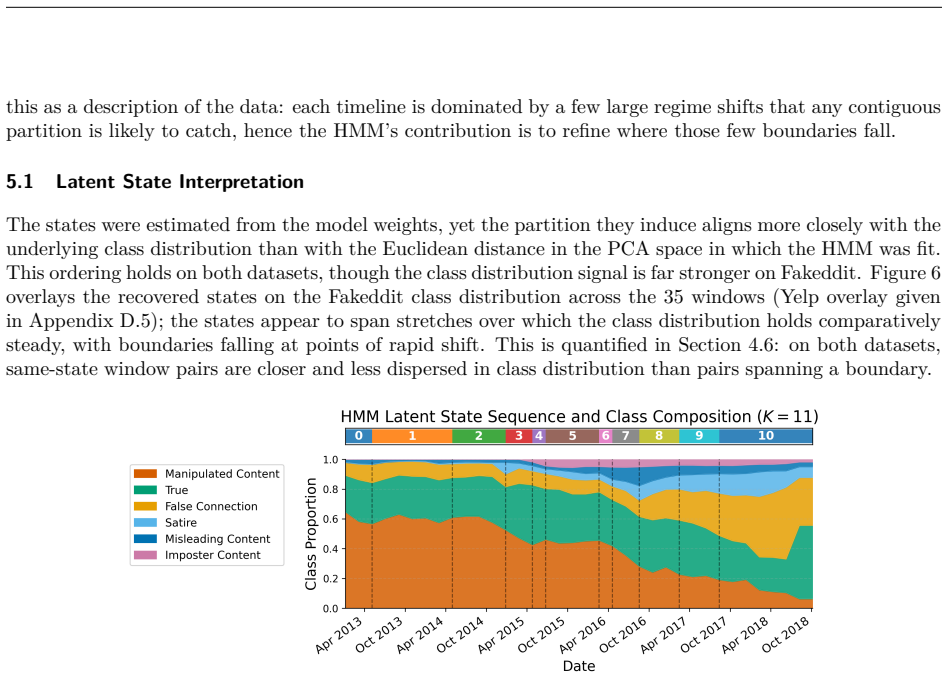
A temporally drifting data stream may pass through discrete regimes rather than changing continuously. We ask whether such regimes are recoverable from the weights of models trained on the stream, using a hidden Markov model (HMM) fit to the chronologically ordered trajectory of those weights. We study this question in two domains known to drift over time: multimodal misinformation detection, using the Fakeddit dataset; and sentiment analysis, using the Yelp dataset. We train classifiers on consecutive temporal windows and fit an HMM to the trajectory of their aligned weights, recovering latent states that partition each timeline into coherent phases. On both datasets, classifiers generalize better to data from windows sharing the state of their training window than to windows across state boundaries. This within-state transfer advantage survives a control for temporal proximity and modestly exceeds the advantage recovered by a naive partition into contiguous states of equal size. Although the states are estimated solely from model weights, they correlate more strongly with shifts in the data's class distribution than with the weight-space geometry used to estimate them. After class divergence and lag are residualized out, the within-state advantage exceeds its permutation null on both tasks, indicating that the states recover structure relevant to transfer beyond the data distribution. Every effect replicates on both tasks but is attenuated on Yelp, whose label distribution is more temporally stable.
Figures




Reference graph
Works this paper leans on
-
[1]
Ainsworth, Jonathan Hayase, and Siddhartha Srinivasa
Samuel K. Ainsworth, Jonathan Hayase, and Siddhartha Srinivasa. Git re-basin: Merging models modulo permutation symmetries.arXiv preprint arXiv:2209.04836,
-
[2]
For 2-way classification, micro F1 fell by 3.3 percentage points (0.886 to 0.853) and macro F1 by 6.1 points (0.881 to 0.820)
Moving from the original to the temporal split produced consistent degradation across both granularities. For 2-way classification, micro F1 fell by 3.3 percentage points (0.886 to 0.853) and macro F1 by 6.1 points (0.881 to 0.820). For the 6-way task, micro F1 dropped by 1.9 points (0.849 to 0.830) and macro F1 by 6.4 points (0.737 to 0.673). The larger ...
2023
-
[3]
B.1 Permutation Alignment This expands the alignment procedure of Section 3.4
Each subsection expands a step summarized in the main text. B.1 Permutation Alignment This expands the alignment procedure of Section 3.4. Hidden units in a feed-forward network are symmetric under permutation (Entezari et al., 2022), so weight vectors must be aligned across seeds before they can be compared. Each hidden unitkis assigned an alignment sign...
2022
-
[10]
Association for Computational Linguistics. doi: 10.18653/v1/ P18-2110. URLhttps://aclanthology.org/P18-2110/. Kokil Jaidka, Niyati Chhaya, and Lyle Ungar. Diachronic degradation of language models: Insights from social media. InProceedings of the 56th Annual Meeting of the Association for Computational Linguistics (Volume 2: Short Papers), pp. 195–200, Me...
-
[12]
Jan Ole Krugmann and Jochen Hartmann
URLhttps://arxiv.org/abs/ 1606.05320. Jan Ole Krugmann and Jochen Hartmann. Sentiment analysis in the age of generative ai.Customer Needs and Solutions, 11(1):3,
-
[14]
Association for Computational Linguistics. doi: 10.18653/v1/W18-6210. URL https://aclanthology.org/W18-6210/. Kai Nakamura, Sharon Levy, and William Yang Wang. Fakeddit: A new multimodal benchmark dataset for fine-grained fake news detection. In Nicoletta Calzolari, Frédéric Béchet, Philippe Blache, Khalid Choukri, Christopher Cieri, Thierry Declerck, Sar...
-
[15]
ISBN 979-10-95546-34-4
European Language Resources Association. ISBN 979-10-95546-34-4. URLhttps://aclanthology.org/2020.lrec-1.755/. Jianmo Ni, Jiacheng Li, and Julian McAuley. Justifying recommendations using distantly-labeled reviews and fine-grained aspects. InProceedings of the 2019 Conference on Empirical Methods in Natural Lan- guage Processing and the 9th International ...
2020
-
[18]
Victor Sanh, Lysandre Debut, Julien Chaumond, and Thomas Wolf. Distilbert, a distilled version of bert: smaller, faster, cheaper and lighter.arXiv preprint arXiv:1910.01108,
Pith/arXiv arXiv 1910
-
[19]
doi: 10.18653/v1/2023.genbench-1.6
Association for Computational Linguistics. doi: 10.18653/v1/2023.genbench-1.6. URLhttps://aclanthology.org/ 2023.genbench-1.6/. Daegun Won, Peter J. Jansen, and Jaime G. Carbonell. Temporal transfer learning for drift adaptation. In Proceedings of the 26th European Symposium on Artificial Neural Networks, Computational Intelligence and Machine Learning (E...
-
[20]
Accessed: 2026-07-01. Liu Ziyin and Masahito Ueda. Exact phase transitions in deep learning.arXiv preprint arXiv:2205.12510,
Pith/arXiv arXiv 2026
-
[1983]
doi: 10.1080/07350015.1983.10509354. Mario Geiger, Stefano Spigler, Stéphane d’Ascoli, Levent Sagun, Marco Baity-Jesi, Giulio Biroli, and Matthieu Wyart. The jamming transition as a paradigm to understand the loss landscape of deep neural networks.arXiv preprint arXiv:1809.09349,
arXiv 1983
-
[2013]
Rahim Entezari, Hanie Sedghi, Olga Saukh, and Behnam Neyshabur
doi: 10.1037/a0034024. Rahim Entezari, Hanie Sedghi, Olga Saukh, and Behnam Neyshabur. The role of permutation invariance in linear mode connectivity of neural networks.arXiv preprint arXiv:2110.06296,
-
[2014]
Komal Florio, Valerio Basile, Marco Polignano, Pierpaolo Basile, and Viviana Patti
doi: 10.1016/j.neuron.2014.01.042. Komal Florio, Valerio Basile, Marco Polignano, Pierpaolo Basile, and Viviana Patti. Time of your hate: The challenge of time in hate speech detection on social media.Applied Sciences, 10(12):4180,
-
[2016]
Latent state models of training dynamics
Mingyuan Hu, Annie Chen, Naomi Saphra, and Kyunghyun Cho. Latent state models of training dynamics. arXiv preprint arXiv:2308.09543,
-
[2017]
doi: 10.1016/j.neuron.2017.06.041. Erica L. Busch, Jessie Huang, Andrew Benz, Tom Wallenstein, Guillaume Lajoie, Guy Wolf, Smita Krish- naswamy, and Nicholas B. Turk-Browne. Multi-view manifold learning of human brain-state trajectories. Nature Computational Science, 3(3):240–253,
-
[2018]
Kaiming He, Xiangyu Zhang, Shaoqing Ren, and Jian Sun
URLhttps://arxiv.org/abs/1809.09349. Kaiming He, Xiangyu Zhang, Shaoqing Ren, and Jian Sun. Deep residual learning for image recognition. In Proceedings of the IEEE conference on computer vision and pattern recognition, pp. 770–778,
-
[2019]
Association for Computational Linguistics. doi: 10.18653/v1/D19-1018. URLhttps://aclanthology.org/D19-1018/. Paul Röttger and Janet Pierrehumbert. Temporal adaptation of BERT and performance on downstream document classification: Insights from social media. In Marie-Francine Moens, Xuanjing Huang, Lu- cia Specia, and Scott Wen-tau Yih (eds.),Findings of t...
-
[2020]
URLhttps://doi.org/10.3390/app10124180
doi: 10.3390/app10124180. URLhttps://doi.org/10.3390/app10124180. David Freedman and David Lane. A nonstochastic interpretation of reported significance levels.Journal of Business & Economic Statistics, 1(4):292–298,
-
[2021]
doi: 10.18653/v1/2021.findings-emnlp.206
Association for Com- putational Linguistics. doi: 10.18653/v1/2021.findings-emnlp.206. URLhttps://aclanthology.org/ 2021.findings-emnlp.206/. Noa Rubin, Inbar Seroussi, and Zohar Ringel. Grokking as a first order phase transition in two layer networks. InInternational Conference on Learning Representations (ICLR),
-
[2022]
Exact Phase Transitions in Deep Learning
doi: 10.48550/arXiv.2205.12510. A Replication of Stepanova and Ross (2023) This appendix collects the architecture, training protocol, and full results of our replication of Stepanova & Ross (2023). Their study examined how the performance of multimodal misinformation classifiers degrades when evaluated on temporally out-of-domain data. 14 A.1 Classifier ...
work page internal anchor Pith review Pith/arXiv arXiv doi:10.48550/arxiv.2205.12510 2023
-
[2023]
Latent State Models of Training Dynamics
doi: 10.48550/arXiv.2308.09543. Xiaolei Huang and Michael J. Paul. Examining temporality in document classification. InProceedings of the 56th Annual Meeting of the Association for Computational Linguistics (Volume 2: Short Papers), pp. 694–699, Melbourne, Australia, July
work page internal anchor Pith review Pith/arXiv arXiv doi:10.48550/arxiv.2308.09543
-
[2024]
doi: 10.1007/s40547-024-00143-4
ISSN 2196-291X. doi: 10.1007/s40547-024-00143-4. URLhttps: //doi.org/10.1007/s40547-024-00143-4. X. Liu, P. Li, H. Huang, Z. Li, X. Cui, J. Liang, and Z. He. Fka-owl: Advancing multimodal fake news detection through knowledge-augmented lvlms. InProceedings of the 32nd ACM International Conference on Multimedia, pp. 10154–10163, October
discussion (0)
Sign in with ORCID, Apple, or X to comment. Anyone can read and Pith papers without signing in.