Artificial Intelligence · arXiv:2607.27910 v2 · submitted 30 Jul 2026
A Cross-Architecture Audit of Direction-Based Inference-Time Defences in Vision-Language Models
The paper says
“Inference time defences against vision language model jailbreaks often subtract a calibrated direction from the residual stream at a chosen decoder layer.”
more of the abstract
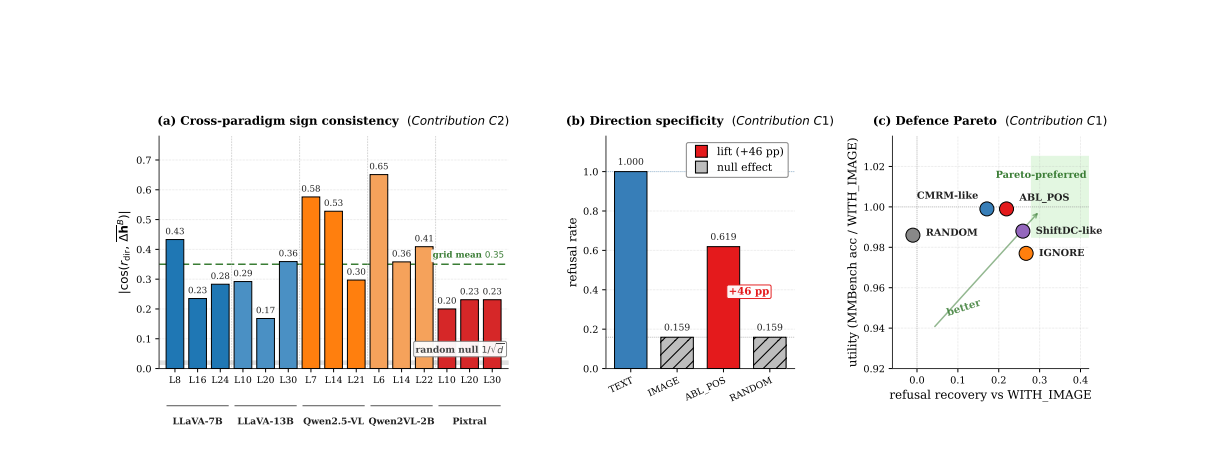
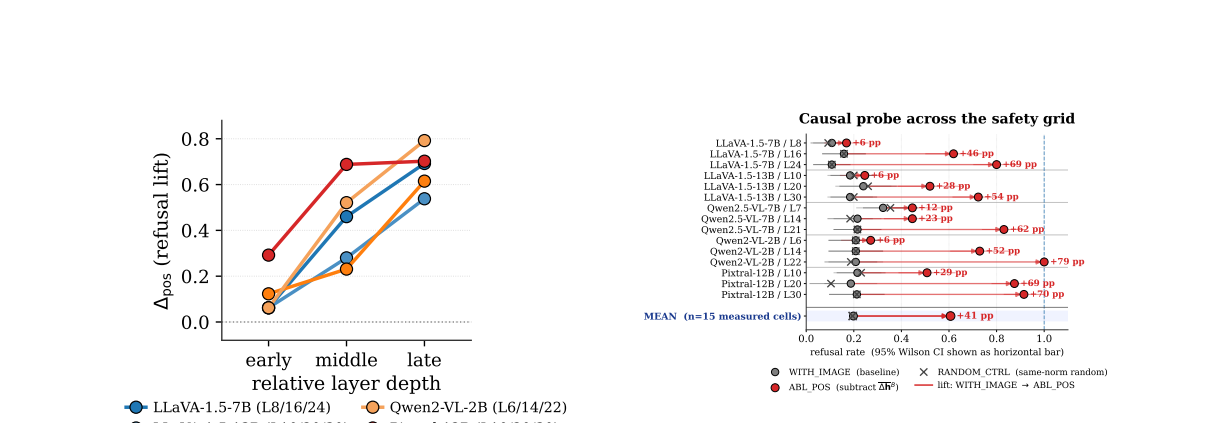
We compare five defence candidates across 15 model and layer cells from four architectural families under a magnitude controlled protocol that matches the intervention size for each prompt and pairs every direction with a random control of the same norm. The candidates are the mean image conditioning shift, a CMRM style refusal direction, a ShiftDC style attack specific residual, a prompt instruction to ignore the image, and a random control. No single candidate dominates on both refusal recovery and utility preservation. The image conditioning shift leads on LLaVA 1.5 and Pixtral 12B and is the only candidate whose utility loss remains at the measurement noise floor in every family. The prompt instruction leads on Qwen2.5 VL, while the attack specific residual leads on Qwen2 VL 2B. The image conditioning direction is direction specific in 13 of 15 cells, but strongly architecture specific and nontransferable across the only dimension compatible pair, LLaVA 1.5 13B and Pixtral 12B. We also connect text only and multimodal refusal geometry. The CMRM direction has positive cosine alignment with the image conditioning shift in all 15 cells, with mean 0.35, range 0.17 to 0.65, 15 to 25 times the random vector null, and a sign test p value of about 3e-5. These results show that the two recipes recover partially overlapping geometry and that direction based defences should be calibrated separately for each language decoder family.
from the abstract
Pith says
Machine review · deepseek-v4-flash · 31 Jul 2026 · of version 1 of the paper; version 2 is newer · what was read was not recorded · not checked by a person
It can be wrong. Challenge this review or reply to it.
Holds up, with conditions. Core audit and cross-paradigm alignment are worth knowing; utility tables have an internal inconsistency that sinks the Pareto claims until fixed. This line is wrong
4 major objections · 3 minor
How often objections from reviews like this one are right: not yet measured
Not checked: figures, code, what the references say.
The paper says, at §5.2, Tables 14–15
The review did not quote this passage.
Pith says: Objection 1 of 4 · major
The ABL_POS and CMRM-like MMBench accuracies are exactly identical in every one of the 15 cells in both Table 14 and Table 15 (e.g., 0.429 vs 0.429 on LLaVA-1.5-7B/L8; 0.689 vs 0.689 in English at n=190). At n=98 and n=190, exact equality across all 15 cells despite per-cell cosines of 0.17–0.65 between the two calibrated directions is statistically implausible and suggests a table-generation or data-handling error.
more of objection 1
These columns drive the Pareto counts in Tables 5–6 and the family-level recommendations (ABL_POS on Pixtral, IGNORE_INSTR on Qwen2.5-VL, ShiftDC-like on Qwen2-VL-2B). Moreover, as printed, Table 5 gives CMRM-like the same utility loss as ABL_POS (+0.001±0.026), which contradicts the abstract's claim that ABL_POS is 'the only candidate whose utility loss remains at the measurement noise floor in every family.' Please recompute the utility numbers from raw per-prompt MMBench s
This review says the paper's mathematics is wrong. Pith did not check that against the paper's source.
The paper says, at §5.2 vs. Appendix E
The review did not quote this passage.
Pith says: Objection 2 of 4 · major
§5.2 states that the five-way defence comparison is performed 'on the same split' as §5, implying a held-out evaluation split. However, the note to Table 11 says the baseline_defences run 'mixes the calibration and held-out indices into a single evaluation set' and reports lower-magnitude refusal rates than the dedicated causal probe.
more of objection 2
Since the cell-mean recovery values in Table 5 appear to be sourced from Tables 11–13, the out-of-sample guarantee for the §5.2 comparison is not met as reported. This is load-bearing for comparing ABL_POS, CMRM-like, ShiftDC-like, and IGNORE_INSTR. Please clarify which run feeds Table 5; if the mixed run is used, rerun the comparison on the true held-out split and update the Pareto counts and family-level conclusions accordingly.
The paper says, at §5.1, robustness check
The review did not quote this passage.
Pith says: Objection 3 of 4 · major
The robustness check that rescores all 15 cells with an independent LLM judge is referenced as '(App.??)' but no such appendix appears in the manuscript. The text asserts that ABL_POS exceeds the random control on 13/15 cells under the alternative refusal metric, but the supporting tables and rubric are missing. This is a verification of two of the paper's central claims, so the missing appendix cannot be treated as a simple typo. Please supply the appendix/tables or remove the claim.
The paper says, at §5.3
The review did not quote this passage.
Pith says: Objection 4 of 4 · major
The sign test (P(15/15)=0.5^15≈3e-5) and the one-sample t-test treat the 15 cells as independent observations. The cells are nested in five models with three probed layers each, and the per-cell cosine values are computed on overlapping/stratified prompt sets, so the effective number of independent units is smaller.
more of objection 4
The qualitative finding is likely robust because the mean alignment (0.35) is far above the random-vector null, but the reported p-values overstate precision. Please supplement with a model-level summary (e.g., all five models show positive sign; mean over models) or a clustered/permutation test that respects the within-model structure.
3 minor objections
The paper says, at §3.1
Pith says: minor objection 1 of 3
The notation for the layer index is inconsistent: the text uses 'h^m_l(x)' and then drops the subscript/superscript with 'h^m', making it hard to track whether quantities are per-layer, per-prompt, or aggregated. Please standardize the notation.
The paper says, at Table 8
Pith says: minor objection 2 of 3
The column 'R_h' (shared-direction ratio) is used without prior definition; it is only defined in the table caption. Please define it in the main text or section where it first appears.
show 1 more
The paper says, at Reproducibility
Pith says: minor objection 3 of 3
The manuscript does not state whether code and raw evaluation logs will be released. Given the audit-style contribution and the data-integrity questions raised above, a code/data availability statement is important.
What would settle it
Re-run the MMBench utility protocol independently for ABL_POS and CMRM-like on the same 15 cells, using fresh inference and the authors' protocol (or a reimplementation), and compare per-prompt accuracy. If the two defences do not produce identical predictions, recompute Tables 14/15 and the Pareto counts; if they do produce identical predictions for all prompts, verify whether the implementation accidentally applies the same direction for both, contradicting the reported cosine <1. Also recover the missing appendix (App.??) for the LLM-judge robustness check and confirm the claimed results.
from the skeptic's reading
How the review went
4 readings by deepseek-v4-flash · 31 Jul 2026
- Reader holds up, with conditions
- Skeptic partly agrees
- Editor wrote the verdict above
- Referee major revision: 4 major objections, 3 minor
Not run on this paper: the simulated authors' defence.
Pith did not check this review's objections against the paper.
The review in full
The review in brief, machine-written
The core empirical story here is worth knowing: the first systematic head-to-head comparison of five direction-based defences across 15 model-layer cells from four VLM families, with per-prompt magnitude matching and a random-direction control. The direction-specificity result—ABL_POS lifts refusal while same-norm random does not, 13/15 cells—is supported by paired CIs and looks solid. The cross-paradigm alignment between the text-only CMRM refusal direction and the image-conditioning shift (positive cosine on all 15 cells, mean 0.35) is genuinely new and interesting, even if the sign-test p-value overstates things because the 15 cells are not independent.
The soft spots are real and one is load-bearing. Tables 14 and 15 report exactly identical MMBench accuracy for ABL_POS and the CMRM-like direction in every one of the 15 cells, despite reporting cosine alignment between those directions in the 0.17–0.65 range. That is not plausible for distinct interventions on 98- or 190-item MCQs, and it undermines the utility-loss measurements driving the Pareto analysis and the per-family "leadership" claims. The paper itself warns that Pareto membership hinging on sub-2pp gaps should be read with caution, but identical columns suggest the utility data is unreliable at any resolution. The LLM-judge robustness check cites "App.??"—a missing appendix. No code or data are released. These are addressable but need fixing.
The architecture-specificity message—calibrate per decoder family, direction does not transfer even between same-dim models—is useful and likely to survive. The paper's self-flagged limitations are honest.
Who is this for: researchers working on VLM inference-time safety who want a baseline comparison across families. With the utility tables corrected and artifacts released, it deserves a serious referee. I'd want the referee to check the utility data closely. As is, I'd read it for the cross-paradigm alignment and the negative transfer result, but not for the Pareto recommendations.
The strongest objection
Tables 14 and 15 report exactly identical MMBench accuracy for ABL_POS and CMRM-like in every one of the 15 cells, despite these being different interventions: the per-cell cosine between the two directions ranges 0.17–0.65 (mean 0.35, §5.3), so exact equality on 15 cells of a 98- or 190-item MCQ is statistically implausible. This internal inconsistency casts doubt on the utility-loss measurements that drive the Pareto analysis (§5.2) and the claim that ABL_POS is 'the only candidate whose utility loss stays at the measurement noise floor in every family' (Table 5). If the columns are erroneous, the per-family leadership recommendations (ABL_POS on Pixtral, IGNORE on Qwen2.5-VL, ShiftDC-like on Qwen2-VL-2B) and the 'no single defence dominates' conclusion are not supported. Additionally, the LLM-judge robustness check described in §5.1 cites 'App.??'—a missing appendix that is supposed to verify the two central claims under an alternative refusal metric. The paper itself warns that Pareto membership hinging on utility gaps below the ~2pp noise floor should be read with caution, yet the suspiciously identical columns imply the utility data may be unreliable at any resolution.
The reader's verdict is CONDITIONAL, and my concern does not move it: the paper's central contribution—image-conditioning shift direction-specificity and cross-paradigm alignment—rests on refusal-recovery measurements that appear solid (paired CIs, random controls, per-attack robustness). However, the utility tables are essential for the paper's secondary but prominent claims about Pareto dominance and per-family deployment rules. The exact equality of ABL_POS and CMRM-like accuracy across all 15 cells is either a remarkable coincidence (probability negligible even given correlated directions) or a reporting/implementation error. Since the paper explicitly relies on MMBench utility loss to argue that ABL_POS is the only candidate at the noise floor and to assign leadership across families, this inconsistency directly affects those conclusions. The reader flagged the identical columns as suspicious and noted the utility noise floor as a weak assumption; I partially agree with the reader's weakest assumption but elevate the internal inconsistency as the more specific, load-bearing issue. The appropriate resolution is to require the authors to release corrected utility tables or explain the equality, alongside making the missing appendix available. Thus CONDITIONAL remains the right verdict.
The referee's report
If the empirical claims withstand scrutiny, this is a genuinely useful contribution: it provides a head-to-head, multi-family comparison of recipes that are usually evaluated in isolation, and the magnitude-matched random-control design is a methodologically strong template. The cross-paradigm alignment measurement is interesting and links two previously separate refusal-geometry literatures; it is an empirical finding, not a circular consequence of the definitions. I see no ad-hoc fitting or axiom invention. However, the paper's headline 'no single defence Pareto-dominates' and the per-family leadership recommendations currently rest on utility and defence-comparison data that contain internal inconsistencies, as detailed below. The direction-specificity result and the alignment measurement are more robust and could stand independently, but the Pareto claims require correction and re-verification.
Pith's reading of the paper (a machine's summary, not the authors')
The paper sets out to answer whether inference-time jailbreak defences that subtract a calibrated direction from a vision-language model's hidden states can be transferred across architectures, or whether the right direction depends on the model. Auditing five candidate directions across fifteen model-and-layer combinations from four VLM families, it finds that no single candidate Pareto-dominates on both refusal recovery and utility preservation: the image-conditioning shift leads on LLaVA-1.5 and Pixtral-12B, a prompt-level 'ignore the image' instruction leads on Qwen2.5-VL, and an attack-specific residual leads on Qwen2-VL-2B. The image-conditioning shift is direction-specific in 13 of 15 cells against a magnitude-matched random control, yet it is architecture-specific and does not transfer even between models with identical residual dimensions, so calibration must be repeated per family. The paper also reports that the text-only refusal direction aligns positively with the multimodal image-conditioning shift on all 15 cells (mean cosine 0.35), the first quantitative cross-paradigm evidence that the two refusal-geometry recipes probe overlapping rather than independent structure. If correct, the practical consequence is that direction-based defences should be selected and calibrated separately for each language-decoder family, not through a single universal recipe.
What carries the argument. The central object is the per-prompt image-conditioning shift Δh_B(x) = h_B(x) − h_T(x), the difference between a model's residual-stream hidden state at a chosen decoder layer for a prompt with a benign image and the same prompt without an image; the defence subtracts the unit-normalised mean of this shift, scaled per prompt by its own norm (Equation 2). The protocol's load-bearing control is a magnitude-matched random direction: every candidate direction is paired with an isotropic random vector of equal norm, so that refusal lifts must exceed what any equally large perturbation would cause. The cross-paradigm result uses the cosine alignment between the text-only CMRM refusal direction an
Core claim. The paper's central claim is that direction-based inference-time defences are not one-size-fits-all: subtracting the mean image-conditioning shift (the residual-stream change caused by adding an image to a prompt) lifts refusal where an equal-magnitude random direction does not, in 13 of 15 tested (model, layer) cells, but the calibrated direction is nearly orthogonal and non-transferable across the only dimension-compatible model pair (LLaVA-1.5-13B and Pixtral-12B, both d=5120). The second discovery connects two previously separate refusal-geometry literatures: the CMRM-style text-only refusal direction has positive cosine alignment with the image-conditioning shift on every one of the 15
The premise it rests on. The Pareto-front utility comparisons assume that 98-prompt MMBench multiple-choice accuracy can resolve differences as small as a couple of percentage points, even though the paper's own paired noise floor is about 2pp and many measured utility losses fall below it; if the noise is larger than the gaps, the per-family 'best defence' leadership claims are not established.
If the paper is right (Pith's inferences, not the authors')
No defence candidate is universally best: ABL_POS leads on LLaVA-1.5 and Pixtral-12B, IGNORE_INSTR on Qwen2.5-VL, and ShiftDC-like on Qwen2-VL-2B; deployment recipes must be constraint- and family-conditional.
The image-conditioning shift is a working inference-time defence: it lifts refusal by up to +46pp on the anchor cell and passes direction-specificity in 13/15 cells, while the same-norm random control never meaningfully lifts refusal, so the effect is specific to the direction.
Calibrated directions do not transfer across architectures, even when residual-stream dimensions match (cos ≤ 0.04 for LLaVA-1.5-13B↔Pixtral-12B), meaning per-family calibration is mandatory for cross-architecture deployment.
Text-only and multimodal refusal geometry overlap: the CMRM-style refusal direction aligns positively with the image-conditioning shift on all 15 cells (mean 0.35, 15–25× the random null), so the two literatures should be read as probing partially shared structure.
Calibration is inexpensive: the image-conditioning direction needs only benign-image prompts (50–97 per cell) and a single vector subtraction at inference time, with no weight updates, auxiliary model, or jailbreak-example collection.
The 'direction encodes image presence, magnitude encodes how strongly' reading suggests a practical jailbreak detector: thresholding the per-prompt projection onto the calibrated shift should separate benign from malicious images; the paper's own 1-D probe results (mean AUC ~0.66) hint at this but stop short of an optimised detector.
If CMRM and ABL_POS directions partially overlap, a combined intervention subtracting a weighted mixture of both might beat either alone on families where ABL_POS is weak (e.g., some Qwen cells); this is a testable extension the paper does not explore.
If the per-family calibration requirement scales to the broader VLM ecosystem, every new model release effectively needs its own safety-direction audit; the paper's protocol—benign-image-only calibration plus a magnitude-matched random control—could serve as a lightweight standard for that audit.
The two cells that fail the strict direction-specificity criterion both have positive point estimates with CI lower bounds just below zero; simply increasing per-cell prompt counts toward ~100 on those cells would likely determine whether the 13/15 headline becomes 15/15.
Check this review
Pith stored no record of this review's passes and took no fingerprint of it. Reviews made by code from 13 Nov 2026 on carry both.
How often reviews like this one are right
Reviews like this one: written by deepseek-v4-flash, where what was read was not recorded.
How often objections from reviews like this one are right: not yet measured
Reviews by people
This review was written by a machine. No person has reviewed this paper on Pith yet. A scientist listed on Pith can review it for a fee, and their review is published here whatever it concludes.
The paper
Abstract
Inference time defences against vision language model jailbreaks often subtract a calibrated direction from the residual stream at a chosen decoder layer. We compare five defence candidates across 15 model and layer cells from four architectural families under a magnitude controlled protocol that matches the intervention size for each prompt and pairs every direction with a random control of the same norm. The candidates are the mean image conditioning shift, a CMRM style refusal direction, a ShiftDC style attack specific residual, a prompt instruction to ignore the image, and a random control. No single candidate dominates on both refusal recovery and utility preservation. The image conditioning shift leads on LLaVA 1.5 and Pixtral 12B and is the only candidate whose utility loss remains at the measurement noise floor in every family. The prompt instruction leads on Qwen2.5 VL, while the attack specific residual leads on Qwen2 VL 2B. The image conditioning direction is direction specific in 13 of 15 cells, but strongly architecture specific and nontransferable across the only dimension compatible pair, LLaVA 1.5 13B and Pixtral 12B. We also connect text only and multimodal refusal geometry. The CMRM direction has positive cosine alignment with the image conditioning shift in all 15 cells, with mean 0.35, range 0.17 to 0.65, 15 to 25 times the random vector null, and a sign test p value of about 3e-5. These results show that the two recipes recover partially overlapping geometry and that direction based defences should be calibrated separately for each language decoder family.
The paper's own sentences, arranged, kept beside the review and separate from it. Each label is drawn from a closed vocabulary; the number beside it is the probability the classifier gave that label. No sentence in this record was written by a model.
abstract compiled · 2026-09-23
The authors' main claim, as the classifier picked it out 0.96
“These results show that the two recipes recover partially overlapping geometry and that direction based defences should be calibrated separately for each language decoder family.”
How the main claim is stated: asserted 0.99
What the abstract itself states, as probabilities: claims first 0.04 · states limitation 0.84 · human participants 0.03 · controlled comparison 0.98 · randomized assignment 0.14 · states quantitative result 0.98 · compares with prior results 0.86 · mentions code or data availability 0.02
The abstract, sentence by sentence
This table labels the abstract only (arXiv listing abstract v2). The number is the probability the classifier gave the label.
| Sentence | Role | The authors' own work | States the main conclusion | Strength |
|---|---|---|---|---|
| Inference time defences against vision language model jailbreaks often subtract a calibrated direction from the residual stream at a chosen decoder layer. | background 1.00 | 0.06 | 0.03 | asserted 0.97 |
| We compare five defence candidates across 15 model and layer cells from four architectural families under a magnitude controlled protocol that matches the intervention size for each prompt and pairs every direction with a random control of the same norm. | method 0.89 | 0.95 | 0.04 | asserted 0.95 |
| The candidates are the mean image conditioning shift, a CMRM style refusal direction, a ShiftDC style attack specific residual, a prompt instruction to ignore the image, and a random control. | method 0.86 | 0.50 | 0.02 | asserted 0.96 |
| No single candidate dominates on both refusal recovery and utility preservation. | result 1.00 | 0.92 | 0.27 | asserted 1.00 |
| The image conditioning shift leads on LLaVA 1.5 and Pixtral 12B and is the only candidate whose utility loss remains at the measurement noise floor in every family. | result 1.00 | 0.94 | 0.21 | asserted 1.00 |
| The prompt instruction leads on Qwen2.5 VL, while the attack specific residual leads on Qwen2 VL 2B. | result 1.00 | 0.93 | 0.05 | asserted 1.00 |
| The image conditioning direction is direction specific in 13 of 15 cells, but strongly architecture specific and nontransferable across the only dimension compatible pair, LLaVA 1.5 13B and Pixtral 12B. | result 1.00 | 0.94 | 0.13 | asserted 1.00 |
| We also connect text only and multimodal refusal geometry. | contribution 0.97 | 0.84 | 0.03 | asserted 0.90 |
| The CMRM direction has positive cosine alignment with the image conditioning shift in all 15 cells, with mean 0.35, range 0.17 to 0.65, 15 to 25 times the random vector null, and a sign test p value of about 3e-5. | result 1.00 | 0.95 | 0.06 | asserted 1.00 |
| These results show that the two recipes recover partially overlapping geometry and that direction based defences should be calibrated separately for each language decoder family. | interpretation 1.00 | 0.90 | 0.78 | asserted 0.99 |
What kind of paper the classifier reports this is: empirical study 1.00 · evidence from observation or experiment 0.96
What was examined, and what was not
Sources read
- arXiv listing abstract v2
Not examined
- full text
- figures and tables
- references and citing sentences
- relations to other papers
Levels run
- P abstract
Not run
- S sections
- T body sentences
- C citations
- R cross-paper relations
How the labels were made
Compiled by classifier-1.13.0 via TypeSafe API, question bank abstract-p1-20260923, 2026-09-23: 1 request, 7,724 input tokens.
Every quoted sentence on this record is the authors'. Every label is from Pith's closed vocabulary, with the probability shown beside it. This record as JSON
Figures (3)
Showing 2 of the paper's 3 figures. Figures are the authors', reproduced from the paper.
Cited by 1 Pith paper
Reviewed papers on Pith that cite this one. The full citation record
How the literature uses it
What this paper does with the arXiv papers it cites
What it cites · 28 sentences without a confident label
Uses the method or tool of 1 paper
-
We measure (M1) refusal rate via a refusal-substring lexicon at the first generation step, following the protocol of [ref] that has been adopted broadly in the refusal-direction literature, and (M2) cosine of the first-step generation logit to the text-only baseline.
Refusal in Language Models Is Mediated by a Single Direction · Ablating the image-conditioning direction · 1.00
Uses data or values from 6 papers
-
We declare a model–layer cell to have consistent positional alignment if at $≥95%$ of safety prompts have a positive cosine similarity with the mean image-conditioning direction (FigStep [ref] , HADES [ref] , JailBreakV [ref] , MM-SafetyBench [ref] ).
MM-SafetyBench: A Benchmark for Safety Evaluation of Multimodal Large Language Models · Per-prompt positional shift · 0.82
-
We declare a model–layer cell to have consistent positional alignment if at $≥95%$ of safety prompts have a positive cosine similarity with the mean image-conditioning direction (FigStep [ref] , HADES [ref] , JailBreakV [ref] , MM-SafetyBench [ref] ).
FigStep: Jailbreaking Large Vision-Language Models via Typographic Visual Prompts · Per-prompt positional shift · 0.82
-
We declare a model–layer cell to have consistent positional alignment if at $≥95%$ of safety prompts have a positive cosine similarity with the mean image-conditioning direction (FigStep [ref] , HADES [ref] , JailBreakV [ref] , MM-SafetyBench [ref] ).
Images are Achilles' Heel of Alignment: Exploiting Visual Vulnerabilities for Jailbreaking Multimodal Large Language Models · Per-prompt positional shift · 0.82
Compares with 1 paper
-
The matched comparisons across text-only, benign-image, and jailbreak-image conditions at one layer differ from layerwise lenses [ref] (which follow depth-wise computation) and from mode-connectivity work [ref] (which connects parameters rather than activations).
Eliciting Latent Predictions from Transformers with the Tuned Lens · Related Work · 0.97
Cites as background 8 papers
-
In VLMs, visual input has been described as shifting multimodal representations away from the text-only regime [ref] , motivating inference-time interventions [ref] and representation-based detectors [ref] , alongside text-only LLM analyses that pin down refusal directions and safety subspaces [ref] .
Refusal in Language Models Is Mediated by a Single Direction · Related Work · 0.93
-
In VLMs, visual input has been described as shifting multimodal representations away from the text-only regime [ref] , motivating inference-time interventions [ref] and representation-based detectors [ref] , alongside text-only LLM analyses that pin down refusal directions and safety subspaces [ref] .
Unraveling and Mitigating Safety Alignment Degradation of Vision-Language Models · Related Work · 0.93
-
In VLMs, visual input has been described as shifting multimodal representations away from the text-only regime [ref] , motivating inference-time interventions [ref] and representation-based detectors [ref] , alongside text-only LLM analyses that pin down refusal directions and safety subspaces [ref] .
The Hidden Dimensions of LLM Alignment: A Multi-Dimensional Analysis of Orthogonal Safety Directions · Related Work · 0.93
Challenges and discussion
Disagree with the review, or know something it missed? Leave a comment, or challenge this review formally: a challenge becomes a permanent entry in this paper's record, and its decision is published here.
Come back by email
A short list of the week's newly reviewed papers. Nothing is sent until you confirm from your inbox, and every email has a link that stops it. No account.
No comments yet.
Sign in to comment