REVIEW 3 major objections 5 minor 21 references
Stability-aware editing of 4-bit LLMs cuts knowledge degradation 11–17% and lifts fact generalization to 28% in sequential UK financial updates.
Reviewed by Pith at T0; open to challenge. T0 means a machine referee read the full paper against a public rubric. the ladder, T0–T4 →
T0 review · grok-4.5
2026-07-31 12:04 UTC pith:YWT5VZZB
load-bearing objection Solid systems engineering on a real failure mode—sequential edits under 4-bit—with honest absolute numbers, but the headline gaps rest on single-run point estimates and adapted baselines. the 3 major comments →
CACHE-UK: A Stability-Aware Memory Editor for Sequentially Updated Quantized LLMs in Finance
The pith
A machine-rendered reading of the paper's core claim, the machinery that carries it, and where it could break.
Core claim
Under identical 4-bit OpenLLaMA-3B and LoRA constraints, CACHE-UK’s combination of rank-1 LoRA perturbation, domain-prioritized edit strength, and a degradation-debt Stability Controller reduces knowledge degradation by 11–17% relative to adapted ROME, MEMIT, EasyEdit, and KnowledgeEditor baselines and achieves the highest test-success rate in the setting (28%, +6 points over the strongest adapted baseline).
What carries the argument
Degradation debt Stability Controller: after each edit it scores a fixed preservation set; when degradation exceeds a threshold the debt rises and the next edit’s strength is scaled by 1/(1+debt), otherwise debt decays—an integral-style feedback loop that keeps sequential quantized edits from cascading into catastrophic forgetting, paired with rank-1 updates applied only to the LoRA B matrix.
Load-bearing premise
The authors’ re-implementations of the baseline editors are fair functional equivalents under 4-bit quantization, so the measured gaps isolate the stability mechanism rather than implementation differences.
What would settle it
Re-run the same sequential UK-finance edit suite on the identical 4-bit OpenLLaMA-3B backbone using the original authors’ optimized editor code (or multi-run randomized orderings) and check whether CACHE-UK’s 11–17% degradation reduction and +6 pp test-success edge disappear.
If this is right
- Resource-constrained financial deployments can keep parametric facts fresher without dequantizing or full retraining.
- Edit strength should be treated as a controllable feedback signal, not a fixed hyperparameter, when quantization is coarse.
- Confining surgical edits to LoRA adapter space is a practical way to widen the viable edit-strength window under INT4.
- Absolute generalization near 28% implies hybrid designs (editing plus retrieval) remain necessary for production accuracy.
- The same degradation-debt loop can be ported to other regulated domains that face continual fact churn on quantized models.
Where Pith is reading between the lines
- If degradation debt generalizes, other PEFT subspaces (not only LoRA rank-16) could inherit the same controller with little redesign.
- The 16× coarser 4-bit step size suggests a predictable stability cliff between 8-bit and 4-bit that bit-width ablations could map as a simple scaling law.
- Keyword domain boosts are a stopgap; embedding-based relevance would test whether content-adaptive strength, not just the controller, drives the retention gain.
Editorial analysis
A structured set of objections, weighed in public.
Referee Report
Summary. The paper identifies a “quantization stability crisis” in which sequential fact edits on 4-bit LLMs suffer severe generalization collapse and cumulative knowledge degradation, and proposes CACHE-UK to address it. CACHE-UK combines (i) rank-1 updates applied only to the LoRA B matrix (Eqs. 1–2), (ii) keyword-based financial domain scaling of edit strength (Eq. 3), and (iii) a closed-loop Stability Controller that accumulates “degradation debt” and attenuates subsequent edit strength (Eqs. 4–5, Algorithm 1). On a 4-bit OpenLLaMA-3B model domain-adapted with LoRA on a curated UK financial corpus, the method reports near-perfect edit success, 28% test success (+6 pp over the strongest adapted baseline), and an 11–17% relative reduction in preservation-set degradation versus adapted ROME, MEMIT, EasyEdit, and KnowledgeEditor under identical quantization and backbone constraints.
Significance. If the relative gains hold under proper multi-run evaluation, the work would be a useful systems contribution for resource-constrained, regulated deployments where full-precision editing and frequent retraining are impractical. The problem framing (resolution barrier under INT4; interference in sequential edits) is concrete, the LoRA-subspace edit design is a natural fit for QLoRA-style stacks, and the degradation-debt controller is a simple, falsifiable control idea. The authors are appropriately cautious that absolute test success remains low (28%) and that the system is a research prototype. Strengths include an end-to-end documented pipeline (corpus → LoRA adaptation → editing), explicit limitations, and controlled same-backbone comparisons rather than inflated full-precision ceilings. The contribution is incremental engineering rather than a new theoretical result, but it targets a practically relevant gap.
major comments (3)
- [§7.1, Table 3, Figure 10] Table 3 and Figure 10 (and §7.1) report the headline +6 pp TS and 11–17% degradation gains from a single edit-ordering run, with no error bars or multi-seed/order replicates. The paper itself notes sequential interference (Fig. 3, §3.2) and that debt trajectories (Eqs. 4–5) depend on when degradation breaches T. Under that dynamics, ordering variance can be comparable to the reported gaps, so the isolation of the Stability Controller is not yet established. Multi-run evaluation with randomized edit orderings (already listed as future work) is load-bearing for the central claim and should be required before acceptance of the quantitative conclusions.
- [§5 Baselines; Table 3] Section 5 states that ROME, MEMIT, EasyEdit, and KnowledgeEditor were re-implemented as “functionally equivalent adaptations” for BitsAndBytes 4-bit models, with equivalence checked only by reproducing edit success on standard prompts. ES is ~100% for all methods in Table 3, so that check does not validate generalization or preservation behavior under quantization—the metrics that drive the claimed gaps. Without a clearer fidelity audit (e.g., matching published full-precision behavior on a shared subset before quantizing, or ablations that disable only the debt controller inside the same edit primitive), it remains ambiguous whether gains come from the Stability Controller versus implementation differences in the adapted baselines.
- [§4, §7.3, Figure 10] The three components are not ablated. Table 3 and Figures 8–10 compare full CACHE-UK only to external baselines. A minimal 2×2 or leave-one-out (LoRA-space ROME alone; +domain scaling; +debt controller) is needed to support the claim that the Stability Controller is “its most robust effect” and that domain prioritization contributes. Without this, the 11–17% DS reduction cannot be attributed to the named mechanism versus simply editing in the 51K-param B subspace (the main design difference from classical ROME-style full-weight updates).
minor comments (5)
- [Figure 2] Figure 2 is labeled “conceptual schematic (not measured data)” yet is used to motivate the crisis; consider moving purely illustrative figures to an appendix or clearly separating them from empirical plots (Figs. 8–11).
- [Table 2; §4.3] Hyperparameters in Table 2 (λ, β_uk, β_bank, T, δ, BASE_STRENGTH) are fixed with no sensitivity analysis except batch size (Fig. 12). A short sweep on T and δ would strengthen confidence that the controller is not brittle.
- [§4.2, Eq. (3)] Domain prioritization via binary lexicon flags (Eq. 3) is acknowledged as limited in Limitations; a one-sentence quantitative note on how often s_uk/s_bank fire on the edit set would help readers judge its practical impact.
- [Abstract; §5; Figure 10] Minor wording/consistency: abstract and §1 use both “11–17%” and “11-17%”; “OpenLLaMA-3B” parameter counts (3B vs 3.4B) should be unified; ensure DS “lower is better” is restated in Table 3 or Fig. 10 caption for skimming readers.
- [§2, §8] Related work could briefly situate against other continual/editing-under-PEFT efforts and against RAG (already in Discussion) with one or two additional citations on quantized or adapter-space editing if available.
Circularity Check
No significant circularity: empirical systems comparison with held-out metrics and fixed hyperparameters, not a self-reducing derivation.
full rationale
CACHE-UK is an engineering/empirical paper, not a first-principles derivation. The load-bearing claims are relative performance gaps (TS 28% vs ≤22%; DS ~55% vs ~61–66%) under matched 4-bit OpenLLaMA-3B + LoRA conditions. Edit Success, Test Success, and Degradation Score are measured on edit prompts, paraphrases, and a static preservation set described as never used during editing for the reported metrics; hyperparameters (Table 2) are stated once rather than fitted to those headline numbers. The Stability Controller’s use of a preservation-set feedback signal (Eqs. 4–5) is closed-loop control of the quantity it monitors, not a claim that DS is predicted from independent theory—so measuring lower final DS versus unmodulated baselines is not tautological. Rank-1 LoRA updates follow the standard ROME closed form applied to B; domain boosts are keyword heuristics, not outcomes fitted then re-reported as predictions. There is no self-citation chain, uniqueness theorem imported from the authors, or ansatz smuggled via overlapping prior work. Single-run edit-order variance and adapted-baseline fidelity are robustness/fairness concerns, not circularity. steps left empty per honest non-finding.
Axiom & Free-Parameter Ledger
free parameters (5)
- BASE_STRENGTH =
0.1
- T (degradation threshold) =
0.6
- δ (debt decay) =
0.5
- β_uk, β_bank =
0.3, 0.2
- λ (base enhancement) =
1.0
axioms (4)
- domain assumption Factual associations are localized in FFN key-value memories and can be edited by rank-one updates (ROME/MEMIT premise).
- ad hoc to paper Author re-implementations of ROME, MEMIT, EasyEdit and KnowledgeEditor are functionally equivalent under BitsAndBytes 4-bit quantization.
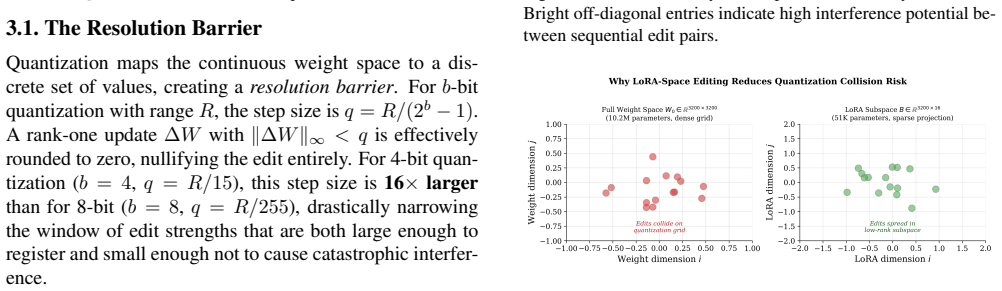
- ad hoc to paper Editing inside the rank-16 LoRA B matrix (51 k params) materially reduces quantization collision relative to full 10.2 M-param weight matrices.
- ad hoc to paper Keyword lexicon matches are a sufficient proxy for financial-domain importance when scaling edit strength.
invented entities (2)
-
degradation debt D_debt
no independent evidence
-
quantization stability crisis
no independent evidence
read the original abstract
Large Language Models (LLMs) deployed in dynamic financial environments face a critical challenge: maintaining factual accuracy as market conditions, regulations, and corporate facts change continuously. While 4-bit quantization enables efficient deployment, it severely limits the viability of sequential memory editing: existing methods undergo catastrophic performance degradation under this "quantization stability crisis." We introduce CACHE-UK (Contextual Adaptive Continual Hybrid Editor for UK Finance), a stability-aware memory editing framework specifically designed for domain-specific, quantized LLMs. CACHE-UK integrates three components: a rank-1 LoRA perturbation mechanism that confines edits to the low-rank adapter subspace, a financial domain prioritization module for content-adaptive edit strength, and a closed-loop Stability Controller that tracks "degradation debt" to prevent catastrophic forgetting across sequential updates. Evaluated on a 4-bit quantized OpenLLaMA-3B model with a curated UK financial corpus of 88,021 documents, CACHE-UK reduces knowledge degradation by 11-17% relative to adapted baselines under identical 4-bit constraints -- its most robust effect -- while attaining the highest test success (generalization) rate observed in our setting (28%, a 6 percentage point improvement over the strongest adapted baseline). These results indicate that stability-aware editing can improve factual maintenance in resource-constrained financial LLM deployments, though absolute generalization rates remain low.
Figures




Reference graph
Works this paper leans on
-
[1]
yfinance Python library.https:// github.com/ranaroussi/yfinance, 2024
Ran Aroussi. yfinance Python library.https:// github.com/ranaroussi/yfinance, 2024
2024
-
[2]
Tom B. Brown, Benjamin Mann, Nick Ryder, Melanie Subbiah, Jared Kaplan, Prafulla Dhariwal, Arvind Neelakantan, Pranav Shyam, Girish Sastry, Amanda Askell, Sandhini Agarwal, Ariel Herbert- V oss, Gretchen Krueger, Tom Henighan, Rewon Child, Aditya Ramesh, Daniel M. Ziegler, Jeffrey Wu, Clemens Winter, Christopher Hesse, Mark Chen, Eric Sigler, Mateusz Litw...
1901
-
[3]
Editing factual knowledge in language models
Nicola De Cao, Wilker Aziz, and Ivan Titov. Editing factual knowledge in language models. InProceed- ings of the 2021 Conference on Empirical Methods in Natural Language Processing (EMNLP), pages 6491– 6506, 2021
2021
-
[4]
8-bit optimizers via block-wise quanti- zation
Tim Dettmers, Mike Lewis, Sam Shleifer, and Luke Zettlemoyer. 8-bit optimizers via block-wise quanti- zation. InInternational Conference on Learning Rep- resentations (ICLR), 2022
2022
-
[5]
QLoRA: Efficient finetuning of quantized LLMs
Tim Dettmers, Artidoro Pagnoni, Ari Holtzman, and Luke Zettlemoyer. QLoRA: Efficient finetuning of quantized LLMs. arXiv:2305.14314, 2023
Pith/arXiv arXiv 2023
-
[6]
GPTQ: Accurate post- training quantization for generative pre-trained trans- formers
Elias Frantar and Dan Alistarh. GPTQ: Accurate post- training quantization for generative pre-trained trans- formers. arXiv:2210.17323, 2022
Pith/arXiv arXiv 2022
-
[7]
Transformer feed-forward layers are key-value memories
Mor Geva, Roei Schuster, Jonathan Berant, and Omer Levy. Transformer feed-forward layers are key-value memories. arXiv:2012.14913, 2020
Pith/arXiv arXiv 2012
-
[8]
Parameter-efficient transfer learning for NLP
Neil Houlsby, Andrei Giurgiu, Stanislaw Jastrzeb- ski, Bruna Morrone, Quentin de Laroussilhe, An- drea Gesmundo, Mona Attariyan, and Sylvain Gelly. Parameter-efficient transfer learning for NLP. arXiv:1902.00751, 2019
Pith/arXiv arXiv 1902
-
[9]
Hu, Yelong Shen, Phillip Wallis, Zeyuan Allen-Zhu, Yuanzhi Li, Shean Wang, Lu Wang, and Weizhu Chen
Edward J. Hu, Yelong Shen, Phillip Wallis, Zeyuan Allen-Zhu, Yuanzhi Li, Shean Wang, Lu Wang, and Weizhu Chen. LoRA: Low-rank adaptation of large language models. arXiv:2106.09685, 2021
Pith/arXiv arXiv 2021
-
[10]
De- mystifying domain-adaptive post-training for financial LLMs
Zhe Ke, Yubo Ming, and Xuan-Phi Nguyen. De- mystifying domain-adaptive post-training for financial LLMs. arXiv:2501.04961, 2025
arXiv 2025
-
[11]
Michael McCloskey and Neal J. Cohen. Catastrophic interference in connectionist networks: The sequential learning problem.Psychology of Learning and Moti- vation, 24:109–165, 1989
1989
-
[12]
Locating and editing factual associations in GPT
Kevin Meng, David Bau, Alex Andonian, and Yonatan Belinkov. Locating and editing factual associations in GPT. InAdvances in Neural Information Process- ing Systems 35 (NeurIPS 2022), pages 17359–17372, 2022
2022
-
[13]
Mass-editing memory in a transformer
Kevin Meng, Arnab Sen Sharma, Alex Andonian, Yonatan Belinkov, and David Bau. Mass-editing memory in a transformer. arXiv:2210.07229, 2023
Pith/arXiv arXiv 2023
-
[14]
Eric Mitchell, Charles Lin, Antoine Bosselut, Chelsea Finn, and Percy Liang. Fast model editing at scale. arXiv:2110.11309, 2022
Pith/arXiv arXiv 2022
-
[15]
OpenLLaMA: An open repro- duction of LLaMA.https://github.com/ openlm-research/open_llama, 2023
OpenLM Research. OpenLLaMA: An open repro- duction of LLaMA.https://github.com/ openlm-research/open_llama, 2023
2023
-
[16]
FinRED: A dataset for relation extraction in fi- nancial domain
Shubham Sharma, Ankur GTM, and Himanshu Beni- wal. FinRED: A dataset for relation extraction in fi- nancial domain. InProceedings of the 31st ACM In- ternational Conference on Information & Knowledge Management, pages 4843–4847, 2022
2022
-
[17]
Gomez, Łukasz Kaiser, and Illia Polosukhin
Ashish Vaswani, Noam Shazeer, Niki Parmar, Jakob Uszkoreit, Llion Jones, Aidan N. Gomez, Łukasz Kaiser, and Illia Polosukhin. Attention is all you need. InAdvances in Neural Information Processing Sys- tems 30, pages 5998–6008, 2017
2017
-
[18]
EasyEdit: An easy-to-use knowl- edge editing framework for large language models
Peng Wang, Ningyu Zhang, Xin Xie, Yunzhi Yao, Bozhong Tian, Mengru Wang, Zekun Xi, Siyuan Cheng, Kangwei Liu, Guozhou Zheng, and Hua- jun Chen. EasyEdit: An easy-to-use knowl- edge editing framework for large language models. arXiv:2308.07269, 2023
Pith/arXiv arXiv 2023
-
[19]
A comprehensive survey on memory editing for large language models.ACM Computing Surveys, 2024
Shuai Wang, Yichong Zhu, Hongzhan Liu, Pin-Yu Chen, and Lidong Bing. A comprehensive survey on memory editing for large language models.ACM Computing Surveys, 2024. Preprint
2024
-
[20]
A comprehensive study of knowledge editing for large language models
Yunzhi Yao, Chuanhao Li, Yu-Chen Lin, Shen-Hui Lee, Haitao Mi, Tung-Hsien Chung, and Hung yi Lee. A comprehensive study of knowledge editing for large language models. arXiv:2305.13172, 2024
Pith/arXiv arXiv 2024
-
[21]
Byun, Zi- fan Wang, Alex Mallen, Steven Basart, Sanmi Koyejo, Dawn Song, Matt Fredrikson, J
Andy Zou, Long Phan, Sarah Chen, James Campbell, Phillip Guo, Richard Ren, Alexander Pan, Xuwang Yin, Mantas Mazeika, Ann-Kathrin Dombrowski, Shashwat Goel, Nathaniel Li, Michael J. Byun, Zi- fan Wang, Alex Mallen, Steven Basart, Sanmi Koyejo, Dawn Song, Matt Fredrikson, J. Zico Kolter, and Dan Hendrycks. Representation engineering: A top- down approach t...
Pith/arXiv arXiv 2023
discussion (0)
Sign in with ORCID, Apple, or X to comment. Anyone can read and Pith papers without signing in.