REVIEW 5 major objections 5 minor 26 references
Under a fixed context window, long-horizon reasoning is best understood as an interface-construction problem: the model must write a reusable intermediate state that replaces discarded history and still supports continued solving, and train
Reviewed by Pith at T0; open to challenge. T0 means a machine referee read the full paper against a public rubric. the ladder, T0–T4 →
T0 review · deepseek-v4-flash
2026-08-03 00:49 UTC pith:FHD5AWF6
load-bearing objection A plausible and well-scoped empirical paper on training LLMs to write reset states by optimizing post-reset continuation success; the central idea is worth engaging, but the missing reset+RL control and the reward/eval identity keep me from fully trusting the causal story. the 5 major comments →
ThinkReset: Learnable Intermediate Interface Construction for Bounded-Context Long-Horizon Reasoning
The pith
A machine-rendered reading of the paper's core claim, the machinery that carries it, and where it could break.
Core claim
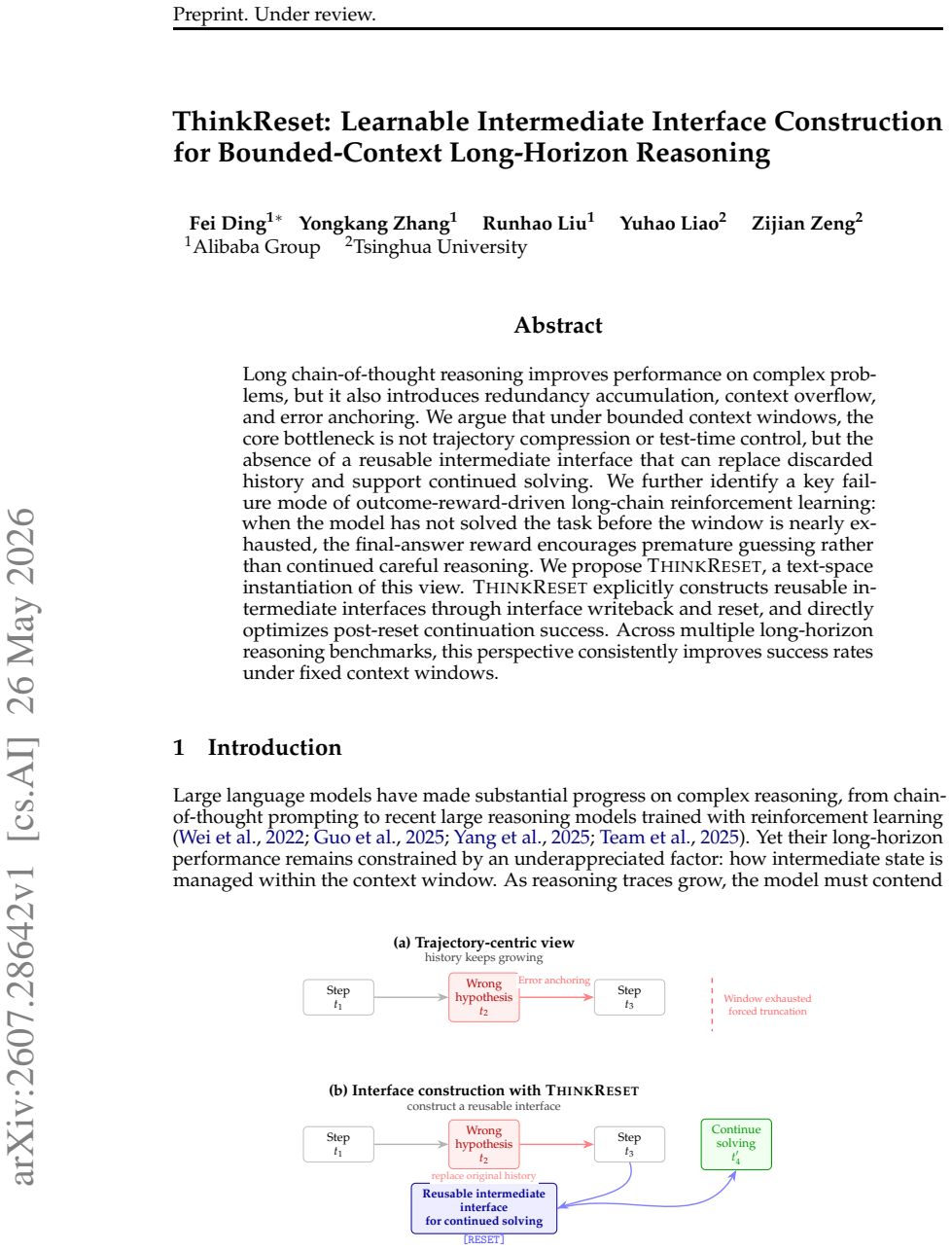
The paper's central claim: bounded-context long-horizon reasoning is an intermediate interface learning problem, and the core object is a reusable intermediate state s, written in text space at a context threshold, that replaces discarded history so later reasoning depends only on x⊕s. The training target Rsucc8 is the fraction of eight independent post-reset continuations reaching the correct answer; optimizing this functional criterion makes the state an interface rather than a summary. The paper also identifies a failure mode of outcome-reward long-chain RL: near window exhaustion, unsolved problems reward guessing, because no term rewards continued solving after reset. ThinkReset's three
What carries the argument
The reusable intermediate interface s: a natural-language state generated from the trigger prefix hi = (x, r1:i, ptrig) when context usage reaches αC, after which the original trace is discarded and all subsequent reasoning sees x⊕s. Its training signal is Rsucc8, the average success of 8 independent continuations sampled from the written-back state; this is a functional reward for 'can solving continue?', not a fidelity or length proxy. The three-stage pipeline (cold-start SFT on 500 examples; RLOO on trajectories that exceed the threshold and end incorrectly, with leave-one-out baseline; second-reset training on samples whose 8 continuations all fail) instantiates the objective and prevent
Load-bearing premise
The training reward Rsucc8 requires an automatic verifier that can decide whether each post-reset continuation reaches the correct answer; all tested benchmarks have checkable answers, and the paper offers no evidence that the method trains without such a verifier.
What would settle it
Run the identical three-stage pipeline on a long-horizon reasoning benchmark with no automatic answer checker, so Rsucc8 cannot be computed; if ThinkReset no longer beats the free-writeback baseline, the method's dependence on verifiable answers is confirmed as load-bearing.
If this is right
- Under a fixed 32k context window, training for post-reset continuation success consistently beats trajectory compression, length-penalized RL, and test-time entropy control across math and logic benchmarks (AIME 2024/2025, ZebraLogic, AutoLogi, GPQA-Diamond).
- The written-back state learns to correct and discard erroneous paths rather than faithfully preserve them, which is the opposite of learned summarization behavior.
- The same objective supports hierarchical interfaces: a second reset on failed samples further improves performance on the hardest instances.
- Because the method works entirely in text space, it transfers to any autoregressive LLM without latent heads or compression modules.
- The gain over a same-trigger free-writeback baseline shows the improvement comes from training the interface, not from the reset action itself.
Where Pith is reading between the lines
- The interface-construction objective could be applied to agentic and tool-using settings where hand-designed state summarization is common; the paper leaves that extension untested.
- The paper's own failed-proxy results (CRP, length rewards, forward consistency, frozen judge) form a spectrum that implies any fidelity-based objective will fail on this problem—a testable prediction for other compression methods.
- If the thesis holds, the same Rsucc8-style reward could be defined in latent space, offering a bridge to latent-state methods like continuous thought; the paper does not claim this.
- The verifier requirement boundaries the method: on open-ended tasks without checkable answers, a learned or heuristic verifier would be needed, and the paper provides no evidence for that regime.
Editorial analysis
A structured set of objections, weighed in public.
Referee Report
Summary. The paper argues that bounded-context long-horizon reasoning should be viewed not as a trajectory-compression or test-time-control problem, but as an intermediate-interface construction problem: the model must learn to write a reusable text-space state that can replace the discarded reasoning history and still support continued solving. The proposed method, ThinkReset, triggers a writeback at a fixed context threshold (αC), replaces the trace with the written state, and trains the writeback with RLOO using Rsucc8 (Eq. 2), the success rate over 8 independent continuations after reset. Training proceeds in three stages: cold-start SFT on 500 examples, RLOO after the first reset on filtered difficult trajectories, and a second-reset stage on samples where all post-reset continuations fail. Experiments on AIME 2024/2025, ZebraLogic, AutoLogi, and GPQA-Diamond with Qwen3-8B/14B/32B report consistent improvements over fixed-ratio trigger + free writeback, length-penalized RLOO, TokenSkip†, and Halo, with 95% bootstrap CIs and paired-bootstrap significance claims.
Significance. If the empirical claims hold, the paper offers a useful reframing and a practical training objective for bounded-context reasoning. The strongest positive evidence is the comparison against fixed-ratio trigger + free writeback, which holds the trigger rule, prompt, stopping rule, and context window fixed and isolates the effect of RL on the written state. The cross-model consistency (8B/14B/32B) and the inclusion of confidence intervals and paired-bootstrap tests are commendable. The paper also explicitly identifies a plausible failure mode of outcome-reward long-chain RL near window exhaustion. However, the manuscript is currently under-supported for its central causal claim: it lacks a key control cell (reset + RL with an alternative reward), reports failed alternative rewards only qualitatively, selects a hyperparameter on the main benchmark, and provides incomplete training details without code or data. These issues are addressable and do not require abandoning the thesis, but they do require additional experiments and reporting before the central claim can be accepted at the standard of a journal publication.
major comments (5)
- [§4.2, Table 1; §3.2, Eq. (2)] The causal attribution to the Rsucc8 objective is not established because the design lacks a reset+RL control cell with an alternative reward. Fixed-ratio trigger + free writeback isolates the presence of RL, and length-penalized RLOO isolates the presence of reset, but no condition holds reset+RL fixed while swapping Rsucc8 for a different reward. The failed attempts in Appendices H/I/J/K are described only qualitatively and are not evaluated under the same protocol, training budget, or confidence intervals. Please add a quantitative baseline such as reset+RL with a length penalty or a local-fidelity reward, and report it in Table 1 or an equivalent table.
- [§4.4, Table 3] α=3/4 is selected from the AIME 2025 benchmark, and the same benchmark appears in the main results with this value. This creates a risk of selection bias. If the sensitivity analysis is used to choose α, it should be performed on a held-out validation split or the main tables should report results for a pre-specified α. Please clarify whether α is varied only at evaluation time or also during training, and report the selection procedure explicitly.
- [§3.2, Eq. (2); §5] The training objective Rsucc8 requires an automatic verifier that can decide whether each of the 8 independent continuations reaches the correct final answer. All benchmarks used in the paper have checkable answers, but the Limitations section does not mention this structural assumption. Without a verifier, or a learned/approximate surrogate, the three-stage pipeline is undefined. The paper should state this scope condition and, ideally, provide evidence about sensitivity to verifier noise or partial verifiability.
- [Appendix L] The 'Training and Evaluation Configuration Overview' omits many details that are essential for reproducing an empirical RL paper: learning rate, batch size, number of RL update steps, number of epochs for cold-start SFT, construction of the 500 SFT examples, GPU budget, and exact context-length accounting. The Reproducibility Statement only says code and materials 'will be released.' For a paper whose central claim is empirical, these missing details and the absence of released artifacts are a significant barrier to verification.
- [Appendix N; Appendices E–K] The claim that 'only directly optimizing continuation success worked' rests on six failed experiments reported qualitatively in Appendices E–K and synthesized in Appendix N. These failures are not quantified with the same evaluation protocol, training budgets, or confidence intervals as the main tables, so the claim that the failure pattern is 'systematic' is not established at the same evidential standard. Please provide at least compact quantitative comparisons (e.g., a summary table with Avg@8 for each failed objective) or clearly label these as anecdotal.
minor comments (5)
- [§3.3, Stage 3] Please specify how the second-reset reward is aggregated when multiple failed first-reset continuations are present, and whether the same G′=16 sampling protocol and leave-one-out baseline are reused. Currently the text says the 'same reward definition is reused' but does not give the grouped-sampling details.
- [Appendix L] Decoding parameters are listed as Temperature=0.6, TopP=0.95, TopK=20, MinP=0. Please define MinP and report the tokenization scheme used for the 32k context window (e.g., tokens vs. characters).
- [Table 3] The column headers '1/2', '2/3', etc. denote α values, but this is not stated in the caption. Please make the meaning of each column explicit and clarify whether the training configuration is truly identical across all settings.
- [Figure 1] The figure caption and the annotated labels (e.g., 'Wrong hypothesis', '[RESET]') are too terse. Please expand the caption to explain the flow and the meaning of the reset token in the interface-construction panel.
- [Appendix C, Table 4] The 14B and 32B tables do not include a column naming the methods; they rely on the row order from Table 1. Please add method names to each row for readability.
Circularity Check
No significant circularity; the main empirical claim is directly optimized by Rsucc8, but this is reward-metric alignment rather than a derivation-level circular step.
full rationale
THINKRESET's reasoning chain is empirical rather than derivational: the paper proposes a reformulation, instantiates it with a three-stage RL pipeline, and validates it on benchmarks. I found no load-bearing self-citation, no imported uniqueness theorem, and no ansatz smuggled in via citation. The one formal near-identity is that the training reward Rsucc8 (Eq. 2) is the same quantity as the Avg@8 evaluation metric; Appendix L explicitly states that "training rewards also use the average over 8 continuations, keeping the training objective aligned with evaluation." That is an objective-alignment choice, not a fit-then-predict step: the paper does not derive a prediction from a fitted parameter, and the comparison against baselines is a genuine (if imperfect) empirical test. The defensible criticism is attribution: because there is no reset+RL baseline with a different reward, gains cannot be uniquely assigned to the interface-construction objective rather than to the reset+RL combination; this is an experimental-design gap, not circularity. Appendix K's discussion of a frozen external judge explicitly addresses the self-evaluation concern and explains the trade-off, and the failed-experiment appendix is self-reported evidence, which affects evidential weight but not circularity. Score 2 reflects these minor evidential weaknesses while concluding that no claim reduces to its inputs by construction.
Axiom & Free-Parameter Ledger
free parameters (6)
- alpha (trigger ratio) =
3/4
- N=8 continuations for Rsucc8 and Avg@8 =
8
- Cold-start SFT example count =
500
- G'=16 sampled trajectories per problem =
16
- Context window C =
32k
- Decoding parameters =
Temp=0.6, TopP=0.95, TopK=20, MinP=0
axioms (5)
- standard math The RLOO policy-gradient estimator (Eq. 3) is a valid estimator of the expected reward gradient.
- domain assumption A sample of 8 continuations estimates continuation success well enough to serve as a training reward.
- domain assumption Final answers on all benchmarks can be automatically checked.
- ad hoc to paper Filtering out trajectories that solve correctly before the threshold prevents degeneration toward trajectory retention.
- domain assumption Outcome-reward long-chain RL near window exhaustion systematically encourages premature guessing.
read the original abstract
Long chain-of-thought reasoning improves performance on complex problems, but it also introduces redundancy accumulation, context overflow, and error anchoring. We argue that under bounded context windows, the core bottleneck is not trajectory compression or test-time control, but the absence of a reusable intermediate interface that can replace discarded history and support continued solving. We further identify a key failure mode of outcome-reward-driven long-chain reinforcement learning: when the model has not solved the task before the window is nearly exhausted, the final-answer reward encourages premature guessing rather than continued careful reasoning. We propose ThinkReset, a text-space instantiation of this view. ThinkReset explicitly constructs reusable intermediate interfaces through interface writeback and reset, and directly optimizes post-reset continuation success. Across multiple long-horizon reasoning benchmarks, this perspective consistently improves success rates under fixed context windows.
Figures
Reference graph
Works this paper leans on
-
[1]
Back to basics: Revisiting REINFORCE -style optimization for learning from human feedback in LLM s
Arash Ahmadian, Chris Cremer, Matthias Gall \'e , Marzieh Fadaee, Julia Kreutzer, Olivier Pietquin, Ahmet \"U st \"u n, and Sara Hooker. Back to basics: Revisiting REINFORCE -style optimization for learning from human feedback in LLM s. In Lun-Wei Ku, Andre Martins, and Vivek Srikumar (eds.), Proceedings of the 62nd Annual Meeting of the Association for C...
2024
-
[2]
Think deep, not just long: Measuring llm reasoning effort via deep-thinking tokens, 2026
Wei-Lin Chen, Liqian Peng, Tian Tan, Chao Zhao, Blake JianHang Chen, Ziqian Lin, Alec Go, and Yu Meng. Think deep, not just long: Measuring llm reasoning effort via deep-thinking tokens, 2026. URL https://arxiv.org/abs/2602.13517
Pith/arXiv arXiv 2026
-
[3]
Metacognitive reuse: Turning recurring llm reasoning into concise behaviors, 2025
Aniket Didolkar, Nicolas Ballas, Sanjeev Arora, and Anirudh Goyal. Metacognitive reuse: Turning recurring llm reasoning into concise behaviors, 2025. URL https://arxiv.org/abs/2509.13237
arXiv 2025
-
[4]
Daya Guo, Dejian Yang, Haowei Zhang, Junxiao Song, Peiyi Wang, Qihao Zhu, Runxin Xu, Ruoyu Zhang, Shirong Ma, Xiao Bi, Xiaokang Zhang, Xingkai Yu, Yu Wu, Z. F. Wu, Zhibin Gou, Zhihong Shao, Zhuoshu Li, Ziyi Gao, Aixin Liu, Bing Xue, Bingxuan Wang, Bochao Wu, Bei Feng, Chengda Lu, Chenggang Zhao, Chengqi Deng, Chong Ruan, Damai Dai, Deli Chen, Dongjie Ji, ...
2025
-
[5]
Training large language models to reason in a continuous latent space
Shibo Hao, Sainbayar Sukhbaatar, DiJia Su, Xian Li, Zhiting Hu, Jason E Weston, and Yuandong Tian. Training large language models to reason in a continuous latent space. In Workshop on Reasoning and Planning for Large Language Models, 2025. URL https://openreview.net/forum?id=KrWSrrYGpT
2025
-
[6]
Zhiwei He, Tian Liang, Jiahao Xu, Qiuzhi Liu, Xingyu Chen, Yue Wang, Linfeng Song, Dian Yu, Zhenwen Liang, Wenxuan Wang, Zhuosheng Zhang, Rui Wang, Zhaopeng Tu, Haitao Mi, and Dong Yu. Deepmath-103k: A large-scale, challenging, decontaminated, and verifiable mathematical dataset for advancing reasoning, 2025. URL https://arxiv.org/abs/2504.11456
Pith/arXiv arXiv 2025
-
[7]
Thinkprune: Pruning long chain-of-thought of LLM s via reinforcement learning
Bairu Hou, Yang Zhang, Jiabao Ji, Yujian Liu, Kaizhi Qian, Jacob Andreas, and Shiyu Chang. Thinkprune: Pruning long chain-of-thought of LLM s via reinforcement learning. Transactions on Machine Learning Research, 2026. ISSN 2835-8856. URL https://openreview.net/forum?id=V51gPu1uQD
2026
-
[8]
Making slow thinking faster: Compressing LLM chain-of-thought via step entropy
Zeju Li, Jianyuan Zhong, Ziyang Zheng, Xiangyu Wen, Zhijian Xu, Yingying Cheng, Fan Zhang, and Qiang Xu. Making slow thinking faster: Compressing LLM chain-of-thought via step entropy. In The Fourteenth International Conference on Learning Representations, 2026 a . URL https://openreview.net/forum?id=cGLqQfS5wH
2026
-
[9]
Limited reasoning space: The cage of long-horizon reasoning in llms, 2026 b
Zhenyu Li, Guanlin Wu, Cheems Wang, and Yongqiang Zhao. Limited reasoning space: The cage of long-horizon reasoning in llms, 2026 b . URL https://arxiv.org/abs/2602.19281
arXiv 2026
-
[10]
The pensieve paradigm: Stateful language models mastering their own context
Xiaoyuan Liu, Tian Liang, Dongyang Ma, Deyu Zhou, Haitao Mi, Pinjia He, and Yan Wang. The pensieve paradigm: Stateful language models mastering their own context. In The Fourteenth International Conference on Learning Representations, 2026. URL https://openreview.net/forum?id=GymjF88oGQ
2026
-
[11]
Beyond context limits: Subconscious threads for long-horizon reasoning, 2025
Hongyin Luo, Nathaniel Morgan, Tina Li, Derek Zhao, Ai Vy Ngo, Philip Schroeder, Lijie Yang, Assaf Ben-Kish, Jack O'Brien, and James Glass. Beyond context limits: Subconscious threads for long-horizon reasoning, 2025. URL https://arxiv.org/abs/2507.16784
Pith/arXiv arXiv 2025
-
[12]
Reasoning models can be effective without thinking, 2025
Wenjie Ma, Jingxuan He, Charlie Snell, Tyler Griggs, Sewon Min, and Matei Zaharia. Reasoning models can be effective without thinking, 2025. URL https://arxiv.org/abs/2504.09858
Pith/arXiv arXiv 2025
-
[13]
Vicky Zhao, Lili Qiu, and Dongmei Zhang
Zhuoshi Pan, Qianhui Wu, Huiqiang Jiang, Menglin Xia, Xufang Luo, Jue Zhang, Qingwei Lin, Victor R \"u hle, Yuqing Yang, Chin-Yew Lin, H. Vicky Zhao, Lili Qiu, and Dongmei Zhang. LLML ingua-2: Data distillation for efficient and faithful task-agnostic prompt compression. In Lun-Wei Ku, Andre Martins, and Vivek Srikumar (eds.), Findings of the Association ...
2024
-
[14]
Xiaoye Qu, Yafu Li, Zhao-Chen Su, Weigao Sun, Jianhao Yan, Dongrui Liu, Ganqu Cui, Daizong Liu, Shuxian Liang, Junxian He, Peng Li, Wei Wei, Jing Shao, Chaochao Lu, Yue Zhang, Xian-Sheng Hua, Bowen Zhou, and Yu Cheng. A survey of efficient reasoning for large reasoning models: Language, multimodality, and beyond, 2025. URL https://arxiv.org/abs/2503.21614
arXiv 2025
-
[15]
Stop overthinking: A survey on efficient reasoning for large language models
Yang Sui, Yu-Neng Chuang, Guanchu Wang, Jiamu Zhang, Tianyi Zhang, Jiayi Yuan, Hongyi Liu, Andrew Wen, Shaochen Zhong, Na Zou, Hanjie Chen, and Xia Hu. Stop overthinking: A survey on efficient reasoning for large language models. Transactions on Machine Learning Research, 2025. ISSN 2835-8856. URL https://openreview.net/forum?id=HvoG8SxggZ
2025
-
[16]
Think silently, think fast: Dynamic latent compression of llm reasoning chains
Wenhui Tan, Jiaze Li, Jianzhong Ju, Zhenbo Luo, Ruihua Song, and Jian Luan. Think silently, think fast: Dynamic latent compression of llm reasoning chains. In D. Belgrave, C. Zhang, H. Lin, R. Pascanu, P. Koniusz, M. Ghassemi, and N. Chen (eds.), Advances in Neural Information Processing Systems, volume 38, pp.\ 4646--4668. Curran Associates, Inc., 2025. ...
arXiv 2025
-
[17]
Yuntian Tang, Bohan Jia, Wenxuan Huang, Lianyue Zhang, Jiao Xie, Wenxi Li, Wei Li, Jie Hu, Xinghao Chen Rongrong Ji, and Shaohui Lin. Towards efficient large language reasoning models via extreme-ratio chain-of-thought compression, 2026. URL https://arxiv.org/abs/2602.08324
Pith/arXiv arXiv 2026
-
[18]
Kimi Team, Angang Du, Bofei Gao, Bowei Xing, Changjiu Jiang, Cheng Chen, Cheng Li, Chenjun Xiao, Chenzhuang Du, Chonghua Liao, Chuning Tang, Congcong Wang, Dehao Zhang, Enming Yuan, Enzhe Lu, Fengxiang Tang, Flood Sung, Guangda Wei, Guokun Lai, Haiqing Guo, Han Zhu, Hao Ding, Hao Hu, Hao Yang, Hao Zhang, Haotian Yao, Haotian Zhao, Haoyu Lu, Haoze Li, Haoz...
Pith/arXiv arXiv 2025
-
[19]
Compass: Enhancing agent long-horizon reasoning with evolving context, 2025
Guangya Wan, Mingyang Ling, Xiaoqi Ren, Rujun Han, Sheng Li, and Zizhao Zhang. Compass: Enhancing agent long-horizon reasoning with evolving context, 2025. URL https://arxiv.org/abs/2510.08790
arXiv 2025
-
[20]
R1-compress: Long chain-of-thought compression via chunk compression and search
Yibo Wang, Haotian Luo, Huanjin Yao, Tiansheng Huang, Haiying He, Rui Liu, Naiqiang Tan, Jiaxing Huang, Xiaochun Cao, Dacheng Tao, and Li Shen. R1-compress: Long chain-of-thought compression via chunk compression and search. In First Workshop on Foundations of Reasoning in Language Models, 2025. URL https://openreview.net/forum?id=H4UTzUhspV
2025
-
[21]
Chain-of-thought prompting elicits reasoning in large language models
Jason Wei, Xuezhi Wang, Dale Schuurmans, Maarten Bosma, brian ichter, Fei Xia, Ed Chi, Quoc V Le, and Denny Zhou. Chain-of-thought prompting elicits reasoning in large language models. In S. Koyejo, S. Mohamed, A. Agarwal, D. Belgrave, K. Cho, and A. Oh (eds.), Advances in Neural Information Processing Systems, volume 35, pp.\ 24824--24837. Curran Associa...
2022
-
[22]
Resum: Unlocking long-horizon search intelligence via context summarization, 2026
Xixi Wu, Kuan Li, Yida Zhao, Liwen Zhang, Litu Ou, Huifeng Yin, Zhongwang Zhang, Xinmiao Yu, Dingchu Zhang, Yong Jiang, Pengjun Xie, Fei Huang, Minhao Cheng, Shuai Wang, Hong Cheng, and Jingren Zhou. Resum: Unlocking long-horizon search intelligence via context summarization, 2026. URL https://arxiv.org/abs/2509.13313
arXiv 2026
-
[23]
T oken S kip: Controllable chain-of-thought compression in LLM s
Heming Xia, Chak Tou Leong, Wenjie Wang, Yongqi Li, and Wenjie Li. T oken S kip: Controllable chain-of-thought compression in LLM s. In Christos Christodoulopoulos, Tanmoy Chakraborty, Carolyn Rose, and Violet Peng (eds.), Proceedings of the 2025 Conference on Empirical Methods in Natural Language Processing, pp.\ 3351--3363, Suzhou, China, November 2025....
-
[24]
An Yang, Anfeng Li, Baosong Yang, Beichen Zhang, Binyuan Hui, Bo Zheng, Bowen Yu, Chang Gao, Chengen Huang, Chenxu Lv, Chujie Zheng, Dayiheng Liu, Fan Zhou, Fei Huang, Feng Hu, Hao Ge, Haoran Wei, Huan Lin, Jialong Tang, Jian Yang, Jianhong Tu, Jianwei Zhang, Jianxin Yang, Jiaxi Yang, Jing Zhou, Jingren Zhou, Junyang Lin, Kai Dang, Keqin Bao, Kexin Yang, ...
Pith/arXiv arXiv 2025
-
[25]
Recursive models for long-horizon reasoning, 2026
Chenxiao Yang, Nathan Srebro, and Zhiyuan Li. Recursive models for long-horizon reasoning, 2026. URL https://arxiv.org/abs/2603.02112
Pith/arXiv arXiv 2026
-
[26]
L ight T hinker: Thinking step-by-step compression
Jintian Zhang, Yuqi Zhu, Mengshu Sun, Yujie Luo, Shuofei Qiao, Lun Du, Da Zheng, Huajun Chen, and Ningyu Zhang. L ight T hinker: Thinking step-by-step compression. In Christos Christodoulopoulos, Tanmoy Chakraborty, Carolyn Rose, and Violet Peng (eds.), Proceedings of the 2025 Conference on Empirical Methods in Natural Language Processing, pp.\ 13307--133...
discussion (0)
Sign in with ORCID, Apple, or X to comment. Anyone can read and Pith papers without signing in.