REVIEW 4 major objections 6 minor 90 references
A pass-ranking model trained on 1,943 circuits picks Qiskit transpiler configurations that never underperform any of Qiskit's four preset optimization levels and, on average, remove 19.1–32.4% more two-qubit gates.
Reviewed by Pith at T0; open to challenge. T0 means a machine referee read the full paper against a public rubric. the ladder, T0–T4 →
T0 review · deepseek-v4-flash
2026-08-03 12:47 UTC pith:GOCQWWL6
load-bearing objection A genuinely new autotuning pipeline for Qiskit init-stage pass selection with a good dataset and honest reporting, but the 'never outperformed' claim is not yet secured because 9% of runs timed out and the handling is unanalyzed. the 4 major comments →
Transpiler Autotuning with Predictive Models for Quantum Circuit Optimization
The pith
A machine-rendered reading of the paper's core claim, the machinery that carries it, and where it could break.
Core claim
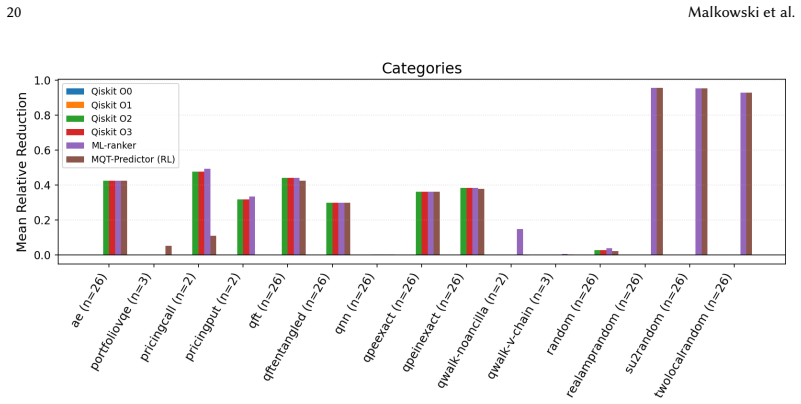
The central claim is that a machine-learned predictor can replace today's fixed Qiskit optimization levels with a circuit-aware selection of init-stage transpiler passes, and that this yields strictly better two-qubit gate reductions on the tested benchmark circuits: the selected configurations never perform worse than any of Qiskit's levels, produce on average 19.1–32.4% additional relative reduction, remove up to 95.8% of two-qubit gates on circuits that Qiskit leaves unchanged, and are competitive with a reinforcement-learning baseline while never losing to it on more than 1.8% of circuits. The authors further claim that a SHAP analysis on the trained model yields transferable knowledge a
What carries the argument
The central mechanism is a feature model of Qiskit's init-stage transpiler passes with cross-tree constraints, sampled via 3-wise interaction sampling into 62 valid configurations; a manually derived execution order φ (Definitions 4.4–4.7) that turns each configuration into a concrete pass sequence; and a learning-to-rank XGBoost model trained with an NDCG loss that, for a new circuit, ranks all 62 ordered configurations by predicted optimization ratio (baseline two-qubit count divided by optimized two-qubit count). The model is guided by a 62-dimensional feature vector of circuit properties, and its predictions are explained via SHAP Shapley values and interaction indices.
Load-bearing premise
All dataset labels and head-to-head comparisons are computed under a single manually derived execution order φ; if that order is not representative or near-optimal, the model's apparent superiority over Qiskit could be an artifact of the chosen ordering rather than of the pass-selection method.
What would settle it
Re-run the entire pipeline (sampling, labeling, training, evaluation) with an alternative execution order, e.g., Qiskit's own internal init-stage ordering or a reversed group order, and check whether the model still never loses to O0–O3 and still delivers ~19–32% average extra two-qubit gate reduction. If the advantage disappears under a plausible reordering, the central claim collapses. Alternatively, on small circuits, compare the model's top-1 selections against an exhaustive search over all valid configurations; if the model frequently misses the globally optimal configuration, the 'never
If this is right
- End users can obtain circuit-specific transpiler pass selections that, on average across the test set, remove 19.1–32.4% more two-qubit gates than Qiskit's default optimization levels and never perform worse on any tested circuit.
- The data-driven SHAP analysis pinpoints passes that are highly effective for specific circuit classes yet absent from Qiskit's defaults, suggesting concrete additions to heuristic transpiler configurations.
- Because the predictor scores all 62 configurations in parallel at inference time, it offers a fast, non-iterative surrogate for configuration selection without running repeated compilations.
- The methodology is device-agnostic and confined to the init stage, so it can be transferred to other transpilers and to later pipeline stages if analogous feature models are built.
- For circuits where Qiskit's optimization levels achieve zero two-qubit gate reduction, the model finds reductions of up to 95.8%, recovering optimization potential that fixed heuristics miss.
Where Pith is reading between the lines
- The claimed superiority is measured against the best of 62 sampled configurations, not against the true global optimum over all valid pass combinations, so the absolute headroom may be larger or smaller than reported.
- Because all labels are computed under the single manually derived execution order φ, the headline numbers could be an artifact of that ordering; an alternative ordering might shrink or erase the advantage over Qiskit.
- A natural testable extension is to combine the predictor with a search over pass orderings, or to retrain on a larger, more exhaustive configuration pool to verify whether the benefit persists.
- The SHAP interaction analysis suggests that simple circuit statistics, such as the count of specific gate types like cp or ry, modulate the effect of passes like LightCone; this could be used to design hand-crafted heuristics that approximate the model's behavior without ML.
Editorial analysis
A structured set of objections, weighed in public.
Referee Report
Summary. The paper proposes an autotuning methodology for Qiskit's init-stage transpiler passes. A feature model of init-stage optimization passes is sampled with 3-wise interaction sampling (YASA) to obtain 62 valid configurations, which are executed on 1,943 MQT Bench circuits under a fixed execution order phi. The resulting 120,466 circuit-configuration pairs (109,603 completed within a 120 s timeout) are used to train an XGBoost learning-to-rank model that ranks the 62 configurations for a given circuit by expected two-qubit-gate reduction. The predictor is evaluated on a group-aware 80/20 split against Qiskit optimization levels O0-O3 and an adapted MQT Predictor baseline, and SHAP is used to identify influential passes. The central claims are a 98.7% top-1 accuracy among sampled configurations, zero losses against Qiskit levels, 19.1%-32.4% mean additional relative reduction, and up to 95.8% reduction on specific circuit families where Qiskit achieves none.
Significance. If the results are robust, the paper makes a useful contribution to quantum software engineering: it is the first learning-to-rank formulation for quantum transpiler pass selection that I am aware of, it provides a substantial public dataset artifact (62 configurations x 1,943 circuits), and the SHAP analysis gives transferable, class-specific insight into which passes drive reductions. The reproducible Docker-based pipeline and publicly stated artifacts are strengths. However, the headline claims currently rest on two load-bearing assumptions that are only partially addressed: the treatment of the 9% of timed-out circuit-configuration pairs, and the use of a single manually derived execution order for all configurations. These issues affect the 'never outperformed' and mean-reduction claims as stated, so the paper needs additional analysis before the results can be taken at face value.
major comments (4)
- [§5.1 Dataset] The paper reports 120,466 circuit-configuration pairs, of which 109,603 'finished in time', i.e., 10,863 pairs (9.0%) timed out under the 120 s limit. Nowhere does the paper state whether timed-out pairs were excluded from training labels, how they affect the top-1/top-3 accuracy and regret in Table 1, or whether the head-to-head counts in Table 2 include only circuits for which the predicted and baseline configurations both completed. If a predicted configuration times out on a test circuit, a deployed user receives no optimized circuit, so '0 losses' and the 19.1%-32.4% mean relative reductions describe the completed subset rather than end-to-end predictor behavior. The authors should report timeout rates per configuration and per circuit class, specify the censoring policy, and provide a sensitivity analysis (e.g., counting timeouts as losses or excluding affected circuits) to show th
- [§4.3 and §5.5] The execution order phi (Definitions 4.4-4.7) is a hand-derived, fixed ordering applied to every sampled configuration, and all dataset labels, Table 2 comparisons, and the 95.8% maximum are computed under this single ordering. Section 5.5 itself acknowledges that 'changes in this ordering could impact the performance of our predictor'. This makes the comparison with Qiskit's O0-O3 partially an ordering comparison rather than a pure pass-selection comparison. The claim that the predictor 'never' underperforms Qiskit is therefore conditional on phi being a good ordering. The authors should add an order-sensitivity study (e.g., two or three alternative reasonable orderings, or Qiskit's internal init-stage order) to show that the selection advantage is not an artifact of the chosen phi. At minimum, the statement of the central claim should be qualified.
- [§5.3 MQT Predictor comparison] The MQT Predictor baseline is described as 'adapted to operate on the same search space of optimization passes' and 'to use the same two-qubit gate reduction metric', but no details are given about the adapted RL agent's architecture, reward, training protocol, hyperparameters, compute budget, or whether it was subject to the same 120 s timeout and timeout-exclusion rule. The claim of competitiveness with MQT Predictor (7 losses, 0.7% mean relative reduction difference) cannot be verified or reproduced from the paper alone. The authors should either provide the full adaptation protocol in the supplementary material or soften the comparative claim to match what is documented.
- [Abstract/Table 2, 'never outperformed'] The phrase 'never outperformed' is stronger than what the experiment actually establishes. The comparison is against Qiskit's optimization levels using a fixed set of 62 sampled configurations under a fixed execution order, and only on the subset of circuit-configuration pairs that did not time out. This is a defensible claim if properly qualified, but as written it overstates the scope. The paper should state explicitly that the result is conditional on (i) the sampled configuration set, (ii) the execution order phi, and (iii) the completed-pair subset, and should avoid 'never' without these qualifications.
minor comments (6)
- [§4.4, Def. 4.9] The optimization ratio b(q_i)/o(q_i, phi_c) is undefined if the optimized circuit has zero two-qubit gates or if the baseline count is zero. MQT Bench circuits at the target-independent level may contain no CX gates for some instances; please state how such cases are handled in labels and metrics.
- [Table 2] Rows O0 and O1 are numerically identical, as are O2 and O3. The text explains that O3 equals O2, but the O0=O1 equality is not explained. If it is intended (e.g., the two O1 passes do not affect this metric on the test set), state that explicitly.
- [§5.3/Figure 5] The text refers to 'green and red' and 'blue and orange' curves in Figure 5, but the figure as printed is grayscale and the legend is small. Please ensure the figure is readable in both color and grayscale versions.
- [Throughout] There are several typos and small wording errors: 'neveryield' in the Conclusion, 'reading reading columns' in §5.4, and 'an two-qubit-gate count reduction' in §3.1. A careful proofread is needed.
- [Reference [80]] The supplementary material is cited as 'Unnamed Contributors'. Please replace this with the actual author/attribution and, preferably, add a versioned DOI or archive link to support reproducibility.
- [§5.1] The paper says the entire experimental pipeline is publicly available, but the artifact is only mentioned via the supplementary reference. A direct link or artifact identifier in the main text would ease verification.
Circularity Check
No circular construction; the derivation is self-contained and the central claim is supported by external, held-out evaluation.
full rationale
The paper does not derive its predictions from the quantity it claims to predict. Labels are measured optimization ratios (Definition 4.9) obtained by transpiling each MQT Bench circuit under the sampled 62 ordered configurations; the XGBoost learning-to-rank model is trained on these measured ratios and evaluated on a group-aware 80/20 split of circuits (Section 5.1), so the test-set predictions are not forced by construction. The Qiskit O0–O3 baselines and the MQT Predictor are external systems/adaptations, and no parameter of the model is fitted to the head-to-head outcome. The manually constructed execution order φ (Definitions 4.4–4.7) is an author-design choice, not a fitted parameter; the paper itself flags in Section 5.5 that 'changes in this ordering could impact the performance of our predictor,' which is a validity threat but not circularity. Self-citations are not load-bearing: [18], [24], [31], and [80] are background/reproducibility references, and the central comparison depends on Qiskit's own pipeline and MQT Bench, not on the authors' prior claims. The unresolved handling of the 10,863 timed-out circuit–configuration pairs (Section 5.1) is a potential selection-bias threat to the 'never outperformed' claim, but it is not a case of a prediction reducing to its inputs by definition; excluding or including timed-out pairs does not change the fact that the model's output is a ranking learned from measured ratios. Overall, no circular step can be quoted, so the score is 0.
Axiom & Free-Parameter Ledger
free parameters (3)
- t-wise interaction strength =
3
- Per-pair timeout =
120 seconds
- XGBoost hyperparameters =
not stated (Optuna search)
axioms (6)
- domain assumption MQT Bench target-independent circuits are representative of quantum workloads where init-stage optimization matters.
- domain assumption Two-qubit gate count in basis B is the right optimization objective for NISQ-quality comparison.
- ad hoc to paper The hand-derived execution order φ (Defs. 4.4–4.7) is a valid, near-optimal ordering for every sampled configuration.
- domain assumption Circuits within an MQT Bench problem class are independent enough that the 80/20 group-aware split does not leak near-duplicate circuits into training.
- domain assumption YASA 3-wise sampling covers the pass interactions that determine two-qubit-gate reduction.
- domain assumption The Qiskit feature model and cross-tree constraints (Eq. 2, Fig. 3) exactly capture valid dependencies among init-stage passes.
read the original abstract
Quantum software engineering is an emerging research field focusing on efficiently embedding the quantum programming paradigm into existing software ecosystems. A key aspect of this field is the realization of quantum algorithms using gate-based programming and the subsequent low-level optimization of the resulting quantum circuits, a process that is commonly performed by so-called transpilation pipelines. One significant challenge in these pipelines is determining which optimizations to apply to a given circuit. This decision is usually based on fixed default configurations that are uniformly applied to all circuits, frequently resulting in missed opportunities for more aggressive circuit optimization. In this work, we tackle this challenge by applying autotuning with supervised machine learning to develop an automated method for selection of transpiler passes. To train our machine-learning models, we employ feature-model based sampling to generate a representative dataset that examines how different combinations of Qiskit transpiler passes perform across thousands of circuits drawn from the state-of-the-art benchmarking suite MQT Bench. Using these data, we build a predictive model extension for the Qiskit transpilation pipeline that uses a machine learning model to automatically select combinations of transpiler passes aiming to achieve a maximum reduction in two-qubit gates. Our empirical evaluation shows that the combinations selected by our model are never outperformed by Qiskit's optimization levels, achieve on average an additional 19.1$\%$ - 32.4$\%$ reduction in two-qubit gates, and for some circuits finds reductions of up to $95.8\%$ in cases where Qiskit achieves no reduction at all.
Figures




Reference graph
Works this paper leans on
-
[1]
Scott Aaronson. 2022. How Much Structure Is Needed for Huge Quantum Speedups? arXiv:2209.06930 [quant-ph] https://arxiv.org/abs/2209.06930
Pith/arXiv arXiv 2022
-
[2]
Iago Abal, Jean Melo, Ştefan Stănciulescu, Claus Brabrand, Márcio Ribeiro, and Andrzej Wasowski. 2018. Variability Bugs in Highly Configurable Systems: A Qualitative Analysis.ACM Transactions on Software Engineering and Methodology26 (01 2018), 1–34. doi:10.1145/3149119
-
[3]
Muhammad AbuGhanem. 2026. Early IBM quantum computers: architectural analysis and performance benchmarks. The Journal of Supercomputing82, 8 (2026), 422
2026
-
[4]
Takuya Akiba, Shotaro Sano, Toshihiko Yanase, Takeru Ohta, and Masanori Koyama. 2019. Optuna: A Next-generation Hyperparameter Optimization Framework. arXiv:1907.10902 [cs.LG] https://arxiv.org/abs/1907.10902
Pith/arXiv arXiv 2019
-
[5]
2019.Qiskit: An Open-source Framework for Quantum Computing
Gadi Aleksandrowicz, Thomas Alexander, Panagiotis Barkoutsos, et al. 2019.Qiskit: An Open-source Framework for Quantum Computing. doi:10.5281/zenodo.2562111
-
[6]
Ashouri, William Killian, John Cavazos, Gianluca Palermo, and Cristina Silvano
Amir H. Ashouri, William Killian, John Cavazos, Gianluca Palermo, and Cristina Silvano. 2018. A Survey on Compiler Autotuning using Machine Learning.ACM Comput. Surv.51, 5, Article 96 (Sept. 2018), 42 pages. doi:10.1145/3197978
doi:10.1145/3197978 2018
-
[7]
Hollingsworth, Boyana Norris, and Richard Vuduc
Prasanna Balaprakash, Jack Dongarra, Todd Gamblin, Mary Hall, Jeffrey K. Hollingsworth, Boyana Norris, and Richard Vuduc. 2018. Autotuning in High-Performance Computing Applications.Proc. IEEE106, 11 (2018), 2068–2083. doi:10.1109/JPROC.2018.2841200
arXiv 2018
-
[8]
Hall, Malik Murtaza Khan, Suchit Maindola, Saurav Muralidharan, Shreyas Ramalingam, Axel Rivera, Manu Shantharam, and Anand Venkat
Protonu Basu, Mary W. Hall, Malik Murtaza Khan, Suchit Maindola, Saurav Muralidharan, Shreyas Ramalingam, Axel Rivera, Manu Shantharam, and Anand Venkat. 2013. Towards making autotuning mainstream.The International Journal of High Performance Computing Applications27 (2013), 379 – 393. https://api.semanticscholar.org/CorpusID:46358633
2013
-
[9]
François Bodin, Toru Kisuki, Peter Knijnenburg, Mike O’ Boyle, and Erven Rohou. 1998. Iterative compilation in a non-linear optimisation space. InWorkshop on Profile and Feedback-Directed Compilation. HAL open science, Paris, France. https://inria.hal.science/inria-00475919
1998
-
[10]
Tamim Burgstaller, Damian Garber, Viet-Man Le, and Alexander Felfernig. 2024. Optimization Space Learning: A Lightweight, Noniterative Technique for Compiler Autotuning. InProceedings of the 28th ACM International Systems and Software Product Line Conference (SPLC ’24). Association for Computing Machinery, New York, NY, USA, 36–46. doi:10.1145/3646548.3672588
arXiv 2024
-
[11]
Qiuhao Chen, Yuxuan Du, Yuliang Jiao, Xiliang Lu, Xingyao Wu, and Qi Zhao. 2024. Efficient and practical quantum compiler towards multi-qubit systems with deep reinforcement learning.Quantum Science and Technology9, 4 (jul 2024), 045002. doi:10.1088/2058-9565/ad420a
-
[12]
Tianqi Chen and Carlos Guestrin. 2016. XGBoost: A Scalable Tree Boosting System. InProceedings of the 22nd ACM SIGKDD International Conference on Knowledge Discovery and Data Mining(San Francisco, California, USA)(KDD ’16). Transpiler Autotuning with Predictive Models for Quantum Circuit Optimization 27 Association for Computing Machinery, New York, NY, U...
arXiv 2016
-
[13]
Keith D. Cooper, Philip J. Schielke, and Devika Subramanian. 1999. Optimizing for reduced code space using genetic algorithms.SIGPLAN Not.34, 7 (May 1999), 1–9. doi:10.1145/315253.314414
arXiv 1999
-
[14]
Andrew W. Cross, Lev S. Bishop, John A. Smolin, and Jay M. Gambetta. 2017. Open Quantum Assembly Language. arXiv:1707.03429 [quant-ph] https://arxiv.org/abs/1707.03429
Pith/arXiv arXiv 2017
-
[15]
Elena Desdentado, Coral Calero, M Ángeles Moraga, and Félix García. 2025. Quantum computing software solutions, technologies, evaluation and limitations: a systematic mapping study: E. Desdentado et al.Computing107, 5 (2025), 110
2025
-
[16]
McGregor, Yguaratã Cerqueira Cavalcanti, and Eduardo Santana de Almeida
Ivan do Carmo Machado, John D. McGregor, Yguaratã Cerqueira Cavalcanti, and Eduardo Santana de Almeida. 2014. On strategies for testing software product lines: A systematic literature review.Information and Software Technology 56, 10 (2014), 1183–1199. doi:10.1016/j.infsof.2014.04.002
-
[17]
Pedro Domingos. 2012. A few useful things to know about machine learning.Commun. ACM55, 10 (Oct. 2012), 78–87. doi:10.1145/2347736.2347755
arXiv 2012
-
[18]
Domenik Eichhorn, Tobias Pett, Tobias Osborne, and Ina Schaefer. 2023. Quantum Computing for Feature Model Analysis: Potentials and Challenges. InProceedings of the 27th ACM International Systems and Software Product Line Conference - Volume A(Tokyo, Japan)(SPLC ’23). Association for Computing Machinery, New York, NY, USA, 1–7. doi:10.1145/3579027.3608971
arXiv 2023
-
[19]
Norhan Elsayed Amer, Walid Gomaa, Keiji Kimura, Kazunori Ueda, and Ahmed El-Mahdy. 2024. On the optimality of quantum circuit initial mapping using reinforcement learning.EPJ Quantum Technology11 (03 2024). doi:10.1140/ epjqt/s40507-024-00225-1
2024
-
[20]
Hongxiang Fan, Ce Guo, and Wayne Luk. 2022. Optimizing quantum circuit placement via machine learning. In Proceedings of the 59th ACM/IEEE Design Automation Conference(San Francisco, California)(DAC ’22). Association for Computing Machinery, New York, NY, USA, 19–24. doi:10.1145/3489517.3530403
arXiv 2022
-
[21]
Edward Farhi, Jeffrey Goldstone, and Sam Gutmann. 2014. A Quantum Approximate Optimization Algorithm. arXiv:1411.4028 [quant-ph] https://arxiv.org/abs/1411.4028
Pith/arXiv arXiv 2014
-
[22]
Jingzhi Gong and Tao Chen. 2024. Deep Configuration Performance Learning: A Systematic Survey and Taxonomy. ACM Trans. Softw. Eng. Methodol.34, 1 (Dec. 2024), 25:1–25:62. doi:10.1145/3702986
-
[23]
Jianmei Guo, Krzysztof Czarnecki, Sven Apel, Norbert Siegmund, and Andrzej Wąsowski. 2013. Variability-Aware Performance Prediction: A Statistical Learning Approach. In2013 28th IEEE/ACM International Conference on Automated Software Engineering (ASE). IEEE, Palo Alto, CA, USA, 301–311. doi:10.1109/ASE.2013.6693089
arXiv 2013
-
[24]
Lukas Güthing, Tobias Pett, and Ina Schaefer. 2024. Out-of-the-Box Prediction of Non-Functional Variant Properties Using Automated Machine Learning. InProceedings of the 28th ACM International Systems and Software Product Line Conference(Dommeldange, Luxembourg)(SPLC ’24). Association for Computing Machinery, New York, NY, USA, 82–87. doi:10.1145/3646548.3676546
arXiv 2024
-
[25]
Mohammad Abrarul Hasanat, Jason Ludmir, Tirthak Patel, and Rohan Basu Roy. 2026. TuniQ: Autotuning Compilation Passes for Quantum Workloads at Scale for Effectiveness and Efficiency. InProceedings of the 40th ACM International Conference on Supercomputing (ICS ’26). Association for Computing Machinery, New York, NY, USA, 1322–1336. doi:10.1145/3797905.3807862
arXiv 2026
-
[26]
Zhimin He, Maijie Deng, Shenggen Zheng, Lvzhou Li, and Haozhen Situ. 2023. GSQAS: Graph Self-supervised Quantum Architecture Search.Physica A: Statistical Mechanics and its Applications630 (2023), 129286. doi:10.1016/j. physa.2023.129286
arXiv 2023
-
[27]
Zhimin He, Lvzhou Li, Shenggen Zheng, Yongyao Li, and Haozhen Situ. 2021. Variational quantum compiling with double Q-learning.New Journal of Physics23, 3 (March 2021), 033002. doi:10.1088/1367-2630/abe0ae
-
[28]
Zhimin He, Xuefen Zhang, Chuangtao Chen, Zhiming Huang, Yan Zhou, and Haozhen Situ. 2023. A GNN-based Predictor for Quantum Architecture Search.Quantum Information Processing22, 2 (2023), 128. doi:10.1007/s11128- 023-03881-x
doi:10.1007/s11128- 2023
-
[29]
Tobias Heß, Tim Jannik Schmidt, Lukas Ostheimer, Sebastian Krieter, and Thomas Thüm. 2024. UnWise: High T-Wise Coverage from Uniform Sampling. InProceedings of the 18th International Working Conference on Variability Modelling of Software-Intensive Systems(Bern, Switzerland)(VaMoS ’24). Association for Computing Machinery, New York, NY, USA, 37–45. doi:10...
arXiv 2024
-
[30]
Jack D. Hidary. 2019.Quantum Computing: An Applied Approach(1st ed.). Springer Publishing Company, Incorporated, New York, USA
2019
-
[31]
Patrick Hopf, Nils Quetschlich, Laura Schulz, and Robert Wille. 2025. Improving figures of merit for quantum circuit compilation. In2025 Design, Automation & Test in Europe Conference (DATE). IEEE, Lyon, France, 1–7
2025
-
[32]
Ching-Yao Huang, Chi-Hsiang Lien, and Wai-Kei Mak. 2022. Reinforcement Learning and DEAR Framework for Solving the Qubit Mapping Problem. InProceedings of the 41st IEEE/ACM International Conference on Computer-Aided Design(San Diego, California)(ICCAD ’22). Association for Computing Machinery, New York, NY, USA, Article 106, 28 Malkowski et al. 9 pages. d...
arXiv 2022
-
[33]
Official Documentation of the Qiskit Transpiler (Qiskit Version 2.3)
IBM Quantum Platform. 2026. "Official Documentation of the Qiskit Transpiler (Qiskit Version 2.3)". https://web.archive. org/web/20260706115018/https://quantum.cloud.ibm.com/docs/de/api/qiskit/2.3/transpiler. accessed 2026-06-15
arXiv 2026
-
[34]
Wood, Jake Lishman, Julien Gacon, Simon Martiel, Paul D
Ali Javadi-Abhari, Matthew Treinish, Kevin Krsulich, Christopher J. Wood, Jake Lishman, Julien Gacon, Simon Martiel, Paul D. Nation, Lev S. Bishop, Andrew W. Cross, Blake R. Johnson, and Jay M. Gambetta. 2024. Quantum computing with Qiskit. arXiv:2405.08810 [quant-ph] https://arxiv.org/abs/2405.08810
Pith/arXiv arXiv 2024
-
[35]
Christian Kaltenecker, Alexander Grebhahn, Norbert Siegmund, Jianmei Guo, and Sven Apel. 2019. Distance-Based Sampling of Software Configuration Spaces. In2019 IEEE/ACM 41st International Conference on Software Engineering (ICSE). ACM, Montréal, Canada, 1084–1094. doi:10.1109/ICSE.2019.00112
arXiv 2019
-
[36]
Kampezidou, Archana Tikayat Ray, Anirudh Prabhakara Bhat, Olivia J
Styliani I. Kampezidou, Archana Tikayat Ray, Anirudh Prabhakara Bhat, Olivia J. Pinon Fischer, and Dimitri N. Mavris
-
[37]
Abhinav Kandala, Antonio Mezzacapo, Kristan Temme, Maika Takita, Markus Brink, Jerry M Chow, and Jay M Gambetta. 2017. Hardware-efficient variational quantum eigensolver for small molecules and quantum magnets. nature549, 7671 (2017), 242–246
2017
-
[38]
K KANG. 1990. Feature-Oriented Domain Analysis (FODA) Feasibility Study
1990
-
[39]
Peter M. W. Knijnenburg, Toru Kisuki, and Michael F. P. O’Boyle. 2000. Combined Selection of Tile Sizes and Unroll Factors Using Iterative Compilation.The Journal of Supercomputing24 (2000), 43–67. https://api.semanticscholar.org/ CorpusID:5831359
2000
-
[40]
Sergiy Kolesnikov, Norbert Siegmund, Christian Kästner, Alexander Grebhahn, and Sven Apel. 2019. Tradeoffs in Modeling Performance of Highly Configurable Software Systems.Software & Systems Modeling18, 3 (June 2019), 2265–2283. doi:10.1007/s10270-018-0662-9
-
[41]
David Kremer, Victor Villar, Hanhee Paik, Ivan Duran, Ismael Faro, and Juan Cruz-Benito. 2025. Practical and efficient quantum circuit synthesis and transpiling with Reinforcement Learning. arXiv:2405.13196 [quant-ph] https://arxiv.org/abs/2405.13196
Pith/arXiv arXiv 2025
-
[42]
Sebastian Krieter, Thomas Thüm, Sandro Schulze, Gunter Saake, and Thomas Leich. 2020. YASA: yet another sampling algorithm. InProceedings of the 14th International Working Conference on Variability Modelling of Software-Intensive Systems. ACM, Magdeburg Germany, 1–10. doi:10.1145/3377024.3377042
arXiv 2020
-
[43]
Krieter, Sebastian and Kuiter, Elias and others. 2026. "FeatJAR". https://github.com/FeatureIDE/FeatJAR. accessed 2026-07-06, commit 23f0262
2026
-
[44]
Yunseok Kwak, Won Joon Yun, Soyi Jung, and Joongheon Kim. 2021. Quantum Neural Networks: Concepts, Applications, and Challenges. arXiv:2108.01468 [quant-ph] https://arxiv.org/abs/2108.01468
Pith/arXiv arXiv 2021
-
[45]
Sangil Kwon, Akiyoshi Tomonaga, Gopika Lakshmi Bhai, Simon J. Devitt, and Jaw-Shen Tsai. 2021. Gate-based superconducting quantum computing.Journal of Applied Physics129, 4 (01 2021), 041102. doi:10.1063/5.0029735
-
[46]
Zikun Li, Jinjun Peng, Yixuan Mei, Sina Lin, Yi Wu, Oded Padon, and Zhihao Jia. 2024. Quarl: A Learning-Based Quantum Circuit Optimizer.Proc. ACM Program. Lang.8, OOPSLA1, Article 114 (April 2024), 28 pages. doi:10.1145/ 3649831
2024
-
[47]
Yi Liu, Yuqiong Jin, and Jinchen Xu. 2025. A Portable Auto-Tuning Framework for Quantum Compilation Optimization Based on D3QN. InProceedings of the 2025 6th International Conference on Computer Information and Big Data Applications (CIBDA ’25). Association for Computing Machinery, New York, NY, USA, 1422–1428. doi:10.1145/3746709. 3746950
-
[48]
Lundberg and Su-In Lee
Scott M. Lundberg and Su-In Lee. 2017. A unified approach to interpreting model predictions. InProceedings of the 31st International Conference on Neural Information Processing Systems(Long Beach, California, USA)(NIPS’17). Curran Associates Inc., Red Hook, NY, USA, 4768–4777
2017
-
[49]
Fan-Xu Meng, Ze-Tong Li, Xu-Tao Yu, and Zai-Chen Zhang. 2021. Quantum Circuit Architecture Optimization for Variational Quantum Eigensolver via Monto Carlo Tree Search.IEEE Transactions on Quantum Engineering2 (2021), 1–10. doi:10.1109/TQE.2021.3119010
arXiv 2021
-
[50]
Enrique Moguel, Javier Berrocal, José García-Alonso, and Juan Manuel Murillo. 2020. A Roadmap for Quantum Software Engineering: Applying the Lessons Learned from the Classics.. InQ-Set@QCE. IEEE, conference was held virtually, 5–13
2020
-
[51]
Christoph Molnar. 2025. Interpretable Machine Learning. https://christophm.github.io/interpretable-ml-book
2025
-
[52]
Lorenzo Moro, Matteo G. A. Paris, Marcello Restelli, and Enrico Prati. 2021. Quantum compiling by deep reinforcement learning.Communications Physics4, 1 (Aug. 2021), 1–8. doi:10.1038/s42005-021-00684-3
-
[54]
Vivek Nair, Zhe Yu, Tim Menzies, Norbert Siegmund, and Sven Apel. 2020. Finding Faster Configurations Using FLASH.IEEE Transactions on Software Engineering46, 7 (July 2020), 794–811. doi:10.1109/TSE.2018.2870895
arXiv 2020
-
[55]
Jeho Oh, Don Batory, Margaret Myers, and Norbert Siegmund. 2017. Finding Near-Optimal Configurations in Product Lines by Random Sampling. InProceedings of the 2017 11th Joint Meeting on Foundations of Software Engineering (ESEC/FSE 2017). Association for Computing Machinery, New York, NY, USA, 61–71. doi:10.1145/3106237.3106273
arXiv 2017
-
[56]
Alexandru Paler, Lucian Sasu, Adrian-Catalin Florea, and Razvan Andonie. 2023. Machine Learning Optimization of Quantum Circuit Layouts.ACM Transactions on Quantum Computing4, 2 (24 Feb. 2023), 1–25. doi:10.1145/3565271
-
[57]
Fabian Pedregosa, Gaël Varoquaux, Alexandre Gramfort, Vincent Michel, Bertrand Thirion, Olivier Grisel, Mathieu Blondel, Peter Prettenhofer, Ron Weiss, Vincent Dubourg, Jake Vanderplas, Alexandre Passos, David Cournapeau, Matthieu Brucher, Matthieu Perrot, and Édouard Duchesnay. 2011. Scikit-learn: Machine Learning in Python.J. Mach. Learn. Res.12, null (...
2011
-
[58]
Juliana Alves Pereira, Hugo Martin, Mathieu Acher, Jean-Marc Jézéquel, Goetz Botterweck, and Anthony Ventresque
-
[59]
Matteo G. Pozzi, Steven J. Herbert, Akash Sengupta, and Robert D. Mullins. 2022. Using Reinforcement Learning to Perform Qubit Routing in Quantum Compilers.ACM Transactions on Quantum Computing3, 2, Article 10 (May 2022), 25 pages. doi:10.1145/3520434
-
[60]
John Preskill. 2018. Quantum Computing in the NISQ era and beyond.Quantum2 (Aug. 2018), 79. doi:10.22331/q- 2018-08-06-79
doi:10.22331/q- 2018
-
[61]
GitHub Repository for Qiskit Version 2.3.0
Qiskit Github Contributors. 2026. "GitHub Repository for Qiskit Version 2.3.0". https://github.com/Qiskit/qiskit/tree/2. 3.0. accessed 2026-06-15
2026
-
[62]
Nils Quetschlich, Lukas Burgholzer, and Robert Wille. 2023. MQT Bench: Benchmarking Software and Design Automation Tools for Quantum Computing.Quantum7 (2023), 1062. MQT Bench is available at https://mqt-bench.app/. arXiv:2204.13719 doi:10.22331/q-2023-07-20-1062
Pith/arXiv arXiv 2023
-
[63]
Nils Quetschlich, Lukas Burgholzer, and Robert Wille. 2023. Predicting Good Quantum Circuit Compilation Options. In2023 IEEE International Conference on Quantum Software (QSW). IEEE, Chicago, USA, 43–53. doi:10.1109/qsw59989. 2023.00015
arXiv 2023
-
[64]
Nils Quetschlich, Lukas Burgholzer, and Robert Wille. 2025. Compiler Optimization for Quantum Computing Using Reinforcement Learning. InProceedings of the 60th Annual ACM/IEEE Design Automation Conference (DAC ’23). IEEE Press, San Francisco, California, United States, 1–6. doi:10.1109/DAC56929.2023.10248002
arXiv 2025
-
[65]
Nils Quetschlich, Lukas Burgholzer, and Robert Wille. 2025. MQT Predictor: Automatic Device Selection with Device- Specific Circuit Compilation for Quantum Computing.ACM Transactions on Quantum Computing6, 1, Article 10 (Jan. 2025), 26 pages. doi:10.1145/3673241
doi:10.1145/3673241 2025
-
[66]
Xiangyu Ren, Tianyu Zhang, Xiong Xu, Yi-Cong Zheng, and Shengyu Zhang. 2024. Invited: Leveraging Machine Learning for Quantum Compilation Optimization. InProceedings of the 61st ACM/IEEE Design Automation Conference (San Francisco, CA, USA)(DAC ’24). Association for Computing Machinery, New York, NY, USA, Article 360, 4 pages. doi:10.1145/3649329.3663510
arXiv 2024
-
[67]
Jordi Riu, Jan Nogué, Gerard Vilaplana, Artur Garcia-Saez, and Marta P. Estarellas. 2025. Reinforcement Learning Based Quantum Circuit Optimization via ZX-Calculus.Quantum9 (May 2025), 1758. doi:10.22331/q-2025-05-28-1758
-
[68]
Atrisha Sarkar, Jianmei Guo, Norbert Siegmund, Sven Apel, and Krzysztof Czarnecki. 2015. Cost-Efficient Sampling for Performance Prediction of Configurable Systems (T). In2015 30th IEEE/ACM International Conference on Automated Software Engineering (ASE). IEEE, Lincoln, USA, 342–352. doi:10.1109/ASE.2015.45
-
[69]
Raphael Seidel, Sebastian Bock, René Zander, Matic Petrič, Niklas Steinmann, Nikolay Tcholtchev, and Manfred Hauswirth. 2024. Qrisp: A Framework for Compilable High-Level Programming of Gate-Based Quantum Computers. arXiv:2406.14792 [quant-ph] https://arxiv.org/abs/2406.14792
Pith/arXiv arXiv 2024
-
[70]
Ruslan Shaydulin, Changhao Li, Shouvanik Chakrabarti, Matthew DeCross, Dylan Herman, Niraj Kumar, Jeffrey Larson, Danylo Lykov, Pierre Minssen, Yue Sun, et al. 2024. Evidence of scaling advantage for the quantum approximate optimization algorithm on a classically intractable problem.Science Advances10, 22 (2024), eadm6761
2024
-
[71]
Norbert Siegmund, Alexander Grebhahn, Sven Apel, and Christian Kästner. 2015. Performance-Influence Models for Highly Configurable Systems. InProceedings of the 2015 10th Joint Meeting on Foundations of Software Engineering (ESEC/FSE 2015). Association for Computing Machinery, New York, NY, USA, 284–294. doi:10.1145/2786805.2786845
arXiv 2015
-
[72]
Kolesnikov, Christian Kästner, Sven Apel, Don Batory, Marko Rosenmüller, and Gunter Saake
Norbert Siegmund, Sergiy S. Kolesnikov, Christian Kästner, Sven Apel, Don Batory, Marko Rosenmüller, and Gunter Saake. 2012. Predicting Performance via Automated Feature-Interaction Detection. In2012 34th International Conference on Software Engineering (ICSE). IEEE, Zurich, Switzerland, 167–177. doi:10.1109/ICSE.2012.6227196
arXiv 2012
-
[73]
Seyon Sivarajah, Silas Dilkes, Alexander Cowtan, Will Simmons, Alec Edgington, and Ross Duncan. 2020. t|ket〉: a retargetable compiler for NISQ devices.Quantum Science and Technology6, 1 (Nov. 2020), 014003. doi:10.1088/2058- 9565/ab8e92 30 Malkowski et al
doi:10.1088/2058- 2020
-
[74]
Krysta Svore, Alan Geller, Matthias Troyer, John Azariah, Christopher Granade, Bettina Heim, Vadym Kliuchnikov, Mariia Mykhailova, Andres Paz, and Martin Roetteler. 2018. Q#: Enabling Scalable Quantum Computing and Development with a High-level DSL. InProceedings of the Real World Domain Specific Languages Workshop 2018 (Vienna, Austria)(RWDSL2018). Assoc...
arXiv 2018
-
[75]
Michael Swaddle, Lyle Noakes, Harry Smallbone, Liam Salter, and Jingbo Wang. 2017. Generating three-qubit quantum circuits with neural networks.Physics Letters A381, 39 (2017), 3391–3395. doi:10.1016/j.physleta.2017.08.043
-
[76]
Wei Tang, Yiheng Duan, Yaroslav Kharkov, Rasool Fakoor, Eric Kessler, and Yunong Shi. 2024. AlphaRouter: Quantum Circuit Routing with Reinforcement Learning and Tree Search. arXiv:2410.05115 [quant-ph] https://arxiv.org/abs/ 2410.05115
Pith/arXiv arXiv 2024
-
[77]
Thomas Thüm, Christian Kästner, Fabian Benduhn, Jens Meinicke, Gunter Saake, and Thomas Leich. 2014. FeatureIDE: An extensible framework for feature-oriented software development.Science of Computer Programming79 (2014), 70–
2014
-
[78]
Smith, Joshua Viszlai, Xin- Chuan Wu, Nikos Hardavellas, Margaret R
Teague Tomesh, Pranav Gokhale, Victory Omole, Gokul Subramanian Ravi, Kaitlin N. Smith, Joshua Viszlai, Xin- Chuan Wu, Nikos Hardavellas, Margaret R. Martonosi, and Frederic T. Chong. 2022. SupermarQ: A Scalable Quantum Benchmark Suite. arXiv:2202.11045 [quant-ph]. doi:10.48550/arXiv.2202.11045
-
[79]
Antonio Tudisco, Deborah Volpe, Giacomo Orlandi, and Giovanna Turvani. 2025. Graph Neural Network-Based Predictor for Optimal Quantum Hardware Selection. In2025 IEEE International Conference on Quantum Computing and Engineering (QCE). IEEE, Albuquerque, USA, 296–301. doi:10.1109/qce65121.2025.10339
arXiv 2025
-
[80]
Supplementary Material for the publication called Transpiler Autotuning with Predic- tive Models for Quantum Circuit Optimizations
Unnamed Contributors. 2026. "Supplementary Material for the publication called Transpiler Autotuning with Predic- tive Models for Quantum Circuit Optimizations". https://github.com/poplrandomauthor/popl-quantum-transpiler- autotuning. accessed 2026-07-09
2026
-
[81]
Krishna Upadhyay, Vinaik Chhetri, AB Siddique, and Umar Farooq. 2025. Analyzing the Evolution and Maintenance of Quantum Software Repositories. In2025 IEEE International Conference on Quantum Software (QSW). IEEE, Helsinki, Finland, 173–184
2025
discussion (0)
Sign in with ORCID, Apple, or X to comment. Anyone can read and Pith papers without signing in.