REVIEW 3 major objections 4 minor 52 references
Fast Trainable Multilinear Bases for Image Compression
T0 review · 3 major / 4 minor · reviewed 2026-08-04 · deepseek-v4-flash
Pith's one-line read The paper claims that trainable isometric tensor-network bases, learned once per dataset, can replace fixed transform bases like the DCT in image compression, storing line-drawing images in roughly 20% fewer bytes than JPEG's 8×8 block cosi
desk verdict Solid new framework, overclaimed headline: 20% Quick Draw gain is codec-specific and the DIV2K tables contradict 'consistently improve'. read the letter →
The pith
A machine-rendered reading of the paper's core claim, the machinery that carries it, and where it could break.
The reading
What carries the argument
The machinery is the isometric tensor network: an image's pixel grid is re-indexed in binary so the image becomes an (m+n)-leg tensor, and a basis is an ordered contraction of small isometric tensors, each acting on one or two legs—the same object as a quantum circuit of unitary gates. The paper's construction route is recurse–decompose–relax: take the Cooley–Tukey FFT or a radix-2 DCT-IV factorization, unroll it into a network of Hadamard-role, controlled-phase, rotation, and sign gates, then replace each fixed gate by a free element of its natural matrix manifold (U(2), U(4), O(2), O(4), or U(1)⁴). Training keeps every gate on its manifold via projection and Cayley retraction (Riemannian A
What would settle it
Rebuild the Quick Draw comparison using JPEG's standard quantization tables and entropy coder (Huffman or arithmetic) for both the trained DCT-IV basis and the 8×8 block DCT, matching total file size; if the trained basis does not store at least 15–20% fewer bytes at 35 dB, the central compression claim is refuted. A second check: train RichBasis at ρ=0.01 instead of 0.1 and see whether its DIV2K PSNR at 1% keep still collapses roughly 7 dB below DCT-IV; if it does, the single-rate training protocol does not generalize.
Extended reading notes
Core claim
The paper's central claim is that a family of isometric tensor networks—circuits of small unitary gates read off from the FFT and DCT-IV decompositions, then relaxed gate-by-gate into trainable unitary or orthogonal manifolds—forms a practical search space for dataset-adaptive sparse bases. Every network in the family is unitary by construction (hence exactly invertible), has O(log²N) parameters, and applies in O(N log N) time; at initialization the QFT and DCT-IV members exactly reproduce the classical transforms. Trained per dataset with Riemannian optimization that minimizes reconstruction error after top-k truncation, the relaxed DCT-IV outperforms the block DCT on line drawings: about 2
Load-bearing premise
The headline saving is measured with a homemade byte-level codec (top-k truncation, uniform quantization, entropy coding of values and positions) applied identically to both the trained basis and the block DCT; if that codec is not a faithful proxy for JPEG's tuned quantization-table pipeline, the relative gain may not survive in a production codec.
Editorial extensions
If this is right
- One small parameter file (64 KB for the Quick Draw basis) adapts the transform to an entire dataset; the transform is then stored and used exactly like a fixed fast transform.
- The technique is aimed at content whose statistics sit away from the AR(1)–Gaussian regime—sketches, diagrams, drawn or animated video frames—where the cosine basis is near-optimal but not optimal.
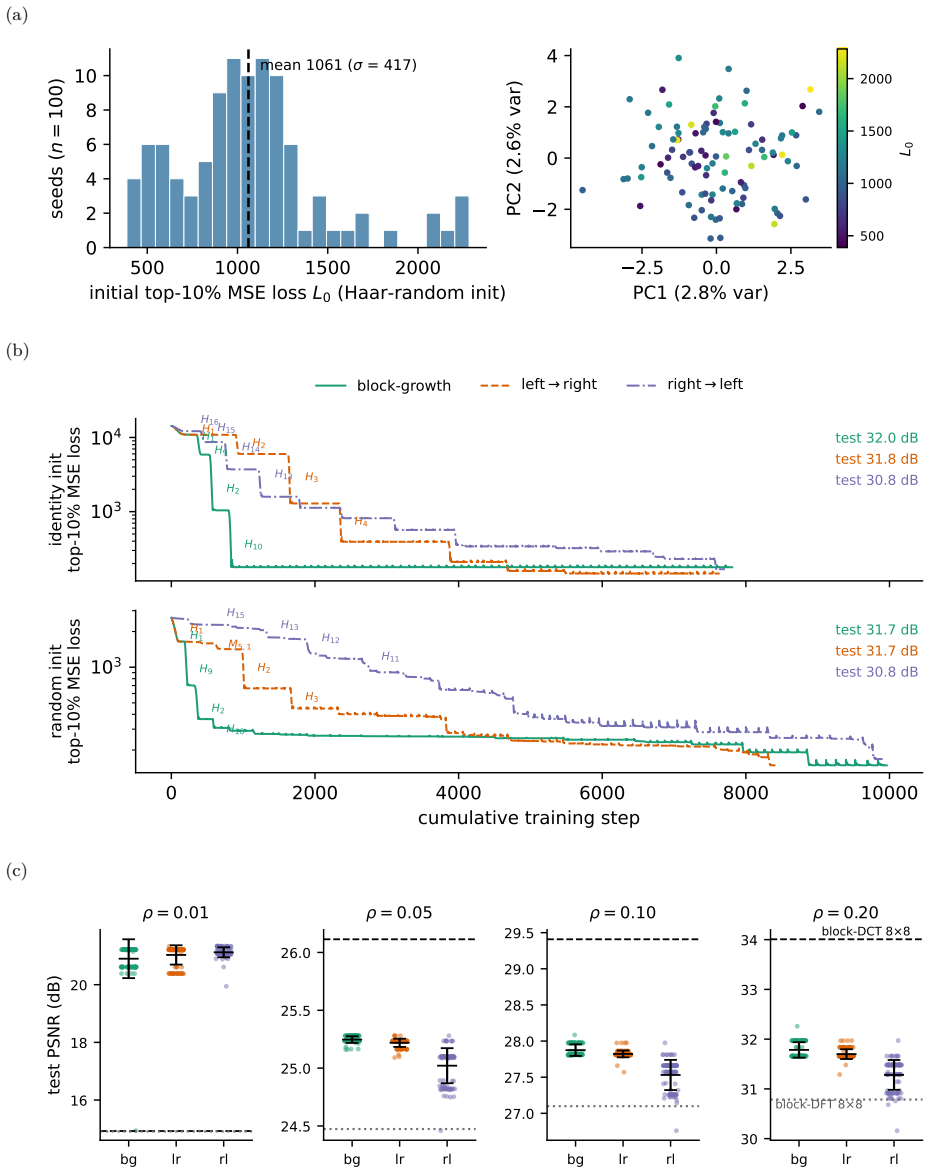
- The gate manifold is the main design lever: swapping diagonal phase gates for full U(4) tensors costs several dB, while connectivity changes at most 0.9 dB on the tested datasets.
- Savings grow at aggressive compression: roughly 30% fewer bytes at lower rate points and +5.5 dB at 40% of raw size on Quick Draw.
- On natural photographs the trained bases match the DCT rather than beating it, so the method is safe to apply but only pays off off-distribution.
Reading between the lines
- If the 20% byte saving survives a JPEG-style quantizer with tuned tables and arithmetic coding, the trained isometric basis could drop into existing codecs as a per-dataset replacement for the DCT stage, since the rest of the pipeline (quantization, entropy coding) stays untouched.
- The RichBasis collapse at keep ratio 0.01 suggests that single-rate training at ρ=0.1 does not transfer to far rates; training with a schedule of keep ratios or a rate–distortion objective—which the paper leaves as future work—might extend the gains across the full operating range.
- The recursive DCT-IV network is a sparse prior on image statistics; richer hierarchical topologies (like MERA) could be tested on other non-photographic corpora where block boundaries are less meaningful.
- The paper's claim that wiring is nearly saturated is a falsifiable design statement: the Entangled QFT, which adds row–column coupling, performed identically to the separable QFT, suggesting that simple entanglement does not help; a testable extension is whether multi-level or structured entanglement helps on content with long-range two-dimensional correlations.
Editorial analysis
A structured set of objections, weighed in public.
Referee Report
Summary. The paper proposes a parametric family of exactly invertible, fast, dataset-adaptive linear transforms for transform coding. The classical FFT/QFT and DCT-IV are first rewritten as isometric tensor networks and then relaxed gate-by-gate into unitary/orthogonal manifolds, giving trainable bases with polylogarithmic parameter counts and O(N log N) application cost. The bases are trained per dataset with Riemannian optimization on the top-k reconstruction MSE, and six topologies (QFT, Entangled QFT, RichBasis, TEBD, MERA, DCT-IV) are evaluated on DIV2K and Quick Draw. The paper reports that trained bases match the DCT on natural photographs and beat an 8x8 block DCT on Quick Draw by roughly 20% in bytes at matched PSNR under a custom byte-level codec.
Significance. The construction is elegant and the mathematical core is solid: the QFT and DCT-IV decompositions in Appendices A.1 and A.2 are genuine identities with no circularity, and the Riemannian optimizer preserves unitarity by construction. The paper has real strengths: the parameter overhead is polylogarithmic, the transform cost is near-linear, the exact fixed transforms are contained as initialization points, and the robustness studies in Appendices C and D (300 seeds, unfreezing orders, disturbance sweeps) are unusually thorough. If the Quick Draw gain survives a fair codec comparison, the result would be a useful basis-design tool for non-AR(1) image classes. However, the two headline claims as stated—'consistently improve on their fixed counterparts' and '20% fewer bytes than JPEG's 8x8 block cosine transform'—are not supported by the evidence as presented. The first is contradicted by Table 2 on DIV2K at moderate-to-high keep ratios; the second is measured under a custom global-top-k codec that is not JPEG, and it excludes a 64KB per-dataset parameter file whose amortized cost exceeds the reported per-image saving on the benchmark corpus.
major comments (3)
- [Abstract / Section 5.1, Table 2] The abstract and introduction claim that trained bases 'consistently improve' on fixed counterparts, but Table 2 shows the opposite on DIV2K. Fixed 8x8 DCT-II is the best method at rho=0.10 (28.98 dB vs best learned 28.82), rho=0.20 (33.59 vs RichBasis 33.31), and rho=0.40 (41.43 vs RichBasis 40.93). The learned bases only lead at rho<=0.05. The paper's own conclusion in Section 6.1 correctly says 'trained bases match the DCT on natural photographs,' so the abstract and introduction should be reworded to say the gains are dataset- and keep-ratio-dependent, not 'consistently improve.' This is a factual overclaim in the paper's central narrative.
- [Section 5.2 / Fig. 4b] The '20% fewer bytes' claim is measured with a homemade codec: global top-k coefficient selection, uniform b-bit quantization, and entropy coding of values and positions. This is not JPEG's 8x8 DCT pipeline, which uses blockwise quantization tables, zig-zag ordering, and run-length coding. Global top-k is structurally unfavorable to a block transform: it can zero entire 8x8 blocks and forgoes the per-block bit allocation that makes JPEG's DCT effective. The paper itself acknowledges in Section 6.2 that the training loss 'never sees the quantizer or the entropy coder' later applied. Therefore the claim that the trained basis stores images in 'roughly 20% fewer bytes than JPEG's 8x8 block cosine transform' is not established. A fair comparison should use a JPEG-style blockwise entropy-constrained codec for both bases, or the byte-level claim should be replaced by a top-k MSE/PSNR compariso
- [Section 5.2, parameter overhead] The reported per-image byte counts exclude the 64KB Quick Draw basis parameter file. Amortized over the 600 benchmark images (500 train + 100 test), that file costs about 109 bytes per image, which is larger than the claimed saving at 35 dB: 472 - 377 = 95 bytes per image. Thus, for the benchmark corpus, the '20% fewer bytes' headline disappears once the amortized parameter cost is included. The paper should report both (a) the per-image codec size excluding the one-time basis and (b) the amortized total cost for the stated corpus, or explicitly state the corpus size at which the savings become positive. The excluded transform definitions of classical references are not comparable because they require no stored parameters.
minor comments (4)
- [Abstract] Typographical spacing errors: 'roughly20%' and 'JPEG's8×8' should have spaces. Other similar spacing issues appear in the text.
- [Section 5.2] The sentence 'the saving grows to ~30% at lower-rate operating points' should give the operating point and bit depth for that figure, and should clarify whether those savings also exclude parameter amortization.
- [Section 5.2 / Fig. 4b] The description of the byte-level codec is incomplete. It says values and positions are entropy-coded, but does not specify the entropy coder (e.g., arithmetic vs Huffman), how positions are serialized, or whether headers are included in the reported sizes. This is needed for reproducibility even though code is provided.
- [Section 3.2 / Table 1] When comparing asymptotic costs, the 8x8 block DCT baseline is O(N) with a small constant, not O(N log N). The paper should state this explicitly so the complexity comparison is not read as a point in favor of the trained family.
Circularity Check
No circular derivation: self-contained QFT/DCT-IV decompositions, held-out evaluation, and disclosed train/eval mismatch; only non-load-bearing self-citations.
full rationale
The paper's derivation chain is not circular. Step (1), the FFT-to-QFT tensor-network construction, is a self-contained algebraic identity derived in Appendix A.1 (eqs. 3-8) from the Cooley-Tukey factorization; step (2), the DCT-IV recursion, is derived in Appendix A.2 from kernel identities and leans on external classical references [42, 43], with an induction claim stated in A.3. Step (3), gate relaxation onto unitary manifolds (Table 3), is an explicit parameterization. The training objective (eq. 1) is minimized on a fixed 500-image training slice with a 15% validation split, and 'the test images play no role in this selection' (sec. 4.3); all Table 2 and Fig. 4b numbers are computed on 100 held-out test images. The headline '20% fewer bytes' at 35 dB is a measured read-off from an empirical rate-distortion curve, not a prediction of a fitted quantity, and the paper itself discloses that the training loss 'never sees the quantizer or the entropy coder that the codec of section 5.2 applies afterwards' (sec. 6.2) - so the byte-level outcome contains components absent from the training objective and is not forced by construction. The robustness check that re-running on the training corpus barely changes the saving (19.7% vs 20%, sec. 5.2) shows the gain is a dataset-statistics effect, not a memorization artifact. Self-citations involving co-author Jin-Guo Liu ([40, 41] on contraction-order optimization; [49, 50] on differentiable tensor networks) support implementation-level techniques only; they are not used as a uniqueness theorem, as an ansatz-forcing authority, or as the justification of the central claim, and the differentiable-programming method is independently published with the code released. The legitimate concerns here are benchmarking validity (the bespoke global-top-k codec of sec. 5.2, applied symmetrically to both bases, may be structurally favorable to full-image transforms and is not JPEG's blockwise pipeline) and accounting completeness (the 64KB basis-parameter file is excluded from reported sizes; amortized over 600 images it exceeds the ~95-byte saving). These are correctness/fairness risks, not definitional reductions: no equation in the paper makes the claimed output equal a fitted input by construction.
Assumptions & free parameters
free parameters (3)
- trainable gate parameters θ (per-dataset basis weights) =
e.g., 2,200 real entries for DCT-IV on 256×256 DIV2K; 64 KB parameter file for Quick Draw basis
- training keep ratio ρ=0.1 =
0.1
- Riemannian Adam hyperparameters =
β1=0.9, β2=0.999, ε=10⁻⁸
assumptions (6)
- standard math The unrolled QFT network equals the classical FFT up to output bit reversal (eqs. 7–8).
- standard math The radix-2 DCT-IV decomposition into rotations, reversals and merges is exact (eq. 11).
- standard math Composition of isometric gate tensors yields a unitary T(θ) with T(θ)†T(θ)=I (eq. 21).
- domain assumption Natural photographs are near the AR(1)–Gaussian regime with ρ_AR→1, so the cosine basis is near-optimal there.
- domain assumption The custom byte-level codec (top-k, uniform b-bit quantization, entropy-coded values and positions) is a fair basis-versus-basis proxy for JPEG's 8×8 block DCT at matched quality.
- domain assumption A single basis trained at ρ=0.1 on a 500-image slice transfers to held-out images and to other keep ratios.
Cite this review
Pith. "Pith review of Fast Trainable Multilinear Bases for Image Compression." pith.science (2026). https://pith.science/paper/2D3PXEYB
@misc{pith2026260800053,
  author       = {Pith},
  title        = {Pith review of: Fast Trainable Multilinear Bases for Image Compression},
  year         = {2026},
  howpublished = {\url{https://pith.science/paper/2D3PXEYB}},
  note         = {Machine review of arXiv:2608.00053}
}
abstract
The Discrete Fourier Transform, the Discrete Cosine Transform, and their block-wise variants underpin most deployed image and video codecs. Their effectiveness rests on three properties: they run in near-linear time (linear up to a polylogarithmic factor), they are exactly invertible, and they carry few to no parameters. In this work, we generalize these bases to isometric multilinear bases, allowing a small number of extra parameters, polylogarithmic in the image size, while preserving all three properties. Given an image dataset, we develop a systematic framework that searches this family for the basis compressing the dataset most effectively: the basis is parameterized as an isometric tensor network, inspired by quantum many-body theory, and trained with Riemannian optimization on the manifold of unitary matrices. Across natural photographs and line drawings, the trained bases consistently improve on their fixed, non-parametric counterparts. On Quick Draw line-drawing compression, they store images in roughly $20\%$ fewer bytes than JPEG's $8 \times 8$ block cosine transform at the same reconstruction quality.
Figures


Figures from the paper (7 more)



Reference graph
Works this paper leans on
-
[1]
Gregory K. Wallace. The JPEG still picture com- pression standard.IEEE Transactions on Con- sumer Electronics, 38(1):xviii–xxxiv, 1992
1992
-
[2]
Sullivan, Jens-Rainer Ohm, Woo-Jin Han, and Thomas Wiegand
Gary J. Sullivan, Jens-Rainer Ohm, Woo-Jin Han, and Thomas Wiegand. Overview of the High Efficiency Video Coding (HEVC) standard. IEEE Transactions on Circuits and Systems for Video Technology, 22(12):1649–1668, 2012
2012
-
[3]
Vivek K. Goyal. Theoretical foundations of transform coding.IEEE Signal Processing Mag- azine, 18(5):9–21, 2001
2001
-
[4]
Academic Press, 3rd edition, 2008
St´ ephane Mallat.A Wavelet Tour of Signal Pro- cessing: The Sparse Way. Academic Press, 3rd edition, 2008. 9
2008
-
[5]
Discrete cosine transform.IEEE Trans- actions on Computers, C-23(1):90–93, 1974
Nasir Ahmed, T Natarajan, and Kamisetty R Rao. Discrete cosine transform.IEEE Trans- actions on Computers, C-23(1):90–93, 1974
1974
-
[6]
An al- gorithm for the machine calculation of complex Fourier series.Mathematics of Computation, 19(90):297–301, 1965
James W Cooley and John W Tukey. An al- gorithm for the machine calculation of complex Fourier series.Mathematics of Computation, 19(90):297–301, 1965
1965
-
[7]
A sinusoidal family of unitary trans- forms.IEEE Transactions on Pattern Analysis and Machine Intelligence, 1(4):356–365, 1979
Anil K Jain. A sinusoidal family of unitary trans- forms.IEEE Transactions on Pattern Analysis and Machine Intelligence, 1(4):356–365, 1979
1979
-
[8]
Lossy image compres- sion with compressive autoencoders
Lucas Theis, Wenzhe Shi, Andrew Cunning- ham, and Ferenc Husz´ ar. Lossy image compres- sion with compressive autoencoders. InInterna- tional Conference on Learning Representations (ICLR), 2017
2017
Show all 52 references
-
[9]
Si- moncelli
Johannes Ball´ e, Valero Laparra, and Eero P. Si- moncelli. End-to-end optimized image compres- sion. InInternational Conference on Learning Representations (ICLR), 2017
2017
-
[10]
An approximate Fourier transform useful in quantum factoring
Don Coppersmith. An approximate Fourier transform useful in quantum factoring. Tech- nical Report RC 19642, IBM Research, 1994. arXiv:quant-ph/0201067
1994 arXiv
-
[11]
Simulating quantum computation by contracting tensor net- works.SIAM Journal on Computing, 38(3):963– 981, 2008
Igor L Markov and Yaoyun Shi. Simulating quantum computation by contracting tensor net- works.SIAM Journal on Computing, 38(3):963– 981, 2008
2008
-
[12]
Tensor-train decomposi- tion.SIAM Journal on Scientific Computing, 33(5):2295–2317, 2011
Ivan V Oseledets. Tensor-train decomposi- tion.SIAM Journal on Scientific Computing, 33(5):2295–2317, 2011
2011
-
[13]
Su- pervised learning with tensor networks
Edwin Stoudenmire and David J Schwab. Su- pervised learning with tensor networks. InAd- vances in Neural Information Processing Systems (NeurIPS), volume 29, 2016
2016
-
[14]
Unsupervised generative model- ing using matrix product states.Physical Review X, 8(3):031012, 2018
Zhao-Yu Han, Jun Wang, Heng Fan, Lei Wang, and Pan Zhang. Unsupervised generative model- ing using matrix product states.Physical Review X, 8(3):031012, 2018
2018
-
[15]
The theory of variational hybrid quantum-classical algorithms
Jarrod R McClean, Jonathan Romero, Ryan Babbush, and Al´ an Aspuru-Guzik. The theory of variational hybrid quantum-classical algorithms. New Journal of Physics, 18(2):023023, 2016
2016
-
[16]
Vari- ational quantum algorithms.Nature Reviews Physics, 3(9):625–644, 2021
Marco Cerezo, Andrew Arrasmith, Ryan Bab- bush, Simon C Benjamin, Suguru Endo, Keisuke Fujii, Jarrod R McClean, Kosuke Mitarai, Xiao Yuan, Lukasz Cincio, and Patrick J Coles. Vari- ational quantum algorithms.Nature Reviews Physics, 3(9):625–644, 2021
2021
-
[17]
Quantum machine learning in feature Hilbert spaces.Phys- ical Review Letters, 122(4):040504, 2019
Maria Schuld and Nathan Killoran. Quantum machine learning in feature Hilbert spaces.Phys- ical Review Letters, 122(4):040504, 2019
2019
-
[18]
Parameterized quantum circuits as machine learning models.Quantum Science and Technology, 4(4):043001, 2019
Marcello Benedetti, Erika Lloyd, Stefan Sack, and Mattia Fiorentini. Parameterized quantum circuits as machine learning models.Quantum Science and Technology, 4(4):043001, 2019
2019
-
[19]
Hillar and Lek-Heng Lim
Christopher J. Hillar and Lek-Heng Lim. Most tensor problems are NP-hard.Journal of the ACM, 60(6):1–39, 2013
2013
-
[20]
Training vari- ational quantum algorithms is NP-hard.Physical Review Letters, 127:120502, 2021
Lennart Bittel and Martin Kliesch. Training vari- ational quantum algorithms is NP-hard.Physical Review Letters, 127:120502, 2021
2021
-
[21]
Rie- mannian adaptive optimization methods
Gary B´ ecigneul and Octavian-Eugen Ganea. Rie- mannian adaptive optimization methods. InIn- ternational Conference on Learning Representa- tions, 2019
2019
-
[22]
Riemannian optimization of isomet- ric tensor networks.SciPost Physics, 10(2):040, 2021
Markus Hauru, Maarten Van Damme, and Jutho Haegeman. Riemannian optimization of isomet- ric tensor networks.SciPost Physics, 10(2):040, 2021
2021
-
[23]
NTIRE 2017 challenge on single image super-resolution: Dataset and study
Eirikur Agustsson and Radu Timofte. NTIRE 2017 challenge on single image super-resolution: Dataset and study. InIEEE Conference on Computer Vision and Pattern Recognition Work- shops, pages 126–135, 2017
2017
-
[24]
Quick, draw! dataset.https:// quickdraw.withgoogle.com/data, 2017
Google. Quick, draw! dataset.https:// quickdraw.withgoogle.com/data, 2017
2017
-
[25]
A neural representa- tion of sketch drawings
David Ha and Douglas Eck. A neural representa- tion of sketch drawings. InInternational Confer- ence on Learning Representations (ICLR), 2018
2018
-
[26]
Arias, and Steven T
Alan Edelman, Tom´ as A. Arias, and Steven T. Smith. The geometry of algorithms with orthog- onality constraints.SIAM Journal on Matrix Analysis and Applications, 20(2):303–353, 1998
1998
-
[27]
Princeton University Press, 2008
P-A Absil, Robert Mahony, and Rodolphe Sepul- chre.Optimization Algorithms on Matrix Mani- folds. Princeton University Press, 2008
2008
-
[28]
Efficient simulation of one- dimensional quantum many-body systems.Phys- ical Review Letters, 93(4):040502, 2004
Guifr´ e Vidal. Efficient simulation of one- dimensional quantum many-body systems.Phys- ical Review Letters, 93(4):040502, 2004
2004
-
[29]
Entanglement renormalization
Guifr´ e Vidal. Entanglement renormalization. Physical Review Letters, 99(22):220405, 2007
2007
-
[30]
Estimating or propagating gradients through stochastic neurons for conditional com- putation.arXiv preprint arXiv:1308.3432, 2013
Yoshua Bengio, Nicholas L´ eonard, and Aaron Courville. Estimating or propagating gradients through stochastic neurons for conditional com- putation.arXiv preprint arXiv:1308.3432, 2013
2013 arXiv
-
[31]
Categor- ical reparameterization with Gumbel-Softmax
Eric Jang, Shixiang Gu, and Ben Poole. Categor- ical reparameterization with Gumbel-Softmax. InInternational Conference on Learning Repre- sentations (ICLR), 2017
2017
-
[32]
Reparam- eterizable subset sampling via continuous relax- ations
Sang Michael Xie and Stefano Ermon. Reparam- eterizable subset sampling via continuous relax- ations. InInternational Joint Conference on Ar- tificial Intelligence (IJCAI), 2019
2019
-
[33]
A feasible method for optimization with orthogonality constraints
Zaiwen Wen and Wotao Yin. A feasible method for optimization with orthogonality constraints. Mathematical Programming, 142(1-2):397–434, 2013. 10
2013
-
[34]
Cambridge University Press, 2023
Nicolas Boumal.An Introduction to Optimiza- tion on Smooth Manifolds. Cambridge University Press, 2023
2023
-
[35]
Kingma and Jimmy Ba
Diederik P. Kingma and Jimmy Ba. Adam: A method for stochastic optimization. InInterna- tional Conference on Learning Representations (ICLR), 2015
2015
-
[36]
Riemannian adaptive stochastic gradient algorithms on matrix manifolds
Hiroyuki Kasai, Pratik Jawanpuria, and Bamdev Mishra. Riemannian adaptive stochastic gradient algorithms on matrix manifolds. InInternational Conference on Machine Learning (ICML), 2019
2019
-
[37]
McClean, Sergio Boixo, Vadim N
Jarrod R. McClean, Sergio Boixo, Vadim N. Smelyanskiy, Ryan Babbush, and Hartmut Neven. Barren plateaus in quantum neural net- work training landscapes.Nature Communica- tions, 9:4812, 2018
2018
-
[38]
Cerezo, Akira Sone, Tyler Volkoff, Lukasz Cincio, and Patrick J
M. Cerezo, Akira Sone, Tyler Volkoff, Lukasz Cincio, and Patrick J. Coles. Cost function de- pendent barren plateaus in shallow parametrized quantum circuits.Nature Communications, 12:1791, 2021
2021
-
[39]
Yip, and K
Vladimir Britanak, Patrick C. Yip, and K. R. Rao.Discrete Cosine and Sine Transforms: Gen- eral Properties, Fast Algorithms and Integer Ap- proximations. Academic Press, 2007
2007
-
[40]
Tropical tensor network for ground states of spin glasses
Jin-Guo Liu, Lei Wang, and Pan Zhang. Tropical tensor network for ground states of spin glasses. Physical Review Letters, 126(9):090506, 2021
2021
-
[41]
Computing solu- tion space properties of combinatorial optimiza- tion problems via generic tensor networks.SIAM Journal on Scientific Computing, 45(3):A1239– A1270, 2023
Jin-Guo Liu, Xun Gao, Madelyn Cain, Mikhail D Lukin, and Sheng-Tao Wang. Computing solu- tion space properties of combinatorial optimiza- tion problems via generic tensor networks.SIAM Journal on Scientific Computing, 45(3):A1239– A1270, 2023
2023
-
[42]
Fast and numerically stable algorithms for discrete cosine transforms.Linear Algebra and its Applications, 394:309–345, 2005
Gerlind Plonka and Manfred Tasche. Fast and numerically stable algorithms for discrete cosine transforms.Linear Algebra and its Applications, 394:309–345, 2005
2005
-
[43]
Markus P¨ uschel and Jos´ e M. F. Moura. Algebraic signal processing theory: Cooley–Tukey type al- gorithms for DCTs and DSTs.IEEE Trans- actions on Signal Processing, 56(4):1502–1521, 2008
2008
-
[44]
Harrison Smith, and S
Wen-Hsiung Chen, C. Harrison Smith, and S. C. Fralick. A fast computational algorithm for the discrete cosine transform.IEEE Transactions on Communications, 25(9):1004–1009, 1977
1977
-
[45]
Moschytz
Christoph Loeffler, Adriaan Ligtenberg, and George S. Moschytz. Practical fast 1-D DCT algorithms with 11 multiplications. InProc. IEEE International Conference on Acoustics, Speech, and Signal Processing (ICASSP), vol- ume 2, pages 988–991, 1989
1989
-
[46]
Fast algo- rithms for the discrete cosine transform.IEEE Transactions on Signal Processing, 40(9):2174– 2193, 1992
Ephraim Feig and Shmuel Winograd. Fast algo- rithms for the discrete cosine transform.IEEE Transactions on Signal Processing, 40(9):2174– 2193, 1992
1992
-
[47]
Suboptimality of the Karhunen–Lo` eve transform for transform coding.IEEE Transac- tions on Information Theory, 50(8):1605–1619, 2004
Michelle Effros, Hanying Feng, and Kenneth Zeger. Suboptimality of the Karhunen–Lo` eve transform for transform coding.IEEE Transac- tions on Information Theory, 50(8):1605–1619, 2004
2004
-
[48]
JAX: composable transformations of Python+NumPy programs.http://github
James Bradbury, Roy Frostig, Peter Hawkins, Matthew James Johnson, Chris Leary, Dou- gal Maclaurin, George Necula, Adam Paszke, Jake VanderPlas, Skye Wanderman-Milne, and Qiao Zhang. JAX: composable transformations of Python+NumPy programs.http://github. com/google/jax, 2018
2018
-
[49]
Differentiable programming tensor net- works.Physical Review X, 9:031041, 2019
Hai-Jun Liao, Jin-Guo Liu, Lei Wang, and Tao Xiang. Differentiable programming tensor net- works.Physical Review X, 9:031041, 2019
2019
-
[50]
Prob- abilistic inference in the era of tensor networks and differential programming.Physical Review Research, 6:033261, 2024
Martin Roa-Villescas, Xuanzhao Gao, Sander Stuijk, Henk Corporaal, and Jin-Guo Liu. Prob- abilistic inference in the era of tensor networks and differential programming.Physical Review Research, 6:033261, 2024
2024
-
[51]
How to generate ran- dom matrices from the classical compact groups
Francesco Mezzadri. How to generate ran- dom matrices from the classical compact groups. Notices of the American Mathematical Society, 54(5):592–604, 2007. A From fast transforms to parametric tensor networks This appendix derives the parametric tensor networks trained in the ...
2007
-
[52]
OnlyO(2)is disconnected, splitting intodet = +1 rotations anddet =−1reflections
A point ofU(1) q is stored as the diagonal gate diag(z1,...,z q). OnlyO(2)is disconnected, splitting intodet = +1 rotations anddet =−1reflections. The DCT-IV ro- tation tensors start in the first component and its merge tensors in the second, atRy(0)H=H; because training moves...
2000
Reviewed August 4, 2026 · model on record in the stance chip above.
Discussion (0). Continue with ORCID to comment.