REVIEW 4 major objections 4 minor 29 references
StreamSplat claims a causal voxel cache lets feed-forward 3D Gaussian splatting scale to 1024-view streams without reprocessing history, improving quality as views arrive.
Reviewed by Pith at T0; open to challenge. T0 means a machine referee read the full paper against a public rubric. the ladder, T0–T4 →
StreamSplat incrementally builds a 3D Gaussian scene from a causal view stream using a memory-bounded voxel cache, and scales to hundreds of views where fixed-context baselines run out of memory.
T0 review reviewed 2026-08-04 challenge →
load-bearing objection Solid streaming 3DGS architecture, but the 512/1024-view causal scaling claim rests on a non-causal ScanNet anchor protocol. the 4 major comments →
StreamSplat: Streaming Feed-Forward 3D Gaussian Splatting
The pith
A machine-rendered reading of the paper's core claim, the machinery that carries it, and where it could break.
The reading
Core claim
The paper establishes a streaming feed-forward 3DGS framework that maintains a persistent 3D scene state in a Voxel-Aligned Causal Cache (VACC). VACC stores historical 3D tokens in a voxel grid of size 0.04 world units, keeping at most K=4 pivots per occupied voxel. When a voxel is full, incoming tokens are merged with the most feature-similar existing pivot via confidence-weighted aggregation (Eq. 4-5), so memory grows with explored scene geometry rather than stream length. History is actively reused by History-Projected Depth Anchoring (HPDA), which projects cached depth into the current views as confidence-aware Gaussian anchors fused into the plane-sweep cost volume (Eq. 7-8), and by Cac
What carries the argument
Voxel-Aligned Causal Cache (VACC): a memory-bounded 3D voxel grid that stores historical Gaussian tokens as at most four confidence-weighted pivots per occupied voxel, merging the most feature-similar pair when full (Eq. 4-5). VACC carries the central claim because it is what bounds memory by explored geometry rather than video length, enabling 1024-view streams on fixed hardware. HPDA and CGFI are the reuse mechanisms that make the cache causally useful: HPDA converts cached depth into Gaussian anchors for the current cost volume, and CGFI injects cached latent features into token regression, allowing history to guide each new chunk while remaining revisable.
Load-bearing premise
The central load-bearing premise is that two tokens landing in the same 0.04-unit voxel with the highest feature cosine similarity are redundant observations of the same surface, so merging them discards no geometry that later chunks need; if a later view observes genuinely new surface detail inside an already-occupied voxel, the merge deletes it.
What would settle it
On a trajectory that revisits a region at increasing resolution, render a novel view before and after the close pass: if VACC is discarding new detail, PSNR on that region should plateau or drop once the voxel is full. Concretely, compare full StreamSplat against an append-all cache run at matched total memory (e.g., half resolution or a larger GPU) at 512 views: if append-all keeps beating StreamSplat as view count grows, the merge is losing geometry rather than compressing redundancy.
If this is right
- Enables anytime reconstruction on long calibrated view streams at fixed hardware memory, without reprocessing the full image history.
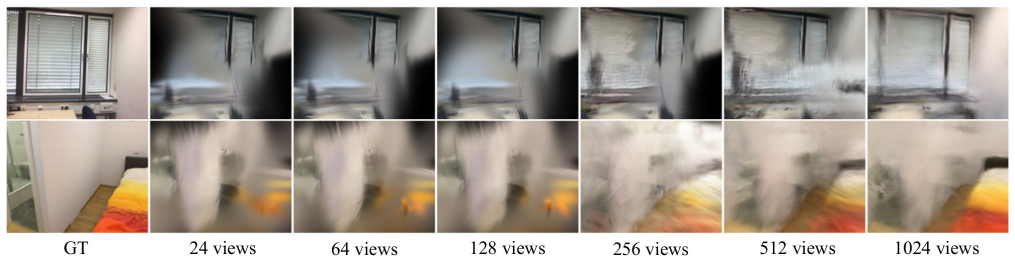
- Quality keeps improving with more context on long indoor trajectories (ScanNet PSNR 15.85→18.07 dB from 256 to 1024 views) where fixed-view baselines run out of memory.
- The causal cache costs only a small near-term quality loss (0.29 dB below an append-all cache at 256 views) but makes much larger contexts reachable, converting new observations into quality gains.
- The learned cache-anchor strength lets the model decide how much to trust history, so uncertain cached geometry can still be revised by the current cost volume.
- Among streaming baselines, OF3GS's quality saturates with more views, whereas StreamSplat accumulates gains, showing the persistent cache is what turns added views into sharper scenes.
Where Pith is reading between the lines
- A testable extension: on trajectories that revisit a surface at increasing resolution, VACC's fixed voxel size and pivot budget may cap representable detail; adaptive voxel resolution or per-voxel detail budgets could be evaluated, and the 0.29 dB gap at 256 views suggests headroom.
- Because memory is decoupled from stream length, the cache core could plausibly be combined with pose-free or dynamic-scene extensions, though the paper leaves those out.
- A controlled comparison at matched memory budgets—e.g., running an append-all cache at half resolution or on a larger GPU—would separate long-context gains attributable to accumulation from gains attributable to compression.
- The evaluation subsamples ScanNet to 1088 frames per sequence and excludes 13 RealEstate10K clips at 256 views, so long-context gains are measured on trajectories of limited overlap; applying the protocol to loop-closing trajectories would stress the merge assumption directly.
Editorial analysis
A structured set of objections, weighed in public.
Referee Report
Summary. StreamSplat proposes a streaming feed-forward 3D Gaussian Splatting system that processes calibrated view streams in chunks and maintains a persistent geometry-grounded scene state. The core module, Voxel-Aligned Causal Cache (VACC), stores historical 3D tokens in a memory-bounded voxel structure, while History-Projected Depth Anchoring (HPDA) and Cache-Guided Feature Injection (CGFI) reuse cached geometry and features to guide depth estimation and token regression. The paper claims competitive performance under sparse causal inputs and, more importantly, scalable reconstruction over long streams (256, 512, 1024 views) with sustained quality gains, evaluated on DL3DV, RealEstate10K, and ScanNet. Ablations isolate the contributions of VACC, HPDA, and CGFI.
Significance. If the claims hold, the paper makes a meaningful step toward online feed-forward 3DGS, where memory scales with scene geometry rather than stream length and anytime reconstruction is possible. The work is careful in several respects: it provides a detailed evaluation protocol in the appendix, uses identical context indices for all methods, reports peak memory measurements under the same hardware, and includes ablations that are individually retrained. The Decoder's train/inference protocol and the explicit acknowledgment of CUDA nondeterminism are also to the authors' credit. However, the central causal-streaming claim is compromised by the ScanNet anchor-frame protocol, which injects future frames into the context, and the long-stream results rest on single-run measurements without statistical support.
major comments (4)
- [Appendix B.1, Table 2, Abstract] The headline claim that StreamSplat works 'without future views or full-scene context' at 256, 512, and 1024 views is not supported by the ScanNet evaluation. Appendix B.1 states that each ScanNet context begins with 8 'globally uniform anchor frames' drawn from the full trajectory before the first V−8 prefix frames. Since the trajectory B spans the whole room-scale sequence, these anchors are future frames relative to the early prefix. Table 2's 512- and 1024-view results are exclusively on ScanNet; DL3DV and RealEstate10K only reach 256 views with strict causal prefixes. The quality gains in Table 2 could therefore stem from the future-selected anchors rather than from the causal voxel cache. The paper's limitation section does not disclose this protocol violation. This must be fixed, e.g., by reselecting anchors from the causal prefix only, or by reporting strict-causal results at 512
- [Appendix B.2, Tables 1-2] Every reported number corresponds to a single evaluation run per configuration, and Appendix B.2 acknowledges that CUDA nondeterminism may cause the last digit to vary. Given this, the 'sustained improvements' of 15.85→16.98→18.07 PSNR over 256→512→1024 views on ScanNet, and the smaller differences in Table 1 and the ablations, are not supported without error bars or multiple seeds. The claim that the model 'consistently improves' with context length is load-bearing; please report at least 3 runs with mean and standard deviation, or a significance test, for the key long-stream comparisons.
- [Method, 'Gaussian Decoder' (paragraph following Eq. 10)] The training and inference protocols for the Gaussian decoder are inconsistent. During training, the decoder is applied to the concatenated gradient-retaining tokens from all chunks, while during inference it is applied to the final fused cache. The fused cache contains at most K pivot tokens per voxel, a different token distribution than the full concatenated set. This train/inference mismatch can cause systematic degradation in the reported anytime reconstruction results. The paper does not discuss this mismatch or provide evidence that the decoder generalizes to the fused-cache input. Please either train the decoder on the fused cache (or a simulated fused cache), or explicitly justify why the mismatch is benign.
- [Eq. (4)-(5), Table 3] VACC assumes that tokens in the same voxel with the highest feature cosine similarity are redundant observations of the same surface, and merging them discards no needed geometry. Table 3 shows that the full model at 256 views is 0.29 dB below the append-all variant, indicating that the merge does discard some useful detail. The long-stream gains in Table 2 are therefore achieved by trading away short-term accuracy for memory efficiency, not by purely accumulating evidence. The paper should analyze the conditions under which merging discards novel surface detail (e.g., later views entering an occupied voxel) and ideally add an ablation with a stricter merge criterion or a separate 'no-merge' memory-unbounded oracle at 512/1024 views to support the claim that VACC 'preserves fine geometric detail'.
minor comments (4)
- [Figure 1] The memory curves would be easier to interpret with numerical labels or a table accompanying the figure; the 96 GB limit line is clear but the exact growth rates for each baseline are hard to read.
- [Appendix D.4] The statement that every ablated variant is retrained is good, but it would help to state the number of training iterations and seeds used for each ablation, to ensure the 0.3-0.4 dB differences are not within training noise.
- [Overall notation] The notation for the projected cache maps in Eq. (6) - specifically D_v_H, Omega_v_H, F_v_H - is not defined formally before use. A one-sentence definition of the projection P would improve readability.
- [Table 3] The 'Baseline' row uses an append-all cache without HPDA/CGFI, while 'w/o VACC' keeps HPDA/CGFI but replaces voxel merging with append-all. The reader must infer this difference from the text; consider spellout in the table caption.
Circularity Check
No substantive circularity: central claims are held-out empirical evaluations; the only flagged factor is a minor non-load-bearing same-author citation.
full rationale
StreamSplat's central claims are empirical measurements on held-out target views under the fixed protocol of Appendix B, not derivations from fitted constants. Eq. (7)-(8) HPDA has a learnable gamma_d, but it is trained on training splits and evaluated on held-out views; VACC (Eq. 4-5), HPDA, and CGFI (Eq. 9-10) are all ablated in Table 3, including an openly reported 0.29 dB accuracy cost for VACC's merge relative to an append-all cache. Thus no prediction reduces to a fitted parameter or to the cache design by construction. The one same-author citation is STAC (Wang et al. 2026), used only as motivation for a spatial token cache; because VACC's effect is directly measured by the paper's own ablations and external benchmarks, this citation is not load-bearing and does not raise the score above the low range. A reviewer-flagged protocol issue, not circularity: Appendix B.1 seeds each ScanNet context with 8 globally uniform anchor frames from the full subsampled sequence, so future-frame information enters the 512/1024-view ScanNet evaluations; this weakens the abstract's 'no future views' wording but is a fairness/control issue, not an equation-level self-reduction. The paper itself discloses limitations such as pose dependence, static scenes, and short-trajectory gaps (Appendix E).
Axiom & Free-Parameter Ledger
free parameters (6)
- voxel_size_delta =
0.04 (world units)
- pivot_budget_K =
4
- confidence_threshold_tau_conf =
0.3
- anchor_variance_sigma_0 =
0.1
- anchor_variance_scale_lambda_sigma =
0.5
- cache_anchor_strength_gamma_d =
learned scalar, value not reported
axioms (5)
- domain assumption The plane-sweep cost volume and depth distribution from DepthSplat (Eq. 3) provide reliable per-view depth estimates.
- domain assumption Cosine similarity between token features is a valid proxy for whether two 3D tokens observe the same surface.
- domain assumption The peak depth probability omega = max_k P(k|u) reliably reflects the geometric confidence of a token.
- ad hoc to paper Causal chunked processing with no retrospective revision can accumulate enough scene evidence to improve quality over long streams.
- domain assumption The provided camera poses are accurate.
Cite this review
Pith. "Pith review of StreamSplat: Streaming Feed-Forward 3D Gaussian Splatting." pith.science (2026). https://pith.science/paper/W5DQAFMT
@misc{pith2026260801659,
  author       = {Pith},
  title        = {Pith review of: StreamSplat: Streaming Feed-Forward 3D Gaussian Splatting},
  year         = {2026},
  howpublished = {\url{https://pith.science/paper/W5DQAFMT}},
  note         = {Machine review of arXiv:2608.01659}
}
read the original abstract
Feed-forward 3D Gaussian Splatting enables efficient novel-view synthesis without per-scene optimization, but most existing methods assume a fixed set of context views and process them jointly. This limits their applicability to online scenarios where calibrated views arrive sequentially and the scene must be updated causally. We present \emph{StreamSplat}, a streaming feed-forward 3DGS framework that incrementally maintains a persistent geometry-grounded scene state and decodes it into renderable 3D Gaussians after each input chunk. StreamSplat centers on a \textbf{Voxel-Aligned Causal Cache (VACC)}, which stores historical 3D tokens in a memory-bounded voxel structure so that memory grows with explored scene geometry rather than stream length. To better reuse history during causal prediction, we introduce \textbf{History-Projected Depth Anchoring (HPDA)} to project cached geometry as depth guidance for current cost-volume estimation, and \textbf{Cache-Guided Feature Injection (CGFI)} to inject cached latent evidence into Gaussian-token regression. Experiments on DL3DV, RealEstate10K, and ScanNet show that StreamSplat remains competitive with state-of-the-art feed-forward 3DGS methods under sparse causal inputs, despite not using future views or full-scene context. More importantly, it scales to long input streams with 256, 512, and 1024 views where fixed-view baselines run out of memory, yielding sustained improvements in novel-view synthesis quality as more observations arrive. The code will be made publicly available upon acceptance.
Figures




Reference graph
Works this paper leans on
-
[1]
L.; Tagliasacchi, A.; and Sitzmann, V
Charatan, D.; Li, S. L.; Tagliasacchi, A.; and Sitzmann, V. 2024. pixelSplat: 3D Gaussian Splats from Image Pairs for Scalable Generalizable 3D Reconstruction. In Proceedings of the IEEE/CVF Conference on Computer Vision and Pattern Recognition, 19457--19467
work page 2024
-
[2]
Chen, R.; Li, F.; Zhou, C.; Li, Z.; Ma, Z.; and Guo, H. 2026. OF ^3 GS : On-the-Fly Feed-Forward 3D Gaussian Splatting from Unposed Images. arXiv:2606.03254
work page internal anchor Pith review Pith/arXiv arXiv 2026
-
[3]
Chen, Y.; Xu, H.; Zheng, C.; Zhuang, B.; Pollefeys, M.; Geiger, A.; Cham, T.-J.; and Cai, J. 2024 a . MVSplat : Efficient 3D Gaussian Splatting from Sparse Multi-View Images. In European Conference on Computer Vision
work page 2024
-
[4]
Chen, Z.; Tan, H.; Zhang, K.; Bi, S.; Luan, F.; Hong, Y.; Li, F.; and Xu, Z. 2024 b . Long-LRM : Long-Sequence Large Reconstruction Model for Wide-Coverage Gaussian Splats. arXiv preprint arXiv:2410.12781
Pith/arXiv arXiv 2024
-
[5]
X.; Savva, M.; Halber, M.; Funkhouser, T.; and Nie ner, M
Dai, A.; Chang, A. X.; Savva, M.; Halber, M.; Funkhouser, T.; and Nie ner, M. 2017. ScanNet : Richly-Annotated 3D Reconstructions of Indoor Scenes. In Proceedings of the IEEE Conference on Computer Vision and Pattern Recognition, 5828--5839
work page 2017
-
[6]
Fang, G.; and Wang, B. 2024. Mini-Splatting: Representing Scenes with a Constrained Number of Gaussians. In European Conference on Computer Vision, 165--181
work page 2024
-
[7]
Hahlbohm, F.; Franke, L.; Eisemann, M.; and Magnor, M. 2026. Faster-GS: Analyzing and Improving Gaussian Splatting Optimization. In Proceedings of the IEEE/CVF Conference on Computer Vision and Pattern Recognition, 18946--18957
work page 2026
-
[8]
Huang, G.; Wang, R.; Gao, X.; Sun, C.; Wu, Y.; Gao, S.; and Jia, Y. 2026. LongSplat : Online Generalizable 3D Gaussian Splatting from Long Sequence Images. In Proceedings of the AAAI Conference on Artificial Intelligence, volume 40, 4994--5002
work page 2026
-
[9]
Jiang, L.; Mao, Y.; Xu, L.; Lu, T.; Ren, K.; Jin, Y.; Xu, X.; Yu, M.; Pang, J.; Zhao, F.; Lin, D.; and Dai, B. 2025. AnySplat : Feed-Forward 3D Gaussian Splatting from Unconstrained Views. ACM Transactions on Graphics, 44(6)
work page 2025
-
[10]
Kerbl, B.; Kopanas, G.; Leimk \"u hler, T.; and Drettakis, G. 2023. 3D Gaussian Splatting for Real-Time Radiance Field Rendering. ACM Transactions on Graphics, 42(4)
work page 2023
-
[11]
Kotovenko, D.; Grebenkova, O.; and Ommer, B. 2026. EDGS : Eliminating Densification for Efficient Convergence of 3DGS. In Proceedings of the IEEE/CVF Conference on Computer Vision and Pattern Recognition, 41065--41076
work page 2026
-
[12]
Li, Y.; Lv, C.; Tang, Z.; Yang, H.; and Huang, D. 2026. TokenSplat : Token-aligned 3D Gaussian Splatting for Feed-forward Pose-free Reconstruction. In Proceedings of the IEEE/CVF Conference on Computer Vision and Pattern Recognition, 40886--40895
work page 2026
-
[13]
Li, Y.; Wang, J.; Chu, L.; Li, X.; Kao, S.-H.; Chen, Y.-C.; and Lu, Y. 2025. StreamGS : Online Generalizable Gaussian Splatting Reconstruction for Unposed Image Streams. In Proceedings of the IEEE/CVF International Conference on Computer Vision, 25841--25850
work page 2025
-
[14]
Ling, L.; Sheng, Y.; Tu, Z.; Zhao, W.; Xin, C.; Wan, K.; Yu, L.; Guo, Q.; Yu, Z.; Lu, Y.; Li, X.; Sun, X.; Ashok, R.; Mukherjee, A.; Kang, H.; Kong, X.; Hua, G.; Zhang, T.; Benes, B.; and Bera, A. 2024. DL3DV-10K : A Large-Scale Scene Dataset for Deep Learning-based 3D Vision. In Proceedings of the IEEE/CVF Conference on Computer Vision and Pattern Recognition
work page 2024
-
[15]
Mildenhall, B.; Srinivasan, P. P.; Tancik, M.; Barron, J. T.; Ramamoorthi, R.; and Ng, R. 2021. NeRF : Representing Scenes as Neural Radiance Fields for View Synthesis. Communications of the ACM, 65(1): 99--106
work page 2021
-
[16]
Mo, Y.; Cai, Y.; and Liu, L. 2026. Plug-and-Play PDE Optimization for 3D Gaussian Splatting: Toward High-Quality Rendering and Reconstruction. In Proceedings of the IEEE/CVF Conference on Computer Vision and Pattern Recognition, 33333--33342
work page 2026
-
[17]
Ren, S.; Wen, T.; Fang, Y.; and Lu, B. 2026. FastGS : Training 3D Gaussian Splatting in 100 Seconds. In Proceedings of the IEEE/CVF Conference on Computer Vision and Pattern Recognition, 26094--26103
work page 2026
-
[18]
Smart, B.; Zheng, C.; Laina, I.; and Prisacariu, V. A. 2024. Splatt3R : Zero-Shot Gaussian Splatting from Uncalibrated Image Pairs. arXiv preprint arXiv:2408.13912
Pith/arXiv arXiv 2024
-
[19]
Veicht, A.; Hong, S.; Barath, D.; and Pollefeys, M. 2026. ZipSplat : Fewer Gaussians, Better Splats. arXiv preprint arXiv:2606.05102
work page internal anchor Pith review Pith/arXiv arXiv 2026
-
[20]
Wang, R.; Song, Y.; Cai, Y.; and Liu, L. 2026. STAC : Plug-and-Play Spatio-Temporal Aware Cache Compression for Streaming 3D Reconstruction. In Proceedings of the IEEE/CVF Conference on Computer Vision and Pattern Recognition, 7567--7576
work page 2026
-
[21]
Wang, Z.; Bovik, A. C.; Sheikh, H. R.; and Simoncelli, E. P. 2004. Image Quality Assessment: From Error Visibility to Structural Similarity. IEEE Transactions on Image Processing, 13(4): 600--612
work page 2004
-
[22]
Wu, Z.; Yan, Q.; Yi, X.; Wang, L.; and Liao, R. 2026. StreamSplat : Towards Online Dynamic 3D Reconstruction from Uncalibrated Video Streams. In International Conference on Learning Representations
work page 2026
-
[23]
Xu, H.; Barath, D.; Geiger, A.; and Pollefeys, M. 2025 a . ReSplat : Learning Recurrent Gaussian Splats. arXiv preprint arXiv:2510.08575
arXiv 2025
-
[24]
Xu, H.; Peng, S.; Wang, F.; Blum, H.; Barath, D.; Geiger, A.; and Pollefeys, M. 2025 b . DepthSplat : Connecting Gaussian Splatting and Depth. In Proceedings of the IEEE/CVF Conference on Computer Vision and Pattern Recognition, 16453--16463
work page 2025
-
[25]
Ye, B.; Liu, S.; Xu, H.; Li, X.; Pollefeys, M.; Yang, M.-H.; and Peng, S. 2025. No Pose, No Problem: Surprisingly Simple 3D Gaussian Splats from Sparse Unposed Images. In International Conference on Learning Representations
work page 2025
-
[26]
Yu, Z.; Chen, A.; Huang, B.; Sattler, T.; and Geiger, A. 2024. Mip-Splatting: Alias-Free 3D Gaussian Splatting. In Proceedings of the IEEE/CVF Conference on Computer Vision and Pattern Recognition, 19447--19456
work page 2024
-
[27]
A.; Shechtman, E.; and Wang, O
Zhang, R.; Isola, P.; Efros, A. A.; Shechtman, E.; and Wang, O. 2018. The Unreasonable Effectiveness of Deep Features as a Perceptual Metric. In Proceedings of the IEEE Conference on Computer Vision and Pattern Recognition, 586--595
work page 2018
-
[28]
Zhou, T.; Tucker, R.; Flynn, J.; Fyffe, G.; and Snavely, N. 2018. Stereo Magnification: Learning View Synthesis Using Multiplane Images. ACM Transactions on Graphics, 37(4): 65:1--65:12
work page 2018
-
[29]
Zhuo, L.; Chen, Y.; Liao, S.; and Hu, H. 2025. Streaming 4D Visual Geometry Transformer. arXiv preprint arXiv:2507.11539
Pith/arXiv arXiv 2025
This paper was first reviewed by deepseek-v4-flash on August 4, 2026.
discussion (0)
Sign in with ORCID, Apple, or X to comment. Anyone can read and Pith papers without signing in.