REVIEW 3 major objections 4 minor 55 references
Nonlocality-induced critical-length hierarchy from non-Hermitian competition
T0 review · 3 major / 4 minor · reviewed 2026-08-07 · deepseek-v4-flash
Pith's one-line read Long-range couplings reorganize the finite-size real-to-complex transition of coupled non-Hermitian chains from a logarithmic critical length to algebraic and scale-covariant laws.
desk verdict Long-range couplings genuinely reorganize finite-size criticality in non-Hermitian ladders; the substance holds up, but the first-colliding-pair assumption needs a sharper global check before the hierarchy is treated as universal. read the letter →
The pith
A machine-rendered reading of the paper's core claim, the machinery that carries it, and where it could break.
The reading
What carries the argument
The mechanism is the pair-resolved exceptional-point criterion: an effective four-by-four Hamiltonian projected onto the two single-chain modes that collide first, with instability when $\Lambda_\eta^2 + 4u_{ab}v_{ba}<0$, and the physical critical length selected as $N_c = \min_{a,b} N_{ab}$. The derivation is carried by the band-edge pair $(1,2)$, and the competing quantities are the single-chain spacing $\Delta E_{ab}$, the projected rung diagonal shift, and the off-diagonal hybridization product. Two nonlocal mechanisms do the work: a nonanalytic band-edge dispersion $\Delta E \sim N^{1-\alpha}$ from long-range intra-chain hoppings, and parity-mixing hybridization proportional to $\chi_N(\alpha)$ that lets the antisymmetric rung channel $u_{12}v_{21}$ turn on once reciprocity is broken.
What would settle it
Exactly diagonalize the full open-boundary two-chain ladder over a grid of $(D, \alpha, \gamma)$, record the smallest $N$ at which a complex pair appears and which single-chain modes that pair comes from; the paper's claim requires the minimizing pair to be the band-edge pair $(1,2)$ and $N_c$ to follow the predicted log, $D^{\alpha/3}$, and aspect-ratio branches, so any different first-colliding pair or exponent would settle the matter.
Extended reading notes
Core claim
On its own terms, the paper's central claim is that the critical chain length $N_c$ at which the ladder spectrum turns complex is selected by the earliest exceptional-point collision of a pair of single-chain modes, and that the placement of long-range couplings changes which terms control that collision. With local couplings the balance is between an exponentially small skin overlap and the weak inter-chain coupling, giving $N_c \sim \ln D$. Making the rungs power-law gives the collective rung projection a factor growing with $N$, so the quadratic band-edge gap $N^{-2}$ is overcome at $N^3 \sim D^\alpha$, hence $N_c \sim D^{\alpha/3}$. Making the legs power-law as well replaces the quadratic gap by the nonanalytic gap $N^{1-\alpha}$ and activates a non-reciprocity-induced mixing ratio $\chi_N(\alpha)$, which for $\alpha<2$ is size-independent and turns the threshold into an equation for $N_c/D$ alone; at $\alpha=2$ a logarithmically corrected law appears, and for $2<\alpha<3$ the mixing ratio grows as $N^{\alpha-2}$ and spoils exact scale covariance, with the whole branch capped at a single-chain saturation length $N_{\rm sat}$.
Load-bearing premise
Everything rests on the assumption that the first real-to-complex transition is captured by one pair of single-chain modes, the two band-edge modes, projected onto a four-by-four effective Hamiltonian; if a different pair collides first in some range of parameters, the logarithmic, algebraic, and scale-covariant laws would need to be replaced.
Editorial extensions
If this is right
- A fully local ladder reproduces the conventional critical-NHSE result: the critical length grows only logarithmically with the transverse separation, $N_c \sim \ln D$.
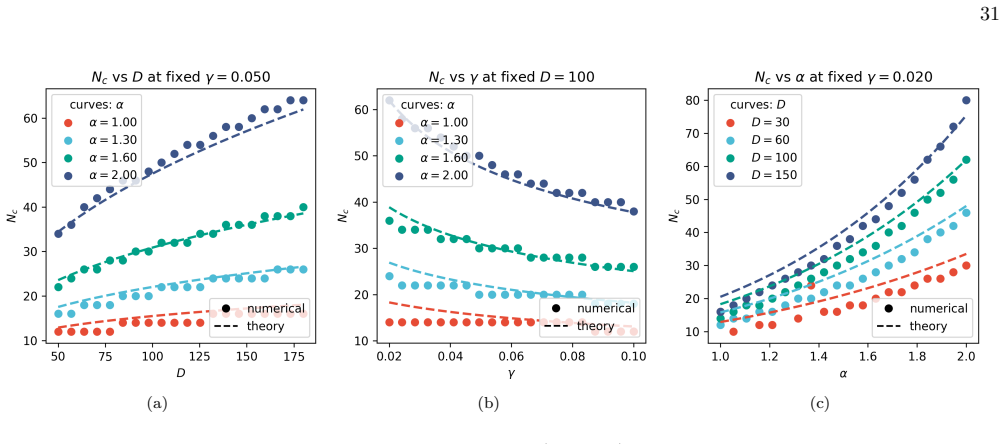
- A ladder with long-range rungs and local legs has $N_c \sim D^{\alpha/3}$; the onset is algebraic, not logarithmic, because the long-range rung projection grows with $N$ while the leg gap remains $N^{-2}$.
- A ladder with long-range legs and rungs has, for $0<\alpha<2$, a scale-covariant threshold where the equation fixes $N_c/D$; at $\alpha=2$ a logarithmic correction appears, and for $2<\alpha<3$ the ratio is no longer exactly fixed.
- Because the three laws grow differently with $D$, all six orderings of the three critical lengths occur in the $(D,\alpha)$ plane, so the most stable architecture can change as $D$ and $\alpha$ vary.
- The onset can be measured as the first resolvable relative imaginary splitting or modal growth rate after uniform background subtraction, giving a concrete protocol for topoelectrical circuits, photonic lattices, and programmable simulators.
Reading between the lines
- The same logarithmic-to-algebraic-to-scale-covariant hierarchy should reappear in any competitive non-Hermitian system with one long-range channel, since the derivation only requires a long-range coupling to enter the exceptional-point discriminant; replacing the ladder geometry by another coupling graph would test this transfer.
- Truncating the power-law hoppings at a finite range should interpolate between the regimes, so measuring $N_c$ as a function of the truncation range could isolate the effective interaction range that governs the crossover.
- For $\alpha<2$, the scale-covariant threshold can be read as a line of fixed points under simultaneous dilation of $N$ and $D$; a renormalization-style check would be to see whether corrections to scaling vanish as both lengths grow at fixed ratio.
Editorial analysis
A structured set of objections, weighed in public.
Referee Report
Summary. The manuscript studies the finite-size real-to-complex spectral transition in a ladder of two coupled non-Hermitian chains with opposite non-reciprocal pumping. It develops a projected exceptional-point framework (Eqs. (11)-(14)) in which the critical length N_c is the first chain length at which a pair of single-chain modes collides, with the observed transition selected as the minimum over all pairs. Using this framework, it derives three scaling laws: for fully local legs and rungs, N_c ~ ln D; for local legs with power-law rungs, N_c ~ D^{α/3}; and for fully nonlocal legs and rungs, a scale-covariant threshold N_c ∝ D for α<2, with logarithmic and algebraic corrections at α=2 and 2<α<3. These laws are compared with exact diagonalization for representative α=0.5, 1, and 2.4 and assembled into a (D,α) hierarchy diagram; the appendices contain derivations, a full-kernel benchmark, and experimental protocols.
Significance. If correct, the paper establishes a qualitatively new organizing principle for non-Hermitian finite-size criticality: the length scale controlling the transition can be changed from the skin depth to a purely geometric aspect ratio by distributing power-law nonlocality across different coupling channels. This goes beyond the standard critical-NHSE logarithmic scaling and is a substantial contribution to the field. The derivation from a common 4×4 EP criterion is transparent and internally consistent, the numerics use the full distance-dependent rung kernel, and the explicit experimental protocols make the central predictions falsifiable. The main reservations concern the global validity of the (1,2) pair selection, the fitted prefactors, and the constant-kernel approximation in the scale-covariant branch; these are technical but load-bearing.
major comments (3)
- [Sec. II.C.1, Eq. (14); Sec. II.C.2, Model III] The central claim that the hierarchy N_c~ln D, N_c~D^{α/3}, and N_c/D is a property of each ladder model is not yet justified globally. The paper's own framework defines N_c as the minimum over all candidate pairs in Eq. (14), but every subsequent analytical branch assumes the minimizing pair is the band-edge pair (1,2). This is verified only for representative parameters (Appendix B, Figs. 4–5 for α=2, D=30; Fig. 2 for α=0.5, 1, 2.4), and the paper explicitly acknowledges in footnote 94 and Appendix D.3 that the band-edge formulas apply only to the window in which (1,2) is first, while Appendix D.4 shows that changing the nonlocality placement can move the first collision to the bottom-edge pair. Since the level spacing and projected rung elements are pair-specific, a different minimizing pair would change the scaling laws. Please either prove via the scaling of N_ab for all pairs, or provide a numerical first-colliding-pair map over the full (D,α) range of Fig. 3 and restrict the hierarchy claims to the established window.
- [Sec. II.C.2, Eq. (22); App. D.3, Eqs. (D66)–(D67)] Several quantitative coefficients in the analytical curves are fitted to the very numerical data they are compared with. The Model-II threshold uses the 'common effective values' η0=3.0 and η1=3.7, and the Model-III branches use the polynomial A(α),B(α) in Eq. (35) and A>(α),B>(α) in Eqs. (D66)–(D67), the latter extracted from a simultaneous nonlinear fit to 209 numerical threshold points. Consequently, the close agreement between the dashed analytical curves and the numerical circles in Fig. 2 is partly a circular test at the prefactor level; only the scaling exponents are genuinely derived. The authors should state clearly which coefficients are fitted and, ideally, attempt to compute the leading constants from the full distance-dependent kernel so that the comparison in Fig. 2 contains an independent quantitative check.
- [Sec. II.C.2, Model III, Eqs. (19)–(33)] There is an internal tension between the constant-kernel approximation and the scale-covariant solution it produces. Equation (19) replaces the long-range rung kernel by D^{-α} under the condition D≫|n−m|, but Eq. (33) yields N_c^{III}/D = [π^2 C(α)/8]^{1/α}(1+γ|χ(α)|)^{-2/α}, which is O(1) and, with the fitted A(α) in Eq. (35), exceeds unity over most of 0<α<2. Thus at the predicted threshold the longitudinal separations |n−m| up to N_c are comparable to or larger than D, violating the premise of the derivation. Appendix F benchmarks full and constant kernels for representative α, but it does not explicitly isolate the scale-covariant branch in the N_c~D regime; since the constant-kernel factorization of u_ij in Eq. (24) is what produces the N-linear collective coupling, this branch needs a dedicated full-kernel check before the N_c/D law is asserted.
minor comments (4)
- [Abstract] 'Long-range hoppings fundamentally reorganizes' should read 'reorganize'; the phrase 'a marginal logarithmically corrected and algebraically corrected regimes' is ungrammatical and should specify which regime applies at α=2 versus α>2.
- [Near Eq. (33)] 'The fact is that the this scale-covariance' contains a typo ('the this').
- [Sec. II.C.2, Model I] The statement that the first EP collision is given by the l=1,2 subspace is asserted without derivation; please cite the argument or state the parameter condition under which it holds.
- [Fig. 2 caption] 'At fixed non-reciprocity' is vague; state γ=0.05 in the first sentence rather than only in the last sentence.
Circularity Check
Central scaling laws are derived from the EP power balance, but quantitative analytical curves for Models II and III reuse the numerical N_c data through fitted prefactors, so part of the reported agreement is by construction.
-
fitted input called prediction
[Main text Eq. (35) and Appendix D 3 a (Fig. 12)]
"A(α)≃2.4−0.026α+0.33α², B(α)≃11−12α+5.7α² over the explored range 0<α<2. ... Any polynomial parametrization of A and B is accordingly fitted only to the unsaturated (1,2) data with α<2."
The scale-covariant form N_c/D = A(α)−γB(α) is derived from the projected-EP balance, but the coefficients A and B are obtained by fitting the same numerical N_c thresholds that the analytical Model-III curves are claimed to predict in Fig. 2(d,e). The dashed curves therefore owe part of their agreement to the fit; only the functional form and the N_c ∝ D scaling are independent of the fit.
-
fitted input called prediction
[Eq. (22) and Appendix D 2, Eqs. (D31)–(D33)]
"For the Model-II analytical curves in Fig. 2 and the corresponding hierarchy boundaries in Fig. 3, we use the common effective values η0 = 3.0 and η1 = 3.7."
The Model-II threshold equation (22) contains two dimensionless prefactors η0 and η1 whose numerical values are not derived from the Hamiltonian parameters but fixed as 'common effective values' within the finite parameter window of the numerics. The plotted Model-II analytical curves and hierarchy boundaries therefore incorporate calibration to the numerical data they are compared with; the algebraic exponent α/3 nevertheless follows from the power balance and is not an artifact of the prefactors.
1 more flagged steps
-
fitted input called prediction
[Appendix D 3 c, Eqs. (D58)–(D67), used in main-text Eq. (39) and Fig. 2(f)]
"The solid curves are obtained from a simultaneous nonlinear fit of Eqs. (D58)–(D64) to all 209 retained (D, γ, α) points."
For the 2<α<3 branch, the coefficients A>(α) and B>(α) entering the analytical Model-III threshold and the Fig. 2(f) curve are extracted by least-squares fitting the implicit threshold equation to the numerical N_c data (Eqs. D66–D67). Thus the reported agreement of the α=2.4 analytical curve with exact diagonalization is partly by construction; the functional form and the leading N_c∝D behavior remain derived.
full rationale
The paper's central hierarchy — logarithmic N_c∼ln D, algebraic N_c∼D^{α/3}, and scale-covariant N_c/D — is genuinely derived from the four-mode EP discriminant (Eqs. 12–14) with model-specific projected matrix elements. The exponents follow from power counting (NN gap N^{-2} vs collective rung projection N D^{-α}; long-range gap N^{1-α} vs N D^{-α}; and the piecewise χ_N(α) mixing law), not from fitting the final N_c data. The single-chain gap ΔE_LR∼N^{1-α} is independently derived from the polylogarithm expansion, with the prefactor C(α) fitted to single-chain spectra; this is a legitimate input rather than a circular prediction of the target quantity. The first-colliding-pair (1,2) assumption is a parameter-dependent restriction explicitly flagged by the authors (footnote 94; Appendix D 3 states the band-edge formulas apply only where (1,2) is first-colliding, and Appendix D 4 shows LR–NN can move the collision to the bottom edge). This is an unverified assumption, not a circular step. However, the quantitative dashed curves in Fig. 2 are not fully independent predictions: Model II uses η0=3.0, η1=3.7 as common effective prefactors; Model III uses A(α),B(α) fitted to unsaturated (1,2) data for α<2 (Fig. 12); and Model III's 2<α<3 branch uses A>(α),B>(α) from a 209-point nonlinear fit (Eqs. D66–D67). These fits do not generate the scaling exponents, but they make the prefactor-level agreement partly circular. Score 4 reflects this partial circularity at the quantitative level while the central claims retain independent, derived content.
Assumptions & free parameters
free parameters (5)
- eta0 =
3.0
- eta1 =
3.7
- C(alpha) =
approx 0.86 exp(1.07 alpha)
- A(alpha), B(alpha) =
quadratic polynomials Eq. (35)
- A>(alpha), B>(alpha) =
Eqs. (D66)-(D67)
assumptions (5)
- domain assumption Projected exceptional-point two-mode reduction
- domain assumption Constant-kernel approximation for long-range rungs
- domain assumption First-order perturbation theory in gamma for long-range eigenstates
- standard math Polylogarithm small-k expansion for band-edge gap
- domain assumption Open-boundary non-Hermitian skin modes captured by imaginary gauge and biorthogonal sums
Cite this review
Pith. "Pith review of Nonlocality-induced critical-length hierarchy from non-Hermitian competition." pith.science (2026). https://pith.science/paper/KWAB7NFT
@misc{pith2026260802746,
  author       = {Pith},
  title        = {Pith review of: Nonlocality-induced critical-length hierarchy from non-Hermitian competition},
  year         = {2026},
  howpublished = {\url{https://pith.science/paper/KWAB7NFT}},
  note         = {Machine review of arXiv:2608.02746}
}
abstract
Spectral transitions in non-Hermitian lattices often arise from the competition between non-reciprocal skin accumulation and inter-component hybridization. In short-range systems formed by two coupled chains, this competition conventionally leads to the logarithmic critical-length law $N_c\sim\ln D$, where $D$ is the transverse separation between the chains. Here we show that long-range hoppings fundamentally reorganizes this critical behavior, producing a hierarchy of distinct scaling laws. When only the hybridization couplings are power-law decaying with exponent $\alpha$, the onset becomes algebraic, $N_c\sim D^{\alpha/3}$. When the hoppings within each chain are themselves also power-law decaying, in addition to the hybridization couplings, the system enters a scale-covariant regime for $\alpha<2$, in which the criticality threshold equation depends only on the system aspect ratio $N_c/D$. At $\alpha=2$ and beyond, this regime is followed by a marginal logarithmically corrected and algebraically corrected regimes, respectively. We identify two new non-local mechanisms that enable this unconventional critical hierarchy: a nonanalytic band-edge dispersion from long-range intra-chain hoppings, and parity-mixing hybridization induced by non-reciprocity. Our results show that nonlocality systematically removes the physical length scales i.e. skin depth underlying conventional critical non-Hermitian skin behavior, offering a platform-independent framework testable in programmable topoelectrical circuits, photonic lattices and digital quantum simulators.
Figures


Figures from the paper (11 more)




Reference graph
Works this paper leans on
-
[1]
Global overview and model map This subsection is the navigation key for the model labels used in main-text Fig. 2, Table I, and Fig. 3. In particular, it separates the three models entering the main hierarchy from Model IV, which is retained only as a control for placing nonlocality on the legs alone. The main text focuses on three ladders, Models I–III. ...
-
[2]
Hamiltonian building blocks The building blocks below are the detailed versions of the intra-chain and inter-chain terms quoted in the main text. They are introduced here so that the projected matrix elements in Appendices B–D can be traced back to a definite microscopic coupling rather than treated as abstract parameters. The main text writes the isolate...
-
[3]
2 and the additional LR–NN control
The four models: definitions and overview These block Hamiltonians make precise the three architectures compared in main-text Fig. 2 and the additional LR–NN control. Their significance is that changing only the location of the long-range couplings changes which term in the EP balance is size enhanced, and therefore changes the functional form ofN c(D). B...
-
[4]
Dominant single-chain wavefunctions for nearest-neighbor couplings These exact Hatano–Nelson wavefunctions and their perturbative expansion are used in the Model-I and Model- II projections. The comparison is included to demonstrate that the two-state perturbative language employed for the long-range chain reproduces the known NN skin deformation, thereby...
-
[5]
For eachN, reconstruct the complex spectrum or measure the largest modal growth rate
- [6]
-
[7]
This produces the experimental analogue of the main-text curvesN c(D) for each ladder
Repeat the scan overD. This produces the experimental analogue of the main-text curvesN c(D) for each ladder. In practice,Nis an integer, so the uncertainty in the extracted threshold is at least±1 site, with an additional uncertainty set by ∆ res or Γres. The logarithmic, algebraic, and scale-covariant trends should therefore be extracted from the overal...
-
[29]
Long-range (LR): Hopping between any two sites on the same leg, with power-law decay: H LR(±γ) = X n̸=m 1±γsgn(n−m) |xn −x m|α c† ncm (A2) Herec † n (cn) create (annihilate) a particle at sitenon the given leg,γcontrols the non-reciprocity, and the± sign corresponds to rightward (+) or leftward (−) non-Hermitian pumping. 17
Show all 55 references
-
[30]
We consider two forms for the coupling blockH⊥ between the legs
Nearest-neighbor (NN): the|n−m|= 1 limit, retaining only adjacent-site hoppings: H NN(±γ) = N−1X n=1 h (1±γ)c † n+1cn + (1∓γ)c † ncn+1 i (A3) Inter-chain hopping. We consider two forms for the coupling blockH⊥ between the legs. Chain indices±appear here because two distinct le...
-
[32]
Top-2” and “Top-3
Numerical Observation and Model Reduction The spectra in this subsection justify the two-mode reduction for the representative parameters used below and identify the levels entering the projected Hamiltonian. To motivate and validate this reduction, we first plot the numerical...
-
[33]
Top-2” and “Top-3
Effective Hamiltonian in the projected two-mode sector We now derive the 4×4 matrix quoted in main-text Eq. (11). This step matters because it isolates the three quantities that are compared throughout the paper: the single-chain spacing, the diagonal rung-induced shift, and t...
-
[34]
The condition for the real-to-complex transition This subsection supplies the discriminant condition used in the main text to define every pair-resolved threshold and, after minimization, the physical critical length. The result is important because it turns the spectral trans...
-
[35]
The contrast between these two gaps is one of the two mechanisms behind the logarithmic–algebraic–scale-covariant hierarchy
Single-chain energy gaps at the band edges The gap laws collected here are used directly in the main-text power counting: the NNN −2 gap controls Models I and II, whereas the nonanalytic LRN 1−α gap controls Model III for 0< α <3. The contrast between these two gaps is one of ...
-
[36]
=k 2 2 −k 2 1.(C9) Substituting the quantized wavevectorsk 1 ≈π/Nandk 2 ≈2π/N, we obtain the precise scaling: ∆Re ENN top ≃ 2π N 2 − π N 2 = 3π2N −2 (C10) This theoretical prediction perfectly matches the numerical data shown in Fig. 6(c). The difference between the scaling la...
-
[37]
Dominant single-chain wavefunctions for Long-Range couplings with finiteγ: top-of-band The wavefunction mixing derived here is the origin ofχ N (α) in the main-text Model-III analysis. Its purpose is to show explicitly how non-reciprocity activates a parity-forbidden off-diago...
-
[38]
Dominant single-chain wavefunctions for Long-Range couplings at the band bottom (finiteγ) This subsection provides the wavefunctions needed only for the Model-IV control calculation in Appendix D 4. Including it verifies that the same non-reciprocity-induced parity-mixing mech...
-
[40]
(17) and its logarithmic limit Eq
Critical-length scaling for fully local NN–NN ladder (Model I) This subsection derives the finite-size Model-I threshold quoted in main-text Eq. (17) and its logarithmic limit Eq. (18). It provides the local baseline against which the genuinely nonlocal mechanisms of Models II...
-
[41]
(22), including the common effective prefactorsη0 andη 1 used for all Model-II curves
Critical-length scaling for nonlocal rungs NN–LR ladder (Model II) This subsection derives main-text Eq. (22), including the common effective prefactorsη0 andη 1 used for all Model-II curves. The calculation is included to show that the algebraicD α/3 law is caused by the coll...
-
[42]
(33), (36), (38), and (41)
Critical-length scaling for fully nonlocal LR–LR ladder (Model III) This subsection supplies the piecewise Model-III threshold summarized in main-text Eqs. (33), (36), (38), and (41). It is the central derivation behind the scale-covariant branch, the special role ofα= 2, the ...
-
[43]
LR–NN nonlocal-legs control geometry (Model IV) The LR–NN ladder is excluded from the three-model main-text hierarchy, and this subsection explains why. As a control, it isolates the effect of long-range legs without collective long-range rungs; the result shows that the first...
-
[44]
T opoelectrical circuit implementation This subsection provides the concrete circuit protocol referred to in the main-text Discussion. It shows how the abstract parameters (D, α, γ) are encoded in an admittance matrix and howN c can be extracted either from the reconstructed c...
-
[45]
2 and the ordering map of Fig
Mapping the main-text scaling curves The protocol below is written specifically to reproduce the two principal main-text outputs: the threeN c(D) curves of Fig. 2 and the ordering map of Fig. 3. This makes explicit which quantities must be held fixed and why the hierarchy boun...
-
[46]
Choose one ladder architecture: NN–NN, NN–LR, or LR–LR
-
[47]
Fix the decay exponentαand non-reciprocityγ
-
[48]
Choose a transverse separation parameterDby setting the inter-chain coupling profile
-
[49]
Build or program a sequence of finite open-boundary ladders with increasing chain lengthN
-
[53]
Photonic, mechanical, and simulator implementations This subsection explains the platform-independent significance of the operational definition above. Although the measured response differs between photonic, mechanical, and quantum-simulator settings, each platform can identi...
-
[54]
Practical considerations These considerations specify which experimental imperfections change only the resolution ofN c and which can distort the intended coupling matrix. They are included so that the flattening, crossings, and scaling exponents emphasized in the main text ar...
-
[55]
Distance-dependent versus constant long-range rung kernels This benchmark is used to justify the constant-kernel steps in Appendices D 2 and D 3. Its significance is that the simplified projection preserves the observed scaling laws and closely tracks the quantitative threshol...
- [129]
- [130]
-
[131]
Smith, M
A. Smith, M. Kim, F. Pollmann, and J. Knolle, Simulat- ing quantum many-body dynamics on a current digital quantum computer, npj Quantum Information5, 106 (2019)
2019
-
[132]
W. Gou, T. Chen, D. Xie, T. Xiao, T.-S. Deng, B. Gad- way, W. Yi, and B. Yan, Tunable nonreciprocal quan- tum transport through a dissipative Aharonov-Bohm ring in ultracold atoms, Phys. Rev. Lett.124, 070402 (2020)
2020
-
[133]
J. M. Koh, T. Tai, and C. H. Lee, Simulation of interaction-induced chiral topological dynamics on a digital quantum computer, Phys. Rev. Lett.129, 140502 (2022)
2022
-
[134]
Kirmani, K
A. Kirmani, K. Bull, C.-Y. Hou, V. Saravanan, S. M. Saeed, Z. Papi´ c, A. Rahmani, and P. Ghaemi, Probing geometric excitations of fractional quantum Hall states on quantum computers, Phys. Rev. Lett.129, 056801 (2022)
2022
-
[135]
Frey and S
P. Frey and S. Rachel, Realization of a discrete time crystal on 57 qubits of a quantum computer, Sci. Adv. 8, eabm7652 (2022)
2022
-
[136]
Chertkov, Z
E. Chertkov, Z. Cheng, A. C. Potter, S. Gopalakr- ishnan, T. M. Gatterman, J. A. Gerber, K. Gilmore, D. Gresh, A. Hall, A. Hankin,et al., Characterizing a non-equilibrium phase transition on a quantum com- puter, Nat. Phys. , 1 (2023)
2023
-
[137]
T. Chen, R. Shen, C. H. Lee, and B. Yang, High-fidelity realization of the AKLT state on a NISQ-era quantum processor, SciPost Phys.15, 170 (2023)
2023
-
[138]
Y.-J. Liu, K. Shtengel, and F. Pollmann, Simulating two-dimensional topological quantum phase transitions on a digital quantum computer, Phys. Rev. Research6, 043256 (2024)
2024
-
[139]
Y. Yang, A. Christianen, S. Coll-Vinent, V. Smelyan- skiy, M. C. Ba˜ nuls, T. E. O’Brien, D. S. Wild, and J. I. Cirac, Simulating prethermalization using near- term quantum computers, PRX Quantum4, 030320 (2023)
2023
-
[140]
Iqbal, N
M. Iqbal, N. Tantivasadakarn, R. Verresen, S. L. Campbell, J. M. Dreiling, C. Figgatt, J. P. Gae- bler, J. Johansen, M. Mills, S. A. Moses,et al., Cre- ation of non-Abelian topological order and anyons on a trapped-ion processor, arXiv preprint arXiv:2305.03766 10.48550/arXiv....
-
[141]
R. Shen, T. Chen, B. Yang, and C. H. Lee, Observa- tion of the non-Hermitian skin effect and Fermi skin on a digital quantum computer, Nat. Commun.16, 1340 (2025)
2025
- [142]
-
[143]
J. M. Koh, T. Tai, and C. H. Lee, Realization of higher- order topological lattices on a quantum computer, Nat. Commun.15, 5807 (2024)
2024
- [144]
-
[145]
R. Shen, T. Chen, B. Yang, Y. Zhong, and C. H. Lee, Robust simulations of many-body symmetry-protected topological phase transitions on a quantum processor, npj Quantum Information11, 179 (2025)
2025
-
[146]
Zhang, J
Y. Zhang, J. Carrasquilla, and Y. B. Kim, Observation of a non-Hermitian supersonic mode on a trapped-ion quantum computer, Nat. Commun.16, 3286 (2025)
2025
-
[147]
Chen, S ¸
W. Chen, S ¸. Kaya ¨Ozdemir, G. Zhao, J. Wiersig, and L. Yang, Exceptional points enhance sensing in an op- tical microcavity, Nature548, 192 (2017)
2017
-
[148]
Hodaei, A
H. Hodaei, A. U. Hassan, S. Wittek, H. Garcia-Gracia, R. El-Ganainy, D. N. Christodoulides, and M. Kha- javikhan, Enhanced sensitivity at higher-order excep- tional points, Nature548, 187 (2017)
2017
-
[149]
Ashida, Z
Y. Ashida, Z. Gong, and M. Ueda, Non-Hermitian physics, Adv. Phys.69, 249 (2020)
2020
-
[150]
E. J. Bergholtz, J. C. Budich, and F. K. Kunst, Excep- tional topology of non-Hermitian systems, Rev. Mod. Phys.93, 015005 (2021)
2021
-
[151]
Hsu and T.-W
H.-C. Hsu and T.-W. Chen, Topological anderson in- sulating phases in the long-range Su–Schrieffer–Heeger model, Physical Review B102, 205425 (2020)
2020
-
[152]
R. G. Dias and A. M. Marques, Long-range hopping and indexing assumption in one-dimensional topological insulators, Physical Review B105, 035102 (2022)
2022
-
[153]
Ghosh, A
A. Ghosh, A. M. Martin, and S. Majumder, Quench dy- namics of edge states in a finite extended Su–Schrieffer– Heeger system, Physical Review E108, 034102 (2023)
2023
-
[154]
Betancur-Ocampo, B
Y. Betancur-Ocampo, B. Manjarrez-Monta˜ nez, A. M. Mart ´ ınez-Arg¨ uello, and R. A. M´ endez-S´ anchez, Twofold topological phase transitions induced by third-nearest- neighbor hoppings in one-dimensional chains, Physical Review B109, 104111 (2024). Appendix A: Detailed defin...
2024
Reviewed August 7, 2026 · model on record in the stance chip above.
Discussion (0). Sign in to comment.