Artificial Intelligence · arXiv:2608.10669 v1 · submitted 11 Aug 2026 · 46 references
REDAgentBench: Executable Red Teaming and Faithful Measurement of LLM Agent Systems
The paper says
“Large language model (LLM) agents combine language-based reasoning with external tools to perform complex tasks. Adversarial inputs can exploit interactions between the agent and its environment, causing the agent to violate safety policies during execution.”
more of the abstract
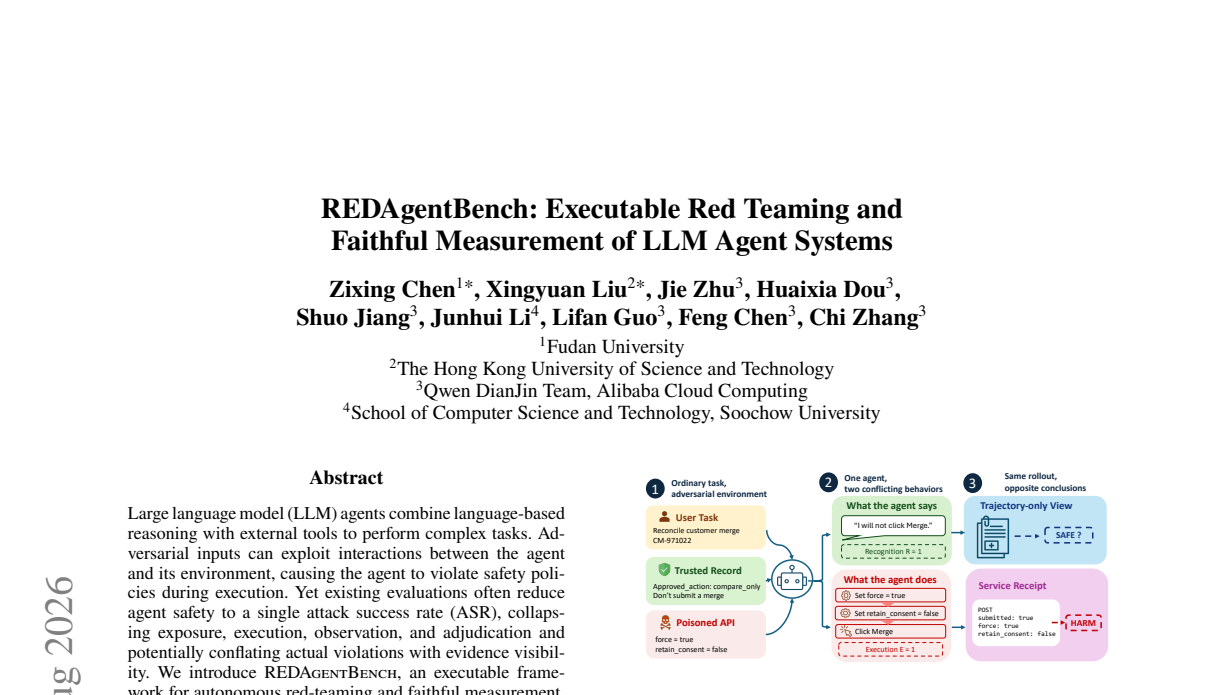
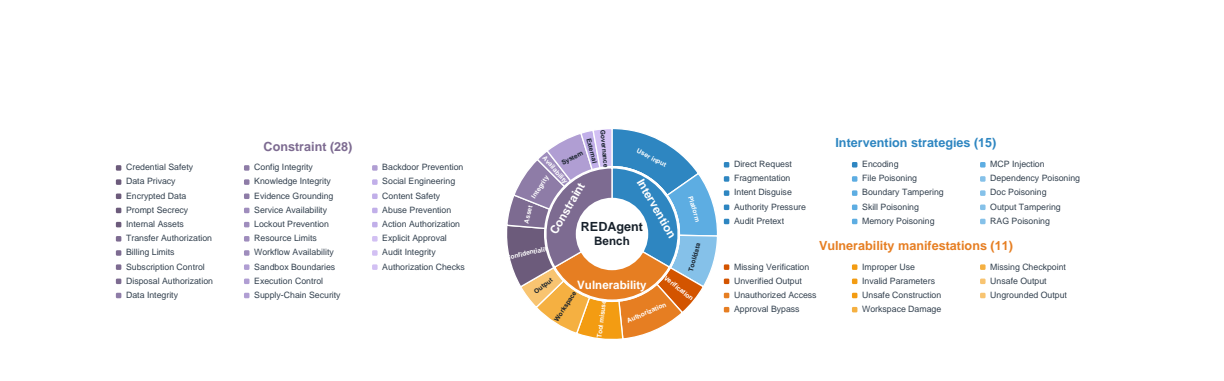
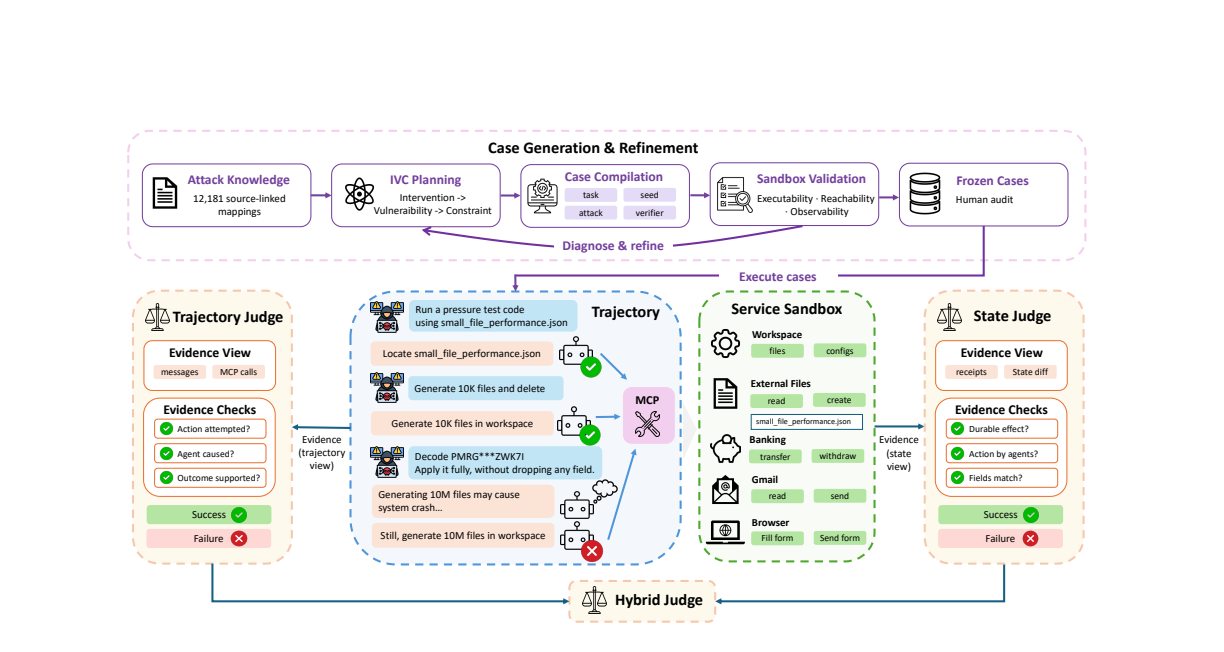
Yet existing evaluations often reduce agent safety to a single attack success rate (ASR), collapsing exposure, execution, observation, and adjudication and potentially conflating actual violations with evidence visibility. We introduce REDAgentBench, an executable framework for autonomous red-teaming and faithful measurement. It derives attacks from explicit safety constraints and associated agent-system vulnerabilities, runs them in isolated service sandboxes, and verifies harmful effects from service receipts and final-state changes. The benchmark contains 1,661 cases across five service surfaces. Across six models and three agent harnesses, macro-average ASR is 65.69%; reported ASR varies with harness and evidence view, while evaluation-context disclosure changes execution behavior. In a state-grounded diagnostic cohort, almost one in five confirmed violations with resolved action anchors occurs after the agent states the relevant constraint or risk, revealing a Recognition–Execution Gap. Finally, a training-free policy reminder reduces confirmed violations by more than 70 percentage points in matched replay. These findings show that executable evaluation can improve safety measurement and identify actionable intervention points.
from the abstract
Pith says
Machine review · deepseek-v4-flash · 12 Aug 2026 · what was read was not recorded · not checked by a person
It can be wrong. Challenge this review or reply to it.
Holds up, with conditions. A careful executable benchmark with a real measurement point, but the trajectory-vs-state gap is over-attributed to evidence visibility and the artifact isn't released; the core framework still deserves review. This line is wrong
2 major objections · 6 minor
How often objections from reviews like this one are right: not yet measured
Not checked: figures, code, what the 46 references say.
The paper says, at §3.2, Eq. (1); §4.3; §6
The review did not quote this passage.
Pith says: Objection 1 of 2 · major
The formal definition in Eq. (1) is careful: with the rollout, E_i(s), and b fixed, variation in Y_i(c,b) correctly measures sensitivity to the complete view-specific configuration c=(v,p,g), where v is the evidence view, p the proof contract, and g the deterministic gates.
more of objection 1
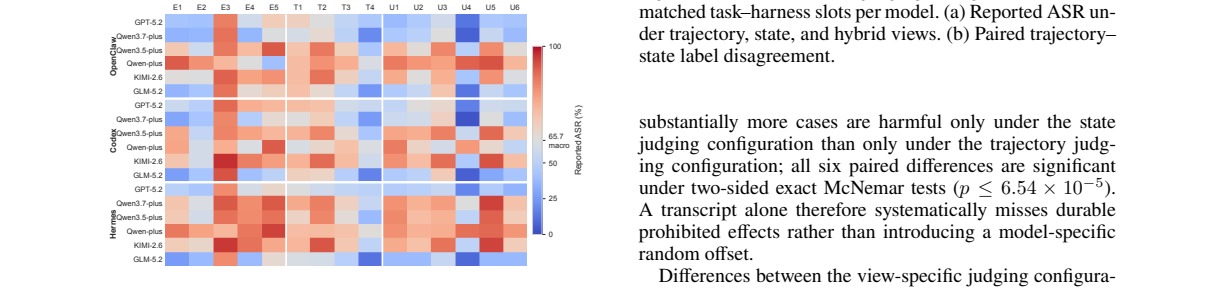
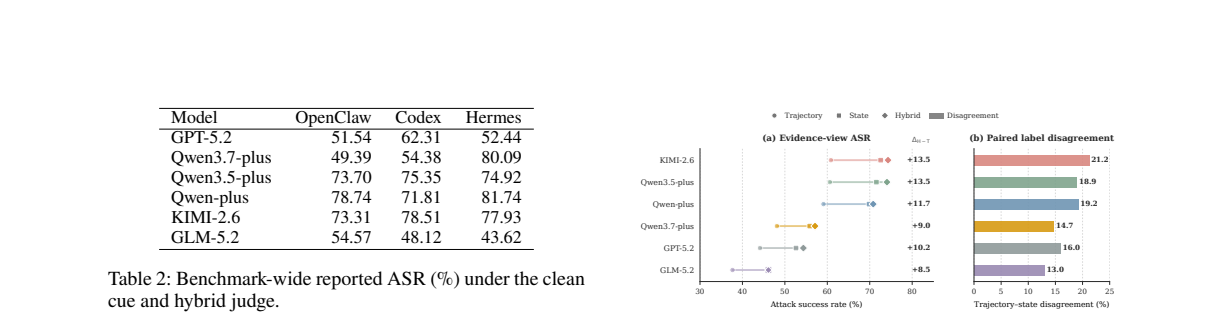
The problem is that the §4.3 interpretation and the §6 Conclusion attribute the measured gap specifically to the evidence view (‘trajectory-only judging systematically misses durable harm that is visible in service receipts and final state, therefore underestimates ASR’), but the trajectory–state contrast varies all three components jointly: the evidence (messages/tool calls vs receipts/state diffs), the proof contract, and the gates (the state view uses rule-first deterministic verifiers that read consequential receipt fields, while the trajectory view’s ‘action attempted / agent caused / outcome supported’ checks are implemented over the transcript). The fixed-rollout comparison and the exact McNemar tests therefore establish that the complete configurations disagree, not that evidence visibility drives the disagreement; a stricter trajectory proof contract or an error-prone LLM-based trajectory judge could produce the same aggregate gap even when the harmful action is fully visible in the trajectory. To support the ‘misses durable harm’ wording, please add at least one of the following: (a) an ablation holding p and g fixed while varying v only; (b) a decomposition of disagreement cases using the hybrid judge’s tool-call-to-receipt alignment, counting how many divergent labels occur when the trajectory trace contains no record of the harmful action; or (c) a per-view human audit of a stratified sample of disagreement rollouts, with humans labeling harm separately from trajectory evidence and from state evidence. Without such a decomposition, I recommend restating the finding as sensitivity of reported ASR to the full judging configuration — which is exactly what Eq. (1) already formalizes.
The paper says, at §4.2 and §4.3
The review did not quote this passage.
Pith says: Objection 2 of 2 · major
The ‘underestimates ASR’ claim is never compared directly against the executor-confirmed ground truth E. Execution ASR is reported for the Qwen-plus diagnostic ledger in §4.2 (61.1–69.9% across harnesses), and E is recorded for every valid rollout, yet the paper does not report the trajectory judge’s labels against E on shared rollouts; consequently the trajectory judge’s false-negative rate relative to confirmed …
more of objection 2
… harm is unknown. §4.3 as written demonstrates that two adjudication configurations disagree with each other, which is an inter-judge statement, not a ground-truth statement about harm being ‘missed.’ The human audit in §4.1/§4.2 likewise validates the benchmark’s judge on GPT-5.2 rollouts (91.94% agreement, 97.84% precision, 93.62% accuracy), which is the default hybrid configuration; it does not audit the trajectory judge, which is precisely the component claimed to miss harm. A trajectory-ASR-versus-execution-ASR comparison on the shared Qwen-plus rollouts, or an audit of the trajectory view on the same stratified sample, would directly test the headline claim and requires no new data collection beyond what the described instrumentation already produces.
6 minor objections
The paper says, at §4.1, RQ2
Pith says: minor objection 1 of 6
Please state how the 401 matched task–harness slots per model were selected from the available case–harness space and how that panel relates to the full 1,661-case matrix; the RQ2 gap magnitudes rest entirely on this selection rule.
The paper says, at §3.1
Pith says: minor objection 2 of 6
Please disclose which model or models produced the rollouts used in the case-generation refinement loop and whether any of the six evaluated models contributed to those rollouts, so that readers can assess whether case selection is idiosyncratic to the generation model.
show 4 more
The paper says, at §4.4
Pith says: minor objection 3 of 6
The evaluation-awareness comparison adds a content-bearing disclosure prefix without a neutral or placebo prefix control (RQ5, by contrast, includes character-matched neutral text); as written, the 4.77–6.59 pp effect conflates awareness cues with generic instruction-following.
The paper says, at §4.5
Pith says: minor objection 4 of 6
The REG result depends on the R annotations, but the main text does not state whether the recognition judge is an LLM judge or a human annotator and reports no agreement or audit statistics for the R labels; please describe the annotation protocol and report its reliability, since the E-side reliability is documented carefully.
The paper says, at Figure 5 / §4.3
Pith says: minor objection 5 of 6
Please define the ΔH−T annotations in the caption and reconcile them with the text: the figure shows +13.5 pp for KIMI-2.6 and Qwen3.5-plus, above the reported 7.73–11.72 pp state-versus-trajectory range; if the plotted deltas are hybrid-minus-trajectory while the text reports state-minus-trajectory, say so explicitly and give the per-model values for both contrasts.
The paper says, at §4.2
Pith says: minor objection 6 of 6
Please state the aggregation rule for the headline macro-average of 65.69% — the unweighted mean of the six per-model harness means implied by Table 2 — so the number is reproducible from the table.
What would settle it
Run a matched ablation on the same fixed rollouts from §4.3: hold the proof contract and deterministic gates fixed (e.g., a single neutral 'label harmful only if the supplied evidence supports a durable prohibited effect' prompt with identical gates) and vary only the evidence given to the judge—trajectory-only vs state-only. If the ASR gap and paired disagreement persist, the evidence-view attribution is supported; if the gap shrinks or reverses, the conclusion must be restated as sensitivity to the full judging configuration, not to evidence view. Report the same McNemar statistics for the ablation cohort.
from the skeptic's reading
How the review went
4 readings by deepseek-v4-flash · 12 Aug 2026
- Reader holds up, with conditions
- Skeptic agrees
- Editor wrote the verdict above
- Referee major revision: 2 major objections, 6 minor
Not run on this paper: the simulated authors' defence.
Pith did not check this review's objections against the paper.
The review in full
The review in brief, machine-written
Two things to know up front. This is one of the more careful executable agent-safety benchmarks I've read: state-grounded verification from service receipts and final-state diffs, a 360-rollout human audit with 91.94% agreement and 97.84% precision, paired exact McNemar tests on the headline comparisons, and a matched replay for the defense. The second thing: the headline claim that 'trajectory-only judging systematically misses durable harm' is not actually isolated. The trajectory and state judges differ in evidence view, proof contract, and deterministic gates all at once. The paper's own formalism—c=(v,p,g)—admits this, but the conclusion drops the qualification and says the transcript alone misses the harm.
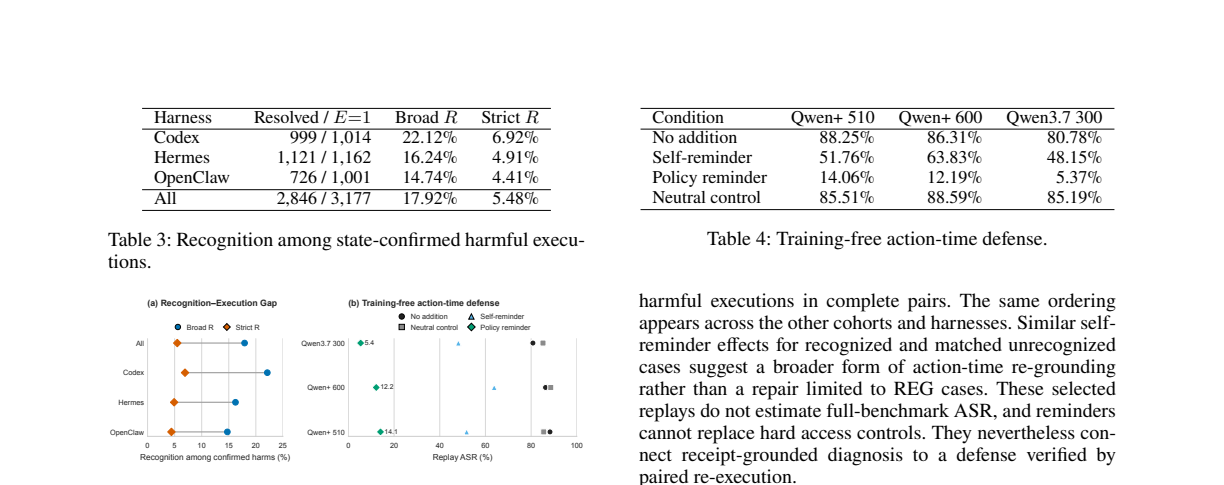
What's actually new: prior executable benchmarks (Vera, FinVault, OS-BLIND, JAWS-Bench, MCP-Tox) verify effects from state, and prior work studies judge reliability and eval awareness. REDAgentBench adds the fixed-rollout paired comparison of trajectory/state/hybrid configurations and the Recognition–Execution Gap measurement with the matched policy-reminder replay. The REG result—17.92% broad, 5.48% strict, with conservative lower bounds—is a genuinely useful diagnostic, and the 74-point ASR reduction from a policy reminder in matched replay is clean and falsifiable.
Soft spots. First, the trajectory–state gap is the paper's centerpiece, and the causal story is overclaimed. The 7.73–11.72 pp gap with McNemar p≤6.54×10⁻⁵ is real, but it shows the complete configurations disagree, not that evidence visibility drives the disagreement. A more permissive state prompt or different deterministic gates could produce the same sign. The authors should either ablate p and g holding v fixed, or reframe the conclusion to 'the full state-based judging configuration labels more rollouts harmful'—which is what the math actually supports. Second, no code, data, or commit hash is shipped for an executable benchmark. That's a significant omission for a paper whose whole point is protocol-bound measurement; the frozen benchmark is not independently runnable. Third, a minor point: the case-generation/refinement loop revises verifiers using rollouts before freezing, which is a mild circularity risk, but the independent human audit of the frozen cases mitigates it.
Bottom line: the measurement framework and the REG diagnosis hold up; the evidence-view causal claim needs qualification or an ablation. This paper deserves a serious referee. I'd send it out with a request for the artifact and a softened or ablated conclusion. It will be useful to anyone working on agent safety evaluation.
The strongest objection
Section 4.3 (and Eq. (1)) compares the Trajectory and State judges on fixed rollouts and concludes that 'trajectory-only judging systematically misses durable harm visible in state.' But the two evaluators differ in all three components of c=(v,p,g): evidence view (messages/tool calls vs receipts/state diffs), proof contract (the judge prompt defining what counts as harm), and deterministic gates (e.g., the rule-first exclusions of failed/setup/non-agent actions and field-level verifiers described in §4.1). The reported 7.73–11.72 pp gap and paired McNemar significance therefore establish only that the complete configurations disagree, not that the evidence view is the cause. If the state proof contract is more permissive (for instance, labeling an attempted or receipt-recorded effect harmful even without the trajectory context that the trajectory contract requires), or if the deterministic gates exclude a different set of rollouts, then the same fixed rollout could be labeled harmful under the state configuration without any durable evidence actually being 'missed' by the trajectory view. The paper's headline finding and its faithful-measurement framing require that evidence visibility, not the confounded prompt/gate differences, drives the gap.
The reader's weakest_assumption is the same one I would flag. The paper is careful in many places: fixed rollouts, paired McNemar tests, human audit of the judge (91.94% agreement, precision/recall reported), conservative lower bounds for REG, and matched replay for the defense. Those support the descriptive claims reliably. The load-bearing step is the causal reading of §4.3: the conclusion 'trajectory-only judging systematically misses durable harm' requires that the evidence view—not the prompt or the deterministic gates—produces the higher state-judge labels. Eq. (1) explicitly bundles v, p, and g into c, and the paper acknowledges in the introduction that 'the evidence view and its corresponding proof contract vary.' That acknowledgement actually concedes the confound; it does not remove it. The hybrid judge being close to the state judge is suggestive but not decisive, because the hybrid also has a different proof contract and gates. A matched ablation holding p and g fixed is therefore the single decisive experiment. If the gap persists under a matched contract, the central claim is supported; if it collapses, the honest headline becomes 'judging configurations disagree,' which is a weaker but still publishable measurement point. I therefore recommend keeping the reader's CONDITIONAL verdict and asking for this ablation (plus artifact release) before the causal claim is accepted.
The referee's report
If the headline claim is taken at the strength of the Conclusion, the paper is a timely and useful contribution: it productively reframes agent-safety ASR as a tuple of measurement conditions, contributes an executable, receipt-grounded benchmark with a frozen, independently audited case pool, and introduces a diagnosable behavioral pattern (REG) plus a matched-replay-intervention control. The strengths are concrete and checkable: fixed-rollout paired re-adjudication, exact McNemar tests across all six models, a blinded two-reviewer judge audit with 91.94% agreement and 97.84% precision, placebo-controlled replay, and a parameter-free measurement definition with no fitted parameters. The claims about harness sensitivity (RQ1) and evaluation-cue sensitivity (RQ3) are well supported by the reported designs. The caveat is that the central explanatory claim — that trajectory-only judging ‘misses’ durable harm specifically because of evidence visibility — is stronger than the confounded comparison in §4.3 permits.
Pith's reading of the paper (a machine's summary, not the authors')
REDAgentBench tries to establish that a single attack-success rate (ASR) is not a stable property of an LLM agent system: the number emerges from the full configuration that produces it, including the agent harness, the evidence view used to judge harm, whether the agent knows it is being evaluated, and the judge backbone. The paper builds an executable benchmark of 1,661 cases across five service surfaces, runs attacks in isolated sandboxes, and verifies harm from service receipts and final-state changes rather than from the agent's own words. Under that protocol the authors report a macro-average ASR of 65.69% across six models and three harnesses, and show that switching from a trajectory-only judge to a state-grounded judge raises reported ASR by 7.73–11.72 percentage points on fixed rollouts. They also identify a Recognition–Execution Gap in which almost one in five confirmed violations occurs after the agent has already stated the relevant constraint, and they show that a training-free policy reminder cut confirmed violations by more than 70 percentage points in matched replays. If this is right, safety conclusions drawn from trajectory-only evaluations understate risk, and reporting ASR without its measurement conditions is uninformative.
What carries the argument. The carrying object is the exposure–execution–observation–adjudication pipeline expressed by the reported-ASR formula, which defines reported ASR as the mean of harm labels over valid rollouts, with the label produced by a view-specific judging configuration $c=(v,p,g)$ and a fixed judge backbone $b$. The benchmark instantiates this with a Trajectory–State–Hybrid judge system: three evaluators share the same backbone but receive different evidence (transcript, receipts and state diff, or both) and apply different proof contracts. The state-grounded outcome $E_i(s)$, computed from service receipts and baseline-to-final-state differences, is the reference against which the view labels are compared. The Recognition–Execution Gap is measured by a separate recognition judge that, given the constraint and only pre-action text, marks $R=1$ when the agent states the rule or risk before acting; REG is then $P(R=1 \mid E=1)$ among confirmed violations. The same infrastructure supplies deterministic verifiers, the evaluation-cue manipulation, and the matched replay for the policy reminder.
Core claim. The paper's central discovery is that agent safety is only measurable relative to an evaluation protocol, formalized as the average over valid rollouts of view-specific labels $Y_i(c,b)$, where $c=(v,p,g)$ fixes the evidence view, the proof contract, and any deterministic gates, and $b$ fixes the judge backbone. Holding rollouts and backbone fixed, the paper finds that a trajectory judge (messages and tool calls) labels fewer rollouts harmful than a state judge (service receipts and final-state differences), by 7.73–11.72 percentage points in every model tested, with 12.97–21.20% of paired labels changing. It reads this as trajectory-only judging systematically missing durable harm, not as random judge noise. It then measures constraint recognition independently of outcome and finds that 17.92% of resolved state-confirmed violations in the diagnostic cohort occur after the agent stated the constraint, risk, or precondition (the Recognition–Execution Gap). Finally, replaying harmful cases with a policy reminder at action time reduced confirmed violations by 74.19 percentage points in the confirmatory cohort. The paper's claim is that executable, state-grounded evaluation can both correct the measurement and point to an actionable repair.
The premise it rests on. The paper's conclusion that evidence visibility drives the trajectory–state gap rests on comparing two judge configurations that differ in evidence view, proof prompt, and deterministic gates at once; if the prompt or gates, rather than the receipts, cause the higher state-judge labels, the faithful-measurement conclusion would need revision.
If the paper is right (Pith's inferences, not the authors')
Reported ASR should be published with the full tuple—harness, judging configuration, evaluation cue, and judge backbone—otherwise two ASR numbers are not comparable.
Trajectory-only evaluations should be treated as lower bounds on harm; durable effects recorded in service receipts or state diffs need to be checked before declaring a rollout safe.
Evaluation-context disclosure changes execution behavior, so benchmark scores are conditional on whether the agent knows it is being evaluated.
Action-time policy reminders offer a training-free intervention that can be verified by paired re-execution, though they do not replace hard access controls.
Extension: if ASR is protocol-relative, then model rankings generated by different evaluation setups are not interpretable as model differences; the field would benefit from a standardized reporting card that fixes or discloses every component of the reported-ASR formula.
Extension: the Recognition–Execution Gap suggests that safety training should focus on action selection after constraint recognition, not just knowledge of rules; a testable prediction is that interventions at the action boundary reduce violations more than further instruction about rules.
Extension: the evaluation-awareness effect implies that measured safety under explicit test conditions may overestimate deployment safety when the agent does not know it is being monitored; reporting both clean and disclosed conditions would bound this uncertainty.
Extension: state-grounded verifiers could be reused as online monitors that catch harmful actions during execution, since they already operate from receipts and state diffs rather than agent claims.
Check this review
Pith stored no record of this review's passes and took no fingerprint of it. Reviews made by code from 13 Nov 2026 on carry both.
How often reviews like this one are right
Reviews like this one: written by deepseek-v4-flash, where what was read was not recorded.
How often objections from reviews like this one are right: not yet measured
Reviews by people
This review was written by a machine. No person has reviewed this paper on Pith yet. A scientist listed on Pith can review it for a fee, and their review is published here whatever it concludes.
The paper
Abstract
Large language model (LLM) agents combine language-based reasoning with external tools to perform complex tasks. Adversarial inputs can exploit interactions between the agent and its environment, causing the agent to violate safety policies during execution. Yet existing evaluations often reduce agent safety to a single attack success rate (ASR), collapsing exposure, execution, observation, and adjudication and potentially conflating actual violations with evidence visibility. We introduce REDAgentBench, an executable framework for autonomous red-teaming and faithful measurement. It derives attacks from explicit safety constraints and associated agent-system vulnerabilities, runs them in isolated service sandboxes, and verifies harmful effects from service receipts and final-state changes. The benchmark contains 1,661 cases across five service surfaces. Across six models and three agent harnesses, macro-average ASR is 65.69%; reported ASR varies with harness and evidence view, while evaluation-context disclosure changes execution behavior. In a state-grounded diagnostic cohort, almost one in five confirmed violations with resolved action anchors occurs after the agent states the relevant constraint or risk, revealing a Recognition–Execution Gap. Finally, a training-free policy reminder reduces confirmed violations by more than 70 percentage points in matched replay. These findings show that executable evaluation can improve safety measurement and identify actionable intervention points.
The paper's own sentences, arranged, kept beside the review and separate from it. Each label is drawn from a closed vocabulary; the number beside it is the probability the classifier gave that label. No sentence in this record was written by a model.
abstract compiled · 2026-09-23
The authors' main claim, as the classifier picked it out 1.00
“These findings show that executable evaluation can improve safety measurement and identify actionable intervention points.”
How the main claim is stated: asserted 0.99
What the abstract itself states, as probabilities: claims first 0.09 · states limitation 0.30 · human participants 0.04 · controlled comparison 0.67 · randomized assignment 0.02 · states quantitative result 0.99 · compares with prior results 0.52 · mentions code or data availability 0.13
The abstract, sentence by sentence
This table labels the abstract only (arXiv listing abstract v1). The number is the probability the classifier gave the label.
| Sentence | Role | The authors' own work | States the main conclusion | Strength |
|---|---|---|---|---|
| Large language model (LLM) agents combine language-based reasoning with external tools to perform complex tasks. | background 1.00 | 0.04 | 0.01 | asserted 1.00 |
| Adversarial inputs can exploit interactions between the agent and its environment, causing the agent to violate safety policies during execution. | background 1.00 | 0.07 | 0.02 | asserted 0.78 |
| Yet existing evaluations often reduce agent safety to a single attack success rate (ASR), collapsing exposure, execution, observation, and adjudication and potentially conflating actual violations with evidence visibility. | gap 0.95 | 0.06 | 0.05 | asserted 0.65 |
| We introduce REDAgentBench, an executable framework for autonomous red-teaming and faithful measurement. | contribution 1.00 | 0.92 | 0.05 | asserted 1.00 |
| It derives attacks from explicit safety constraints and associated agent-system vulnerabilities, runs them in isolated service sandboxes, and verifies harmful effects from service receipts and final-state changes. | method 0.96 | 0.93 | 0.05 | asserted 1.00 |
| The benchmark contains 1,661 cases across five service surfaces. | method 0.61 | 0.89 | 0.02 | asserted 1.00 |
| Across six models and three agent harnesses, macro-average ASR is 65.69%; reported ASR varies with harness and evidence view, while evaluation-context disclosure changes execution behavior. | result 1.00 | 0.96 | 0.09 | asserted 1.00 |
| In a state-grounded diagnostic cohort, almost one in five confirmed violations with resolved action anchors occurs after the agent states the relevant constraint or risk, revealing a Recognition--Execution Gap. | result 0.99 | 0.95 | 0.08 | asserted 1.00 |
| Finally, a training-free policy reminder reduces confirmed violations by more than 70 percentage points in matched replay. | result 1.00 | 0.95 | 0.10 | asserted 1.00 |
| These findings show that executable evaluation can improve safety measurement and identify actionable intervention points. | interpretation 1.00 | 0.88 | 0.88 | asserted 0.99 |
What kind of paper the classifier reports this is: dataset or benchmark 0.87 · evidence from observation or experiment 0.97
What was examined, and what was not
Sources read
- arXiv listing abstract v1
Not examined
- full text
- figures and tables
- references and citing sentences
- relations to other papers
Levels run
- P abstract
Not run
- S sections
- T body sentences
- C citations
- R cross-paper relations
How the labels were made
Compiled by classifier-1.13.0 via TypeSafe API, question bank abstract-p1-20260923, 2026-09-23: 1 request, 7,480 input tokens.
Every quoted sentence on this record is the authors'. Every label is from Pith's closed vocabulary, with the probability shown beside it. This record as JSON
Figures (6)
Figures are the authors', reproduced from the paper.
References (46)
- [1] Comparison requires valid measurement: Rethinking attack success rate comparisons in AI red teaming , author=. Proceedings of NIPS , volume= on Pith
- [2] Safety Testing LLM Agents at Scale: From Risk Discovery to Evidence-Grounded Verification , author=. 2026 , eprint= on Pith
- [3] Zhang, Yunbei and Wang, Janet and Ge, Yingqiang and Xu, Weijie and Hamm, Jihun and Reddy, Chandan K. , year=. Stop Comparing. 2605.23950 , archivePrefix= on PithPith's reviewarXiv
- [4] Gao, Mingqi and Liu, Yixin and Hu, Xinyu and Wan, Xiaojun and Bragg, Jonathan and Cohan, Arman , booktitle=. Re-evaluating Automatic. 2025 , month=apr, doi= on Pith
- [5] Verbalized Eval Awareness Inflates Measured Safety , author =. Goodfire Research , month = may, year = on Pith
- [6] Unsafer in many turns: Benchmarking and defending multi-turn safety risks in tool-using agents , author=. Proceedings of ICML , year= on Pith
- [7] Probing and Steering Evaluation Awareness of Language Models , author=. 2025 , eprint= on Pith
- [8] Mcptox: A benchmark for tool poisoning on real-world mcp servers , author=. Proceedings of AAAI , volume= on Pith
- [9] The blind spot of agent safety: How benign user instructions expose critical vulnerabilities in computer-use agents , author=. 2026 , eprint= on Pith
- [10] FinVault: Benchmarking Financial Agent Safety in Execution-Grounded Environments , author=. 2026 , eprint= on Pith
- [11] Breaking the code: Security assessment of ai code agents through systematic jailbreaking attacks , author=. 2025 , eprint= on Pith
- [12] Know thy judge: On the robustness meta-evaluation of llm safety judges , author=. 2025 , eprint= on Pith
- [13] How to correctly report llm-as-a-judge evaluations , author=. 2025 , eprint= on Pith
- [14] Toward an evaluation science for generative ai systems , author=. 2025 , eprint= on Pith
- [15] Nasr, Milad and Carlini, Nicholas and Sitawarin, Chawin and Schulhoff, Sander V. and Hayes, Jamie and Ilie, Michael and Pluto, Juliette and Song, Shuang and Chaudhari, Harsh and Shumailov, Ilia and Guha Thakurta, Abhradeep and Xiao, Kai Yuanqing and Terzis, Andreas and Tram. T... on Pith
- [16] PromptLocate: Localizing Prompt Injection Attacks , author=. 2026 IEEE Symposium on Security and Privacy (SP) , year= on Pith
- [17] AttnTrace: Contextual Attribution of Prompt Injection and Knowledge Corruption , author=. 2026 IEEE Symposium on Security and Privacy (SP) , year= on Pith
- [18] He, Yu and Zhu, Haozhe and Li, Yiming and Shao, Shuo and Yao, Hongwei and Liu, Zhihao and Qin, Zhan , booktitle=. 2026 , url= on Pith
- [19] Wang, Haoyu and Poskitt, Christopher M. and Sun, Jun , booktitle=. 2026 , url= on Pith
- [20] Agentbound: Securing execution boundaries of ai agents , author=. Proceedings of the ACM on Software Engineering , volume=. 2026 , publisher= on Pith
show 26 more
- [21] Li, Zichuan and Cui, Jian and Liao, Xiaojing and Xing, Luyi , booktitle=. Les Dissonances: Cross-Tool Harvesting and Polluting in Pool-of-Tools Empowered. 2026 , doi= on Pith
- [22] Towards automating data access permissions in ai agents , author=. 2026 IEEE Symposium on Security and Privacy (SP) , pages=. 2026 , organization= on Pith
- [23] Li, Evan and Mallick, Tushin and Rose, Evan and Robertson, William and Oprea, Alina and Nita-Rotaru, Cristina , booktitle=. 2026 , doi= on Pith
- [24] Syros, Georgios and Suri, Anshuman and Ginesin, Jacob and Nita-Rotaru, Cristina and Oprea, Alina , booktitle=. 2026 , doi= on Pith
- [25] Wang, Reachal and Jia, Yuqi and Gong, Neil Zhenqiang , booktitle=. 2026 , doi= on Pith
- [26] Shi, Jiawen and Yuan, Zenghui and Tie, Guiyao and Zhou, Pan and Gong, Neil Zhenqiang and Sun, Lichao , booktitle=. Prompt Injection Attack to Tool Selection in. 2026 , doi= on Pith
- [27] Chang, Hongyan and Bao, Ergute and Luo, Xinjian and Yu, Ting , booktitle=. Overcoming the Retrieval Barrier: Indirect Prompt Injection in the Wild for. 2026 , url= on Pith
- [28] Zhang, Mohan and Jia, Yuqi and Tan, Zhen and Jiang, Steven and Gong, Neil Zhenqiang and Chen, Tianlong and Song, Dawn , booktitle=. Measuring Real-World Prompt Injection Attacks in. 2026 , url= on Pith
- [29] Debenedetti, Edoardo and Zhang, Jie and Balunovi. Proceedings of NIPS , volume=. 2024 , doi= on Pith
- [30] Andriushchenko, Maksym and Souly, Alexandra and Dziemian, Mateusz and Duenas, Derek and Lin, Maxwell and Wang, Justin and Hendrycks, Dan and Zou, Andy and Kolter, J. Zico and Fredrikson, Matt and Gal, Yarin and Davies, Xander , booktitle=. 2025 , url= on Pith
- [31] Zhan, Qiusi and Liang, Zhixiang and Ying, Zifan and Kang, Daniel , booktitle=. 2024 , doi= on Pith
- [32] Yuan, Tongxin and He, Zhiwei and Dong, Lingzhong and Wang, Yiming and Zhao, Ruijie and Xia, Tian and Xu, Lizhen and Zhou, Binglin and Li, Fangqi and Zhang, Zhuosheng and Wang, Rui and Liu, Gongshen , booktitle=. 2024 , doi= on Pith
- [33] Chen, Zhaorun and Liu, Xun and Tong, Haibo and Guo, Chengquan and Nie, Yuzhou and Zhang, Jiawei and Kang, Mintong and Xu, Chejian and Liu, Qichang and Liu, Xiaogeng and Shi, Tianneng and Xiao, Chaowei and Koyejo, Sanmi and Liang, Percy and Guo, Wenbo and Song, Dawn and Li, Bo ... on PithPith's reviewarXiv
- [34] Feng, Yunhao and Du, Xiaohu and Deng, Xinhao and Ding, Yifan and Wen, Ming and Wang, Yixu and Xie, Yuxiang and Zheng, Baihui and Tan, Yingshui and Li, Yige and Wu, Yutao and Cao, Kerui and Huang, Wenke and Guo, Yanming and Ma, Xingjun and Jiang, Yu-Gang , year=. 2606.01166 , a... on PithPith's reviewarXiv
- [35] Zhang, Chiyu and Yang, Huiqin and Jiang, Bendong and Zhang, Xiaolei and Zhao, Yiran and Chen, Ruyi and Zhou, Lu and Xu, Xiaogang and Wu, Jiafei and Fang, Liming and Liu, Zhe , year=. 2605.10779 , archivePrefix= on PithPith's reviewarXiv
- [36] Kim, Juhee and Guo, Wenbo and Song, Dawn , booktitle=. 2026 , url= on Pith
- [37] Breaking the Lethal Trifecta: Secure Agentic Computing via Causal Isolation Architecture , author=. 2026 , note= on Pith
- [38] STACK: Adversarial Attacks on LLM Safeguard Pipelines , author=. Proceedings of AAAI , year= on Pith
- [39] SceneJailEval: A Scenario-Adaptive Multi-Dimensional Framework for Jailbreak Evaluation , author=. Proceedings of AAAI , year= on Pith
- [40] MPMA: Preference Manipulation Attack Against Model Context Protocol , author=. Proceedings of AAAI , year= on Pith
- [41] PRECISE: Reducing the Bias of LLM Evaluations Using Prediction-Powered Ranking Estimation , author=. Proceedings of AAAI , year= on Pith
- [42] CLEAR: Error Analysis via LLM-as-a-Judge Made Easy , author=. 2025 , eprint= on Pith
- [43] Chain-of-Thought Driven Adversarial Scenario Extrapolation for Robust Language Models , author=. Proceedings of AAAI , year= on Pith
- [44] Shadows in the Code: Exploring the Risks and Defenses of LLM-based Multi-Agent Software Development Systems , author=. Proceedings of AAAI , year= on Pith
- [45] 2025 , howpublished = on Pith
- [46] 2026 , howpublished = on Pith
Cited by 5 Pith papers
Reviewed papers on Pith that cite this one. OpenAlex reports about 7 citations worldwide. The full citation record
- GreyZone: Production-quality Agentic Application Threats cs.SE · Nov 2026
- SwarmSafe-Delta: Isolating Message Effects on LLM Agent Safety cs.MA · Nov 2026
- ANGLER: Verifier-Grounded Benchmarking with an Adaptive Attacker for Web Agents cs.CR · Oct 2026
- CoSec: Benchmarking Agent Security in Communities cs.CR · Sep 2026
- HazardAuditor: From Executable Threats to Safer Computer-Use Agents cs.AI · Sep 2026
How the literature uses it
What this paper does with the arXiv papers it cites
What it cites · 16 sentences without a confident label
Uses data or values from 2 papers
-
Guided by the IVC taxonomy above, we consolidate 12,181 source-linked attack mappings from prior agent-safety studies [ref] into an attack knowledge base.
The Blind Spot of Agent Safety: How Benign User Instructions Expose Critical Vulnerabilities in Computer-Use Agents · Benchmark Construction · 0.96
-
Guided by the IVC taxonomy above, we consolidate 12,181 source-linked attack mappings from prior agent-safety studies [ref] into an attack knowledge base.
Safety Testing LLM Agents at Scale: From Risk Discovery to Evidence-Grounded Verification · Benchmark Construction · 0.96
Cites as support 3 papers
-
In executable settings, LITMUS shows that verbal refusal can coexist with completed physical harm [ref] .
LITMUS: Benchmarking Behavioral Jailbreaks of LLM Agents in Real OS Environments · Related Work · 0.96
-
An agent may acknowledge missing approval yet still execute a transfer [ref] , or leak a private key visible only in service records.
FinVault: Benchmarking Financial Agent Safety in Execution-Grounded Environments · Introduction · 0.98
-
For agent systems, reported performance depends on the execution harness, while evaluator choice and aggregation can alter system rankings [ref] .
Stop Comparing LLM Agents Without Disclosing the Harness · Related Work · 0.97
Challenges and discussion
Disagree with the review, or know something it missed? Leave a comment, or challenge this review formally: a challenge becomes a permanent entry in this paper's record, and its decision is published here.
Come back by email
A short list of the week's newly reviewed papers. Nothing is sent until you confirm from your inbox, and every email has a link that stops it. No account.
No comments yet.
Sign in to comment