REVIEW 3 major objections 6 minor 65 references
Evolution of the underlying event and non-extensive thermodynamics in pp collisions from RHIC to LHC energies
T0 review · 3 major / 6 minor · reviewed 2026-08-12 · deepseek-v4-flash
Pith's one-line read The paper claims that the underlying event in proton–proton collisions occupies an enlarged azimuthal window, $40^\circ \lesssim |\Delta\phi| \lesssim 140^\circ$, from RHIC to LHC energies, with a stable but energy-dependent…
desk verdict Competent PYTHIA8 extension of the sliding-angle UE framework to RHIC–LHC energies with a useful Tsallis baseline; the 62.4 GeV endpoint is missing from the defining figures and the extended-UE validation is partly self-referential. read the letter →
The pith
A machine-rendered reading of the paper's core claim, the machinery that carries it, and where it could break.
The reading
What carries the argument
The load-bearing tools are the thermodynamically consistent Tsallis–Pareto distribution, Eq. (1), fitted in fixed $20^\circ$ azimuthal bins relative to the leading charged particle; the extended-UE criterion $\bar{S}'_0(\Delta\phi) > \bar{S}_0(\rm MB)$, carried over from the sliding-angle method; and the Tsallis thermometer, the $(q, T_{\rm s})$ plane in which each $\Delta\phi$ bin maps to a point. The identity $q-1 = -\langle n\rangle^{-1} + \Delta n^2/\langle n\rangle^2$ ties $q$ to event-by-event multiplicity fluctuations and is used to interpret the near- and away-side excesses as fluctuation effects rather than pure spectral hardness. Together these provide a multi-differential map of geometry, event topology, and thermodynamics as functions of $\Delta\phi$, $\sqrt{s}$, and event class.
What would settle it
Measure azimuthally resolved charged-particle $p_{\rm T}$ spectra in real pp data at $\sqrt{s}\approx 200$ GeV, 900 GeV, 7 TeV and 13 TeV, fit Eq. (1) in $20^\circ$ bins, and test whether $(q, T_{\rm s})$ inside $40^\circ < |\Delta\phi| < 140^\circ$ form a compact cluster and whether the multiplicity and spherocity profiles are flat there; if the cluster is not compact or the profiles are modulated, the universality of the extended UE window would be falsified.
Extended reading notes
Core claim
The paper's central claim is that the underlying-event region in pp collisions extends beyond the conventional transverse side, so that $40^\circ \lesssim |\Delta\phi| \lesssim 140^\circ$ ($2\pi/9 \le |\Delta\phi| < 7\pi/9$) is a UE-dominated window valid from RHIC to LHC energies. The evidence is that both the $\Delta\phi$-differential charged-particle multiplicity and the average transverse spherocity $\bar{S}'_0$ are flat in that window and satisfy $\bar{S}'_0(\Delta\phi) > \bar{S}_0(\rm MB)$, while the Tsallis parameters extracted from the spectra are jointly stable there. For minimum-bias and isotropic event selections, the compactness of the $(q, T_{\rm s})$ cluster is universal from $\sqrt{s}=62.4$ GeV to 13 TeV, but its position moves toward higher $T_{\rm s}$ and higher $q$ as energy increases, so the UE recedes from the $q\to1$ limit. Jetty events break the compactness because fragmentation products contaminate the window, and the near- and away-side enhancements of $q$ are traced to the leading hard scattering rather than to the overall multiparton-interaction activity.
Load-bearing premise
The load-bearing premise is that the PYTHIA8 Monte Carlo with the Monash tune correctly predicts how soft QCD and multiparton interactions evolve with collision energy, since only the inclusive multiplicity trend is compared with data while the azimuthally resolved spectra that feed the Tsallis fits are not checked against experiment.
Editorial extensions
If this is right
- UE studies gain a larger, statistically more robust angular acceptance: $40^\circ\!-\!140^\circ$ instead of the conventional $60^\circ\!-\!120^\circ$ transverse side.
- The extended UE region's $(q, T_{\rm s})$ pair provides an energy-dependent reference point for the soft, multiparton-interaction-dominated component of pp collisions.
- The UE is not universally close to Boltzmann–Gibbs; it moves away from $q\to1$ as $\sqrt{s}$ increases, so its near-equilibrium character is an LHC-energy statement.
- Transverse spherocity and charged-particle flattenicity are complementary: spherocity separates jetty and isotropic events more strongly in $q$, while flattenicity yields a cleaner and more extended $q$–$T_{\rm s}$ correlation.
- The near- and away-side enhancement of $q$ is governed by the leading hard scattering rather than by the overall level of multiparton interactions, as shown by selections on $N_{\rm mpi}$ and $\hat{p}_{\rm T}$.
Reading between the lines
- The compactness of the extended-UE cluster in the $(q, T_{\rm s})$ plane could be repurposed as a quantitative figure of merit for how well any event-shape selection isolates the underlying event, beyond the two classifiers studied here.
- If real azimuthally resolved data confirm the flat $q$ and $T_{\rm s}$ profiles in the $40^\circ\!-\!140^\circ$ window, the same window could become a standard experimental definition for UE measurements in small collision systems.
- The stated link between $q-1$ and multiplicity fluctuations suggests a direct experimental test: measuring the per-$\Delta\phi$ multiplicity variance and comparing the predicted $q(\Delta\phi)$ with the fitted values would probe the fluctuation mechanism itself.
- The energy-dependent shift of the UE cluster away from the Boltzmann–Gibbs limit implies that system-size comparisons (pp versus larger nuclei) should quote the collision energy alongside the $(q, T_{\rm s})$ pair, otherwise apparent medium effects may be confused with the trivial $\sqrt{s}$ trend.
Editorial analysis
A structured set of objections, weighed in public.
Referee Report
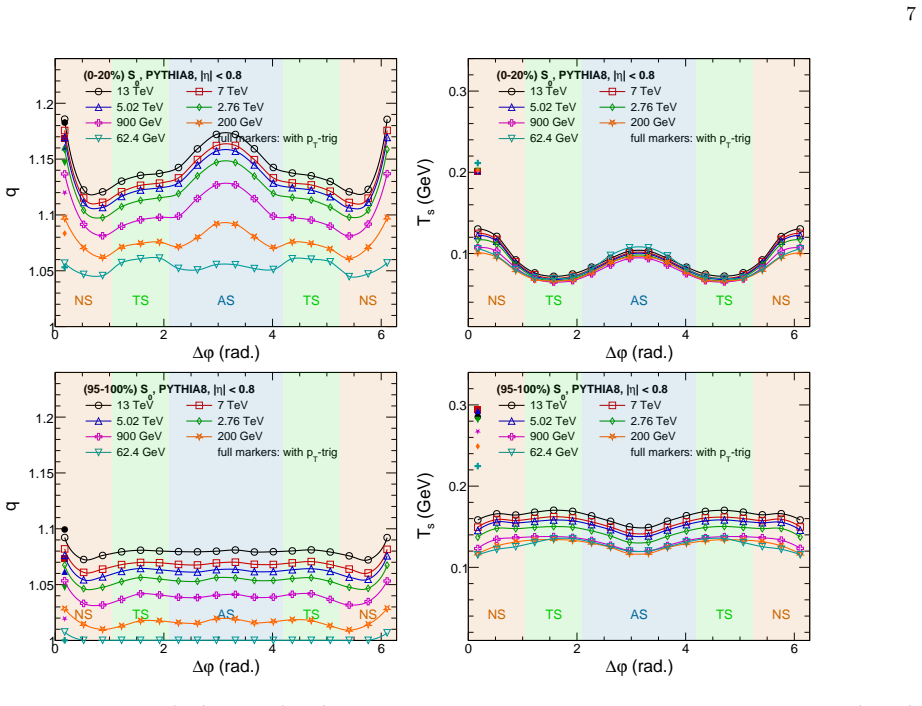
Summary. The manuscript uses PYTHIA 8.317 with the Monash 2013 tune to study the azimuthal structure of charged-particle production in pp collisions from sqrt(s)=62.4 GeV to 13 TeV. Working in 20-degree sliding-angle bins relative to the leading charged particle, the authors extract Tsallis–Pareto parameters from the pT spectra in each bin, and study their dependence on collision energy and on event-shape classes defined by transverse spherocity and charged-particle flattenicity. The central claims are: (i) the underlying-event region extends beyond the conventional transverse side to 40–140 degrees, and this extended interval is valid across RHIC and LHC energies; (ii) the angular decomposition of event activity and topology is qualitatively universal in shape across energies; (iii) jetty events have larger q and smaller Ts than isotropic events; and (iv) on the Tsallis thermometer, the bins inside the extended UE region form a compact, energy-dependent cluster that moves away from the Boltzmann–Gibbs limit as collision energy increases. The paper is primarily a model-level phenomenological study; the only experimental comparison shown is dN_ch/dEta versus ALICE data in Appendix A.
Significance. If the claims are correct, the paper would provide a useful model-based reference for an enlarged UE acceptance window and establish an energy-dependent Tsallis reference for soft, MPI-dominated particle production in pp collisions. The presentation is generally transparent: the generator version, tune, soft-QCD settings, cuts, and fit ranges are stated, and the dN_ch/dEta comparison with ALICE data in Fig. 7 is a useful sanity check. The use of flattenicity as a forward-rapidity classifier that is less autocorrelated with midrapidity spectra, and the direct comparison of high-N_MPI with hard-scattering selections in Appendix C, are genuine strengths that sharpen the interpretation of the q and Ts azimuthal modulation. The principal weaknesses are evidential and logical rather than computational: the endpoint energy 62.4 GeV is absent from the key topology figures, the extended-UE criterion is essentially a definition, and the azimuthally resolved UE and Tsallis content are never validated against experimental data. These issues do not destroy the paper's model-level contribution, but they limit the strength of the 'validation' claim.
major comments (3)
- [Sec. III.A and Figs. 2, 3; Sec. II.A] The abstract and Sec. IV claim that the extended UE interval 40–140 degrees is validated 'from RHIC to LHC energies', with 62.4 GeV as the lower endpoint, but Figs. 2 and 3 showing the defining quantities of Eq. (5) cover only 200 GeV, 900 GeV, 7 TeV, and 13 TeV; 62.4 GeV is absent. This omission is load-bearing because Sec. II.A states that the forward-acceptance requirement retains a significantly smaller fraction of inelastic events at RHIC energies, making the 62.4 GeV sample a rare, forward-biased subset. If Eq. (5) fails in any 20-degree bin within 40–140 degrees at 62.4 GeV, the claimed universality of the enlarged window is false inside the generator. Please either add the 62.4 GeV panels to Figs. 2 and 3 and verify Eq. (5) bin-by-bin, or explicitly restrict the claim to 200 GeV and above and adjust the abstract and conclusions accordingly.
- [Sec. II.D, Eq. (5); Sec. III.A] The extended UE region is defined by Eq. (5), S0'(Delta-phi) > S0(MB). The demonstration in Sec. III.A that Eq. (5) holds for the displayed energies is therefore a consistency check of the definition, not an independent validation of the interval. The independent support should come from observables that are not used in the definition, such as the small angular derivatives of Ts and q in the extended window, Eq. (8), or the compact grouping of the (q, Ts) pairs in Fig. 6. Please state this distinction explicitly and provide a quantitative test of Eq. (8) within the 40–140 degree window, including a statement of the threshold on |dTs/dDelta-phi| and |dq/dDelta-phi| that counts as 'approximately zero'. As written, the text presents Eq. (5) as both the definition and the evidence, which is circular.
- [Sec. II.A and Appendix A] The only external data comparison in the paper is dN_ch/dEta at midrapidity versus ALICE data (Fig. 7). That observable is azimuthally integrated and does not constrain the Delta-phi-resolved UE structure, the pT spectra in fixed Delta-phi bins, or the Tsallis parameters that carry the paper's central claims. The abstract and Sec. III use the word 'validating' for the extended UE window, but within the generator this is a prediction, not a data-calibrated statement. Please either add experimental comparisons of azimuthally resolved UE observables (for example, UE charged-particle density or scalar pT sum versus Delta-phi, or Delta-phi-resolved pT spectra from ALICE or CMS) or soften the wording from 'validating' to 'predicting within PYTHIA8 Monash'. This distinction is load-bearing because the model's energy trend for soft particle production is exactly what determines the claimed universality.
minor comments (6)
- [Sec. II.B, after Eq. (1)] The text contains the duplicated phrase 'The parameterT s The parameterT s sets the slope...'; the duplication should be removed.
- [Fig. 6 caption] The caption as printed is garbled in the manuscript (for example, 'o-20ofull markers: 0s, one per o-140oboxes: ext. UE 40' is unreadable); please regenerate the caption and ensure axis labels and marker definitions are legible.
- [Sec. III.C, paragraph on full markers] The sentence 'Since the leading particle enters this bin once per event and is by construction the hardest particle.' is a sentence fragment; it should be joined to the following sentence or rewritten.
- [Sec. II.A] The manuscript states that 'approximately a billion minimum-bias events' are generated across seven energies, but does not list the number of events after selection per energy. Please provide per-energy event counts after all cuts so that the statistical uncertainties quoted in the figures can be evaluated.
- [Sec. II.A and Fig. 8 caption] The main text specifies SoftQCD:inelastic = on, while the Fig. 8 caption states SoftQCD:all = on; please make the generator settings consistent.
- [Sec. II.D] The definition of the 'conventional CDF UA definition' of the transverse side is not cited precisely; please add a reference or a parenthetical definition so the '66% larger' statement can be checked.
Circularity Check
The extended-UE claim is partly definitional: Eq. (5) defines the region that is then 'validated', though independent Tsallis compactness gives real support.
-
self definitional
[Sec. II D, Eq. (5), and Sec. III A]
"Particularly, the region which satisfies the following condition is regarded as the extended UE region. ¯S′0(∆ϕ)> ¯S0(MB) (5) ... Therefore Eq. (5) is satisfied in pp collisions from collision energies ranging from RHIC to LHC."
By Eq. (5), the extended UE region is defined as the set of ∆φ bins where ¯S′0(∆φ) > ¯S0(MB). The paper's support for the central claim that 'the UE region extends beyond the conventional transverse side' is then the statement that Eq. (5) is satisfied. That is the same inequality used to construct the region, so the confirmation is built into the definition. The claim is not entirely vacuous because it also asserts that the fixed 40°–140° interval satisfies the inequality at every energy, and the later compact clustering of (q, Ts) in that window is an independent check that was not used in the definition.
-
ansatz smuggled in via citation
[Sec. II D, Ref. [36]]
"Ref. [36] introduced a sliding-angle analysis ... This approach revealed that the region associated with the underlying event extends beyond the conventional TS boundaries, proposing an Extended UE region covering 40◦ ≲ |∆ϕ| ≲ 140◦ ... The revised topology, shown in Fig. 1, was established from the combined behavior of charged-particle multiplicity and transverse spherocity."
The criterion Eq. (5) and the entire extended-UE topology are imported from Ref. [36], whose authorship overlaps with the present paper (Mishra, Barnaföldi, Paić). The paper does not re-derive or externally validate Eq. (5); it treats the 13 TeV result of [36] as established and then checks it at other energies. Since the criterion is an ansatz rather than a derived theorem, the energy-universality claim inherits its definition from a same-author prior paper. This is load-bearing for the central extended-UE claim, though the Tsallis-level compactness analysis is new and gives independent content.
full rationale
The paper's most load-bearing step is the definition of the extended UE region via Eq. (5). Because the region is defined as the set of azimuthal bins satisfying ¯S′0(∆φ) > ¯S0(MB), demonstrating that Eq. (5) holds across energies is partly a restatement of the criterion rather than an independent prediction. This alone would make the 'extended UE' headline substantially definitional. However, the paper does not stop there: the compact grouping of (q, Ts) points inside the 40°–140° window, the flatness of dTs/d∆φ and dq/d∆φ, and the energy-dependent shift of the cluster are genuine, non-definitional observations that support the physical relevance of the chosen window. Those observations were not used to define the region, so the central claim retains independent content. The self-citation of Ref. [36] is also load-bearing for the specific 40°–140° criterion, but the same-author prior work is openly cited and the current study generalizes it across energies and event shapes. Separately, 62.4 GeV does not appear in the topology figures that establish Eq. (5), and the paper acknowledges that the low-energy event selection retains a strongly biased subset; these are evidential weaknesses rather than circularity. Overall, the derivation chain is partially circular at the definitional level but not forced entirely by self-citation or by construction, so a moderate score of 4 is appropriate.
Assumptions & free parameters
free parameters (5)
- Tsallis temperature T_s =
roughly 0.11 to 0.30 GeV depending on Delta-phi, event class, and sqrt(s)
- Non-extensive parameter q =
roughly 1.00 to 1.30 depending on Delta-phi, event class, and sqrt(s)
- Tsallis normalization A =
not reported numerically
- Spherocity percentile cuts =
0-20% lowest S0 as jetty, 95-100% highest S0 as isotropic
- Flattenicity percentile cuts =
0-20% lowest (1-rho_ch) as jetty, 95-100% highest as isotropic
assumptions (5)
- domain assumption The thermodynamically consistent Tsallis-Pareto distribution, Eq. (1), adequately describes charged-particle pT spectra in each Delta-phi bin.
- domain assumption PYTHIA8 8.317 with the Monash 2013 tune correctly captures the energy dependence of soft-QCD, MPI, and UE activity.
- domain assumption The leading charged particle can be used as a proxy for the hard-scattering axis without imposing a pT threshold on the leading particle.
- domain assumption Pion mass is assumed for all charged particles in the Tsallis fits.
- domain assumption The multiplicity-fluctuation relation q = 1 - 1/<n> + Delta n^2/<n>^2, Eq. (6), is a valid interpretation of the fitted q.
Cite this review
Pith. "Pith review of Evolution of the underlying event and non-extensive thermodynamics in pp collisions from RHIC to LHC energies." pith.science (2026). https://pith.science/paper/QQ5RO3FA
@misc{pith2026260810717,
  author       = {Pith},
  title        = {Pith review of: Evolution of the underlying event and non-extensive thermodynamics in pp collisions from RHIC to LHC energies},
  year         = {2026},
  howpublished = {\url{https://pith.science/paper/QQ5RO3FA}},
  note         = {Machine review of arXiv:2608.10717}
}
abstract
We investigate the geometrical and thermodynamical aspects of particle production in pp collisions over a broad center-of-mass energy, ranging from $\sqrt{s}=62.4$ GeV to 13 TeV using PYTHIA8. We study the azimuthal dependence of charged-particle production relative to the leading particle. This includes the study of the Tsallis--Pareto parameters extracted from the charged-particle transverse-momentum spectra in fixed $\Delta\phi$ intervals relative to the leading charged particle. The simultaneous analysis of charged-particle multiplicity and event topology demonstrates that the underlying event (UE) dominated region can be extended beyond the conventional transverse side region across RHIC and LHC energies. To further disentangle effects from soft and hard particle production mechanisms, the study is performed in different transverse spherocity and charged-particle flattenicity classes. We demonstrate that the UE region extends beyond the conventional transverse region, validating an enlarged angular interval of $40^\circ\lesssim|\Delta\phi|\lesssim140^\circ$ from RHIC to LHC energies. Event-shape selections reveal that jetty events consistently exhibit larger $q$ and lower $T_{\rm s}$ than isotropic events. The $\Delta\phi$ profiles of charged-particle multiplicity and transverse spherocity remain universal in shape across collision energies despite the strong increase in overall event activity, whereas the Tsallis parameters retain a residual, leading-particle-driven energy dependence in the near- and away-side regions.
Figures


Figures from the paper (6 more)


Reference graph
Works this paper leans on
-
[1]
Transverse spherocity The transverse spherocity (S 0) is defined for a unit vector ˆnin the transverse plane which minimizes the ra- tio [37–40]: S0 = π2 4 min ˆn PNch i=1 |⃗ pT,i ׈n| PNch i=1 |⃗ pT,i| !2 ,(3) where,p T,i is the transverse momentum ofi th charged particle andN ch is the total number of charged particles in|η|<0.8 withp T >0.15 GeV/c.π 2/...
-
[2]
Charged-particle flattenicity The newly introduced event shape classifier, charged- particle flattenicity (ρ ch), is designed to have minimum selection bias, as the calculation requires charged-particle information in forward and backward pseudorapidity re- gions rather than midrapidity regions, where most of the particle properties are studied. For this ...
-
[3]
The statistical uncer- tainties are smaller than the marker size
for different slid- ing angles (∆ϕ) calculated at different √sin minimum-bias pp collisions using PYTHIA8 Monash. The statistical uncer- tainties are smaller than the marker size. erarchy between different regions is preserved across all√sshown in the figure, confirming that the azimuthal structure of event activity is qualitatively universal from RHIC to...
work page 2022
-
[4]
Arseneet al.[BRAHMS], Nuclear Physics A757, 1 (2005)
I. Arseneet al.[BRAHMS], Nuclear Physics A757, 1 (2005)
work page 2005
-
[5]
B. B. Backet al.[PHOBOS], Nuclear Physics A757, 28 (2005)
work page 2005
-
[6]
Adamset al.[STAR], Nuclear Physics A757, 102 (2005)
J. Adamset al.[STAR], Nuclear Physics A757, 102 (2005)
work page 2005
-
[7]
Adcoxet al.[PHENIX], Nuclear Physics A757, 184 (2005)
K. Adcoxet al.[PHENIX], Nuclear Physics A757, 184 (2005). 13
work page 2005
- [8]
Show all 65 references
-
[9]
Abelevet al.[ALICE], Phys
B. Abelevet al.[ALICE], Phys. Lett. B720, 52 (2013)
2013
-
[10]
Aadet al.[ATLAS], Phys
G. Aadet al.[ATLAS], Phys. Lett. B719, 220 (2013)
2013
-
[11]
Khachatryanet al.[CMS], JHEP09, 091 (2010)
V. Khachatryanet al.[CMS], JHEP09, 091 (2010)
2010
-
[12]
Aadet al.[ATLAS], Phys
G. Aadet al.[ATLAS], Phys. Rev. Lett.116, 172301 (2016)
2016
-
[13]
Khachatryanet al.[CMS], Phys
V. Khachatryanet al.[CMS], Phys. Rev. Lett.116, 172302 (2016)
2016
-
[14]
Khachatryanet al.[CMS], Phys
V. Khachatryanet al.[CMS], Phys. Lett. B765, 193 (2017)
2017
-
[15]
Chatrchyanet al.[CMS], Phys
S. Chatrchyanet al.[CMS], Phys. Lett. B718, 795 (2013)
2013
-
[16]
Abelevet al.[ALICE], Phys
B. Abelevet al.[ALICE], Phys. Lett. B719, 29 (2013)
2013
-
[17]
Belyaevet al.[CMS], Phys
A. Belyaevet al.[CMS], Phys. Lett. B880, 140679 (2026)
2026
-
[18]
Ali Hassan Abdallahet al.[ALICE], arXiv:2606.19967
D. Ali Hassan Abdallahet al.[ALICE], arXiv:2606.19967
- [19]
- [20]
-
[21]
A. N. Mishra, A. Ortiz and G. Pai´ c, Phys. Rev. C99, 034911 (2019)
2019
-
[22]
Field [CDF], Int
R. Field [CDF], Int. J. Mod. Phys. A16S1A, 250 (2001)
2001
-
[23]
T. A. Aaltonenet al.[CDF], Phys. Rev. D92, 092009 (2015)
2015
-
[24]
A. G. Ag´ ocs, G. G. Barnaf¨ oldi and P. L´ evai, EPJ Web Conf.13, 04006 (2011)
2011
-
[25]
Tsallis, J
C. Tsallis, J. Statist. Phys.52, 479 (1988)
1988
-
[26]
Tsallis, Eur
C. Tsallis, Eur. Phys. J. A40, 257 (2009)
2009
-
[27]
T. S. Bir´ o and A. Jakovac, Phys. Rev. Lett.94, 132302 (2005)
2005
-
[28]
T. S. Bir´ o, G. G. Barnaf¨ oldi and P. V´ an, Physica A417, 215 (2015)
2015
-
[29]
C.-Y. Wong, G. Wilk, L. J. Cirto and C. Tsallis, Phys. Rev. D91, 114027 (2015)
2015
-
[30]
Gyulai, G
L. Gyulai, G. B ´ ır´ o, R. V´ ertesi and G. G. Barnaf¨ oldi, Int. J. Mod. Phys. A40, 2444010 (2025)
2025
-
[31]
B ´ ır´ o, G
G. B ´ ır´ o, G. G. Barnaf¨ oldi and T. S. Bir´ o, J. Phys. G47, 105002 (2020)
2020
-
[32]
Gyulai, G
L. Gyulai, G. Biro, R. Vertesi and G. G. Barnafoldi, J. Phys. G51, 085103 (2024)
2024
- [33]
-
[34]
V´ ertesi, A
R. V´ ertesi, A. G´ emes and G. G. Barnaf¨ oldi, Phys. Rev. D103, L051503 (2021)
2021
-
[35]
B ´ ır´ o, G
G. B ´ ır´ o, G. G. Barnaf¨ oldi, T. S. Bir´ o, K.¨Urm¨ ossy and ´A. Tak´ acs, Entropy19, 88 (2017)
2017
-
[36]
Varga, R
Z. Varga, R. V´ ertesi and G. G. Barnaf¨ oldi, Universe5, 132 (2019)
2019
-
[37]
K. Shen, G. G. Barnaf¨ oldi and T. S. Bir´ o, Universe5, 122 (2019)
2019
-
[38]
K. M. Shen, B. W. Zhang and E. K. Wang, Physica A 487, 215 (2017)
2017
-
[39]
A. N. Mishra, G. G. Barnaf¨ oldi and G. Pai´ c, J. Phys. G 50, 095004 (2023)
2023
-
[40]
Acharyaet al.[ALICE], JHEP05, 184 (2024)
S. Acharyaet al.[ALICE], JHEP05, 184 (2024)
2024
-
[41]
Cuautle, R
E. Cuautle, R. Jimenez, I. Maldonado, A. Ortiz, G. Paic and E. Perez, arXiv:1404.2372
-
[42]
Ortiz, G
A. Ortiz, G. Pai´ c and E. Cuautle, Nucl. Phys. A941, 78 (2015)
2015
-
[43]
Prasad, S
S. Prasad, S. Tripathy, B. Sahoo and R. Sahoo, Phys. Rept.1181, 1 (2026)
2026
-
[44]
Prasad, B
S. Prasad, B. Sahoo, S. Tripathy, N. Mallick and R. Sa- hoo, Phys. Rev. C111, 044902 (2025)
2025
-
[45]
Ortiz, A
A. Ortiz, A. Khuntia, O. V´ azquez-Rueda, S. Tripathy, G. Bencedi, S. Prasad and F. Fan, Phys. Rev. D107, 076012 (2023)
2023
-
[46]
Ortiz and G
A. Ortiz and G. Paic, Rev. Mex. Fis. Suppl.3, 040911 (2022)
2022
-
[47]
Acharyaet al.[ALICE], Phys
S. Acharyaet al.[ALICE], Phys. Rev. D111, 012010 (2025)
2025
-
[48]
Sj¨ ostrandet al., Comput
T. Sj¨ ostrandet al., Comput. Phys. Commun.191, 159 (2015)
2015
-
[49]
Skands, S
P. Skands, S. Carrazza and J. Rojo, Eur. Phys. J. C74, 3024 (2014)
2014
-
[50]
Aamodtet al.[ALICE], Phys
K. Aamodtet al.[ALICE], Phys. Rev. Lett.105, 252301 (2010)
2010
-
[51]
Acharyaet al.[ALICE], JHEP04, 192 (2020)
S. Acharyaet al.[ALICE], JHEP04, 192 (2020)
2020
-
[52]
Adamet al.[ALICE], Eur
J. Adamet al.[ALICE], Eur. Phys. J. C77, 33 (2017)
2017
-
[53]
Aamodtet al.[ALICE], Eur
K. Aamodtet al.[ALICE], Eur. Phys. J. C68, 89 (2010)
2010
-
[54]
Adamet al.[ALICE], Phys
J. Adamet al.[ALICE], Phys. Lett. B753, 319 (2016)
2016
-
[55]
ALICE Collaboration, ALICE-PUBLIC-2017-005 (2017)
2017
-
[56]
Cleymans, G
J. Cleymans, G. I. Lykasov, A. S. Parvan, A. S. Sorin, O. V. Teryaev and D. Worku, Phys. Lett. B723, 351 (2013)
2013
-
[57]
M. D. Azmi and J. Cleymans, J. Phys. G41, 065001 (2014)
2014
-
[58]
A. S. Parvan, O. V. Teryaev and J. Cleymans, Eur. Phys. J. A53, 102 (2017)
2017
-
[59]
M. D. Azmi and J. Cleymans, Eur. Phys. J. C75, 430 (2015)
2015
-
[60]
A. S. Parvan, Phys. Lett. A350, 331 (2006)
2006
-
[61]
Bhattacharyya, J
T. Bhattacharyya, J. Cleymans, L. Marques, S. Mogliacci and M. W. Paradza, J. Phys. G45, 055001 (2018)
2018
-
[62]
R. N. Patra, B. Mohanty and T. K. Nayak, Eur. Phys. J. Plus136, 702 (2021)
2021
-
[63]
Gyulai, G
L. Gyulai, G. B ´ ır´ o, R. V´ ertesi and G. G. Barnaf¨ oldi, Phys. Rev. D113, 016021 (2026)
2026
-
[64]
Banfi, G
A. Banfi, G. P. Salam and G. Zanderighi, JHEP1006, 038 (2010)
2010
-
[65]
Acharyaet al.[ALICE], JHEP06, 023 (2023)
S. Acharyaet al.[ALICE], JHEP06, 023 (2023). Appendix A: √sversusdN ch/dη Figure 7 shows the energy dependence of the charged- particle pseudorapidity density, dN ch/dη, measured at midrapidity (|η|<0.5) in proton–proton collisions over a centre-of-mass energy range spanning r...
2023
Reviewed August 12, 2026 · model on record in the stance chip above.
Discussion (0). Continue with ORCID to comment.