Analysis of PDEs · arXiv:2608.13323 v1 · submitted 13 Aug 2026 · 138 references
Existence of homeomorphic minimizers via mappings of finite distortion in compressible magnetoelasticity
The paper says
“We establish the existence of an energy minimizer for a variational model of compressible magnetoelastic solids. The analysis is carried out in a new admissible class of deformations consisting of mappings of finite distortion, which extends previously available existence frameworks.”
more of the abstract
A key ingredient is a compactness result under the critical integrability assumption on the outer distortion coefficient, which significantly weakens the regularity requirements imposed in earlier works. To obtain this result, we prove a diameter estimate for finite-distortion mappings satisfying the Ciarlet-Nečas condition and derive an open mapping theorem under the optimal integrability assumption, that is, the outer distortion is in Ln−1. This provides a partial positive result in the direction of the Iwaniec-Šverák conjecture and implies that admissible deformations are homeomorphisms. These topological and compactness properties allow us to apply the direct method of the calculus of variations and establish the existence of minimizers for compressible magnetoelastic solids within the admissible class of deformations consisting of mappings of finite distortions.
from the abstract
Pith says
Machine review · deepseek-v4-flash · 14 Aug 2026 · what was read was not recorded · not checked by a person
It can be wrong. Challenge this review or reply to it.
Does not hold up as stated. The main existence theorem is not established as written—Theorem 3.7's openness proof contains a false equality—but the framework is serious, partly novel, and worth a careful referee. This line is wrong
3 major objections · 5 minor
How often objections from reviews like this one are right: not yet measured
Not checked: figures, code, what the 138 references say.
The paper says, at Theorem 3.7, Step III (after Eq. (41))
The review did not quote this passage.
Pith says: Objection 1 of 3 · major
The proof ends with the assertion y(Ω)\y(∂Ω)=y(Ω) and then y^{-1}(y(Ω)\y(∂Ω))=Ω. Both equalities are false in general: for y(x)=x on the unit ball, y(Ω)\y(∂Ω) is the punctured ball B(0,1)\S(0,1), not B(0,1), and its preimage is not the whole domain Ω. Continuity of y^{-1} on y(Ω)\y(∂Ω) therefore does not imply continuity of y^{-1} on all of y(Ω), and the claimed openness of y on Ω does not follow from the preceding argument.
more of objection 1
Since Lemma 4.1 and Theorem 4.3 both rest on Theorem 3.7, the main existence result is unsupported as written.
The paper says, at Section 4.1, Step I, Eqs. (55)-(59)
The review did not quote this passage.
Pith says: Objection 2 of 3 · major
From the weak convergence det(∇y_k) ⇀ det(∇y) in L^{p/3}, the text infers that, up to a subsequence, det(∇y_k) → 0 a.e. on the set V0 where det(∇y)=0. Weak convergence in L^q with q>1 does not imply almost everywhere convergence along a subsequence, so the subsequent Fatou argument in (58)-(59) is invalid.
more of objection 2
A different argument, for example lower semicontinuity of the convex functional t ↦ 1/t on (0,∞), might repair the positivity conclusion, but the proof as it stands does not establish det(∇y)>0 a.e.
This review says the paper's mathematics is wrong. Pith did not check that against the paper's source.
The paper says, at Theorem 3.7, Step I, after Eq. (32)
The review did not quote this passage.
Pith says: Objection 3 of 3 · major
The claim that the Ciarlet-Nečas condition implies N(y,Ω,x)≤1 a.e. is stated without proof or citation. A derivation is possible using the area formula together with N(y,Ω,x)≥1 on y(Ω), but the manuscript does not supply it, and the estimate is used to drop the multiplicity factor in (32). Because this step is load-bearing for the Rademacher-Stepanov differentiability argument for y^{-1}, the derivation should be written out explicitly.
5 minor objections
The paper says, at Section 2.1, Eq. (7)
Pith says: minor objection 1 of 5
The displayed sentence defining the inner distortion contains a duplicated phrase: 'is given by is defined by' should be corrected.
The paper says, at Section 1.1
Pith says: minor objection 2 of 5
In the sentence 'Later, James and Kinderlehrer [RL05] established the existence of minimizers', the reference [RL05] is Rybka and Luskin, not James and Kinderlehrer; the citation should be corrected.
show 3 more
The paper says, at Section 4.1, Step I, Eqs. (64)-(65)
Pith says: minor objection 3 of 5
The trace convergence γ(y_k) → γ(y) a.e. is stated 'in Ω'; it should be stated as almost everywhere on ∂Ω.
The paper says, at Theorem 4.6, Eq. (101)
Pith says: minor objection 4 of 5
The deduction of strong convergence from weak convergence plus convergence of norms relies on uniform convexity of L^p for 1<p<∞; this fact should be stated explicitly.
The paper says, at Proof of Theorem 4.3
Pith says: minor objection 5 of 5
The final paragraph of the proof contains two consecutive sentences that restate the same direct-method argument; one of them should be removed.
What would settle it
Take Ω=B(0,1)⊂R^n and y(x)=x. This map satisfies all hypotheses of Theorem 3.7: p>n, det∇y=1, K_O=1∈L^{n-1}, and the Ciarlet-Nečas condition holds with equality. For this map, y(Ω)\y(∂Ω)=B(0,1)\S(0,1), which is not equal to y(Ω)=B(0,1). Since Step III explicitly relies on the equality y(Ω)\y(∂Ω)=y(Ω) to conclude openness, the proof is invalid as written. The decisive check is to ask for a corrected Step III that proves openness without this false identity (for example, by exhausting Ω with compactly contained subdomains and applying the inverse regularity on each y(Ω_j)\y(∂Ω_j), then invoking invariance of domain). If no such repair is supplied, Theorem 3.7 and the consequent homeomorphism and existence results are unproved.
from the skeptic's reading
How the review went
4 readings by deepseek-v4-flash · 14 Aug 2026
- Reader does not hold up
- Skeptic partly agrees
- Editor wrote the verdict above
- Referee reject: 3 major objections, 5 minor
Not run on this paper: the simulated authors' defence.
Pith did not check this review's objections against the paper.
The review in full
The review in brief, machine-written
Short version: this is a genuine attempt at an existence theory for compressible magnetoelastic solids using finite-distortion deformations, and the diameter estimate is a solid piece of work. But the main theorem rests on an open mapping proof that contains a false equality, so the central result does not go through as stated. I would send it to referees, but not with any expectation of quick acceptance.
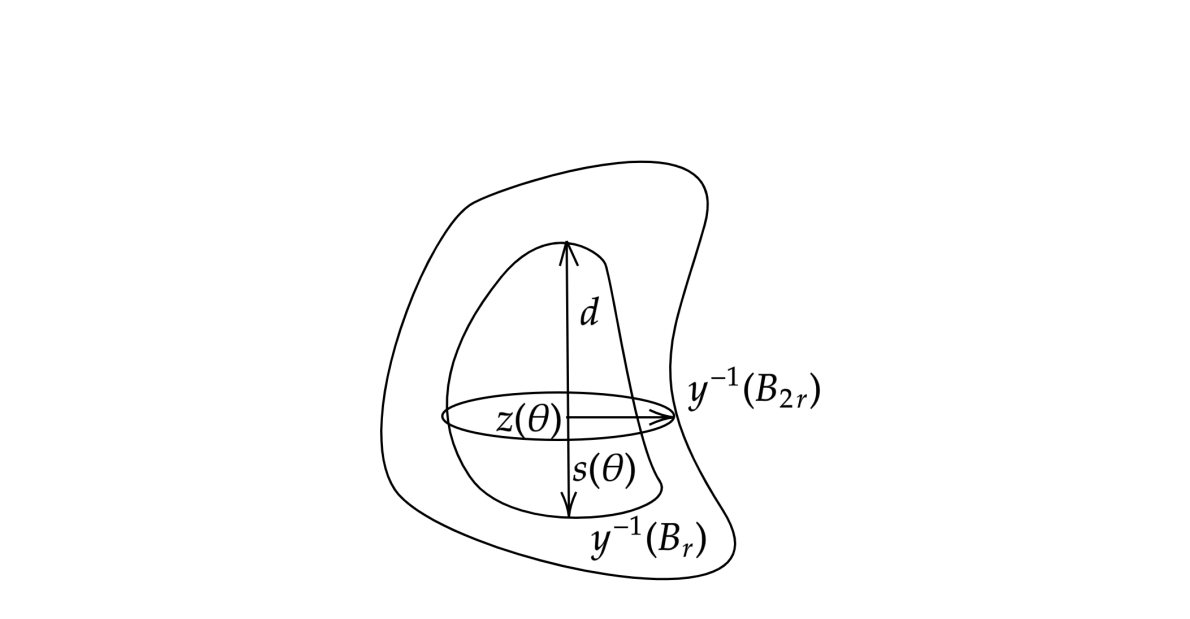
What is actually new: the admissible class combines the Ciarlet-Nečas condition with finite distortion and critical Ln−1 integrability of the outer distortion. Lemma 3.3, the diameter estimate for inverse images of balls, is a real contribution. If Theorem 3.7 were correct, it would be a meaningful partial step toward the Iwaniec-Šverák conjecture under an extra condition, and the magnetoelastic existence theorem would be new. The compactness and lower-semicontinuity sections show a working knowledge of the direct method, and the exposition is mostly clear.
The soft spot is not minor. In Step III of Theorem 3.7, after proving y−1 in W1,n_{loc}(y(Ω)\y(∂Ω)), the proof asserts y(Ω)\y(∂Ω) = y(Ω). That is false: for the identity map on the unit ball, the left side is the punctured ball, not the ball. The subsequent conclusion that y−1(y(Ω)\y(∂Ω)) = Ω is also false. Since Lemma 4.1 and Theorem 4.3 depend on Theorem 3.7, the existence theorem is unsupported. This is a load-bearing flaw, not a gap in presentation.
There are two other gaps worth naming. In Step I, the multiplicity bound N(y,Ω,x) ≤ 1 is asserted to follow from the Ciarlet-Nečas condition with no derivation. That one is repairable via the area formula, as the stress-test note says. In Section 4.1, the proof infers from weak convergence of det(∇yk) that, on a set where the limit vanishes, det(∇yk) → 0 a.e. and 1/det(∇yk) → +∞. Weak convergence does not give that; this step needs a different argument, possibly using biting convergence or the equi-integrability that is already present.
These are not cosmetic flaws, but the paper is not a bluff. The framework is serious, the authors engage honestly with the literature, and the self-citation to the first author's thesis is organizational, not circular. For researchers in finite distortion or nonlinear elasticity, the diameter estimate and the overall strategy are worth knowing even before a fix. I would not cite the existence theorem yet, but I would encourage a serious referee to read this and tell the authors exactly where the topological proof breaks, because I think the damage may be repairable.
The strongest objection
Theorem 3.7 is the load-bearing topological ingredient: Lemma 4.1 (admissible deformations are homeomorphisms) and hence Theorem 4.3 (existence of minimizers) both depend on its conclusion that y is open. The proof breaks in Step III. After establishing y^{-1} in W^{1,n}_{loc}(y(Ω)\y(∂Ω)), the text asserts the identity y(Ω)\y(∂Ω)=y(Ω) and then concludes y is an open mapping on Ω. This identity is false in general: for y(x)=x on the unit ball, y(Ω)\y(∂Ω) is the punctured ball B(0,1)\S(0,1), which is not equal to B(0,1). Moreover, the subsequent assertion y^{-1}(y(Ω)\y(∂Ω))=Ω is also false. Thus the continuity of the inverse on the full image, and therefore the openness of y, does not follow from the preceding argument. Unlike the multiplicity bound N≤1 in Step I, which can be derived from the area formula together with the Ciarlet-Nečas condition (∫det∇y = ∫N dx ≥ μ(y(Ω)) ≥ ∫det∇y, forcing N=1 a.e.), the false equality in Step III is an outright invalid inference. The central existence claim is therefore unsupported as written; Theorem 3.7 may be repairable, but the written proof does not establish it.
The reader's overall rejection is justified, and I agree that the proof of Theorem 3.7 is not rigorous. However, I do not regard the multiplicity bound N≤1 as the most fragile premise: the Ciarlet-Nečas condition, the area formula, and det∇y>0 a.e. together imply ∫N dx = ∫det∇y ≤ μ(y(Ω)), while N≥1 a.e. on y(Ω) gives ∫N dx ≥ μ(y(Ω)). Hence N=1 a.e., so that step is repairable with a short argument. The genuinely load-bearing defect is the final step of Theorem 3.7, where the paper asserts y(Ω)\y(∂Ω)=y(Ω) and y^{-1}(y(Ω)\y(∂Ω))=Ω; both are false for the identity map on the unit ball. Since openness of admissible deformations is what upgrades a.e. injectivity to a homeomorphism property in Lemma 4.1, and since the compactness and lower-semicontinuity arguments in Section 4 assume the homeomorphic character of the limit deformation, this false identity undermines the existence theorem. The verdict should remain REJECT as the paper stands, with the caveat that the flaw is localized and may be repairable by a correct exhaustion argument.
The referee's report
The paper is well motivated: it connects nonlinear elasticity to the finite-distortion theory and aims at a partial positive result in the direction of the Iwaniec-Šverák conjecture under the additional Ciarlet-Nečas condition. If the open mapping theorem were correct, the proposed existence framework would be a meaningful extension of earlier magnetoelasticity results. However, the written proof of the open mapping theorem contains an invalid inference, and the subsequent existence and compactness arguments depend on that theorem. As a result, the central claim is not established by the manuscript in its current form.
Pith's reading of the paper (a machine's summary, not the authors')
This paper proves an existence theorem for a variational model of compressible magnetoelastic solids: under polyconvexity, coercivity in the deformation gradient and outer distortion, and blow-up as volume goes to zero, the total energy attains a minimizer in an admissible class built from mappings of finite distortion. The decisive fact is that every admissible deformation is a homeomorphism, which follows from an open mapping theorem for finite-distortion mappings with outer distortion in the critical space $L^{n-1}$ satisfying the Ciarlet-Ne\u010das volume condition. That theorem is a partial positive result toward the Iwaniec-\u0160ver\u00e1k conjecture. The homeomorphism property converts the problem into one where the direct method applies: energy-bounded sequences are compact in the admissible class, the magnetostrictive, exchange, and stray-field terms are lower semicontinuous, and the minimizer is therefore attained as a homeomorphism.
What carries the argument. The load-bearing object is the outer distortion coefficient $K_O^y = |\nabla y|^n / J_y$ when $J_y>0$ and $1$ otherwise, together with the critical integrability $K_O^y \in L^{n-1}$ and the Ciarlet-Ne\u010das condition $\int_\Omega \det\nabla y\, dX \le |y(\Omega)|$. The mechanism that carries the argument is the proof of Theorem 3.7: Lemma 3.3 estimates $\operatorname{diam}(y^{-1}(B_r))$ by $C\, r^{1-n}\,[\mu(y^{-1}(B_{2r}))]^{(p-n+1)/p}\,\|\nabla y\|_{L^p(y^{-1}(B_{2r}))}^{n-1}$; feeding this through the area formula and the multiplicity bound $N(y,\Omega,x)\le 1$ yields a controlled limsup of the diameter ratio, which by the Rademacher-Stepanov theorem makes $y^{-1}$ differentiable almost everywhere. The inverse then inherits finite distortion, and its $W^{1,n}$ regularity together with the continuity theorem for finite-distortion mappings gives openness.
Core claim. The paper's central assertion is Theorem 4.3: if $W$ satisfies (9), (10), (11), then $E_{\mathrm{mag}}$ admits a minimizer on the admissible class $\mathcal{A}$. The proof rests on two structural results. Lemma 4.1 shows that every admissible deformation $y\in\mathcal{Y}$ is a homeomorphism from $\Omega$ onto $y(\Omega)$: the Ciarlet-Ne\u010das condition together with positive Jacobian gives injectivity almost everywhere, while Theorem 3.7 supplies openness. Theorem 3.7 is the analytical heart: a mapping of finite distortion with $K_O^y \in L^{n-1}$, $\det\nabla y>0$ almost everywhere, and $\int_\Omega \det\nabla y\,dX \le |y(\Omega)|$ is open. Its proof combines a diameter estimate for inverse images of balls, the area formula, and Rademacher-Stepanov differentiability of the inverse to show the inverse has finite distortion and hence a continuous representative. With the admissible class closed under energy-bounded limits and the energy lower semicontinuous, the direct method yields a minimizer.
The premise it rests on. The entire chain rests on the assertion, made without proof or citation in Theorem 3.7 Step I, that the Ciarlet-Ne\u010das condition $\int_\Omega \det\nabla y \le |y(\Omega)|$ forces the multiplicity function $N(y,\Omega,x)$ to be at most $1$ almost everywhere; remove that step and the openness theorem, the homeomorphism property, and the existence theorem all give way.
If the paper is right (Pith's inferences, not the authors')
Every admissible deformation is a homeomorphism onto its image, so the minimizer produced by the direct method is an orientation-preserving homeomorphism and interpenetration of matter is excluded.
Existence of minimizers holds for compressible magnetoelastic solids at the critical distortion integrability $K_O\in L^{n-1}$, replacing the $W^{2,2}$ or $W^{1,p}$, $p>3$ regularity used in earlier treatments.
The open mapping theorem gives a partial positive result toward the Iwaniec-\u0160ver\u00e1k conjecture: openness holds in the borderline regime whenever the Ciarlet-Ne\u010das condition is imposed.
Energy-bounded sequences have subsequences converging in the admissible class with the limit deformation again a homeomorphism; injectivity is not lost under weak convergence in this class.
The compactness and lower semicontinuity framework extends routinely, as the paper notes, to include a Zeeman term for a prescribed external magnetic field.
If the unproved multiplicity step can be replaced by a weaker control of inverse images, the admissible class might be enlarged beyond homeomorphisms to bimeasurable finite-distortion maps, at the cost of a more delicate treatment of the magnetostatic term.
The compactness mechanism depends mainly on the outer distortion bound and determinant coercivity, so the same proof should yield minimizers for other polyconvex energies with a saturation constraint of the form $|M|\det\nabla y=1$.
The paper leaves open regularity of minimizers beyond homeomorphicity, as well as whether the minimizer satisfies the Euler-Lagrange equations; the direct method establishes existence in the finite-distortion class but does not address uniqueness or smoothness.
Check this review
Pith stored no record of this review's passes and took no fingerprint of it. Reviews made by code from 13 Nov 2026 on carry both.
How often reviews like this one are right
Reviews like this one: written by deepseek-v4-flash, where what was read was not recorded.
How often objections from reviews like this one are right: not yet measured
Reviews by people
This review was written by a machine. No person has reviewed this paper on Pith yet. A scientist listed on Pith can review it for a fee, and their review is published here whatever it concludes.
The paper
Abstract
We establish the existence of an energy minimizer for a variational model of compressible magnetoelastic solids. The analysis is carried out in a new admissible class of deformations consisting of mappings of finite distortion, which extends previously available existence frameworks. A key ingredient is a compactness result under the critical integrability assumption on the outer distortion coefficient, which significantly weakens the regularity requirements imposed in earlier works. To obtain this result, we prove a diameter estimate for finite-distortion mappings satisfying the Ciarlet-Nečas condition and derive an open mapping theorem under the optimal integrability assumption, that is, the outer distortion is in Ln−1. This provides a partial positive result in the direction of the Iwaniec-Šverák conjecture and implies that admissible deformations are homeomorphisms. These topological and compactness properties allow us to apply the direct method of the calculus of variations and establish the existence of minimizers for compressible magnetoelastic solids within the admissible class of deformations consisting of mappings of finite distortions.
The paper's own sentences, arranged, kept beside the review and separate from it. Each label is drawn from a closed vocabulary; the number beside it is the probability the classifier gave that label. No sentence in this record was written by a model.
abstract compiled · 2026-09-23
The authors' main claim, as the classifier picked it out 0.93
“We establish the existence of an energy minimizer for a variational model of compressible magnetoelastic solids.”
How the main claim is stated: asserted 1.00
What the abstract itself states, as probabilities: claims first 0.08 · states limitation 0.57 · human participants 0.01 · controlled comparison 0.02 · randomized assignment 0.01 · states quantitative result 0.52 · compares with prior results 0.93 · mentions code or data availability 0.02
The abstract, sentence by sentence
This table labels the abstract only (arXiv listing abstract v1). The number is the probability the classifier gave the label.
| Sentence | Role | The authors' own work | States the main conclusion | Strength |
|---|---|---|---|---|
| We establish the existence of an energy minimizer for a variational model of compressible magnetoelastic solids. | result 0.85 | 0.96 | 0.92 | asserted 1.00 |
| The analysis is carried out in a new admissible class of deformations consisting of mappings of finite distortion, which extends previously available existence frameworks. | contribution 0.68 | 0.89 | 0.06 | asserted 1.00 |
| A key ingredient is a compactness result under the critical integrability assumption on the outer distortion coefficient, which significantly weakens the regularity requirements imposed in earlier works. | contribution 0.55 | 0.79 | 0.06 | asserted 1.00 |
| To obtain this result, we prove a diameter estimate for finite-distortion mappings satisfying the Ciarlet-Ne\v{c}as condition and derive an open mapping theorem under the optimal integrability assumption, that is, the outer distortion is in $L^{n-1}$. | method 0.85 | 0.95 | 0.06 | asserted 1.00 |
| This provides a partial positive result in the direction of the Iwaniec-\v{S}ver\'ak conjecture and implies that admissible deformations are homeomorphisms. | interpretation 0.92 | 0.88 | 0.15 | asserted 0.81 |
| These topological and compactness properties allow us to apply the direct method of the calculus of variations and establish the existence of minimizers for compressible magnetoelastic solids within the admissible class of deformations consisting of mappings of finite distortions. | result 0.72 | 0.94 | 0.70 | asserted 1.00 |
What kind of paper the classifier reports this is: theoretical result 1.00 · evidence from proof or derivation 1.00
What was examined, and what was not
Sources read
- arXiv listing abstract v1
Not examined
- full text
- figures and tables
- references and citing sentences
- relations to other papers
Levels run
- P abstract
Not run
- S sections
- T body sentences
- C citations
- R cross-paper relations
How the labels were made
Compiled by classifier-1.13.0 via TypeSafe API, question bank abstract-p1-20260923, 2026-09-23: 1 request, 5,131 input tokens.
Every quoted sentence on this record is the authors'. Every label is from Pith's closed vocabulary, with the probability shown beside it. This record as JSON
Figures (1)
Figures are the authors', reproduced from the paper.
References (138)
- [1] Null Lagrangians, weak continuity, and variational problems of arbitrary order , author=. Journal of Functional Analysis , volume=. 1981 , publisher= on Pith
- [2] Local invertibility in Sobolev spaces with applications to nematic elastomers and magnetoelasticity , author=. Archive for Rational Mechanics and Analysis , volume=. 2017 , publisher= on Pith
- [3] Ginzburg-Landau vortices , author=. 1994 , publisher= on Pith
- [4] Golovaty, Dmitry and Montero, Jos. Dimension reduction for the. Journal of Nonlinear Science , volume=. 2015 , publisher= on Pith
- [5] Global Integrability of the Reciprocal of Jacobians for Homeomorphisms of Finite Distortion , author=. arXiv preprint arXiv:2512.15519 , year= on PitharXiv
- [6] (INV) condition and regularity of the inverse , author=. Journal of Functional Analysis , pages=. 2025 , publisher= on Pith
- [7] The formation of gradient-driven singular structures of codimension one and two in two-dimensions: The case study of ferronematics , author=. arXiv preprint arXiv:2505.07506 , year= on PithPith's reviewarXiv
- [8] An effective model for boundary vortices in thin-film micromagnetics , author=. Mathematical Models and Methods in Applied Sciences , volume=. 2023 , publisher= on Pith
- [9] A note on locking materials and gradient polyconvexity , author=. Mathematical Models and Methods in Applied Sciences , volume=. 2018 , publisher= on Pith
- [10] Quasistatic evolution in magnetoelasticity under subcritical coercivity assumptions , author=. Calculus of Variations and Partial Differential Equations , volume=. 2023 , publisher= on Pith
- [11] Existence results in large-strain magnetoelasticity , author=. Annales de l'Institut Henri Poincar on Pith
- [12] A relation between pointwise convergence of functions and convergence of functionals , author=. Proceedings of the American Mathematical Society , volume= on Pith
- [13] Energy minimizers for large ferromagnetic bodies , author=. Archive for Rational Mechanics and Analysis , volume=. 1993 , publisher= on Pith
- [14] Existence of Minimizers for a Variational Problem in Two-Dimensional Nonlinear Magnetoelasticity , author=. Archive for Rational Mechanics and Analysis , volume=. 1998 , publisher= on Pith
- [15] Evans, Lawrence C. and Ronald, Gariepy F. , title=. 2018 , publisher= on Pith
- [16] Magnetic domains: the analysis of magnetic microstructures , author=. 2008 , publisher= on Pith
- [17] Fonseca, Irene and Leoni, Giovanni , title=. 2007 , publisher= on Pith
- [18] On the weak limit of mappings with finite distortion , author=. Proceedings of the American Mathematical Society , volume= on Pith
- [19] The pullback equation for differential forms , author=. 2011 , publisher= on Pith
- [20] The limit of mappings with finite distortion , author=. Annales Fennici Mathematici , volume= on Pith
show 80 more
- [21] A phase-field approach to Eulerian interfacial energies , author=. Archive for Rational Mechanics and Analysis , volume=. 2019 , publisher= on Pith
- [22] Equilibrium for multiphase solids with Eulerian interfaces , author=. Journal of Elasticity , volume=. 2020 , publisher= on Pith
- [23] Hencl, S. and Rajala, K. Optimal assumptions for discreteness. Archive for Rational Mechanics and Analysis. 2013 on Pith
- [24] Lectures on mappings of finite distortion , author=. 2014 , publisher= on Pith
- [25] On mappings with integrable dilatation , author=. Proceedings of the American Mathematical Society , pages=. 1993 , publisher= on Pith
- [26] Theory of magnetostriction with applications to TbxDy1-xFe2 , author=. Philosophical Magazine B , volume=. 1993 , publisher= on Pith
- [27] Existence results for incompressible magnetoelasticity , author=. Discrete and Continuous Dynamical Systems , volume=. 2014 , publisher= on Pith
- [28] Injectivity almost everywhere and mappings with finite distortion in nonlinear elasticity , author=. Calculus of Variations and Partial Differential Equations , volume=. 2020 , publisher= on Pith
- [29] Thin layers in micromagnetism , author=. Mathematical Models and Methods in Applied Sciences , volume=. 2001 , publisher= on Pith
- [30] Ginzburg-Landau vortices for thin ferromagnetic films , author= on Pith
- [31] Boundary vortices for thin ferromagnetic films , author=. Archive for Rational Mechanics and Analysis , volume=. 2004 , publisher= on Pith
- [32] Moving boundary vortices for a thin-film limit in micromagnetics , author=. Communications on Pure and Applied Mathematics: A Journal Issued by the Courant Institute of Mathematical Sciences , volume=. 2005 , publisher= on Pith
- [33] Global Jacobian and -convergence in a two-dimensional Ginzburg-Landau model for boundary vortices , author=. Journal of Functional Analysis , volume=. 2021 , publisher= on Pith
- [34] Müller, S. Higher integrability of determinants and weak convergence in L^ 1. Journal fuer die reine und angewandte Mathematik. 1999 on Pith
- [35] Regularity of the inverse of spatial mappings with finite distortion. , author=. Calculus of Variations & Partial Differential Equations , volume= on Pith
- [36] Rajala, K. Remarks on the Iwaniec–Šverák conjecture. Indiana Univ. Math. J. 2010 on Pith
- [37] Rajala, K. Reshetnyak's Theorem and The Inner Distortion. Pure and Applied Mathematics Quarterly. 2011 on Pith
- [38] Rindler, F. Calculus of Variations. 2018 on Pith
- [39] Existence of energy minimizers for magnetostrictive materials , author=. SIAM Journal on Mathematical Analysis , volume=. 2005 , publisher= on Pith
- [40] V \"a is \"a l \"a , Jussi. Lectures on n-dimensional quasiconformal mappings. 2006 on Pith
- [41] Brown, William Fuller. Magnetoelastic interactions. 1966 on Pith
- [42] Soft fibers with magnetoelasticity for wearable electronics , author=. Nature Communications , volume=. 2021 , publisher= on Pith
- [43] Smith, S. E. Neuromuscular blocking drugs in man. Neuromuscular junction. H andbook of experimental pharmacology. 1976 on Pith
- [44] Chung, S. T. and Morris, R. L. Isolation and characterization of plasmid deoxyribonucleic acid from Streptomyces fradiae. 1978 on Pith
- [45] Hao, Z. and AghaKouchak, A. and Nakhjiri, N. and Farahmand, A. Global integrated drought monitoring and prediction system (GIDMaPS) data sets. 2014 on Pith
- [46] Babichev, S. A. and Ries, J. and Lvovsky, A. I. Quantum scissors: teleportation of single-mode optical states by means of a nonlocal single photon. 2002 on Pith
- [47] Beneke, M. and Buchalla, G. and Dunietz, I. Mixing induced CP asymmetries in inclusive B decays. Phys. L ett. 1997. arXiv:0707.3168 on PithPith's reviewarXiv
- [48] Stahl, B. deep SIP : deep learning of S upernova I a P arameters. 2020. ascl:2006.023 on Pith
- [49] Abbott, T. M. C. and others. Dark Energy Survey Year 1 Results: Constraints on Extended Cosmological Models from Galaxy Clustering and Weak Lensing. Phys. Rev. D. 2019. doi:10.1103/PhysRevD.99.123505. arXiv:1810.02499 on PithPith's reviewarXiv
- [50] Steady-state problems of nonlinear electro-magneto-thermo-elasticity , author=. Technical Summary Report Wisconsin Univ , year= on Pith
- [51] Existence results for large deformations of magnetostrictive materials , author=. Journal of Intelligent Material Systems and Structures , volume=. 1993 , publisher= on Pith
- [52] Nonlocal variational problems in nonlinear electromagneto-elastostatics , author=. SIAM Journal on Mathematical Analysis , volume=. 1988 , publisher= on Pith
- [53] Convexity conditions and existence theorems in nonlinear elasticity , author=. Archive for Rational Mechanics and Analysis , volume=. 1976 , publisher= on Pith
- [54] Tailored morphologies in two-dimensional ferronematic wells , author=. Physical Review E , volume=. 2020 , publisher= on Pith
- [55] Ferromagnetism in suspensions of magnetic platelets in liquid crystal , author=. Nature , volume=. 2013 , publisher= on Pith
- [56] Elementary numerical analysis: an algorithmic approach , author=. 2017 , publisher= on Pith
- [57] Two-dimensional nematic colloidal crystals self-assembled by topological defects , author=. Science , volume=. 2006 , publisher= on Pith
- [58] Shape-controlled colloidal interactions in nematic liquid crystals , author=. Science , volume=. 2009 , publisher= on Pith
- [59] A. Majumdar and A. Zarnescu. Landau-de G ennes theory of nematic liquid crystals: the Oseen--Frank limit and beyond. Arch. Ration. Mech. Anal. 2010 on Pith
- [60] Novel colloidal interactions in anisotropic fluids , author=. Science , volume=. 1997 , publisher= on Pith
- [61] C. Tsakonas and A. J. Davidson and C. V. Brown and N. J. Mottram , journal =. Multistable alignment states in nematic liquid crystal filled wells on Pith
- [62] Luo, Chong and Majumdar, Apala and Erban, Radek. Multistability in planar liquid crystal wells. Physical Review E. 2012 on Pith
- [63] J. M. Ball. Liquid crystals and their defects. arXiv:1706.06861v3 [cond-mat.soft]. 2017 on PithPith's reviewarXiv
- [64] Two-dimensional ferronematics, canonical harmonic maps and minimal connections , author=. Archive for Rational Mechanics and Analysis , volume=. 2023 , publisher= on Pith
- [65] Canevari, Giacomo and Harris, Joseph and Majumdar, Apala and Wang, Yiwei , journal=. The Well Order Reconstruction Solution for three dimensional wells in the on Pith
- [66] One-dimensional ferronematics in a channel: Order reconstruction, bifurcations, and multistability , author=. SIAM Journal on Applied Mathematics , volume=. 2022 , publisher= on Pith
- [67] A reduced theory for thin-film micromagnetics , author=. Communications on Pure and Applied Mathematics: A Journal Issued by the Courant Institute of Mathematical Sciences , volume=. 2002 , publisher= on Pith
- [68] Micromagnetics of very thin films , author=. Proceedings of the Royal Society of London. Series A: Mathematical, Physical and Engineering Sciences , volume=. 1997 , publisher= on Pith
- [69] The physics of liquid crystals , author=. International Series of Monographs on Physics , volume= on Pith
- [70] Magnetic nanoparticles in a nematic channel: A one-dimensional study , author=. Physical Review E , volume=. 2019 , publisher= on Pith
- [71] Theory of magnetic suspensions in liquid crystals , author=. Journal de Physique , volume=. 1970 , publisher= on Pith
- [72] Multistable nematic wells: Modelling perspectives, recent results and new directions , author=. Liquid Crystals , volume=. 2016 , publisher= on Pith
- [73] Landau description of ferrofluid to ferronematic phase transition , author=. Magnetohydrodynamics , volume= on Pith
- [74] Observation of macroscopic collective behavior and new texture in magnetically doped liquid crystals , author=. Physical Review Letters , volume=. 1983 , publisher= on Pith
- [75] Parameter dependent finite element analysis for ferronematics solutions , author=. Computers & Mathematics with Applications , volume=. 2021 , publisher= on Pith
- [76] Golovaty, Dmitry and Montero, Jos. On minimizers of a. Archive for Rational Mechanics and Analysis , volume=. 2014 , publisher= on Pith
- [77] Another thin-film limit of micromagnetics , author=. Archive for Rational Mechanics and Analysis , volume=. 2005 , publisher= on Pith
- [78] Reduced energies for thin ferromagnetic films with perpendicular anisotropy , author=. arXiv preprint arXiv:2306.07634 , year= on PithPith's reviewarXiv
- [79] Optical patterning of magnetic domains and defects in ferromagnetic liquid crystal colloids , author=. Applied Physics Letters , volume=. 2015 , publisher= on Pith
- [80] Ferronematics and Living Liquid Crystals , author=. 2025 , publisher= on Pith
- [81] Mappings of finite distortion: monotonicity and continuity , author=. Inventiones mathematicae , volume=. 2001 , publisher= on Pith
- [82] Homogenization of magnetoelastic materials with rigid magnetic inclusions at small strains , author=. Journal of Nonlinear Science , volume=. 2026 , publisher= on Pith
- [83] Ferromagnetic nematic suspensions with negative dielectric anisotropy: Competing effects of magnetic and electric fields , author=. Physical Review Applied , volume=. 2025 , publisher= on Pith
- [84] Ferromagnetic nematic liquid crystals , author=. Liquid Crystals Reviews , volume=. 2017 , publisher= on Pith
- [85] Numerical analysis. 3rd edn Boston , author=. 1985 , publisher= on Pith
- [86] Optimal transport: Theory and applications , author=. 2014 , publisher= on Pith
- [87] Gradient flows: in metric spaces and in the space of probability measures , author=. 2008 , publisher= on Pith
- [88] Magnetically actuated liquid crystals , author=. Nano Letters , volume=. 2014 , publisher= on Pith
- [89] Spontaneous liquid crystal and ferromagnetic ordering of colloidal magnetic nanoplates , author=. Nature Communications , volume=. 2016 , publisher= on Pith
- [90] An effective model for nematic liquid crystal composites with ferromagnetic inclusions , author=. SIAM Journal on Applied Mathematics , volume=. 2014 , publisher= on Pith
- [91] Mathematical analysis of weak and strong solutions to an evolutionary model for magnetoviscoelasticity , author=. Discrete & Continuous Dynamical Systems-Series S , volume= on Pith
- [92] Dimensional reduction for the ferroelectric smectic A-type phase of bent-core liquid crystals , author=. Journal of Nonlinear Science , volume=. 2023 , publisher= on Pith
- [93] Numerical solution of partial differential equations: finite difference methods , author=. 1985 , publisher= on Pith
- [94] Ferronematics: enhanced magneto-optical response of a liquid crystalline system , author=. Materials Science and Engineering: C , volume=. 1995 , publisher= on Pith
- [95] Direct observation of internal spin structure of magnetic vortex cores , author=. Science , volume=. 2002 , publisher= on Pith
- [96] Mathematical Thermodynamics of Complex Fluids , author=. 2017 , publisher= on Pith
- [97] Tailored nematic and magnetization profiles on two-dimensional polygons , author=. Physical Review E , volume=. 2021 , publisher= on Pith
- [98] A new era for liquid crystal research: Applications of liquid crystals in soft matter nano-, bio-and microtechnology , author=. Current Applied Physics , volume=. 2012 , publisher= on Pith
- [99] Biofunctionalized magnetic-vortex microdiscs for targeted cancer-cell destruction , author=. Nature materials , volume=. 2010 , publisher= on Pith
- [100] Mathematics and liquid crystals , author=. Molecular Crystals and Liquid Crystals , volume=. 2017 , publisher= on Pith
The first 100 of 138 references are listed here. All of them are in this paper's citation record.
How the literature uses it
What this paper does with the arXiv papers it cites
What it cites
Cites as background 1 paper
-
Recent developments in this direction include [ref] .
2512.15519 · The state of the art · 0.86
Challenges and discussion
Disagree with the review, or know something it missed? Leave a comment, or challenge this review formally: a challenge becomes a permanent entry in this paper's record, and its decision is published here.
Come back by email
A short list of the week's newly reviewed papers. Nothing is sent until you confirm from your inbox, and every email has a link that stops it. No account.
No comments yet.
Sign in to comment