Computation and Language · arXiv:2608.15980 v1 · submitted 17 Aug 2026 · 8 references
Whose Gold? Annotator-Pool Disagreement Is Large at the Item Level, and Hidden by Small Leaderboards
The paper says
“Preference benchmarks are built by hiring annotators, and the identity of those annotators is treated as an implementation detail. We measure what that detail buys.”
more of the abstract
On the 2,885 MultiPref items where both pools are internally unanimous, so no tie-breaking convention is consulted at all, expert and crowd annotators assign a different majority label to 23.6% and name the opposite winner on 9.2%; on the 246 comparably unanimous MT-Bench cells, benchmark authors and recruited experts differ on 30.5% and reverse on 8.5%. Yet on both corpora the resulting model leaderboards are bit-identical: Kendall tau = 1.00 with zero of six models displaced. That invariance is far weaker evidence than it looks, and we quantify how weak. Switching pools moves a model's win rate by 1.9pp (SD), one adjacent pair in our own leaderboard sits 0.8pp apart and had a 38% chance of swapping, and an item-level bootstrap displaces at least one model in 28% of resamples. The observed zero is the common outcome, not a property of aggregation: on the same measured perturbation, a ten-model leaderboard is displaced with probability 0.86 and a twenty-model leaderboard with probability 0.9997. Reporting a six-model leaderboard is safe; the safety does not generalise, and everything that consumes labels per item is not safe at any size. We make the distinction precise, show that a widely used dataset's stated assumption of no intra-group annotator variability is false, and show that an LLM judge tracks the crowd pool over the expert pool on all three models we test, including one from a different vendor. All code, per-call outputs, and pre-registered decision rules will be released upon acceptance.
from the abstract
Pith says
Machine review · deepseek-v4-flash · 27 Aug 2026 · what was read was not recorded · not checked by a person
It can be wrong. Challenge this review or reply to it.
Holds up, with conditions. A careful measurement of annotator-pool divergence that makes a real point, but the leaderboard-size extrapolation is oversold. This line is wrong
2 major objections · 4 minor
How often objections from reviews like this one are right: not yet measured
Not checked: figures, code, what the 8 references say.
The paper says, at Section 4, Table 3
The review did not quote this passage.
Pith says: Objection 1 of 2 · major
The extrapolation of displacement probabilities to K=10, 20, 30, and 50 models assumes that the measured pairwise pool-shift distribution (SD = 2.6 pp) is Gaussian, that shifts are independent across models, and that the observed six-model win-rate span is the correct baseline for larger leaderboards.
more of objection 1
The agreement of the K=6 parametric row (0.281) with the item-level bootstrap (0.282) validates the model at that single point, but the bootstrap resamples items within the same six models and does not constrain the joint distribution of shifts among many models. If model shifts are positively correlated (for example, within model families), the effective pairwise SD would be smaller than 2.6 pp, and the probabilities in Table 3 would be materially lower; heavier-tailed distributions would move them in the opposite direction. Because the abstract and Section 4 present 0.86 and 0.9997 as point estimates, the authors should either add sensitivity analyses (varying SD, correlated shift structures, heavier-tailed families, different spans) or explicitly re-label these numbers as illustrative predictions under a simplified model rather than measured probabilities.
The paper says, at Section 4, 'Where the invariance ends'
The review did not quote this passage.
Pith says: Objection 2 of 2 · major
The statement that real arenas cluster models more tightly than uniform spacing, so the Table 3 numbers are lower bounds, is not established for growing K. The calculation fixes the win-rate span to the observed six-model span; if a 20- or 50-model leaderboard spans a wider range of win rates, the average adjacent gap shrinks more slowly than the table suggests, and the displacement probabilities could be substantially lower.
more of objection 2
The lower-bound claim needs a supporting argument or a sensitivity analysis that varies the span (for example, scaling the span as a function of K), otherwise the 'lower bound' framing may overstate the transferability of the invariance result to the field's larger arenas.
4 minor objections
The paper says, at Throughout
Pith says: minor objection 1 of 4
The dataset name is written inconsistently as MULTIPREF, MultiPref, and MULTIPREF; please standardize (e.g., MultiPref) after defining it.
The paper says, at Section 2, Setup
Pith says: minor objection 2 of 4
Please clarify whether the 10,461 MULTIPREF comparisons correspond to a specific number of items and models; the MT-Bench side reports 292 item cells, so a comparable item count would be helpful for interpreting the two corpora.
show 2 more
The paper says, at Figure 1
Pith says: minor objection 3 of 4
In panel A, the bars mix percentages for majority-label changes and winner reversals; a separate panel or an explicit figure legend would make the two quantities easier to distinguish.
The paper says, at Section 7, Limitations
Pith says: minor objection 4 of 4
The mention of 'LAGUNAS 2.1' is not introduced or referenced; if it is a model name, please provide a citation or explain what it is, since it is used to justify the choice of the third judge.
What would settle it
Run a sensitivity version of Table 3: from an item-level bootstrap of MultiPref (B=10,000), estimate the full 6x6 covariance matrix of the crowd-minus-expert win-rate shifts. Simulate 10/20/30/50-model leaderboards by drawing shift vectors from a multivariate normal with this covariance (not independent), with models uniformly spaced on the observed six-model span, and also on the empirical gap distribution of a real large leaderboard such as Chatbot Arena. If the K=20 displacement probability is below 0.99, or the K=10 probability below 0.76, the Table 3 point estimates are not robust and the abstract should present them as conditional on independence.
from the skeptic's reading
How the review went
4 readings by deepseek-v4-flash · 27 Aug 2026
- Reader holds up, with conditions
- Skeptic agrees
- Editor wrote the verdict above
- Referee major revision: 2 major objections, 4 minor
Not run on this paper: the simulated authors' defence.
Pith did not check this review's objections against the paper.
The review in full
The review in brief, machine-written
The part of this paper worth your time is the measurement in Tables 1 and 2. On 2,885 MultiPref items where both pools are internally unanimous, expert and crowd majority labels disagree 23.6% of the time and name opposite winners 9.2%. The MT-Bench numbers are similar. That is a clean, concrete result, and the tie-avoidance restriction is the right way to get it: the authors don't let a convention decide the items they're counting.
The paper also earns credit for what it does with the aggregate. The six-model leaderboards are bit-identical, but the authors show that this is a spacing artifact. One adjacent pair sits 0.8pp apart and had a 38% chance of swapping under the measured pool shift; an item-level bootstrap displaces at least one model in 28% of resamples. That reframes leaderboard stability as a small-sample phenomenon and distinguishes leaderboard-level robustness from per-item reliability, which is the useful distinction.
The soft spot is the extrapolation to larger leaderboards. The 0.86 and 0.9997 probabilities in Table 3 assume the pool perturbation is Gaussian and independent across models, estimated from six models, and that K models spread uniformly over the observed span is a fair test. The bootstrap validates only the K=6 row. If shifts correlate with model family, the effective pairwise SD could be lower and displacement rarer. The limitations section says this, but the abstract quotes the point estimates without the caveat, which is overselling. This matters because those two numbers are the ones people will remember.
That said, the overclaim is not load-bearing. The central point—that identical leaderboards tell you little about per-item label reliability—stands on the bootstrap and the close pair. The paper would be nearly as convincing with Table 3 removed and a sentence saying larger boards are more likely to move.
The LLM-judge arm is suggestive but weaker: three models, two vendors, and the authors report large position and format effects that move results more than the pool does. They handle this honestly, including reporting a failed under-powered run and withdrawing an explanation. That transparency is rare and should be credited.
Citation pattern is fine. The paper engages the relevant perspectivist and judge-bias work.
Who should read it: anyone who builds or consumes per-item preference labels—reward-model training, active learning, LLM-judge validation. It deserves a serious referee. I'd send it out with a request to temper the abstract and either add sensitivity analysis to Table 3 or demote it to a conjecture.
Regards.
The strongest objection
Section 4's extrapolation (Table 3) is the load-bearing step for the central claim that the identical six-model rankings are a small-leaderboard artifact. The paper estimates the crowd-minus-expert win-rate shift SD as 1.9pp, infers a pairwise-difference SD of 2.6pp, and computes P(at least one displaced) for K=6,10,20,30,50 by treating adjacent pairs as independent draws from a Gaussian difference distribution and spreading K models uniformly over the observed six-model win-rate span. The K=6 row is validated by an item-level bootstrap (0.282 vs 0.281), which is genuine supporting evidence. But that validation does not constrain the joint distribution needed for K>6. The extrapolation silently assumes three things: (i) model shifts are independent, yet pool preference may be correlated with model family or style, so adjacent models can share a common shift component and the effective pairwise-difference SD may be well below 2.6pp; (ii) Gaussian tails are accurate, though only 15 pairwise differences from six models estimate the distribution; (iii) the six-model win-rate span is representative of larger leaderboards. If, say, the effective SD were 1.5pp instead of 2.6pp, the K=20 probability would still be high but not 0.9997; if shifts are rank-correlated, displacement could be materially rarer. The abstract quotes 0.86 and 0.9997 as point estimates, so this parametric bridge is not a minor caveat. The paper's Limitations section acknowledges the Gaussian/independence assumption, but the headline inherits it.
The reader's weakest-assumption analysis identifies exactly the same load-bearing step: the Table 3 extrapolation from six models to K=10/20/30/50 under Gaussian and independence assumptions. My stress-test concurs, and adds that the item-level bootstrap validating the K=6 row cannot validate the K>6 rows because adjacent-pair swap events share model shifts; the empirical check at K=6 is necessary but not sufficient. The qualitative message that larger leaderboards are more likely to be displaced is probably robust: any reasonable perturbation with SD near 2.6pp will displace a 20-model board with 1.1pp gaps with high probability. But the specific numbers 0.86 and 0.9997 are point estimates resting on an unverified parametric bridge, and they appear in the abstract as if measured. The paper is otherwise careful: it avoids tie-breaking by restricting to unanimous items, reports the failed underpowered run and the withdrawn explanation, and pre-registers decision rules. Those behaviors are creditworthy but do not remove the need to stress-test the extrapolation. Because the reader already conditioned acceptance on this uncertainty, my read does not change the verdict; it sharpens the condition: the authors should either provide the non-parametric sensitivity analysis or downgrade the precise displacement probabilities to ranges conditional on independence.
The referee's report
The item-level empirical results are a valuable, careful contribution: they quantify how much the choice of annotator pool changes the labels that power benchmark evaluation, and they show that leaderboard invariance does not imply per-item reliability. The authors handle the tie-breaking issue by restricting to convention-free unanimous items and transparently label the resulting estimate as a floor. The pre-registration, the reporting of a null and a failed run, and the internal bootstrap check for the K=6 row are exemplary practices. If the extrapolation concerns are addressed, this would be an important methodological contribution for benchmark construction, LLM-judge validation, and reward-model training. The LLM-judge result, though secondary, is honestly reported and provides a caution for the common practice of validating judges against a single annotator pool.
Pith's reading of the paper (a machine's summary, not the authors')
This paper tries to establish that the choice of annotator pool behind a preference benchmark's gold labels is far from an implementation detail. On the 2,885 MultiPref items where both pools are internally unanimous, expert and crowd annotators assign different majority labels 23.6% of the time and name opposite winners 9.2% of the time; on 246 comparable MT-Bench cells, the rates are 30.5% and 8.5%. Yet the resulting six-model leaderboards are bit-identical, with Kendall tau = 1.00 and zero of six models displaced. The paper argues that this invariance is a spacing artifact, not evidence of robustness: the same measured pool perturbation would displace at least one model on a ten-model leaderboard with probability 0.86 and on a twenty-model one with probability 0.9997. That distinction matters because every per-item consumer of these labels—reward-model training, annotation routing, LLM-judge validation—inherits the large item-level divergence that the aggregate hides.
What carries the argument. The load-bearing object is the spacing argument: a leaderboard's invariance under an annotator-pool swap is determined by whether adjacent models' win-rate gaps exceed the pool-induced shift, not by any property of aggregation. The paper measures the perturbation as the crowd-minus-expert shift in each model's win rate, whose standard deviation is 1.9 percentage points, and computes the pairwise-difference standard deviation of 2.6 points that any adjacent swap must overcome. It validates this arithmetic with an item-level bootstrap that draws the same item indices for both label sources, reproduces a 28% whole-board displacement rate, and then extrapolates to larger leaderboards by spreading K models uniformly over the observed win-rate span. To avoid tie-breaking confounds, the primary analysis conditions on items where both pools are internally unanimous, so no convention is consulted at all.
Core claim. The central claim is that item-level annotator-pool divergence is large while aggregate leaderboard invariance is misleadingly small. On items that need no tie-breaking convention, two pools assign different majority labels to 23.6% (MultiPref) and 30.5% (MT-Bench) of comparisons, and name opposite winners on 9.2% and 8.5%. The same models ranked under expert-gold and crowd-gold labels give identical orderings, Kendall tau = 1.00 with zero of six models displaced. That zero is the modal outcome of a perturbation, not a guarantee: switching pools moves a model's win rate with standard deviation 1.9 percentage points, an adjacent pair in the paper's own leaderboard sits 0.8 points apart with a 38% swap chance, and an item-level bootstrap displaces at least one model in 28% of resamples. Extrapolating the measured perturbation, a ten-model leaderboard is displaced with probability 0.86 and a twenty-model one with probability 0.9997, so small leaderboards are safe in a way that larger arenas are not.
The premise it rests on. The extrapolation to larger leaderboards assumes that the pool perturbation measured on six models is roughly Gaussian and independent across models, and that spreading K models uniformly over the observed win-rate span is a valid lower bound; if the perturbation is correlated or non-Gaussian, the predicted displacement probabilities for K=10, 20, 30, and 50 would change.
If the paper is right (Pith's inferences, not the authors')
LLM-judge agreement figures are under-specified unless the annotator pool defining the reference labels is reported; the paper measures a 3.7–6.9 percentage-point crowd lean across three judges from two vendors.
Per-item consumers of gold labels—reward-model training, active-annotation routing, and judge validation—see the full item-level divergence (23.6% and 30.5% majority-label changes) even when the leaderboard hides it.
A six-model leaderboard with large adjacent gaps can be in a safe regime, but the paper's Table 3 gives the arithmetic for checking any given board: the same perturbation makes displacement likely once the board holds ten or more closely spaced models.
The datasets' stated assumption of no intra-group annotator variability is false, since on MultiPref the two experts on a single item disagree with each other 50.1% of the time.
Position bias and output-format sensitivity move LLM judges more than the pool does, so judge numbers are conditional on presentation order and output format, which are rarely reported.
If the same divergence holds beyond these two corpora, leaderboard scores from papers that used different annotator pools for gold labels may not be comparable, and reporting pool identity alongside scores would be a cheap fix the paper does not explicitly call for.
The monotone decrease in crowd lean as judges get cleaner (6.9 → 5.2 → 3.7 pp) suggests a mechanism the paper leaves open: post-training preference data for open-weight models is often gathered from crowd annotators, which could imprint a crowd-shaped prior; this could be tested by comparing judges whose alignment-data provenance is known.
The spacing arithmetic is not specific to annotator pools: the same calculation gives expected leaderboard displacement rates for any gold-label perturbation—label noise, prompt changes, judge variants—whenever the standard deviation of pairwise differences is known.
A practical extension the paper does not state: benchmark builders could report item-level pool divergence alongside leaderboards, since per-item consumers are the majority of downstream uses and aggregate stability is a poor proxy.
Check this review
Pith stored no record of this review's passes and took no fingerprint of it. Reviews made by code from 13 Nov 2026 on carry both.
How often reviews like this one are right
Reviews like this one: written by deepseek-v4-flash, where what was read was not recorded.
How often objections from reviews like this one are right: not yet measured
Reviews by people
This review was written by a machine. No person has reviewed this paper on Pith yet. A scientist listed on Pith can review it for a fee, and their review is published here whatever it concludes.
The paper
Abstract
Preference benchmarks are built by hiring annotators, and the identity of those annotators is treated as an implementation detail. We measure what that detail buys. On the 2,885 MultiPref items where both pools are internally unanimous, so no tie-breaking convention is consulted at all, expert and crowd annotators assign a different majority label to 23.6% and name the opposite winner on 9.2%; on the 246 comparably unanimous MT-Bench cells, benchmark authors and recruited experts differ on 30.5% and reverse on 8.5%. Yet on both corpora the resulting model leaderboards are bit-identical: Kendall tau = 1.00 with zero of six models displaced. That invariance is far weaker evidence than it looks, and we quantify how weak. Switching pools moves a model's win rate by 1.9pp (SD), one adjacent pair in our own leaderboard sits 0.8pp apart and had a 38% chance of swapping, and an item-level bootstrap displaces at least one model in 28% of resamples. The observed zero is the common outcome, not a property of aggregation: on the same measured perturbation, a ten-model leaderboard is displaced with probability 0.86 and a twenty-model leaderboard with probability 0.9997. Reporting a six-model leaderboard is safe; the safety does not generalise, and everything that consumes labels per item is not safe at any size. We make the distinction precise, show that a widely used dataset's stated assumption of no intra-group annotator variability is false, and show that an LLM judge tracks the crowd pool over the expert pool on all three models we test, including one from a different vendor. All code, per-call outputs, and pre-registered decision rules will be released upon acceptance.
The paper's own sentences, arranged, kept beside the review and separate from it. Each label is drawn from a closed vocabulary; the number beside it is the probability the classifier gave that label. No sentence in this record was written by a model.
abstract compiled · 2026-09-23
The authors' main claim, as the classifier picked it out 0.89
“Reporting a six-model leaderboard is safe; the safety does not generalise, and everything that consumes labels per item is not safe at any size.”
How the main claim is stated: asserted 1.00
What the abstract itself states, as probabilities: claims first 0.05 · states limitation 0.82 · human participants 0.76 · controlled comparison 0.32 · randomized assignment 0.04 · states quantitative result 0.99 · compares with prior results 0.59 · mentions code or data availability 0.60
The abstract, sentence by sentence
This table labels the abstract only (arXiv listing abstract v1). The number is the probability the classifier gave the label.
| Sentence | Role | The authors' own work | States the main conclusion | Strength |
|---|---|---|---|---|
| Preference benchmarks are built by hiring annotators, and the identity of those annotators is treated as an implementation detail. | background 0.99 | 0.07 | 0.02 | asserted 1.00 |
| We measure what that detail buys. | contribution 0.92 | 0.56 | 0.03 | asserted 0.85 |
| On the 2,885 MultiPref items where both pools are internally unanimous, so no tie-breaking convention is consulted at all, expert and crowd annotators assign a different majority label to 23.6% and name the opposite winner on 9.2%; on the 246 comparably unanimous MT-Bench cells, benchmark authors and recruited experts differ on 30.5% and reverse on 8.5%. | result 1.00 | 0.93 | 0.12 | asserted 1.00 |
| Yet on both corpora the resulting model leaderboards are bit-identical: Kendall tau = 1.00 with zero of six models displaced. | result 1.00 | 0.87 | 0.15 | asserted 1.00 |
| That invariance is far weaker evidence than it looks, and we quantify how weak. | interpretation 0.68 | 0.55 | 0.16 | asserted 1.00 |
| Switching pools moves a model's win rate by 1.9pp (SD), one adjacent pair in our own leaderboard sits 0.8pp apart and had a 38% chance of swapping, and an item-level bootstrap displaces at least one model in 28% of resamples. | result 1.00 | 0.94 | 0.14 | asserted 1.00 |
| The observed zero is the common outcome, not a property of aggregation: on the same measured perturbation, a ten-model leaderboard is displaced with probability 0.86 and a twenty-model leaderboard with probability 0.9997. | result 0.72 | 0.92 | 0.26 | asserted 1.00 |
| Reporting a six-model leaderboard is safe; the safety does not generalise, and everything that consumes labels per item is not safe at any size. | interpretation 0.93 | 0.82 | 0.55 | asserted 1.00 |
| We make the distinction precise, show that a widely used dataset's stated assumption of no intra-group annotator variability is false, and show that an LLM judge tracks the crowd pool over the expert pool on all three models we test, including one from a different vendor. | contribution 0.82 | 0.94 | 0.15 | asserted 1.00 |
| All code, per-call outputs, and pre-registered decision rules will be released upon acceptance. | future work 0.60 | 0.27 | 0.02 | asserted 0.92 |
What kind of paper the classifier reports this is: empirical study 1.00 · evidence from observation or experiment 0.77
What was examined, and what was not
Sources read
- arXiv listing abstract v1
Not examined
- full text
- figures and tables
- references and citing sentences
- relations to other papers
Levels run
- P abstract
Not run
- S sections
- T body sentences
- C citations
- R cross-paper relations
How the labels were made
Compiled by classifier-1.13.0 via TypeSafe API, question bank abstract-p1-20260923, 2026-09-23: 1 request, 7,836 input tokens.
Every quoted sentence on this record is the authors'. Every label is from Pith's closed vocabulary, with the probability shown beside it. This record as JSON
Figures (1)
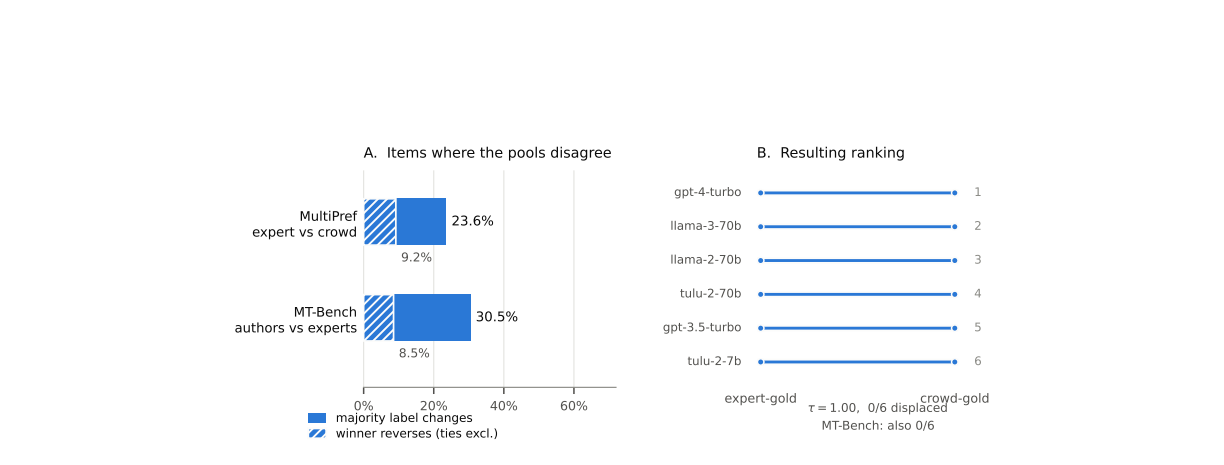
Figures are the authors', reproduced from the paper.
References (8)
- [1] L. Miranda et al. Hybrid Preferences: Learning to Route Instances for Human vs.\ AI Feedback. arXiv:2410.19133 https://arxiv.org/abs/2410.19133, 2024 on PithPith's reviewarXiv
- [2] L. Zheng et al. Judging LLM-as-a-Judge with MT-Bench and Chatbot Arena. NeurIPS Datasets and Benchmarks, 2023. arXiv:2306.05685 https://arxiv.org/abs/2306.05685 on PithPith's reviewarXiv
- [3] H. R. Kirk et al. The PRISM Alignment Dataset. NeurIPS Datasets and Benchmarks, 2024. arXiv:2404.16019 https://arxiv.org/abs/2404.16019 on PithPith's reviewarXiv
- [4] Z. Wang et al. HelpSteer2: Open-source dataset for training top-performing reward models. arXiv:2406.08673 https://arxiv.org/abs/2406.08673, 2024 on PithPith's reviewarXiv
- [5] Y. Xu and D. Jurgens. Beyond consensus: Perspectivist modeling and evaluation of annotator disagreement in NLP. arXiv:2601.09065 https://arxiv.org/abs/2601.09065, 2026 on PithPith's reviewarXiv
- [6] A. Bonagiri et al. STABLEVAL: Disagreement-aware and stable evaluation of AI systems. arXiv:2605.02122 https://arxiv.org/abs/2605.02122, 2026 on PithPith's reviewarXiv
- [7] L. Mazur. LLM judge position-bias benchmark. https://github.com/lechmazur/position_bias, 2026. Accessed 2026-08-16 on Pith
- [8] R. R. Bellibatlu, E. Raff, and W. Zhang. JudgeSense: A benchmark for prompt sensitivity in LLM-as-a-judge systems. arXiv:2604.23478 https://arxiv.org/abs/2604.23478, 2026 on PithPith's reviewarXiv
Cited by 1 Pith paper
Reviewed papers on Pith that cite this one. The full citation record
How the literature uses it
What this paper does with the arXiv papers it cites
What it cites · 5 sentences without a confident label
Uses data or values from 2 papers
-
MultiPref [ref] contains $10,461$ pairwise comparisons over six models, each annotated twice by crowdworkers and twice by screened experts on a five-point preference scale.
Hybrid Preferences: Learning to Route Instances for Human vs. AI Feedback · Setup · 0.99
-
MT-Bench human judgments [ref] contains $3,355$ human votes; $292$ item cells are rated by both the benchmark's own authors () and recruited expert annotators (), giving an independent pool contrast over a different task and a different six-model set.
Judging LLM-as-a-Judge with MT-Bench and Chatbot Arena · Setup · 0.94
Cites as background 2 papers
-
Perspectivist and disagreement-aware evaluation argues that annotator disagreement is signal rather than noise [ref] and proposes aggregation that models annotator confusion [ref] .
Beyond Consensus: Perspectivist Modeling and Evaluation of Annotator Disagreement in NLP · Related work · 0.93
-
Perspectivist and disagreement-aware evaluation argues that annotator disagreement is signal rather than noise [ref] and proposes aggregation that models annotator confusion [ref] .
STABLEVAL: Disagreement-Aware and Stable Evaluation of AI Systems · Related work · 0.93
Challenges and discussion
Disagree with the review, or know something it missed? Leave a comment, or challenge this review formally: a challenge becomes a permanent entry in this paper's record, and its decision is published here.
Come back by email
A short list of the week's newly reviewed papers. Nothing is sent until you confirm from your inbox, and every email has a link that stops it. No account.
No comments yet.
Sign in to comment