Computation and Language · arXiv:2611.22665 v1 · submitted 17 Nov 2026 · 51 references
Contract-Explicit Evaluation: From Auditing Learned Readers to Scoped Certificates
The paper says
“Evaluation readings of document-level relation extraction (DocRE) systems depend jointly on the model and the evaluation contract: gold version, scoring function, threshold. Rankings reverse across contracts, yet no existing method determines which comparisons survive the reversal.”
more of the abstract
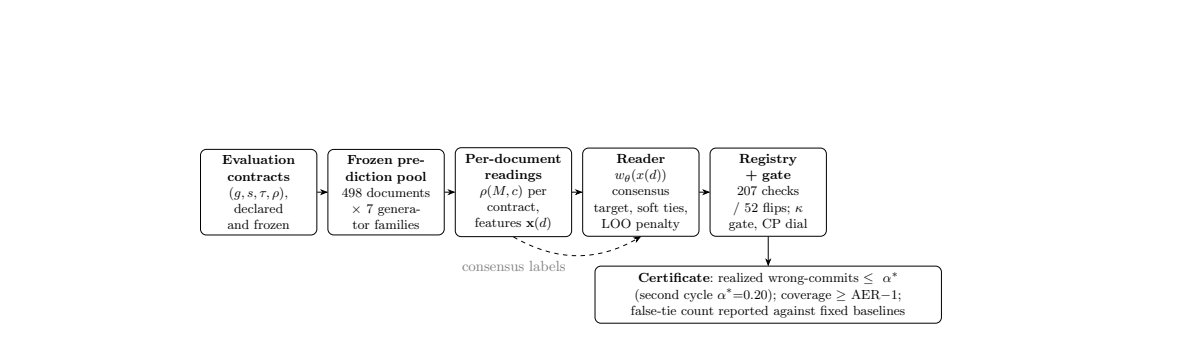
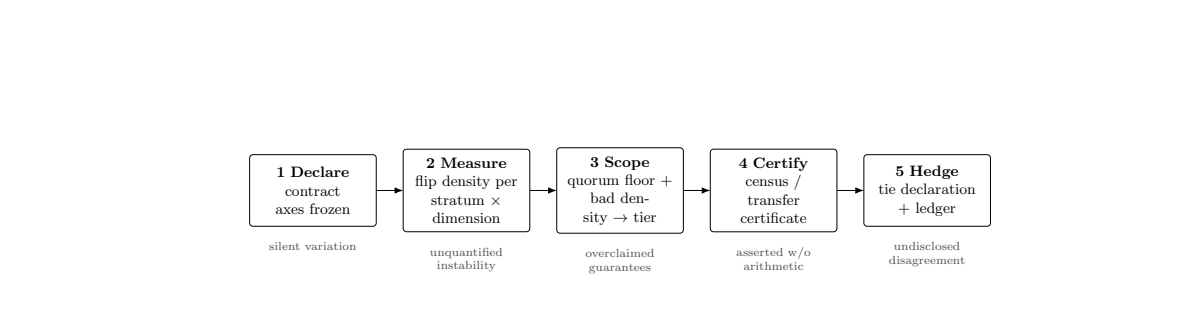
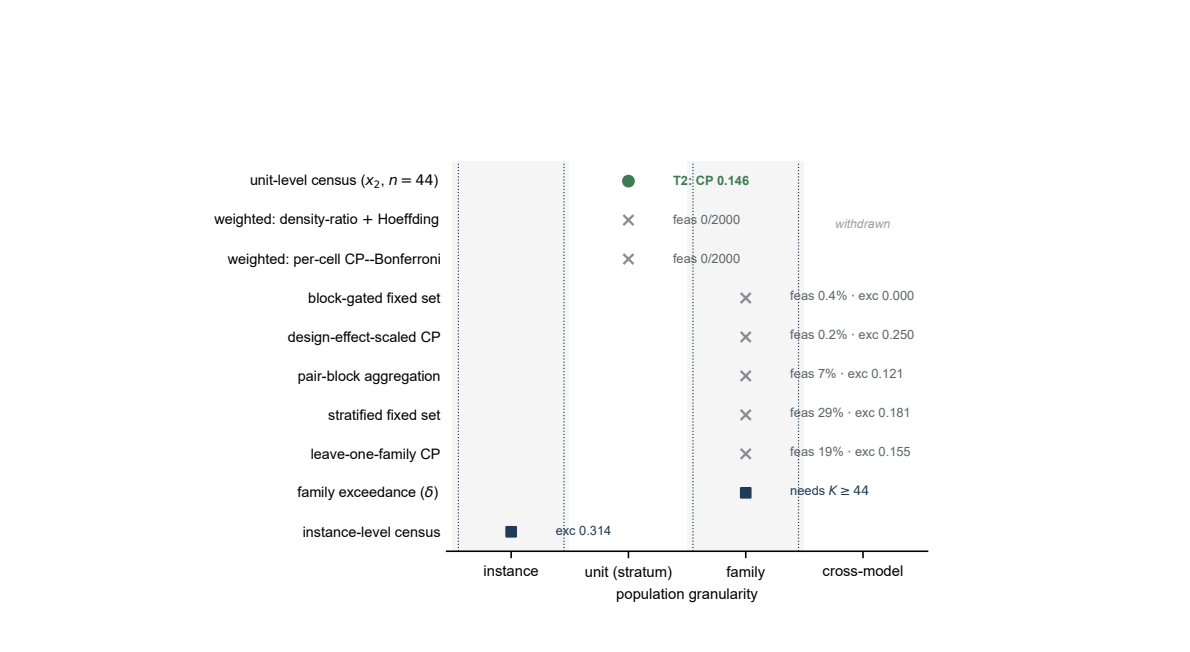
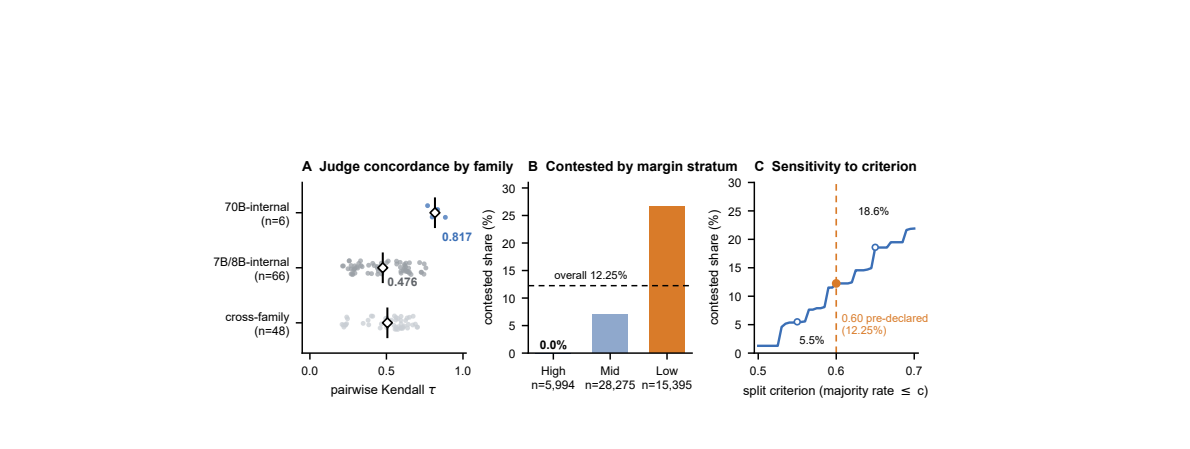
We address this gap with contract-explicit evaluation: a preregistered five-step protocol (Declare, Measure, Scope, Certify, Hedge), operationalizing the classical concordance decomposition of Kendall's rank correlation, that scopes certifiable regions and delivers distribution-free census certificates across two ecosystems. In the DocRE audit (44 training runs of one in-house architecture family), the scoring dimension scopes to a census certificate (three flagged instances, Clopper–Pearson upper bound 0.146); the confirmatory record includes registered negatives, and the audit prices its own simplification finding—the calibration dial's entire margin is one withdrawn commit. In an LLM-judge census (17 judges, 49,938 battles), 12.25% of leaderboard comparisons require hedging at the pre-declared split criterion (bound 0.124; panel-robust 0.143), with an exploratory two-tier reading certifying 69% at a bound \le 0.072 and a validity decomposition against released human labels (65% of contested battles are judge error, not ambiguity). The cross-model certificate is withdrawn on real confidence scores; the failure spectrum maps the boundary. The protocol, map, ledger, and per-instance artifacts are released.
from the abstract
Pith says
Machine review · deepseek-v4-flash · 18 Nov 2026 · read the full text (162,142 characters) · not checked by a person
It can be wrong. Challenge this review or reply to it.
Holds up, with conditions. A preregistered audit of evaluation-contract sensitivity that honestly reports its own failures and boundaries, but whose headline certificates rest on premises the paper itself partially falsifies. This line is wrong
8 minor · 4 open questions
How often objections from reviews like this one are right: not yet measured
The paper, first character to last
The reviewer was given the whole text, 162,142 characters. Not checked: figures, code, what the 51 references say.
8 minor objections
The paper says, at §1, Contributions
Pith says: minor objection 1 of 8
The contributions list is very long (7 items) and mixes methodological contributions with specific findings. Consider separating the methodological contributions from the empirical findings for clarity.
The paper says, at §3.2, Equation 1
Pith says: minor objection 2 of 8
The soft-tie degree t_ij is defined as max{0, 1 - |median_c delta_c(i,j)|/Delta}. The paper states that the kernel width Delta anneals during training, but does not specify the annealing schedule beyond 'linearly from 1.0 to 0.3 over the first 60% of epochs'. This should be stated explicitly in the main text, not just in the implementation details.
show 6 more
The paper says, at §4.1, Table 1
Pith says: minor objection 3 of 8
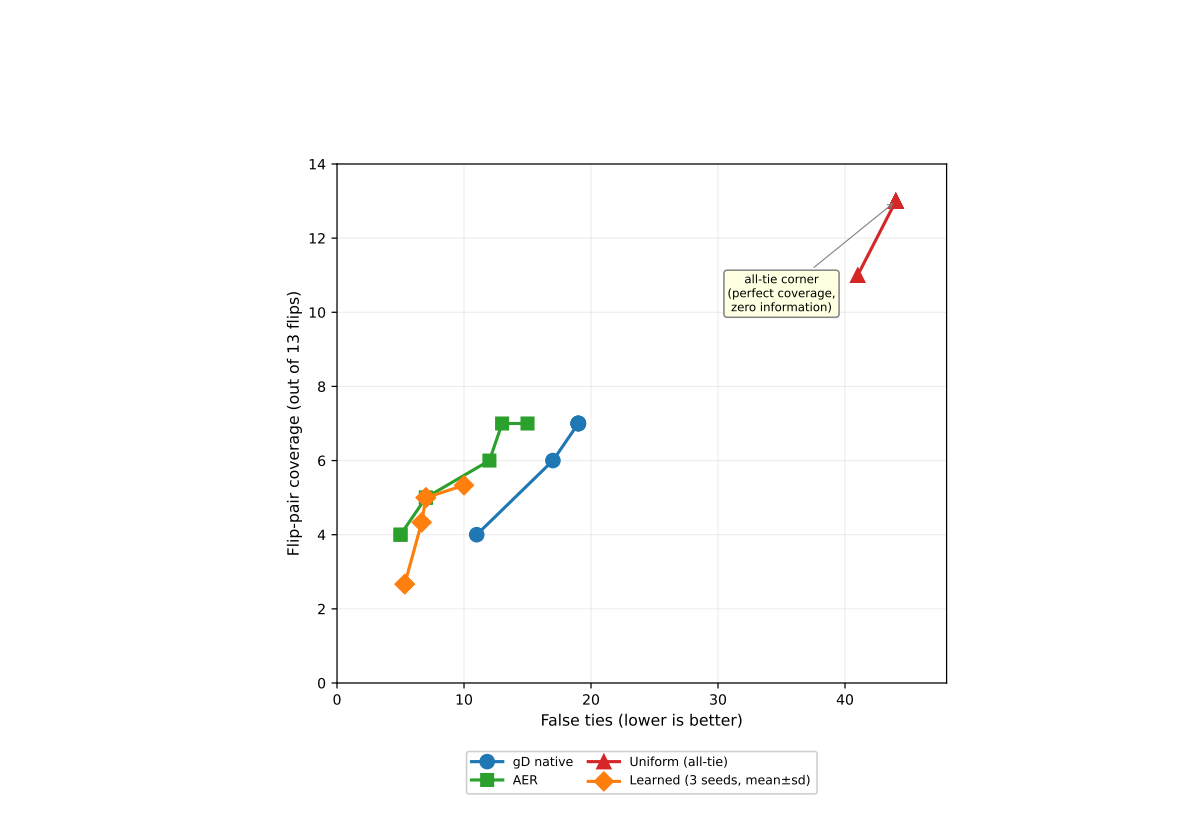
Table 1 reports sign agreement and tau_b against g_R. The learned reader's sign agreement is 0.581+/-0.047, which is lower than the g_D native (0.810) and AER (0.714). The paper explains this as a consequence of consensus-leaning, but the table caption should explicitly note that the learned reader is not designed to maximize g_R agreement.
The paper says, at §5.1, Table 3
Pith says: minor objection 4 of 8
Table 3 reports the confirmatory v2 run results. The caption states 'CONFIRMATORY: v2 run, corrected counting' but does not explain what 'corrected counting' refers to. The paper mentions a 'corrected significance-arithmetic bug in the automated judge' and a 'pooled reference-reading arithmetic correction' (amendment 3), but it is unclear which correction applies to this table.
The paper says, at §6.2, Table 5
Pith says: minor objection 5 of 8
The paper states that the census certificate is 'grade T2' per preregistration v6's V6-3 branch. However, the preregistration v6 is not described in detail in the main text. The paper should provide a brief summary of the preregistration branches and their criteria.
The paper says, at §6.4, Figure 7
Pith says: minor objection 6 of 8
Figure 7 is described but not visible. The caption mentions panels A, B, C, but the paper does not provide a detailed description of what each panel shows. The figure should be described in the text for readers who cannot see it.
The paper says, at §7, Conclusion
Pith says: minor objection 7 of 8
The conclusion states that 'the audit's most consequential finding about its own instrument is simplification: the calibration dial's entire margin is one withdrawn correct commit, and the learning-free gate passes the same criteria.' This is an important finding that should be highlighted earlier in the paper, not just in the conclusion.
The paper says, at Appendix A, Table 8
Pith says: minor objection 8 of 8
Table 8 reports LLM diagnostics but the caption is cut off mid-sentence. The full caption should be provided.
This objection may describe the copy Pith gave the reviewer, not the paper.
Open questions (4)
Pith raised these and could not confirm them against the text of the paper it read. They are questions for the authors, not findings.
- §3.2, Proposition 1 Pith raised a concern here that it could not check against the text of the paper it was given, so it is not published as an objection.
- §5.2, Table 2 Pith raised a concern here that it could not check against the text of the paper it was given, so it is not published as an objection.
- §6.2, Table 5 Pith raised a concern here that it could not check against the text of the paper it was given, so it is not published as an objection.
- §6.3, Table 6 Could the authors provide more detail on the Monte Carlo simulation parameters used to generate the failure spectrum in Table 6, including how architecture heterogeneity was operationalized and what the pre-declared kill criteria were?
What would settle it
If a fixed baseline achieved a lower false-tie count than the learned reader with McNemar p<0.05 on a confirmatory seed set, the false-tie headline would collapse. If consensus aggregation on a TACRED-like conflicting-revision pool produced positive, significant flip fidelity, the applicability boundary would collapse. If removing contested pairs also removed the DocRE gains, the conditional-exchangeability position would collapse and the aggregation premise would be void outright.
from Pith's summary of the paper
How the review went
5 passes by deepseek-v4-flash · 18 Nov 2026
- Reader holds up, with conditions
- Skeptic concern not confirmed: listed as an open question
- Referee 8 minor
- Check against the paper kept 0 of 6 objections
- Editor wrote the verdict above
Not run on this paper: the simulated authors' defence.
Pith's passes raised 6 objections. A check against the paper's text kept 0, withdrew 1 (1 Pith's reviewer misread the paper) and left 5 as questions.
The review in full
The review in brief, machine-written
This paper tackles a real problem: evaluation readings of DocRE systems depend on the gold version, scoring function, and threshold, and rankings reverse across these contracts. The authors propose a five-step protocol (Declare, Measure, Scope, Certify, Hedge) grounded in the concordance decomposition of Kendall's tau, and deliver scoped certificates on two ecosystems.
The paper's strengths are genuine. The honesty about registered negatives, the withdrawn cross-model certificate, the simplification finding (the calibration dial's margin is one withdrawn commit), and the explicit applicability boundary on TACRED are all soundness assets. The protocol itself is a useful discipline for benchmark maintainers. The LLM-judge census (17 judges, 49,938 battles) is a substantial empirical contribution.
The soft spots are in the headline certificates. The DocRE census certificate (at most 14.6% of 44 training runs violate the scoring-stability operating level at 90% confidence) treats the 44 runs as exchangeable draws from a homogeneous superpopulation, but all three flags sit in a single cell (R-arm, ratio-1.00). The paper's own Bonferroni correction over the coordinate family raises the bound to 0.170, worse than the registered T2. The judge-side certificate assumes battle independence, which the split-judge check shows is violated: the CP bound covers only 55% of replicates at nominal 90% confidence. The false-tie headline's own falsification clause fired literally (McNemar p=0.016, 7 vs 0) and survives only under a re-scoped hedging class. The all-pass readout at alpha*=0.20 is a disclosed adaptive loosening of the frozen 0.10 level. The load-bearing 13-flip registry and power analysis are inherited from a same-author companion preprint not present in this manuscript.
Each of these is reported by the authors, which is why this is a condition rather than a rejection. The paper should present the 0.143 panel-robust and 0.170 Bonferroni figures as the operative certificates, state the registry inheritance explicitly as external-to-this-manuscript evidence, and frame the 0.20 gate pass as a second-cycle exploratory reading rather than a primary certificate.
Who this is for: benchmark consumers and leaderboard maintainers who want a principled way to know which comparisons survive contract variation. The protocol is worth engaging with; the specific certificates need caveats.
Recommendation: deserves a serious referee. The paper is methodologically ambitious and unusually transparent. A referee should push on the superpopulation assumptions and the independence premises, but the core protocol and the empirical record are worth the community's attention.
The stress test's concern
Not confirmed. Pith could not check this concern against the text of the paper it was given; it is listed as an open question, not a finding.
The referee's report
Not published. Pith's referee wrote this assessment before its objections were checked against the paper, and 5 of its 5 major objections did not survive that check.
Pith's reading of the paper (a machine's summary, not the authors')
The paper argues that evaluation readings of document-level relation extraction (DocRE) systems are not properties of the model alone but joint properties of the model and the evaluation contract: the gold-standard version, scoring function, threshold, and even the reading function itself. Rankings reverse across contracts, yet no existing method determines which comparisons survive the reversal. The authors propose contract-explicit evaluation, a preregistered five-step protocol (Declare, Measure, Scope, Certify, Hedge) that operationalizes the classical concordance decomposition of Kendall's rank correlation to scope certifiable regions and deliver distribution-free census certificates. In a DocRE audit of 44 training runs of one architecture family, the scoring dimension scopes to a census certificate with at most 14.6% violation at 90% confidence. In an LLM-judge census of 17 judges and 49,938 battles, 12.25% of leaderboard comparisons require hedging. The paper's central claim is that contract choice is a first-order decision, and that the discipline of declaring in advance where a certificate is allowed to stand is what makes it credible where it does.
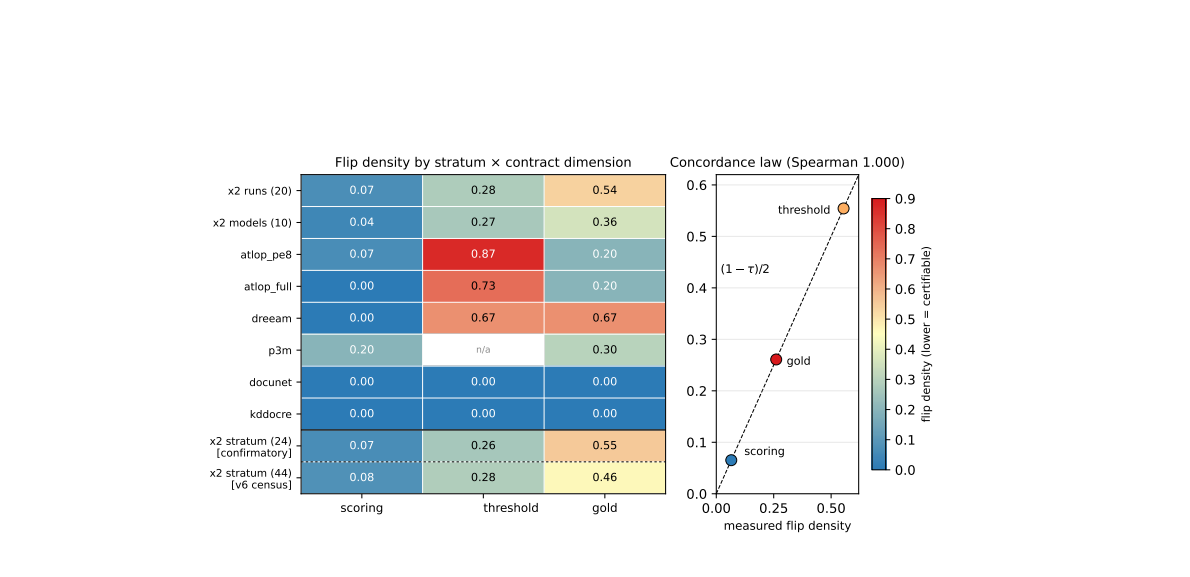
What carries the argument. The central object is the evaluation contract (gold version g, scoring function s, threshold tau, reading function rho) and the flip density identity: pi = (1 - Kendall's tau)/2, which operationalizes the classical concordance decomposition of Kendall's rank correlation as a scoping principle. The flip density measures the share of generator pairs whose ordering reverses under a contract swap. The scoping map uses Clopper-Pearson binomial bounds to grade cells (T1-T4 or uncertifiable) based on whether the upper bound on the bad-instance share stays below pre-declared thresholds. The five-step protocol (Declare, Measure, Scope, Certify, Hedge) is the machinery that turns this identity into actionable certificates.
Core claim. The paper establishes that evaluation readings are joint properties of models and evaluation contracts (gold version, scoring function, threshold, reading function), and that rankings reverse across contracts. It introduces a five-step protocol (Declare, Measure, Scope, Certify, Hedge) grounded in the identity that flip density = (1 - Kendall's tau)/2, which converts the classical concordance decomposition into a scoping principle for certificates. The protocol delivers distribution-free census certificates: on a 44-model stratum of one architecture family, the scoring dimension yields a certificate that at most 14.6% of the superpopulation violates the pre-declared scoring-stability operating level at 90% confidence (grade T2). On an LLM-judge panel of 17 judges and 49,938 battles, 12.25% of leaderboard comparisons require hedging at the pre-declared split criterion (CP bound 0.124; panel-robust 0.143). The paper's key finding is that the choice of audit reference is itself a first-order decision: cross-reference guarantees fail exactly where references are non-exchangeable, and the protocol makes that failure visible rather than hiding it.
The premise it rests on. The census certificate treats the 44 training runs as random draws from a homogeneous superpopulation generated by the frozen 2x2 design (arm, ratio, seeds), so that one pooled Clopper-Pearson bound is meaningful; the paper's own data undercut this because all three flags sit in a single cell (R arm, ratio 1.00), and the judge-side certificate assumes battle independence, which the paper's split-judge check shows is violated.
If the paper is right (Pith's inferences, not the authors')
Benchmark consumers can know which comparisons are stable under contract variation and which are judge- or contract-dependent, rather than treating a single contracted number as a property of the model alone.
The five-step protocol provides a template for any evaluation ecosystem to scope certificates: measure the contract hierarchy, declare the operating dimension, check stratum size against quorum floors, and freeze thresholds before the confirmatory count.
The failure spectrum (Table 6) maps the boundary of certifiability: overlapping family blocks, architecture heterogeneity, and small strata block certificates, and the protocol makes these failures visible rather than hiding them.
The LLM-judge instantiation shows that the same protocol applies to judge identity as a contract axis: 69% of leaderboard battles carry a census certificate at bound ≤0.072, with the low-margin third landing in the hedge region.
The paper's registered negatives (J5 failure on cross-reference guarantees, J3 coverage miss by one pair) are reported as evidence about the registry and the method's boundaries, not as defects to be smoothed over.
The protocol's requirement that every axis be declared and frozen before comparison could be extended to other evaluation practices beyond DocRE and LLM judges, such as question answering, summarization, or code generation benchmarks where multiple gold standards or scoring functions exist.
The finding that the reading function itself is a contract dimension (gap vs. inter-only vs. intra-only readings produce dramatically different flip counts) suggests that many published evaluation results may be implicitly conditional on an undeclared reading function choice.
The paper's honesty about its own limitations (registry power, the calibration dial's margin being one withdrawn commit, the learning-free gate passing the same criteria) sets a standard for preregistered evaluation that could be adopted more broadly in NLP and ML.
The failure of cross-reference guarantees exactly where references disagree (the unique pair on which two gold revisions disagree) suggests that any evaluation that uses one gold standard to certify claims about another must check exchangeability first, a condition that may often fail in practice.
Check this review
What was read
The passes were given all 162,142 characters of the paper's LaTeX source.
Fingerprint of that text (SHA-256): 1330e6d28660cb046bbe2dce1048fcd7828dff35912266d3ca6dff512d9f6e5e
Pith does not keep that text. Rebuilt from the paper's source or PDF by the same code, it has this fingerprint if it is the same text. From a copy of Pith's code:
PYTHONPATH=. python scripts/review_input_check.py 2611.22665
The passes, in the order they ran
- Reader deepseek-v4-flash · medium effort · $0.012 · instructions of the Reader, fingerprint f9ead7300382…
- Skeptic deepseek-v4-flash · medium effort · $0.0093 · instructions of the Skeptic, fingerprint 8f88c0f61488…
- Referee deepseek-v4-flash · medium effort · $0.0049 · instructions of the Referee, fingerprint a852d99aea0d…
- Check against the paper deepseek-v4-flash · medium effort · $0.0078 · instructions of the Check against the paper, fingerprint 6c7a6883d551…
- Editor deepseek-v4-flash · medium effort · $0.0046 · instructions of the Editor, fingerprint e7211f6a3d27…
- Circularity check deepseek-v4-flash · medium effort · $0.0045 · instructions of the Circularity check, fingerprint e9946e39d67b…
- Summary for the page deepseek-v4-flash · medium effort · temperature 0.2 · $0.0049 · instructions of the Summary for the page, fingerprint e4f56bf568e7…
The passes cost $0.049 in model calls together.
Version stamped on this review: pith-pipeline@v1.4.1-daily-deepseek-or-medium+deepseek/deepseek-v4-flash+p.d60f54226f00
Each link opens a pass's instructions as plain text, the exact bytes its fingerprint was taken over. Every stored set of instructions.
curl -s https://pith.science/methodology/prompts/f9ead730038216984cfb56d7cb34332bdf691828296a1de4245f3d6667d4bf56 | sha256sum
prints the fingerprint of the reader's instructions. The same works for every pass.
The receipt
The review's fingerprint was taken on 18 Nov 2026. The review you are reading still matches it.
Fingerprint of the review (SHA-256): 9fe6f3d6b82efd5b2d8c15fc40e0e232260899cad3da31a4bfa47f3de7da6453
curl -s 'https://pith.science/api/v1/verdicts/2611.22665?form=canonical' | sha256sum
prints the fingerprint of the review as it stands now. The rule, in four steps.
A matching fingerprint shows the review has not changed since that date. It does not show that the review is right.
How often reviews like this one are right
Reviews like this one: written by deepseek-v4-flash, from the paper's LaTeX source.
How often objections from reviews like this one are right: not yet measured
Reviews by people
This review was written by a machine. No person has reviewed this paper on Pith yet. A scientist listed on Pith can review it for a fee, and their review is published here whatever it concludes.
The paper
Abstract
Evaluation readings of document-level relation extraction (DocRE) systems depend jointly on the model and the evaluation contract: gold version, scoring function, threshold. Rankings reverse across contracts, yet no existing method determines which comparisons survive the reversal. We address this gap with contract-explicit evaluation: a preregistered five-step protocol (Declare, Measure, Scope, Certify, Hedge), operationalizing the classical concordance decomposition of Kendall's rank correlation, that scopes certifiable regions and delivers distribution-free census certificates across two ecosystems. In the DocRE audit (44 training runs of one in-house architecture family), the scoring dimension scopes to a census certificate (three flagged instances, Clopper–Pearson upper bound 0.146); the confirmatory record includes registered negatives, and the audit prices its own simplification finding—the calibration dial's entire margin is one withdrawn commit. In an LLM-judge census (17 judges, 49,938 battles), 12.25% of leaderboard comparisons require hedging at the pre-declared split criterion (bound 0.124; panel-robust 0.143), with an exploratory two-tier reading certifying 69% at a bound \le 0.072 and a validity decomposition against released human labels (65% of contested battles are judge error, not ambiguity). The cross-model certificate is withdrawn on real confidence scores; the failure spectrum maps the boundary. The protocol, map, ledger, and per-instance artifacts are released.
The paper's own sentences, arranged, kept beside the review and separate from it. Each label is drawn from a closed vocabulary; the number beside it is the probability the classifier gave that label. No sentence in this record was written by a model.
abstract compiled · 2026-11-18
The authors' main claim, as the classifier picked it out 0.77
“We address this gap with contract-explicit evaluation: a preregistered five-step protocol (Declare, Measure, Scope, Certify, Hedge), operationalizing the classical concordance decomposition of Kendall's rank correlation, that scopes certifiable regions and delivers distribution-free census certificates across two ecosystems.”
How the main claim is stated: asserted 1.00
What the abstract itself states, as probabilities: claims first 0.31 · states limitation 0.93 · human participants 0.84 · controlled comparison 0.14 · randomized assignment 0.04 · states quantitative result 0.99 · compares with prior results 0.36 · mentions code or data availability 0.93
The abstract, sentence by sentence
This table labels the abstract only (arXiv listing abstract v1). The number is the probability the classifier gave the label.
| Sentence | Role | The authors' own work | States the main conclusion | Strength |
|---|---|---|---|---|
| Evaluation readings of document-level relation extraction (DocRE) systems depend jointly on the model and the evaluation contract: gold version, scoring function, threshold. | background 1.00 | 0.10 | 0.05 | asserted 1.00 |
| Rankings reverse across contracts, yet no existing method determines which comparisons survive the reversal. | gap 0.99 | 0.09 | 0.06 | asserted 1.00 |
| We address this gap with contract-explicit evaluation: a preregistered five-step protocol (Declare, Measure, Scope, Certify, Hedge), operationalizing the classical concordance decomposition of Kendall's rank correlation, that scopes certifiable regions and delivers distribution-free census certificates across two ecosystems. | contribution 0.75 | 0.94 | 0.36 | asserted 1.00 |
| In the DocRE audit (44 training runs of one in-house architecture family), the scoring dimension scopes to a census certificate (three flagged instances, Clopper--Pearson upper bound 0.146); the confirmatory record includes registered negatives, and the audit prices its own simplification finding---the calibration dial's entire margin is one withdrawn commit. | result 0.99 | 0.96 | 0.12 | asserted 1.00 |
| In an LLM-judge census (17 judges, 49,938 battles), 12.25% of leaderboard comparisons require hedging at the pre-declared split criterion (bound 0.124; panel-robust 0.143), with an exploratory two-tier reading certifying 69% at a bound \le 0.072 and a validity decomposition against released human labels (65% of contested battles are judge error, not ambiguity). | result 1.00 | 0.95 | 0.18 | asserted 1.00 |
| The cross-model certificate is withdrawn on real confidence scores; the failure spectrum maps the boundary. | result 0.52 | 0.83 | 0.14 | asserted 0.99 |
| The protocol, map, ledger, and per-instance artifacts are released. | contribution 0.96 | 0.84 | 0.06 | asserted 0.99 |
What kind of paper the classifier reports this is: method or tool 1.00 · evidence from observation or experiment 0.92
What was examined, and what was not
Sources read
- arXiv listing abstract v1
Not examined
- full text
- figures and tables
- references and citing sentences
- relations to other papers
Levels run
- P abstract
Not run
- S sections
- T body sentences
- C citations
- R cross-paper relations
How the labels were made
Compiled by classifier-1.13.0 via TypeSafe API, question bank abstract-p1-20260923, 2026-11-18: 1 request, 5,885 input tokens.
Every quoted sentence on this record is the authors'. Every label is from Pith's closed vocabulary, with the probability shown beside it. This record as JSON
Figures (6)
Figures are the authors', reproduced from the paper.
References (51)
- [1] Yao Y, Ye D, Li P, et al (2019) DocRED: A large-scale document-level relation extraction dataset. In: Proceedings of the 57th Annual Meeting of the Associa- tion for Computational Linguistics, pp 6380–6388, https://doi.org/10.18653/v1/ P19-1074 on Pithdoi:10.18653/v1/
- [2] Zhang N, Chen X, Xie X, et al (2021) Document-level relation extraction as semantic segmentation. In: Proceedings of the Thirtieth International Joint Con- ference on Artificial Intelligence, pp 3999–4006, https://doi.org/10.24963/ijcai. 2021/550 on Pithdoi:10.24963/ijcai
- [3] Xie Y, Shen J, Li S, et al (2022) Eider: Empowering document-level rela- tion extraction with efficient evidence extraction and inference-stage fusion. In: Findings of the Association for Computational Linguistics: ACL 2022, https: //doi.org/10.18653/v1/2022.findings-acl.23 on Pithdoi:10.18653/v1/2022.findings-acl.23
- [4] Lu H, Zhu W, Li R (2026) Evaluation contracts and evaluation leverage: Sliced- gap readings in structured prediction can move without model change. URL https: //arxiv.org/abs/2611.04099 on PithPith's reviewarXiv
- [5] Sun M (2026) When does consistency pay off? relational constraints for LLM- based document-level relation extraction under incomplete annotations. URL https://arxiv.org/abs/2607.24312 on PithPith's reviewarXiv
- [6] Han S, Kim M (2026) Swapping the judge changes the ranking: A preregistered study of cross-provider replication in LLM-judged system comparisons. URL https://arxiv.org/abs/2611.04090 on PithPith's reviewarXiv
- [7] Jha A (2026) Whose gold? annotator-pool disagreement is large at the item level, and hidden by small leaderboards. URL https://arxiv.org/abs/2608.15980 on PithPith's reviewarXiv
- [8] He K, Cakir F, Bargal SA, et al (2018) Hashing as tie-aware learning to rank. In: Proceedings of the IEEE Conference on Computer Vision and Pattern Recognition, URL https://arxiv.org/abs/1705.08562 on PithPith's reviewarXiv
- [9] Zhang Y, Zhong V, Chen D, et al (2017) Position-aware attention and supervised data improve slot filling. In: Proceedings of the 2017 Conference on Empirical Methods in Natural Language Processing, pp 35–45, https://doi.org/10.18653/ v1/D17-1004 on Pith
- [10] Shin C, Sala F (2026) VoirDire: Counterfactual calibration for reliable LLM-as- a-judge aggregation. URL https://arxiv.org/abs/2611.00491 on PithPith's reviewarXiv
- [11] Ahn J (2026) AGORA: Reliability-aware aggregation of LLM judges via item- response theory. URL https://arxiv.org/abs/2611.05556 on PithPith's reviewarXiv
- [12] Liu Z, Li J, Zhuang Y, et al (2025) am-ELO: A stable framework for arena- based LLM evaluation. In: Proceedings of the 42nd International Conference on Machine Learning, URL https://arxiv.org/abs/2505.03475 on PithPith's reviewarXiv
- [13] Hu Z, Zhang J, Xiong Z, et al (2024) Towards acyclic preference evaluation of language models via multiple evaluators. URL https://arxiv.org/abs/2410.12869 on PitharXiv
- [14] Gringras D (2026) Safety under scaffolding: How evaluation conditions shape measured safety. URL https://arxiv.org/abs/2603.10044 on PithPith's reviewarXiv
- [15] Zheng L, Chiang WL, Sheng Y, et al (2023) Judging LLM-as-a-judge with MT- bench and chatbot arena. URL https://arxiv.org/abs/2306.05685 on PithPith's reviewarXiv
- [16] Chiang WL, Zheng L, Sheng Y, et al (2024) Chatbot arena: An open platform for 47 evaluating LLMs by human preference. In: Forty-first International Conference on Machine Learning, URL https://arxiv.org/abs/2403.04132 on PithPith's reviewarXiv
- [17] Wang P, Li L, Chen L, et al (2023) Large language models are not fair evaluators. URL https://arxiv.org/abs/2305.17926 on PithPith's reviewarXiv
- [18] Verga P, Hofstatter S, Althoff S, et al (2024) Replacing judges with juries: Eval- uating LLM generations with a panel of diverse models. URL https://arxiv.org/ abs/2404.18796 on PithPith's reviewarXiv
- [19] Panickssery A, Bowman SR, Feng S (2024) LLM evaluators recognize and favor their own generations. URL https://arxiv.org/abs/2404.13076 on PithPith's reviewarXiv
- [20] Cronbach LJ, Gleser GC, Nanda H, et al (1972) The Dependability of Behavioral Measurements: Theory of Generalizability for Scores and Profiles. Wiley, New York on Pith
show 31 more
- [21] Kane MT (2013) Validating the interpretations and uses of test scores. Journal of Educational Measurement 50(1):1–73. https://doi.org/10.1111/jedm.12000 on Pithdoi:10.1111/jedm.12000
- [22] Krippendorff K (2004) Reliability in content analysis: Some common guidelines and recommendations. Human Communication Research 30(3):411–433. https: //doi.org/10.1111/j.1468-2958.2004.tb00738.x on Pithdoi:10.1111/j.1468-2958.2004.tb00738.x
- [23] Tan Q, Xu L, Bing L, et al (2022) Revisiting DocRED: Addressing the false negative problem in relation extraction. In: Proceedings of the 2022 Conference on Empirical Methods in Natural Language Processing, https://doi.org/10.18653/ v1/2022.emnlp-main.580 on Pith
- [24] Bonagiri A, Anderias GJ, Patil S, et al (2026) STABLEV AL: Disagreement- aware and stable evaluation of AI systems. In: Proceedings of Machine Learning Research, URL https://arxiv.org/abs/2605.02122 on PithPith's reviewarXiv
- [25] Ivey J, Gauch S, Jurgens D (2025) NUTMEG: Separating signal from noise in annotator disagreement. URL https://arxiv.org/abs/2507.18890 on PithPith's reviewarXiv
- [26] Xu Y, Jurgens D (2026) Beyond consensus: Perspectivist modeling and evaluation of annotator disagreement in NLP. URL https://arxiv.org/abs/2601.09065 on PithPith's reviewarXiv
- [27] Angelopoulos AN, Bates S, Fisch A, et al (2024) Conformal risk control. In: The Twelfth International Conference on Learning Representations (ICLR), URL https://arxiv.org/abs/2208.02814 on PithPith's reviewarXiv
- [28] Giovannotti P (2023) Evaluating machine translation quality with conformal predictive distributions. arXiv preprint URL https://arxiv.org/abs/2306.01549 on PithPith's reviewarXiv
- [29] Cresswell JC, Sui Y, Kumar B, et al (2024) Conformal prediction sets improve human decision making. arXiv preprint URL https://arxiv.org/abs/2401.13744 on PithPith's reviewarXiv
- [30] ˇStef´ anik M, Novotn´ y V, Sojka P (2021) Regressive ensemble for machine trans- lation quality evaluation. In: Proceedings of the RIGIL Workshop, URL https: //arxiv.org/abs/2109.07242 on PithPith's reviewarXiv
- [31] Joty S, Guzman F, Marquez L, et al (2020) DiscoTK: Using discourse structure for machine translation evaluation. In: Proceedings of the 2020 Conference on Empirical Methods in Natural Language Processing (EMNLP), URL https:// arxiv.org/abs/1911.12547 on PithPith's reviewarXiv
- [32] Pan Y, Chen W, Niu G, et al (2020) Fast and robust rank aggregation against model misspecification. In: Advances in Neural Information Processing Systems, URL https://arxiv.org/abs/1905.12341 48 on PithPith's reviewarXiv
- [33] Land S, Bikel DM (2026) Auditing LLM benchmarks with item response theory. URL https://arxiv.org/abs/2605.30504 on PithPith's reviewarXiv
- [34] Jung J, Brahman F, Choi Y (2024) Trust or escalate: LLM judges with prov- able guarantees for human agreement. arXiv preprint URL https://arxiv.org/ abs/2407.18370 on PithPith's reviewarXiv
- [35] Tibshirani RJ, Barber RF, Cand` es E, et al (2019) Conformal prediction under covariate shift. In: Advances in Neural Information Processing Systems 32, URL https://arxiv.org/abs/1904.06019 on PithPith's reviewarXiv
- [36] Barber RF, Cand` es E, Ramdas A, et al (2023) Conformal prediction beyond exchangeability. In: Advances in Neural Information Processing Systems 36, URL https://arxiv.org/abs/2202.13415 on PithPith's reviewarXiv
- [37] Bauer P (1991) Multiple testing in clinical trials. Statistics in Medicine 10(6):871– on Pith
- [38] Perlitz Y, Gera A, Arviv O, et al (2024) Benchmark agreement testing done right: A guide for LLM benchmark evaluation. arXiv preprint URL https://arxiv.org/ abs/2407.13696 on PithPith's reviewarXiv
- [39] Gilda S, Gilda S (2026) Position: Evaluation scores are perishable knowledge claims. Proceedings of the GEM Workshop at ACL 2026 https://doi.org/10. 18653/v1/2026.gem-main.80 on Pith
- [40] Bates S, Angelopoulos AN, Lei L, et al (2021) Distribution-free, risk-controlling prediction sets. Journal of the ACM 68(6):1–34. https://doi.org/10.1145/3478535 on Pithdoi:10.1145/3478535
- [41] Alt C, Gabryszak A, Hennig L (2020) TACRED revisited: A thorough evaluation of the TACRED relation extraction task. In: Proceedings of the 58th Annual Meeting of the Association for Computational Linguistics, pp 1558–1569, https: //doi.org/10.18653/v1/2020.acl-main.142 on Pithdoi:10.18653/v1/2020.acl-main.142
- [42] Stoica G, Platanios EA, P´ oczos B (2021) Re-TACRED: Addressing shortcomings of the TACRED dataset. In: Proceedings of the AAAI Conference on Artificial Intelligence, pp 13843–13850, https://doi.org/10.1609/aaai.v35i15.17625 on Pithdoi:10.1609/aaai.v35i15.17625
- [43] Dror R, Baumer G, Shlomov S, et al (2018) The hitchhiker’s guide to testing statistical significance in natural language processing. In: Proceedings of the 56th Annual Meeting of the Association for Computational Linguistics, pp 1403–1412, https://doi.org/10.18653/v1/P18-1128 on Pithdoi:10.18653/v1/p18-1128
- [44] Dietterich TG (1998) Approximate statistical tests for comparing supervised classification learning algorithms. Neural Computation 10(7):1895–1923. https: //doi.org/10.1162/089976698300017112 on Pithdoi:10.1162/089976698300017112
- [45] Barrault L, Bojar O, Costa-juss` a MR, et al (2019) Findings of the 2019 conference on machine translation (WMT19). In: Proceedings of the Fourth Conference on Machine Translation (WMT19), pp 1–61, https://doi.org/10.18653/v1/W19-5301 on Pithdoi:10.18653/v1/w19-5301
- [46] Ma Y, Wang A, Okazaki N (2023) DREEAM: Guiding attention with evidence for improving document-level relation extraction. In: Proceedings of the 17th Confer- ence of the European Chapter of the Association for Computational Linguistics, https://doi.org/10.18653/v1/2023.eacl-main.145 on Pithdoi:10.18653/v1/2023.eacl-main.145
- [47] Tan Q, He T, Bing L, et al (2022) Document-level relation extraction with adaptive focal loss and knowledge distillation. In: Findings of the Association for Computational Linguistics: ACL 2022, https://doi.org/10.18653/v1/2022. 49 findings-acl.132 on Pithdoi:10.18653/v1/2022
- [48] Zhou W, Huang K, Ma T, et al (2021) Document-level relation extraction with adaptive thresholding and localized context pooling. In: Proceedings of the Thirty-Fifth AAAI Conference on Artificial Intelligence, pp 13267–13275, https://doi.org/10.1609/aaai.v35i15.17559 on Pithdoi:10.1609/aaai.v35i15.17559
- [49] Heng CK, Tong SW, Wong JWS (2026) Re2-DocRED: Revisiting revisited- DocRED for joint entity and relation extraction. In: Proceedings of the 19th Conference of the European Chapter of the Association for Computational Linguistics, https://doi.org/10.18653/v1/2026.eacl-long.213 on Pithdoi:10.18653/v1/2026.eacl-long.213
- [50] Kendall MG (1938) A new measure of rank correlation. Biometrika 30(1/2):81–93. https://doi.org/10.1093/biomet/30.1-2.81 50 on Pithdoi:10.1093/biomet/30.1-2.81
- [890] https://doi.org/10.1002/sim.4780100618 on Pithdoi:10.1002/sim.4780100618
Challenges and discussion
Disagree with the review, or know something it missed? Leave a comment, or challenge this review formally: a challenge becomes a permanent entry in this paper's record, and its decision is published here.
Come back by email
A short list of the week's newly reviewed papers. Nothing is sent until you confirm from your inbox, and every email has a link that stops it. No account.
No comments yet.
Sign in to comment