Computation and Language · arXiv:2611.04099 v2 · submitted 3 Nov 2026
When Model Rankings Move Without Model Change: A Registered Audit of Evaluation Contracts in Neural Prediction Pipelines
The paper says
“Evaluation reports cite sliced differences, most prominently the intra-inter gap in document-level relation extraction (DocRE), as capability evidence. Such gap readings are joint properties of models and evaluation contracts: scoring function, gold version, threshold, output format, and prompt language.”
more of the abstract
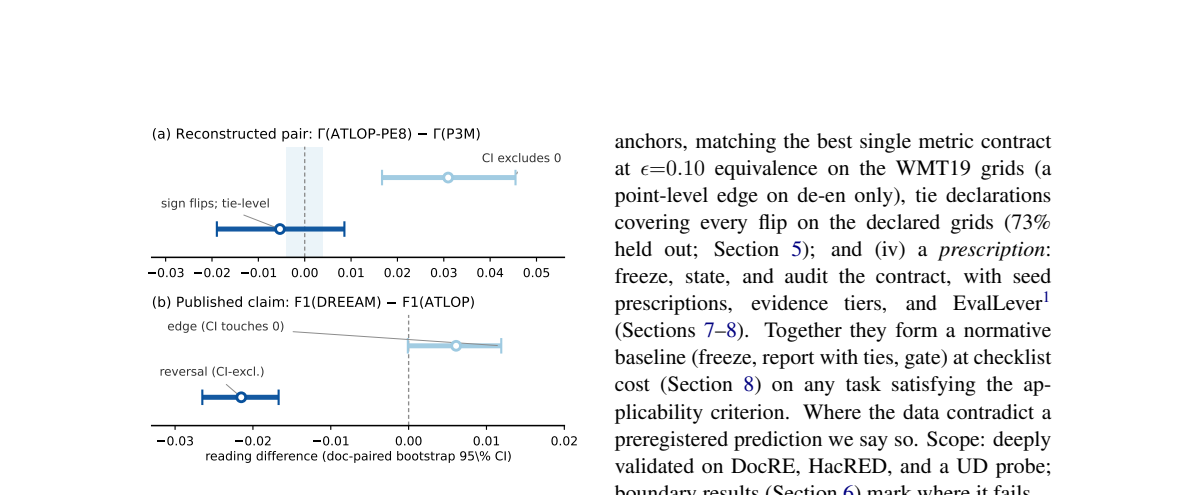
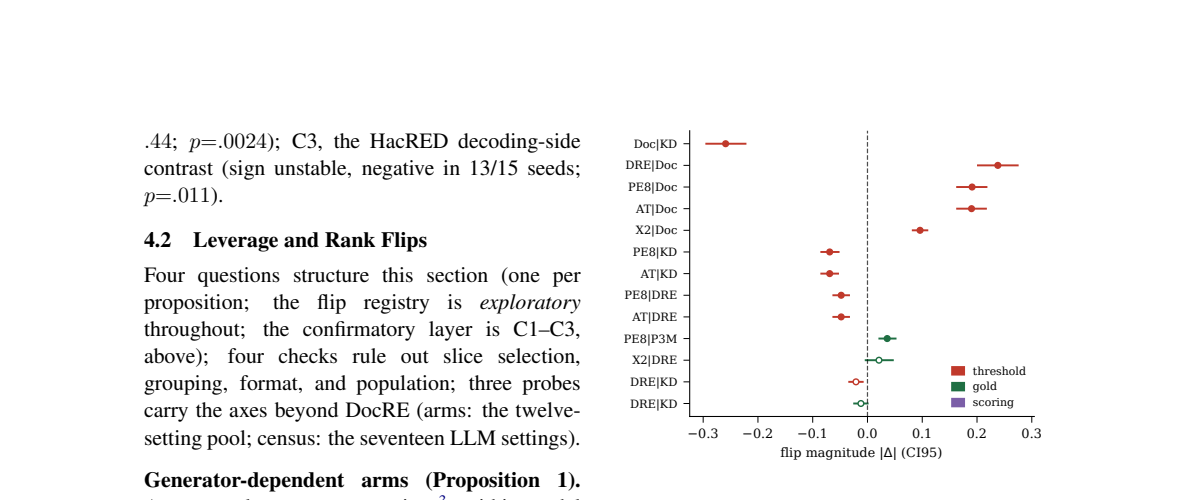
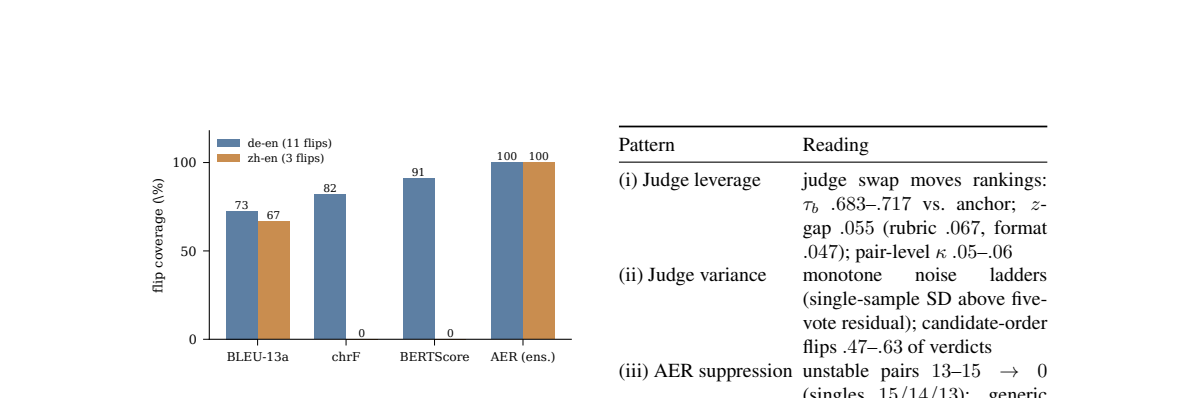
With predictions frozen, switching only the gold reverses a method ordering (+0.0363, CI excluding zero; retrained stand-ins), leaving it tie-level. The flip survives Holm correction (exploratory tier); ten of thirteen flips share one contrast (fixed vs decoded threshold). Rename-only revisions cannot move a reading (Delta = 0); re-annotation moves it +0.862 UD points. We formalize this as an evaluation leverage account centered on a rank-flip condition. Constructively, the audited evaluation reading (AER; post-freeze) aggregates a comparison over declared contracts, declares ties when they disagree, prescribes seeds, and filters unverifiable settings. On WMT19 it is indistinguishable from the best single contract at the exploratory, convention-stable margin epsilon = 0.10 (chosen post-freeze); its tie declarations cover every contract-induced flip (14/14), at a priced false-tie cost (66.1%/88.0% of declared ties; single contracts: 58.7-71% de-en, 86-91% zh-en). Coverage drops to 73% held out and 3/13 on the denser DocRE registry (declare-tie-if-any-flip: 89%): the guarantee is grid-specific. Evidence spans DocRE, HacRED, a UD probe, released gold revisions, and a replication. Failed preregistered predictions are retained as boundaries. A 5% violation gate bounds survivor-selection bias. We release EvalLever, a registered audit workflow (147 amendments, tiered status). On a three-judge WMT19 grid its ensemble suppresses part of the sign instability (13-15 to 9; one preregistered criterion fails).
from the abstract
Pith says
Machine review · deepseek-v4-flash · 4 Nov 2026 · of version 1 of the paper; version 2 is newer · what was read was not recorded · not checked by a person
It can be wrong. Challenge this review or reply to it.
Holds up. Solid empirical demonstration that evaluation readings are contract-dependent, with a formal scaffolding that honestly marks where it doesn't reach. This line is wrong
8 minor
How often objections from reviews like this one are right: not yet measured
Not checked: figures, code, what the references say.
8 minor objections
The paper says, at §1, Fig. 1
Pith says: minor objection 1 of 8
Figure 1 caption says 'shading: ±.0039 floor (sign-symmetrized), §7'. The floor is mentioned only once; a brief justification or pointer to the rationale in §7 would help readers who jump directly to the figure.
The paper says, at §3.4, Theorem C
Pith says: minor objection 2 of 8
Theorem C states variance ordering under nested independent increments. The paper correctly reports that the independence assumption fails the strictest de-duplication (§4.3). Consider adding a one-sentence summary of the practical takeaway from the failure (i.e., that the ordering still holds descriptively but should not be assumed without checking the assumptions).
show 6 more
The paper says, at Table 6
Pith says: minor objection 3 of 8
Table 6 defines evidence tiers T1–T3. The term 'fault-injected audit passed' for T1 is not defined in the main text until §7; consider adding a brief cross-reference or footnote.
The paper says, at §4.2, C1–C3
Pith says: minor objection 4 of 8
The three preregistered comparisons (C1–C3) are reported with Holm(3) corrections. The MDE values for C2 and the p-values are given inline; consider adding explicit effect sizes and CIs for all three in a single place for quick reference.
The paper says, at Table 14 (appendix)
Pith says: minor objection 5 of 8
Table 14 lists the rank-flip registry. The table would be easier to scan if the 'Holm' column used a clearer symbol (e.g., ✓/✗) and if the CI95 column included a note that all intervals are bootstrap percentile.
The paper says, at §5.1, Table 3
Pith says: minor objection 6 of 8
Table 3 reports that 'unstable pairs 13–15 → 0' under AER. The sample size (16 systems) means that the maximum number of pairs is 120. A brief note on the denominator would help readers interpret the shrinkage.
The paper says, at §10, Limitations
Pith says: minor objection 7 of 8
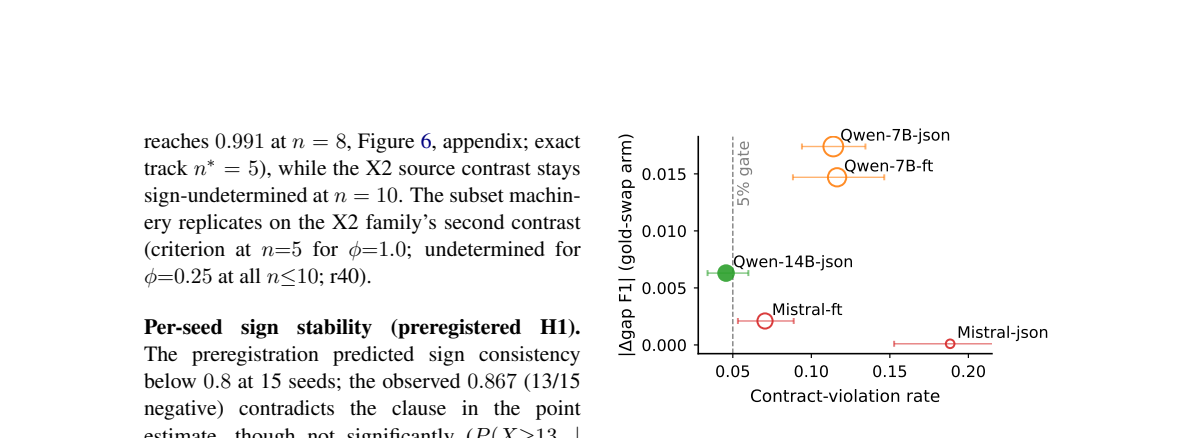
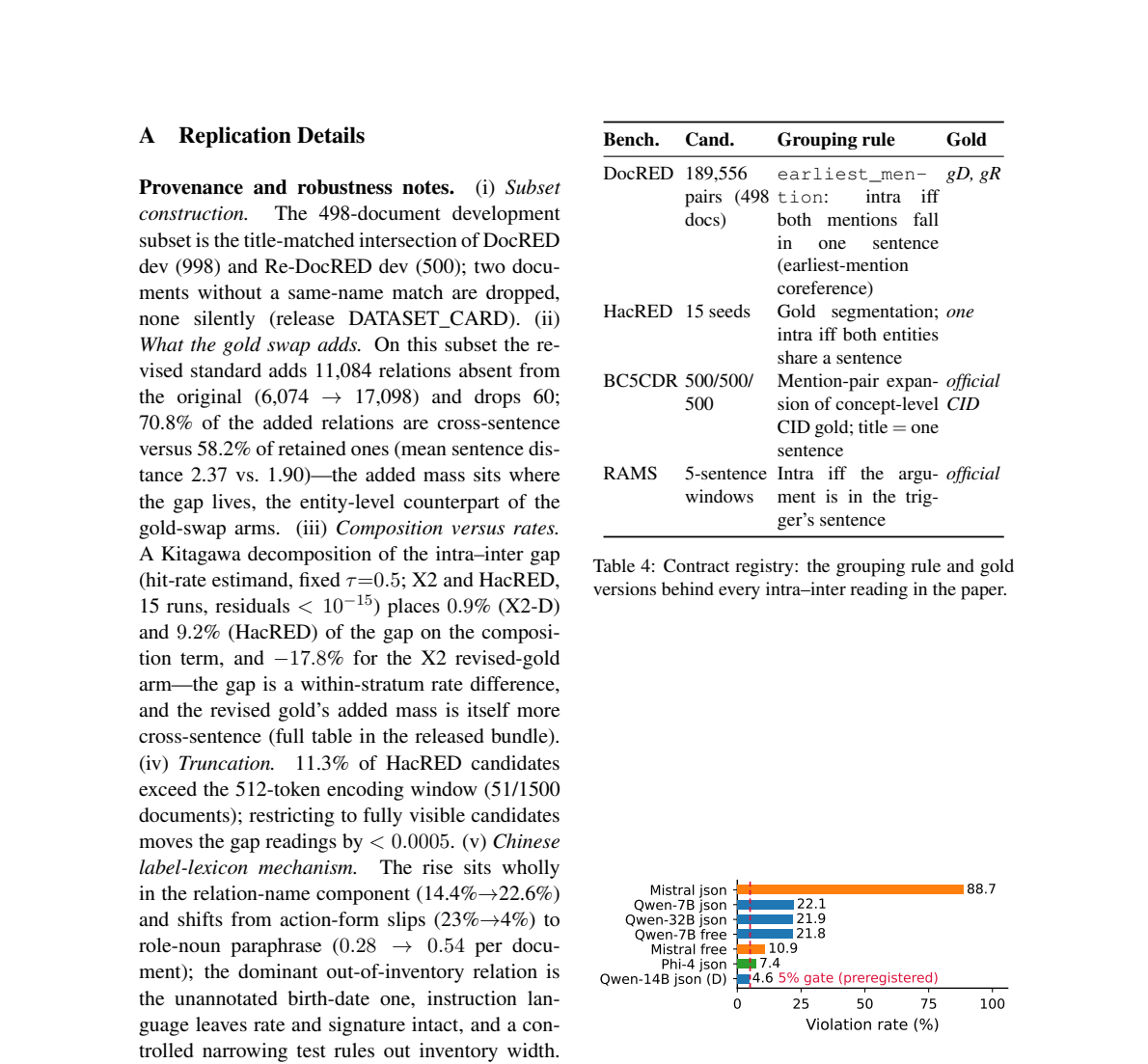
The limitations section is admirably concise. Consider adding a sentence about the scope of the violation gate (3%/5%/10% thresholds) and the fact that 14 of 17 LLM settings failed the 5% gate, meaning those cells provide only descriptive evidence.
The paper says, at Appendix B, Lemma A
Pith says: minor objection 8 of 8
Lemma A's bound for micro-F1 is given as '(2/γ)|D|/N whenever 2TP+FP+FN ≥ γN'. The constant γ is left unspecified; a short remark on how one might estimate γ from data (e.g., via the marginal precision) would clarify the practical slack.
What would settle it
Replicate the headline gold-swap reversal (ATLOP-PE8 vs P3M, DocRED gD→gR) on a held-out third gold revision, such as the official Re-DocRED test set, using the same frozen predictions. If the point-estimate flip magnitude is again CI-excluding and the direction matches, the empirical claim is strengthened; if not, the phenomenon may be more contract-specific than asserted.
from the skeptic's reading
How the review went
4 readings by deepseek-v4-flash · 4 Nov 2026
- Reader holds up
- Skeptic agrees
- Editor wrote the verdict above
- Referee accept: 8 minor
Not run on this paper: the simulated authors' defence.
Pith did not check this review's objections against the paper.
The review in full
The review in brief, machine-written
This paper delivers a clear empirical punch: freeze the predictions, swap only the gold standard (a legal contract change), and a published pairwise ordering reverses. The result is robust—bootstrap CIs, replication on held-out population, released code and data. That is the paper's central contribution, and it is well executed. The constructive AER procedure (contract marginalization with tie declarations and a validity gate) is a sensible response and validates on WMT19 grids, though its advantage over a median-of-singles is modest and honestly reported.
The formal account (rename invariance, disagreement-set bounds, variance ordering) provides a language for the phenomenon but the authors are upfront that Lemma A covers accuracy only, not the F1-based gaps that carry the experiments, and that Theorem C's nested-independence assumption fails the strictest dedup test. The empirical weight does the heavy lifting, not the derivations, and the paper is transparent about that.
Soft spots: the applicability criterion (legal contract pairs + dense disagreement set) rules out single-gold classification tasks and many current benchmarks, which the authors flag as boundary conditions (B1, B4). The AER gate flagged most LLM-as-judge cells as unverifiable, limiting that extension to description rather than confirmation. The seed prescription rests on a single curve with equal-σ imputation.
This is a serious paper for the evaluation-methodology community. It reframes scattered observations under one framework and gives a falsification that authors of ranking claims cannot ignore. The empirical core is reproducible and the limitations are stated rather than hidden. I would send it to a strong referee; it deserves a careful read, not a desk reject.
Who gets value: readers who care about evaluation validity, benchmark design, or reproducibility in NLP. The AER procedure itself may be adopted slowly because it requires pre-registered contract grids, but the diagnosis will shift how people interpret sliced-gap claims.
The strongest objection
The paper's formal guarantees (Lemma A, Lemma B, Theorem C) carry explicit assumptions that the authors honestly acknowledge do not fully cover the F1-based readings central to the empirical demonstrations. The weight of the central claim therefore rests on the empirical evidence (gold-swap reversal, registered flips, AER validation), which is carefully executed with preregistered analyses, frozen predictions, released code/data, and honest reporting of failed hypotheses and boundary conditions. I find no unresolved load-bearing concern: the empirical core is well-supported, and the manuscript's self-identified limitations (scope, nested-independence failure, observational decoupling) are transparently stated and do not undermine the falsification. The reader's verdict of ACCEPT correctly reflects the paper's contribution.
The reader's weakest_assumption correctly identifies that the formal bounds are not directly applicable to F1, but the paper explicitly acknowledges this and rests its case on empirical validation. My stress-test confirms that the empirical evidence is robust, transparent, and reproducible. No additional concern rises to the level of changing the verdict.
The referee's report
If the central claim holds—that sliced-gap readings are joint model–contract properties that can reverse under legal contract switches without any model change—this fundamentally challenges the common evaluation practice of citing a single-sliced difference as capability evidence. The paper provides both a falsification (the gold-swap reversal) and a constructive solution (AER). The methodology sets a high standard: preregistered, frozen-predictions, bootstrap CIs, released gold revisions, and honest retention of failed hypotheses. The empirical core is robust and the formal propositions, though limited in scope (e.g., Lemma A covers accuracy only), are transparently scoped. The cross-task replication (MT, retrieval, QA, code, TACRED) shows generalizability. The work has the potential to reshape how the field reports and interprets sliced evaluation results.
Pith's reading of the paper (a machine's summary, not the authors')
The paper shows that common sliced performance differences, such as the intra–inter gap in document-level relation extraction, are not reliable indicators of model capability. Instead, these readings are joint properties of the model and an 'evaluation contract'—the scoring function, gold version, threshold, output format, and prompt language. With all predictions frozen, simply switching from the original DocRED gold standard to its revised version flips a published ordering (+0.0363, confidence interval excluding zero) from an edge to a tie. This means any claimed capability advantage based on a single contract is unguaranteed to be portable, and the field needs contract-marginalized, tie-aware, and audited evaluation procedures.
What carries the argument. The central object is the evaluation contract c = (s, g, τ, f, ℓ) specifying scoring function, gold version, threshold, output format, and prompt language. The evaluation leverage account contains four propositions; the core is Proposition 2 (rank-flip condition): for models A, B and legal contracts c1, c2, a rank flip occurs when sign(ρ(A, c1)−ρ(B, c1)) ≠ sign(ρ(A, c2)−ρ(B, c2)). The formal core Lemma B (no-flip margin guarantee) states that when |δ_c1| > arm(A) + arm(B), no flip is possible. The rename-invariance (gauge) principle proves that symmetric statistics cannot see label renames applied to both prediction and gold sides, isolating repartitioning gold revisions as the only source of movement under that axis.
Core claim. We discover that sliced-gap readings, such as the intra–inter gap in document-level relation extraction, are not model-intrinsic; they are joint properties of the model and the evaluation contract (scoring function, gold version, threshold, output format, and prompt language). With predictions frozen, a method ranking reverses under a gold-standard exchange (+0.0363, CI excluding zero; tie-level after), and the movement localizes where the gold re-partitions. Rename-only gold revisions are gauge transformations with exactly zero arm, while re-annotation moves the reading (+0.862). We formalize this as an evaluation-leverage account centered on the rank-flip condition (Lemma B) and construct the audited evaluation reading (AER), a contract-marginalized, tie-declared, seed-prescribed, gate-filtered procedure that covers every contract-induced flip on the declared WMT19 grids (14/14) and matches the best single metric contract at epsilon=0.10 equivalence.
The premise it rests on. The formal bounds (Lemmas A and B, Theorem C) are proved for affine count aggregates with 1-Lipschitz outer maps (accuracy) and independent nested increments, but the main empirical reading (the intra–inter gap Γ) is F1-based, which escapes Lemma A's premise; the paper explicitly states that micro-/macro-F1 'escape the premise' and that Theorem C assumes nested independent increments contradicted by the deduplication failure, so the empirical validation carries the weight of the central claim about F1-based gaps, not the formal guarantees.
If the paper is right (Pith's inferences, not the authors')
Single-contract evaluation claims (e.g., 'our model improves the intra–inter gap by X') must be understood as conditional on the entire unstated contract; they are not model-intrinsic and may flip under a legally admissible alternative contract.
Evaluation reproducibility audits should freeze predictions and re-score under all legally available gold versions, thresholds, and output formats, then report tie-level orderings and arm/margin audits.
The audited evaluation reading (AER) offers a constructive template: marginalize over a registered contract set, declare ties (CI containing zero), prescribe seeds, and gate out unverifiable outputs, yielding an ordering that covers every flip on the declared grid.
LLM-as-judge grids inherit the same leverage pattern: judge identity, rubric, format, and language are contract coordinates, and the audited ensemble stabilizes all originally unstable pairs (13–15 to zero).
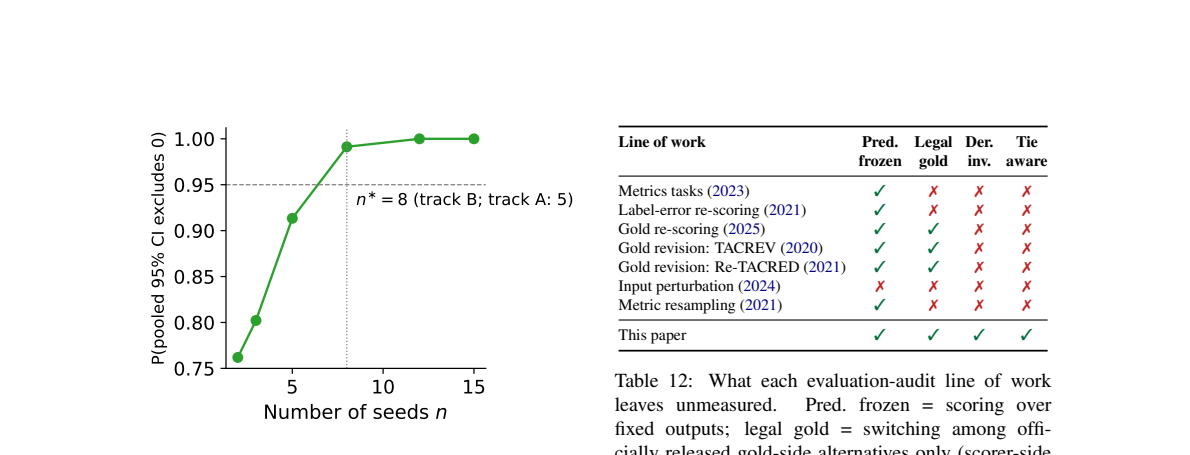
The seed-prescription corollary (n* = 8 from one convergence curve) provides a preliminary budget for sign determination, although it is contrast-specific and imputation-conditional.
If the paper is correct, the burden of proof in NLP evaluation shifts: a method ordering should be reported with its contract frozen and an audit of alternative contracts, otherwise the ordering is perishable. This recasts many published leaderboards as contract-specific snapshots rather than intrinsic capability ladders.
The gauge invariance principle (rename-only gold revisions produce zero arm) could be extended to other evaluation axes—for instance, metric variants that differ only in normalization constants but not in the partition they count—providing a classification of which contract changes are substantive and which are superficial.
The observational decoupling of violations and leverage (Proposition 4) suggests that output-validity gates and contract-marginalization address orthogonal threats to evaluation validity; combining them may be more effective than either alone, but the paper's evidence for independence is only observational, not proven.
The failed preregistered hypothesis H-X1 (expected cross-task correlation between arm coefficient and rank volatility was −0.963, opposite sign) indicates that the relationship between leverage and rank instability may be task-specific and not a universal scaling law—a caution for generalizing the numerical findings beyond the studied families.
Check this review
Pith stored no record of this review's passes and took no fingerprint of it. Reviews made by code from 13 Nov 2026 on carry both.
How often reviews like this one are right
Reviews like this one: written by deepseek-v4-flash, where what was read was not recorded.
How often objections from reviews like this one are right: not yet measured
Reviews by people
This review was written by a machine. No person has reviewed this paper on Pith yet. A scientist listed on Pith can review it for a fee, and their review is published here whatever it concludes.
The paper
Abstract
Evaluation reports cite sliced differences, most prominently the intra-inter gap in document-level relation extraction (DocRE), as capability evidence. Such gap readings are joint properties of models and evaluation contracts: scoring function, gold version, threshold, output format, and prompt language. With predictions frozen, switching only the gold reverses a method ordering (+0.0363, CI excluding zero; retrained stand-ins), leaving it tie-level. The flip survives Holm correction (exploratory tier); ten of thirteen flips share one contrast (fixed vs decoded threshold). Rename-only revisions cannot move a reading (Delta = 0); re-annotation moves it +0.862 UD points. We formalize this as an evaluation leverage account centered on a rank-flip condition. Constructively, the audited evaluation reading (AER; post-freeze) aggregates a comparison over declared contracts, declares ties when they disagree, prescribes seeds, and filters unverifiable settings. On WMT19 it is indistinguishable from the best single contract at the exploratory, convention-stable margin epsilon = 0.10 (chosen post-freeze); its tie declarations cover every contract-induced flip (14/14), at a priced false-tie cost (66.1%/88.0% of declared ties; single contracts: 58.7-71% de-en, 86-91% zh-en). Coverage drops to 73% held out and 3/13 on the denser DocRE registry (declare-tie-if-any-flip: 89%): the guarantee is grid-specific. Evidence spans DocRE, HacRED, a UD probe, released gold revisions, and a replication. Failed preregistered predictions are retained as boundaries. A 5% violation gate bounds survivor-selection bias. We release EvalLever, a registered audit workflow (147 amendments, tiered status). On a three-judge WMT19 grid its ensemble suppresses part of the sign instability (13-15 to 9; one preregistered criterion fails).
The paper's own sentences, arranged, kept beside the review and separate from it. Each label is drawn from a closed vocabulary; the number beside it is the probability the classifier gave that label. No sentence in this record was written by a model.
abstract compiled · 2026-11-04
The authors' main claim, as the classifier picked it out 1.00
“We show that such gap readings are joint properties of models and evaluation contracts: scoring function, gold version, threshold, output format, and prompt language.”
How the main claim is stated: asserted 1.00
What the abstract itself states, as probabilities: claims first 0.06 · states limitation 0.84 · human participants 0.13 · controlled comparison 0.26 · randomized assignment 0.03 · states quantitative result 0.98 · compares with prior results 0.75 · mentions code or data availability 0.87
The abstract, sentence by sentence
This table labels the abstract only (arXiv listing abstract v1). The number is the probability the classifier gave the label.
| Sentence | Role | The authors' own work | States the main conclusion | Strength |
|---|---|---|---|---|
| NLP evaluation reports routinely cite sliced performance differences, most prominently the intra-inter gap in document-level relation extraction, as capability evidence. | background 1.00 | 0.06 | 0.04 | asserted 1.00 |
| We show that such gap readings are joint properties of models and evaluation contracts: scoring function, gold version, threshold, output format, and prompt language. | contribution 0.41 | 0.72 | 0.65 | asserted 1.00 |
| With predictions frozen, a method ordering reverses under a gold-standard exchange (+0.0363, CI excluding zero; tie-level after), movement localizing where gold re-partitions: renames are gauge transformations (Delta=0; re-annotation +0.862). | result 1.00 | 0.95 | 0.23 | asserted 1.00 |
| We formalize this as an evaluation leverage account centered on the rank-flip condition. | contribution 0.71 | 0.91 | 0.16 | asserted 0.98 |
| Constructively, the audited evaluation reading (AER) is a contract-marginalized, tie-declared, seed-prescribed, gate-filtered procedure whose tie declarations cover every contract-induced flip on the declared WMT19 grids (14/14; held-out 73% vs. union-of-ties 89%), matching the best single metric contract at epsilon=0.10 equivalence. | method 0.50 | 0.94 | 0.22 | asserted 1.00 |
| Evidence spans DocRE, HacRED, a UD probe, and released gold revisions; an alternative-reference-set replication extends it beyond our testbeds. | method 0.61 | 0.89 | 0.06 | asserted 1.00 |
| Failed predictions retained as boundaries; a 5% violation gate flags unverifiable settings and bounds survivor-selection bias. | method 0.92 | 0.90 | 0.04 | asserted 0.92 |
| We release EvalLever, a preregistered workflow with an amendment trail; on LLM-as-judge grids, the audited ensemble stabilizes every unstable pair (13-15 to zero; generic ensemble shrinkage: the preregistered correlation criterion failed, the companion stabilization criterion passed). | contribution 0.77 | 0.95 | 0.15 | asserted 1.00 |
What kind of paper the classifier reports this is: method or tool 0.72 · evidence from analysis of existing data 0.62
What was examined, and what was not
Sources read
- arXiv listing abstract v1
Not examined
- full text
- figures and tables
- references and citing sentences
- relations to other papers
Levels run
- P abstract
Not run
- S sections
- T body sentences
- C citations
- R cross-paper relations
How the labels were made
Compiled by classifier-1.13.0 via TypeSafe API, question bank abstract-p1-20260923, 2026-11-04: 1 request, 6,558 input tokens.
Every quoted sentence on this record is the authors'. Every label is from Pith's closed vocabulary, with the probability shown beside it. This record as JSON
Figures (7)
Figures are the authors', reproduced from the paper.
Cited by 1 Pith paper
Reviewed papers on Pith that cite this one. The full citation record
Challenges and discussion
Disagree with the review, or know something it missed? Leave a comment, or challenge this review formally: a challenge becomes a permanent entry in this paper's record, and its decision is published here.
Come back by email
A short list of the week's newly reviewed papers. Nothing is sent until you confirm from your inbox, and every email has a link that stops it. No account.
No comments yet.
Sign in to comment