Artificial Intelligence · arXiv:2611.05556 v2 · submitted 3 Nov 2026
AGORA: Reliability-Aware Aggregation of LLM Judges on Small Evaluation Sets
The paper says
“LLM-as-a-judge is a common substitute for costly human evaluation, and aggregating several judges is the standard remedy for any single judge's bias.”
more of the abstract
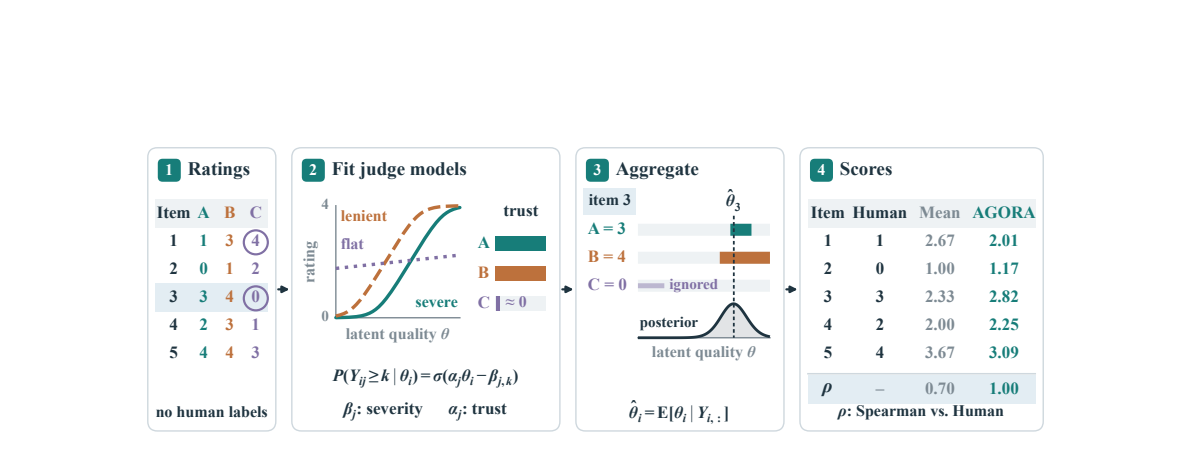
Judge pools mix judges of very different reliability, while the human-labeled sets that validate them hold a few hundred items or fewer. In this regime the per-item mean weights weak judges as heavily as strong ones, and confusion-table models such as Dawid-Skene must estimate a per-judge error table from too few items. We propose AGORA (Aggregation Of Reliability-weighted Assessments), an item-response-theory aggregator that places every item on one latent quality scale and describes each judge by a sensitivity parameter and ordered rating thresholds, so judge reliability is learned from all items jointly and without human labels. Across three benchmarks, AGORA matches or exceeds Dawid-Skene on large evaluation sets, and its advantage widens as the set shrinks toward a few hundred items. It remains accurate as pools grow more uneven, a label-free dispersion statistic indicates in advance when trust weighting helps, and its learned trust weights track per-judge human validity. Code is available at https://github.com/JunhyungAhn/llm-as-judge-irt.
from the abstract
Pith says
Machine review · deepseek-v4-flash · 5 Nov 2026 · of version 1 of the paper; version 2 is newer · what was read was not recorded · not checked by a person
It can be wrong. Challenge this review or reply to it.
Holds up. Solid incremental work: applies item-response theory to aggregate LLM judges, shows a clear small-set advantage over Dawid-Skene with careful experiments. Not groundbreaking, but competent and useful. This line is wrong
5 minor
How often objections from reviews like this one are right: not yet measured
Not checked: figures, code, what the references say.
5 minor objections
The paper says, at §3.4
Pith says: minor objection 1 of 5
The EAP estimate uses a discretized grid of 150 points on [-4.5, 4.5] (App. A). Consider mentioning this grid size in the main text for readers who skip the appendix.
The paper says, at §5.3
Pith says: minor objection 2 of 5
The agreement dispersion statistic δ is defined as std_j(ρ̄_j)/mean_j(ρ̄_j). A brief note on why the mean normalization is included (to make δ scale-invariant) would improve clarity.
show 3 more
The paper says, at Eq. (6)
Pith says: minor objection 3 of 5
The term v_{ij}(θ) is said to be the 'item-level information factor' but is not defined in the main text; the appendix definition (Fisher information factorization) could be referenced here.
The paper says, at Figure 3
Pith says: minor objection 4 of 5
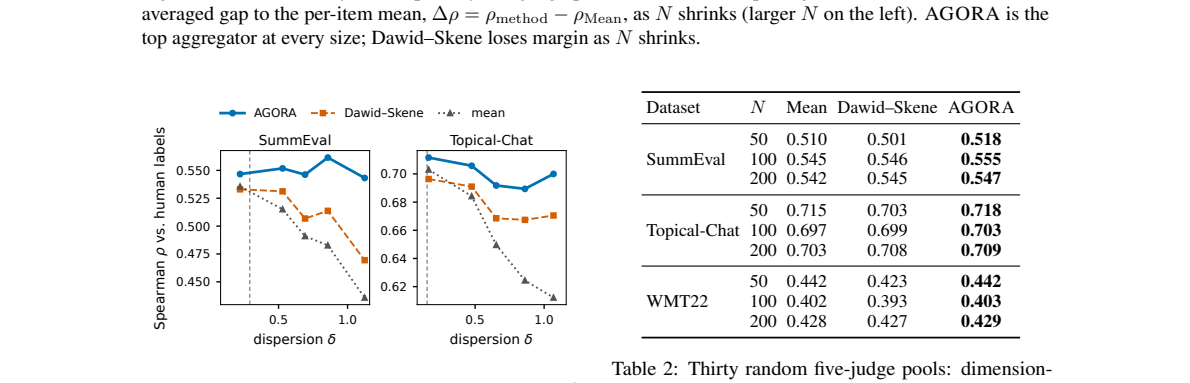
The x-axis label 'dispersion δ' is clear, but the figure caption could explicitly state that δ is computed from the score matrix alone (no human labels).
The paper says, at Table 3
Pith says: minor objection 5 of 5
R1 uses a 'pooled discrimination shared by all judges.' The text should state how this pooled value is estimated (e.g., fit as a single free parameter), to avoid confusion.
What would settle it
Independently reimplement AGORA and Dawid-Skene from §3 and App. B.3 on SummEval and Topical-Chat and recompute the Table 1 N=50 primary-pool margin with the same 50-subset protocol; if the AGORA minus Dawid-Skene margin does not reproduce within about ±0.005, the small-sample claim should be revisited.
from the skeptic's reading
How the review went
4 readings by deepseek-v4-flash · 5 Nov 2026
- Reader holds up
- Skeptic partly agrees
- Editor wrote the verdict above
- Referee accept: 5 minor
Not run on this paper: the simulated authors' defence.
Pith did not check this review's objections against the paper.
The review in full
The review in brief, machine-written
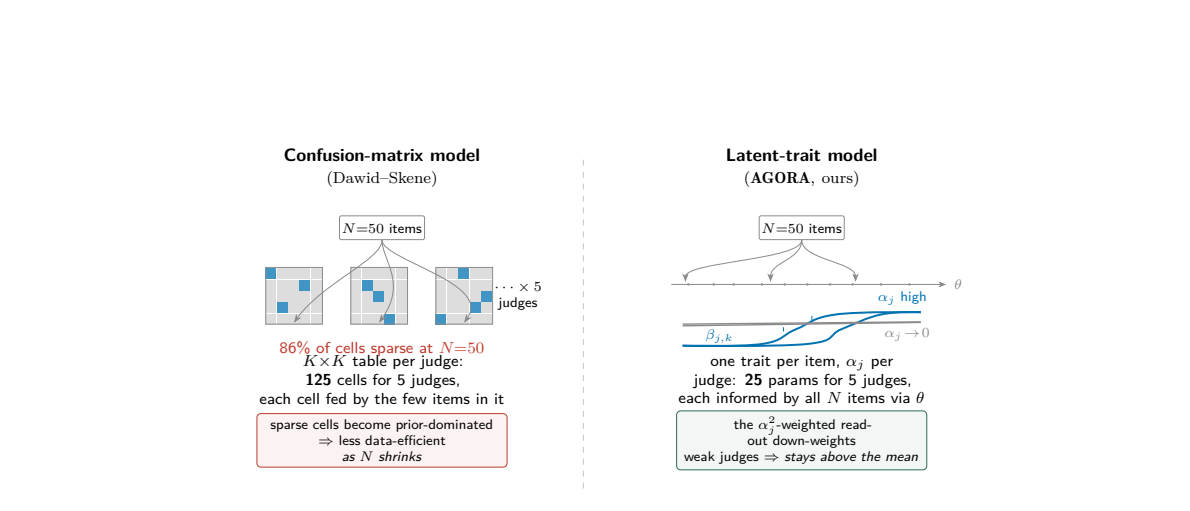
This paper pitches a graded-response model (IRT) as a drop-in replacement for Dawid-Skene confusion tables when aggregating LLM judges on small human-referenced sets. The core insight is straightforward and correct: on a K-point scale, each judge in AGORA needs K parameters (one discrimination, K-1 thresholds) rather than K2 confusion cells, so parameter estimates should stay tighter with few items. The experiments bear this out—AGORA matches or narrowly beats Dawid-Skene at full sample sizes and its margin grows as N shrinks toward 50 items, with consistent results across three benchmarks and multiple random judge pools.
What the paper does well: the experimental design is thorough. The authors run subsampling ladders, control for random pool composition, ablate the read-out and the prior, add adversarial judges, and tie the learned discriminations to human validity. The label-free dispersion statistic is a practical bonus—it tells you when trust weighting is likely to help, before you collect human labels. The limitations section is honest (three tasks, ordinal ratings only, conditional independence assumed).
The soft spots are mostly about effect size and scope. The absolute gains over the per-item mean or Dawid-Skene are modest—often +0.01 to +0.03 in Spearman ρ. Those are real improvements at the margin, but they aren't the kind of jump that changes practice for a practitioner who is happy with the simple mean. The paper doesn't release code or data, which is a minor reproducibility hit, though the method is described well enough to reimplement. The independence assumption (Eq. 1) is standard IRT but could be load-bearing if judges share systematic biases beyond scale use; the authors flag it as future work, so it's acknowledged, not buried.
Overall, this is a clean, honest paper. It applies an existing psychometric tool to a new setting with careful empirical work. The improvement is real but incremental. I would take it seriously as a referee.
My recommendation: send it to review. It's not a home run, but it's solid work that the community should be aware of.
The strongest objection
I read the central claim as an empirical parameterization argument: a graded-response model with K parameters per judge should remain stable when a confusion-table model's K^2 cells become sparse, and should not lose on large sets. The reported evidence supports this: AGORA is at or above Dawid-Skene at full N, and its margin grows as N falls from 400 to 50 on all three benchmarks; the read-out ablations (Table 3), prior ablation (Table 4), and random-pool results (Tables 2 and 6) are consistent and internally coherent. The weakest model assumption is conditional independence in Eq. (1), which the authors explicitly acknowledge in §8 when they list dependence-aware likelihoods as future work; this is a real scope condition, but it is not load-bearing for the central comparison because Dawid-Skene and the other baselines rely on the same independence-style assumption, and the claimed advantage is about parameter efficiency rather than resolving shared judge biases. No internal inconsistency or unsupported cited result surfaced. The absence of released code and data is a reproducibility weakness, not a correctness objection.
The reader's weakest assumption, conditional independence in Eq. (1), is indeed the least secure modeling assumption and the right place to look. I part ways only on its status: it is explicitly acknowledged in §8, it does not drive the central comparative claim, and the small-set advantage is explained by parameter count rather than by the independence assumption, so it does not change the verdict. The supporting ablations and random-pool analyses give independent support to the parameterization argument, and the sensitivity checks in App. A suggest the fixed settings are not tuned to the result. If I had to name a practical gap, it is the lack of shared code and data for exact reproduction, which the reader also noted; I do not treat that as grounds for changing an ACCEPT.
The referee's report
AGORA addresses a genuine practical problem: aggregating LLM judges on small human-referenced validation sets where confusion-table models become unstable. The parameter-efficiency argument is clearly motivated and empirically supported by multiple benchmarks, subsampling protocols, and ablations. The connection of item-response theory to LLM evaluation is novel and well executed. The paper includes thorough sensitivity analyses, controlled adversarial experiments, and a label-free diagnostic. If the results hold, AGORA offers a principled and immediately useful tool for LLM meta-evaluation.
Pith's reading of the paper (a machine's summary, not the authors')
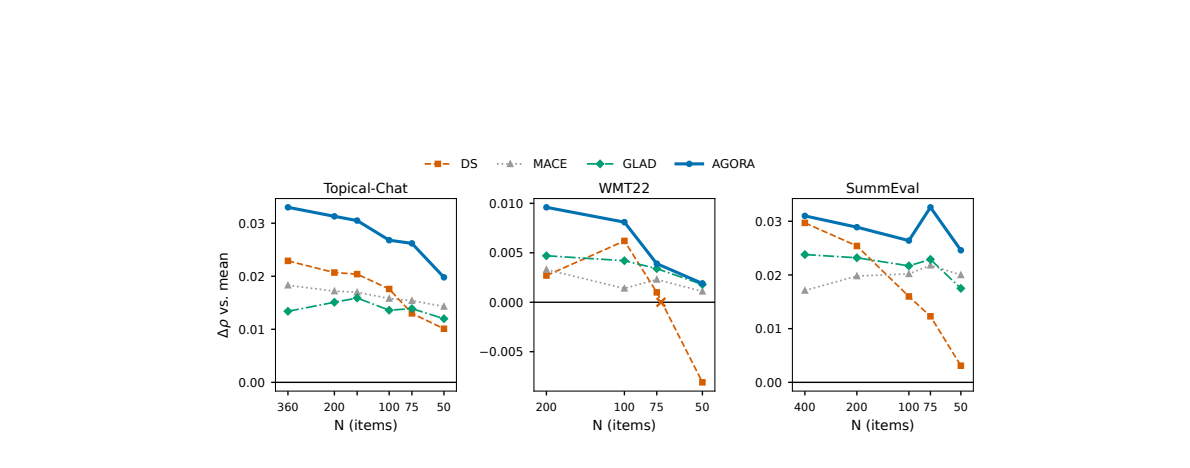
The paper argues that the standard ways of combining LLM judges — plain averaging, or per-judge confusion-table models such as Dawid–Skene — are mismatched to the small human-labeled sets that meta-evaluation can actually afford, and that an item-response-theory model removes the mismatch. AGORA assigns every evaluated item one latent quality, gives every judge one learned reliability weight (a discrimination parameter) plus ordered rating thresholds, and fits all of it from the judge-score matrix alone, with no human labels. Because each judge costs only $K$ parameters instead of $K^2$ confusion-table cells, and every judgment informs every parameter, the reliability weights stay trustworthy when only fifty to a few hundred items are labeled. Across SummEval, Topical-Chat, and WMT22, AGORA matches or beats Dawid–Skene at full scale and widens the gap as the item set shrinks, beating it on 98–100% of 60 random five-judge pools at 50 items. It also reports a label-free dispersion statistic that predicts when the weighting will help, and learned trust weights that track each judge's human validity.
What carries the argument. The load-bearing object is the graded-response model, the item-response-theory model for ordinal ratings: each item sits on one latent quality scale $\theta_i\sim N(0,1)$, and judge $j$'s chance of rating at or above category $k$ is $\sigma(\alpha_j\theta_i-\beta_{j,k})$, so $\alpha_j$ controls how steeply the judge's scores track latent quality while the ordered thresholds $\beta_{j,1}<\cdots<\beta_{j,K-1}$ absorb leniency and range compression. This parameterization does two jobs: it cuts each judge from $K^2$ confusion-table cells to $K$ parameters that every item informs, and it turns the read-out into a trust-weighted average, because the EAP estimate's local linearization weights each judge by $\alpha_j^2$ times that judge's Fisher information near the item's quality. Around it sit the regularized horseshoe prior on $\alpha_j$, which shrinks uninformative judges without flattening informative ones, and the EM/grid-posterior estimation scheme whose scale updates use an inverse-gamma augmentation of the half-Cauchy priors.
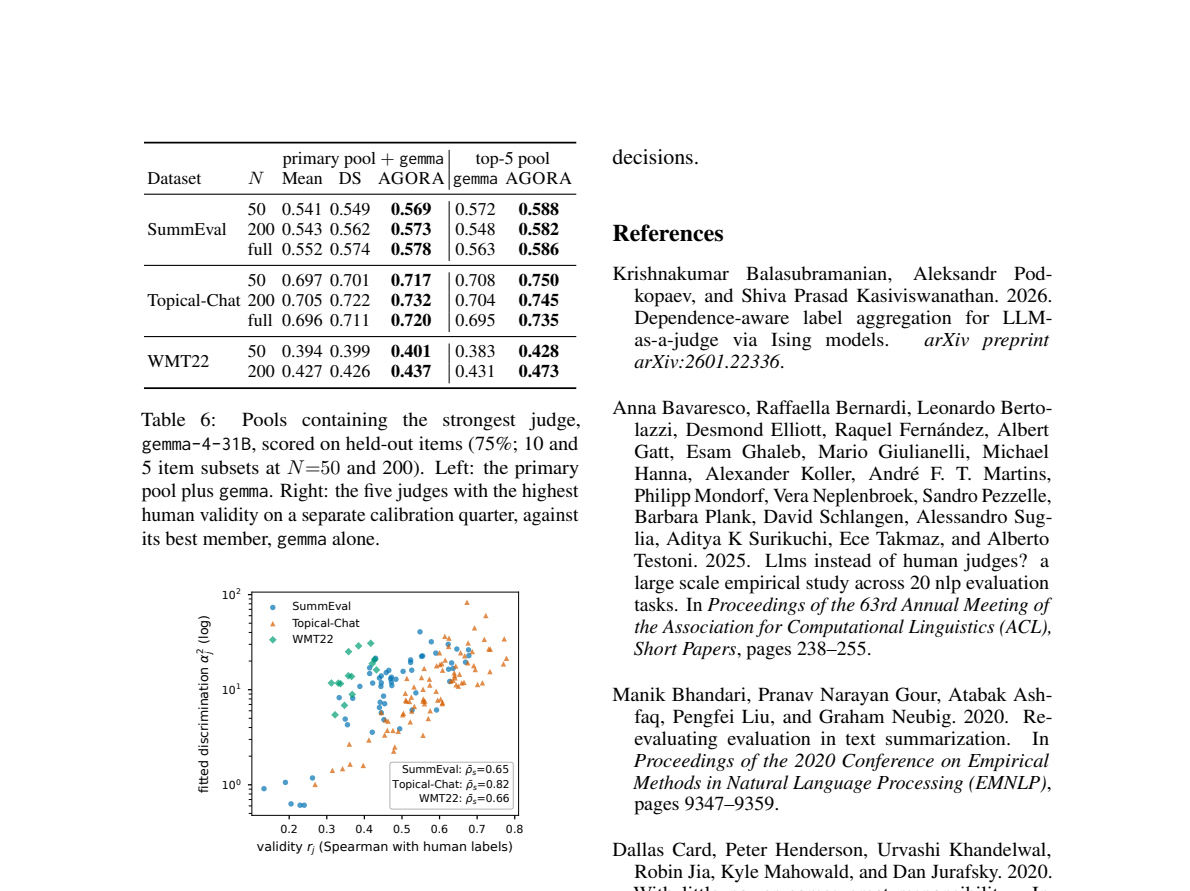
Core claim. AGORA's central claim is that reliability-aware aggregation of LLM judges is a latent-trait estimation problem rather than an error-table estimation problem. Given only the judge-score matrix, it fits the graded-response model of item-response theory, $P(Y_{ij}\ge k\mid\theta_i)=\sigma(\alpha_j\theta_i-\beta_{j,k})$, with latent quality $\theta_i$ per item, a discrimination $\alpha_j$ per judge acting as the trust weight, and ordered thresholds $\beta_{j,k}$ that absorb each judge's severity and scale use. A horseshoe prior shrinks uninformative judges toward zero, an EM procedure over grid posteriors produces an expected-a-posteriori quality per item, and a test-characteristic-curve map converts that quality back to the benchmark's rating scale. The empirical claim is that exactly where meta-evaluation lives — reference sets of fifty to a few hundred items — the $K^2$ confusion-table cells of Dawid–Skene go sparse (86% of cells have fewer than five observations on SummEval at $N=50$) while AGORA's $K$ parameters per judge stay informed by all items, so AGORA retains its margin where Dawid–Skene loses it. It exceeds Dawid–Skene on 98–100% of 60 random five-judge pools at $N=50$ on SummEval and Topical-Chat, and its fitted discriminations correlate with per-judge human validity at 0.65, 0.82, and 0.66 (dimension-averaged Spearman) on the three benchmarks.
The premise it rests on. The load-bearing premise is conditional independence: once an item's latent quality is fixed, each judge's rating is assumed to carry no information about the others beyond what the fitted thresholds express. If judges share systematic biases that the single quality dimension cannot absorb — for example a common preference for longer outputs — that independence breaks and the learned trust weights can be wrong; the paper acknowledges exactly this in its limitations and points to dependence-aware likelihoods as future work.
If the paper is right (Pith's inferences, not the authors')
At $N=50$ items with five judges, AGORA exceeds Dawid–Skene on 98–100% of 60 random pools on SummEval and Topical-Chat, so reliability-aware aggregation no longer needs the hundreds of shared items that confusion-table models require.
The learned discriminations $\alpha_j^2$ correlate with per-judge human validity (0.65, 0.82, and 0.66 dimension-averaged Spearman), so the same fitted weights serve as a label-free screen for judge quality before any annotation is paid for.
The dispersion statistic $\delta$ — the coefficient of variation of judges' mean inter-judge agreement — predicts AGORA's gain over the per-item mean (Spearman +0.73 on SummEval, +0.61 on Topical-Chat, $p<0.001$), telling practitioners before labels exist whether trust weighting will pay.
Under adversarial corruption, where injected judges mirror an existing judge around the rating midpoint, the horseshoe prior adds +0.008 to +0.017 over an unpenalized fit while costing almost nothing on clean pools.
On WMT22's full 19,725-item set, AGORA ranks first under Spearman, Kendall's $\tau_b$, and pairwise accuracy, so the trust-weighted latent-trait route does not sacrifice large-scale performance.
The $K$-versus-$K^2$ parameter argument implies a testable scaling law the paper does not run: on 7- or 10-point rating scales AGORA's margin over Dawid–Skene should widen further, because confusion tables grow quadratically in scale width while the graded-response model grows linearly.
Because the dispersion statistic $\delta$ is computable before any human labels exist and predicts where weighting pays, it could be inverted into a panel-design tool — assemble judge pools that maximize dispersion to get the most from AGORA — a use the paper presents as a diagnostic but does not propose as a construction rule.
If conditional independence fails in practice, the $\alpha_j$ weights will over-trust blocks of mutually correlated judges and multiply their shared bias instead of diluting it; the first observable symptom would be a drop in the $\alpha_j^2$-versus-validity correlation reported in the paper's trust-weight analysis, and a grouped or dependence-aware prior is the direct repair.
Check this review
Pith stored no record of this review's passes and took no fingerprint of it. Reviews made by code from 13 Nov 2026 on carry both.
How often reviews like this one are right
Reviews like this one: written by deepseek-v4-flash, where what was read was not recorded.
How often objections from reviews like this one are right: not yet measured
Reviews by people
This review was written by a machine. No person has reviewed this paper on Pith yet. A scientist listed on Pith can review it for a fee, and their review is published here whatever it concludes.
The paper
Abstract
LLM-as-a-judge is a common substitute for costly human evaluation, and aggregating several judges is the standard remedy for any single judge's bias. Judge pools mix judges of very different reliability, while the human-labeled sets that validate them hold a few hundred items or fewer. In this regime the per-item mean weights weak judges as heavily as strong ones, and confusion-table models such as Dawid-Skene must estimate a per-judge error table from too few items. We propose AGORA (Aggregation Of Reliability-weighted Assessments), an item-response-theory aggregator that places every item on one latent quality scale and describes each judge by a sensitivity parameter and ordered rating thresholds, so judge reliability is learned from all items jointly and without human labels. Across three benchmarks, AGORA matches or exceeds Dawid-Skene on large evaluation sets, and its advantage widens as the set shrinks toward a few hundred items. It remains accurate as pools grow more uneven, a label-free dispersion statistic indicates in advance when trust weighting helps, and its learned trust weights track per-judge human validity. Code is available at https://github.com/JunhyungAhn/llm-as-judge-irt.
The paper's own sentences, arranged, kept beside the review and separate from it. Each label is drawn from a closed vocabulary; the number beside it is the probability the classifier gave that label. No sentence in this record was written by a model.
abstract compiled · 2026-11-05
The authors' main claim, as the classifier picked it out 0.92
“Across three benchmarks, AGORA matches or exceeds Dawid-Skene on large evaluation sets, and its advantage widens as the set shrinks toward a few hundred items.”
How the main claim is stated: asserted 1.00
What the abstract itself states, as probabilities: claims first 0.05 · states limitation 0.15 · human participants 0.10 · controlled comparison 0.88 · randomized assignment 0.02 · states quantitative result 0.32 · compares with prior results 0.98 · mentions code or data availability 0.03
The abstract, sentence by sentence
This table labels the abstract only (arXiv listing abstract v1). The number is the probability the classifier gave the label.
| Sentence | Role | The authors' own work | States the main conclusion | Strength |
|---|---|---|---|---|
| LLM-as-a-judge is a common substitute for costly human evaluation, and aggregating several judges is the standard remedy for any single judge's bias. | background 1.00 | 0.04 | 0.03 | asserted 1.00 |
| Judge pools mix judges of very different reliability, while the human-labeled sets that validate them hold a few hundred items or fewer. | background 0.71 | 0.14 | 0.02 | asserted 1.00 |
| In this regime the per-item mean weights weak judges as heavily as strong ones, and confusion-table models such as Dawid-Skene must estimate a per-judge error table from too few items. | gap 0.57 | 0.11 | 0.03 | asserted 1.00 |
| We propose AGORA (Aggregation Of Reliability-weighted Assessments), an item-response-theory aggregator that places every item on one latent quality scale and describes each judge by a sensitivity parameter and ordered rating thresholds, so judge reliability is learned from all items jointly and without human labels. | method 0.69 | 0.89 | 0.21 | asserted 1.00 |
| Across three benchmarks, AGORA matches or exceeds Dawid-Skene on large evaluation sets, and its advantage widens as the set shrinks toward a few hundred items. | result 1.00 | 0.95 | 0.47 | asserted 1.00 |
| It remains accurate as pools grow more uneven, a label-free dispersion statistic indicates in advance when trust weighting helps, and its learned trust weights track per-judge human validity. | result 1.00 | 0.93 | 0.24 | asserted 0.92 |
What kind of paper the classifier reports this is: method or tool 1.00 · evidence from observation or experiment 0.75
What was examined, and what was not
Sources read
- arXiv listing abstract v1
Not examined
- full text
- figures and tables
- references and citing sentences
- relations to other papers
Levels run
- P abstract
Not run
- S sections
- T body sentences
- C citations
- R cross-paper relations
How the labels were made
Compiled by classifier-1.13.0 via TypeSafe API, question bank abstract-p1-20260923, 2026-11-05: 1 request, 5,073 input tokens.
Every quoted sentence on this record is the authors'. Every label is from Pith's closed vocabulary, with the probability shown beside it. This record as JSON
Figures (5)
Figures are the authors', reproduced from the paper.
Cited by 1 Pith paper
Reviewed papers on Pith that cite this one. The full citation record
Challenges and discussion
Disagree with the review, or know something it missed? Leave a comment, or challenge this review formally: a challenge becomes a permanent entry in this paper's record, and its decision is published here.
Come back by email
A short list of the week's newly reviewed papers. Nothing is sent until you confirm from your inbox, and every email has a link that stops it. No account.
No comments yet.
Sign in to comment