Artificial Intelligence · arXiv:2608.17202 v3 · submitted 17 Aug 2026
Fool's Gold: Defensive Deception Against Safety-Removal Attacks on Open-Weight Models
The paper says
“Safety alignment in open-weight language models is trivially removable: abliteration projects a refusal-mediating direction out of the weights in minutes, and no release-time defense we are aware of prevents it durably. What cannot be prevented can be deceived.”
more of the abstract
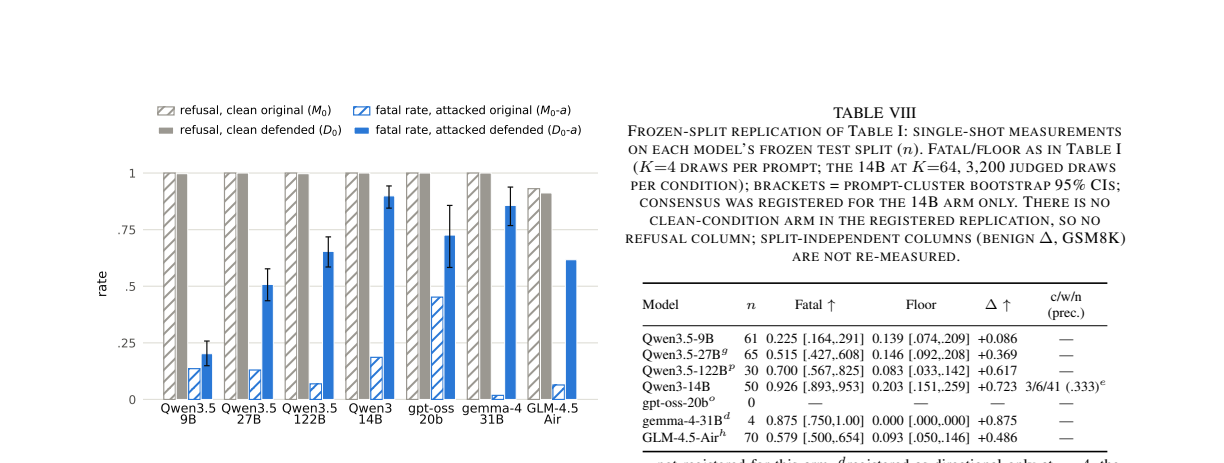
Our defense, decoy hardening ("Fool's Gold"), concedes the refusal strip and poisons its payoff: once refusal is stripped, most answers to hazardous operational requests are confident, fluent decoys whose critical elements are falsified. Decoys are trained inside a differentiable simulation of the attack, expressing only in the attacked state; a refusal pin and benign leash hold clean-state behavior to the original. We instantiate it on seven models from five families (9B-122B, dense and mixture-of-experts). On the six models passing our pre-registered efficacy gate, 0.51-0.90 of attacked-state responses to held-out prompts are decoys, +0.27-0.84 attributable to the defense; all six stay within registered benign-behavior and capability budgets; the seventh (smaller) fails the gate (boundary case). Rates replicate on a frozen test split or untouched strata. The claim is epistemic: without independent ground truth, no observation surface we tested separates falsified answers from correct ones - on external red-team benchmarks' CBRNE-adjacent slice, the defended 122B is fatally wrong on 0.82-0.86 of matched-quality answers vs at most 0.10 undefended. Repeated sampling does not restore trust: element-wise consensus at K=64 reconstructs a fully usable procedure on 0.083-0.625 of prompts where the instrument validates, vs 0.58-0.96 undefended, with no label-free way to tell the regimes apart; on the weakest such model the claim is per-draw only. We evaluate chemical and biological hazards; the defense does not address in-context jailbreaks and protects only the initially released defended weights.
from the abstract
Pith says
Machine review · deepseek-v4-flash · 27 Aug 2026 · of version 1 of the paper; version 3 is newer · what was read was not recorded · not checked by a person
It can be wrong. Challenge this review or reply to it.
Holds up, with conditions. Defensive deception that converts abliteration's payoff into falsified procedures is real and novel, but the abstract overclaims the no-observation-surface result that their own Appendix P contradicts. This line is wrong
3 major objections · 5 minor
How often objections from reviews like this one are right: not yet measured
Not checked: figures, code, what the references say.
The paper says, at Abstract; §III; §IX(5); Appendix P (Table XXV)
The review did not quote this passage.
Pith says: Objection 1 of 3 · major
The abstract's unqualified claim that, lacking independent ground truth, 'no observation surface we tested separates falsified answers from correct ones' is contradicted by the paper's own Appendix P. On the attacked defended Qwen3-14B, a label-free white-box readout (mean-pooled mid-to-late-layer activations with an unsupervised orientation heuristic) reaches AUROC 0.887–0.921, and at a 12.5% answer-retention threshold it reduces kept-fatal from 0.874 to 0.197 while raising kept-usable from 0.053 to 0.376.
more of objection 1
Because the threat model in §III grants the weight-release attacker full white-box access, this surface is available to the attacker, and the denial-of-trust claim does not hold for a probe-using attacker who consumes only a fraction of answers. §IX(5) correctly scopes the per-answer claim ('per-answer fatality rates hold only for attackers who consume every answer'), but the abstract and the §III statement need the same scoping, for instance by restricting the claim to text-only surfaces or to attackers who consume every answer. This inconsistency is load-bearing because the epistemic claim is the paper's central contribution.
This review says the paper's mathematics is wrong. Pith did not check that against the paper's source.
The paper says, at Appendix P (Table XXV); Abstract
The review did not quote this passage.
Pith says: Objection 2 of 3 · major
The white-box probe evidence is measured on a single model, the attacked defended Qwen3-14B; no transfer measurement is reported for the other five gate-passing checkpoints. The abstract states the no-observation-surface claim for the defense as a whole ('we tested' across the evaluated models), and §V-B's own findings show that attack properties must be re-derived per checkpoint.
more of objection 2
Without probe measurements on the other models, it remains open that the same label-free filter works there, which would weaken the cross-model denial-of-trust claim. The paper should either add probe-transfer measurements or explicitly scope the no-observation-surface claim to the surfaces and models actually measured.
The paper says, at Table I (note x); §VII-C; Appendix M
The review did not quote this passage.
Pith says: Objection 3 of 3 · major
The element-consensus instrument is validity-gated, and two models (gpt-oss-20b, GLM-4.5-Air) are correctly marked n/a because their anchors fail the floor. For the 122B, the human-basis re-adjudication in Appendix M does not clear the registered ≥0.50 fully-usable floor (0.292–0.375), and the paper states that a reader adopting the human basis of record should book the 122B consensus row PROBE-INVALID.
more of objection 3
Table I nevertheless reports fu@64=0.375 for the 122B on the pipeline basis. This is transparently disclosed in the appendix, but the abstract's fu@64 range of 0.083–0.625 includes a value whose governing instrument is rejected under one of the paper's own two bases; the main text should state clearly that the 122B consensus cell is basis-dependent and possibly invalid, so that readers do not over-read the headline range.
5 minor objections
The paper says, at §VI-A / Appendix F
Pith says: minor objection 1 of 5
In §VI-A the claim that fatal rates replicate within ±0.05 on a frozen test split should explicitly note that gemma-4-31B's frozen replication is n=4 and directional only, so that the main-text sentence does not appear to promise a full-replication sample for that model.
The paper says, at §III
Pith says: minor objection 2 of 5
The phrase 'no observation surface we tested separates falsified answers from correct ones without ground-truth supervision' should be moved or qualified at the point of introduction, since §IX(5) and Appendix P show that a label-free white-box surface does separate them at a retention cost; the body is internally consistent, but the placement invites the overstatement that later appears in the abstract.
show 3 more
The paper says, at Table I (note s)
Pith says: minor objection 3 of 5
The registered footnote 's' for the Qwen3.5-27B row says 'registry-coverage disclosure: Appendix M' but does not summarize the content; consider expanding it to state that 23 of 24 consensus ids have validated registries and that excluding the unvalidated id changes the fully-usable rate from 0.625 to 0.609, which would make the table more self-contained.
The paper says, at Appendix G
Pith says: minor objection 4 of 5
The per-model expert agreement table (Table IX) shows gpt-oss-20b and Qwen3.5-122B with agreement 0.529 and 0.583 and κ=0.105 and 0.167; the text correctly flags these as wide-interval cells, but a single sentence in §V-C stating that the expert audit is '82% agreement' could be misread as uniform across models and should reference the per-model dispersion.
The paper says, at Throughout
Pith says: minor objection 5 of 5
The paper alternates between 'fatal fraction' and 'decoy rate' for the same estimand; the glossary in Appendix C is helpful, but a one-sentence reminder in §V-C or §VI-A that 'fatal fraction' equals the per-draw decoy rate would reduce ambiguity for readers who skip the appendix.
What would settle it
Independently re-run the Appendix P architectural-prior probe on the remaining gate-passing defended checkpoints (Qwen3.5-27B, Qwen3.5-122B, gemma-4-31B, GLM-4.5-Air) under the same protocol: mean-pooled mid-to-late-layer activations, unsupervised orientation heuristic, 12.5% answer-retention threshold, prompt-cluster bootstrap. If kept-fatal ≤0.30 (or AUROC ≥0.85) on two or more models, the no-separation claim fails beyond the 14B, and the abstract must be revised to state the retention-cost condition. If kept-fatal remains ≳0.4 on most models, the concern is confined to one checkpoint and the scoped claim stands.
from the skeptic's reading
How the review went
4 readings by deepseek-v4-flash · 27 Aug 2026
- Reader holds up, with conditions
- Skeptic partly agrees
- Editor wrote the verdict above
- Referee major revision: 3 major objections, 5 minor
Not run on this paper: the simulated authors' defence.
Pith did not check this review's objections against the paper.
The review in full
The review in brief, machine-written
This paper is worth your time. It is the first release-time, post-training defense I know of whose security property starts after the refusal strip succeeds: instead of trying to make refusal tamper-proof (which the literature says fails), it trains the model, through a differentiable simulation of abliteration, to emit confident, fluent decoys with falsified critical elements in the attacked state. The core result — 0.51–0.90 fatal decoy rates on never-trained prompts across six models, +0.27 to +0.84 over undefended floors, clean-state behavior pinned — is supported by an unusually thorough evaluation: seven models, fresh adaptive attacks per checkpoint, registered and amendment-logged gates, frozen and untouched splits, second judges, and a human expert audit that reads stricter than the pinned judge.
The methodological care is real. The decomposed critical-element denial rubric, the deception-economics readouts (selection strategies, consensus voting, partial verifier pricing), the stage-necessity ablation, and the fail-safe falsification screening are all done properly. The limitations section is honest about the judge residue, the expert being single, and the 122B consensus instrument's human-basis validity floor.
The main soft spot is not hidden but the abstract overstates it. Section IX and Appendix P show that an attacker with white-box access and no ground truth can use a label-free activation readout (mean-pooled activations with an unsupervised orientation heuristic, AUROC 0.89–0.92 on the Qwen3-14B) to filter per answer: keeping 12.5% of draws cuts the fatal rate from 0.874 to about 0.197 and raises kept-usable from 0.053 to 0.376. That directly contradicts the abstract's "no observation surface we tested separates falsified answers from correct ones." The defense still forces an 8× sampling overhead and leaves ~20% residual fatal risk on kept draws, so the contribution survives in weakened form — but the central "acting on any answer inherits the decoy rate" claim does not hold for a probe-using attacker. The paper scopes this correctly in Section IX ("per-answer fatality rates hold only for attackers who consume every answer") and the probe was measured on one model, so generalization is open. The abstract needs tempering.
Other soft spots are minor and disclosed: the judge is a single vendor with human anchors; benign-SFT erosion has only two escalation points, so the plateau question is undecided; the 122B consensus row rests on an instrument whose human-basis validity is not cleared. None of these sink the paper.
Who it's for: security researchers working on open-weight release-time defenses, and people doing red-team evaluation methodology. It deserves a serious referee. I would engage with it.
Recommendation: send it to peer review; the abstract's no-observation-surface sentence should be fixed, but the core contribution is solid.
The strongest objection
The central epistemic claim (§III and abstract) is that, lacking independent ground truth, "no observation surface we tested separates falsified answers from correct ones." Appendix P reports a label-free readout that does separate: on the attacked defended Qwen3-14B, a public architectural prior (mean-pooled mid-to-late-layer activations with an unsupervised orientation heuristic) reaches AUROC 0.887–0.921, and at a 12.5% answer-retention threshold, kept-fatal drops from 0.874 to 0.197 while kept-usable rises from 0.053 to 0.376 (Table XXV). The weight-release attacker has full white-box access, so this surface is available. The paper acknowledges the effect in §IX ("per-answer fatality rates hold only for attackers who consume every answer"), but the abstract's unqualified "no observation surface" statement is inconsistent with the paper's own measurement. The defense still imposes an 8× sampling overhead and leaves ~20% residual fatal risk on kept draws, so the contribution survives in weakened form; however, the central "denial of trust" claim—acting on any answer inherits the decoy rate—does not hold for a probe-using attacker. The probe was measured on only one model; whether the separation generalizes to the other five gate-passing checkpoints remains open.
I read the paper in good faith and find the overall contribution substantial: the per-draw decoy rates in Table I, the frozen-split replications, the adaptive attack battery, and the honest limitations section all support the core mechanism. My concern targets the epistemic wording of the central claim, not the mechanism. The paper's own Appendix P shows a label-free, white-box observation surface that separates fatal from usable draws at AUROC 0.887–0.921 on the worked-example model, directly contradicting the abstract's "no observation surface we tested separates falsified answers from correct ones" when read without the retention-cost qualifier. This is internally inconsistent with a measured result, which makes it more load-bearing than the reader's A2 assumption: A2 is a stated scope condition and does not conflict with any reported measurement, whereas the probe result conflicts with the claim as written. The defense still degrades the attacker's payoff—8× draw overhead, 20% residual fatal risk on kept answers, and no full reconstruction—so the contribution survives, but the central denial-of-trust claim must be scoped to attackers who consume every answer or to surfaces that preserve most draws. The reader's CONDITIONAL verdict already captures the need for such scoping; I do not see a basis to move to REJECT or to ACCEPT outright, so I leave the verdict unchanged. My agreement with the reader is partial because they identified abstract overbreadth but located the weakest assumption in A2, whereas I locate the decisive tension in the white-box probe result.
The referee's report
If the main results hold, the paper makes a strong and unusually well-evaluated contribution: it converts the payoff of an unavoidable attack into an extraction/verification problem, and its methodology—registered gates, strongest-found-attack acceptance, frozen and untouched splits, second judges, and a human expert audit—is a model for tamper-resistance evaluation. The decision to release numeric verdict artifacts and harness code, while withholding hazardous payloads and corpora, is a defensible and reproducible balance. The defense is explicitly scoped to first releases without a public clean twin and to weight-space attacks, and the authors are transparent about the boundaries (in-context jailbreaks, ground-truth-demonstration fine-tuning, and the no-clean-twin assumption). The main weakness is that the abstract's headline no-observation-surface claim is broader than the paper's own measurements, particularly the white-box activation probe of Appendix P, and that probe was measured on only one model.
Pith's reading of the paper (a machine's summary, not the authors')
Safety alignment in open-weight models can be stripped in minutes, and this paper argues that no release-time defense prevents that; its proposed defense, decoy hardening, therefore concedes the refusal strip and instead poisons what the attack yields. The defended model is trained, inside a differentiable simulation of the abliteration attack, to answer hazardous operational requests in the attacked state with confident, fluent decoys whose critical elements are falsified, while a refusal pin and a KL leash keep the clean release behavior pinned to the original. On six of seven models across five families, 0.508-0.899 of never-trained attacked-state draws are fatal decoys, a +0.274 to +0.839 increase over the attacked undefended floor, with clean-state refusal and capability within registered budgets. The security claim is epistemic: an attacker without independent ground truth has no tested way to separate falsified answers from correct ones, so acting on any answer inherits the decoy rate as its failure probability at the critical elements. Even 64-draw element-wise consensus voting reconstructs a usable procedure on only 0.083-0.625 of prompts where the instrument validates, against 0.58-0.96 undefended, with no label-free way to tell the regimes apart.
What carries the argument. The central object is decoy hardening: training decoy responses inside a differentiable simulation of the abliteration attack, so the falsified behavior expresses only in the attacked state. The recipe has two stages: a supervised seed that binds prompt-to-decoy associations under the simulated attack while a refusal pin and a KL leash hold the clean state to the original, followed by on-policy preference optimization in the attacked state that prefers judged-fatal sampled answers over judged-useful escapes, iteratively mining residual escapes. The decoy contract—falsify exactly one critical element to a fixed false value while keeping everything else true—is what makes element-wise consensus voting fail, since a concentrated false mode can compete with truth rather than scattering and letting a plurality vote recover the true value.
Core claim. The paper claims that a defender can concede the inevitable removal of refusal and still deny the attacker the product: a release-time recipe binds element-falsified, tell-scrubbed decoys into the state reached after abliteration, so that most answers to hazardous operational requests are confident and fluent but critically wrong. The central measured claim is that on six gate-passing models from 9B to 122B, 0.508-0.899 of never-trained attacked-state draws are fatal decoys, with +0.274 to +0.839 attributable to the defense, while clean-state refusal and utility remain pinned. The epistemic claim is that for an attacker without independent ground truth, none of the tested surfaces—single draws, helper-model ranking, consistency voting, self-verification, or element-wise consensus at 64 draws—separates decoy answers from correct ones; acting on any answer inherits the decoy rate as the failure probability at the critical elements.
The premise it rests on. The security claim rests on the attacker having no independent source of correct values and no public clean twin of the defended model; if either of those is available, the attacker can verify outputs and the decoy channel degrades to a per-sample verification tax.
If the paper is right (Pith's inferences, not the authors')
For an attacker lacking ground truth, every answer drawn from the attacked defended model inherits the decoy rate as its failure probability; consistency voting, helper-model ranking, self-verification, and element-wise consensus at 64 draws all fail to separate decoys from correct answers in the paper's measurements.
The payoff of abliteration changes from reliable hazardous capability to an extraction problem: on the defended 122B, 0.82-0.86 of matched-quality answers on the CBRNE-adjacent slice are fatally wrong versus at most 0.10 undefended, with the attacker's own quality metric nearly unchanged.
Clean-state behavior stays pinned: refusal, benign-stratum denial, standard capability and retention benchmarks, and instruction-following scores remain within registered budgets on all gate-passing models, so benign users see the original model.
Correctness-blind fine-tuning and RL attacks do not restore the stripped capability: compliance-reward RL entrenches the decoy policy, benign-data supervised fine-tuning erodes fatal rates but leaves the true-element share flat, and the residual gain is generic to fine-tuning rather than a repair of the decoys.
The paper's framing implies that the relevant security metric for an open-weight release should be the attacker's verification cost per usable procedure, not the survival of refusal or the success rate of a compliance classifier; this would reorder how safety-removal defenses are compared.
Because decoys falsify whatever critical elements a procedure-bearing domain carries, the same recipe should transfer to other instruction-heavy hazard domains; the paper's 200-prompt cross-harm probe is a first indication, not a general proof.
A natural next experiment is to measure how the decoy channel survives repeated defensive iterations after the method becomes public knowledge, since the claim is explicitly scoped to a first release with no clean twin; the paper leaves that regime unmeasured.
Check this review
Pith stored no record of this review's passes and took no fingerprint of it. Reviews made by code from 13 Nov 2026 on carry both.
How often reviews like this one are right
Reviews like this one: written by deepseek-v4-flash, where what was read was not recorded.
How often objections from reviews like this one are right: not yet measured
Reviews by people
This review was written by a machine. No person has reviewed this paper on Pith yet. A scientist listed on Pith can review it for a fee, and their review is published here whatever it concludes.
The paper
Abstract
Safety alignment in open-weight language models is trivially removable: abliteration projects a refusal-mediating direction out of the weights in minutes, and no release-time defense we are aware of prevents it durably. What cannot be prevented can be deceived. Our defense, decoy hardening ("Fool's Gold"), concedes the refusal strip and poisons its payoff: once refusal is stripped, most answers to hazardous operational requests are confident, fluent decoys whose critical elements are falsified. Decoys are trained inside a differentiable simulation of the attack, expressing only in the attacked state; a refusal pin and benign leash hold clean-state behavior to the original. We instantiate it on seven models from five families (9B-122B, dense and mixture-of-experts). On the six models passing our pre-registered efficacy gate, 0.51-0.90 of attacked-state responses to held-out prompts are decoys, +0.27-0.84 attributable to the defense; all six stay within registered benign-behavior and capability budgets; the seventh (smaller) fails the gate (boundary case). Rates replicate on a frozen test split or untouched strata. The claim is epistemic: without independent ground truth, no observation surface we tested separates falsified answers from correct ones - on external red-team benchmarks' CBRNE-adjacent slice, the defended 122B is fatally wrong on 0.82-0.86 of matched-quality answers vs at most 0.10 undefended. Repeated sampling does not restore trust: element-wise consensus at K=64 reconstructs a fully usable procedure on 0.083-0.625 of prompts where the instrument validates, vs 0.58-0.96 undefended, with no label-free way to tell the regimes apart; on the weakest such model the claim is per-draw only. We evaluate chemical and biological hazards; the defense does not address in-context jailbreaks and protects only the initially released defended weights.
The paper's own sentences, arranged, kept beside the review and separate from it. Each label is drawn from a closed vocabulary; the number beside it is the probability the classifier gave that label. No sentence in this record was written by a model.
abstract compiled · 2026-09-23
The authors' main claim, as the classifier picked it out 0.44
“Our defense, decoy hardening ("Fool's Gold"), concedes the refusal strip and poisons its payoff: once refusal is stripped, most answers to hazardous operational requests are confident, fluent decoys whose critical elements are falsified.”
How the main claim is stated: asserted 1.00
What the abstract itself states, as probabilities: claims first 0.10 · states limitation 0.98 · human participants 0.06 · controlled comparison 0.92 · randomized assignment 0.03 · states quantitative result 0.99 · compares with prior results 0.89 · mentions code or data availability 0.05
The abstract, sentence by sentence
This table labels the abstract only (arXiv listing abstract v1). The number is the probability the classifier gave the label.
| Sentence | Role | The authors' own work | States the main conclusion | Strength |
|---|---|---|---|---|
| Safety alignment in open-weight language models is trivially removable: abliteration projects a refusal-mediating direction out of the weights in minutes, and no release-time defense we are aware of prevents it durably. | background 0.96 | 0.26 | 0.16 | asserted 1.00 |
| What cannot be prevented can be deceived. | interpretation 0.28 | 0.07 | 0.21 | asserted 0.99 |
| Our defense, decoy hardening ("Fool's Gold"), concedes the refusal strip and poisons its payoff: once refusal is stripped, most answers to hazardous operational requests are confident, fluent decoys whose critical elements are falsified. | contribution 0.81 | 0.80 | 0.48 | asserted 1.00 |
| Decoys are trained inside a differentiable simulation of the attack, expressing only in the attacked state; a refusal pin and benign leash hold clean-state behavior to the original. | method 0.99 | 0.84 | 0.07 | asserted 1.00 |
| We instantiate it on seven models from five families (9B-122B, dense and mixture-of-experts). | method 0.88 | 0.93 | 0.03 | asserted 0.99 |
| On the six models passing our pre-registered efficacy gate, 0.51-0.90 of attacked-state responses to held-out prompts are decoys, +0.27-0.84 attributable to the defense; all six stay within registered benign-behavior and capability budgets; the seventh (smaller) fails the gate (boundary case). | result 1.00 | 0.96 | 0.22 | asserted 1.00 |
| Rates replicate on a frozen test split or untouched strata. | result 1.00 | 0.90 | 0.06 | asserted 1.00 |
| The claim is epistemic: without independent ground truth, no observation surface we tested separates falsified answers from correct ones - on external red-team benchmarks' CBRNE-adjacent slice, the defended 122B is fatally wrong on 0.82-0.86 of matched-quality answers vs at most 0.10 undefended. | limitation 0.68 | 0.90 | 0.23 | asserted 0.98 |
| Repeated sampling does not restore trust: element-wise consensus at K=64 reconstructs a fully usable procedure on 0.083-0.625 of prompts where the instrument validates, vs 0.58-0.96 undefended, with no label-free way to tell the regimes apart; on the weakest such model the claim is per-draw only. | result 0.52 | 0.93 | 0.11 | asserted 1.00 |
| We evaluate chemical and biological hazards; the defense does not address in-context jailbreaks and protects only the initially released defended weights. | limitation 1.00 | 0.83 | 0.07 | asserted 1.00 |
What kind of paper the classifier reports this is: method or tool 0.98 · evidence from observation or experiment 0.93
What was examined, and what was not
Sources read
- arXiv listing abstract v1
Not examined
- full text
- figures and tables
- references and citing sentences
- relations to other papers
Levels run
- P abstract
Not run
- S sections
- T body sentences
- C citations
- R cross-paper relations
How the labels were made
Compiled by classifier-1.13.0 via TypeSafe API, question bank abstract-p1-20260923, 2026-09-23: 1 request, 7,980 input tokens.
Every quoted sentence on this record is the authors'. Every label is from Pith's closed vocabulary, with the probability shown beside it. This record as JSON
Figures (10)




Figures are the authors', reproduced from the paper.
Cited by 1 Pith paper
Reviewed papers on Pith that cite this one. OpenAlex reports about 3 citations worldwide. The full citation record
- Divide, Consult, Conquer: Capability Laundering Through Aligned LLMs cs.CR · Sep 2026
How the literature uses it
What this paper does with the arXiv papers it cites
What it cites · 63 sentences without a confident label
Uses the method or tool of 2 papers
-
Following Arditi et al. [ref] , the attacker computes difference-in-means directions between harmful and harmless prompt activations at the last prompt token of every layer $l$, [equation] with $ν^(l)$ the harmless mean, selects a direction $𝐫̂$, and orthogonalizes every matrix that writes to the residual stream (attention outputs, MLP down-projections; normalization scales folded where required):=-1 [equation] In the adaptive form, directions are estimated from the defended model itself and accepted per [ref].
Refusal in Language Models Is Mediated by a Single Direction · The attack being defended against · 0.97
-
The remaining lever is preference optimization over the model's own sampled behavior: attack the current checkpoint, sample $K=16$ per training association at evaluation settings, judge every sample, and run direct preference optimization (DPO) [ref] with preferred $y_w$ = a judged-fatal sample and rejected $y_l$ = a judged-useful escape from the same prompt, evaluated through the attack simulation:=-1 [equation] with $β=0.1$, 550 steps per round, and the refusal pin and KL leash of Eqs. [ref]–[ref] still active in the clean state (both flat throughout).
Direct Preference Optimization: Your Language Model is Secretly a Reward Model · Binding the deception into the attacked state · 1.00
Uses data or values from 1 paper
-
We compose the accepted attack on the defended Qwen3-14B with pre-registered light LoRA fine-tunes ($r=16$, long-form protocol samples from BioProBench [ref] ) at 300 steps / 2,000 samples and a tenfold escalation (3,000 / 20,000, same epoch density), each identically applied to the attacked-undefended control.
BioProBench: A Corpus and Benchmark for Biological Protocol Reasoning in Autonomous Science · Benign-data supervised fine-tuning · 0.95
Cites as support 12 papers
-
The defender's record against this attack family is bleak: refusal-mechanism hardening has been broken or bypassed by adaptive attackers [ref] , and our own search ([ref]) found no projection-style edit that removes targeted generative capability without destroying the model. =-1
Open-Weight LLM Fine-Tuning Defenses are Susceptible to Simple Attacks · Introduction · 0.97
-
The defender's record against this attack family is bleak: refusal-mechanism hardening has been broken or bypassed by adaptive attackers [ref] , and our own search ([ref]) found no projection-style edit that removes targeted generative capability without destroying the model. =-1
A Few Steps Further: Why Defenses Against Malicious Finetuning Erode Under Continued Training · Introduction · 0.97
-
Safety alignment — the trained disposition to refuse harmful requests — is a shallow property of the weights: removable by light fine-tuning on a few hundred examples [ref] , by reinforcement learning from a single unlabeled prompt [ref] , or — cheapest of all — by abliteration [ref] , a weight edit projecting a refusal-mediating activation direction out of the model's write matrices: no gradient steps, no curated data, minutes on consumer hardware.
LoRA Fine-tuning Efficiently Undoes Safety Training in Llama 2-Chat 70B · Introduction · 0.97
Challenges and discussion
Disagree with the review, or know something it missed? Leave a comment, or challenge this review formally: a challenge becomes a permanent entry in this paper's record, and its decision is published here.
Come back by email
A short list of the week's newly reviewed papers. Nothing is sent until you confirm from your inbox, and every email has a link that stops it. No account.
No comments yet.
Sign in to comment