Machine Learning · arXiv:2608.19013 v2 · submitted 19 Aug 2026
Harness Continual Learning: Continual Adaptation Beyond Model Parameters
The paper says
“Continual learning has largely been model-centric, treating model parameters as the state that changes with sequential experience. Modern agents can also adapt through a harness of prompts, memories, tools, skills, and routing rules.”
more of the abstract
Because these contents jointly shape later execution, a harness update can disrupt previously reliable behavior even when the model is frozen. This raises a new question: how can an agent continually improve its state outside the model while retaining behavior acquired earlier? We formulate Harness Continual Learning (HCL), a new continual learning paradigm in which the harness evolves around a frozen foundation model, and define the resulting loss of earlier behavior as harness-level forgetting. We instantiate HCL with four execution-facing components: the Task Interface, Experience Memory, Capability Map, and Adaptive Router. We further introduce guarded harness evolution to separate update generation from state commitment. A Continual Optimizer proposes candidate harnesses from post-execution feedback, and a Continual Evaluator commits the resulting candidate harness only after checking current improvement, historical retention, and validity. Experiments on textual reasoning, multimodal perception, and open-world interaction demonstrate capability accumulation and failure recovery, with relative gains exceeding 10% over corresponding baselines in multiple settings. Component ablations assess the contribution of each harness component, while controlled retention sweeps reveal measurable harness-level forgetting and show that the stability–plasticity trade-off can be explicitly adjusted.
from the abstract
Pith says
Machine review · deepseek-v4-flash · 27 Aug 2026 · of version 1 of the paper; version 2 is newer · what was read was not recorded · not checked by a person
It can be wrong. Challenge this review or reply to it.
Holds up, with conditions. A credible framework for continual learning outside model parameters, but the retention guarantee is limited to a finite anchor set and the experiments need variance estimates before the headline numbers can be trusted. This line is wrong
4 major objections · 5 minor
How often objections from reviews like this one are right: not yet measured
Not checked: figures, code, what the references say.
The paper says, at §4.4, Eq. (11), Eq. (13)
The review did not quote this passage.
Pith says: Objection 1 of 4 · major
The historical-retention guarantee is only with respect to the finite anchor set A_n. Eq. (11) counts only anchors a ∈ A_n that are solved by H_n and fail under the candidate, so Eq. (13) cannot enforce retention on historical cases outside A_n.
more of objection 1
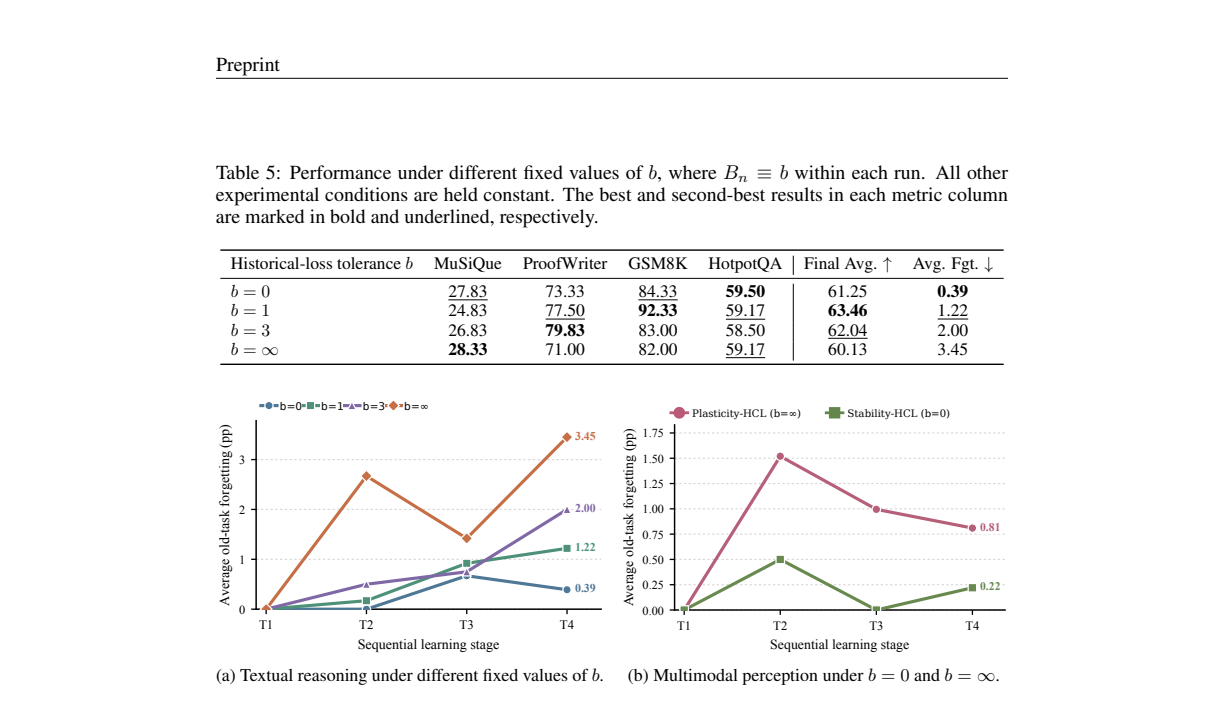
Section 4.4 admits this explicitly, and Table 5 confirms the gap empirically: at b=0, where every currently solved anchor should be preserved, average forgetting is 0.39 percentage points. As written, the paper's central claim of "retaining earlier reliable behavior" is supported only as "retaining behavior on the sampled anchor subset." This is load-bearing because the anchor selection rule (a predefined, unreported ratio of successful and failed cases, per Section 4.4 and Appendix C) shapes which candidates are accepted and hence the entire update trajectory. Please either report anchor coverage and recall against the held-out historical test sets, provide a sensitivity analysis over anchor composition and size, or carefully restate the retention claim to match the evidence.
The paper says, at §4, Tables 2–6
The review did not quote this passage.
Pith says: Objection 2 of 4 · major
All experimental results are reported as single point estimates, with no seeds, error bars, significance tests, or independent runs. This is especially consequential because candidate generation is performed by stochastic LLM inference (Section 3.3.1) and commitment decisions depend on sampled anchors and validation cases.
more of objection 2
Without repeated runs, the claimed relative gains over baselines and the differences between Stability-HCL and Plasticity-HCL could be within run-to-run noise. Please add multiple seeds (at least for the controlled streams and the budget sweep), report means and variances, and where feasible perform paired significance tests across the same proposal sequences.
The paper says, at §4.2.1, §4.3.2
The review did not quote this passage.
Pith says: Objection 3 of 4 · major
The comparison baselines MemP, MemRL, and DGG are reimplemented inside the authors' own harness, with statements such as "reimplemented within our framework with unified data processing and action selection" and DGG's setting merely "aligns" with the controlled stream. Because no validation of these reimplementations against their original published results is provided, and no code or full configuration is released, the relative-gain claims in Tables 2–4 could reflect reimplementation quality rather than genuine superiority of HCL.
more of objection 3
Please either compare against official implementations, report the original published scores on the same tasks, or release the reimplementation code and configurations so the comparisons are reproducible.
The paper says, at §4.4, §A.2
The review did not quote this passage.
Pith says: Objection 4 of 4 · major
The anchor composition parameter is described as a "predefined parameter" but its value is never reported, despite the fact that the paper itself notes that retention results are sensitive to which anchors are sampled. Moreover, the budget sweep uses a stricter current-improvement requirement (two additional correct validation cases) than the main profiles (at least one validation case), and the main profiles require only "at least one" improvement while Section 4.4 says δ in Eq.
more of objection 4
(9) requires two correct cases. These inconsistencies make it difficult to compare Table 3 with Table 5 and to assess whether the observed trade-off is driven by B_n or by other threshold differences. Please report the exact anchor ratio and reconcile the threshold statements.
5 minor objections
The paper says, at §3.3.1
Pith says: minor objection 1 of 5
Equation (2) contains a typographical double colon after "context for generating a candidate harness:", and the following paragraph repeats the sentence about generating up to K alternatives. Please clean up this section.
The paper says, at §4.2.2, Table 8
Pith says: minor objection 2 of 5
The Minecraft experiment is reported only through Figure 3, with no numerical table of task-completion counts, recovery events, or validated skill changes. Since the appendix summary lists these as the reported quantities, a small table would make the claims checkable.
show 3 more
The paper says, at §4.4 and §4.3.1
Pith says: minor objection 3 of 5
Table 5 uses 300 adaptation/80 validation examples per task, while Table 3 uses 250/50; the b=∞ row of Table 5 (60.13%) therefore should not be directly compared with Plasticity-HCL in Table 3 (64.70%). Please state this explicitly to avoid an apparent contradiction.
The paper says, at Abstract
Pith says: minor objection 4 of 5
The abstract's "relative gains exceeding 10% over corresponding baselines" is not tied to specific tables or comparison conditions. Please define the baseline(s) and settings for which this figure holds.
The paper says, at References
Pith says: minor objection 5 of 5
Reference [Li et al., 2026a] is marked as a withdrawn TMLR submission; citing a withdrawn paper without noting the withdrawal in the reference entry is inadvisable.
What would settle it
Re-run the Section 4.4 textual sweep under Stability-HCL (b=0) with five independent anchor draws per earlier task, and also evaluate each candidate on a held-out probe of 200 historical test cases per earlier task that is never used for anchor selection. Report probe forgetting alongside anchor loss for each draw. If probe forgetting remains well above zero while anchor loss is identically zero, the finite-anchor gate is the source of residual forgetting; if probe forgetting is also near zero, the Table 5 residual is instead due to stochasticity or evaluation noise. Additionally vary the anchor success/failure ratio and check whether final AvgT and Fgt shift; if they do, the retention guarantee is selection-dependent rather than a property of the guarded-evolution rule.
from the skeptic's reading
How the review went
4 readings by deepseek-v4-flash · 27 Aug 2026
- Reader holds up, with conditions
- Skeptic agrees
- Editor wrote the verdict above
- Referee major revision: 4 major objections, 5 minor
Not run on this paper: the simulated authors' defence.
Pith did not check this review's objections against the paper.
The review in full
The review in brief, machine-written
Two things to know. First, this paper gives the agent-harness literature a useful organizing frame: it treats prompts, memory, tools, and routing rules as one versioned state and defines harness-level forgetting explicitly. That is genuinely new, even though each component comes from prior systems. Second, the paper's strongest claim—that guarded evolution retains earlier reliable behavior—is only approximately true. The gate checks a finite anchor set; the paper admits this in Section 4.4, and Table 5 shows 0.39 pp forgetting even at b=0. So read it as controllable anchor retention, not full behavioral retention.
What it does well: the proposal–evaluation–commitment split is clean and the equations (9)–(13) make the gate precise. The experiments span three very different regimes, all with frozen models, and the budget sweep shows the trade-off behaves monotonically. The ablations give credible evidence that all four components contribute. The paper also deserves credit for stating the anchor limitation in the main text rather than burying it.
Where it's soft: statistical reporting is thin—no error bars, no seeds, no significance tests, so we can't tell how robust the headline numbers are. The baselines are reimplemented inside the authors' own harness, which is a real confound even if done fairly. No code or data release. The anchor selection rule (the predefined ratio of successful to failed cases) is not reported in the main text; since the update trajectory depends on which anchors are sampled, the stability–plasticity conclusions could shift with that parameter. These are all fixable in a revision. The central framework idea does not collapse; it's just less clean than the abstract promises.
Bottom line: this deserves a serious referee. The right fix is to add variance estimates, release code and data, report anchor composition, and soften the abstract to 'retains behavior on a finite set of historical anchors.' I'd be comfortable citing the formalization in my own work.
The strongest objection
The central claim is that guarded harness evolution lets a harness improve while retaining earlier reliable behavior. The implemented guarantee is narrower: Eq. (13) commits a candidate only if the finite anchor loss D_n defined in Eq. (11) is at most B_n over A_n. Nothing in the framework controls historical cases outside A_n, and Section 4.4 concedes exactly this: 'Preserving all anchors currently solved by H_n cannot guarantee unchanged behavior on historical cases not represented by A_n.' The concession is not merely formal: in the controlled textual sweep, Table 5 reports average forgetting of 0.39 percentage points at b=0 even though Stability-HCL should reject every candidate that causes any currently solved anchor to fail. Thus the headline retention result is not 'retaining earlier reliable behavior' but 'retaining behavior on a hand-selected anchor subset.' The anchor selection rule, a predefined ratio of successful and failed cases described in Appendix C, is heuristic, and the actual ratio parameter is not reported. Because commitment decisions and the resulting update trajectory depend on which anchors happen to be sampled, the stability–plasticity conclusions in Tables 3–5 could be artifacts of anchor selection rather than of the retention mechanism itself. This does not invalidate the framework, but it does mean the paper's strongest empirical claim, controllable retention of earlier behavior, is only approximately supported.
The reader's weakest assumption correctly identifies the anchor set representativeness problem, and the paper itself states the limitation in Section 4.4, making this the most load-bearing concern. My stress-test adds a concrete internal data point: even the strictest gate, b=0, leaves 0.39 pp of average forgetting in the textual sweep, which is direct evidence that the implemented guard does not fully deliver the paper's stated retention claim. The concern is genuine and central to the headline, but it is also acknowledged by the authors and does not destroy the paper's contribution as a framework with approximate, controllable retention. The experiments are coherent, the qualitative stability–plasticity trend is consistent, and the concession is stated rather than hidden. Therefore the appropriate verdict remains the reader's CONDITIONAL acceptance: the framework is plausible and useful, but the empirical retention claims need stronger validation of anchor representativeness, plus the missing statistical and reproducibility evidence noted by the reader.
The referee's report
If validated, HCL is a useful conceptual contribution: it shifts the object of continual learning from model parameters to an editable, execution-shaping harness, and it makes retention an explicit commitment condition rather than an implicit side effect. The proposal–evaluation–commitment separation is clean and the framework sensibly maps replay, representation, architecture, and regularization principles from model-centric continual learning onto harness mechanisms. The controlled sweep over b (Table 5) shows the trade-off behaving in the expected direction, and Section 4.4 gives an unusually honest statement of the anchor-set limitation. However, the empirical support is currently weakened by the absence of repeated-run statistics and by the fact that the headline retention result is demonstrated only over finite anchor sets, not over all previously reliable behavior.
Pith's reading of the paper (a machine's summary, not the authors')
Harness Continual Learning (HCL) is the paper's proposal to move continual learning from the model's weights to the harness, meaning the prompts, task templates, memory records, reusable skills, and routing rules that wrap a frozen foundation model. The paper argues that harness components are coupled in execution, so updating one can silently break behavior that previously worked, a phenomenon it names harness-level forgetting. Its solution, guarded harness evolution, separates the generation of candidate harnesses from their deployment: a Continual Optimizer proposes updates from post-execution feedback, and a Continual Evaluator commits a candidate only if it improves the current task, keeps historical anchor cases solved within a tolerance, and passes validity checks. Experiments on textual reasoning, multimodal perception, and open-world interaction report capability accumulation and failure recovery with relative gains exceeding 10% over baselines in several settings, and they show that the tolerance for historical loss is an explicit dial for the stability–plasticity trade-off. If these results hold, continual learning can be achieved, audited, and controlled entirely outside the model.
What carries the argument. The machinery that carries the argument is the guarded commitment gate of the Continual Evaluator, applied to whole-harness candidates rather than component patches. The optimizer first proposes candidate harnesses by prompting the frozen foundation model with the deployed harness and the interaction record $e_n=(u_n,i_n,z_n,y_n,f_n)$; the evaluator then runs each candidate under the same conditions on three tests. Current improvement compares validation performance $P(H,V_n)$; historical retention counts, over the finite anchor set $A_n$, cases that were solved by $H_n$ but fail under the candidate; validity checks enforce artifact syntax, output-schema compliance, legal tool use, and environment consistency. The conjunction in Eq. (13), $\Delta_n\ge\delta_n$, $D_n\le B_n$, and every validity check satisfied, is a hard admissibility gate: no single component change can enter the deployed harness unless the whole candidate passes, and if none passes the deployed harness $H_n$ is retained. This proposal–evaluation–commitment separation is what converts retention from an aspiration into an explicit, inspectable condition of every update.
Core claim. HCL's central claim is that the state to be learned sequentially is the harness $H_n=(I_n,M_n,C_n,R_n)$ around a frozen foundation model $F_\theta$, not the parameters $\theta$; the four components are the Task Interface, Experience Memory, Capability Map, and Adaptive Router, and they are versioned jointly so that no individual edit can enter the deployed harness alone. Harness-level forgetting is the paper's definition of the failure mode: a later harness update turns an earlier correct answer, valid tool call, or successful action trajectory into a failure even though the model has not changed, because memory retrieval, capability selection, and routing are coupled. Guarded harness evolution is the proposed control: the Continual Optimizer proposes candidate harnesses from interaction evidence, and the Continual Evaluator commits a candidate only if the gate in Eq. (13) passes, namely $\Delta_n \ge \delta_n$, $D_n \le B_n$, and all validity checks hold. The quantity $D_n$ counts anchors $a\in A_n$ that succeed under the deployed harness but fail under the candidate, so $B_n$ is an explicit budget on historical loss; setting $B_n=0$ is the stability configuration and $B_n=\infty$ the plasticity configuration. The experiments claim that this process accumulates capability and supports failure recovery on frozen models, that average forgetting is measurably nonzero and grows with $B_n$, and that overall performance is not monotone in $B_n$: the best final average in the textual sweep occurs at $b=1$, not at $b=\infty$.
The premise it rests on. The load-bearing premise is that a small set of saved example cases stands in for all previously reliable behavior; if a regression happens on a case none of those examples resembles, the guard lets it through.
If the paper is right (Pith's inferences, not the authors')
A frozen foundation model can still improve across a stream of tasks, because experience, skills, and routing rules accumulate in the harness rather than in the weights.
Harness-level forgetting is real and measurable: the paper records nonzero old-task forgetting even under a zero-loss tolerance, confirming that updates to prompts and memory can break earlier behavior.
The historical-loss tolerance $B_n$ gives a direct control knob for the stability–plasticity trade-off, with stricter budgets reducing forgetting and looser budgets enabling more adaptation.
Component ablations show that disabling Experience Memory updates hurts final performance most and increases forgetting, indicating that memory is the harness component carrying both acquisition and retention.
In the open-world Minecraft curriculum, the evolving harness completes all 50 tasks while the static harness plateaus at 15, and it uses fewer environment actions than memory-only baselines, showing that harness evolution adds efficiency as well as capability.
Because the retention check depends on a finite anchor set, the practical limit of HCL is anchor coverage: actively selected anchors that maximize input or failure-mode diversity could close the measured gap between anchor retention and true test-set forgetting.
HCL is complementary to model-centric continual learning: a model that is itself continually updated could also carry a harness, and the two forms of state could be versioned together, an extension the paper does not develop.
Harness state is textual and versioned, so HCL may offer an audit trail that parameter updates do not: one can inspect exactly which prompt, memory entry, skill, or routing rule changed and caused a regression.
A testable extension would be to replace the hand-set ratio of successful and failed anchors with coverage-driven selection and to measure whether that reduces test-set forgetting for the same budget $B_n$.
Check this review
Pith stored no record of this review's passes and took no fingerprint of it. Reviews made by code from 13 Nov 2026 on carry both.
How often reviews like this one are right
Reviews like this one: written by deepseek-v4-flash, where what was read was not recorded.
How often objections from reviews like this one are right: not yet measured
Reviews by people
This review was written by a machine. No person has reviewed this paper on Pith yet. A scientist listed on Pith can review it for a fee, and their review is published here whatever it concludes.
The paper
Abstract
Continual learning has largely been model-centric, treating model parameters as the state that changes with sequential experience. Modern agents can also adapt through a harness of prompts, memories, tools, skills, and routing rules. Because these contents jointly shape later execution, a harness update can disrupt previously reliable behavior even when the model is frozen. This raises a new question: how can an agent continually improve its state outside the model while retaining behavior acquired earlier? We formulate Harness Continual Learning (HCL), a new continual learning paradigm in which the harness evolves around a frozen foundation model, and define the resulting loss of earlier behavior as harness-level forgetting. We instantiate HCL with four execution-facing components: the Task Interface, Experience Memory, Capability Map, and Adaptive Router. We further introduce guarded harness evolution to separate update generation from state commitment. A Continual Optimizer proposes candidate harnesses from post-execution feedback, and a Continual Evaluator commits the resulting candidate harness only after checking current improvement, historical retention, and validity. Experiments on textual reasoning, multimodal perception, and open-world interaction demonstrate capability accumulation and failure recovery, with relative gains exceeding 10% over corresponding baselines in multiple settings. Component ablations assess the contribution of each harness component, while controlled retention sweeps reveal measurable harness-level forgetting and show that the stability–plasticity trade-off can be explicitly adjusted.
The paper's own sentences, arranged, kept beside the review and separate from it. Each label is drawn from a closed vocabulary; the number beside it is the probability the classifier gave that label. No sentence in this record was written by a model.
abstract compiled · 2026-09-23
The authors' main claim, as the classifier picked it out 0.80
“Experiments on textual reasoning, multimodal perception, and open-world interaction demonstrate capability accumulation and failure recovery, with relative gains exceeding 10% over corresponding baselines in multiple settings.”
How the main claim is stated: asserted 1.00
What the abstract itself states, as probabilities: claims first 0.14 · states limitation 0.59 · human participants 0.04 · controlled comparison 0.92 · randomized assignment 0.02 · states quantitative result 0.98 · compares with prior results 0.95 · mentions code or data availability 0.03
The abstract, sentence by sentence
This table labels the abstract only (arXiv listing abstract v1). The number is the probability the classifier gave the label.
| Sentence | Role | The authors' own work | States the main conclusion | Strength |
|---|---|---|---|---|
| Continual learning has largely been model-centric, treating model parameters as the state that changes with sequential experience. | background 1.00 | 0.06 | 0.03 | asserted 1.00 |
| Modern agents can also adapt through a harness of prompts, memories, tools, skills, and routing rules. | background 0.98 | 0.08 | 0.04 | asserted 0.66 |
| Because these contents jointly shape later execution, a harness update can disrupt previously reliable behavior even when the model is frozen. | background 0.81 | 0.14 | 0.05 | asserted 0.91 |
| This raises a new question: how can an agent continually improve its state outside the model while retaining behavior acquired earlier? | gap 0.98 | 0.07 | 0.05 | unclear 0.52 |
| We formulate Harness Continual Learning (HCL), a new continual learning paradigm in which the harness evolves around a frozen foundation model, and define the resulting loss of earlier behavior as harness-level forgetting. | contribution 0.97 | 0.90 | 0.20 | asserted 0.99 |
| We instantiate HCL with four execution-facing components: the Task Interface, Experience Memory, Capability Map, and Adaptive Router. | method 0.64 | 0.93 | 0.05 | asserted 1.00 |
| We further introduce guarded harness evolution to separate update generation from state commitment. | method 0.84 | 0.82 | 0.04 | asserted 0.98 |
| A Continual Optimizer proposes candidate harnesses from post-execution feedback, and a Continual Evaluator commits the resulting candidate harness only after checking current improvement, historical retention, and validity. | method 0.99 | 0.91 | 0.08 | asserted 0.98 |
| Experiments on textual reasoning, multimodal perception, and open-world interaction demonstrate capability accumulation and failure recovery, with relative gains exceeding 10% over corresponding baselines in multiple settings. | result 1.00 | 0.96 | 0.39 | asserted 1.00 |
| Component ablations assess the contribution of each harness component, while controlled retention sweeps reveal measurable harness-level forgetting and show that the stability--plasticity trade-off can be explicitly adjusted. | result 0.92 | 0.96 | 0.21 | asserted 1.00 |
What kind of paper the classifier reports this is: method or tool 1.00 · evidence from observation or experiment 1.00
What was examined, and what was not
Sources read
- arXiv listing abstract v1
Not examined
- full text
- figures and tables
- references and citing sentences
- relations to other papers
Levels run
- P abstract
Not run
- S sections
- T body sentences
- C citations
- R cross-paper relations
How the labels were made
Compiled by classifier-1.13.0 via TypeSafe API, question bank abstract-p1-20260923, 2026-09-23: 1 request, 7,530 input tokens.
Every quoted sentence on this record is the authors'. Every label is from Pith's closed vocabulary, with the probability shown beside it. This record as JSON
Figures (4)


Figures are the authors', reproduced from the paper.
Cited by 10 Pith papers
Reviewed papers on Pith that cite this one. The full citation record
- The Trinity: Capability-Driven Recursive Self-Improvement for Multimodal Agents cs.AI · Oct 2026
- Bad Genius: Counterfactual-Guided Harness Evolution Beyond Task-Specific Shortcuts cs.AI · Sep 2026
- Assurance-Conditioned Continuous Authorization for Autonomous AI Agents cs.AI · Nov 2026
- VEvo-Harness: Causally-Guarded Self-Evolving Harness for Agentic Image Generation cs.CV · Oct 2026
- HERD: Harness-Evolving Recursive Distillation for Continual Learning cs.CL · Oct 2026
- Elicitation or Expansion? Demystifying Gains from Agent Harness Optimization cs.LG · Oct 2026
- ServeLearnBench: How Well Can Agents Self-Improve from Serving Experience? cs.LG · Oct 2026
- Test-Time Adaptation of Reasoning Strategies with Bayesian Nonparametric Memory cs.CL · Oct 2026
- RSI-Router: Evolving Subtask-Level LLM Routing and Skills for Cost-Efficient Agents cs.AI · Sep 2026
- Lessons Outlive Their Failures: A Case Study of Rules for AI Coding Agents cs.SE · Oct 2026
How the literature uses it
What this paper does with the arXiv papers it cites
What it cites · 11 sentences without a confident label
Uses data or values from 1 paper
-
The textual stream follows the order MuSiQue [ref] , ProofWriter [ref] , GSM8K [ref] , and HotpotQA [ref] .
Training Verifiers to Solve Math Word Problems · Textual Reasoning · 0.86
Compares with 2 papers
-
We compare HCL with a Static Harness, a RAG baseline, MemP [ref] , and MemRL [ref] .
MemRL: Self-Evolving Agents via Runtime Reinforcement Learning on Episodic Memory · ALFWorld · 1.00
-
We additionally compare with DGG [ref] , a recent adaptive method for sequential multi-task continual learning whose setting aligns with this controlled multimodal stream.
2511.15164 · Multimodal Perception · 1.00
Cites as background 7 papers
-
MemGPT, Reflexion, and Voyager retain experience as memory, feedback, or executable skills [ref] .
MemGPT: Towards LLMs as Operating Systems · Harness Engineering · 0.83
-
Toolformer, MRKL, and HuggingGPT expose and coordinate external capabilities [ref] .
MRKL Systems: A modular, neuro-symbolic architecture that combines large language models, external knowledge sources and discrete reasoning · Harness Engineering · 0.86
-
Architecture-based approaches isolate, expand, or select model components to reduce interference between tasks [ref] .
CP-MoE: Consistency-Preserving Mixture-of-Experts for Continual Learning · Model-Centric Continual Learning · 0.81
Challenges and discussion
Disagree with the review, or know something it missed? Leave a comment, or challenge this review formally: a challenge becomes a permanent entry in this paper's record, and its decision is published here.
Come back by email
A short list of the week's newly reviewed papers. Nothing is sent until you confirm from your inbox, and every email has a link that stops it. No account.
No comments yet.
Sign in to comment