Quantum Physics · arXiv:2608.27568 v2 · submitted 27 Aug 2026
Quantifying the Dual-isotope Advantage for Ytterbium-array Surface Codes using Realistic Noise Models
The paper says
“Neutral-atom quantum computers are a promising platform for fault-tolerant quantum computation, but logical performance depends on systemic realistic noise factors during syndrome extraction.”
more of the abstract
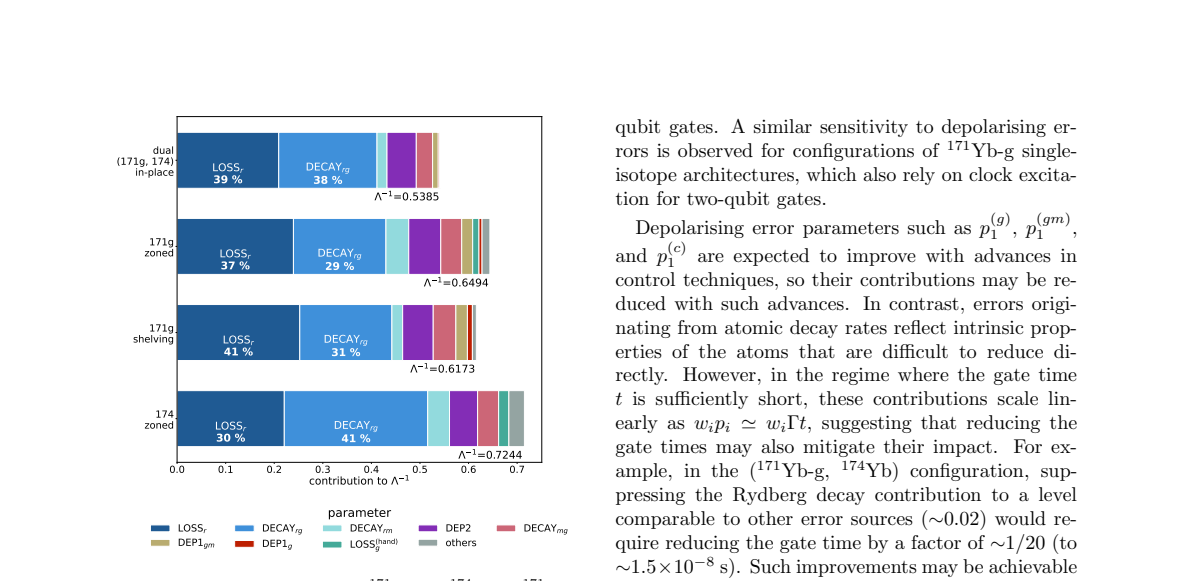
In dual-isotope Yb arrays, the roles of data and ancilla qubits are separated spectrally, allowing ancilla qubits to be measured in place without additional transport or shelving operations. Here we quantify the advantage of a dual-isotope Yb architecture for surface code memories. We develop an experimentally motivated Clifford-compatible noise model for dual-isotope 171Yb-174Yb systems using generalised Pauli twirling and implement it as a wrapper for Stim called DualYbSim, which has been packaged as an open source Python library. Simulations of rotated and XZZX surface codes show that a dual-isotope architecture with in-place measurement achieves the lowest logical error rates among the architectures considered, outperforming single-isotope schemes based on shelving or zoned measurement. Our error-budget analysis also identifies Rydberg-state decay as the dominant limitation, contributing to 74-80% of the logical error rate scaling, highlighting concrete experimental targets for improving FTQC performance.
from the abstract
Pith says
Machine review · deepseek-v4-flash · 9 Sep 2026 · of version 1 of the paper; version 2 is newer · what was read was not recorded · not checked by a person
It can be wrong. Challenge this review or reply to it.
The passes disagreed. Reader: holds up. Skeptic: holds up only with conditions. Referee: minor revision.
Solid simulation study with open-source code showing dual-isotope Yb advantage; the GPTA for sequential decays is a real but probably minor weakness that should be addressed. This line is wrong
1 major objection · 10 minor
How often objections from reviews like this one are right: not yet measured
Not checked: figures, code, what the references say.
The paper says, at Section 2.3 and Appendix A.10
The review did not quote this passage.
Pith says: Objection 1 of 1 · major
The paper relies on the generalized Pauli twirling approximation (GPTA) to convert non-Pauli physical noise into Clifford-simulatable Pauli and erasure channels. The derivation in Appendix A.10 shows that for fast Rydberg decay (Γ_r >> Γ_m, Γ_g) the aggregate channel approximately factorises into independent steps, and this ordering is used in the simulation.
more of objection 1
However, the paper does not validate the GPTA against exact density-matrix simulation for the specific multi-step decay sequences that occur in the model (e.g., Rydberg→metastable→ground). The concern is that the composition of independently twirled channels may not equal the twirl of the composition, and that off-diagonal coherences or ordering-dependent branchings are lost. While the comparative ranking of architectures may be robust to small systematic errors, the quantitative logical error rates and error-budget fractions could shift. The authors should either provide a small-scale numerical comparison (e.g., for a single CZ gate) demonstrating that the GPTA reproduces the exact error probabilities to within the statistical uncertainty of the LER estimates, or add a clear discussion of the expected error and why it does not affect the conclusions.
10 minor objections
The paper says, at Abstract
Pith says: minor objection 1 of 10
The phrase 'systemic realistic noise factors' should likely read 'systematic realistic noise factors' for clarity, or 'systemic' should be defined if it is intended to mean inherent to the system.
The paper says, at Section 1
Pith says: minor objection 2 of 10
The reference to the open-source library [1] should be accompanied by a persistent identifier (e.g., a DOI or permanent repository URL) to ensure accessibility beyond the arXiv submission.
show 8 more
The paper says, at Section 2.3, Eq. (4)
Pith says: minor objection 3 of 10
The composition E_erase ∘ ~E_twirl is introduced without specifying the order of application at this point. While Appendix A.9 defines the ordering for each operation, a brief note in the main text (e.g., 'the twirled Pauli channel is applied before the erasure channel') would help the reader.
The paper says, at Section 3, Figure 2 caption
Pith says: minor objection 4 of 10
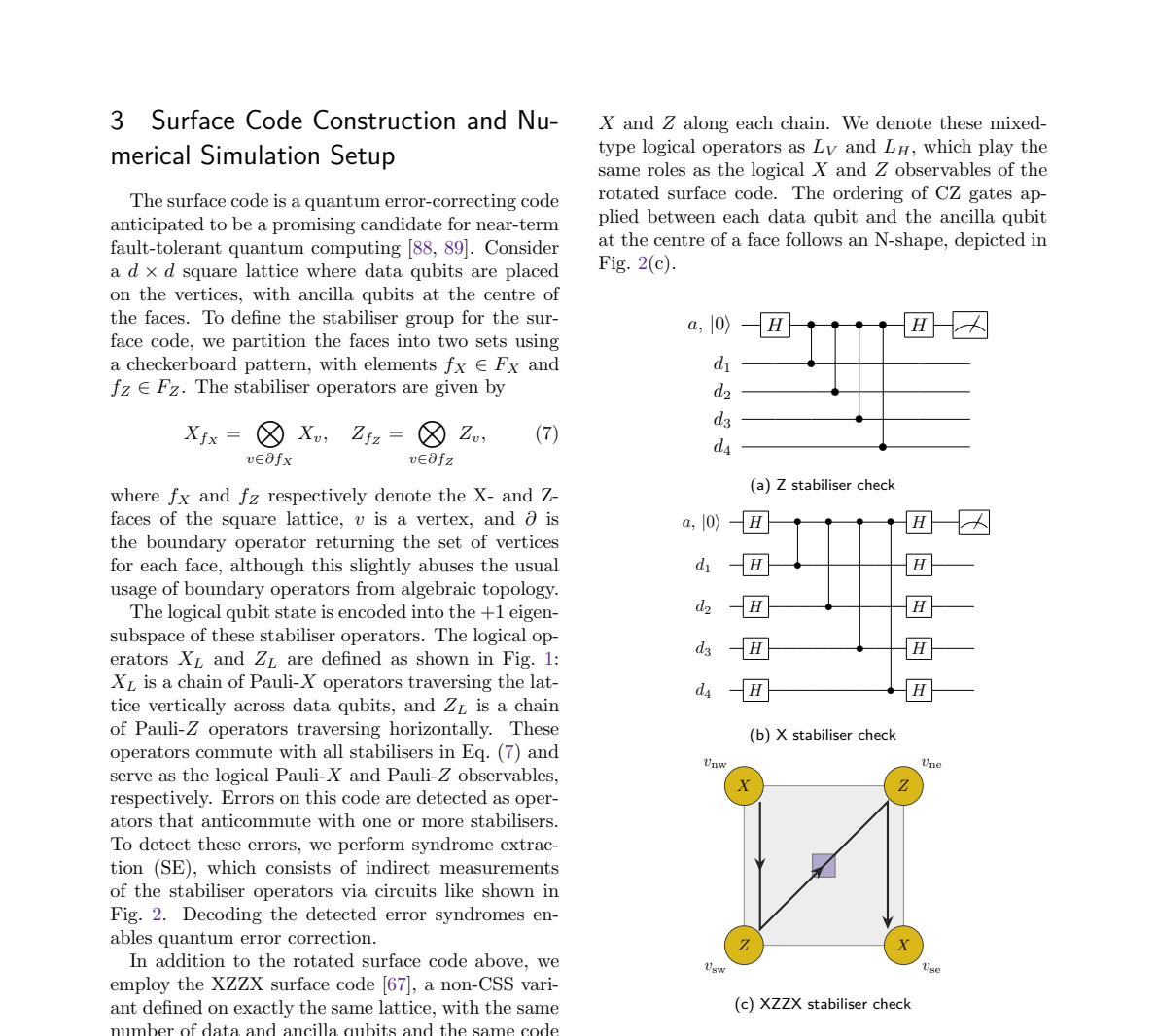
In panel (c), the 'N-shaped arrow' denoting the gate order is described in the caption but may be difficult to see in print. Please ensure the figure resolution is adequate and consider adding a more explicit description in the caption.
The paper says, at Section 3, Figure 3 caption
Pith says: minor objection 5 of 10
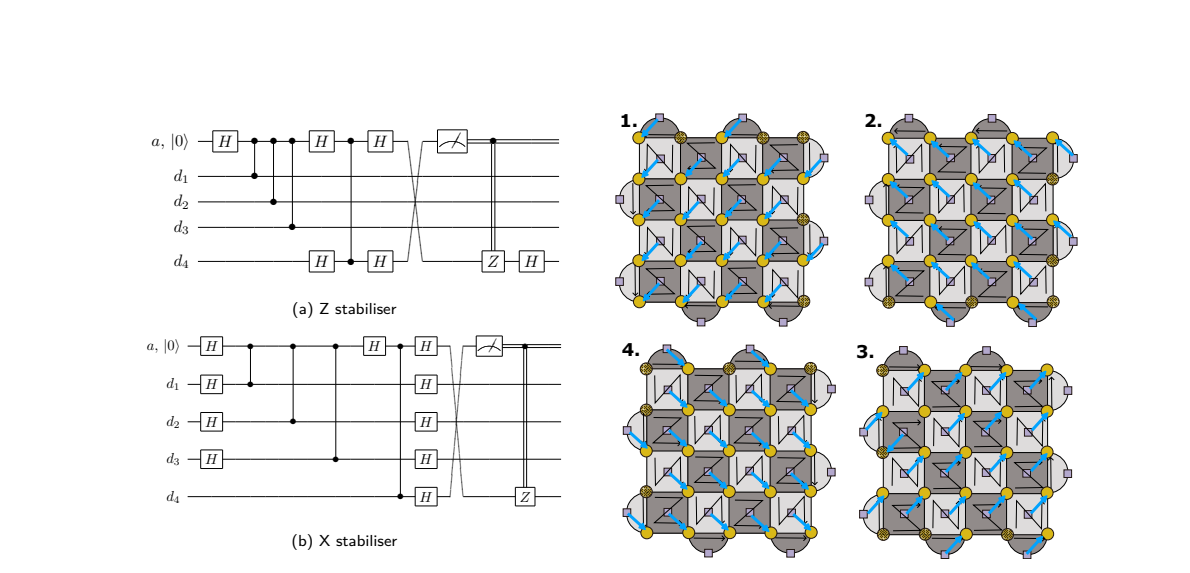
The circuit symbols for the SWAP operation (physical exchange and state SWAP) are used but not defined in the caption. Please add a brief definition or a reference to the explanation in the main text.
The paper says, at Section 4.1, paragraph 2
Pith says: minor objection 6 of 10
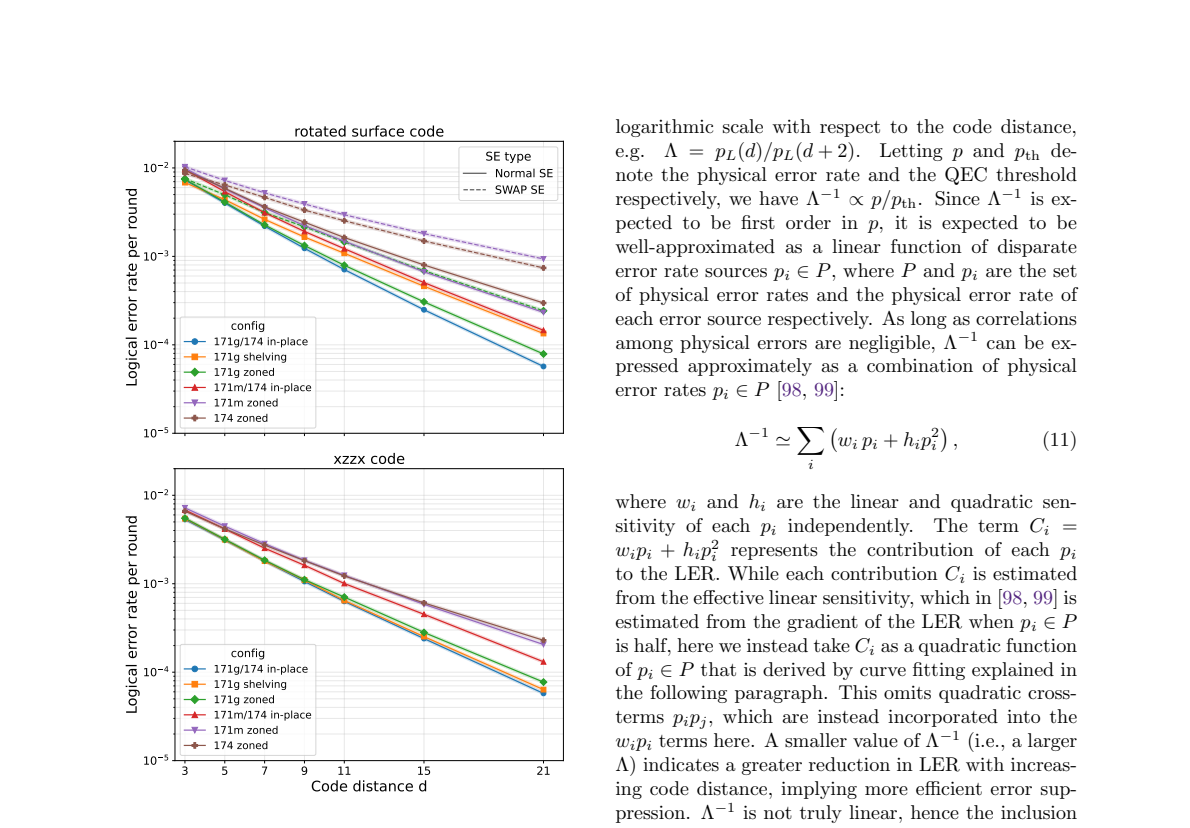
The paper states that p_L decreases with code distance 'implying subthreshold behaviour at the error rates of the model.' The threshold itself is not extracted or compared. A table of estimated thresholds or a comparison to previously reported neutral-atom surface code thresholds would strengthen the interpretation.
The paper says, at Section 4.2, Eq. (11)
Pith says: minor objection 7 of 10
The term 'stray error' is introduced as the residual Λ^{-1} - Σ C_i. The magnitude of the stray error for each configuration in Figure 6 should be reported explicitly (e.g., in the caption or a supplementary table) to demonstrate that the linear+quadratic approximation is adequate.
The paper says, at Table 1
Pith says: minor objection 8 of 10
For the DECAYrm entry in the dual-isotope case, the linear sensitivity w_i is reported as 0. This is unexpected for a decay channel with a finite contribution C_i. Please clarify whether this is a genuine fit result (the quadratic term dominates) or an artifact of the fitting procedure (e.g., limited data points for the linear term due to the chosen parameter sweep range).
The paper says, at Appendix A.10
Pith says: minor objection 9 of 10
The derivation approximates (I + L/Γ_r) ≈ I by assuming Γ_r >> |L|. The matrix L contains rates up to ~1 s^{-1}, which are indeed much smaller than Γ_r ≈ 2×10^4 s^{-1}. An explicit comparison of these timescales (or a brief statement that Γ_r is at least 10^4 times larger) would make the approximation more transparent.
The paper says, at Appendix B.3, first paragraph
Pith says: minor objection 10 of 10
The sentence 'For the 171Yb-g qubit, on the other hand, we assume these channels act as the identity because the decay from the metastable manifolds to the ground manifolds is negligible, except when applying the clock-transition excitation during the two-qubit gate' would benefit from a cross-reference to Appendix B.4, where the clock-transition excitation and its associated decay are described.
What would settle it
For the dual-isotope (171Yb-g, 174Yb) and the single-isotope 171Yb-m configurations, build the exact composite noise channel for a single two-qubit gate cycle (including the CZ gate and the subsequent idling/decay period) by numerically solving the Lindblad master equation on the full multi-level Hilbert space (6 levels for 171Yb, 4 for 174Yb). Then compare the resulting logical error rate for d=3 surface code (using exact density-matrix simulation or tensor-network) to the prediction from the twirled approximation used in the paper. If the discrepancy in p_L exceeds ~20% of the difference between the two configurations at d=3, the twirling approximation may alter the architectural ranking at larger d.
from the skeptic's reading
How the review went
4 readings by deepseek-v4-flash · 9 Sep 2026
- Reader holds up
- Skeptic agrees: says it holds up only with conditions Generalized Pauli twirling of sequentially composed decay channels may miss correlated errors from leakage returning to the computational subspace, potentially affecting relative advantage.
- Editor wrote the verdict above
- Referee minor revision: 1 major objection, 10 minor
Not run on this paper: the simulated authors' defence.
Pith did not check this review's objections against the paper.
The review in full
The review in brief, machine-written
This paper does what it says: it builds an experimentally motivated Clifford-compatible noise model for dual-isotope Yb systems, packages it as open-source Python (DualYbSim), and runs head-to-head surface-code simulations comparing dual-isotope in-place measurement against single-isotope shelving and zoned measurement. The central result—that the dual-isotope (171Yb-g, 174Yb) configuration with in-place measurement gives the lowest logical error rates—is well supported by the data. The error-budget analysis (Rydberg decay dominant, ~74-80%) is clean and actionable. The paper is competently written and the code availability is a real strength.
The main soft spot is the reliance on the generalized Pauli twirling approximation for sequential decay channels (e.g., Rydberg→metastable→ground). The stress-test concern—that twirling each decay independently loses correlated errors from leakage that returns to the computational subspace—is technically correct. The paper acknowledges the GPTA but does not validate it for multi-step sequences against exact density-matrix simulation for a small system. That said, the dominant Rydberg decay timescales (50 µs lifetime, gate time 0.3 µs) make the probability of two sequential decays within a gate very low, so the impact on the main conclusions is likely small. Still, a brief validation or a discussion of the regime where GPTA might break down would strengthen the paper.
A minor note: the paper uses erasure channels without passing herald flags to the decoder, which is a deliberate choice, so the SWAP SE disadvantage might partly reflect that. This is fine as stated but worth keeping in mind.
Overall, this is a solid contribution that gives quantitative guidance for architectural choices in neutral-atom QEC. It is not groundbreaking but it is careful and reproducible. I would accept it after minor revision to add a paragraph addressing the GPTA limitation and its expected impact.
The strongest objection
The paper decomposes physical noise into independent Pauli-twirled channels (Eq. 4) applied in a fixed order (Appendix A.9). For multi-level decays such as Rydberg→metastable (DECAYrm) followed by metastable→ground (DECAYmg), the exact composition is a two-step process that can produce a correlated error (e.g., a biased bit-flip plus erasure). The GPTA treats each decay as either an erasure or a single Pauli error (Appendix B.3), but the twirling is performed independently on each channel. The composition of twirled channels does not generally equal the twirl of the composition; off-diagonal coherences and ordering-dependent branchings are lost. This matters most for configurations with more metastable-qubit exposure (171Yb-m) or longer idling times where sequential decays are likely. If the twirling underestimates or misrepresents the net effect of leakage that returns to the computational subspace, the quantitative LERs for different architectures could shift by an amount comparable to the advantage claimed in Figure 5. The paper does not validate the GPTA for multi-step decay sequences against exact simulation.
The paper is otherwise very solid, with open code and thorough modeling. The central claim is well-supported under the chosen approximations. However, the validation of the GPTA for the specific multi-level Yb system is absent, and the composition of twirled channels introduces a known source of error that could affect relative comparisons. A small-scale exact check would greatly strengthen confidence. Given the high quality of the rest of the work, I recommend conditional acceptance requiring this validation or an explicit discussion of the expected error from the approximation.
The referee's report
If the quantitative results hold, this work provides valuable guidance for the design of near-term neutral-atom fault-tolerant quantum computers. The comparison of dual-isotope and single-isotope architectures under realistic noise is timely, as neutral-atom platforms are maturing toward QEC experiments. The open-source simulation library (DualYbSim) is a practical contribution that enables the community to reproduce and extend the results. The error-budget analysis highlights concrete experimental targets (reducing Rydberg decay) that are actionable for hardware teams. The study is methodologically sound, using standard tools (Stim, PyMatching) and a well-documented noise model with parameters drawn from recent experimental demonstrations.
Pith's reading of the paper (a machine's summary, not the authors')
This paper simulates the logical error rates of surface-code quantum memories using a realistic noise model for ytterbium atom arrays. It finds that a dual-isotope architecture, where data qubits and ancilla qubits are spectrally separated, achieves lower logical error rates than single-isotope configurations that require additional operations like shelving or atom transport. The advantage comes from in-place measurement without extra overhead. The results also identify Rydberg-state decay during two-qubit gates as the dominant error source, accounting for 74–80% of the logical error rate scaling, pointing to concrete experimental targets for improvement.
What carries the argument. The paper's core tool is a Clifford-compatible noise model (implemented in the open-source library DualYbSim) that uses generalized Pauli twirling to approximate the complex multi-level decay and loss processes of ytterbium atoms as Pauli and erasure channels, enabling large-scale surface-code simulations. The key comparison is between dual-isotope in-place measurement and single-isotope shelving or zoned measurement schemes, evaluated via Monte Carlo sampling with Stim and decoded with minimum-weight perfect matching.
Core claim. The paper demonstrates that for both rotated and XZZX surface codes, the dual-isotope (171Yb-g data qubit, 174Yb ancilla qubit) configuration with in-place measurement yields the smallest logical error per round among all considered architectures, with an error suppression factor Λ≈1.86. This advantage arises because the dual-isotope scheme avoids additional gate errors and transport-induced losses that plague single-isotope schemes based on shelving or zoned measurement. Error-budget analysis attributes 74–80% of the logical error rate to Rydberg-state decay, making it the primary bottleneck.
The premise it rests on. The noise model uses a generalized Pauli twirling approximation to convert non-Pauli physical noise (such as decay and loss) into Pauli and erasure channels, but the accuracy of this approximation for the specific multi-level ytterbium system is not independently validated in the paper.
If the paper is right (Pith's inferences, not the authors')
Dual-isotope architectures should be prioritized for near-term neutral-atom fault-tolerant quantum computers because they achieve the lowest logical error rates without requiring additional mid-circuit operations.
Reducing Rydberg-state decay (e.g., by shortening gate times via higher-power lasers) will improve logical error rates more than other hardware improvements, as it contributes 74–80% of the error budget.
The DualYbSim tool allows researchers to evaluate other quantum error-correcting codes and alternative noise parameters without performing full density-matrix simulations.
The error-budget methodology demonstrated here can be applied to other atomic species and code families to identify dominant noise channels and guide experimental efforts.
The advantage of dual-isotope in-place measurement may extend beyond surface codes to high-rate quantum LDPC codes that also benefit from low-overhead syndrome extraction.
If the erasure information from decay events (which the paper does not use for decoding) were exploited, the logical error rates could be reduced further, potentially widening the advantage over single-isotope schemes.
The accuracy of the generalized Pauli twirling approximation for this specific multi-level system could be validated by comparing full density-matrix simulations of small codes (e.g., distance 3) with the twirled results.
The dual-isotope approach might be combined with erasure conversion techniques to convert Rydberg decay into detectable erasure events, further improving threshold and logical error rates.
Check this review
Pith stored no record of this review's passes and took no fingerprint of it. Reviews made by code from 13 Nov 2026 on carry both.
How often reviews like this one are right
Reviews like this one: written by deepseek-v4-flash, where what was read was not recorded.
How often objections from reviews like this one are right: not yet measured
Reviews by people
This review was written by a machine. No person has reviewed this paper on Pith yet. A scientist listed on Pith can review it for a fee, and their review is published here whatever it concludes.
The paper
Abstract
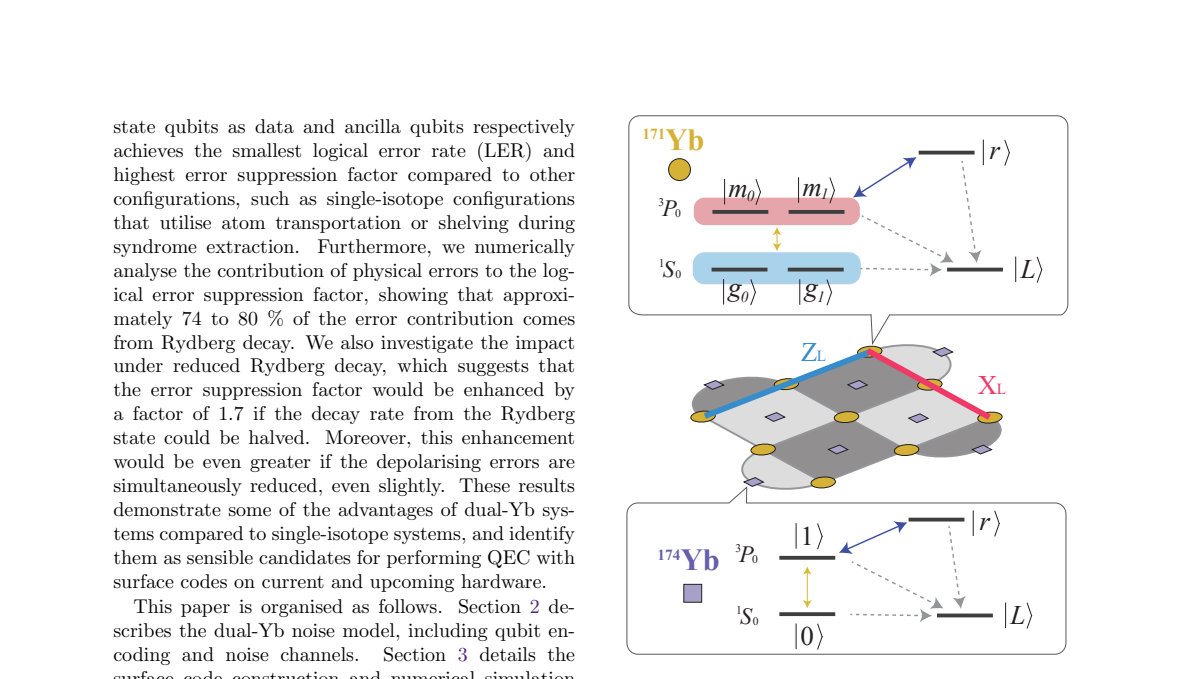
Neutral-atom quantum computers are a promising platform for fault-tolerant quantum computation, but logical performance depends on systemic realistic noise factors during syndrome extraction. In dual-isotope Yb arrays, the roles of data and ancilla qubits are separated spectrally, allowing ancilla qubits to be measured in place without additional transport or shelving operations. Here we quantify the advantage of a dual-isotope Yb architecture for surface code memories. We develop an experimentally motivated Clifford-compatible noise model for dual-isotope 171Yb-174Yb systems using generalised Pauli twirling and implement it as a wrapper for Stim called DualYbSim, which has been packaged as an open source Python library. Simulations of rotated and XZZX surface codes show that a dual-isotope architecture with in-place measurement achieves the lowest logical error rates among the architectures considered, outperforming single-isotope schemes based on shelving or zoned measurement. Our error-budget analysis also identifies Rydberg-state decay as the dominant limitation, contributing to 74-80% of the logical error rate scaling, highlighting concrete experimental targets for improving FTQC performance.
The paper's own sentences, arranged, kept beside the review and separate from it. Each label is drawn from a closed vocabulary; the number beside it is the probability the classifier gave that label. No sentence in this record was written by a model.
abstract compiled · 2026-09-23
The authors' main claim, as the classifier picked it out 1.00
“Simulations of rotated and XZZX surface codes show that a dual-isotope architecture with in-place measurement achieves the lowest logical error rates among the architectures considered, outperforming single-isotope schemes based on shelving or zoned measurement.”
How the main claim is stated: asserted 1.00
What the abstract itself states, as probabilities: claims first 0.05 · states limitation 0.72 · human participants 0.02 · controlled comparison 0.83 · randomized assignment 0.01 · states quantitative result 0.98 · compares with prior results 0.90 · mentions code or data availability 0.96
The abstract, sentence by sentence
This table labels the abstract only (arXiv listing abstract v2). The number is the probability the classifier gave the label.
| Sentence | Role | The authors' own work | States the main conclusion | Strength |
|---|---|---|---|---|
| Neutral-atom quantum computers are a promising platform for fault-tolerant quantum computation, but logical performance depends on systemic realistic noise factors during syndrome extraction. | background 1.00 | 0.06 | 0.02 | asserted 0.87 |
| In dual-isotope Yb arrays, the roles of data and ancilla qubits are separated spectrally, allowing ancilla qubits to be measured in place without additional transport or shelving operations. | background 0.92 | 0.12 | 0.05 | asserted 1.00 |
| Here we quantify the advantage of a dual-isotope Yb architecture for surface code memories. | contribution 1.00 | 0.89 | 0.06 | asserted 0.71 |
| We develop an experimentally motivated Clifford-compatible noise model for dual-isotope 171Yb-174Yb systems using generalised Pauli twirling and implement it as a wrapper for Stim called DualYbSim, which has been packaged as an open source Python library. | method 0.90 | 0.96 | 0.04 | asserted 1.00 |
| Simulations of rotated and XZZX surface codes show that a dual-isotope architecture with in-place measurement achieves the lowest logical error rates among the architectures considered, outperforming single-isotope schemes based on shelving or zoned measurement. | result 1.00 | 0.95 | 0.81 | asserted 1.00 |
| Our error-budget analysis also identifies Rydberg-state decay as the dominant limitation, contributing to 74-80% of the logical error rate scaling, highlighting concrete experimental targets for improving FTQC performance. | result 0.76 | 0.95 | 0.21 | asserted 1.00 |
What kind of paper the classifier reports this is: simulation study 0.75 · evidence from simulation or computation 1.00
What was examined, and what was not
Sources read
- arXiv listing abstract v2
Not examined
- full text
- figures and tables
- references and citing sentences
- relations to other papers
Levels run
- P abstract
Not run
- S sections
- T body sentences
- C citations
- R cross-paper relations
How the labels were made
Compiled by classifier-1.13.0 via TypeSafe API, question bank abstract-p1-20260923, 2026-09-23: 1 request, 5,136 input tokens.
Every quoted sentence on this record is the authors'. Every label is from Pith's closed vocabulary, with the probability shown beside it. This record as JSON
Figures (7)
Showing 6 of the paper's 7 figures. Figures are the authors', reproduced from the paper.
How the literature uses it
What this paper does with the arXiv papers it cites
What it cites · 20 sentences without a confident label
Uses the method or tool of 3 papers
-
Using the noise model developed for this work, which has been packaged as a publicly available open-source Python library [ref] , we simulate and compare the logical error rates across various Yb-isotope configurations including single-isotope configurations with atom transportation [ref] or shelving [ref] during syndrome extraction (SE).
Quantum error correction with the toric code · Introduction · 0.94
-
To implement loss-aware readout [ref] , we employ a three-step procedure: (1) fluorescence detection via the $$ or $$ transition to identify atoms in the ground state, (2) a $π$-pulse on the $↔$ clock-transition to swap the populations of $|0⟩$ and $|1⟩$, and (3) a second fluorescence detection to identify atoms originally in the metastable state.
Low-Overhead Surface Code with Delayed Atom-Loss Detection via Pauli Envelope · Dual-isotope Ytterbium qubits · 0.89
-
We utilise the correlated matching option [ref] provided by pymatching to decode syndromes.
Optimal complexity correction of correlated errors in the surface code · Surface Code Construction and Numerical Simulation Setup · 1.00
Cites as support 3 papers
-
This target-performance assumption is motivated by recent progress in interspecies Rydberg gates and by the expectation that the dominant gate errors can be reduced with improved Rydberg-gate control [ref] .
2601.16257 · Coherent-control channels · 0.99
-
This target-performance assumption is motivated by recent progress in interspecies Rydberg gates and by the expectation that the dominant gate errors can be reduced with improved Rydberg-gate control [ref] .
Qubit syndrome measurements with a high fidelity Rb-Cs Rydberg gate · Coherent-control channels · 0.99
-
This target-performance assumption is motivated by recent progress in interspecies Rydberg gates and by the expectation that the dominant gate errors can be reduced with improved Rydberg-gate control [ref] .
Multi-Qubit Stabilizer Readout on a Dual-Species Rydberg Array · Coherent-control channels · 0.99
Cites as background 8 papers
-
These features constitute a versatile framework for exploring resource-efficient quantum error correction (QEC) schemes and logical operations, including high-rate QEC codes [ref] and transversal logic [ref] .
Towards Ultra-High-Rate Quantum Error Correction with Reconfigurable Atom Arrays · Introduction · 0.88
-
These features constitute a versatile framework for exploring resource-efficient quantum error correction (QEC) schemes and logical operations, including high-rate QEC codes [ref] and transversal logic [ref] .
Fast correlated decoding of transversal logical algorithms · Introduction · 0.88
-
Neutral atoms in optical tweezer arrays have emerged as a promising platform for quantum computing [ref] , offering advantages such as long coherence times [ref] , high-fidelity gate operations [ref] , scalability [ref] , and flexible connectivity enabled by coherent atom transport [ref] .
2603.15561 · Introduction · 0.94
Challenges and discussion
Disagree with the review, or know something it missed? Leave a comment, or challenge this review formally: a challenge becomes a permanent entry in this paper's record, and its decision is published here.
Come back by email
A short list of the week's newly reviewed papers. Nothing is sent until you confirm from your inbox, and every email has a link that stops it. No account.
No comments yet.
Sign in to comment