Quantum Physics · arXiv:2603.13492 v4 · submitted 13 Mar 2026 · 51 references
Qubit syndrome measurements with a high fidelity Rb-Cs Rydberg gate
The paper says
“We demonstrate an inter-species entangling Rydberg gate between rubidium (Rb) and cesium (Cs) atoms with fidelity ℱ = 0.975 ± 0.002.”
more of the abstract
The two-species atom array enables in-place quantum non-demolition (QND) qubit measurements which are a key capability for quantum error correction. We demonstrate this functionality with multi-atom error syndrome measurements achieving QND measurement fidelities of ${\mathcal F}_{\rm QND} = 0.933(12)$ and 0.865(17) for two- and three-qubit plaquettes, respectively.
from the abstract
Pith says
Machine review · deepseek-v4-flash · 3 Aug 2026 · what was read was not recorded · not checked by a person
It can be wrong. Challenge this review or reply to it.
Holds up, with conditions. Genuine advance in interspecies gates, but the headline fidelity is a symmetric-subspace measurement; worth a serious referee. This line is wrong
3 major objections · 4 minor
How often objections from reviews like this one are right: not yet measured
Not checked: figures, code, what the 51 references say.
The paper says, at CZ Characterization (Fig. 4, Eq. (1))
The review did not quote this passage.
Pith says: Objection 1 of 3 · major
The RB circuits apply identical GR angles to both Rb and Cs and start from |00>. Since the ideal CZ is symmetric under qubit exchange, and global rotations U⊗U preserve the symmetric subspace, every circuit remains in the symmetric subspace.
more of objection 1
The measured decay therefore characterizes the gate only on symmetric input states. Eq. (1) then converts this decay into a fidelity using a depolarizing-noise model appropriate to a full twirl. The physical errors are not exchange-symmetric: the Rydberg Rabi rates differ (1.2085 vs 1.2219 MHz), as do beam waists and detunings, so errors in the antisymmetric block are simply not sampled. The reported F = 0.975(2) is thus a symmetric-subspace fidelity, not the full average gate fidelity. The error-model simulation in SM.4 also targets a Bell state, which is symmetric, so the agreement does not validate full-space performance. Please either perform RB
The paper says, at CZ Characterization / Fig. 4
The review did not quote this passage.
Pith says: Objection 2 of 3 · major
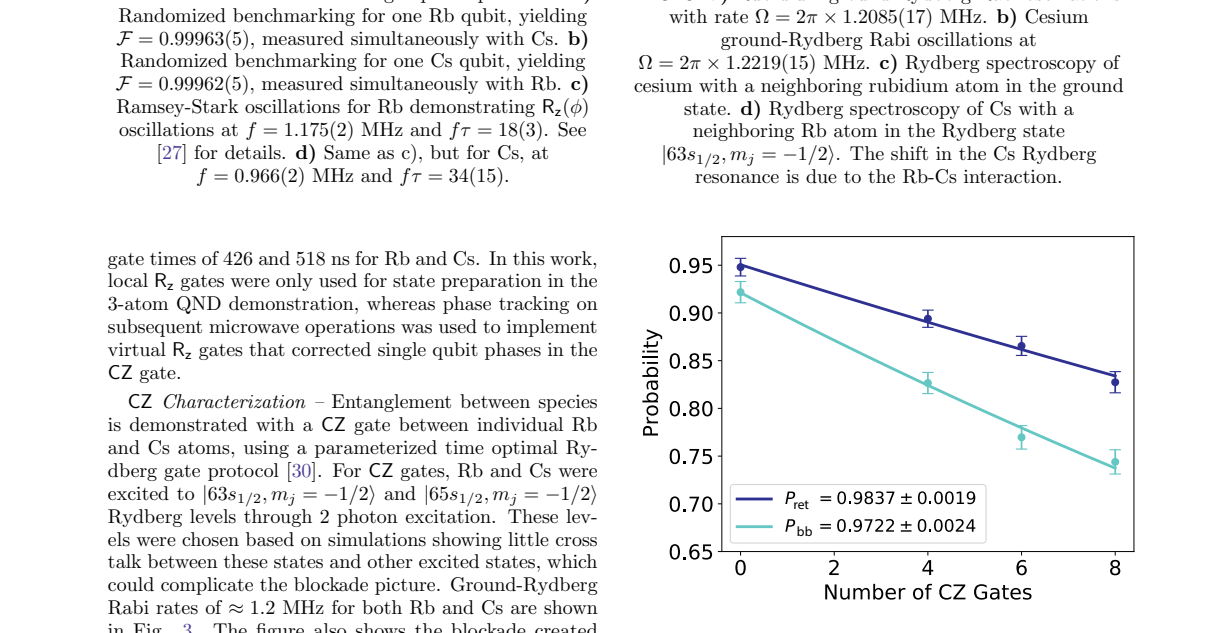
The RB data extend only to CZ depth 8, with 35 circuits total (five for depth zero, ten for the other depths). With this shallow depth and small number of circuits, the exponential fit has limited leverage; the quoted statistical uncertainty of 0.002 may not include systematic errors from the assumed functional form, especially if coherent errors produce non-exponential decays.
more of objection 2
In the same vein, P_leak = 0.002 in Eq. (1) is 'conservatively estimated' rather than measured; varying P_leak over a plausible range shifts F by roughly 0.001-0.005, comparable to the quoted error. Please report the number and spacing of the RB depths, show fit residuals, and provide a sensitivity analysis of F to P_leak, or measure P_leak directly.
The paper says, at Quantum Non-Demolition Measurements / SM.2
The review did not quote this passage.
Pith says: Objection 3 of 3 · major
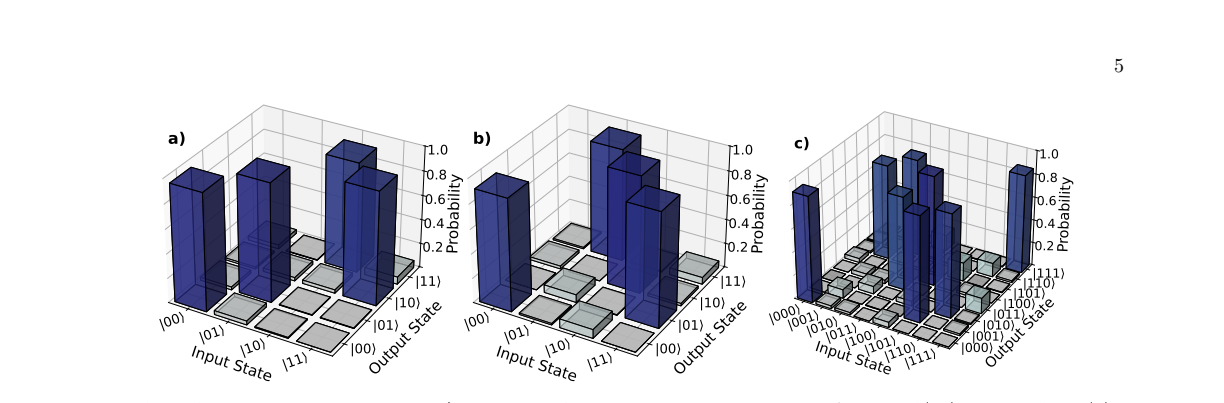
The two- and three-atom QND demonstrations use final readout of all atoms; no circuit performs an ancilla readout in the middle followed by continued operation on the data qubit. The claim that the register is crosstalk-free therefore rests on T2* measurements taken 'with or without background readout of the other species' (Experimental apparatus).
more of objection 3
The supplemental material, however, describes only 'isolated' versus 'simultaneous dual-species' Ramsey measurements, without specifying whether one species is imaged during the other's Ramsey evolution. Please clarify the timing of the crosstalk T2* measurement or perform a direct mid-circuit readout demonstration to fully support the in-place syndrome measurement claim.
4 minor objections
The paper says, at Experimental apparatus
Pith says: minor objection 1 of 4
The camera label 'N¨ uV¨ u HN¨ u 512' appears garbled; please use standard typography or a model name.
The paper says, at Fig. 2 caption
Pith says: minor objection 2 of 4
The notation 'f τ = 18(3)' is unclear; define τ and state the units explicitly.
show 2 more
The paper says, at QND Measurements
Pith says: minor objection 3 of 4
The definition of F_QND as an average of per-input-state success probabilities should be stated in the main text, not only in the supplemental material, to make the metric unambiguous.
The paper says, at Outlook
Pith says: minor objection 4 of 4
The projection of F > 0.997 depends on several simultaneous improvements to the apparatus; please label this explicitly as a theoretical projection rather than a demonstrated result.
What would settle it
Re-run the same RB protocol but apply independent random SU(2) rotations to the Rb qubit and the Cs qubit instead of identical global rotations (the two microwave systems are independent, as stated). Alternatively, perform standard two-qubit Clifford RB with local Cliffords. Compare the extracted CZ fidelity to F=0.975(2). If it differs by more than the quoted uncertainty, the restricted-subspace RB was biased and the headline fidelity must be revised. A second, model-independent cross-check is to prepare the Bell state (|00>+|11>)/sqrt(2) and perform full two-qubit state tomography.
from the skeptic's reading
How the review went
4 readings by deepseek-v4-flash · 3 Aug 2026
- Reader holds up, with conditions
- Skeptic partly agrees
- Editor wrote the verdict above
- Referee major revision: 3 major objections, 4 minor
Not run on this paper: the simulated authors' defence.
Pith did not check this review's objections against the paper.
The review in full
The review in brief, machine-written
Net take: this is a genuine experimental advance. A Rb-Cs CZ gate at 0.975(2) fidelity is a big jump from the ~0.7 numbers for prior heteronuclear gates, and the two- and three-qubit QND syndrome measurements are a useful step toward neutral-atom QEC without transport. The paper deserves a serious referee. But I would not take the headline fidelity at face value as the full two-qubit average.
What's new and good: the apparatus is well engineered—adiabatic cooling to ~4 uK, individual Rydberg addressing with sub-MHz Rabi rates, independent microwave control for both species, and a clean 12 MHz blockade measurement. The Monte Carlo error model is unusually detailed, and the agreement with the measured error (0.0232 vs 0.025) gives confidence the error budget is understood. The QND circuits are clearly described, and the raw count matrices in the supplement look honest. The T2* crosstalk comparison (isolated vs simultaneous readout) is the right type of evidence for the in-place readout claim.
The main soft spot: the RB protocol applies the same global rotation angles to both atoms. With a symmetric CZ and initial state |00>, the entire circuit lives in the exchange-symmetric subspace. The measured decay therefore extracts the gate's fidelity on symmetric inputs only. Errors that act differently on the antisymmetric block (e.g., Rabi-rate mismatch, species-dependent dephasing) are not properly weighted. The 0.975(2) is a subspace fidelity, not necessarily the standard average gate fidelity. The Monte Carlo simulation has the same bias because its Bell-state test also starts from |00>. I don't think the bias is huge: the QND data show similar success probabilities for |01> and |10> inputs as for |00> and |11>, and several error sources in the budget are non-symmetric. But it's a real methodological gap, and the authors should be asked to either do full SU(2) RB (they have independent microwave drives, so there's no hardware obstacle) or explicitly state that the reported F is a symmetric-subspace fidelity and give an estimate of the full-space number.
Other issues are minor. P_leak is estimated, not measured; it shifts F at the ~0.001 level. The RB depth of 8 is short but enough to see decay, though longer sequences would tighten the fit. The QND demonstrations use final readout rather than true mid-circuit measurement; the crosstalk data in the supplement address this, but the 'in-place' claim is one step removed from what was demonstrated.
Recommendation: send it to peer review. Ask for the subspace issue to be addressed or bounded. This is a solid experimental result that will be cited, and the referee process should tighten the interpretation.
The strongest objection
The CZ fidelity is extracted from RB in which 'the same GR angles are applied to Rb and Cs' (CZ Characterization). With identical single-qubit rotations and a symmetric CZ, every circuit preserves the exchange-symmetric subspace, and the initial state |00> lies in that subspace. The measured survival probability therefore characterizes the gate only on symmetric input states, not the full two-qubit Hilbert space. Equation (1) then converts this decay to a gate fidelity under a depolarizing-noise assumption appropriate for a full twirl. The two species are not identical: the Rydberg Rabi rates differ (1.2085 vs 1.2219 MHz), detunings and beam waists differ, so errors need not be exchange-symmetric. Errors that act purely in the antisymmetric block (or that average differently over the full space) can be missing or weighted incorrectly in the symmetric-subspace decay. The reported 0.975(2) is thus a subspace fidelity, not necessarily the average gate fidelity claimed. This is the central quantitative claim, so a bias here propagates to the error-budget comparison and to the projected surface-code performance. The mid-circuit QND concern raised by the reader is real, but secondary: the syndrome fidelities are measured with final readout and would not detect dephasing crosstalk during an ancilla readout. The headline fidelity is more load-bearing.
The reader's weakest assumption concerns whether the QND demonstrations, which measure all atoms at the end, actually validate the in-place mid-circuit readout claim. That is a legitimate concern: final Z-basis measurements are insensitive to dephasing of the data qubit caused by ancilla readout light, so the measured F_QND does not fully bound mid-circuit crosstalk. However, the more load-bearing issue for the paper's central claim is the gate fidelity extraction itself. The RB protocol as described is restricted to the exchange-symmetric subspace because identical GR angles are applied to both species. The CZ gate is symmetric, but the error operators need not be, since Rb and Cs are distinct physical systems with different Rabi rates and laser parameters. A symmetric-subspace RB measurement yields a decay that is not guaranteed to equal the full average gate fidelity under depolarizing noise. Since Eq. (1) assumes a depolarizing channel and a full twirl, the extracted F=0.975(2) may be an overestimate (or at least an unverified subspace quantity). This directly affects the headline number, whereas the QND concern affects the interpretation of the syndrome-measurement capability. I therefore agree partially with the reader: the QND concern is valid and should be addressed, but the subspace-RB issue should be fixed or explicitly justified before the reported fidelity can be taken as the average gate fidelity. The verdict remains CONDITIONAL; no change from the reader's recommendation is needed.
The referee's report
If the fidelity claim is robust, the result is a significant advance for neutral-atom QEC: an interspecies Rydberg gate with fidelity well above previous Rb-Cs demonstrations (0.69-0.73), and QND measurements on multi-atom plaquettes that are directly relevant to surface-code syndrome extraction. The paper's strengths include raw count data for the QND circuits, a detailed error budget with explicit mechanisms, crosstalk coherence measurements, and a clear discussion of remaining limitations. However, the central gate fidelity is extracted from a restricted-subspace RB protocol, so the full two-qubit average gate fidelity is not directly established; this is a load-bearing point for the abstract and for the projected QEC performance.
Pith's reading of the paper (a machine's summary, not the authors')
This paper demonstrates an entangling gate between two different atomic species, rubidium and cesium, with fidelity 0.975(2), roughly an order of magnitude better than previous Rb–Cs results. The authors use that gate to perform quantum non-demolition (QND) parity measurements on two- and three-qubit plaquettes, the basic building blocks of syndrome extraction for quantum error correction. Because the two species respond to different readout wavelengths, the idea is that ancilla qubits of one species can be measured while data qubits of the other species remain undisturbed in place. If this holds up, neutral-atom quantum computers could run error correction without the time and error overhead of moving atoms to a measurement zone or shelving data qubits.
What carries the argument. The load-bearing object is the interspecies Rydberg blockade gate between 87Rb and 133Cs. Rb is excited via a two-photon transition to |63s1/2, mj = -1/2⟩ and Cs to |65s1/2, mj = -1/2⟩; the Rydberg interaction, measured as a 12.01(22) MHz blockade shift, enforces the coherent CZ dynamics. Individual addressing uses focused beams at 421 and 1005 nm for Rb and 459 and 1040 nm for Cs, with a parameterized time-optimal pulse sequence and EOM phase control. The companion mechanism is species-selective readout: 780 nm blow-away and imaging for Rb, 852 nm for Cs, with 25 THz spectral separation that suppresses cross-talk.
Core claim. We demonstrate an inter-species CZ gate between 87Rb and 133Cs hyperfine clock qubits with fidelity F = 0.975 ± 0.002, using a parameterized time-optimal Rydberg blockade protocol with individual focused beams. This gate is then used to implement two-qubit and three-qubit QND parity measurements, achieving syndrome measurement fidelities of F_QND = 0.933(12) (average of both species as target) and 0.865(17) respectively. The enabling feature is the spectral isolation between the species: Rb and Cs readouts are separated by about 25 THz, and Ramsey coherence of each species is unchanged when the other species is read out in the background. The paper argues that this allows ancilla qubits of o
The premise it rests on. The in-place QND scheme assumes that reading out ancilla atoms of one species (for example, 780 nm blow-away and imaging of Rb) leaves data qubits of the other species completely undisturbed; the paper supports this with coherence measurements and 25 THz spectral separation, but it does not demonstrate an actual mid-circuit ancilla readout followed by continued operation on the data qubit.
If the paper is right (Pith's inferences, not the authors')
Neutral-atom quantum error correction can extract syndromes in place, eliminating the need for atom transport to a measurement zone or shelving/hiding operations, which slow the logical cycle and add errors.
The demonstrated CZ fidelity of 0.975(2), with a detailed Monte Carlo error model, identifies a concrete path to gate fidelities above 0.997, which would be usable for fault-tolerant surface-code operation.
Two-qubit QND parity checks work with either species as the ancilla target (F_QND = 0.937(8) for Rb, 0.929(9) for Cs), and the three-qubit ZZ stabilizer measurement (F_QND = 0.865(17)) is a direct weight-2 parity check as used on the surface-code boundary.
The observed readout isolation—no statistically significant change in T2* when the other species is read out in the background—supports the existence of decoupled data and ancilla registers in a dual-species array.
Editorial inference: A true test of the scheme requires a mid-circuit readout of the ancilla species followed by continued operation on the data species; the reported QND demonstrations measure all atoms at circuit end, so the full error-correction loop remains an extrapolation.
Editorial inference: The same species-selective isolation could enable continuous monitoring of environmental noise by one species while the other performs computation, providing real-time feedback to stabilize data-qubit coherence.
Editorial inference: The gate architecture should transfer to other heteronuclear Rydberg pairs, opening the possibility of multi-species logical qubits where cross-talk is suppressed at the hardware level rather than by scheduling.
Editorial inference: The quoted gate fidelity is extracted from randomized benchmarking under a depolarizing-error model with an assumed leakage probability of 0.002; direct Bell-state tomography or interleaved RB would anchor the number without model assumptions.
Check this review
Pith stored no record of this review's passes and took no fingerprint of it. Reviews made by code from 13 Nov 2026 on carry both.
How often reviews like this one are right
Reviews like this one: written by deepseek-v4-flash, where what was read was not recorded.
How often objections from reviews like this one are right: not yet measured
Reviews by people
This review was written by a machine. No person has reviewed this paper on Pith yet. A scientist listed on Pith can review it for a fee, and their review is published here whatever it concludes.
The paper
Abstract
We demonstrate an inter-species entangling Rydberg gate between rubidium (Rb) and cesium (Cs) atoms with fidelity ℱ = 0.975 ± 0.002. The two-species atom array enables in-place quantum non-demolition (QND) qubit measurements which are a key capability for quantum error correction. We demonstrate this functionality with multi-atom error syndrome measurements achieving QND measurement fidelities of ${\mathcal F}_{\rm QND} = 0.933(12)$ and 0.865(17) for two- and three-qubit plaquettes, respectively.
The paper's own sentences, arranged, kept beside the review and separate from it. Each label is drawn from a closed vocabulary; the number beside it is the probability the classifier gave that label. No sentence in this record was written by a model.
abstract compiled · 2026-09-23
The authors' main claim, as the classifier picked it out 0.63
“We demonstrate an inter-species entangling Rydberg gate between rubidium (Rb) and cesium (Cs) atoms with fidelity $\mathcal F = 0.975\pm 0.002$.”
How the main claim is stated: asserted 1.00
What the abstract itself states, as probabilities: claims first 0.05 · states limitation 0.21 · human participants 0.01 · controlled comparison 0.04 · randomized assignment 0.01 · states quantitative result 0.99 · compares with prior results 0.07 · mentions code or data availability 0.02
The abstract, sentence by sentence
This table labels the abstract only (arXiv listing abstract v4). The number is the probability the classifier gave the label.
| Sentence | Role | The authors' own work | States the main conclusion | Strength |
|---|---|---|---|---|
| We demonstrate an inter-species entangling Rydberg gate between rubidium (Rb) and cesium (Cs) atoms with fidelity $\mathcal F = 0.975\pm 0.002$. | result 0.71 | 0.97 | 0.56 | asserted 1.00 |
| The two-species atom array enables in-place quantum non-demolition (QND) qubit measurements which are a key capability for quantum error correction. | interpretation 0.52 | 0.49 | 0.17 | asserted 1.00 |
| We demonstrate this functionality with multi-atom error syndrome measurements achieving QND measurement fidelities of ${\mathcal F}_{\rm QND} = 0.933(12)$ and $0.865(17)$ for two- and three-qubit plaquettes, respectively. | result 0.99 | 0.97 | 0.26 | asserted 1.00 |
What kind of paper the classifier reports this is: empirical study 0.93 · evidence from observation or experiment 1.00
What was examined, and what was not
Sources read
- arXiv listing abstract v4
Not examined
- full text
- figures and tables
- references and citing sentences
- relations to other papers
Levels run
- P abstract
Not run
- S sections
- T body sentences
- C citations
- R cross-paper relations
How the labels were made
Compiled by classifier-1.13.0 via TypeSafe API, question bank abstract-p1-20260923, 2026-09-23: 1 request, 3,093 input tokens.
Every quoted sentence on this record is the authors'. Every label is from Pith's closed vocabulary, with the probability shown beside it. This record as JSON
Figures (5)
Showing 3 of the paper's 5 figures. Figures are the authors', reproduced from the paper.
References (51)
- [1] H. J. Manetsch, G. Nomura, E. Bataille, K. H. Leung, X. Lv, and M. Endres, A tweezer array with 6100 highly coherent atomic qubits, Nature647, 60 (2025) on Pith
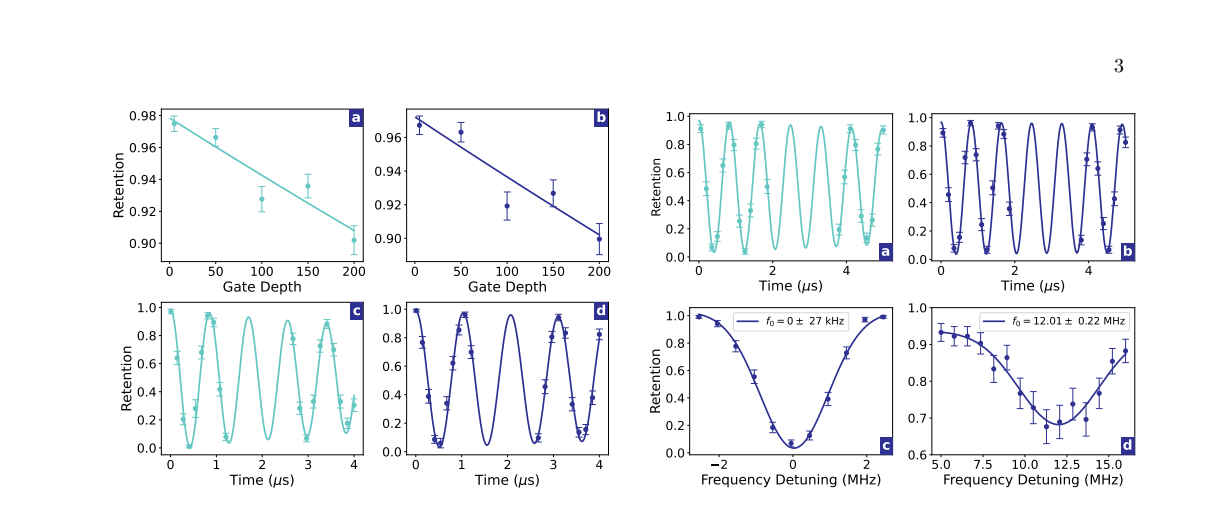
- [2] for details.d)Same as c), but for Cs, at f= 0.966(2) MHz andf τ= 34(15). gate times of 426 and 518 ns for Rb and Cs. In this work, localR z gates were only used for state preparation in the 3-atom QND demonstration, whereas phase tracking on subsequent microwave operations was... on Pith
- [3] A. G. Radnaev, W. C. Chung, D. C. Cole, D. Ma- son, T. G. Ballance, M. J. Bedalov, D. A. Belknap, M. R. Berman, M. Blakely, I. L. Bloomfield, P. D. Buttler, C. Campbell, A. Chopinaud, E. Copenhaver, M. K. Dawes, S. Y. Eubanks, A. J. Friss, D. M. Gar- cia, J. Gilbert, M. Gillet... on Pith
- [4] S. J. Evered, D. Bluvstein, M. Kalinowski, S. Ebadi, T. Manovitz, H. Zhou, S. H. Li, A. A. Geim, T. T. Wang, N. Maskara, H. Levine, G. Semeghini, M. Greiner, V. Vuleti´ c, and M. D. Lukin, High-fidelity parallel entan- gling gates on a neutral-atom quantum computer, Nature 622... on Pith
- [5] J. A. Muniz, M. Stone, D. T. Stack, M. Jaffe, J. M. Kindem, L. Wadleigh, E. Zalys-Geller, X. Zhang, C.-A. Chen, M. A. Norcia, J. Epstein, E. Halperin, F. Hum- mel, T. Wilkason, M. Li, K. Barnes, P. Battaglino, T. C. Bohdanowicz, G. Booth, A. Brown, M. O. Brown, W. B. Cairncros... on Pith
- [6] M. Peper, Y. Li, D. Y. Knapp, M. Bileska, S. Ma, G. Liu, P. Peng, B. Zhang, S. P. Horvath, A. P. Burgers, and J. D. Thompson, Spectroscopy and modeling of 171Yb Rydberg states for high-fidelity two-qubit gates, Phys. Rev. X15, 011009 (2025) on Pith
- [7] E. Deist, Y.-H. Lu, J. Ho, M. K. Pasha, J. Zeiher, Z. Yan, and D. M. Stamper-Kurn, Mid-circuit cavity measure- ment in a neutral atom array, Phys. Rev. Lett.129, 203602 (2022) on Pith
- [8] R. B.-S. Tsai, X. Sun, A. L. Shaw, R. Finkelstein, and M. Endres, Benchmarking and fidelity response theory of high-fidelity Rydberg entangling gates, PRX Quantum6, 010331 (2025) on Pith
- [9] J. W. Lis, A. Senoo, W. F. McGrew, F. R¨ onchen, A. Jenkins, and A. M. Kaufman, Mid-circuit operations using the omg-architecture in neutral atom arrays, Phys. Rev. X13, 041035 (2023) on Pith
- [10] D. Bluvstein, H. Levine, G. Semeghini, T. T. Wang, S. Ebadi, M. Kalinowski, A. Keesling, N. Maskara, H. Pichler, M. Greiner, V. Vuleti´ c, and M. D. Lukin, A quantum processor based on coherent transport of en- tangled atom arrays, Nature604, 451 (2022) on Pith
- [11] S. Ma, G. Liu, P. Peng, B. Zhang, S. Jandura, J. Claes, A. P. Burgers, G. Pupillo, S. Puri, and J. D. Thompson, High-fidelity gates and mid-circuit erasure conversion in an atomic qubit, Nature622, 279 (2023) on Pith
- [12] M. A. Norcia, W. B. Cairncross, K. Barnes, P. Battaglino, A. Brown, M. O. Brown, K. Cassella, 6 C.-A. Chen, R. Coxe, D. Crow, J. Epstein, C. Griger, A. M. W. Jones, H. Kim, J. M. Kindem, J. King, S. S. Kondov, K. Kotru, J. Lauigan, M. Li, M. Lu, E. Megidish, J. Marjanovic, M. ... on Pith
- [13] D. Bluvstein, A. A. Geim, S. H. Li, S. J. Evered, J. P. B. Ataides, G. Baranes, A. Gu, T. Manovitz, M. Xu, M. Kalinowski, S. Majidy, C. Kokail, N. Maskara, E. C. Trapp, L. M. Stewart, S. Hollerith, H. Zhou, M. J. Gullans, S. F. Yelin, M. Greiner, V. Vuletic, M. Cain, and M. D.... on Pith
- [14] T. M. Graham, L. Phuttitarn, R. Chinnarasu, Y. Song, C. Poole, K. Jooya, J. Scott, A. Scott, P. Eichler, and M. Saffman, Mid-circuit measurements on a neutral atom quantum processor, Phys. Rev. X13, 041051 (2023) on Pith
- [15] V. Negnevitsky, M. Marinelli, K. K. Mehta, H.-Y. Lo, C. Fl¨ uhmann, and J. P. Home, Repeated multi-qubit readout and feedback with a mixed-species trapped-ion register, Nature563, 527 (2018) on Pith
- [16] I. I. Beterov and M. Saffman, Rydberg blockade, F¨ orster resonances, and quantum state measurements with dif- ferent atomic species, Phys. Rev. A92, 042710 (2015) on Pith
- [17] K. Singh, C. E. Bradley, S. Anand, V. Ramesh, R. White, and H. Bernien, Mid-circuit correction of correlated phase errors using an array of spectator qubits, Science 380, 1265 (2023) on Pith
- [18] K. Singh, S. Anand, A. Pocklington, J. T. Kemp, and H. Bernien, Dual-element, two-dimensional atom ar- ray with continuous-mode operation, Phys. Rev. X12, 011040 (2022) on Pith
- [19] N. Samboy, Long-range interactions between rubidium and potassium Rydberg atoms, Phys. Rev. A95, 032702 (2017) on Pith
- [20] M. Saffman, T. G. Walker, and K. Mølmer, Quantum information with Rydberg atoms, Rev. Mod. Phys.82, 2313 (2010) on Pith
show 31 more
- [21] P. M. Ireland, D. M. Walker, and J. D. Pritchard, Inter- species F¨ orster resonances for Rb-Cs Rydbergd-states for enhanced multi-qubit gate fidelities, Phys. Rev. Res. 6, 013293 (2024) on Pith
- [22] J. S. Otto, N. Kjærgaard, and A. B. Deb, Strong zero- field F¨ orster resonances in K-Rb Rydberg systems, Phys. Rev. Res.2, 033474 (2020) on Pith
- [23] T. M. Graham, Y. Song, J. Scott, C. Poole, L. Phutti- tarn, K. Jooya, P. Eichler, X. Jiang, A. Marra, B. Grinke- meyer, M. Kwon, M. Ebert, J. Cherek, M. T. Licht- man, M. Gillette, J. Gilbert, D. Bowman, T. Ballance, C. Campbell, E. D. Dahl, O. Crawford, N. S. Blunt, B. Rogers... on Pith
- [24] C. Fang, J. Miles, J. Goldwin, M. Lichtman, M. Gillette, M. Bergdolt, S. Deshpande, S. A. Norrell, P. Huft, M. A. Kats, and M. Saffman, Interleaved dual-species arrays of single atoms using a passive optical element and one trapping laser, Sci. Adv.11, eadw4166 (2025) on Pith
- [25] S. Anand, C. E. Bradley, R. White, V. Ramesh, K. Singh, and H. Bernien, A dual-species Rydberg array, Nat. Phys. 20, 1744 (2024) on Pith
- [26] W. C. Chung, D. C. Cole, P. Gokhale, E. B. Jones, K. W. Kuper, D. Mason, V. Omole, A. G. Radnaev, R. Rines, M. H. Teo, M. J. Bedalov, M. Blakely, P. D. But- tler, C. Carnahan, F. T. Chong, P. Goiporia, B. Heim, G. T. Hickman, R. A. Jones, P. Khalate, J.-S. Kim, M. T. Lichtman,... on Pith
- [27] provides numerical simulations of these effects and their dependence on trap depth. A complete set of one-qubit gates is implemented with the 421 and 459 nm first-photon Rydberg lasers for indi- vidualR z(ϕ) gates and 6.8 and 9.2 GHz microwaves for global rotation (GR)R(θ, ϕ) ... on Pith
- [28] R. White, V. Ramesh, A. Impertro, S. Anand, F. Cesa, G. Giudici, T. Iadecola, H. Pichler, and H. Bernien, Quantum cellular automata on a dual-species Rydberg processor, arXiv:2601.16257 (2026) on PitharXiv
- [29] See Supplemental Material at [URL will be inserted by publisher] which includes references [35–39] on Pith
- [30] C. Tuchendler, A. M. Lance, A. Browaeys, Y. R. P. Sor- tais, and P. Grangier, Energy distribution and cooling of a single atom in an optical tweezer, Phys. Rev. A78, 033425 (2008) on Pith
- [31] M. Saffman and T. G. Walker, Analysis of a quantum logic device based on dipole-dipole interactions of opti- cally trapped Rydberg atoms, Phys. Rev. A72, 022347 (2005) on Pith
- [32] S. Jandura and G. Pupillo, Time-optimal two- and three- qubit gates for Rydberg atoms, Quantum6, 712 (2022) on Pith
- [33] C. H. Baldwin, B. J. Bjork, J. P. Gaebler, D. Hayes, and D. Stack, Subspace benchmarking high-fidelity en- tangling operations with trapped ions, Phys. Rev. Res. 2, 013317 (2020) on Pith
- [34] Y. Zeng, P. Xu, X. He, Y. Liu, M. Liu, J. Wang, D. J. Papoular, G. V. Shlyapnikov, and M. Zhan, Entangling two individual atoms of different isotopes via Rydberg blockade, Phys. Rev. Lett.119, 160502 (2017) on Pith
- [35] R. Rines, B. Hall, M. H. Teo, J. Viszlai, D. C. Cole, D. Mason, C. Barker, M. J. Bedalov, M. Blakely, T. Bothwell, C. Carnahan, F. T. Chong, S. Y. Eubanks, B. Fields, M. Gillette, P. Goiporia, P. Gokhale, G. T. Hickman, M. Iliev, E. B. Jones, R. A. Jones, K. W. Kuper, S. Lee, ... on PithPith's reviewarXiv
- [36] A. Eickbusch, M. McEwen, V. Sivak, A. Bourassa, J. Atalaya, J. Claes, D. Kafri, C. Gidney, C. W. War- ren, J. Gross, A. Opremcak, N. Zobrist, K. C. Miao, G. Roberts, K. J. Satzinger, A. Bengtsson, M. Neeley, W. P. Livingston, A. Greene, R. Acharya, L. A. Beni, G. Aigeldinger, ... on Pith
- [37] X. Jiang, J. Scott, M. Friesen, and M. Saffman, Sensitiv- ity of quantum gate fidelity to laser phase and intensity noise, Phys. Rev. A107, 042611 (2023) on Pith
- [38] N. ˘Sibali´ c, J. Pritchard, C. Adams, and K. Weatherill, Arc: An open-source library for calculating properties of alkali Rydberg atoms, Comp. Phys. Commun.220, 319 (2017) on Pith
- [39] T. G. Walker and M. Saffman, Consequences of Zeeman degeneracy for the van der Waals blockade between Ry- dberg atoms, Phys. Rev. A77, 032723 (2008) on Pith
- [40] M. Saffman, X. L. Zhang, A. T. Gill, L. Isenhower, and T. G. Walker, Rydberg state mediated quantum gates and entanglement of pairs of neutral atoms, J. Phys.: Conf. Ser.264, 012023 (2011) on Pith
- [41] K. Maller, M. T. Lichtman, T. Xia, Y. Sun, M. J. Pi- otrowicz, A. W. Carr, L. Isenhower, and M. Saffman, Rydberg-blockade controlled-NOT gate and entangle- ment in a two-dimensional array of neutral-atom qubits, Phys. Rev. A92, 022336 (2015). . SM.1 Supplemental Material for Q... on Pith
- [42] Intermediate state decay: The model Hamiltonian is a three-level system (|0⟩,|1⟩,|r⟩) that does not explicitly include the intermediate state, but includes decay of|1⟩and|r⟩due to off-resonant coupling with the intermediate state, and that coupling is assumed to produce loss o... on Pith
- [43] Rydberg state decay: The model Hamiltonian includes decay out of the Rydberg state due to the finite Rydberg state lifetime, which is assumed to produce loss out of the three-level system. This contribution is isolated by comparison to a system that does not include this decay term on Pith
- [44] Atom velocity and localization: The model samples from the atom velocity and position distributions that are calculated for the atom temperature and trap potential. We can independently zero either the velocity or position, and so we isolate these error contributions by compar... on Pith
- [45] Blockade fluctuation: The model uses a nominal blockade strength which we get from measurements (see Fig. 3d in the main text) or from calculation (see Fig. SM.6a). This blockade is then modified shot-to-shot asr −6 using the sampled atom positions, and this blockade fluctuati... on Pith
- [46] Finite beam size: This is used to model the effect of atom position and beam misalignment, by calculating the SM.9 intensity of the Gaussian beams at the atom. This error contribution is minimal in our baseline system, but its effect can be seen in Fig. SM.7b as the atom local... on Pith
- [47] Pulse energy fluctuations: These fluctuations are sampled shot-to-shot for each laser, and are used to modify the light shifts and therefore the Rydberg detuning, as well as the Rydberg Rabi frequencies. This contribution is isolated by comparison to a system with no fluctuations on Pith
- [48] Magnetic and electric field noise: These contributions as discussed above are both implemented as a correlated Rydberg detuning noise, and can be isolated by removing eitherσ= 7 kHz contribution from the total correlated noise contribution on Pith
- [49] Laser frequency noise: This is modeled as an additional 2-photon detuning, with uncorrelated samples for each atom. In simulation this error contribution can be isolated independently of laser intensity noise, or atom position and velocity effects that also contributed to the ... on Pith
- [50] Beam pointing dynamic fluctuation and static misalignment: Beam pointing fluctuation represents the shot-to- shot AOD aiming and system vibration noise that affects the laser intensity at the atoms, and therefore Rydberg Rabi rate and Rydberg detuning. Beam misalignment repres... on Pith
- [51] Rydberg Rabi mismatch: This represents error where our initial calibration steps do not hit the precise target for laser intensity tuning. A uniform distribution will be used due to the nature of the calibration algorithm that halts within a certain tolerance. The overall leve... on Pith
Cited by 6 Pith papers
Reviewed papers on Pith that cite this one. The full citation record
- Spin-exchange interactions between circular Rydberg atoms over long times physics.atom-ph · Sep 2026
- Observation of Crossover from Repulsive to Attractive Interactions between Two $nS$-Rydberg Atoms in Dual-Species Atom Arrays physics.atom-ph · Nov 2026
- Augmenting Quantum Neural Networks with Contractive Layers quant-ph · Nov 2026
- Quantifying the Dual-isotope Advantage for Ytterbium-array Surface Codes using Realistic Noise Models quant-ph · Aug 2026
- Quantum Spin Liquid State of a Dual-Species Atomic Array on Kagome Lattice quant-ph · May 2026
- Optimized EIT-Based Multi-Target CNOT^k Gates in Heteronuclear Rydberg Atom Arrays quant-ph · Aug 2026
How the literature uses it
5 arXiv papers cite this in 8 sentences
Papers citing it · 7 sentences without a confident label
Cites it as support 1 paper
-
This target-performance assumption is motivated by recent progress in interspecies Rydberg gates and by the expectation that the dominant gate errors can be reduced with improved Rydberg-gate control [ref] .
Quantifying the Dual-isotope Advantage for Ytterbium-array Surface Codes using Realistic Noise Models · Coherent-control channels · 0.99
What it cites
Compares with 1 paper
-
Gate fidelity of $ℱ = 0.975(2)$ is demonstrated which is well above previous Rb-Cs results with hyperfine encoded qubits [ref] , and comparable to the recent demonstration of a Cs-Cs gate mediated by a Rb atom using ground-Rydberg encoding which achieved $ℱ = 0.967(17)$ [ref] .
2601.16257 · Introduction · 0.99
Challenges and discussion
Disagree with the review, or know something it missed? Leave a comment, or challenge this review formally: a challenge becomes a permanent entry in this paper's record, and its decision is published here.
Come back by email
A short list of the week's newly reviewed papers. Nothing is sent until you confirm from your inbox, and every email has a link that stops it. No account.
No comments yet.
Sign in to comment