Atomic Physics · arXiv:2611.21171 v1 · submitted 16 Nov 2026 · 47 references
Observation of Crossover from Repulsive to Attractive Interactions between Two nS-Rydberg Atoms in Dual-Species Atom Arrays
The paper says
“Dual-species Rydberg atom arrays provide a flexible platform for engineering long-range interactions beyond the conventional isotropic blockade regime. We spectroscopically study interactions between different s-state Rydberg levels in a 87Rb–85Rb optical-tweezer array.”
more of the abstract
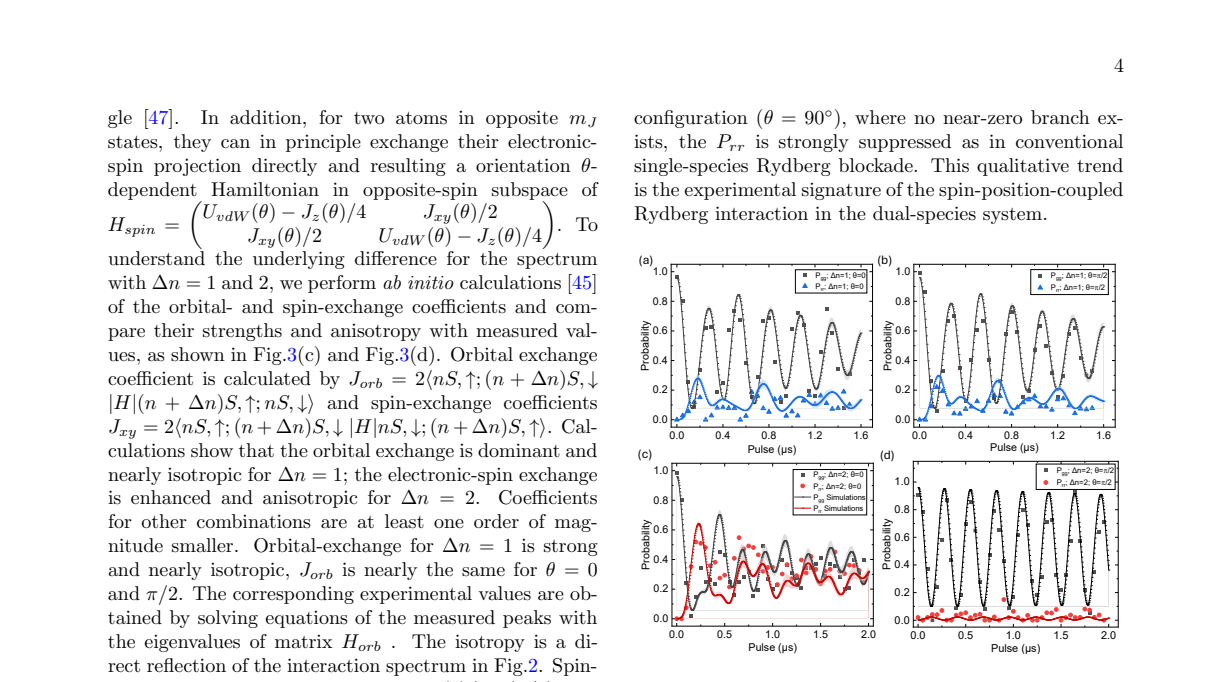
By varying the principal-quantum-number difference Δn around 61S1/2, we observe a crossover from repulsive to attractive interactions. We identify a distinct regime at Δn = 2 in which Förster-enhanced electronic spin exchange dominates over orbital exchange and produces a strongly bond-orientation-dependent pair spectrum. Time-domain collective-excitation measurements reveal this geometry-dependent spin exchange through a pronounced anisotropy of the double-excitation probability. For Δn = 1, by contrast, orbital exchange dominates and the interaction is nearly isotropic. These results establish the principal-quantum-number difference and bond orientation as complementary control parameters for tailoring Rydberg interaction spectra and collective excitation dynamics, opening new opportunities for engineering spin-dependent Hamiltonians in programmable atom arrays.
from the abstract
Pith says
Machine review · deepseek-v4-flash · 17 Nov 2026 · read the full text (32,864 characters) · not checked by a person
It can be wrong. Challenge this review or reply to it.
Holds up, with conditions. This paper reports the first experimental observation of a repulsive-to-attractive crossover in Rydberg pair interactions controlled by the principal-quantum-number difference Δn, and identifies a geometry-dependent spin-exchange regime at Δn=2 in a dual-isotope array. This line is wrong
7 minor
How often objections from reviews like this one are right: not yet measured
The paper, first character to last
The reviewer was given the whole text, 32,864 characters. Not checked: figures, code, what the 47 references say.
7 minor objections
The paper says, at Experimental Setup
Pith says: minor objection 1 of 7
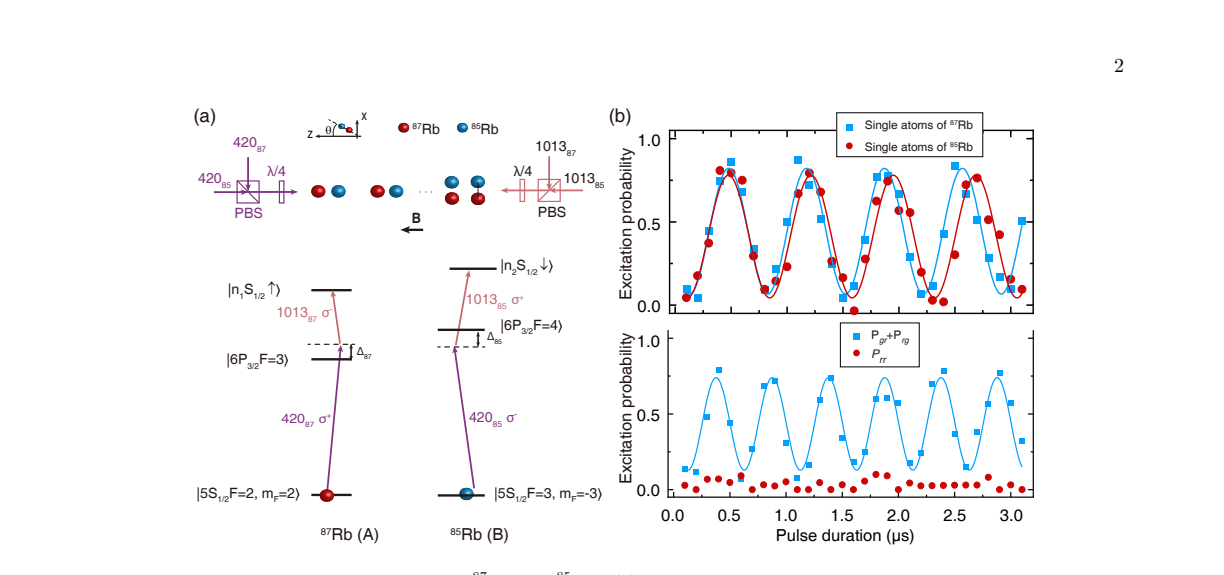
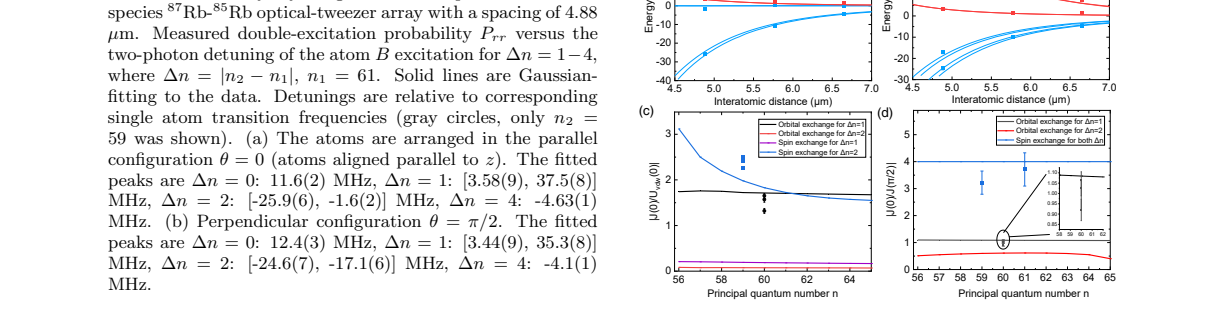
The paper states 'The tweezer trap spacings are tuned between 4.88(6) μm and 6.65(6) μm.' but later only shows data at 4.88 μm for the spectra in Fig. 2 and collective dynamics in Fig. 4. The distance-dependent data in Fig. 3(a,b) are mentioned but the distances are not specified in the caption or text. Please specify the distances used.
The paper says, at Interaction spectroscopy
Pith says: minor objection 2 of 7
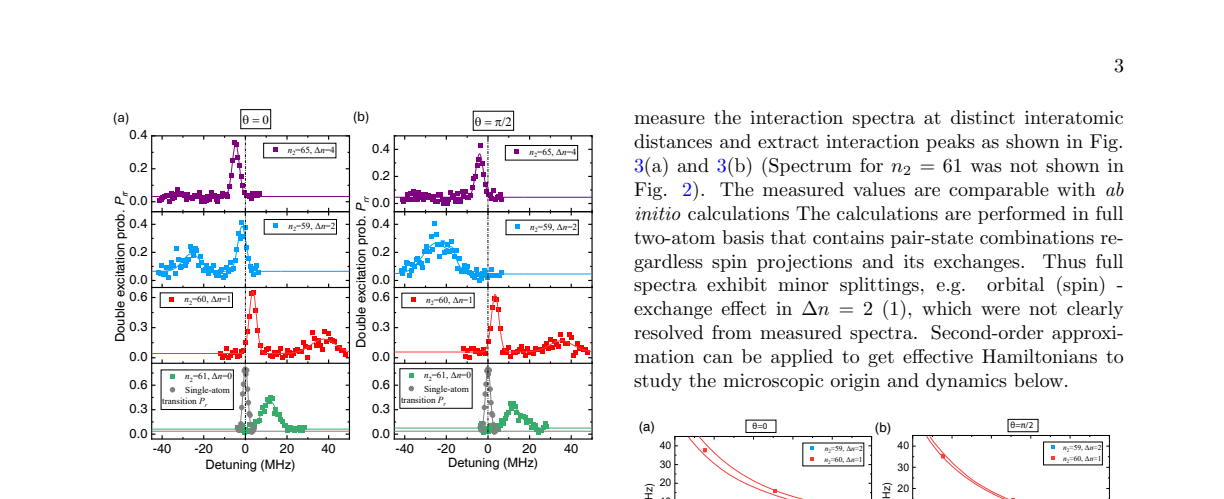
In Fig. 2 caption, the fitted peaks for Δn=2 at θ=0 are given as [-25.9(6), -1.6(2)] MHz, and at θ=π/2 as [-24.6(7), -17.1(6)] MHz. The near-resonant branch at θ=0 is at -1.6 MHz, which is close to zero but still negative. The text describes it as 'near-resonant branch appearing for parallel alignment' and 'near-zero branch'. This is consistent but the sign should be noted.
show 5 more
The paper says, at Microscopic origin
Pith says: minor objection 3 of 7
The paper says 'Orbital-exchange for Δn = 1 is strong and nearly isotropic, J_orb is nearly the same for θ=0 and π/2.' However, Fig. 3(c) and (d) are not visible in the manuscript. The text should provide the numerical values or ratios to support this claim.
The paper says, at General
Pith says: minor objection 4 of 7
The paper uses the notation |↑⟩ and |↓⟩ for m_J = +1/2 and -1/2 respectively. This is clear but should be explicitly defined earlier. It is defined in Fig. 1 caption but not in the main text until later.
The paper says, at Interaction spectroscopy
Pith says: minor objection 5 of 7
The sentence 'The measured values are comparable with ab initio calculations' is vague. Please provide a quantitative comparison (e.g., a table or plot) or state the level of agreement.
The paper says, at Dual-species collective excitation
Pith says: minor objection 6 of 7
The master equation is mentioned but not written explicitly. The dissipation term is said to be 'added especially the interaction spectrum broadening'. The form of the Lindblad operators and the rates used should be specified for reproducibility.
The paper says, at General
Pith says: minor objection 7 of 7
There are several grammatical issues and typos: 'rearrangment' should be 'rearrangement'; 'detuning' used as a verb; 'resulting a orientation' should be 'resulting in an orientation'; 'Förster-enhanced' should be 'Förster-enhanced' (umlaut). These do not affect scientific content but should be corrected.
What would settle it
A direct measurement of spin-exchange oscillations in the time domain for $\Delta n=2$ at $\theta=0$ and $\theta=\pi/2$ would test whether the exchange coefficients extracted from the static spectra correctly predict the coherent dynamics. If the oscillation frequencies do not match the predicted $J_{xy}$ values, the assignment to electronic spin exchange would be called into question.
from Pith's summary of the paper
How the review went
5 passes by deepseek-v4-flash · 17 Nov 2026
- Reader holds up, with conditions
- Skeptic concern withdrawn: Pith's reviewer misread the paper
- Referee 7 minor
- Check against the paper kept 0 of 5 objections
- Editor wrote the verdict above
Not run on this paper: the simulated authors' defence.
Pith's passes raised 5 objections. A check against the paper's text kept 0 and withdrew 5 (5 Pith's reviewer misread the paper).
The review in full
The review in brief, machine-written
This paper reports the first experimental observation of a repulsive-to-attractive crossover in Rydberg pair interactions controlled by the principal-quantum-number difference Δn, and identifies a geometry-dependent spin-exchange regime at Δn=2 in a dual-isotope array. The experiment is clean: the dual-species platform allows independent addressing, the spectroscopy is standard and the data carry reasonable uncertainties. The central claim—that at Δn=2 Förster-enhanced electronic spin exchange dominates and produces a strongly orientation-dependent spectrum—is supported by the measured angular contrast and by comparison with ab initio calculations. The paper does what it says on the tin.
The soft spots are about attribution, not data. The identification of spin exchange at Δn=2 rests on inverting effective two-state Hamiltonians with fixed Jz/J_xy ratios derived from angular-momentum theory, and on ab initio PairInteraction coefficients whose inputs are not specified. The figures are not visible in the supplied text, so the reader cannot independently verify the peak fits or the extracted exchange ratios. The paper states no limitations and flags no assumptions, which is a minor omission for a PRL-length letter but worth noting. The Δn=0 and Δn=4 endpoints match ab initio C6, which is a solid external check; the Δn=1 and Δn=2 attributions are more model-dependent but still plausible.
This paper is for experimentalists working on Rydberg arrays and quantum simulation. It deserves a serious referee: the data are real, the crossover is new, and the geometric control of spin exchange is a useful addition to the toolbox. The referee should ask for the ab initio inputs to be stated and for the J extraction to be shown step by step, but the core result is likely to hold.
Recommendation: send to peer review.
The stress test's concern
Withdrawn: Pith's reviewer misread the paper.
The paper says
“Spin-exchange has a universal ratio of $J_{xy}(0)/J_{xy}(\pi/2)=4$ that determined by angular-momentum coupling coefficients. For $\Delta n = 2$, spin exchange is F\"orster enhanced compared with other $\Delta n$ values due to electronic spin-orbit coupling of underlying interaction channels, that contain both $|P_{1/2}\rangle$ and $|P_{3/2}\rangle$ states and resulting in a spin-dependent interaction. The resulting exchange term in $H_{spin}$ is close to diagonal elements for \(\theta=0\), leading to a near zero eigenvalue, whereas for \(\theta=\pi/2\), exchange term is much smaller than diagonal elements. The experimental $J_{xy}$ ratios are obtained by solving equations of the measured peaks with the eigenvalues of matrix $H_{spin}$ with the relation $J_z(0)/J_{xy}(0)=-1/2$ and $J_z(\pi/2)/J_{xy}(\pi/2)=4$.”
The referee's report
Not published. Pith's referee wrote this assessment before its objections were checked against the paper, and 4 of its 4 major objections did not survive that check.
Pith's reading of the paper (a machine's summary, not the authors')
The paper reports experiments in a dual-isotope $^{87}$Rb–$^{85}$Rb optical-tweezer array where two atoms are excited to different $nS$ Rydberg states. By varying the difference in principal quantum numbers $\Delta n$ around $61S_{1/2}$, the authors observe that the pair interaction crosses from repulsive ($\Delta n=0$) to attractive ($\Delta n=4$), with measured energies matching ab initio van der Waals coefficients. At $\Delta n=1$, orbital exchange dominates and the interaction is nearly isotropic. At $\Delta n=2$, Förster-enhanced electronic spin exchange dominates, producing a strongly bond-orientation-dependent spectrum: a near-resonant branch appears when the interatomic axis is parallel to the quantization axis, while the perpendicular configuration remains strongly blockaded. Time-domain collective-excitation measurements confirm this anisotropy. The authors argue that $\Delta n$ and bond angle are complementary control parameters for engineering spin-dependent Rydberg Hamiltonians.
What carries the argument. The central objects are two effective two-state Hamiltonians: $H_{\mathrm{orb}}$ for orbital exchange (exchange of principal quantum numbers) and $H_{\mathrm{spin}}$ for electronic spin exchange (exchange of spin projections). The orbital exchange Hamiltonian is isotropic, while the spin exchange Hamiltonian has a universal angular dependence with $J_{xy}(0)/J_{xy}(\pi/2)=4$ and $J_z(0)/J_{xy}(0)=-1/2$, $J_z(\pi/2)/J_{xy}(\pi/2)=4$. The key mechanism is that at $\Delta n=2$, Förster resonances enhance the spin-exchange channel relative to orbital exchange, making the interaction strongly bond-orientation-dependent. The experimental data are interpreted by inverting these Hamiltonians to extract exchange coefficients from measured interaction spectra.
Core claim. The paper establishes that the principal-quantum-number difference $\Delta n$ between two $nS$ Rydberg atoms in a dual-species array controls the sign, magnitude, and angular dependence of the pair interaction. For $\Delta n=0$, the interaction is repulsive (van der Waals blockade). For $\Delta n=4$, it becomes attractive. At $\Delta n=1$, orbital exchange dominates and the interaction is nearly isotropic. At $\Delta n=2$, Förster-enhanced electronic spin exchange dominates, producing a strongly orientation-dependent spectrum: a near-resonant branch appears for parallel alignment ($\theta=0$), while the perpendicular configuration ($\theta=\pi/2$) remains strongly shifted and blockaded. The authors identify this as a signature of spin-position-coupled Rydberg interactions and demonstrate that rotating the interatomic axis switches the collective excitation response between appreciable double excitation and strong blockade.
The premise it rests on. The identification of electronic spin exchange at $\Delta n=2$ and the extraction of exchange coefficients rely on the assumed angular-momentum ratio relations $J_z(0)/J_{xy}(0)=-1/2$ and $J_z(\pi/2)/J_{xy}(\pi/2)=4$; if these ratios are incorrect or if the effective two-state Hamiltonian does not capture the full channel structure, the observed angular contrast could have a different microscopic origin.
If the paper is right (Pith's inferences, not the authors')
If the claim is correct, $\Delta n$ and bond angle provide two independent knobs for engineering spin-dependent Rydberg interactions in programmable atom arrays, enabling anisotropic spin models and geometry-programmable Hamiltonians.
The near-resonant branch at $\Delta n=2$ and $\theta=0$ could be used to implement coherent spin-exchange dynamics and entanglement operations that are switchable by rotating the interatomic axis.
The crossover from repulsive to attractive interactions as $\Delta n$ increases offers a route to tune quantum criticality and explore phases of matter that require both blockade and attractive interactions.
The identification of distinct orbital- and spin-exchange-dominated regimes provides a framework for designing dual-species Rydberg platforms where the dominant exchange process can be selected by choosing $\Delta n$.
The paper does not demonstrate coherent spin-exchange oscillations; the evidence for spin exchange is spectroscopic and based on the angular dependence of the interaction spectrum. A direct time-domain observation of spin-exchange oscillations would strengthen the claim.
The quantitative extraction of exchange coefficients relies on the assumed ratio relations $J_z(0)/J_{xy}(0)=-1/2$ and $J_z(\pi/2)/J_{xy}(\pi/2)=4$, which are derived from angular-momentum coupling. If these ratios are not exact for the specific Rydberg states used, the inferred exchange coefficients could be systematically biased.
The ab initio calculations of van der Waals coefficients and exchange coefficients are performed with the PairInteraction or ARC packages, but the paper does not specify the input parameters (e.g., quantum defects, matrix elements). Reproducibility would benefit from specifying these inputs.
The dual-species platform could be extended to study three-body interactions and many-body dynamics where the sign and anisotropy of interactions are programmable, potentially enabling the realization of spin models with competing interactions.
Check this review
What was read
The passes were given all 32,864 characters of the paper's LaTeX source.
Fingerprint of that text (SHA-256): 3e1b006276b2259c0efa85afe1506b4eb6bd62dca2a61252ccdd61fc4894a486
Pith does not keep that text. Rebuilt from the paper's source or PDF by the same code, it has this fingerprint if it is the same text. From a copy of Pith's code:
PYTHONPATH=. python scripts/review_input_check.py 2611.21171
The passes, in the order they ran
- Reader deepseek-v4-flash · medium effort · $0.0050 · instructions of the Reader, fingerprint f9ead7300382…
- Skeptic deepseek-v4-flash · medium effort · $0.0013 · instructions of the Skeptic, fingerprint 8f88c0f61488…
- Referee deepseek-v4-flash · medium effort · $0.0016 · instructions of the Referee, fingerprint a852d99aea0d…
- Check against the paper deepseek-v4-flash · medium effort · $0.0018 · instructions of the Check against the paper, fingerprint 6c7a6883d551…
- Editor deepseek-v4-flash · medium effort · $0.0013 · instructions of the Editor, fingerprint e7211f6a3d27…
- Circularity check deepseek-v4-flash · medium effort · $0.0013 · instructions of the Circularity check, fingerprint e9946e39d67b…
- Summary for the page deepseek-v4-flash · medium effort · temperature 0.2 · $0.0017 · instructions of the Summary for the page, fingerprint e4f56bf568e7…
The passes cost $0.014 in model calls together.
Version stamped on this review: pith-pipeline@v1.4.1-daily-deepseek-or-medium+deepseek/deepseek-v4-flash+p.d60f54226f00
Each link opens a pass's instructions as plain text, the exact bytes its fingerprint was taken over. Every stored set of instructions.
curl -s https://pith.science/methodology/prompts/f9ead730038216984cfb56d7cb34332bdf691828296a1de4245f3d6667d4bf56 | sha256sum
prints the fingerprint of the reader's instructions. The same works for every pass.
The receipt
The review's fingerprint was taken on 17 Nov 2026. The review you are reading still matches it.
Fingerprint of the review (SHA-256): 7a4f5a18610be9ad5e0b25c6cedf7c93b05e03a00470ccbb146392dba04a823c
curl -s 'https://pith.science/api/v1/verdicts/2611.21171?form=canonical' | sha256sum
prints the fingerprint of the review as it stands now. The rule, in four steps.
A matching fingerprint shows the review has not changed since that date. It does not show that the review is right.
How often reviews like this one are right
Reviews like this one: written by deepseek-v4-flash, from the paper's LaTeX source.
How often objections from reviews like this one are right: not yet measured
Reviews by people
This review was written by a machine. No person has reviewed this paper on Pith yet. A scientist listed on Pith can review it for a fee, and their review is published here whatever it concludes.
The paper
Abstract
Dual-species Rydberg atom arrays provide a flexible platform for engineering long-range interactions beyond the conventional isotropic blockade regime. We spectroscopically study interactions between different s-state Rydberg levels in a 87Rb–85Rb optical-tweezer array. By varying the principal-quantum-number difference Δn around 61S1/2, we observe a crossover from repulsive to attractive interactions. We identify a distinct regime at Δn = 2 in which Förster-enhanced electronic spin exchange dominates over orbital exchange and produces a strongly bond-orientation-dependent pair spectrum. Time-domain collective-excitation measurements reveal this geometry-dependent spin exchange through a pronounced anisotropy of the double-excitation probability. For Δn = 1, by contrast, orbital exchange dominates and the interaction is nearly isotropic. These results establish the principal-quantum-number difference and bond orientation as complementary control parameters for tailoring Rydberg interaction spectra and collective excitation dynamics, opening new opportunities for engineering spin-dependent Hamiltonians in programmable atom arrays.
The paper's own sentences, arranged, kept beside the review and separate from it. Each label is drawn from a closed vocabulary; the number beside it is the probability the classifier gave that label. No sentence in this record was written by a model.
abstract compiled · 2026-11-17
The authors' main claim, as the classifier picked it out 1.00
“These results establish the principal-quantum-number difference and bond orientation as complementary control parameters for tailoring Rydberg interaction spectra and collective excitation dynamics, opening new opportunities for engineering spin-dependent Hamiltonians in programmable atom arrays.”
How the main claim is stated: asserted 0.99
What the abstract itself states, as probabilities: claims first 0.05 · states limitation 0.07 · human participants 0.02 · controlled comparison 0.15 · randomized assignment 0.01 · states quantitative result 0.67 · compares with prior results 0.27 · mentions code or data availability 0.02
The abstract, sentence by sentence
This table labels the abstract only (arXiv listing abstract v1). The number is the probability the classifier gave the label.
| Sentence | Role | The authors' own work | States the main conclusion | Strength |
|---|---|---|---|---|
| Dual-species Rydberg atom arrays provide a flexible platform for engineering long-range interactions beyond the conventional isotropic blockade regime. | background 1.00 | 0.09 | 0.04 | asserted 0.99 |
| We spectroscopically study interactions between different $s$-state Rydberg levels in a $^{87}\mathrm{Rb}$--$^{85}\mathrm{Rb}$ optical-tweezer array. | contribution 0.55 | 0.96 | 0.02 | asserted 0.99 |
| By varying the principal-quantum-number difference $\Delta n$ around $61S_{1/2}$, we observe a crossover from repulsive to attractive interactions. | result 1.00 | 0.96 | 0.27 | asserted 1.00 |
| We identify a distinct regime at $\Delta n=2$ in which F\"orster-enhanced electronic spin exchange dominates over orbital exchange and produces a strongly bond-orientation-dependent pair spectrum. | result 0.95 | 0.96 | 0.17 | asserted 1.00 |
| Time-domain collective-excitation measurements reveal this geometry-dependent spin exchange through a pronounced anisotropy of the double-excitation probability. | result 0.82 | 0.95 | 0.06 | asserted 1.00 |
| For $\Delta n=1$, by contrast, orbital exchange dominates and the interaction is nearly isotropic. | result 0.98 | 0.91 | 0.05 | asserted 1.00 |
| These results establish the principal-quantum-number difference and bond orientation as complementary control parameters for tailoring Rydberg interaction spectra and collective excitation dynamics, opening new opportunities for engineering spin-dependent Hamiltonians in programmable atom arrays. | interpretation 0.98 | 0.67 | 0.93 | asserted 0.99 |
What kind of paper the classifier reports this is: empirical study 1.00 · evidence from observation or experiment 1.00
What was examined, and what was not
Sources read
- arXiv listing abstract v1
Not examined
- full text
- figures and tables
- references and citing sentences
- relations to other papers
Levels run
- P abstract
Not run
- S sections
- T body sentences
- C citations
- R cross-paper relations
How the labels were made
Compiled by classifier-1.13.0 via TypeSafe API, question bank abstract-p1-20260923, 2026-11-17: 1 request, 5,717 input tokens.
Every quoted sentence on this record is the authors'. Every label is from Pith's closed vocabulary, with the probability shown beside it. This record as JSON
Figures (4)
Figures are the authors', reproduced from the paper.
References (47)
- [1] M. Saffman, Neutral atom quantum computing, arXiv: 2608.30783 (2026) on PithPith's reviewarXiv
- [2] A. J. Menssenet al, Strategic Plan for Neutral Atom Quantum Computation, arXiv: 2607.21554 (2026) on PithPith's reviewarXiv
- [3] A. Browaeys and T. Lahaye, Many-body physics with individually controlled Rydberg atoms. Nat. Phys.16, 132-142 (2020) on Pith
- [4] D. Jaksch, J. I. Cirac, P. Zoller, S. L. Rolston, R. Cˆ ot´ e, and M. D. Lukin, Fast Quantum Gates for Neu- tral Atoms, Phys. Rev. Lett.85, 2208 (2000) on Pith
- [5] M. Saffman, T. G. Walker, and K. Mølmer, Quantum information with Rydberg atoms, Rev. Mod. Phys.82, 2313 (2010) on Pith
- [6] S. J. Evered, M. Xu, S. H. Li, A. A. Geim, J. P. B. Ataides, M. Kalinowski, D. Bluvstein, N. Maskara, C. Kokail, M. Greiner, V. Vuleti´ c, and M. D. Lukin, High- fidelity entangling gates and nonlocal circuits with neu- tral atoms, Science394, 197 (2026) on Pith
- [7] C. J. Turner, A. A. Michailidis, D. A. Abanin, M. Serbyn, and Z. Papi´ c, Weak ergodicity breaking from quantum many-body scars, Nat. Phys.14, 745 (2018) on Pith
- [8] W. W. Ho, S. Choi, H. Pichler, and M. D. Lukin, Pe- riodic orbits, entanglement, and quantum many-body scars in constrained models: Matrix product state ap- proach, Phys. Rev. Lett.122, 040603 (2019) on Pith
- [9] M. Serbyn, D. A. Abanin, and Z. Papi´ c, Quantum many- body scars and weak breaking of ergodicity, Nat. Phys. 17, 675 (2021) on Pith
- [10] Y. Cheng and H. Zhai, Emergent U(1) lattice gauge the- ory in Rydberg atom arrays, Nat. Rev. Phys.6, 566 (2024) on Pith
- [11] H. Bernien, S. Schwartz, A. Keesling, H. Levine, A. Om- ran, H. Pichler, S. Choi, A. S. Zibrov, M. Endres, M. Greiner, V. Vuleti´ c, and M. D. Lukin, Probing many- body dynamics on a 51-atom quantum simulator, Nature 551, 579 (2017) on Pith
- [12] A. Keesling, A. Omran, H. Levine, H. Bernien, H. Pich- ler, S. Choi, R. Samajdar, S. Schwartz, P. Silvi, S. Sachdev, P. Zoller, M. Endres, M. Greiner, V. Vuleti´ c, and M. D. Lukin, Quantum Kibble–Zurek mechanism and critical dynamics on a programmable Rydberg sim- ulator, Nat... on Pith
- [13] F. M. Surace, P. P. Mazza, G. Giudici, A. Lerose, A. Gambassi, and M. Dalmonte, Lattice Gauge Theories and String Dynamics in Rydberg Atom Quantum Simulators, Phys. Rev. X10, 021041 (2020) on Pith
- [14] D. Gonz´ alez-Cuadra et al., Observation of string break- ing on a (2 + 1)D Rydberg quantum simulator, Nature 642, 321 (2025) on Pith
- [15] G. Semeghini, H. Levine, A. Keesling, S. Ebadi, T. T. Wang, D. Bluvstein, R. Verresen, H. Pichler, M. Kali- nowski, R. Samajdar, A. Omran, S. Sachdev, A. Vish- wanath, M. Greiner, V. Vuleti´ c, and M. D. Lukin, Prob- ing topological spin liquids on a programmable quantum simul... on Pith
- [16] M. Qiao, G. Emperauger, C. Chen, L. Homeier, S. Hol- lerith, G. Bornet, R. Martin, B. G´ ely, L. Klein, D. Barredo, S. Geier, N.-C. Chiu, F. Grusdt, A. Bohrdt, T. Lahaye, and A. Browaeys, Realization of a doped quan- tum antiferromagnet in a Rydberg tweezer array, Nature 644, ... on Pith
- [17] Z. Lan, W. Li, and I. Lesanovsky, Quantum melting of two-component Rydberg crystals, Phys. Rev. A94, 051603(R) (2016) on Pith
- [18] K. Slagle, D. Aasen, H. Pichler, R. S. K. Mong, P. Fend- ley, X. Chen, M. Endres, and J. Alicea, Microscopic char- acterization of Ising conformal field theory in Rydberg chains, Phys. Rev. B104, 235109 (2021) on Pith
- [19] C. Li, S. Liu, H. Wang, W. Zhang, Z.-X. Li, H. Zhai, and Y. Gu, Uncovering Emergent Spacetime Supersym- metry with Rydberg Atom Arrays, Phys. Rev. Lett.133, 223401 (2024) on Pith
- [20] H. Wang, X. Li, C. Li, Tricritical Kibble-Zurek Scal- ing in Rydberg Atom Ladders, Nat. Commun.16, 10584 (2025) on Pith
show 27 more
- [21] L.-Y.-N. Liu, S.-Y. Yu, S.-R. Peng, J. Sheng, S. Yi, P. Xu, S.-S. Gong, T. Shi, and J. Cui, Distinct many-body scars and emergent quantum phases driven by competing 6 interactions in two-species Rydberg arrays, Phys. Rev. B 114, 115406 (2026) on Pith
- [22] T. G. Walker and M. Saffman, Consequences of Zeeman degeneracy for the van der Waals blockade between Ry- dberg atoms, Phys. Rev. A77, 032723 (2008) on Pith
- [23] D. Cano and J. Fort´ agh, Nonadditive potentials between three Rydberg atoms, Phys. Rev. A86, 043422 (2012) on Pith
- [24] X.-F. Shi, F. Bariani, and T. A. B. Kennedy, Entangle- ment of neutral-atom chains by spin-exchange Rydberg interaction, Phys. Rev. A90, 062327 (2014) on Pith
- [25] I. I. Beterov and M. Saffman, Rydberg blockade, F¨ orster resonances, and quantum state measurements with dif- ferent atomic species, Phys. Rev. A92, 042710 (2015) on Pith
- [26] A. Paris-Mandoki, H. Gorniaczyk, C. Tresp, I. Mirgorod- skiy and S. Hofferberth, Tailoring Rydberg interactions via F¨ orster resonances: state combinations, hopping and angular dependence, J. Phys. B: At. Mol. Opt. Phys.49, 164001 (2016) on Pith
- [27] K. Wadenpfuhl and C. S. Adams, Unraveling the struc- tures in the van der Waals interactions of alkali-metal Rydberg atoms, Phys. Rev. A111, 062803 (2025) on Pith
- [28] C. Li and H. Zhai, Universal Spin-Position Coupled Ry- dberg Interactions, arXiv: 2608.23694 (2026) on PithPith's reviewarXiv
- [29] C. Sheng, J.-Y. Hou, X.-D. He, K.-P. Wang, R.-J. Guo, J. Zhuang, B. Mamat, P. Xu, M. Liu, J. Wang, and M.-S. Zhan, Defect-Free Arbitrary-Geometry Assembly of Mixed-Species Atom Arrays, Phys. Rev. Lett.128, 083202 (2022) on Pith
- [30] K. Singh, S. Anand, A. Pocklington, J. T. Kemp, and H. Bernien, Dual-Element, Two-Dimensional Atom Ar- ray with Continuous-Mode Operation, Phys. Rev. X12, 011040 (2022) on Pith
- [31] J. T. Zhang, L. R. B. Picard, W. B. Cairncross, K. Wang, Y. Yu, F. Fang, and K.-K. Ni, An optical tweezer array of ground-state polar molecules, Quantum Sci. Technol. 7, 035006 (2022) on Pith
- [32] Y. Nakamura, T. Kusano, R. Yokoyama, K. Saito, K. Higashi, N. Ozawa, T. Takano, Y. Takasu, and Y. Taka- hashi, Hybrid Atom Tweezer Array of Nuclear Spin and Optical Clock Qubits, Phys. Rev. X14, 041062 (2024) on Pith
- [33] C. Fang et al., Interleaved dual-species arrays of single atoms using a passive optical element and one trapping laser, Sci. Adv.11, eadw4166 (2025) on Pith
- [34] S. Anand, C. E. Bradley, R. White, V. Ramesh, K. Singh, and H. Bernien, A dual-species Rydberg array, Nat. Phys.20, 1744 (2024) on Pith
- [35] J. Mileset al, Qubit syndrome measurements with a high fidelity Rb-Cs Rydberg gate, arXiv: 2603.13492 on PithPith's reviewarXiv
- [36] Yu Wang, Ryan Cimmino, Kenneth Wang, Santiago Lopez, Jeffrey Li, Jin Ming Koh, Jonathan N. Hall´ en, Anne Matthies, Norman Y. Yao, Kang-Kuen Ni, Multi- Qubit Stabilizer Readout on a Dual-Species Rydberg Ar- ray, arXiv: 2605.10924 (2026) on PithPith's reviewarXiv
- [37] N. Chepiga, Tunable quantum criticality in multicom- ponent Rydberg arrays, Phys. Rev. Lett.132, 076505 (2024) on Pith
- [38] J. Dobrzyniecki, P. Heim, and M. Tomza, Tunable two- species spin models with Rydberg atoms in circular and elliptical states, Phys. Rev. Res.7, 013321 (2025) on Pith
- [39] F. Cesa, A. D. Fini, D. A. Korbany, R. Tricarico, H. Bernien, H. Pichler, and L. Piroli, Engineering discrete local dynamics in globally driven dual-species atom ar- rays, arXiv: 2601.16961 (2026) on PitharXiv
- [40] G. Emperauger, M. Qiao, G. Bornet, C. Chen, R. Martin, Y. T. Chew, B. G´ ely, L. Klein, D. Barredo, A. Browaeys, and T. Lahaye, Benchmarking direct and indirect dipolar spin-exchange interactions between two Rydberg atoms, Phys. Rev. A111, 062806 (2025) on Pith
- [41] L. Ruan, Z. Zhou, Y. Guo, C. Li, and C. Chen, Ob- servation of electron spin interactions between Rydberg atoms, arXiv: 2608.23711 (2026) on PithPith's reviewarXiv
- [42] K.-P. Wanget al., Preparation of a heteronuclear two- atom system in the three-dimensional ground state in an optical tweezer, Phys. Rev. A100, 063429 (2019) on Pith
- [43] M.-R. Weiet al., Enhanced atom-by-atom assembly of defect-free two-dimensional mixed-species atomic arrays, Phys. Rev. Applied25, 034009 (2026) on Pith
- [44] A. Ga¨ etan, Y. Miroshnychenko, T. Wilk, A. Chotia, M. Viteau, D. Comparat, P. Pillet, A. Browaeys, and P. Grangier, Observation of collective excitation of two indi- vidual atoms in the Rydberg blockade regime, Nat. Phys. 5, 115 (2009) on Pith
- [45] J. M¨ ogerle, F. Hummel, A. Keil, T. Legrand, E. J. Braun, H. Menke, J. King, B. Olmos, S. Hofferberth, H. P. B¨ uchler, and S. Weber, The PairInteraction toolkit for modeling Rydberg physics in alkali and alkaline-earth- like atoms, Sci. Rep.16, 31484 (2026) on Pith
- [46] N. ˇSibali´ c, J. D. Pritchard, K. J. Weatherill, C. S. Adams, ARC: An open-source library for calculating properties of alkali Rydberg atoms, Comput. Phys. Commun.220, 319 (2017) on Pith
- [47] A. Signoles, T. Franz, R. F. Alves, M. G¨ arttner, S. Whit- lock, G. Z¨ urn, and M. Weidem¨ uller, Glassy Dynamics in a Disordered Heisenberg Quantum Spin System, Phys. Rev. X11, 011011 (2021) on Pith
Challenges and discussion
Disagree with the review, or know something it missed? Leave a comment, or challenge this review formally: a challenge becomes a permanent entry in this paper's record, and its decision is published here.
Come back by email
A short list of the week's newly reviewed papers. Nothing is sent until you confirm from your inbox, and every email has a link that stops it. No account.
No comments yet.
Sign in to comment