Atomic Physics · arXiv:2609.37766 v2 · submitted 29 Sep 2026 · 79 references
Spin-exchange interactions between circular Rydberg atoms over long times
The paper says
“Arrays of neutral atoms excited to Rydberg levels have emerged as one of the most promising platforms for quantum computation and simulation. With the hope to outperform classical devices, the number of atoms has been increased by orders of magnitude.”
more of the abstract
However, the interaction time, i.e., the maximum accumulated time during which an atom interacts with its neighbours, has been limited to a few microseconds only. This restrains the number of gates per atom or prevents the simulation of long-time dynamics of quantum many-body systems. Here, we observe the spin-exchange interaction between two spin 1/2s encoded in laser-trapped circular Rydberg atoms over more than 60μs and 40 spin-oscillation periods, improving the state of the art by an order of magnitude. These unprecedented timescales allow us to record for weak atomic trapping a collapse and revival of the spin-exchange oscillation contrast induced by spin-motion coupling. Our results constitute the first observation of this coupling with laser-trapped Rydberg atoms. To counteract its detrimental effect for quantum simulation, we demonstrate a novel dynamical decoupling method that prevents the collapse of the spin oscillations. This method exploits the advantages of our recently developed hybrid platform that enables the measurement and the optical manipulation of long-lived circular Rydberg atoms with auxiliary Rydberg atoms. This work opens a direct route to long-duration quantum simulation of strongly-interacting many-body systems.
from the abstract
Pith says
Machine review · deepseek-v4-flash · 1 Oct 2026 · what was read was not recorded · not checked by a person
It can be wrong. Challenge this review or reply to it.
Holds up, with conditions. The order-of-magnitude extension of spin-exchange time is real and the spin-motion signature is qualitatively solid; quantitative revival/decoupling claims rest on a model with fitted parameters and an unmeasured temperature anisotropy that the authors themselves flag. This line is wrong
3 major objections · 4 minor
How often objections from reviews like this one are right: not yet measured
Not checked: figures, code, what the 79 references say.
The paper says, at Methods (Numerical simulations); b161-b165
The review did not quote this passage.
A classifier read this sentence of the paper as acknowledging the concern (probability 0.79):
“The exaggerated oscillations predicted by the model may indicate a mis-estimation of the temperature for the motion along this direction.”
Pith says: Objection 1 of 3 · major
The quantitative content of the spin-motion and decoupling claims is conditioned on the temperature of the atomic motion along the weakly-trapping laser-propagation axis, which is not measured independently. The Methods state that the release-recapture temperature is obtained from a Monte-Carlo fit that 'assumes identical temperatures along the three trap-oscillation directions', while the text notes that the thermal spread along this …
more of objection 1
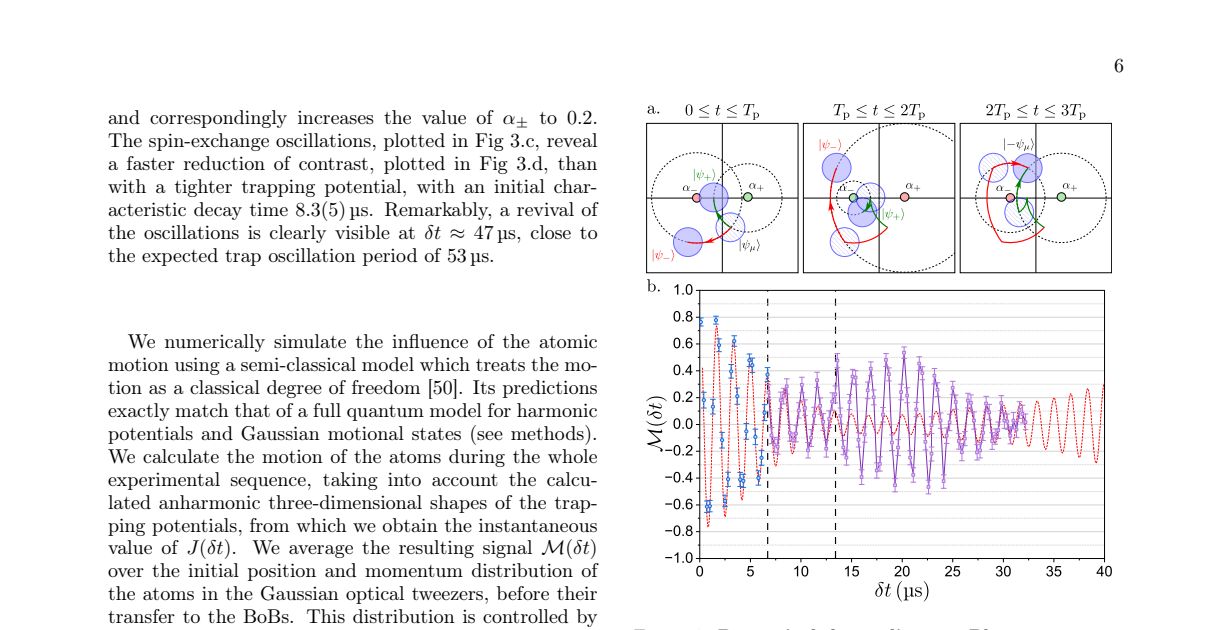
… direction 'plays a critical role in the simulated damping' and that the 'exaggerated oscillations predicted by the model may indicate a mis-estimation of the temperature for the motion along this direction' (b163-b164). Because the collapse rate (8.3 µs), the revival contrast, and the decoupling contrast all scale with this spread, the claim of 'excellent agreement' for the low-power data (b165) is hard to assess while the same model visibly over-predicts contrast at high power. I request a sensitivity analysis over the anisotropic temperature (for example, the ratio of the temperature along the propagation axis to the transverse temperature, or the scalar value of Theta that reproduces the observed high-power damping), with the resulting range of predicted revival times and decoupling contrasts stated explicitly. This would convert the acknowledged limitation into a bounded uncertainty and is needed to support the quantitative statements in the text.
The paper says, at Fig. 3.c-d; Eq. (2)-(3); b151, b160-b161
The review did not quote this passage.
Pith says: Objection 2 of 3 · major
The revival position is not an independent test of the trap model in its present form, because the trap frequency nu_t is obtained from the fitted power P_BoB,H = 181 mW, which deviates from the measured ~0.16 W (the authors attribute this to a discrepancy between the calculated and actual BoB profiles, b161), and the revival then occurs at the fitted trap period T_t = 50 µs rather than the nominal 53 µs.
more of objection 2
The observed revival at ~47 µs lies about 6% below the fitted period, which is encouraging, but the uncertainty on nu_t inherited from the P_BoB fit and from the isotropic-temperature assumption is not propagated into the predicted revival time. I ask the authors to report this error budget so the reader can judge whether 47 µs falls inside the model's own variance. To be clear, the constrained low-power collapse at P_BoB,H/3.3 with no new free parameter and the decoupling timing are genuine predictive checks in the paper's favour; the request is for the propagation of uncertainties, not for a re-fit of the data.
The paper says, at Fig. 4; b189
The review did not quote this passage.
Pith says: Objection 3 of 3 · major
The quantitative decoupling prediction (99% overlap at t = 3T_p in the harmonic coherent-state model) is not confronted with the paper's own semi-classical machinery. The red dashed line in Fig. 4.b is the no-decoupling simulation of Fig. 3.c, and no simulation of the decoupled trajectory is shown that includes the two phase flips, the tau_p = 3 µs dead times, and the thermal distribution along the propagation direction.
more of objection 3
The observed maximum contrast of ≲50% at t ≈ 20 µs is roughly half of the harmonic-model prediction, a deviation of the same character as the model's over-prediction in Fig. 3.b. The qualitative signature (a revival where the contrast was previously minimal) is robust, and the paper's central claim does not depend on the 99% number, but the framing of the method as preventing collapse would be materially stronger if the decoupling sequence were run through the fitted Monte-Carlo model and the expected contrast reported with uncertainty. At minimum, the large gap between the analytic prediction and the measured contrast should be discussed in the text rather than only implied by the acknowledgement of over-predicted contrast.
4 minor objections
The paper says, at Fig. 2.d caption and abstract vs b108
Pith says: minor objection 1 of 4
The reported fit frequency is inconsistent: the abstract and the Fig. 2.d caption give J = 594(2) kHz, while the main text (b108) gives J = 594(1) kHz. Please harmonize the quoted uncertainty.
The paper says, at Methods (Phase flips)
Pith says: minor objection 2 of 4
Please clarify how the tau_p = 3 µs phase-flip windows are treated. The text argues that the 0.1 µs electric-field rotation justifies neglecting the tau_p delay, but the flips themselves include the 2 pi auxiliary excitation during which the field is at theta_M; state explicitly that the spin-exchange phase is frozen during those windows (so that the accumulated phase is evaluated over the field-on intervals only), or explain which cancellation makes the delay irrelevant.
show 2 more
The paper says, at Discussion, b191
Pith says: minor objection 3 of 4
The sentence 'Our work constitutes the first observation of interaction dynamics between circular Rydberg atoms' is broader than what the abstract claims, and should be sharpened against prior spectroscopy-based studies of interacting circular Rydberg atoms (for example Ref. [13]). If those works reported only static interaction shifts or bound-state spectroscopy, the qualifier 'coherent spin-exchange dynamics' makes the novelty precise; as written, the Discussion sentence invites a rejection on prior-observation grounds that the rest of the paper does not deserve.
The paper says, at Section 'Spin-motion coupling'
Pith says: minor objection 4 of 4
The text gives an 'expected oscillation frequency' of nu_t ≈ 34 kHz for the high-power configuration in the harmonic estimate of |alpha_plus_minus| = 0.08, but the fitted model later returns nu_t = 36 kHz. State explicitly which value of nu_t is used for the |alpha_plus_minus| = 0.08 estimate so the reader can trace the numbers, or note that the estimate uses the nominal power while the fit uses P_BoB,H = 181 mW.
What would settle it
Replace the fitted trap parameters with directly measured ones and re-run the simulation of Figs. 3.c-d and 4. Concretely: (1) fix d to the independently calibrated interatomic spacing and P_BoB to the measured laser power rather than fitting them; (2) measure the trap frequency along the BoB propagation axis nu_t,z and a directional temperature Theta_z (e.g., parametric excitation of the trapped Rydberg atoms, or time-resolved release-recapture along z only, instead of the isotropic 3D release-recapture). If the refit with these fixed inputs still places the revival within ~10% of the observed 47 us, the collapse time near 8.3 us, and the decoupling contrast within ~2x of the observed 50%, then the isotropic-temperature assumption and fitted parameters are not load-bearing.
from the skeptic's reading
How the review went
4 readings by deepseek-v4-flash · 1 Oct 2026
- Reader holds up, with conditions
- Skeptic agrees
- Editor wrote the verdict above
- Referee major revision: 3 major objections, 4 minor
Not run on this paper: the simulated authors' defence.
Pith did not check this review's objections against the paper.
The review in full
The review in brief, machine-written
The headline is that the central claim holds up: 67 microseconds and 40 oscillation periods of spin exchange between laser-trapped circular Rydberg atoms, with clean Clopper-Pearson statistics and a fitted J=594 kHz matching the hydrogenic value at the deduced distance. That's an order-of-magnitude improvement over the prior art and a genuine platform advance. The syndrome post-selection that effectively doubles the Rydberg lifetime is also a nice, clearly explained trick. What's genuinely new: the first observation of spin-motion coupling collapse and revival in laser-trapped Rydberg atoms (as opposed to free-flying ones), and the phase-flip dynamical decoupling that revives the oscillations. The three qualitative predictions are mutually consistent: faster collapse at lower trapping power, a revival near the trap period, and an earlier revival when phase flips are applied. That consistency is what makes the spin-motion picture credible; it isn't a single curve fit to a single model. The soft spots are quantitative. The semi-classical model that converts the data into the revival timing and decoupling contrast relies on the 3D polynomial trap of Eq. (2), a scalar temperature assumed isotropic, and the fitted free parameters d and P_BoB. The observed revival sits at ~47 us versus a predicted 53 us, and the decoupling contrast reaches only ~50% versus 99% predicted. The authors openly say the model's exaggerated oscillations may indicate a mis-estimation of the temperature along the weakly-trapping axis (b164). That is honest, but it means the quantitative agreement is partly fit, not pure prediction. The low-power collapse/revival does use a constrained power (P/3.3) with no new free parameters, which argues in the authors' favor. No code or data are shipped, which is a transparency gap but not a scientific error. Who gets value: the Rydberg quantum simulation community, especially groups working on long-lived circular states and on extending interaction times. The paper deserves a serious referee. I would send it to peer review, with the main request being an independent measurement of the temperature along the trap-propagation axis, or a model that is less sensitive to that single unmeasured number. The central observation, though, is robust and the paper is a solid step toward millisecond-scale simulation.
The strongest objection
The central claim has two legs: an order-of-magnitude interaction duration, and the first observation of spin-motion coupling (collapse/revival) with laser-trapped Rydberg atoms plus the decoupling protocol. The first leg is solid: 40 oscillation periods at J=594(2) kHz with clean Clopper-Pearson statistics, matching the hydrogenic 3847 GHz*um^3/d^3 value at the fitted distance, and a relaxation rate cleanly separated from the spin-motion signature. The second leg is supported qualitatively by three specific, mutually consistent predictions — faster collapse at lower trap power, revival near a trap period, and an earlier revival (at ~3 Tp) when phase flips are applied — so I do not see a route by which the existence of spin-motion coupling collapses. The load-bearing weakness is quantitative. The semi-classical model that converts the data into the spin-motion fingerprint depends jointly on (i) the 3D polynomial trap of Eq. (2) with the a_ijk table, (ii) a single scalar temperature Theta=5.9/9.5 uK assumed isotropic ('assumes identical temperatures along the three trap-oscillation directions', Methods), and (iii) fitted free parameters d and P_BoB,H. The collapse rate (8.3 us), the revival position (47 us observed vs 53 us predicted) and the decoupling contrast (50% vs 99%) all scale with nu_t (set by the fitted P_BoB) and with the thermal spread along the weakly-trapping laser-propagation axis, which the text states 'plays a critical role in the simulated damping' (b163). A mis-estimated Theta_z can be partially absorbed by adjusting the fitted d and P_BoB, so the reported curve shapes and fitted parameters are not uniquely pinned down. The authors themselves attribute the model's 'exaggerated oscillations' to 'a mis-estimation of the temperature for the motion along this direction' (b164); this is an honest and plausible statement, but it means the quantitative interpretation currently rests on a temperature the experiment does not measure.
The reader's weakest_assumption is exactly the one I find most load-bearing: the semi-classical model's predictive output (collapse rate, revival position, decoupling contrast) depends on the fitted d and P_BoB together with a temperature measured by isotropic release-recapture, and the authors' own sentence b164 concedes the model over-predicts revived contrast, plausibly from a mis-estimated temperature along the weakly-trapping axis. I stress-test this further rather than relitigate it. The tension I add is internal-consistency flavoured: the decoupling data implies an effective trap period near 40 us (Tp=6.7 us chosen for ~99% overlap at 3Tp), while the fitted low-power nu_t=20 kHz implies ~50 us; reconciling these requires the model's anharmonic effects, which are exactly the unverified part of the polynomial/temperature model. I do not escalate the verdict toward reject or unverdict because the three qualitative predictions — power-dependent collapse, revival at a trap period, and phase-flip-shifted revival — are distinctive signatures that would be hard to reproduce accidentally, and the duration leg of the central claim is statistically and physically robust. The concern is confined to the quantitative strength of the spin-motion-coupling claim, which is what the conditional verdict already reflects. I keep CONDITIONAL and recommend no change, with the independent nu_t,z / Theta_z measurement as the natural next step to either confirm the fitted model or reveal that its quantitative predictions needed the free parameters to absorb a temperature anisotropy.
The referee's report
If the results hold, the platform extends the achievable interaction time of Rydberg-based simulation by an order of magnitude and provides the first evidence of spin-motion coupling in laser-trapped Rydberg atoms, a regime that previously could only be studied with free-flying atoms. The manuscript has notable strengths: the 40-period oscillation is directly visible with Clopper-Pearson error bars and is consistent with the hydrogenic J(d) at the fitted distance; the relaxation contribution (Tr ≈ 127 µs) is computed in a separate QuTiP simulation and is well separated from the spin-motion rate; the low-power collapse uses a constrained power P_BoB,L = P_BoB,H/3.3 with no new free parameters; and the Methods section supplies the equivalence argument between the classical and quantum treatments. The main weakness is quantitative: the quantitative content of the spin-motion and decoupling claims rests on a fitted trap power, an assumed isotropic temperature, and an acknowledged model over-prediction of the contrast.
Pith's reading of the paper (a machine's summary, not the authors')
This paper claims that quantum simulation with neutral atoms need not be limited to a few microseconds of interaction time. The authors encode two spin-1/2 qubits in long-lived circular Rydberg levels (principal quantum numbers 53 and 54) held in optical bottle-beam traps 19 µm apart, and watch the dipole-dipole spin-exchange oscillation between them persist for 67 µs, about 40 full periods, an order of magnitude beyond the prior state of the art. That long view exposes a second effect: because the exchange strength J depends on the interatomic distance, the two spin states push the atomic motion in opposite directions, collapsing the oscillation contrast until it revives near the trap period, the first observation of spin-motion coupling for laser-trapped Rydberg atoms. To counter this, the authors demonstrate a dynamical decoupling sequence that restores the oscillations. If right, the work establishes laser-trapped circular Rydberg atoms as a route to millisecond-scale simulation of strongly interacting many-body systems.
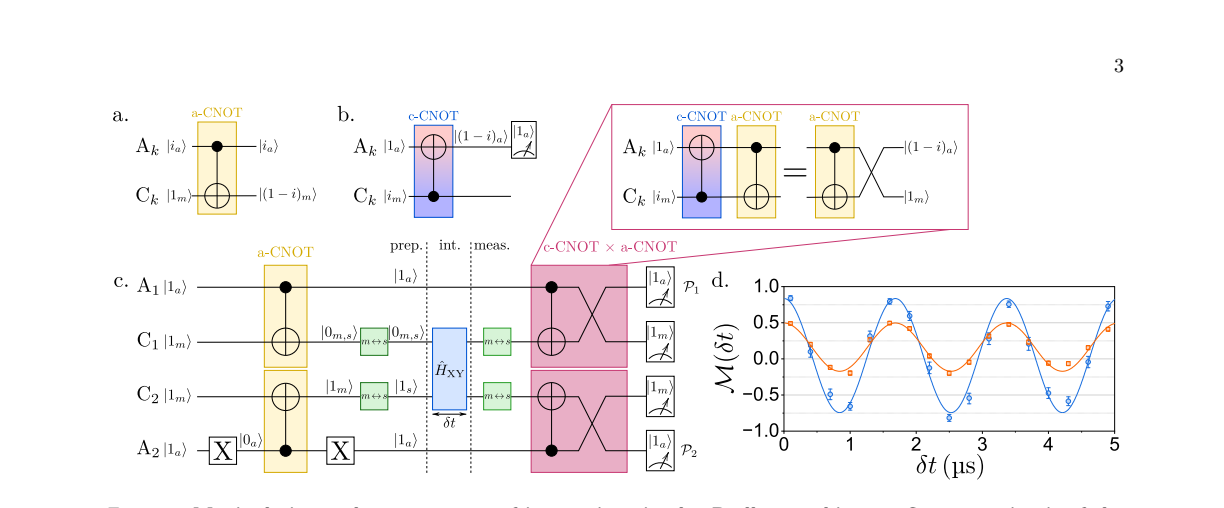
What carries the argument. The central mechanism is the position-dependent dipole-dipole XY Hamiltonian \hat{H}_{XY} = \frac{hJ(d)}{2}(3\$cos^{2}$\$\theta$-1)(\hat{\$\sigma$}^+_1\hat{\$\sigma$}^-_2 + \hat{\$\sigma$}^-_1\hat{\$\sigma$}^+_2) between two circular Rydberg qubits, with interaction strength $J(d) = 3847\,\text{GHz}\,\mu\text{m}^3/d^3$, switched on by rotating the electric field from the magic angle $\theta_M \approx 54.7^\circ$ (interaction cancelled) to $\theta = \pi/2$. Spin-motion coupling enters through $J(d)$: a spin-state-dependent force displaces the relative-motion coherent state about opposite phase-space centres $\alpha_\pm = \pm(3x_0/d)(J/2\nu_t)$, and the measured oscillation contrast is governed by the overlap factor $|\langle\psi_+|\psi_-\rangle|^2$, which collapses and revives at the trap period. The supporting apparatus is a hybrid platform in which auxiliary ground-state atoms, transiently excited to $|45S\rangle$, couple to the circular levels through a Stark-tuned F\"orster resonance to provide CNOT gates, QND readout and phase flips, together with a syndrome measurement that post-selects on both qubits remaining in the measurement basis, and a sixth-order 3D polynomial fit to the computed bottle-beam potential (Eq.~2 with the $a_{ijk}$ coefficient table) feeding the Monte-Carlo trajectories that reproduce the collapse and revival.
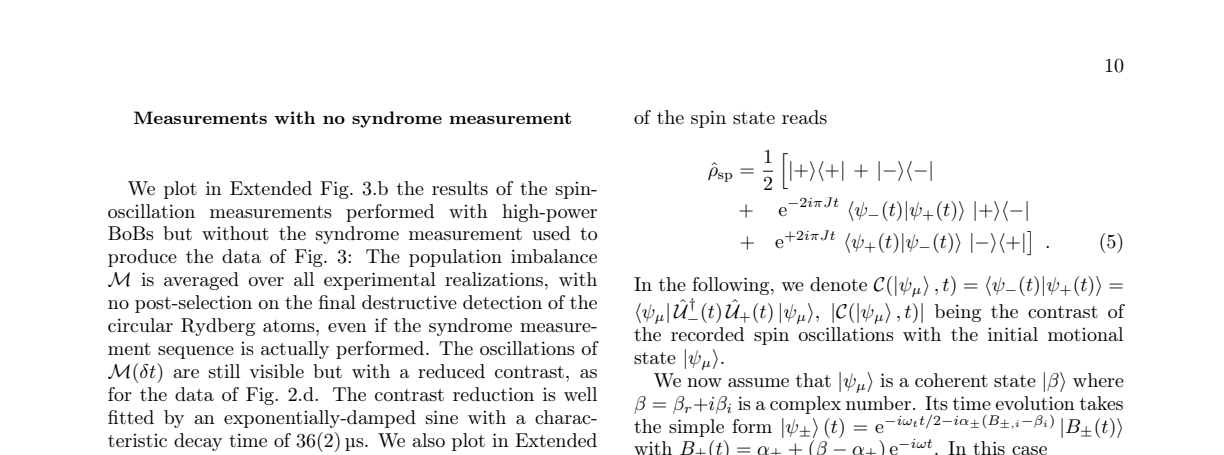
Core claim. The central claim is that spin-exchange dynamics between two laser-trapped circular Rydberg qubits persists over more than 67 µs and 40 oscillation periods, an order of magnitude beyond the prior best, with the measured exchange frequency of about 594 kHz matching the theoretical dipole-dipole prediction for an 18.6 µm interatomic distance. With weak trapping, the authors record a collapse of the oscillation contrast (initial decay time 8.3(5) µs) and its revival near 47 µs, close to the predicted trap period of 53 µs, which they attribute to spin-motion coupling: a spin-state-dependent force displaces the relative motion about opposite phase-space centres, so contrast is lost when the motional states carry which-path information about the spin and restored once they re-overlap at the trap period. They further demonstrate a dynamical decoupling protocol of two phase flips at Tp = 6.7 µs that revives the oscillations around 20 µs, where contrast was minimal without the flips. A syndrome measurement that post-selects on both qubits remaining in the simulation basis approximately doubles the effective qubit lifetime and raises the oscillation contrast from 33(1)% to 79(3)%. Together these constitute the first observation of interaction dynamics between circular Rydberg atoms and the first spin-motion coupling signal in a laser-trapped Rydberg system.
The premise it rests on. The quantitative collapse-and-revival prediction rests on the trap model, a numerically fitted sixth-order polynomial of the bottle-beam potential combined with a single temperature $\Theta$ measured by release-recapture assuming identical temperatures along all three trap axes; if the true axial temperature differs from that assumption, the predicted revival timing of 53 µs and contrast would shift away from the observed 47 µs revival.
If the paper is right (Pith's inferences, not the authors')
Establishes laser-trapped circular Rydberg atoms as a viable platform for millisecond-scale quantum simulation, since the observed 67 µs and 40-period exchange extends the interaction window an order of magnitude while retaining the gates needed for many-body studies.
The syndrome measurement, which cancels half the Rydberg-level leakage channels by post-selecting on qubits still in the simulation basis, effectively doubles the qubit lifetime and could be combined with erasure conversion in other Rydberg platforms.
The demonstrated dynamical decoupling restores spin-oscillation contrast for trapped atoms, removing a key obstacle to long-duration simulation in the presence of thermal motion.
With cryogenic operation and ground-state cooling, the authors project millisecond-range lifetimes and hundreds of spin-oscillation periods, with motion-induced contrast loss falling below a few percent at the demonstrated $|\alpha_\pm| = 0.08$.
If the axial temperature is indeed the source of the model's over-predicted contrast, as the authors suggest, then the observed 47 µs revival versus the 53 µs prediction implies the collapse-revival timing could serve as an in-situ thermometer of the weakly-trapping axis, an extension the paper does not pursue.
The paper's demonstration that classical and quantum spin-motion models coincide for harmonic, linearized, Gaussian states means the collapse-revival signature, by itself, cannot certify quantum entanglement of spin and motion; a squeezed or Fock motional state would be required to expose a genuinely non-classical deviation.
The same dipole-dipole spin-motion coupling should appear in other laser-trapped dipolar systems, such as polar molecules or alkaline-earth Rydberg traps with different axis anisotropies, where the collapse-revival signature would offer a direct diagnostic of trapping anisotropy.
Check this review
Pith stored no record of this review's passes and took no fingerprint of it. Reviews made by code from 13 Nov 2026 on carry both.
How often reviews like this one are right
Reviews like this one: written by deepseek-v4-flash, where what was read was not recorded.
How often objections from reviews like this one are right: not yet measured
Reviews by people
This review was written by a machine. No person has reviewed this paper on Pith yet. A scientist listed on Pith can review it for a fee, and their review is published here whatever it concludes.
How Pith checks papers · The full audit of this paper · Review history (2 versions)
The paper
Abstract
Arrays of neutral atoms excited to Rydberg levels have emerged as one of the most promising platforms for quantum computation and simulation. With the hope to outperform classical devices, the number of atoms has been increased by orders of magnitude. However, the interaction time, i.e., the maximum accumulated time during which an atom interacts with its neighbours, has been limited to a few microseconds only. This restrains the number of gates per atom or prevents the simulation of long-time dynamics of quantum many-body systems. Here, we observe the spin-exchange interaction between two spin 1/2s encoded in laser-trapped circular Rydberg atoms over more than 60μs and 40 spin-oscillation periods, improving the state of the art by an order of magnitude. These unprecedented timescales allow us to record for weak atomic trapping a collapse and revival of the spin-exchange oscillation contrast induced by spin-motion coupling. Our results constitute the first observation of this coupling with laser-trapped Rydberg atoms. To counteract its detrimental effect for quantum simulation, we demonstrate a novel dynamical decoupling method that prevents the collapse of the spin oscillations. This method exploits the advantages of our recently developed hybrid platform that enables the measurement and the optical manipulation of long-lived circular Rydberg atoms with auxiliary Rydberg atoms. This work opens a direct route to long-duration quantum simulation of strongly-interacting many-body systems.
The paper's own sentences, arranged, kept beside the review and separate from it. Each label is drawn from a closed vocabulary; the number beside it is the probability the classifier gave that label. No sentence in this record was written by a model.
abstract compiled · 2026-09-30
The authors' main claim, as the classifier picked it out 0.72
“This work opens a direct route to long-duration quantum simulation of strongly-interacting many-body systems.”
How the main claim is stated: asserted 0.72
What the abstract itself states, as probabilities: claims first 0.93 · states limitation 0.46 · human participants 0.02 · controlled comparison 0.12 · randomized assignment 0.01 · states quantitative result 0.98 · compares with prior results 0.95 · mentions code or data availability 0.02
The abstract, sentence by sentence
This table labels the abstract only (arXiv listing abstract v1). The number is the probability the classifier gave the label.
| Sentence | Role | The authors' own work | States the main conclusion | Strength |
|---|---|---|---|---|
| Arrays of neutral atoms excited to Rydberg levels have emerged as one of the most promising platforms for quantum computation and simulation. | background 1.00 | 0.04 | 0.02 | asserted 0.97 |
| With the hope to outperform classical devices, the number of atoms has been increased by orders of magnitude. | background 1.00 | 0.08 | 0.02 | asserted 0.84 |
| However, the interaction time, i.e., the maximum accumulated time during which an atom interacts with its neighbours, has been limited to a few microseconds only. | background 0.57 | 0.07 | 0.02 | asserted 1.00 |
| This restrains the number of gates per atom or prevents the simulation of long-time dynamics of quantum many-body systems. | background 0.64 | 0.05 | 0.03 | asserted 0.84 |
| Here, we observe the spin-exchange interaction between two spin 1/2s encoded in laser-trapped circular Rydberg atoms over more than $60\mu s$ and 40 spin-oscillation periods, improving the state of the art by an order of magnitude. | result 0.76 | 0.97 | 0.74 | asserted 1.00 |
| These unprecedented timescales allow us to record for weak atomic trapping a collapse and revival of the spin-exchange oscillation contrast induced by spin-motion coupling. | result 0.98 | 0.96 | 0.11 | asserted 0.99 |
| Our results constitute the first observation of this coupling with laser-trapped Rydberg atoms. | result 0.66 | 0.90 | 0.12 | asserted 1.00 |
| To counteract its detrimental effect for quantum simulation, we demonstrate a novel dynamical decoupling method that prevents the collapse of the spin oscillations. | contribution 0.73 | 0.96 | 0.15 | asserted 1.00 |
| This method exploits the advantages of our recently developed hybrid platform that enables the measurement and the optical manipulation of long-lived circular Rydberg atoms with auxiliary Rydberg atoms. | method 0.93 | 0.50 | 0.05 | asserted 0.99 |
| This work opens a direct route to long-duration quantum simulation of strongly-interacting many-body systems. | interpretation 0.87 | 0.31 | 0.58 | asserted 0.72 |
What kind of paper the classifier reports this is: empirical study 0.99 · evidence from observation or experiment 1.00
What was examined, and what was not
Sources read
- arXiv listing abstract v1
Not examined
- full text
- figures and tables
- references and citing sentences
- relations to other papers
Levels run
- P abstract
Not run
- S sections
- T body sentences
- C citations
- R cross-paper relations
How the labels were made
Compiled by classifier-1.13.0 via TypeSafe API, question bank abstract-p1-20260923, 2026-09-30: 1 request, 7,570 input tokens.
Every quoted sentence on this record is the authors'. Every label is from Pith's closed vocabulary, with the probability shown beside it. This record as JSON
Figures (4)

Figures are the authors', reproduced from the paper.
References (79)
- [1] D. Barredo, S. de Léséleuc, V. Lienhard, T. Lahaye, and A. Browaeys, An atom-by-atom assembler of defect-free arbitrary two-dimensional atomic arrays, Science354, 1021 (2016) on Pith
- [2] M. Endres, H. Bernien, A. Keesling, H. Levine, E. R. Anschuetz, A. Krajenbrink, C. Senko, V. Vuletic, M. Greiner, and M. D. Lukin, Atom-by-atom assembly of defect-free one-dimensional cold atom arrays, Science 354, 1024 (2016) on Pith
- [3] A. Browaeys and T. Lahaye, Many-body physics with individually controlled Rydberg atoms, Nature Physics 16, 132 (2020) on Pith
- [4] M. Morgado and S. Whitlock, Quantum simulation and computing with Rydberg-interacting qubits, AVS Quan- tum Science3, 023501 (2021) on Pith
- [5] D. Bluvstein, A. A. Geim, S. H. Li, S. J. Evered, J. P. Bonilla Ataides, G. Baranes, A. Gu, T. Manovitz, M. Xu, M. Kalinowski, S. Majidy, C. Kokail, N. Maskara, E. C. Trapp, L. M. Stewart, S. Hollerith, H. Zhou, M. J. Gullans, S. F. Yelin, M. Greiner, V. Vuletić, M. Cain, and ... on Pith
- [6] G. Pichard, D. Lim, É. Bloch, J. Vaneecloo, L. Boura- chot, G.-J. Both, G. Mériaux, S. Dutartre, R. Hostein, J. Paris, B. Ximenez, A. Signoles, A. Browaeys, T. La- haye, and D. Dreon, Rearrangement of individual atoms in a 2000-site optical-tweezer array at cryogenic temper- a... on Pith
- [7] H. J. Manetsch, G. Nomura, E. Bataille, X. Lv, K. H. Leung, and M. Endres, A tweezer array with 6,100 highly coherent atomic qubits, Nature647, 60 (2025) on Pith
- [8] R. Lin, H.-S. Zhong, Y. Li, Z.-R. Zhao, L.-T. Zheng, T.-R. Hu, H.-M. Wu, Z. Wu, W.-J. Ma, Y. Gao, Y.-K. Zhu, Z.-F. Su, W.-L. Ouyang, Y.-C. Zhang, J. Rui, M.- C. Chen, C.-Y. Lu, and J.-W. Pan, AI-Enabled Parallel Assembly of Thousands of Defect-Free Neutral Atom Ar- rays, Physi... on Pith
- [9] D. Lim, H. Mamann, G. Pichard, L. Bourachot, A. Lind- berg, C. Hamot, H. Le Bars, F. Fasola, S. Tan, G. Cournez, S. Dutartre, T. Cartry, S. Lemettre, R. Hostein, J. Paris, F. Ferreyrol, A. Collardey, A. Sig- noles, T. Lahaye, C. Monmeyran, and B. Ximenez, Defect-Free Arrays at... on Pith
- [10] J. Zhu, C. Chen, L. Zhou, X. Xie, C. Jiang, Z. Ding, F. Wu, F. Yang, G. Wang, Q. Gong, P. Zhang, S. Zhang, and P. Peng, High-Efficiency Loading of 2400 Ytterbium Atoms in Optical Tweezer Arrays, Physical Review Let- ters137, 063201 (2026) on Pith
- [11] S. J. Evered, D. Bluvstein, M. Kalinowski, S. Ebadi, T. Manovitz, H. Zhou, S. H. Li, A. A. Geim, T. T. Wang, N. Maskara, H. Levine, G. Semeghini, M. Greiner, V. Vuletić, and M. D. Lukin, High-fidelity parallel entan- gling gates on a neutral-atom quantum computer, Nature 622, ... on Pith
- [12] G. Emperauger, M. Qiao, G. Bornet, C. Chen, R. Martin, Y. T. Chew, B. Gély, L. Klein, D. Barredo, A. Browaeys, and T. Lahaye, Benchmarking direct and indirect dipolar spin-exchange interactions between two Rydberg atoms, Physical Review A111, 062806 (2025) on Pith
- [13] T. L. Nguyen, J. M. Raimond, C. Sayrin, R. Cor- tiñas, T. Cantat-Moltrecht, F. Assemat, I. Dotsenko, S. Gleyzes, S. Haroche, G. Roux, Th. Jolicoeur, and M. Brune, Towards Quantum Simulation with Circular Rydberg Atoms, Phys. Rev. X8, 011032 (2018) on Pith
- [14] B. Ravon, P. Méhaignerie, Y. Machu, A. D. Hernández, M. Favier, J. M. Raimond, M. Brune, and C. Sayrin, Array of Individual Circular Rydberg Atoms Trapped in Optical Tweezers, Physical Review Letters131, 093401 (2023) on Pith
- [15] C. Hölzl, A. Götzelmann, E. Pultinevicius, M. Wirth, and F. Meinert, Long-Lived Circular Rydberg Qubits of Alkaline-Earth Atoms in Optical Tweezers, Physical Re- view X14, 021024 (2024) on Pith
- [16] P. Méhaignerie, C. Sayrin, J.-M. Raimond, M. Brune, and G. Roux, Spin-motion coupling in a circular- Rydberg-state quantum simulator: Case of two atoms, Physical Review A107, 063106 (2023) on Pith
- [17] Y. Machu, A. Durán-Hernández, G. Creutzer, A. A. Young, J. M. Raimond, M. Brune, and C. Sayrin, Nonde- structive Optical Readout and Manipulation of Circular Rydberg Atoms, Physical Review X16, 021040 (2026) on Pith
- [18] R. P. Feynman, Simulating physics with computers, International Journal of Theoretical Physics21, 467 (1982) on Pith
- [19] S. Lloyd, Universal Quantum Simulators, Science273, 1073 (1996) on Pith
- [20] D. Wu, R. Rossi, F. Vicentini, N. Astrakhantsev, F. Becca, X. Cao, J. Carrasquilla, F. Ferrari, A. Georges, M. Hibat-Allah, M. Imada, A. M. Läuchli, G. Mazzola, A. Mezzacapo, A. Millis, J. Robledo Moreno, T. Neupert, Y. Nomura, J. Nys, O. Parcollet, R. Pohle, I. Romero, M. Sch... on Pith
show 59 more
- [21] Z. Bai, C. Chen, F. Yang, and W. Li, Many-Body Physics with Rydberg Atoms: Quantum Simulation and Non- equilibrium Dynamics (2026), arXiv:2607.11038 [quant- ph] on PithPith's reviewarXiv
- [22] P. Scholl, M. Schuler, H. J. Williams, A. A. Eberharter, D. Barredo, K.-N. Schymik, V. Lienhard, L.-P. Henry, T. C. Lang, T. Lahaye, A. M. Läuchli, and A. Browaeys, Quantum simulation of 2D antiferromagnets with hun- dreds of Rydberg atoms, Nature595, 233 (2021) on Pith
- [23] S. Ebadi, T. T. Wang, H. Levine, A. Keesling, G. Se- meghini, A. Omran, D. Bluvstein, R. Samajdar, H. Pich- ler, W. W. Ho, S. Choi, S. Sachdev, M. Greiner, V. Vuletić, and M. D. Lukin, Quantum phases of matter on a 256-atom programmable quantum simulator, Nature 595, 227 (2021) on Pith
- [24] S. de Léséleuc, V. Lienhard, P. Scholl, D. Barredo, S. We- ber, N. Lang, H. P. Büchler, T. Lahaye, and A. Browaeys, Observation of a symmetry-protected topological phase of interacting bosons with Rydberg atoms, Science365, 775 (2019) on Pith
- [25] G. Semeghini, H. Levine, A. Keesling, S. Ebadi, T. T. Wang, D. Bluvstein, R. Verresen, H. Pichler, M. Kali- nowski, R. Samajdar, A. Omran, S. Sachdev, A. Vish- wanath, M. Greiner, V. Vuletić, and M. D. Lukin, Prob- 12 ing topological spin liquids on a programmable quantum simu... on Pith
- [26] S. J. Evered, M. Kalinowski, A. A. Geim, T. Manovitz, D. Bluvstein, S. H. Li, N. Maskara, H. Zhou, S. Ebadi, M. Xu, J. Campo, M. Cain, S. Ostermann, S. F. Yelin, S. Sachdev, M. Greiner, V. Vuletić, and M. D. Lukin, Probing the Kitaev honeycomb model on a neutral-atom quantum c... on Pith
- [27] G. Bornet, M. Bintz, C. Chen, G. Emperauger, M. Qiao, R. Martin, D. Barredo, S. Chatterjee, V. S. Liu, T. La- haye, M. P. Zaletel, N. Y. Yao, and A. Browaeys, Dirac Spin Liquid Candidate in a Rydberg Quantum Simulator (2026), arXiv:2602.14323 [cond-mat] on PithPith's reviewarXiv
- [28] C. Chen, G. Emperauger, G. Bornet, F. Caleca, B. Gély, M. Bintz, S. Chatterjee, V. Liu, D. Barredo, N. Y. Yao, T. Lahaye, F. Mezzacapo, T. Roscilde, and A. Browaeys, Spectroscopy of elementary excitations from quench dy- namics in a dipolar XY Rydberg simulator, Science389, 483 (2025) on Pith
- [29] T. Manovitz, S. H. Li, S. Ebadi, R. Samajdar, A. A. Geim, S. J. Evered, D. Bluvstein, H. Zhou, N. U. Koylu- oglu, J. Feldmeier, P. E. Dolgirev, N. Maskara, M. Kali- nowski, S. Sachdev, D. A. Huse, M. Greiner, V. Vuletić, and M. D. Lukin, Quantum coarsening and collective dy- n... on Pith
- [30] D. Bluvstein, A. Omran, H. Levine, A. Keesling, G. Se- meghini, S. Ebadi, T. T. Wang, A. A. Michailidis, N. Maskara, W. W. Ho, S. Choi, M. Serbyn, M. Greiner, V. Vuletić, and M. D. Lukin, Controlling quantum many- body dynamics in driven Rydberg atom arrays, Science 371, 1355 (2021) on Pith
- [31] D. González-Cuadra, M. Hamdan, T. V. Zache, B. Braverman, M. Kornjača, A. Lukin, S. H. Cantú, F. Liu, S.-T. Wang, A. Keesling, M. D. Lukin, P. Zoller, and A. Bylinskii, Observation of string breaking on a (2 + 1)D Rydberg quantum simulator, Nature642, 321 (2025) on Pith
- [32] X. Liang, Z. Yue, Y.-X. Chao, Z.-X. Hua, Y. Lin, M. K. Tey, and L. You, Observation of Anomalous Information Scrambling in a Rydberg Atom Array, Physical Review Letters135, 050201 (2025) on Pith
- [33] L. Leclerc, S. Julià-Farré, G. S. Freitas, G. Villaret, B. Albrecht, L. Béguin, L. Bourachot, C. Briosne- Frejaville, D. Claveau, A. Cornillot, J. de Hond, D. Di- allo, C. Dupays, R. Dupont, T. Eritzpokhoff, E. Got- tlob, L. Henriet, M. Kaicher, L. Lassablière, A. Lind- berg, ... on PithPith's reviewarXiv
- [34] M. Schmitt, M. M. Rams, J. Dziarmaga, M. Heyl, and W. H. Zurek, Quantum phase transition dynamics in the two-dimensional transverse-field Ising model, Science Ad- vances8, eabl6850 (2022) on Pith
- [35] R. Haghshenas, E. Chertkov, M. Mills, W. Kadow, S.- H. Lin, Y. H. Chen, C. Cade, I. Niesen, T. Begušić, M. S. Rudolph, C. Cirstoiu, K. Hémery, C. Mc Keever, M. Lubasch, E. Granet, C. H. Baldwin, J. P. Bartolotta, M. Bohn, J. J. Burau, J. Cline, M. DeCross, J. M. Dreil- ing, C.... on Pith
- [36] J. Vovrosh, S. Julià-Farré, W. Krinitsin, M. Kaicher, F. Hayes, E. Gottlob, A. Kshetrimayum, K. Bidzhiev, S. B. Jäger, M. Schmitt, J. Tindall, C. Dalyac, T. Mendes-Santos, and A. Dauphin, Simulating dynam- ics of the two-dimensional transverse-field Ising model: A comparatives... on Pith
- [37] J. Tindall, A. F. Mello, M. Fishman, E. M. Stoudenmire, and D. Sels, Dynamics of disordered quantum systems with two- and three-dimensional tensor networks, Science 392, 868 (2026) on Pith
- [38] C. J. Turner, A. A. Michailidis, D. A. Abanin, M. Serbyn, and Z. Papić, Weak ergodicity breaking from quantum many-body scars, Nature Physics14, 745 (2018) on Pith
- [39] M. Serbyn, D. A. Abanin, and Z. Papić, Quantum many- body scars and weak breaking of ergodicity, Nature Physics17, 675 (2021) on Pith
- [40] P. Hosur, X.-L. Qi, D. A. Roberts, and B. Yoshida, Chaos in quantum channels, Journal of High Energy Physics 2016, 4 (2016) on Pith
- [41] D. Yuan, S.-Y. Zhang, Y. Wang, L.-M. Duan, and D.- L. Deng, Quantum information scrambling in quantum many-body scarred systems, Physical Review Research 4, 023095 (2022) on Pith
- [42] S. Xu and B. Swingle, Scrambling Dynamics and Out-of- Time-Ordered Correlators in Quantum Many-Body Sys- tems, PRX Quantum5, 010201 (2024) on Pith
- [43] C. B. Dağ, H. Ma, P. M. Eugenio, F. Fang, and S. F. Yelin, Emergent Disorder and Sub-ballistic Dynamics in Quantum Simulations of the Ising Model Using Ryd- berg Atom Arrays, Physical Review Letters135, 250403 (2025) on Pith
- [44] R. G. Cortiñas, M. Favier, B. Ravon, P. Méhaignerie, Y. Machu, J. M. Raimond, C. Sayrin, and M. Brune, Laser Trapping of Circular Rydberg Atoms, Physical Re- view Letters124, 123201 (2020) on Pith
- [45] D. Barredo, V. Lienhard, P. Scholl, S. de Léséleuc, T. Boulier, A. Browaeys, and T. Lahaye, Three- Dimensional Trapping of Individual Rydberg Atoms in Ponderomotive Bottle Beam Traps, Physical Review Let- ters124, 023201 (2020) on Pith
- [46] J. T. Wilson, S. Saskin, Y. Meng, S. Ma, R. Dilip, A. P. Burgers, and J. D. Thompson, Trapping Alkaline Earth Rydberg Atoms Optical Tweezer Arrays, Physical Re- view Letters128, 033201 (2022) on Pith
- [47] S. Ma, G. Liu, P. Peng, B. Zhang, S. Jandura, J. Claes, A. P. Burgers, G. Pupillo, S. Puri, and J. D. Thompson, High-fidelity gates and mid-circuit erasure conversion in an atomic qubit, Nature622, 279 (2023) on Pith
- [48] P. Scholl, A. L. Shaw, R. B.-S. Tsai, R. Finkelstein, J. Choi, and M. Endres, Erasure conversion in a high- fidelity Rydberg quantum simulator, Nature622, 273 (2023) on Pith
- [49] V. Bharti, S. Sugawa, M. Kunimi, V. S. Chauhan, T. P. Mahesh, M. Mizoguchi, T. Matsubara, T. Tomita, S. de 13 Léséleuc, and K. Ohmori, Strong Spin-Motion Coupling in the Ultrafast Dynamics of Rydberg Atoms, Physical Review Letters133, 093405 (2024) on Pith
- [50] G. Emperauger, M. Qiao, G. Bornet, Y. T. Chew, R. Martin, B. Gély, L. Klein, D. Barredo, T. Lahaye, and A. Browaeys, Probing spin-motion coupling of two Ry- dberg atoms by a Stern-Gerlach-like experiment (2025), arXiv:2508.08899 [physics] on PitharXiv
- [51] S. R. Cohen and J. D. Thompson, Quantum Computing with Circular Rydberg Atoms, PRX Quantum2, 030322 (2021) on Pith
- [52] I. I. Beterov and M. Saffman, Rydberg blockade, {F\"orster} resonances, and quantum state measure- ments with different atomic species, Physical Review A 92, 042710 (2015) on Pith
- [53] S. Anand, C. E. Bradley, R. White, V. Ramesh, K. Singh, and H. Bernien, A dual-species Rydberg array, Nature Physics20, 1744 (2024) on Pith
- [54] J. Miles, M. T. Lichtman, A. M. Scott, J. Scott, S. A. Norrell, M. J. Bedalov, D. A. Belknap, D. C. Cole, S. Y. Eubanks, M. Gillette, P. Gokhale, J. Goldwin, M. Iliev, R. A. Jones, K. W. Kuper, D. Mason, P. T. Mitchell, J. D. Murphree, N. A. Neff-Mallon, T. W. Noel, A. G. Radn... on PithPith's reviewarXiv
- [55] Y. Wang, R. Cimmino, K. Wang, S. Lopez, J. Li, J. M. Koh, J. N. Hallén, A. Matthies, N. Y. Yao, and K.-K. Ni, Multi-Qubit Stabilizer Readout on a Dual-Species Ryd- berg Array (2026), arXiv:2605.10924 [quant-ph] on PithPith's reviewarXiv
- [56] C. Zhang and M. Tarbutt, Quantum Computation in a Hybrid Array of Molecules and Rydberg Atoms, PRX Quantum3, 030340 (2022) on Pith
- [57] L. Zhu, J. Luke, R. Shaham, Y.-X. Liu, and K.-K. Ni, Probing Dipolar Interactions between Rydberg Atoms and Ultracold Polar Molecules, Physical Review Letters 135, 153001 (2025) on Pith
- [58] D. K. Ruttley, T. R. Hepworth, J. M. García-Garrido, C. J. H. Rich, R. González-Férez, A. Guttridge, and S. L. Cornish, Harnessing resonant dipolar interactions in a hybrid atom-molecule quantum system (2026), arXiv:2607.15976 [physics.atom-ph] on PithPith's reviewarXiv
- [59] M. D. Lukin, M. Fleischhauer, R. Cote, L. M. Duan, D. Jaksch, J. I. Cirac, and P. Zoller, Dipole Blockade and Quantum Information Processing in Mesoscopic Atomic Ensembles, Phys. Rev. Lett.87, 037901 (2001) on Pith
- [60] P. Méhaignerie, Y. Machu, A. Durán Hernández, G. Creutzer, D. Papoular, J. Raimond, C. Sayrin, and M. Brune, Interacting Circular Rydberg Atoms Trapped in Optical Tweezers, PRX Quantum6, 010353 (2025) on Pith
- [61] M. Hüls, A. A. Young, C. Sayrin, M. Brune, J.- M. Raimond, T. Calarco, F. Motzoi, R. Zeier, and E. Cuestas, Fast Pulses for High-Fidelity Circularization of Interacting Rydberg atoms (2026), arXiv:2607.05216 [physics.atom-ph] on PithPith's reviewarXiv
- [62] K.-N. Schymik, S. Pancaldi, F. Nogrette, D. Barredo, J. Paris, A. Browaeys, and T. Lahaye, Single Atoms with 6000-Second Trapping Lifetimes in Optical-Tweezer Ar- rays at Cryogenic Temperatures, Physical Review Ap- plied16, 034013 (2021) on Pith
- [63] Z. Zhang, T.-W. Hsu, T. Y. Tan, D. H. Slichter, A. M. Kaufman, M. Marinelli, and C. A. Regal, High Optical Access Cryogenic System for Rydberg Atom Arrays with a 3000-Second Trap Lifetime, PRX Quantum6, 020337 (2025) on Pith
- [64] J.Jin, Y.Shi, Y.A.Alaoui, J.Deng, Y.Lu, J.D.Thomp- son, and W. S. Bakr, Extended Rydberg Lifetimes in a Cryogenic Atom Array, PRX Quantum7, 033009 (2026) on Pith
- [65] T. Cantat-Moltrecht, R. Cortiñas, B. Ravon, P. Méhaignerie, S. Haroche, J. M. Raimond, M. Favier, M. Brune, and C. Sayrin, Long-lived circular Rydberg states of laser-cooled rubidium atoms in a cryostat, Physical Review Research2, 022032 (2020) on Pith
- [66] J. D. Thompson, T. G. Tiecke, A. S. Zibrov, V. Vuletić, and M. D. Lukin, Coherence and Raman Sideband Cool- ing of a Single Atom in an Optical Tweezer, Physical Review Letters110, 133001 (2013) on Pith
- [67] S. Zhang, F. Robicheaux, and M. Saffman, Magic- wavelength optical traps for Rydberg atoms, Phys. Rev. A84, 043408 (2011) on Pith
- [68] J. Wilson, S. Saskin, Y. Meng, S. Ma, R. Dilip, A. Burg- ers, and J. Thompson, Trapped arrays of alkaline earth Rydberg atoms in optical tweezers, arXiv:1912.08754 [physics, physics:quant-ph] (2019), arXiv:1912.08754 [physics, physics:quant-ph] on PithPith's reviewarXiv
- [69] R. Wußler, C. Nill, S. de Léséleuc, C. Groß, and I. Lesanovsky, Creating squeezed and non-classical collective motional many-body states through stro- boscopic Rydberg dressing (2026), arXiv:2606.17849 [physics.atom-ph] on PithPith's reviewarXiv
- [70] A. L. Shaw, P. Scholl, R. Finkelstein, R. B.-S. Tsai, J. Choi, and M. Endres, Erasure cooling, control, and hyperentanglement of motion in optical tweezers, Science 388, 845 (2025) on Pith
- [71] C. Nill, S. de Léséleuc, C. Groß, and I. Lesanovsky, Res- onant stroboscopic Rydberg dressing: Electron-motion coupling and multibody interactions, Physical Review A 111, L041104 (2025) on Pith
- [72] M. Magoni, R. Joshi, and I. Lesanovsky, Molecular Dy- namics in Rydberg Tweezer Arrays: Spin-Phonon Entan- glement and Jahn-Teller Effect, Physical Review Letters 131, 093002 (2023) on Pith
- [73] L. Anderegg, L. W. Cheuk, Y. Bao, S. Burchesky, W. Ketterle, K.-K. Ni, and J. M. Doyle, An optical tweezer array of ultracold molecules, Science365, 1156 (2019) on Pith
- [74] Y. Bao, S. S. Yu, L. Anderegg, E. Chae, W. Ketterle, K.-K. Ni, and J. M. Doyle, Dipolar spin-exchange and entanglement between molecules in an optical tweezer ar- ray, Science382, 1138 (2023) on Pith
- [75] C. M. Holland, Y. Lu, and L. W. Cheuk, On-demand entanglement of molecules in a reconfigurable optical tweezer array, Science382, 1143 (2023) on Pith
- [76] A. Holman, Y. Xu, X. Sun, J. Wu, M. Wang, Z. Zhu, B. Seo, N. Yu, and S. Will, Trapping of single atoms in metasurface optical tweezer arrays, Nature649, 859 (2026) on Pith
- [77] K. Wang, C. P. Williams, L. R. Picard, N. Y. Yao, and K.-K. Ni, Enriching the Quantum Toolbox of Ul- tracold Molecules with Rydberg Atoms, PRX Quantum 3, 030339 (2022) on Pith
- [78] J. Mögerle, F. Hummel, A. Keil, T. Legrand, E. J. Braun, H. Menke, J. King, B. Olmos, S. Hofferberth, H. P. Büch- ler, and S. Weber, Accurate Modeling of Rydberg Atoms and Their Interactions: Theory and Implementation in PairInteraction (2026) on Pith
- [79] N. Lambert, E. Giguère, P. Menczel, B. Li, P. Hopf, G. Suárez, M. Gali, J. Lishman, R. Gadhvi, R. Agarwal, 14 A. Galicia, N. Shammah, P. Nation, J. R. Johansson, S. Ahmed, S. Cross, A. Pitchford, and F. Nori, QuTiP 5: The quantum toolbox in Python, Physics Reports1153, 1 (2026... on Pith
Challenges and discussion
Disagree with the review, or know something it missed? Leave a comment, or challenge this review formally: a challenge becomes a permanent entry in this paper's record, and its decision is published here.
Come back by email
A short list of the week's newly reviewed papers. Nothing is sent until you confirm from your inbox, and every email has a link that stops it. No account.
No comments yet.
Sign in to comment